I Haven't Heard Back From You: Better Follow-Up Email Lines
"I haven't heard back from you" is the most-sent, least-effective line in B2B follow-up. Here's what it actually signals to a prospect, plus replacement openers, cadence rules, and six templates that pull replies instead of guilt.
TL;DR
- "I haven't heard back from you" makes your silence the prospect's problem. It adds no new information, so there is nothing for them to reply to.
- Replace the guilt opener with a reason to reply: new information, a narrower ask, a relevant trigger event, or a clean exit.
- Three to five touches over 14–21 days beats nine touches over 40 days. Frequency is not the lever — angle variation is.
- Breakup emails still work in 2026, but only when they genuinely close the loop instead of faking one.
- Half of all "no reply" problems are data problems, not copy problems. Verify the address before you rewrite the sentence for the fourth time.
Why does "I haven't heard back from you" kill your reply rate?#
Because it is a sentence about you, not about them. When you open with "I haven't heard back from you," you are reporting your own inbox status to someone who never agreed to manage it. The prospect reads one of three things: mild guilt, mild annoyance, or nothing at all — because the line is so common that it has become invisible.
There is also a structural problem. A follow-up email needs a hook — a piece of information that did not exist in the previous message. "I haven't heard back" contains zero new information. It is a receipt, not an email. The reader has nothing to react to, so the path of least resistance is archive.
Compare the two mental states you can create:
- Guilt frame: "You owe me a response." The prospect's cheapest way out is silence, because replying means admitting they ignored you.
- Value frame: "Here is something new that might matter to you." The cheapest way out is still silence, but now replying costs almost nothing and might be useful.
You will never win by making silence expensive. You win by making replying cheap.
What is the prospect actually hearing when you write it?#
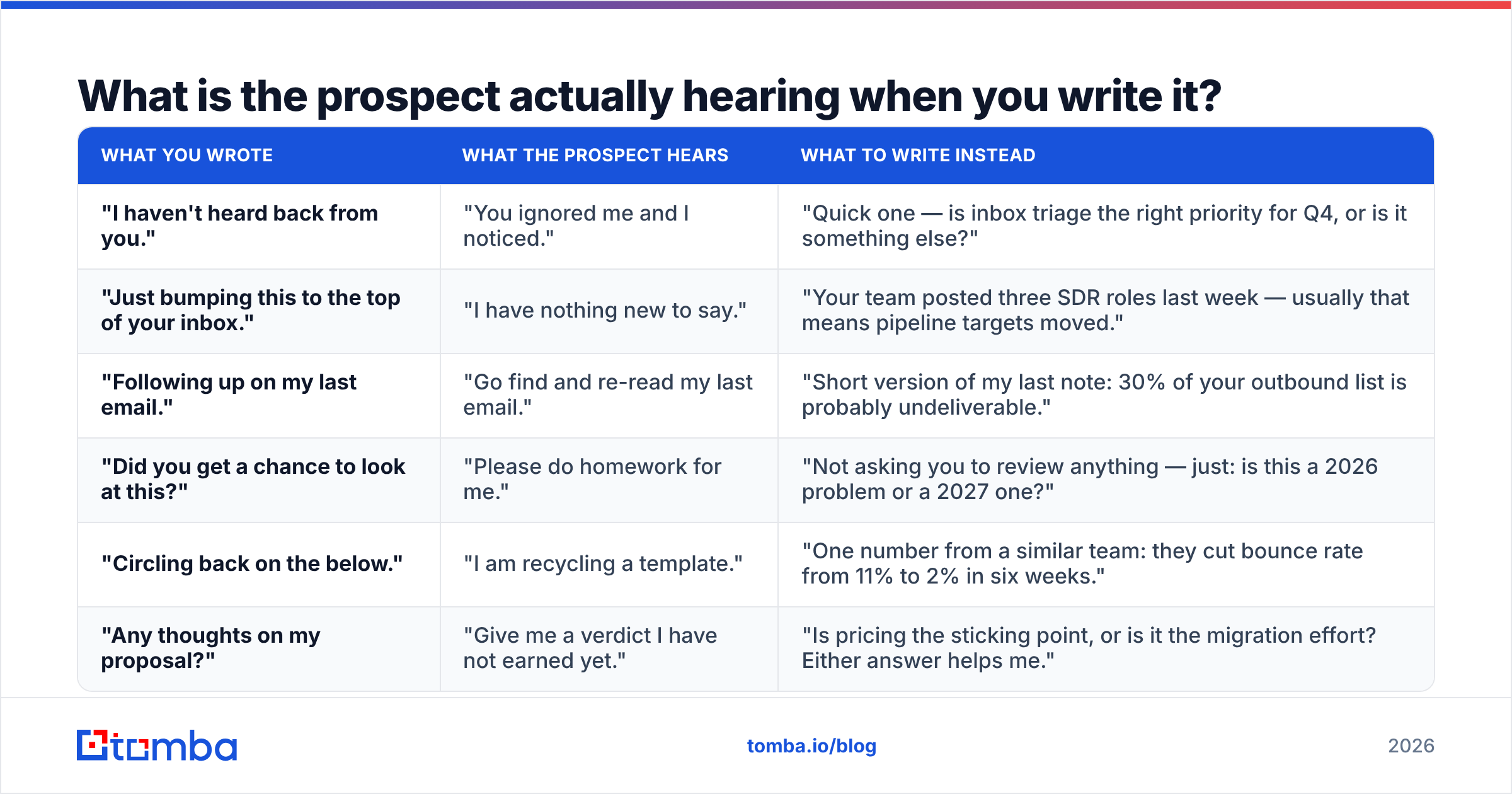
Here is the translation layer, line by line. This is the part most reps skip: they rewrite the wording without changing the function of the sentence.
| What you wrote | What the prospect hears | What to write instead |
|---|---|---|
| "I haven't heard back from you." | "You ignored me and I noticed." | "Quick one — is inbox triage the right priority for Q4, or is it something else?" |
| "Just bumping this to the top of your inbox." | "I have nothing new to say." | "Your team posted three SDR roles last week — usually that means pipeline targets moved." |
| "Following up on my last email." | "Go find and re-read my last email." | "Short version of my last note: 30% of your outbound list is probably undeliverable." |
| "Did you get a chance to look at this?" | "Please do homework for me." | "Not asking you to review anything — just: is this a 2026 problem or a 2027 one?" |
| "Circling back on the below." | "I am recycling a template." | "One number from a similar team: they cut bounce rate from 11% to 2% in six weeks." |
| "Any thoughts on my proposal?" | "Give me a verdict I have not earned yet." | "Is pricing the sticking point, or is it the migration effort? Either answer helps me." |
Notice the pattern in the right-hand column. Every replacement does one of four things:
- Adds new information — a stat, a trigger event, a customer result, a piece of research about their company.
- Narrows the ask — from "let's book 30 minutes" down to a yes/no or an A/B choice.
- Removes the homework — restates the point in one line so nobody has to scroll.
- Gives permission to close — makes "not interested" a completely acceptable, low-friction answer.
That is the entire craft. Everything else is phrasing.
How many follow-ups should you send, and when?#
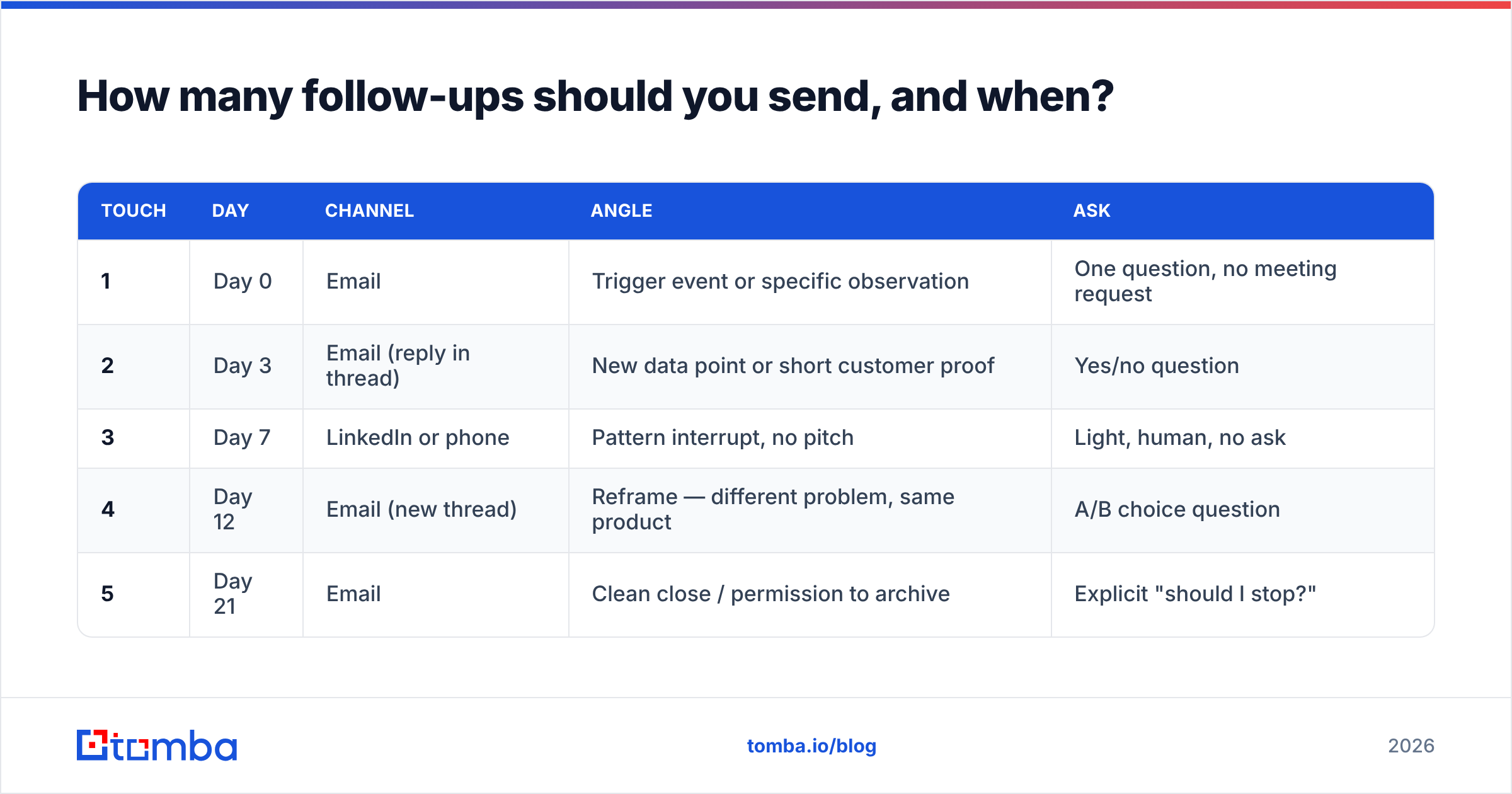
The honest answer: fewer than the sequence templates you were handed, and spaced more deliberately. Most teams over-index on volume because volume is easy to configure and hard to argue with. But each touch that repeats the previous angle depresses the whole sequence — it trains the prospect that your emails are safe to ignore.
A cadence that holds up in 2026 looks like this:
| Touch | Day | Channel | Angle | Ask |
|---|---|---|---|---|
| 1 | Day 0 | Trigger event or specific observation | One question, no meeting request | |
| 2 | Day 3 | Email (reply in thread) | New data point or short customer proof | Yes/no question |
| 3 | Day 7 | LinkedIn or phone | Pattern interrupt, no pitch | Light, human, no ask |
| 4 | Day 12 | Email (new thread) | Reframe — different problem, same product | A/B choice question |
| 5 | Day 21 | Clean close / permission to archive | Explicit "should I stop?" |
Three rules make this work:
- Vary the angle, not just the wording. Five emails about the same value proposition is one email sent five times.
- Reply in-thread twice, then start fresh. Long quoted threads signal "unanswered obligation." A new subject line resets the frame.
- Stop at five. HubSpot's sales research and most vendor benchmark reports converge on the same shape: reply probability drops sharply after the fourth or fifth touch, while unsubscribe and spam-complaint risk keeps climbing.
If your team measures nothing else, measure response rate per touch number. The touch where reply rate falls below roughly a fifth of touch #1 is your real stopping point, whatever the playbook says.
What should you write instead? Nine openers that replace the guilt line#
Swap the dead sentence for one of these. Each is a first line, not a whole email — keep the body under 90 words.
- The new-information opener: "New number since we last spoke: [specific stat]. Changes the math on [their problem]."
- The trigger opener: "Saw [company] just [hired / launched / raised / expanded]. That usually puts [problem] on someone's desk."
- The one-line recap: "Short version of my last note, since it was too long: [single sentence]."
- The narrowed ask: "Not asking for a meeting. Just: is this a you problem or a [other department] problem?"
- The A/B question: "Two options — (a) this matters but not this quarter, (b) it's not a fit at all. Either is a useful answer."
- The peer proof: "[Similar company] had the same bounce-rate issue. Here's the one thing they changed: [detail]."
- The honest observation: "You opened this twice and didn't reply, which usually means the timing is wrong, not the topic."
- The referral pivot: "If this sits with someone else on your team, happy to take it off your plate — who should I ask?"
- The clean close: "I'll assume this isn't a priority and close the loop. If that's wrong, one word gets us back on track."
None of these mention your inbox. That is the point.
Do breakup emails still work in 2026?#
Yes — but only the honest ones. The breakup email works because of loss aversion: the prospect suddenly weighs a closing door instead of an open obligation. That mechanism is real and it still fires.
What has stopped working is the theatrical breakup. Lines like "Since I haven't heard back, I'll assume you've been abducted by aliens" or "Permission to close your file?" followed by three more emails next week. Buyers have seen that move hundreds of times. Fake finality is worse than no finality, because it costs you the one thing you had left: credibility.
A breakup email that performs has four properties:
- It is actually final. If you send another sequence in 30 days, you lied.
- It is short. Two or three sentences. No recap of the value proposition.
- It hands them the easy exit. "No reply is a fine answer — I'll close this out Friday."
- It leaves a door, not a hook. "If [problem] comes back in Q2, I'm easy to find."
Here is a version that works:
Subject: Closing this out
[First name] — no reply on my last two notes, which I read as "not now."
I'll stop here so I'm not cluttering your inbox. If deliverability moves back up the list in Q2, reply to this thread and I'll pick it back up.
Either way, good luck with the [specific initiative] rollout.
That email gets replies precisely because it does not ask for one.
What do six replacement templates look like in full?#
1. The trigger follow-up (touch 2)
Saw the three AE roles posted on your careers page. When headcount jumps like that, list quality usually becomes the bottleneck before quota does.
Two teams we work with hit the same wall — the fix was verification before import, not more data.
Is list quality already on your radar for Q4, or is that a next-year problem?
2. The one-line recap (touch 2 alternative)
My last email was too long. One sentence: about 1 in 8 addresses in a 6-month-old B2B list is already dead, and that's what drives most bounce spikes.
Worth 10 minutes, or not a priority right now?
3. The A/B close (touch 4)
I'd rather get a clean "no" than keep guessing, so — (a) relevant but the timing's wrong, (b) not a fit at all, (c) wrong person.
A single letter is a complete reply.
4. The referral pivot (touch 3 or 4)
This might not be your lane at all. If deliverability and list hygiene sit with someone else, point me at them and I'll stop filling your inbox.
5. The peer proof (touch 2 or 4)
A 12-person outbound team we work with was seeing 9% bounces. They ran their existing list through verification before importing to their sequencer and it dropped to 1.8% in three weeks — same list, same copy.
Is your bounce rate where you want it?
6. The clean close (touch 5)
I'll close this out — no reply reads as "not now," and that's a fine answer.
If it changes, this thread still works.
Steal the structure, not the sentences. If you want a starting library, Tomba's cold email templates and subject line generator cover the common outbound shapes.
Is the problem your copy, or is it your data?#
This is the question almost nobody asks after four unanswered follow-ups — and it is the one that most often explains the silence.
If the address is wrong, stale, or routed to a catch-all black hole, your follow-up copy is irrelevant. You are A/B testing sentences that no human will ever read. Three failure modes account for most of it:
- The person left. B2B contact data decays roughly 2–3% per month. A list built in January is materially wrong by August.
- The address never existed. Pattern-guessed addresses (
first.last@) fail often enough that unverified guessing inflates bounce rates and burns sender reputation. - The domain is catch-all. The server accepts everything, so nothing bounces and nothing arrives at a real mailbox. Your "no reply" rate looks like disinterest. It is not.
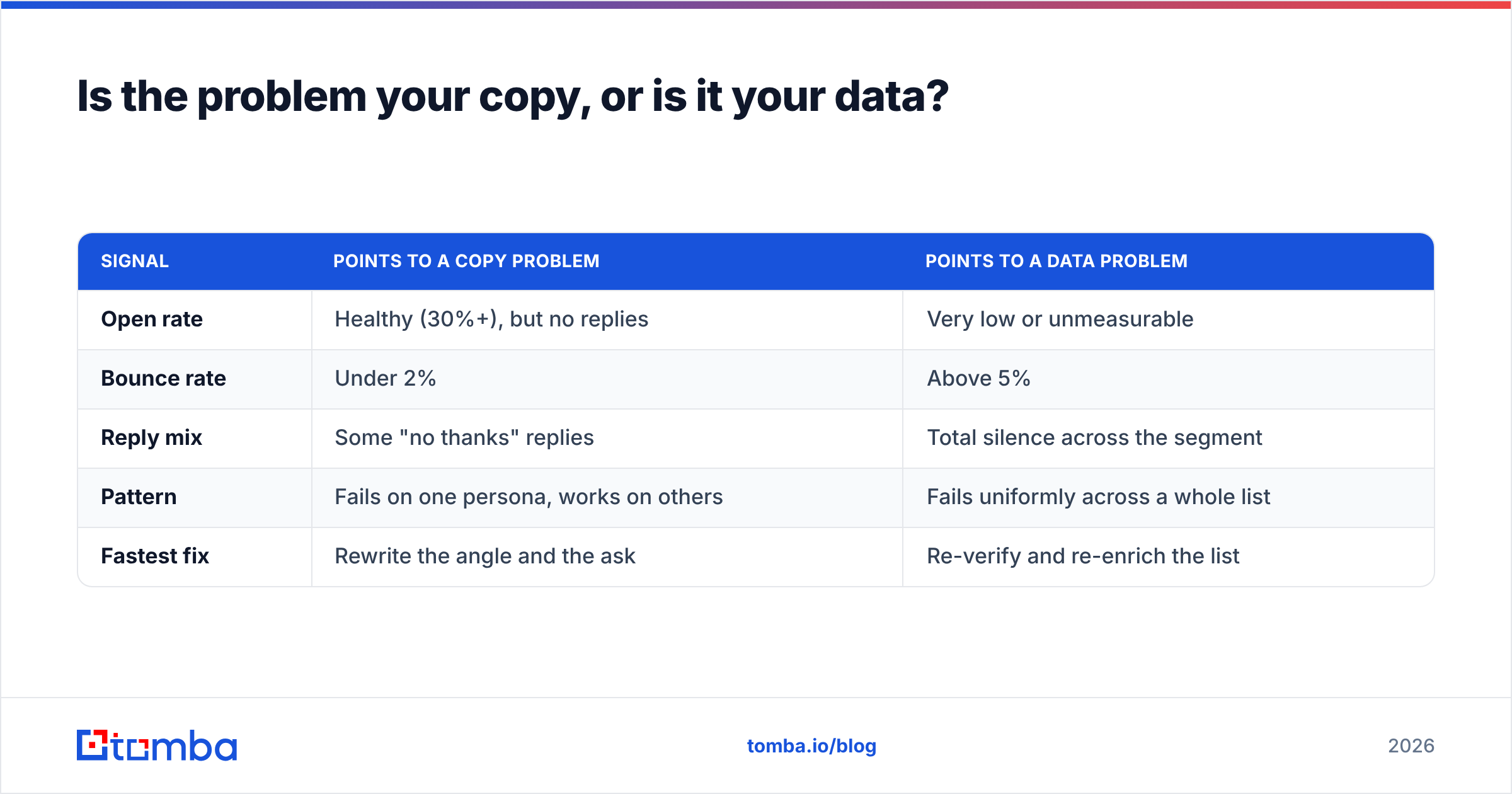
Here is how the two diagnoses compare, so you spend your time on the right fix:
| Signal | Points to a copy problem | Points to a data problem |
|---|---|---|
| Open rate | Healthy (30%+), but no replies | Very low or unmeasurable |
| Bounce rate | Under 2% | Above 5% |
| Reply mix | Some "no thanks" replies | Total silence across the segment |
| Pattern | Fails on one persona, works on others | Fails uniformly across a whole list |
| Fastest fix | Rewrite the angle and the ask | Re-verify and re-enrich the list |
Run the cheap check first. Push the segment through an email verifier, look at the catch-all share, and only then start rewriting openers. Vendor comparison sites like G2 are useful for sanity-checking which verification tools your peers actually keep after the trial, but the diagnostic itself takes an afternoon.
What should you stop doing today?#
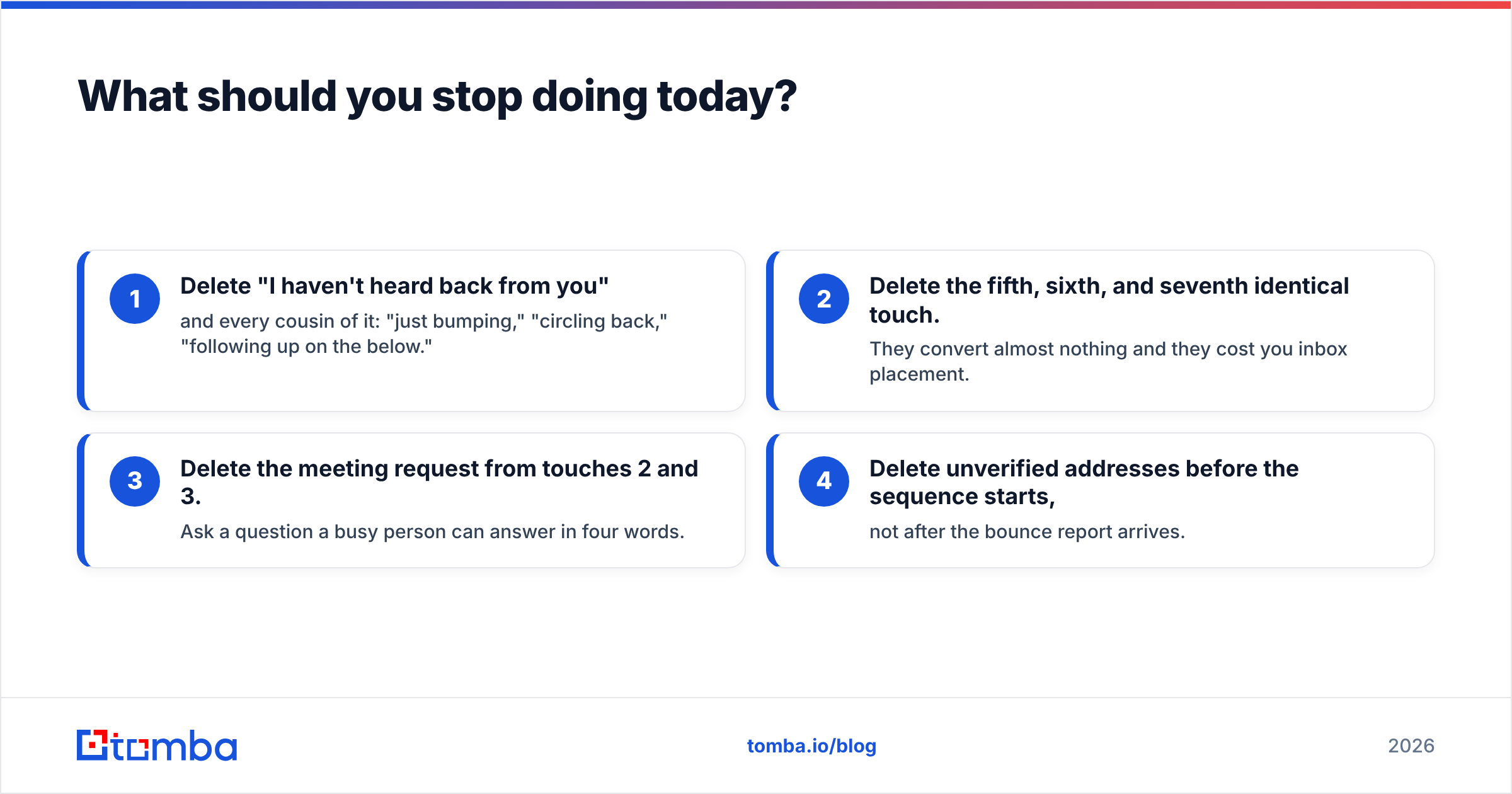
Four deletions, ranked by how much they cost you:
- Delete "I haven't heard back from you" and every cousin of it: "just bumping," "circling back," "following up on the below."
- Delete the fifth, sixth, and seventh identical touch. They convert almost nothing and they cost you inbox placement.
- Delete the meeting request from touches 2 and 3. Ask a question a busy person can answer in four words.
- Delete unverified addresses before the sequence starts, not after the bounce report arrives.
The follow-up sentence people quote as "polite" is usually the one doing the damage. Replace the receipt with information, narrow the ask, and give the prospect a graceful way to say no — reply rates move without touching your product story at all.
Fix the data half of the problem first. If your follow-ups are landing on dead or guessed addresses, no rewrite will save them. Use the Tomba Email Finder to source verified, current work addresses by name and domain, then run the list through verification before it ever hits your sequencer. The free tier covers 25 searches a month so you can test a segment before committing; paid plans start at $49/mo on Tomba pricing. Clean list first, better sentences second — in that order.
Related guides#
Ready to find emails that actually work?
Join 150,000+ professionals who stopped guessing and started sending. Free credits on signup — no credit card required.
Get the Tomba newsletter
Practical outbound tactics and product updates — once every two weeks.
About the author