"I Need to Think About It": How to Handle the Stall in 2026
"I need to think about it" is rarely about thinking. It's a polite cover for missing budget, missing authority, or missing urgency. Here's how to decode it in the moment and get a real answer instead of a ghost.
TL;DR
- "I need to think about it" is almost never about thinking. It's a polite exit from a conversation where something — budget, authority, urgency, or trust — is missing and the buyer doesn't want to say which.
- The single highest-leverage response is to grant permission to stall, then ask what specifically they want to think through. Pressure closes the door; curiosity keeps it open.
- Deals that end on a vague "let me think" close at a fraction of the rate of deals that end on a scheduled next step with a named attendee and an agenda.
- Prevent the stall upstream: qualify for a decision process, not just interest, and surface objections before you ask for the close.
- If the stall came from a cold outbound sequence, the problem usually isn't your reply script — it's that you were talking to someone who never had authority in the first place.
What does "I need to think about it" actually mean?#
It means the buyer has decided not to tell you the real reason. That's the whole thing.
Think of it like a friend saying "let's grab coffee sometime." Nobody is lying. Nobody is booking anything either. The phrase exists to end an interaction gracefully without conflict — which is exactly what a stalled prospect needs when the real answer is "I can't get budget for this until Q1" or "my boss already picked someone else" or "I don't trust that your numbers are real."
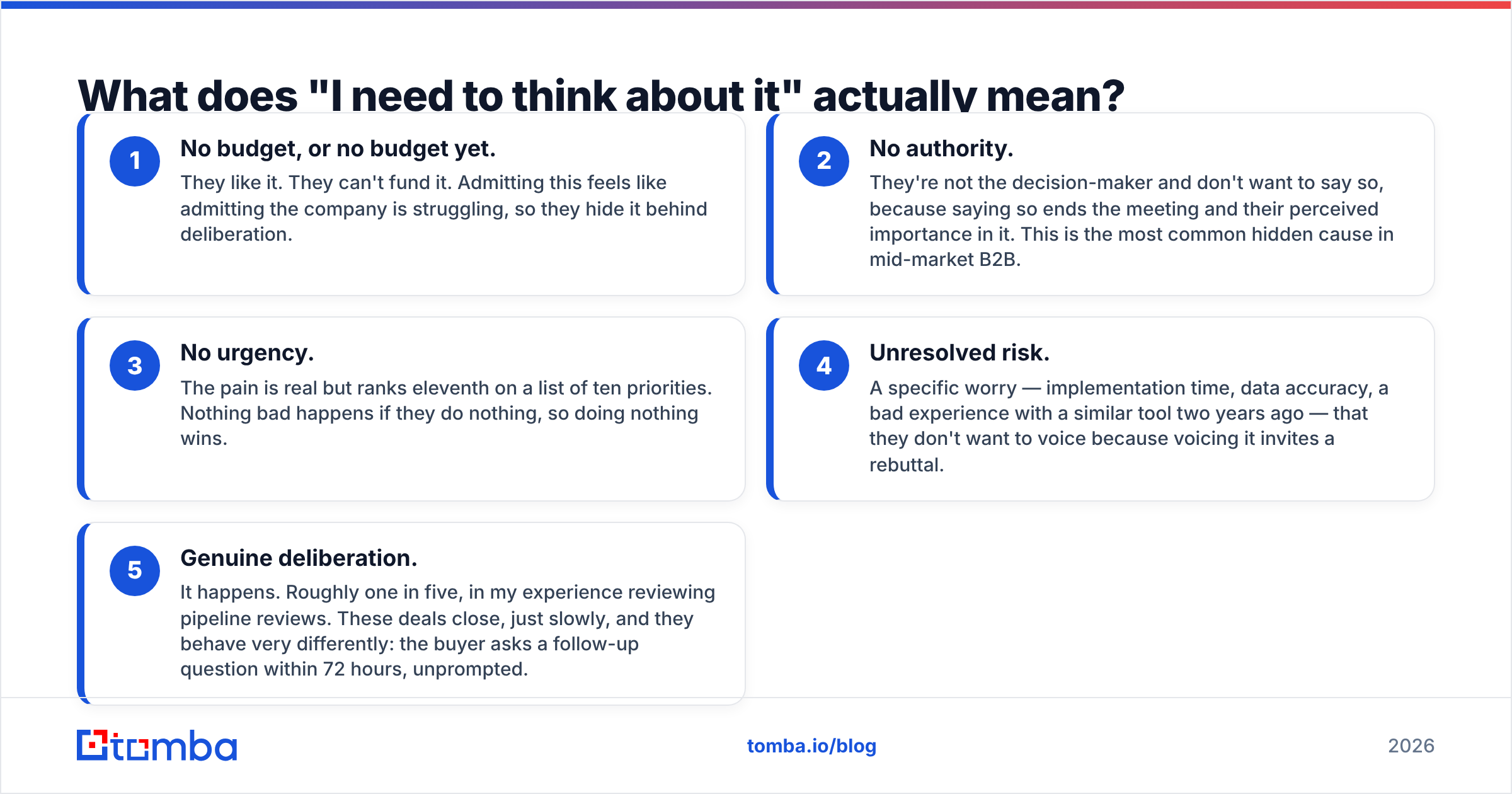
Underneath "I need to think about it," you'll find one of five things:
- No budget, or no budget yet. They like it. They can't fund it. Admitting this feels like admitting the company is struggling, so they hide it behind deliberation.
- No authority. They're not the decision-maker and don't want to say so, because saying so ends the meeting and their perceived importance in it. This is the most common hidden cause in mid-market B2B.
- No urgency. The pain is real but ranks eleventh on a list of ten priorities. Nothing bad happens if they do nothing, so doing nothing wins.
- Unresolved risk. A specific worry — implementation time, data accuracy, a bad experience with a similar tool two years ago — that they don't want to voice because voicing it invites a rebuttal.
- Genuine deliberation. It happens. Roughly one in five, in my experience reviewing pipeline reviews. These deals close, just slowly, and they behave very differently: the buyer asks a follow-up question within 72 hours, unprompted.
The job of your response isn't to overcome the objection. It's diagnostic. You need to figure out which of the five you're holding before you decide what to do next.
Is it a real objection or a brush-off?#
Real objections are specific. Brush-offs are vague. That's the tell, and it holds up across nearly every deal I've watched die.
"I need to run the security review past our IT lead before we can sign" is an objection. It has a person, a process, and an implied timeline. You can work with it.
"I need to think about it" has none of those. It's a shape where an objection should be.
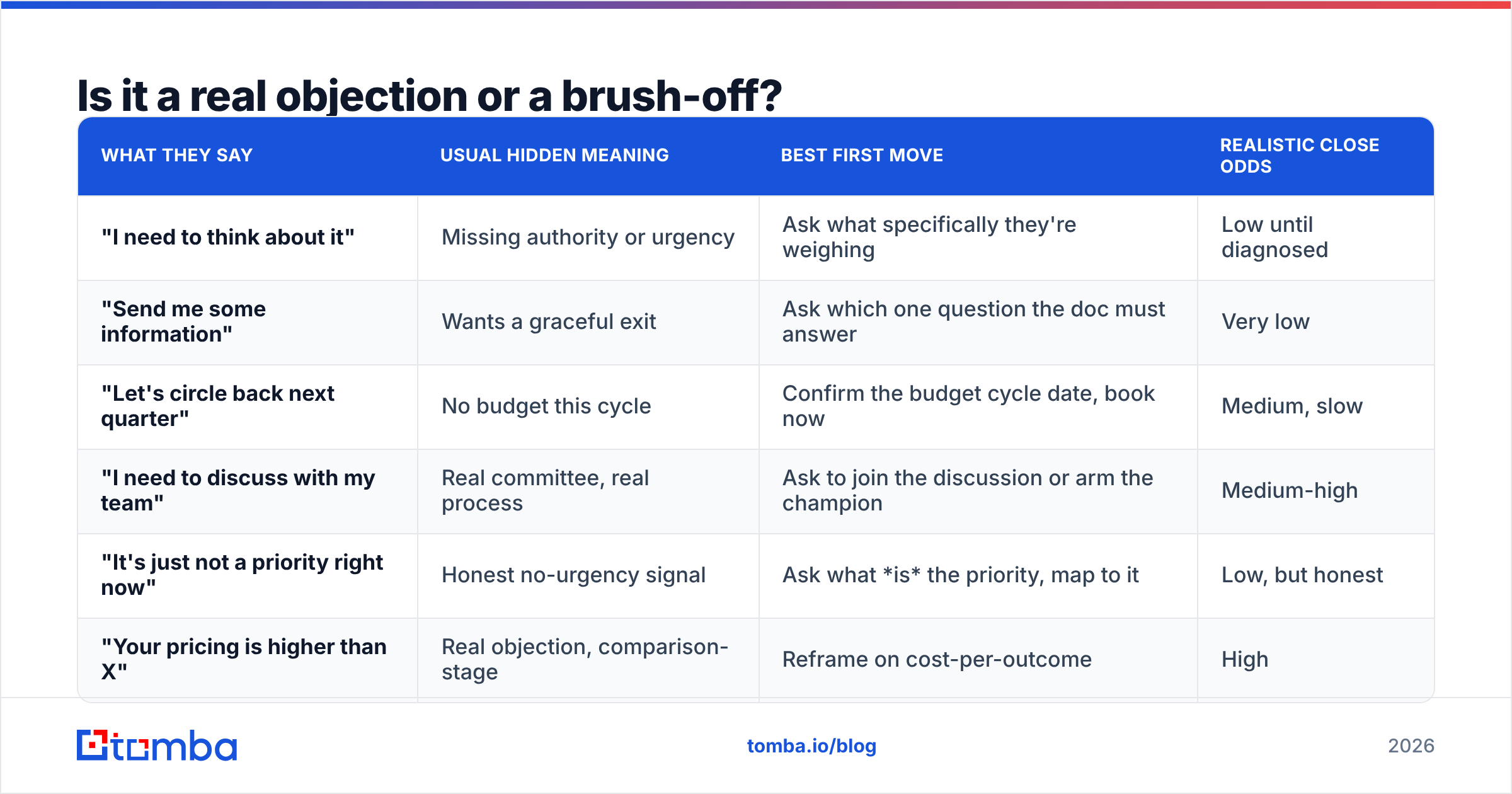
Here's how the common stall variants map to what's actually happening and what to do:
| What they say | Usual hidden meaning | Best first move | Realistic close odds |
|---|---|---|---|
| "I need to think about it" | Missing authority or urgency | Ask what specifically they're weighing | Low until diagnosed |
| "Send me some information" | Wants a graceful exit | Ask which one question the doc must answer | Very low |
| "Let's circle back next quarter" | No budget this cycle | Confirm the budget cycle date, book now | Medium, slow |
| "I need to discuss with my team" | Real committee, real process | Ask to join the discussion or arm the champion | Medium-high |
| "It's just not a priority right now" | Honest no-urgency signal | Ask what is the priority, map to it | Low, but honest |
| "Your pricing is higher than X" | Real objection, comparison-stage | Reframe on cost-per-outcome | High |
Notice the last row. A pricing objection is good news. The buyer has done work, compared options, and is engaging on substance. "I need to think about it" is the opposite — it signals that no work has been done and none is scheduled.
The other diagnostic: what happens in the next 72 hours. Genuine deliberators send you a question. Brush-offs go silent. Build that into your CRM as a field, not a feeling — track "stall reason: undiagnosed" and you'll be shocked how much of your forecast sits in that bucket.
How should you respond in the moment?#
Lower the pressure first, then ask a specific question. In that order. Reversing them makes you sound like you're arguing.
Seven responses that work, roughly in order of how often I'd reach for them:
1. The permission-plus-question. "Totally fair — I'd want to think it over too. Just so I don't send you the wrong follow-up: is it the pricing, the timeline, or whether this actually solves the problem you described?"
This works because it grants the stall (removing the need to defend it) and then offers a multiple-choice menu. Multiple choice is much easier to answer than an open question when someone is trying to disengage.
2. The negative-reversal. "Sounds like this might not be the right fit — should I close the file on it?"
Chris Voss-adjacent, and it works for a reason: people hate having options taken away. If the deal is alive, they'll rescue it. If it's dead, you learn today instead of after six follow-ups. Use it once, and only when you're genuinely willing to walk.
3. The scale question. "On a scale of one to ten, where are you on moving forward?" Then, whatever number they say — even a three — ask "what would make it a [number + 1]?" Never ask why it isn't a ten. That's a trap they'll resent.
4. The what's-changed frame. "When we started this conversation, you said [specific pain] was costing you [specific amount]. Has that changed?" You're not pressuring them. You're asking them to reconcile their own stated position with their current behavior.
5. The decision-process question. "What does the decision process look like from here — who else needs to weigh in?" This exposes hidden authority gaps faster than anything else on this list. If the answer is a name you've never heard, you found your real problem.
6. The pre-mortem. "If you look back in six months and this didn't happen, what's the most likely reason?" Buyers will tell you the truth in hypothetical form when they won't tell you directly.
7. The scheduled-thinking close. "Makes sense. How much time do you need — a week? Let's put fifteen minutes on the calendar for next Thursday so you're not chasing me down." Never leave without a calendar entry. A stall with a date is a deal. A stall without one is a loss you haven't recorded yet.
What all seven have in common: none of them re-pitch. The instinct to repeat your value prop when someone stalls is the single most reliable way to convert a maybe into a no. HubSpot's objection-handling research makes the same point from a different angle — reps who ask a question after an objection outperform reps who make a statement, consistently.
Why does the stall happen so often in 2026?#
Because buying committees got bigger and nobody told the rep. Gartner's B2B buying journey research has tracked committee size climbing for a decade — a typical software purchase now involves somewhere between six and ten people, most of whom you will never meet.
When you ask a single contact for a decision that requires eight signatures, "I need to think about it" is the only honest answer available to them. They're not stalling you. They're translating "I need to run this through a process I haven't told you about" into something socially comfortable.
Two other pressures make it worse:
- Budget scrutiny. Post-2023 procurement discipline never fully relaxed. Deals under $10k that used to go on a card now go through a review.
- Tool fatigue. The average go-to-market team already owns more software than it uses. Every new purchase implicitly asks "which of our existing tools does this replace?" — and if you haven't answered that, the buyer will stall while they figure it out themselves.
There's also a plain cognitive explanation: analysis paralysis is real, and it gets worse as options multiply. Your job is to shrink the decision, not expand it. A buyer choosing between "your plan A and your plan B" decides faster than a buyer choosing between "your five plans and four competitors."
How do you follow up after "I need to think about it"?#
With a specific artifact and a specific date — not a check-in.
"Just checking in" is the follow-up equivalent of the stall itself: polite, contentless, easy to ignore. Every follow-up should carry something the buyer didn't have before.
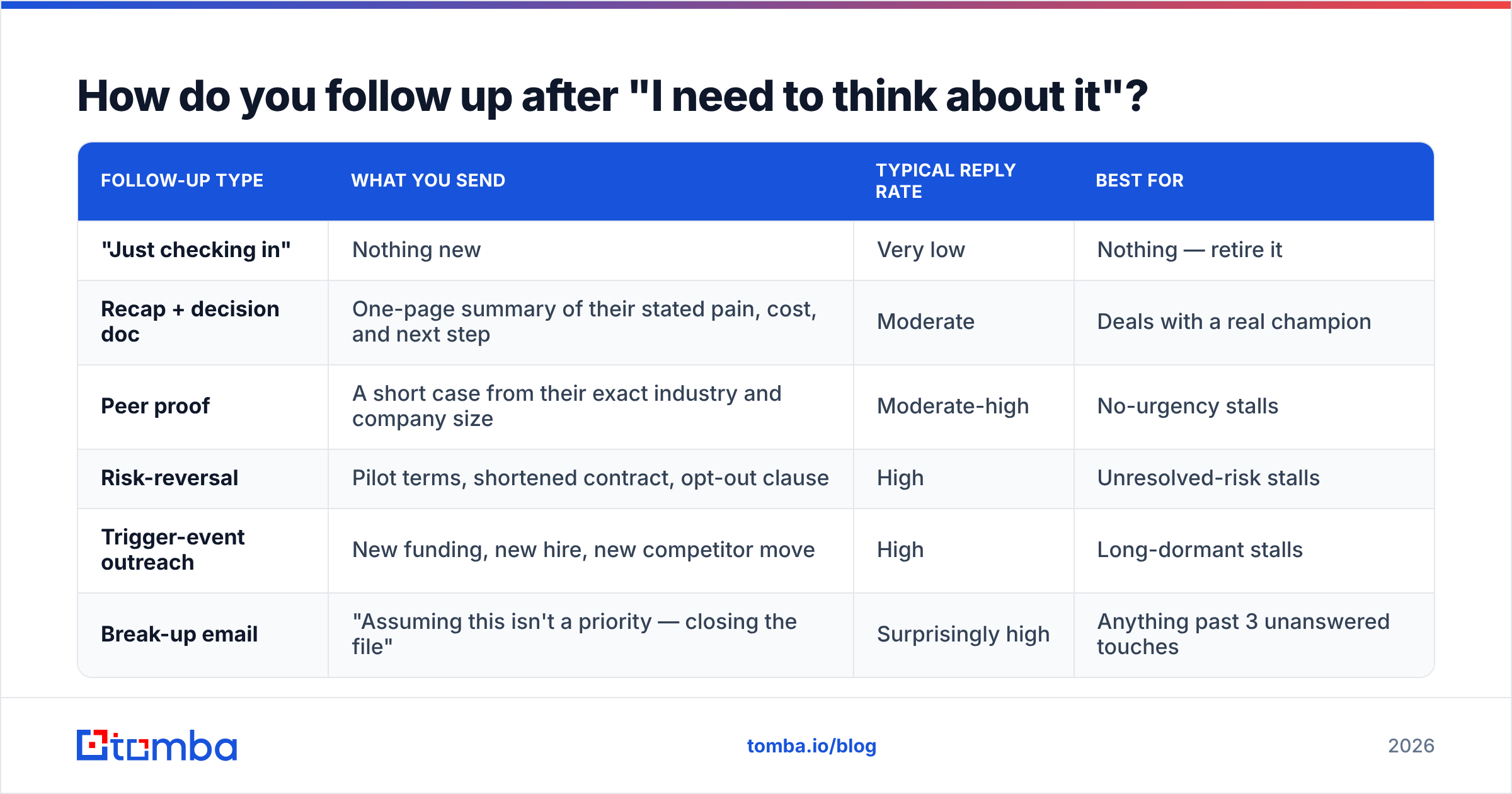
| Follow-up type | What you send | Typical reply rate | Best for |
|---|---|---|---|
| "Just checking in" | Nothing new | Very low | Nothing — retire it |
| Recap + decision doc | One-page summary of their stated pain, cost, and next step | Moderate | Deals with a real champion |
| Peer proof | A short case from their exact industry and company size | Moderate-high | No-urgency stalls |
| Risk-reversal | Pilot terms, shortened contract, opt-out clause | High | Unresolved-risk stalls |
| Trigger-event outreach | New funding, new hire, new competitor move | High | Long-dormant stalls |
| Break-up email | "Assuming this isn't a priority — closing the file" | Surprisingly high | Anything past 3 unanswered touches |
The break-up email deserves its reputation. It reliably outperforms the fourth and fifth "checking in" note, because it's the only message in the sequence that costs the buyer something to ignore.
One structural rule: cap your follow-up sequence. Four to six touches over three weeks, then move to a quarterly nurture. Reps who send eleven follow-ups aren't more persistent; they're training an entire market segment to filter their domain. If you're worried about what that does to your inbox placement, run your list through an email verifier before you sequence — dead addresses in a follow-up cadence damage sender reputation faster than volume does.
How do you prevent the stall before it happens?#
Qualify for the decision, not for the interest. Interest is free. Decisions are expensive.
Four changes that cut the "think about it" rate more than any script:
Ask the process question early. On the first real call, not the fourth: "If this works, what happens next on your side to actually get it bought?" Reps skip this because it feels presumptuous. It isn't. It's the single most predictive question in discovery.
Surface the objection yourself. Before you ask for the close: "Usually at this point people tell me the timing's tough or they need to check with finance. Is either of those in play here?" Naming it first removes the social cost of admitting it.
Make the next step smaller than the decision. Instead of "do you want to buy," offer "do you want to run this against fifty of your own accounts and see what comes back?" A pilot is a decision a single person can make. A purchase usually isn't.
Talk to the right person from the start. Half of all "I need to think about it" responses are authority problems wearing a costume. If your outbound is landing on whoever's email address you could find rather than whoever owns the budget line, you're manufacturing stalls at the top of the funnel. Targeting the actual owner — with a verified address and, when it matters, a direct phone finder number — removes an entire category of stall before it exists.
That last point is worth sitting with. A stall at the close is often a sourcing mistake three weeks earlier. You can't script your way out of talking to the wrong human.
What should you never say?#
Some responses are actively worse than silence:
- "What's there to think about?" — Adversarial. You've just told them their deliberation is illegitimate.
- "This offer expires Friday." — Fake urgency. Sophisticated B2B buyers have seen it a thousand times and it lowers trust immediately. Real deadlines are fine. Invented ones cost you the deal and the referral.
- "Let me send over a few more case studies." — More information does not cure a decision problem. It usually deepens it.
- "I'll follow up Monday." — Passive. You've handed the entire next step to yourself and asked nothing of them.
- Anything that re-pitches. If the pitch didn't land the first time, volume won't fix it.
The through-line: every one of these is about you managing your own discomfort. The buyer went vague and you filled the silence. Don't. Ask a question and let it sit.
How do you know when to walk away?#
When there's no date, no name, and no question. Three strikes.
If, after two attempts to diagnose the stall, you still don't have (a) a scheduled next step, (b) the name of another person involved, or (c) a specific question they want answered — the deal isn't slow, it's over. Recording it as lost costs you nothing and makes your forecast honest. Leaving it in pipeline at 40% costs you a quarter.
Track this properly and you'll see your real win rate rise, not because you're closing more, but because you're forecasting less fiction. Managers who clean stalled deals out of the board on a 30-day rule tend to run tighter, more accurate teams — and reps who aren't nursing zombie deals have more hours for new ones.
Then go rebuild the top of the funnel. The cure for a pipeline full of "I need to think about it" is more first conversations with people who can actually say yes.
FAQ#
Is "I need to think about it" ever a good sign? Occasionally — when it arrives with a specific question attached ("I need to think about whether we can handle the migration in Q4"). Bare and unqualified, it's a warning.
How long should I wait before following up? Ask them. "How much time do you need?" gives you a permission-based date instead of a guess. If they won't name one, default to three business days for a small deal, a week for a larger one.
Does this apply to cold email replies too? Yes, and it's even more common there, because the recipient has less invested. In cold outbound, treat it as an authority signal first: verify you're talking to a budget owner before you invest in a reply sequence.
Should I ever offer a discount to break the stall? Almost never as a first move. Discounting an undiagnosed stall teaches the buyer that waiting lowers the price, and it doesn't address the actual blocker — which is usually process, not money.
Start with the right person, not the better script#
The best objection-handling in the world can't rescue a conversation with someone who was never going to sign. If your calendar is full of polite stalls, look upstream: are you reaching decision-makers, or reaching whoever was easiest to find?
Tomba Email Finder gets you verified, role-accurate contacts by domain, name, or company — so your first conversation happens with the person who owns the budget line instead of the person who has to go ask. Start free with 25 searches a month, or check Tomba pricing if you're running volume: Starter is $49/mo, Growth $99/mo, Pro $249/mo. Fewer stalls, fewer follow-ups, shorter cycles.
Related guides#
// get started
Find, verify and enrich your first contacts today
Start on the free plan with 25 searches a month, then scale when your team is ready.
Free plan · No credit card required · GDPR & CCPA
// about the author