I Would Like to Follow Up on My Previous Email: Better Lines
"I would like to follow up on my previous email" is the most-sent, least-read sentence in B2B. Here is what it signals to a busy buyer, when it still works, and seven replacement openers plus a cadence that actually earns replies.
TL;DR
- "I would like to follow up on my previous email" tells the reader one thing: you have nothing new to say. It restates your last message instead of adding value.
- The line is not banned. It works in exactly two contexts — a warm thread the prospect already engaged with, and a formal/administrative chase (invoice, contract, scheduled deliverable).
- Replace it with a new reason to reply: a trigger event, a specific question, a resource, a deadline, or a graceful close-out.
- Cadence beats phrasing. Three to five touches over 14–21 days, each with its own angle, outperforms eight "just bumping this" nudges.
- Most follow-up failure is not copy — it is the address. If the first email never landed, no amount of rewriting saves the thread. Verify before you re-send.
What does "I would like to follow up on my previous email" actually say to the reader?#
It says: I sent something, you ignored it, now I am making that your problem.
Think of it like knocking on a door and, when nobody answers, knocking again in the same rhythm. You have not given the person inside a single new reason to get off the couch. The words are polite. The content is empty.
Three things go wrong at once in that sentence:
- It is about you, not them. "I would like" is the subject of the sentence. Nothing in it references the recipient's quarter, stack, hiring plan, or problem.
- It refers to something they never read. If they missed email one, "my previous email" is a dead pointer. You are asking them to scroll and reconstruct context you should be supplying.
- It is pattern-matched as bulk. Buyers in software, agencies, and finance see this exact string dozens of times a week. Pattern recognition is instant, and the delete is reflexive.
There is a reason sales teams keep sending it anyway: it feels professional and it costs zero thought. That is also why it does not work. Anything that costs the sender zero thought communicates zero thought to the reader.

Is "I would like to follow up on my previous email" ever acceptable?#
Yes — in two narrow cases.
Case 1: the thread is already warm. They replied once, asked for pricing, then went quiet for ten days. Here "following up on my previous email" is a reasonable pointer because the previous email genuinely exists in their memory. Even then, put the new information first and the reference second.
Case 2: the message is administrative, not persuasive. Chasing a signed MSA, an unpaid invoice, a security questionnaire, or a scheduling confirmation. Formality is the point. Nobody expects a clever hook attached to a W-9 request. Write it plainly and attach the document again so they do not have to hunt.
Everywhere else — cold outreach, post-demo silence, a renewal push, a partnership pitch — the line is dead weight. Real follow-up strategy guides from HubSpot's sales blog have been saying the same thing for a decade: the follow-up has to carry its own weight as a standalone message.
What should you write instead of "I would like to follow up"?#
Pick a new angle every time you touch the thread. Each of these openers replaces the empty bump with a reason the email exists today, in this inbox.
- The trigger opener — "Saw you opened two SDR roles in Berlin last week." Tie the follow-up to something that changed on their side. This is the single highest-performing replacement because it proves the email was sent on purpose.
- The single-question opener — "Quick one: is outbound owned by you or by demand gen?" One question, answerable in four words, zero commitment. Low friction gets replies that long pitches never do.
- The resource opener — "Put together the ramp math for a 4-rep team — want it?" You are offering, not asking. The reply is a yes/no, not a meeting.
- The social-proof opener — "A similar team at [comparable company] cut their bounce rate from 14% to 3%." Specific, verifiable, and about outcomes rather than features.
- The deadline opener — "Pricing on the current tier locks on the 30th." Only use a real deadline. A fake one costs you the account permanently.
- The close-out opener — "Assuming this isn't a priority this quarter — want me to circle back in Q2?" Counterintuitively, this often outperforms every other line in the sequence. Loss aversion plus permission to say no is a powerful combination.
Notice what all six share: the recipient can act without re-reading anything. That is the actual job of a follow-up.
How do the phrasings compare in practice?#
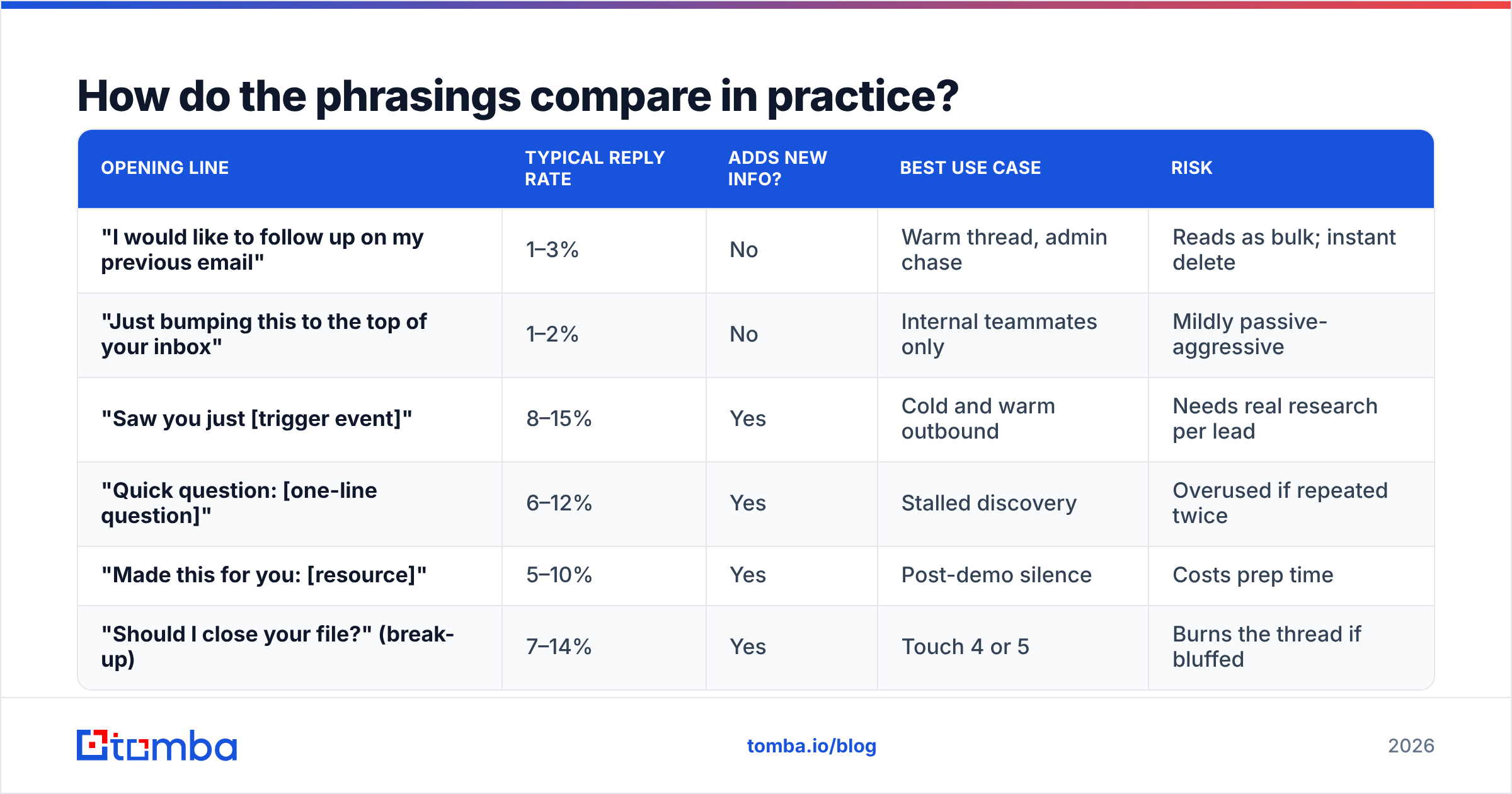
Here is how the common openers stack up across the dimensions that matter. Reply-rate figures reflect typical B2B ranges reported by sales-engagement vendors and practitioner benchmarks; treat them as directional, not gospel — your list quality moves these numbers more than your wording does.
| Opening line | Typical reply rate | Adds new info? | Best use case | Risk |
|---|---|---|---|---|
| "I would like to follow up on my previous email" | 1–3% | No | Warm thread, admin chase | Reads as bulk; instant delete |
| "Just bumping this to the top of your inbox" | 1–2% | No | Internal teammates only | Mildly passive-aggressive |
| "Saw you just [trigger event]" | 8–15% | Yes | Cold and warm outbound | Needs real research per lead |
| "Quick question: [one-line question]" | 6–12% | Yes | Stalled discovery | Overused if repeated twice |
| "Made this for you: [resource]" | 5–10% | Yes | Post-demo silence | Costs prep time |
| "Should I close your file?" (break-up) | 7–14% | Yes | Touch 4 or 5 | Burns the thread if bluffed |
Two takeaways. First, every line that beats the baseline does so by adding information rather than by sounding more polite. Second, the break-up email — the one most reps are afraid to send — consistently ranks near the top. Silence is not a "maybe." Forcing a decision is a service to both sides.
How many follow-ups should you send, and how far apart?#
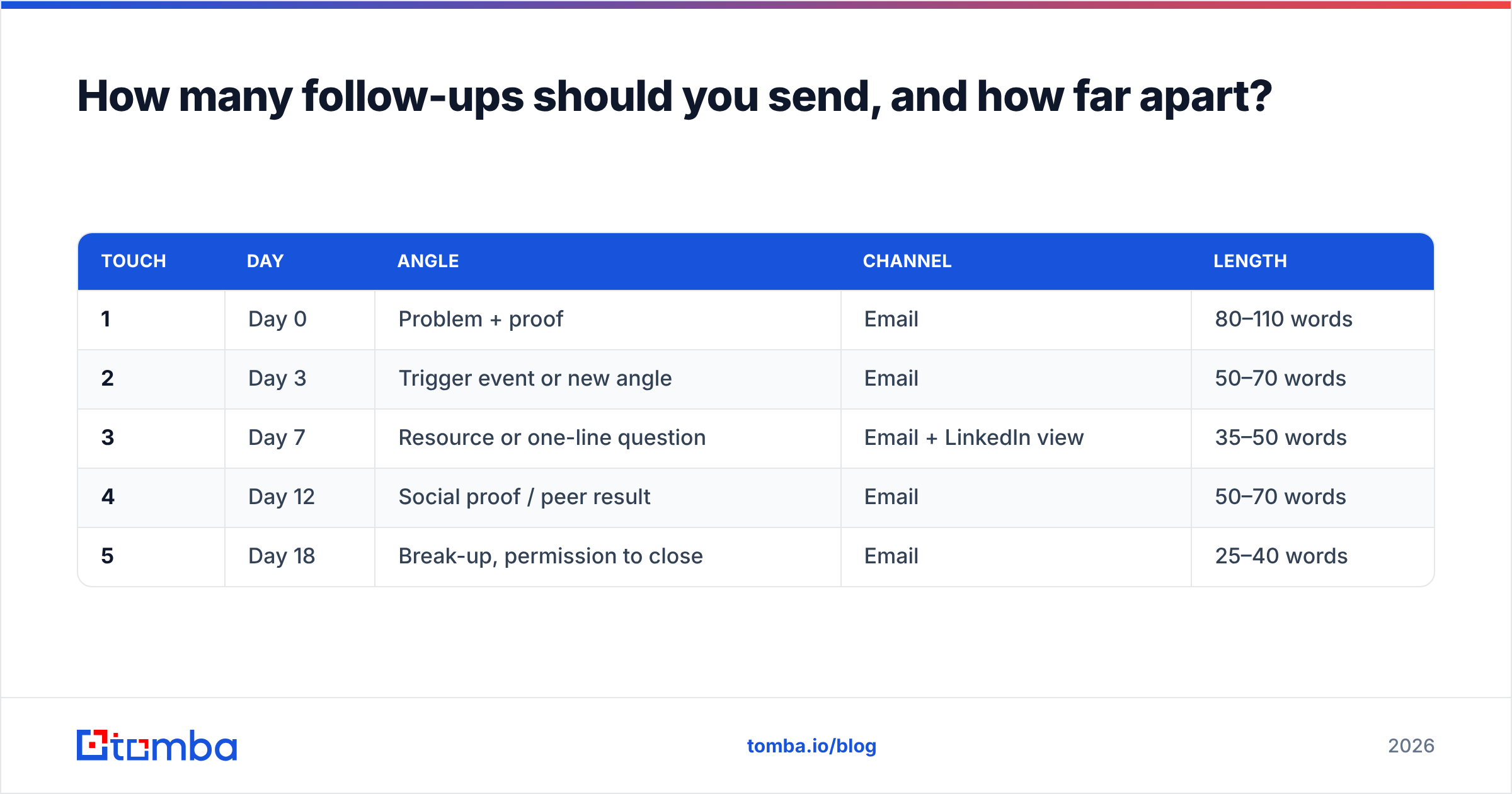
Most teams send too few touches, too close together, with too little variety. The shape below is a defensible default for B2B outbound; compress it for time-sensitive offers, stretch it for enterprise cycles where buying committees move at Gartner's documented glacial pace.
| Touch | Day | Angle | Channel | Length |
|---|---|---|---|---|
| 1 | Day 0 | Problem + proof | 80–110 words | |
| 2 | Day 3 | Trigger event or new angle | 50–70 words | |
| 3 | Day 7 | Resource or one-line question | Email + LinkedIn view | 35–50 words |
| 4 | Day 12 | Social proof / peer result | 50–70 words | |
| 5 | Day 18 | Break-up, permission to close | 25–40 words |
Rules that make this cadence work:
- Emails get shorter as the sequence progresses. By touch four you should be under 60 words. A long fourth email signals desperation.
- Never send two touches with the same angle. If touch two was a question, touch three is a resource.
- Do not send follow-ups on the same weekday at the same hour. You are competing with your own noise and training their filter.
- Stop at five. Touch six through ten produce marginal replies and material spam complaints, which damages your sender reputation for every other campaign you run.
What subject line should a follow-up email use?#
Two workable options, and one that quietly kills your open rate.
Option A — reply in the existing thread. Keeping the Re: thread preserves context and usually lifts opens, because the recipient sees a conversation rather than a cold pitch. Use this when they engaged at least once.
Option B — a fresh subject line. For cold sequences where the first email was never opened, a new subject is strictly better; the old one already failed. Keep it under 45 characters, lowercase, and specific: question about your SDR ramp, bounce rate on the Feb send. If you are stuck, a subject line generator is faster than staring at the cursor, but edit whatever it hands you — generated lines tend toward generic.
The one to avoid: subject lines that announce the follow-up itself. Following up, Checking in, Touching base, Re: Re: Re: quick chat. They advertise that the message contains no new information, which is exactly the impression you are trying to undo.

What do good follow-up emails look like end to end?#
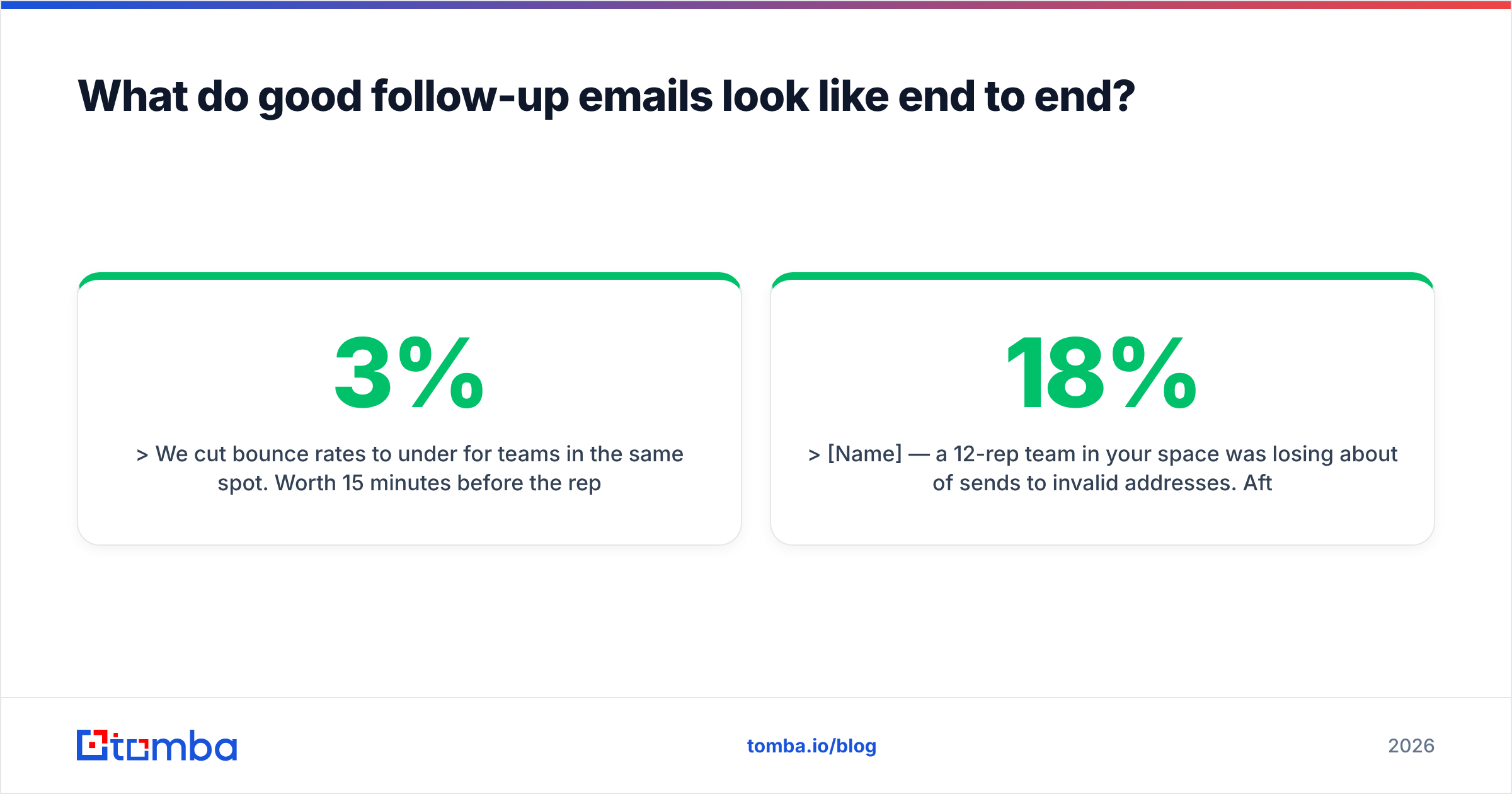
Four templates you can lift and adapt. Swap the brackets for real specifics — a template with the placeholders still visible is worse than no template.
1. Trigger-based (touch 2)
Subject: your new Berlin SDR roles
[Name] — saw the two SDR openings went up Tuesday. Ramping new reps is usually where list quality starts hurting: they burn week one on bounced sends.
We cut bounce rates to under 3% for teams in the same spot. Worth 15 minutes before the reps start?
2. Single question (touch 3)
Subject: quick one
[Name] — is outbound data owned by you or by RevOps on your side? Happy to route this to the right person instead of pestering you.
3. Peer proof (touch 4)
Subject: what [peer company] did
[Name] — a 12-rep team in your space was losing about 18% of sends to invalid addresses. After verification they got that to 2.4%, which gave them roughly 400 extra delivered emails a month at no extra spend.
Want the one-page breakdown of how they did it?
4. Break-up (touch 5)
Subject: closing this out
[Name] — I'll assume the timing is wrong and stop here. If deliverability becomes a priority next quarter, reply "Q2" and I'll circle back then.
More ready-to-edit structures live in our cold email templates library if you want a starting point per scenario.
Why do perfectly good follow-ups still get no reply?#
Because a large share of "ignored" emails were never received. Before you rewrite the copy a third time, rule out the mechanical causes:
- The address was wrong. Pattern-guessed addresses (
first.last@) fail often enough that entire sequences die silently. A hard bounce on touch one means touches two through five landed nowhere. - The domain is catch-all. It accepted your message and then discarded it. Catch-all domains need a different validation path than standard mailboxes — see catch-all verification.
- You hit the promotions tab or spam. Heavy HTML, tracking pixels on every touch, and link-stuffed signatures all push you there. Check your setup against a spam checker before blaming the words.
- The contact left. B2B data decays at roughly 20–30% per year. Your champion may have changed companies between touch one and touch four.
- You are emailing the wrong role. A great follow-up sent to someone with no budget is still a dead thread.
Sequence platforms reviewed on G2's sales engagement category will happily send touch five into a void. They do not validate the address for you. That gap is where most "our follow-ups don't work" complaints actually originate, and it is measurable: compare your bounce rate against your response rate before you touch a single line of copy.
What should you do this week?#
Run the audit in this order, because fixing copy on a broken list is wasted effort.
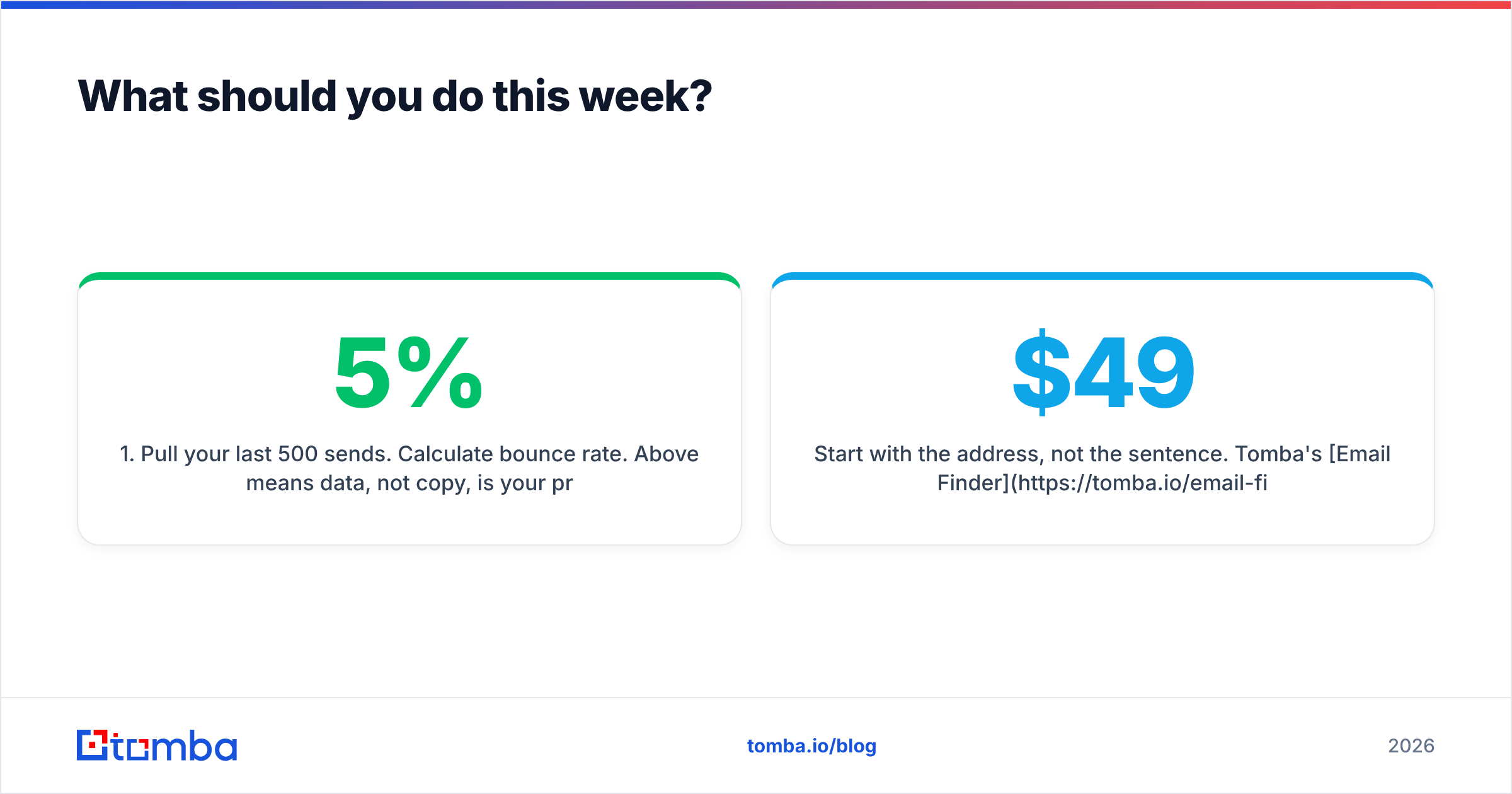
- Pull your last 500 sends. Calculate bounce rate. Above 5% means data, not copy, is your problem.
- Grep your sequences for the dead phrases.
following up,just checking in,bumping this,touching base. Replace each with one of the six openers above. - Assign one distinct angle per touch. Write the angle in the sequence step name so nobody silently duplicates it later.
- Add a real break-up email at touch five. Then actually stop.
- Verify every address before touch one, not after the bounces come back.
Do those five and the phrasing question mostly answers itself. The follow-up that works is the one that arrives at a real inbox, on a day when something changed, with a question the reader can answer in one line.
Start with the address, not the sentence. Tomba's Email Finder returns verified, source-attributed professional emails so your first touch lands and your follow-ups have somewhere to go. The free tier covers 25 searches a month; paid plans start at $49/mo on Starter, with Growth at $99/mo and Pro at $249/mo — full Tomba pricing is public. Fix the data, then rewrite the line.
Related guides#
// get started
Find, verify and enrich your first contacts today
Start on the free plan with 25 searches a month, then scale when your team is ready.
Free plan · No credit card required · GDPR & CCPA
// about the author