Ice Breaker Sales: 21 Openers That Actually Start Deals
Most sales ice breakers get skipped or deleted. Here is which opener types still earn a reply in 2026, which ones quietly kill trust, and a 90-second research routine to pick the right one.
TL;DR
- An ice breaker in sales is the first 1-2 lines of a call, email, or DM whose only job is to buy you the next 10 seconds — not to build friendship.
- Personal-life ice breakers ("saw you ran a marathon") now underperform. Observation-based and role-based openers win because they signal you did work, not stalking.
- The channel changes everything: a cold call ice breaker should acknowledge the interruption, a cold email ice breaker should prove relevance in under 12 words.
- The bottleneck is rarely creativity. It's data — you can't reference a company's hiring surge or tech stack if your contact record is a name and a guessed email.
- Measure ice breakers the same way you measure subject lines: reply rate and positive-reply rate, tested in batches of 100+, never by gut feel.
What is an ice breaker in sales?#
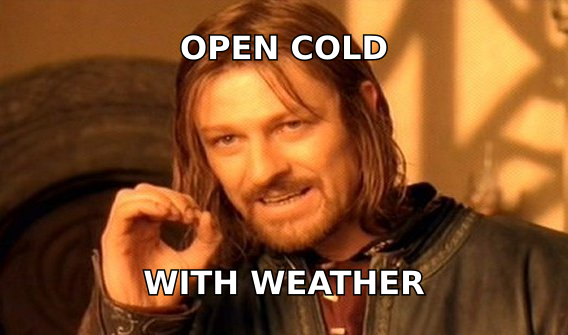
A sales ice breaker is the opening move that converts a stranger's default "no" into a temporary "go on." That's it. It is not rapport, it is not friendship, and it is definitely not the weather.
Think of it like the first five seconds of a phone call from an unknown number. Your brain runs one test: is this person here to take something from me, or do they know something I care about? Everything you say before your value prop is evidence in that test.
Technically, the ice breaker occupies the "pattern interrupt" slot in an outbound sequence — the moment before the prospect's script ("not interested, thanks") fires automatically. In cold email it's the first line above the fold in the preview pane. On a cold call it's the seven words after "Hi, is that Sarah?" In a discovery call it's the 20 seconds before you share your screen.
Three things separate an ice breaker from small talk:
- It is earned, not generic. It references something only someone who looked would know.
- It is short. Under 20 words in email, under 10 seconds on a call.
- It hands control back. It ends in a question or a pause, not a monologue.
Do sales ice breakers actually work in 2026?#
Yes — but the effective set has shrunk hard, and the reason is volume. Buyers now receive AI-assembled "personalization" at industrial scale, so the old markers of effort have inverted. Referencing someone's LinkedIn post about their half marathon used to say I researched you. In 2026 it says a tool scraped you.
What still works is specificity that a scraper can't fake convincingly: a line in the company's job posting, a pricing page change, a stack migration, a comment the prospect made on someone else's post that reveals a live opinion. HubSpot's sales research has consistently found relevance beats warmth on first touch, and conversation-intelligence vendors like Gong report the same directional finding on calls: openers that name the prospect's situation outperform openers that flatter the prospect.
The honest version: an ice breaker cannot save a bad list. If you're emailing the wrong persona at the wrong company, the world's best first line changes your reply rate from 0.4% to 0.6%. The ice breaker is a multiplier on targeting, not a substitute for it.

Which ice breaker types perform best?#
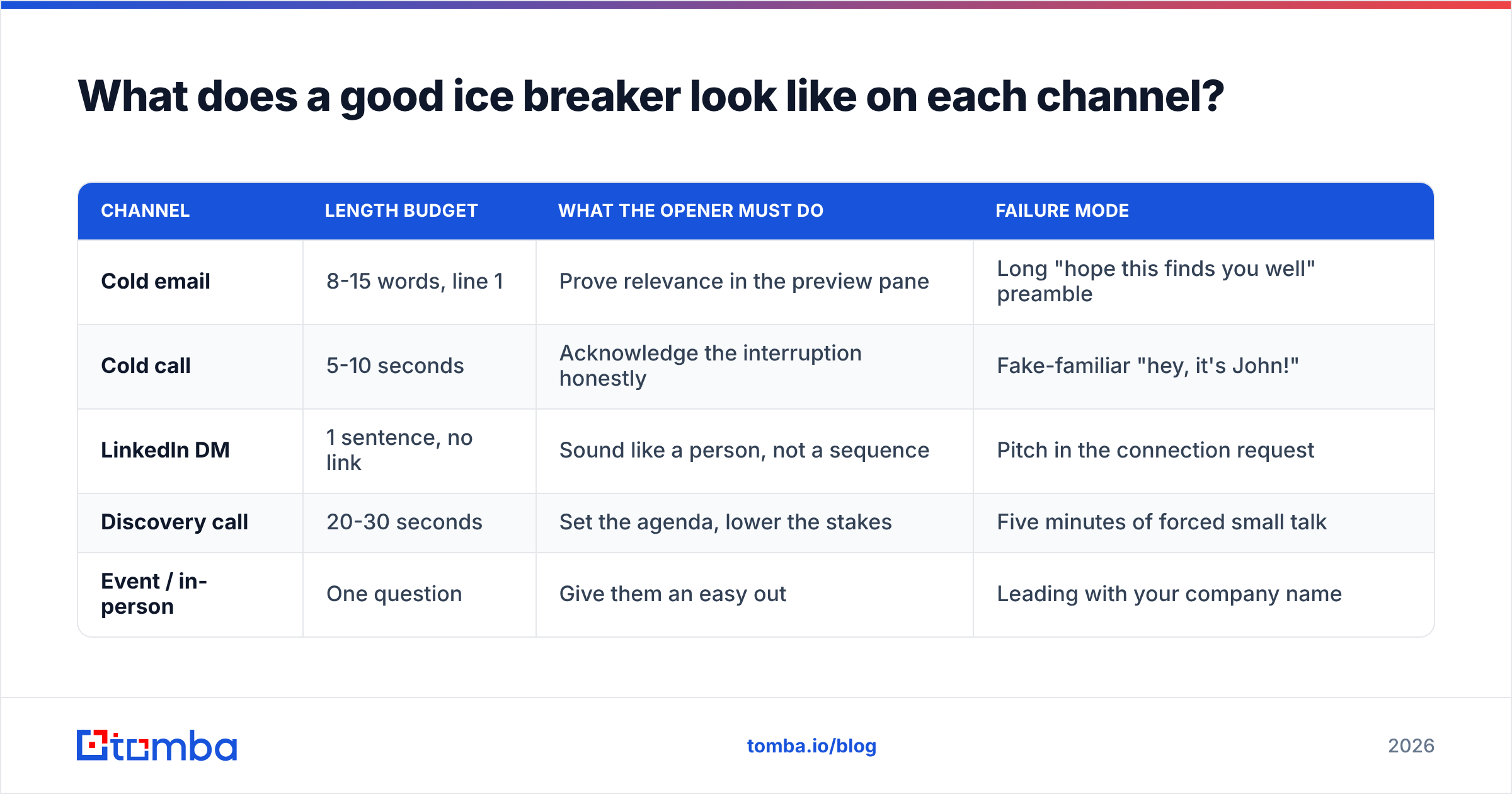
Here's the practical ranking. "Effort to produce" matters as much as raw performance — an opener that takes eight minutes per prospect can't run at 400 touches a week.
| Ice breaker type | Example seed | Typical reply lift | Effort per prospect | Risk of backfire |
|---|---|---|---|---|
| Observation (company signal) | "You're hiring 3 RevOps roles in Q3" | High | 60-90 sec | Low |
| Role/peer reference | "Two other Series B CFOs told me X" | High | 30 sec | Low |
| Trigger event | Funding, exec hire, new office | Medium-high | Automated | Medium (stale data) |
| Content reaction | "Your take on usage pricing — one pushback" | Medium | 3-5 min | Low |
| Mutual connection | "Dan mentioned you own onboarding" | Very high | Varies | High if exaggerated |
| Compliment | "Love what you're building" | Very low | 5 sec | High (reads as filler) |
| Personal life | Marathon, dog, alma mater | Low | 2 min | High (feels invasive) |
| Weather / small talk | "Happy Friday!" | None | 0 | Medium (signals mass send) |
Two rows deserve a note. Mutual connection is the strongest opener in sales and also the easiest to ruin — if "Dan mentioned you" means Dan is a LinkedIn 2nd-degree you've never spoken to, you've burned two relationships instead of one. Only use it when the referral is real and Dan knows you're using his name.
Trigger events score lower than most teams expect because of latency. A funding announcement is a great ice breaker for 10 days and an embarrassment at day 90 ("congrats on the raise!" — that was two quarters ago). Freshness of your data pipeline decides whether this row works for you at all.
What does a good ice breaker look like on each channel?#
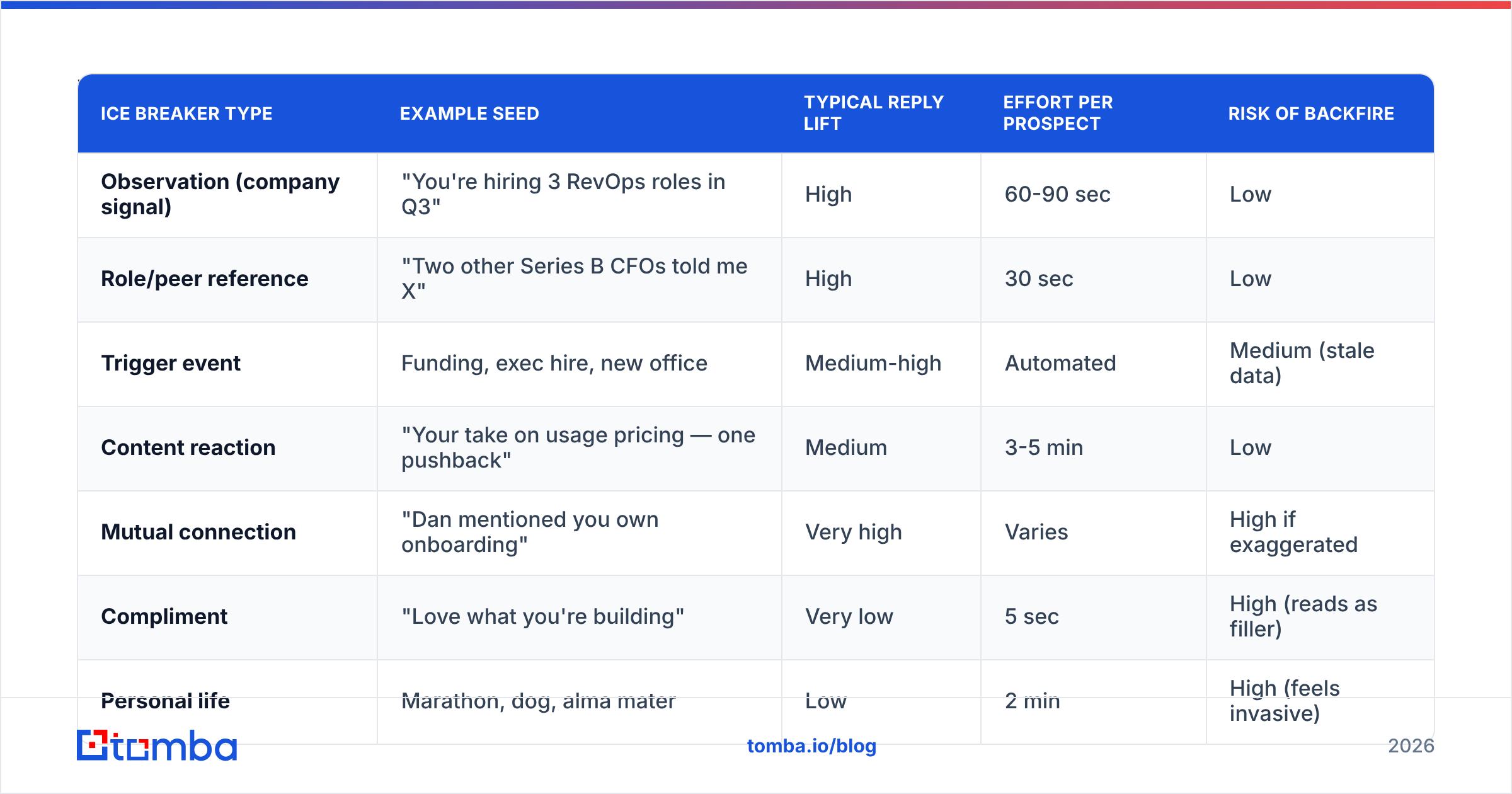
Same principle, four very different executions.
| Channel | Length budget | What the opener must do | Failure mode |
|---|---|---|---|
| Cold email | 8-15 words, line 1 | Prove relevance in the preview pane | Long "hope this finds you well" preamble |
| Cold call | 5-10 seconds | Acknowledge the interruption honestly | Fake-familiar "hey, it's John!" |
| LinkedIn DM | 1 sentence, no link | Sound like a person, not a sequence | Pitch in the connection request |
| Discovery call | 20-30 seconds | Set the agenda, lower the stakes | Five minutes of forced small talk |
| Event / in-person | One question | Give them an easy out | Leading with your company name |
Cold email openers that survive the preview pane#
- "Saw you're hiring two SDRs in Berlin — is that a new motion or backfill?" Specific, answerable, no pitch yet.
- "Your docs still list SOC 2 as 'in progress' — are you handling that in-house?" Observation with a natural business bridge.
- "Quick one: who owns lead routing now that Maria's moved to ops?" Uses a real org change; also qualifies.
- "I'll be direct — cold email. 30 seconds on why I picked you specifically." Radical transparency; performs surprisingly well with technical buyers.
Cold call openers that don't trigger the script#
- "Hi Sarah — you don't know me, I'm calling out of the blue. Can I have 27 seconds?" Permission plus an oddly specific number.
- "I'll be honest, this is a sales call. You can hang up, but I think the reason I called is relevant." Names the elephant.
- "I called because of the warehouse role you posted — is that team standing up new reporting?" Research-first, no pitch.
- "Bad time? I can be quick or I can call back — your call." Gives control, which is what the script defends.
LinkedIn and social openers#
- "Your comment on the pricing thread — the part about grandfathering. Did that actually hold up?" Reacts to a comment, not a post (far rarer, far more flattering).
- "Not pitching. You're the third ops lead this month to mention the same tooling gap — curious if it's real for you too." Peer pattern, no ask.
- "Read your changelog for fun. Ambitious release cadence — who handles QA?" Signals genuine attention.
How do you research an ice breaker in under 90 seconds?#
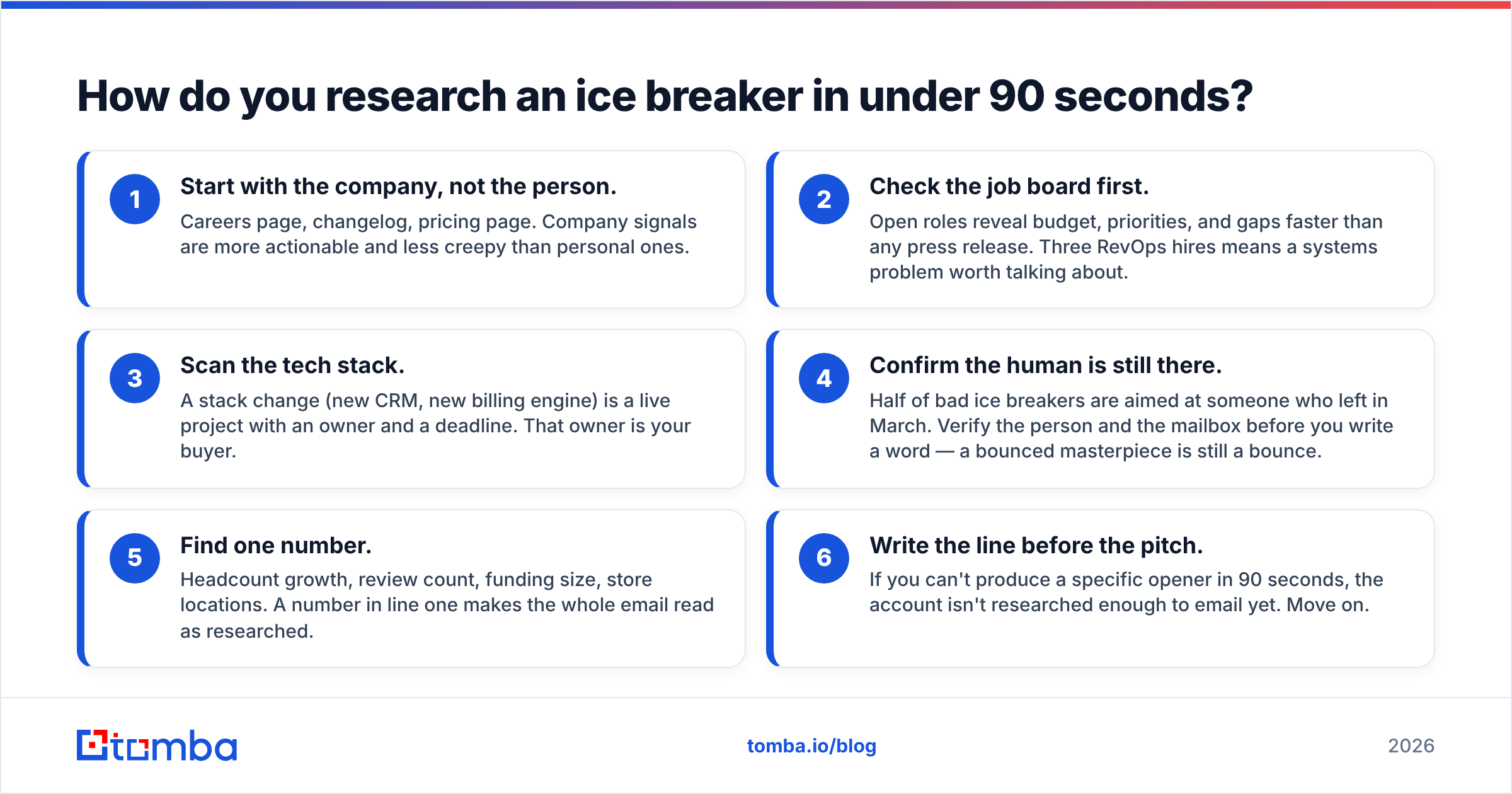
This is the part teams skip, and it's why their openers default to compliments. Here's a repeatable routine that fits in the time between dials.
- Start with the company, not the person. Careers page, changelog, pricing page. Company signals are more actionable and less creepy than personal ones.
- Check the job board first. Open roles reveal budget, priorities, and gaps faster than any press release. Three RevOps hires means a systems problem worth talking about.
- Scan the tech stack. A stack change (new CRM, new billing engine) is a live project with an owner and a deadline. That owner is your buyer.
- Confirm the human is still there. Half of bad ice breakers are aimed at someone who left in March. Verify the person and the mailbox before you write a word — a bounced masterpiece is still a bounce.
- Find one number. Headcount growth, review count, funding size, store locations. A number in line one makes the whole email read as researched.
- Write the line before the pitch. If you can't produce a specific opener in 90 seconds, the account isn't researched enough to email yet. Move on.
Steps 3 and 4 are where most workflows break, because they need data your CRM doesn't have. Running the account through data enrichment to pull role, seniority, and company attributes — then a quick pass through an email verifier — turns a name into a contact you can actually open a conversation with. Providers differ in how they source that data: BookYourData leans on a curated purchased-list model, while Tomba builds from public web sources and verifies at query time. Both are legitimate approaches; what matters is that your ice breaker is grounded in something true today.
What makes an ice breaker fail?#
Five patterns account for nearly every dead opener I see in sequence audits.
It flatters instead of informs. "Huge fan of what you're building at Acme" is unfalsifiable. Any sender could write it to any company. Unfalsifiable equals worthless.
It's personal in the wrong direction. Referencing someone's kid's school, their neighborhood, or their vacation photos reads as surveillance. The line is roughly: professional public artifacts are fair game, personal life is not.
It's stale. Congratulating a promotion from 14 months ago tells the prospect your data is old, which tells them your product decisions probably are too.
It's too long. A four-sentence opener means the prospect reaches your ask in paragraph three. On mobile, they never get there.
It doesn't connect. The best-researched ice breaker in the world fails if the next line is a hard pivot: "You're hiring 3 SDRs! Anyway, we do payroll software." The opener has to lead into the reason you're writing. If it doesn't, cut it and open with the reason instead.
There's a sixth, quieter failure: the ice breaker is great and the email never arrives. Deliverability problems and stale addresses kill more good openers than bad copy does. If your bounce rate is above 3%, fix the list before you touch the script — start with the free email checker on a sample of 50 before committing a whole campaign.
How do you scale ice breakers without sounding like a bot?#
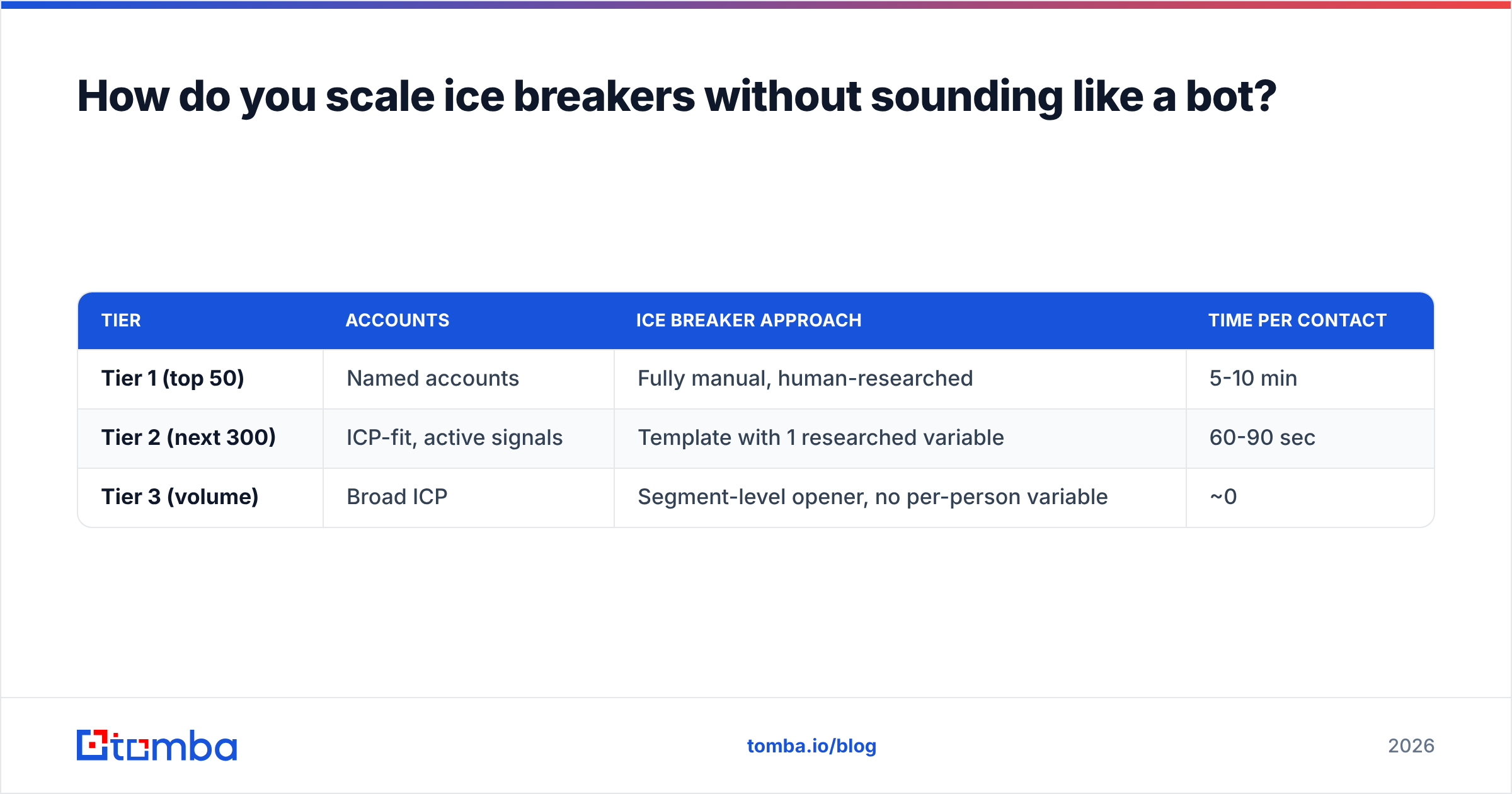
Use tiers instead of trying to hand-write everything.
| Tier | Accounts | Ice breaker approach | Time per contact |
|---|---|---|---|
| Tier 1 (top 50) | Named accounts | Fully manual, human-researched | 5-10 min |
| Tier 2 (next 300) | ICP-fit, active signals | Template with 1 researched variable | 60-90 sec |
| Tier 3 (volume) | Broad ICP | Segment-level opener, no per-person variable | ~0 |
The critical insight: Tier 3 should not attempt personalization at all. A segment-level opener ("Every ops lead I talk to at 200-person fintechs is fighting the same reconciliation problem") is honest, relevant, and scales infinitely. A fake-personal opener at Tier 3 ("Loved your recent post!") is worse than no opener, because it announces the automation.
For Tier 2, build one variable slot and fill it from structured data — hiring signal, tool detected, headcount band — rather than from free-text scraping. Structured variables fail gracefully. Free-text variables fail hilariously, and your prospect screenshots it.
Also: send from a real person, reply from a real person, and keep the sequence short. Ice breaker quality and response rate both collapse once a prospect realizes they're in step four of an eight-step machine.
How do you measure ice breaker performance?#
Test openers the way you test subject lines: one variable, big enough samples, and the right success metric.
- Sample size: minimum 100 sends or 60 dials per variant. Below that you're reading noise.
- Primary metric: positive reply rate, not raw reply rate. "Unsubscribe" is a reply.
- Secondary metric on calls: seconds-to-hangup. A better ice breaker buys time even when it doesn't book.
- Control for list quality: run variants across the same segment in the same week, or list differences will masquerade as copy differences.
- Kill fast: if a variant is 40% below control after 150 sends, retire it. Don't nurse it.
One more thing worth tracking: how often your opener gets quoted back. When prospects reply with "yes, we are hiring for that role — how'd you know?", you've found an opener worth cloning across the segment. That's the signal that your research routine, not your wording, is doing the work.
Where should you start tomorrow?#
Pick your 50 highest-fit accounts. Spend 90 seconds each on the routine above. Write one observation-based opener per account, send them Tuesday, and compare against whatever your sequence is running now. You'll know within a week.
The research is only as good as the contact data underneath it. If you're guessing at addresses or working from a list that hasn't been touched in a year, your best ice breaker never gets read. Use the Tomba Email Finder to get verified, current addresses for the people you actually researched — free tier includes 25 searches a month, and paid plans start at $49/mo on the Starter tier. See Tomba pricing for the full breakdown. Get the list right, then let the opener do its job.
Related guides#
// get started
Find, verify and enrich your first contacts today
Start on the free plan with 25 searches a month, then scale when your team is ready.
Free plan · No credit card required · GDPR & CCPA
Get the Tomba newsletter
Product and data updates
// about the author