What Is an ICP? Ideal Customer Profile Guide for 2026
An ICP is not a persona, and it is not your TAM. Here is how to build an ideal customer profile from closed-won data, score accounts against it, and kill the outbound that never had a chance.
Your ideal customer profile is the filter that decides which accounts get your reps' time. Get it wrong and everything downstream — messaging, channel, pricing — points at the wrong companies.
TL;DR
- An ideal customer profile (ICP) describes the company you should sell to. A buyer persona describes the human inside it. Confusing the two is the most common reason outbound underperforms.
- Build your ICP from closed-won and closed-lost data, not from a whiteboard workshop. Ten to thirty of your best accounts hold almost everything you need.
- A useful ICP has four layers: firmographic, technographic, behavioral, and economic. Two layers is a wish list. Four layers is a filter you can query.
- Score accounts 0-10 against the ICP and route by tier. Tier 1 gets human research. Tier 3 gets a nurture sequence. Anything under the cutoff never enters a sequence.
- Refresh quarterly. Your ICP decays the moment your pricing, product, or market shifts — and in 2026 all three shift faster than your CRM fields do.
What is an ideal customer profile, exactly?#
An ideal customer profile is a written description of the type of company that gets the most value from your product, fastest, at the lowest cost to serve. Those are the accounts that renew and expand.
Think of it like a fishing license that names one lake. It doesn't tell you which fish to cast at or what bait to use. It tells you which body of water to stand in. Everything downstream — persona targeting, messaging, channel choice, pricing — comes after you've picked the lake.
A complete ideal customer profile answers five questions about an account:
- Who they are — industry, employee count, revenue band, geography, funding stage, business model (self-serve, enterprise sales, marketplace).
- What they run — the tech stack, integrations, and tooling that make your product plug in cleanly or make it dead on arrival.
- What they're doing right now — hiring signals, a new VP, funding, a website relaunch, a compliance deadline. Timing is what separates a good-fit account from one that will actually buy this quarter.
- What they're worth — expected ACV, gross margin, support load, and expansion path. A 5,000-employee logo that needs six months of custom onboarding can be a worse fit than a 60-person team that self-serves.
- Why they leave — the churn tells. If accounts under 25 employees churn at 4x your average, "under 25 employees" is an anti-ICP attribute and belongs in the doc.
Notice that only the first item is firmographic. Most teams stop there. They publish a slide that says "B2B SaaS, 50-500 employees, North America" and call it an ICP. That's a market segment, not a profile. Roughly 90,000 companies match it, and you have no way to rank them.
What is the difference between an ideal customer profile, a persona, and a TAM?#
These three get used interchangeably in the same sales meeting. That is how a rep ends up prospecting a perfect-fit persona at a company that will never buy.
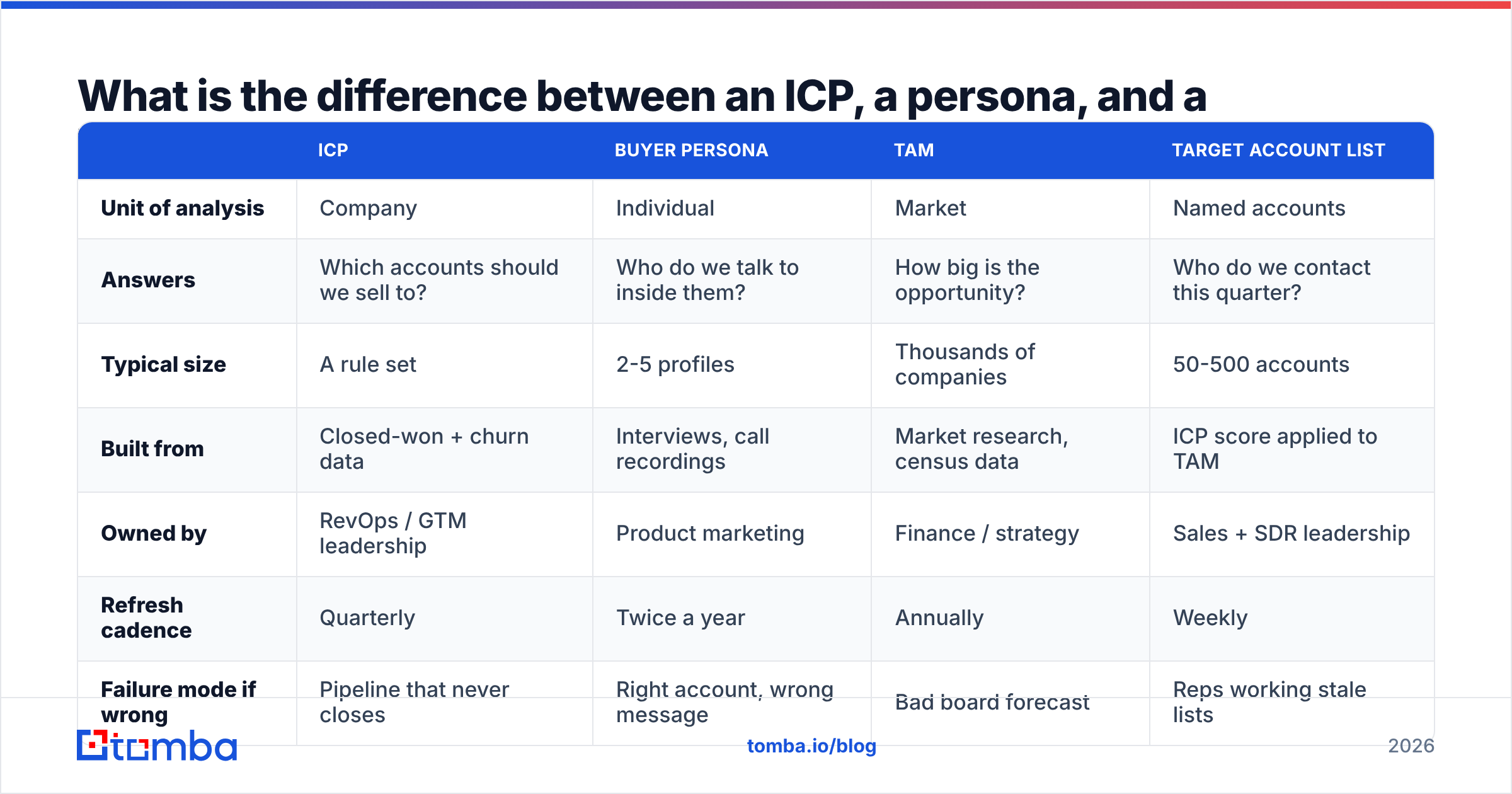
| ICP | Buyer persona | TAM | Target account list | |
|---|---|---|---|---|
| Unit of analysis | Company | Individual | Market | Named accounts |
| Answers | Which accounts should we sell to? | Who do we talk to inside them? | How big is the opportunity? | Who do we contact this quarter? |
| Typical size | A rule set | 2-5 profiles | Thousands of companies | 50-500 accounts |
| Built from | Closed-won + churn data | Interviews, call recordings | Market research, census data | ICP score applied to TAM |
| Owned by | RevOps / GTM leadership | Product marketing | Finance / strategy | Sales + SDR leadership |
| Refresh cadence | Quarterly | Twice a year | Annually | Weekly |
| Failure mode if wrong | Pipeline that never closes | Right account, wrong message | Bad board forecast | Reps working stale lists |
The chain runs in one direction: TAM → ICP → target account list → persona. Your TAM is the pond. Your ideal customer profile is the filter. Your account list is what survives the filter. Your persona shapes the words you use once you're inside. Skip a link and the whole thing wobbles. Gartner's sales research has shown for years that B2B buying groups now average six to ten stakeholders. That is exactly why persona work has to happen after account selection, not instead of it.
Why do most ideal customer profiles fail?#
Four reasons, in order of how often you'll see them.
They're built from opinion, not evidence. A workshop produces the accounts the leadership team wishes they sold to. Your CRM holds the accounts you actually close. When those two disagree, the CRM is right.
They describe the buyer, not the account. "VP of Marketing at a fast-growing company who cares about efficiency" is a persona wearing an ICP costume. You can't query a database for "cares about efficiency."
They have no exclusion criteria. A profile that only says yes is half a profile. Name what disqualifies an account — under 10 employees, no in-house dev team, agencies, regions you can't support. That saves more money than any inclusion rule.
They never get enforced. The doc exists, and reps still work whatever list they can pull. If your ICP isn't wired into lead routing, scoring, and SDR quota credit, it's a PDF, not a strategy.
How do you build an ideal customer profile from your own data?#
Five steps. Budget a week, not a quarter.
- Pull your best 20-30 accounts. Not your biggest — your best. Rank closed-won accounts by retention past 18 months, gross margin, expansion revenue, and time-to-value. The top decile is your evidence base.
- Pull the mirror set. Take 20-30 churned or closed-lost accounts and run the same attribute extraction on them.
- Extract attributes across all four layers. Firmographic, technographic, behavioral, and economic.
- Find the attributes with separation. Keep anything where the win set and the loss set diverge by 2x or more.
- Write it as a query, not a paragraph. The final artifact has to be executable.
The mirror set is what makes this evidence instead of a wish list. Attributes that show up in the win set and not the loss set are your real signal. Anything present in both is noise, however intuitive it feels.
The four layers, in short: firmographic (size, industry, geo, funding), technographic (CRM, cloud provider, payment stack, marketing automation), behavioral (hiring velocity, product-usage triggers, content consumption), and economic (ACV, CAC payback, support tickets per seat).
In practice, five to nine attributes matter and the rest don't. Resist the extras. Every added criterion shrinks your addressable list without improving fit.
Step five looks like this: employees 50-500 AND industry IN (SaaS, fintech) AND uses HubSpot OR Salesforce AND NOT agency AND hq_country IN (US, CA, UK, DE). If a RevOps analyst can't turn your ideal customer profile into a filter in your B2B database or CRM, it isn't finished.
That last point is where most ICP projects quietly die. A profile written in prose gets read differently by every rep. A profile written as a boolean gets applied the same way to every record.
What does a real ideal customer profile scorecard look like?#
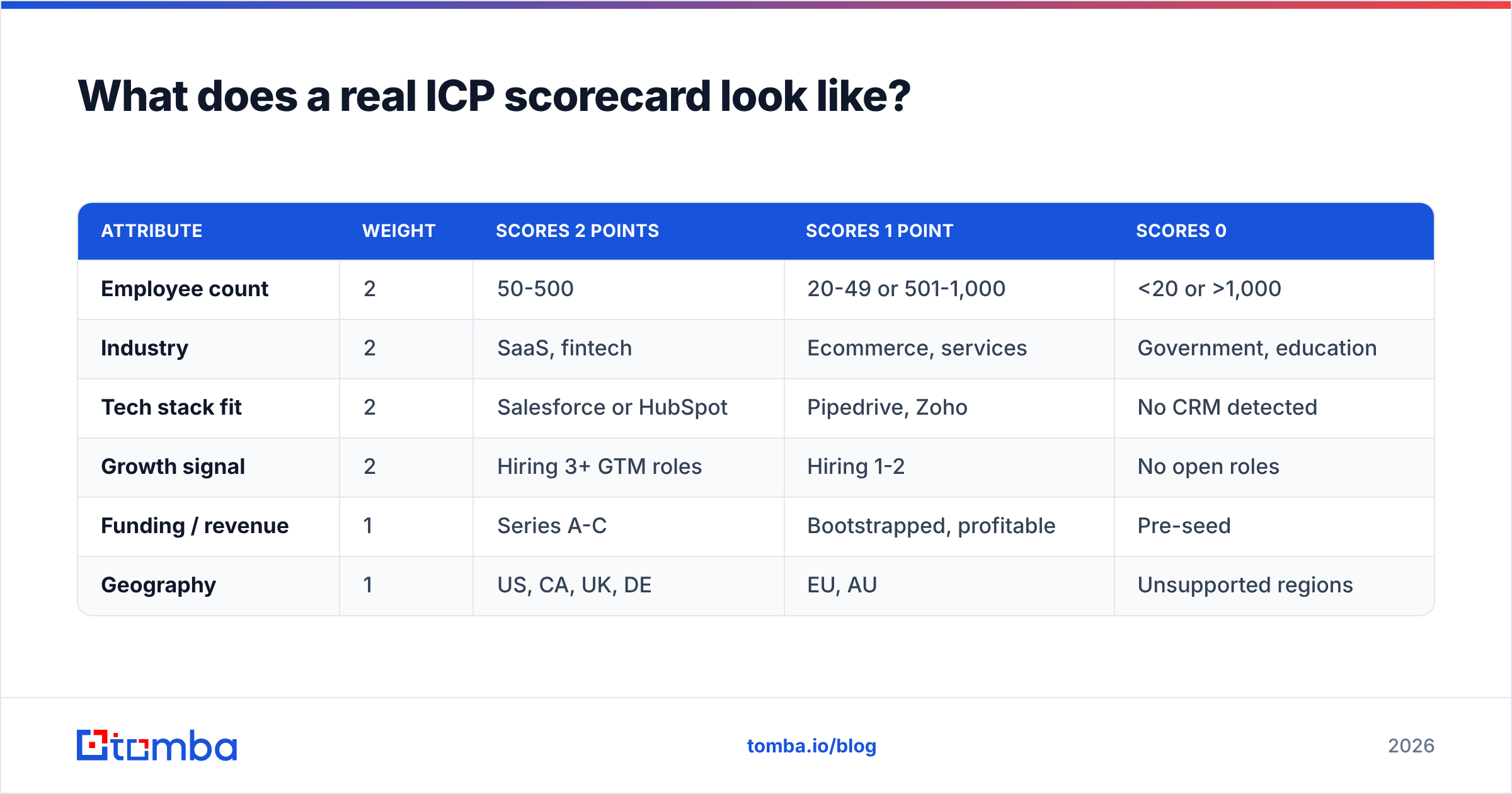
Once the attributes are set, turn them into weighted points so any account can score 0-10. Weights should reflect how strongly each attribute separated wins from losses in step 4.
| Attribute | Weight | Scores 2 points | Scores 1 point | Scores 0 |
|---|---|---|---|---|
| Employee count | 2 | 50-500 | 20-49 or 501-1,000 | <20 or >1,000 |
| Industry | 2 | SaaS, fintech | Ecommerce, services | Government, education |
| Tech stack fit | 2 | Salesforce or HubSpot | Pipedrive, Zoho | No CRM detected |
| Growth signal | 2 | Hiring 3+ GTM roles | Hiring 1-2 | No open roles |
| Funding / revenue | 1 | Series A-C | Bootstrapped, profitable | Pre-seed |
| Geography | 1 | US, CA, UK, DE | EU, AU | Unsupported regions |
Then route by tier rather than treating every scoring account the same:
- 8-10 — Tier 1. Manual research, multithreaded outreach across three to five contacts, custom first line, AE involved from touch one.
- 6-7 — Tier 2. Templated-but-relevant sequence, two contacts per account, SDR owns end-to-end.
- 4-5 — Tier 3. Nurture and content only. No SDR capacity. Revisit if a trigger event fires.
- 0-3 — out. Do not sequence. Do not buy data on them. This is the tier that saves your budget.
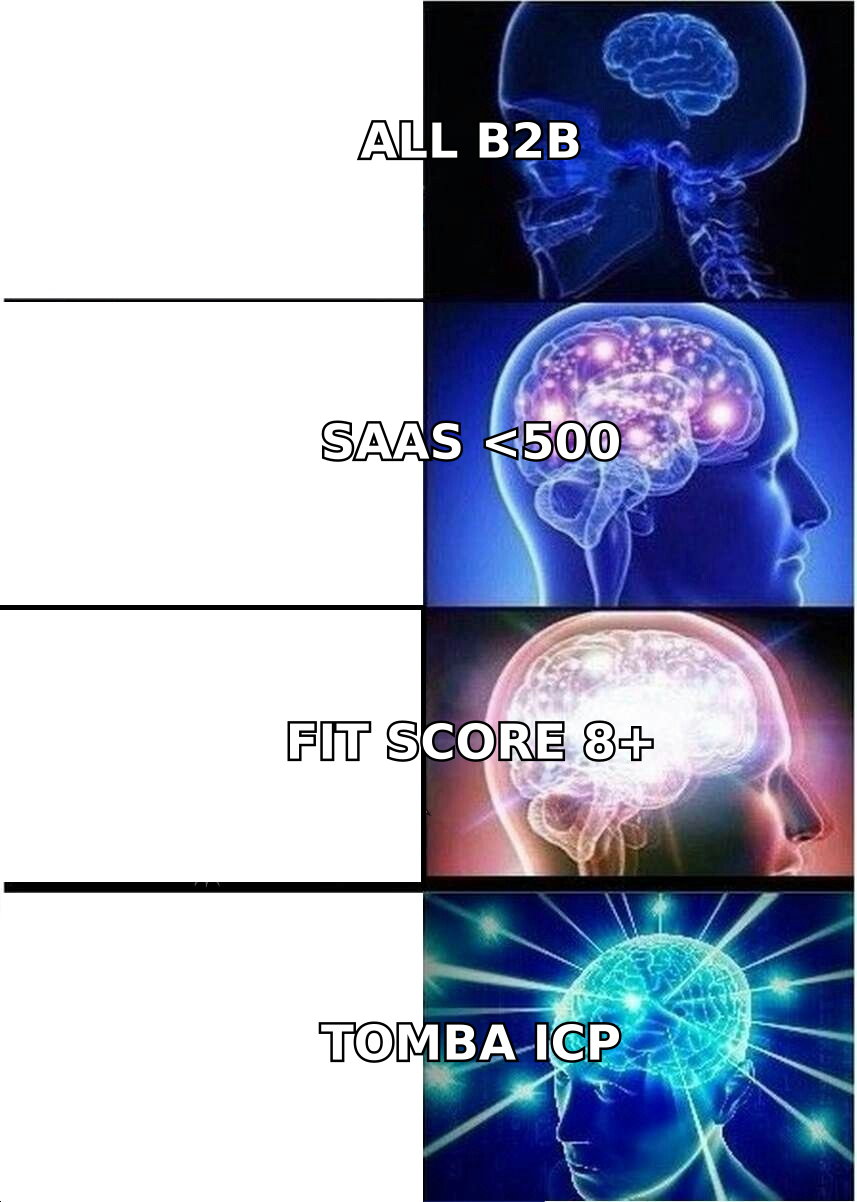
The discipline is in that last row. Most teams will happily accept a 3-scoring account into a sequence because "it's only an email." It isn't only an email. It's a deliverability cost, a bounce risk, and an hour of SDR time that Tier 1 didn't get.
Which data sources fill an ideal customer profile?#
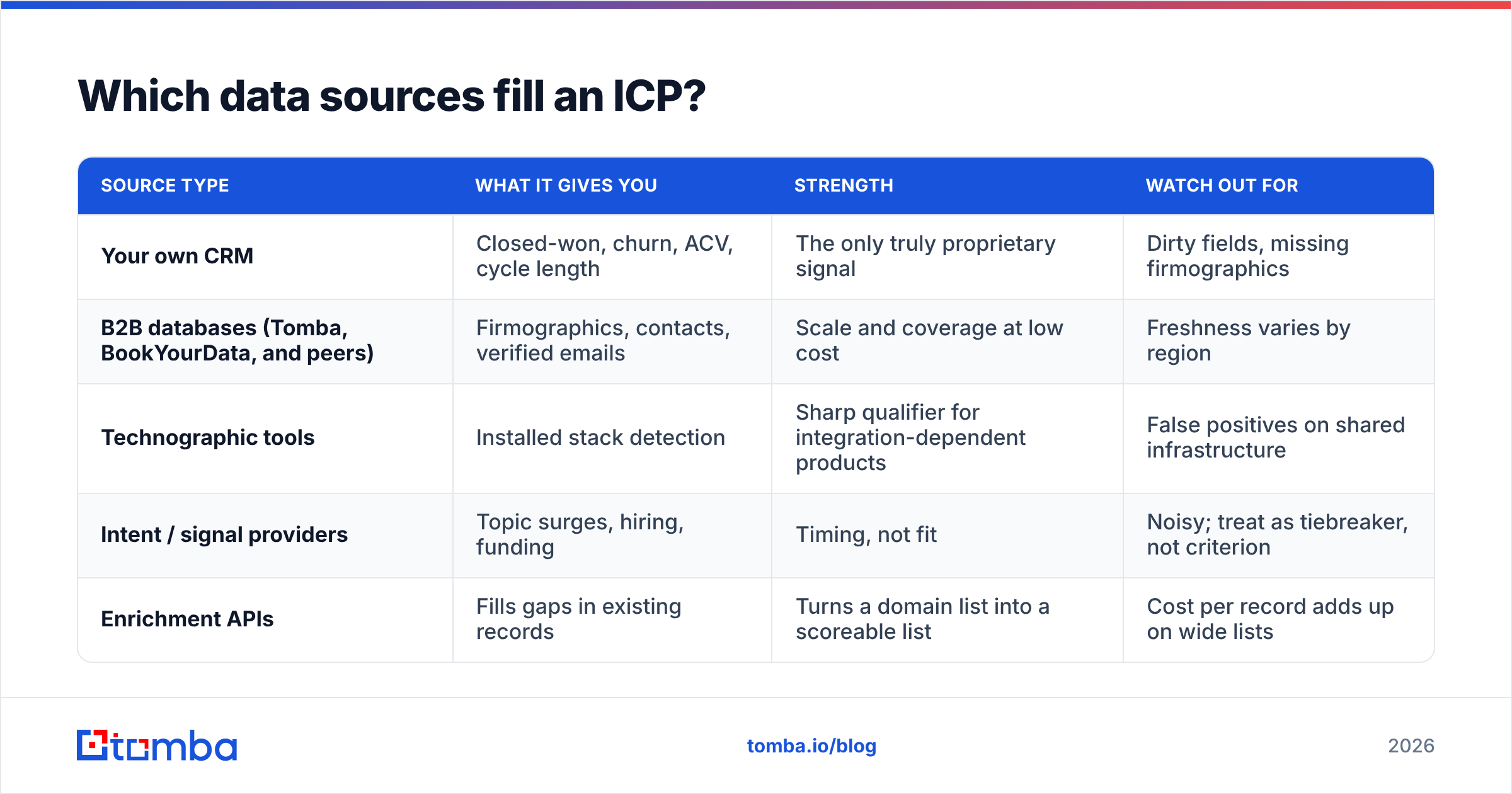
You need three categories of data, and no single vendor does all three well. Here's how the common options break down:
| Source type | What it gives you | Strength | Watch out for |
|---|---|---|---|
| Your own CRM | Closed-won, churn, ACV, cycle length | The only truly proprietary signal | Dirty fields, missing firmographics |
| B2B databases (Tomba, BookYourData, and peers) | Firmographics, contacts, verified emails | Scale and coverage at low cost | Freshness varies by region |
| Technographic tools | Installed stack detection | Sharp qualifier for integration-dependent products | False positives on shared infrastructure |
| Intent / signal providers | Topic surges, hiring, funding | Timing, not fit | Noisy; treat as tiebreaker, not criterion |
| Enrichment APIs | Fills gaps in existing records | Turns a domain list into a scoreable list | Cost per record adds up on wide lists |
A practical stack: score your existing CRM records first, for free. Then enrich the gaps with contact enrichment so every account has the fields your scorecard needs. Only then use domain search to pull contacts for the Tier 1 and Tier 2 accounts that survived scoring. Buying contacts before scoring is the classic sequencing error. You pay for data on accounts you'd have disqualified for free.
Reviews on G2 are useful for gauging data freshness by region before you commit budget. Coverage in DACH or LATAM often differs sharply from a vendor's North American numbers.
How do you know your ideal customer profile is working?#
Four metrics, tracked as a segment split between in-ICP and out-of-ICP accounts:
- Win rate delta. In-ICP deals should close at least 1.5x as often as out-of-ICP deals. If they don't, your profile isn't separating anything.
- Sales cycle length. Good fit shortens cycles, usually by 20-40%. A profile that produces equal-length cycles is describing your average customer, not your ideal one.
- Net revenue retention. The real test. ICP accounts should retain and expand measurably better at the 12-month mark.
- Reply-to-meeting conversion. Fit shows up early. If your Tier 1 response rate isn't beating Tier 3 by a wide margin, your weights are off.
HubSpot's research on ideal customer profiles makes the same point from the marketing side: the value of the profile is measured in what it excludes, not what it includes. And if you want the underlying theory, ICP work is applied market segmentation. The difference is that B2B segments are small enough to name every account inside them.
How often should you refresh your ideal customer profile?#
Quarterly review, annual rebuild.
The quarterly pass is cheap. Re-run the win/loss attribute comparison on the last 90 days of closed deals, then check whether any weight has drifted. If a new attribute shows 2x separation — say, accounts that adopted a specific integration — add it and reweight.
The annual rebuild is the serious one. Force it whenever any of these fire:
- You changed pricing or packaging.
- You shipped a feature that opens a new segment, or closes one off.
- A competitor repositioned into your space.
- Your churn profile shifted, with new reasons appearing in exit interviews.
- You entered a new geography.
An ICP that hasn't changed in two years isn't stable, it's unmaintained. Teams running structured revenue operations usually put the review on the same cadence as territory planning, so the account lists get rebuilt in the same motion.
What should you do first if you have no ideal customer profile today?#
Start with the cheapest possible version and improve it. This week:
- Export your last 50 closed-won accounts and your last 50 closed-lost.
- Add employee count, industry, and country to each. Enrich the blanks rather than guessing.
- Find the three attributes with the biggest gap between the two sets.
- Write those three as a filter and score your current pipeline against them.
- Look at how much of your active pipeline scores below the cutoff. That number is your case for doing the full exercise.
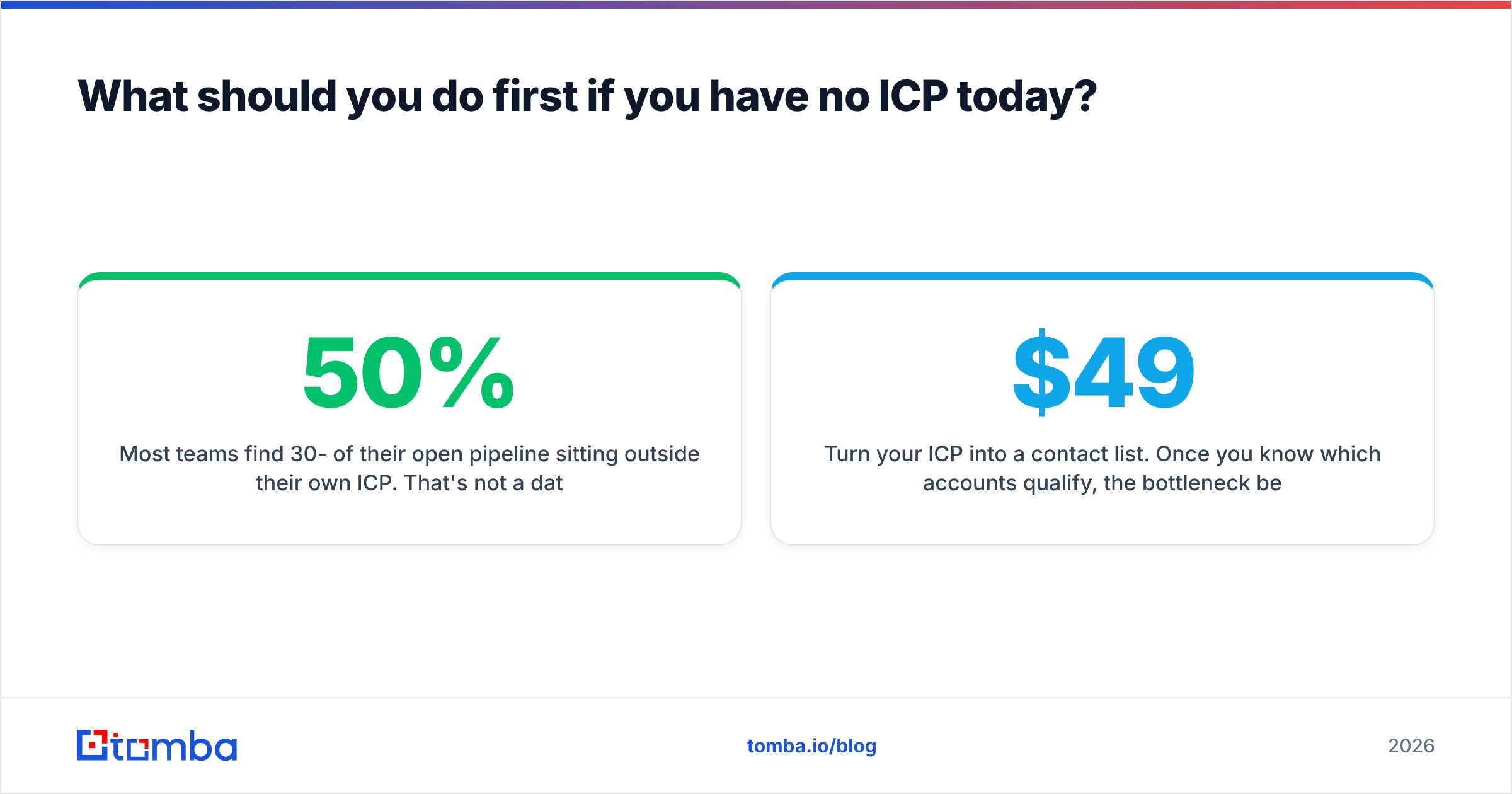
Most teams find 30-50% of their open pipeline sitting outside their own ICP. That's not a data problem. It's a targeting problem, and a scorecard fixes it in a quarter.
Turn your ICP into a contact list. Once you know which accounts qualify, the bottleneck becomes reaching the right people inside them. Tomba's Email Finder pulls verified professional email addresses by domain, name, or company. You go from a scored account list to a working outbound list without paying for contacts at accounts you already disqualified. Start free with 25 searches a month. Paid plans open at $49/mo on Starter and $99/mo on Growth if you're running enrichment at volume, and full Tomba pricing is public.
Related guides#
// get started
Find, verify and enrich your first contacts today
Start on the free plan with 25 searches a month, then scale when your team is ready.
Free plan · No credit card required · GDPR & CCPA
// about the author