ICP ABM in 2026: How to Build Both Without Wasting Budget
Most ABM programs fail because the ICP underneath them is a slide, not a data filter. Here is how to build an ICP that actually feeds account-based marketing — with tiers, data sources, and a scoring model you can run this quarter.
TL;DR — what a working ICP ABM program needs
- An ICP is a filter, not a persona slide. If you cannot express it as a query against firmographic, technographic, and intent fields, it is not operational.
- ABM without a tested ICP is just expensive spray-and-pray with nicer creative — you spend Tier-1 budget on Tier-3 accounts.
- Tier your target account list (roughly 30-50 Tier 1, 150-300 Tier 2, 1,000+ Tier 3) and match spend to tier. One-to-one plays on a Tier-3 account destroy your CAC.
- Contact coverage is the silent killer: a named account you cannot reach is a rounding error. Aim for 4-8 verified contacts per Tier-1 account before launch.
- Review the ICP quarterly against closed-won and churned data. Most ICPs drift within two quarters of a pricing or product change.
What is the difference between an ICP and ABM?#
Your ICP answers who is worth selling to. ABM answers how you sell to them. One is a definition; the other is a motion. Teams mix them up all the time. That confusion is where six-figure programs go to die.
Think of it like fishing. Your ICP is the decision that you are fishing for tuna in the North Atlantic in August — species, water, season. ABM is the boat, the crew, the sonar, and the bait. A world-class crew fishing in a drained pond catches nothing. That is the whole ICP ABM story. Most failures start when teams ignore that split.
Technically: an Ideal Customer Profile is a set of account-level traits — industry, employee count, revenue band, tech stack, geography, funding stage, growth signals. Those traits track with high win rates, big deals, fast closes, and low churn. An ICP describes companies, not people. Buyer personas describe people, and they sit one layer down.
Account-Based Marketing is a go-to-market motion. Sales and marketing treat named accounts as markets of one (or of a hundred, by tier). They line up ads, outbound, events, and content against one shared account list. ITSMA coined the term in 2004. The tools caught up around 2016. In most teams, the practice still has not.
Here is the test. If someone asks for your ICP and you send a slide with a smiling stock photo named "Marketing Mary," you have a persona, not an ICP. If you send a filter — industry IN (SaaS, fintech) AND employees BETWEEN 50 AND 500 AND uses(Salesforce) AND raised_series_a_within_18_months — you have an ICP.
Why do most ABM programs fail before the first ad runs?#
Four failure modes, in order of how often I see them.
- The ICP was written by committee, not drawn from data. Someone in a room guessed "mid-market SaaS" because that is what the last company sold to. Nobody queried closed-won.
- The account list has no tiers. Every account gets the same treatment. So Tier-1 accounts get too little, or Tier-3 accounts get one-to-one budget they will never repay.
- Contact coverage was never checked. The list has 400 logos and 90 reachable humans. Ads run. Nobody follows up. The numbers look terrible.
- No exit rule. Accounts sit in the program for 14 months. Nobody ever defined what "this account is not going to buy" looks like.
The third one matters most. It is the easiest to fix and the most ignored. Forrester's research on ABM finds that buying groups in big deals now run to 6-10 people. Say your account record holds one gatekeeper email, scraped 18 months ago. Then your ICP ABM program is really contact-based with extra steps.
Before you spend on ABM creative, run a coverage audit. For each Tier-1 account, how many verified, role-relevant contacts do you hold? If the median is below four, fix that first. A domain search across your target list will tell you in an afternoon what your CRM has been hiding for a year.
How do you build an ICP that ABM can actually use?#
Six steps. Do them in order. Skip step one and you get the committee ICP.
- Pull your closed-won cohort. Minimum 30 deals, ideally 100+. Include ACV, sales cycle length, and 12-month retention. If you have fewer than 30, use your best 10 and label the ICP a hypothesis, not a definition.
- Pull your churned and closed-lost-for-fit cohort. This is the half everyone skips. Negative traits tell you more than positive ones. You learn faster from "companies under 20 employees churn at 60%" than from "SaaS companies buy."
- Find the separating attributes. Compare the two groups field by field: employee band, industry, tech stack, funding, region, and the team that champions you. Keep only the fields where the two groups really split. Most teams end up with 5-9 of them.
Steps four to six turn that analysis into a filter the team can run.
- Express it as a query. Write it in the syntax your data vendor or CRM uses. If you cannot run it, nobody will enforce it.
- Size the resulting market. Run the filter against a B2B database and count. If it returns 40 companies, your ICP is too narrow to build a program on. If it returns 400,000, it is too loose to tier.
- Score and tier. Assign weights, then cut the list into tiers by score. Details below.
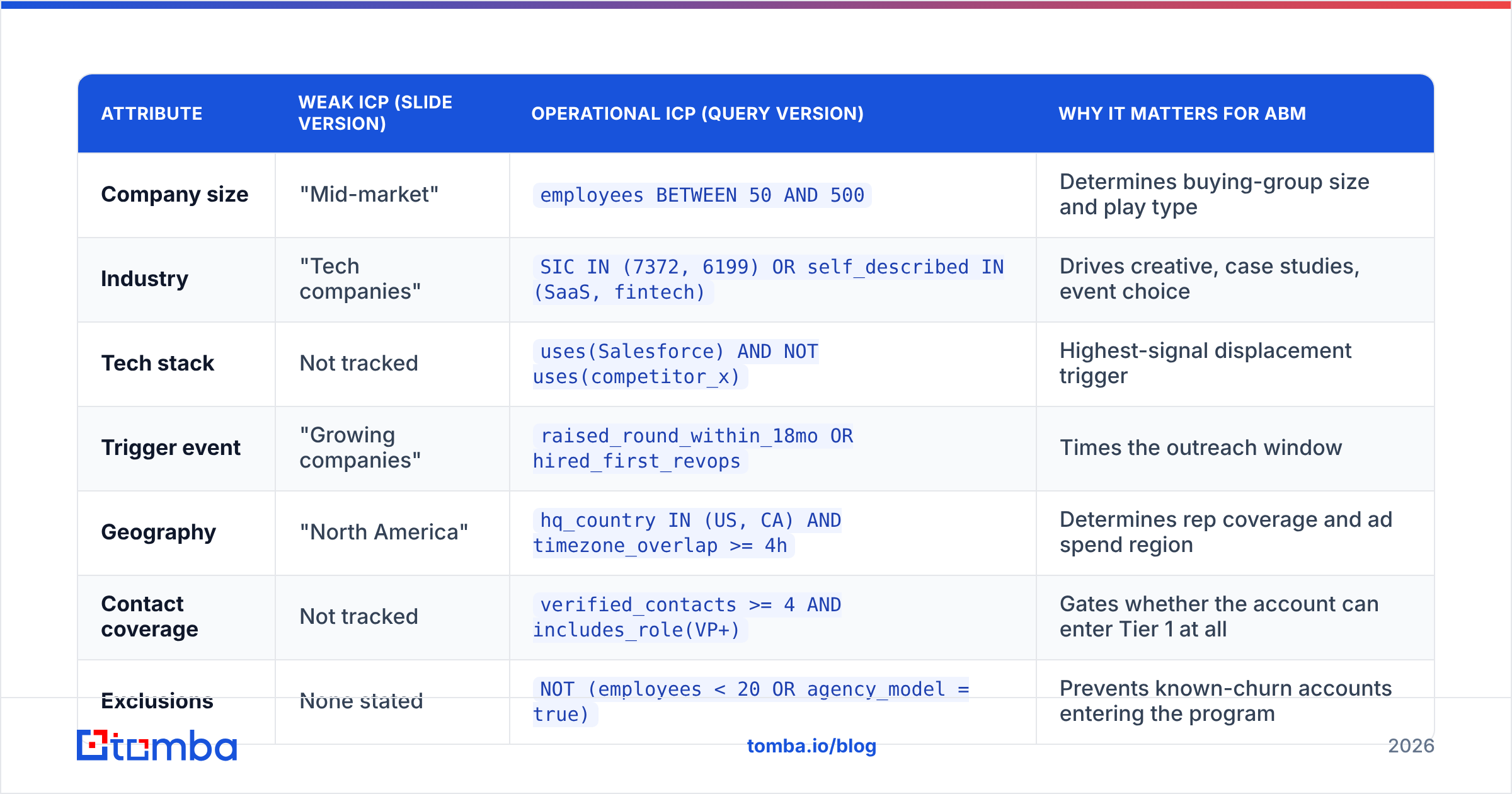
Here is what a working attribute set looks like versus the version that gets nodded through in a QBR:
| Attribute | Weak ICP (slide version) | Operational ICP (query version) | Why it matters for ABM |
|---|---|---|---|
| Company size | "Mid-market" | employees BETWEEN 50 AND 500 |
Determines buying-group size and play type |
| Industry | "Tech companies" | SIC IN (7372, 6199) OR self_described IN (SaaS, fintech) |
Drives creative, case studies, event choice |
| Tech stack | Not tracked | uses(Salesforce) AND NOT uses(competitor_x) |
Highest-signal displacement trigger |
| Trigger event | "Growing companies" | raised_round_within_18mo OR hired_first_revops |
Times the outreach window |
| Geography | "North America" | hq_country IN (US, CA) AND timezone_overlap >= 4h |
Determines rep coverage and ad spend region |
| Contact coverage | Not tracked | verified_contacts >= 4 AND includes_role(VP+) |
Gates whether the account can enter Tier 1 at all |
| Exclusions | None stated | NOT (employees < 20 OR agency_model = true) |
Prevents known-churn accounts entering the program |
That last row is the one that separates teams who have run ABM before from teams who are about to. Explicit exclusions save more money than any targeting refinement.
How should you tier target accounts?#
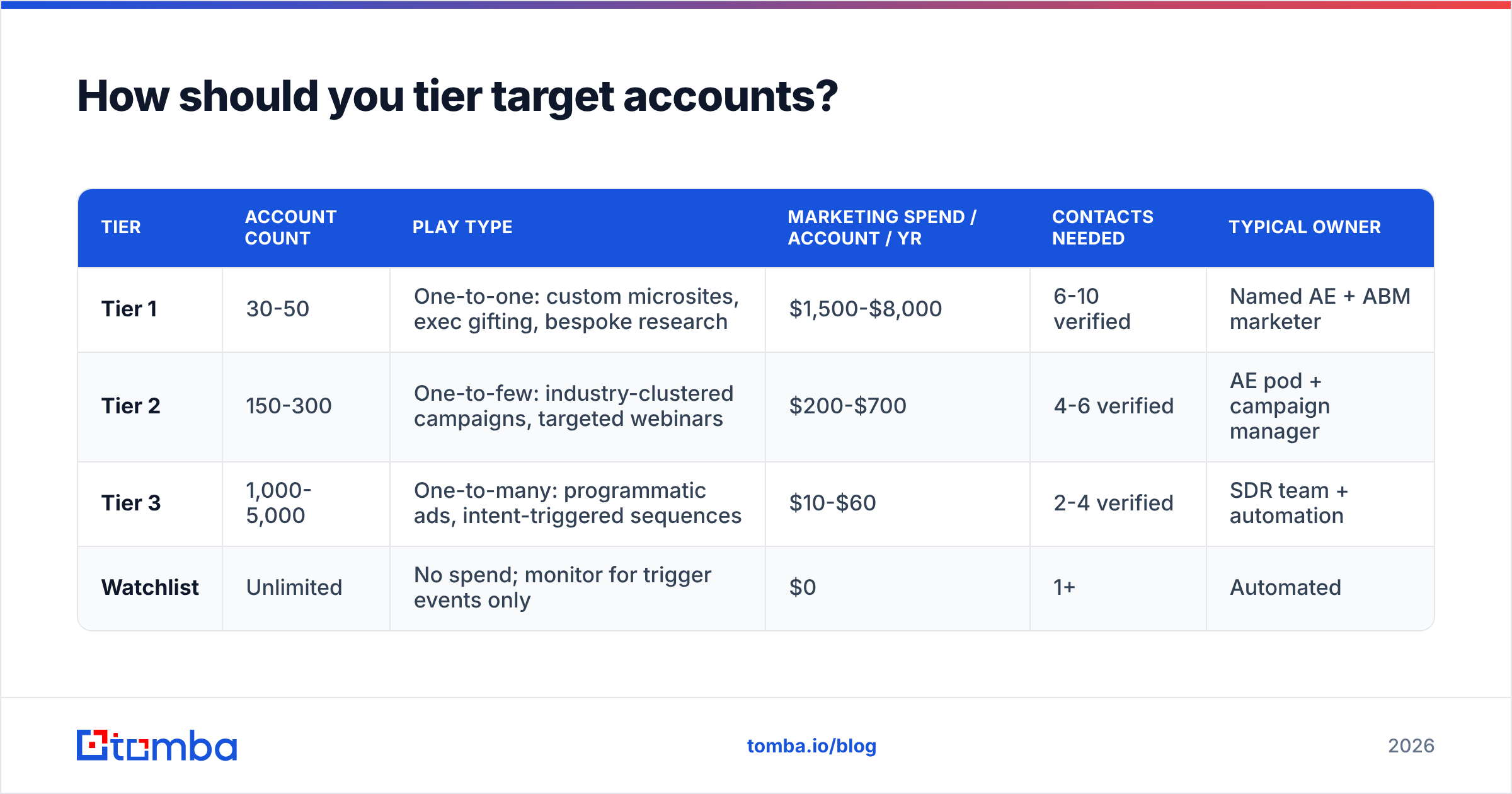
Tiering is budget planning dressed as segmentation. The tier decides how much human time an account gets. Human time is the scarcest thing you have.
| Tier | Account count | Play type | Marketing spend / account / yr | Contacts needed | Typical owner |
|---|---|---|---|---|---|
| Tier 1 | 30-50 | One-to-one: custom microsites, exec gifting, bespoke research | $1,500-$8,000 | 6-10 verified | Named AE + ABM marketer |
| Tier 2 | 150-300 | One-to-few: industry-clustered campaigns, targeted webinars | $200-$700 | 4-6 verified | AE pod + campaign manager |
| Tier 3 | 1,000-5,000 | One-to-many: programmatic ads, intent-triggered sequences | $10-$60 | 2-4 verified | SDR team + automation |
| Watchlist | Unlimited | No spend; monitor for trigger events only | $0 | 1+ | Automated |
Two rules that keep this honest.
Rule one: an account cannot enter Tier 1 without contact coverage. No exceptions. A Tier-1 play costs thousands of dollars and dozens of hours. Running it against an account where you know one person is arson. Verify first, promote second. Use an email verifier to check that the contacts are live before you promote the account, not after the campaign flops.
Rule two: tiers are quarterly, not permanent. Accounts get demoted. Say a Tier-1 account shows zero engagement for two quarters and no trigger event fires. It moves to Tier 2, and the budget follows. Programs that never demote pile up dead weight until the whole thing looks broken.
What data do you actually need per account?#
Three layers, and most teams only buy the first.
Firmographic — employee count, revenue, industry, HQ, subsidiaries. Cheap, easy to buy, and slow to decay. This is table stakes. It is also where most data budgets get spent.
Technographic — what they run. This is the best signal for displacement plays and integration angles. It decays medium-fast, so re-check it each quarter.
Contact-level — named humans, verified email, role, seniority, LinkedIn, phone. This layer decays fastest. Roughly 25-30% of B2B contact data goes stale each year as people change jobs. It is also the layer that decides whether you can reach the account at all.
Intent and trigger — hiring signals, funding, tech changes, content reads, site visits. These go stale within weeks. Use them for timing, never for targeting on their own. Intent without ICP fit is how you end up pitching students and rivals.
The order matters. Build the firmographic filter first. Layer technographic on top to sharpen it. Then spend contact-data budget only on the accounts that survive both filters. Buying data on 10,000 accounts you will never work is the fastest way to burn the budget in Q1 and have nothing left in Q3. Run data enrichment after the filter, not before it.
For contact discovery, one workflow holds up. Pull the account list. Run a domain search per account to find the buying group. Verify every address. Push it into the CRM with a verified_at timestamp. Re-verify anything older than 90 days before it enters a Tier-1 sequence.
How do you score accounts without overengineering it?#
Keep it to a single 100-point scale with three components. Anyone should be able to explain a score in one sentence.
- Fit (0-50 points) — how closely the account matches the ICP query. Weight the fields that split your won and churned groups most sharply. If tech stack was your strongest signal, it gets the most points, not industry.
- Intent (0-30 points) — trigger events and behavior in the last 90 days. Decay these fast. A funding round from 14 months ago is history, not intent.
- Reachability (0-20 points) — verified contact count and seniority coverage. Zero verified contacts should cap the total score regardless of fit.
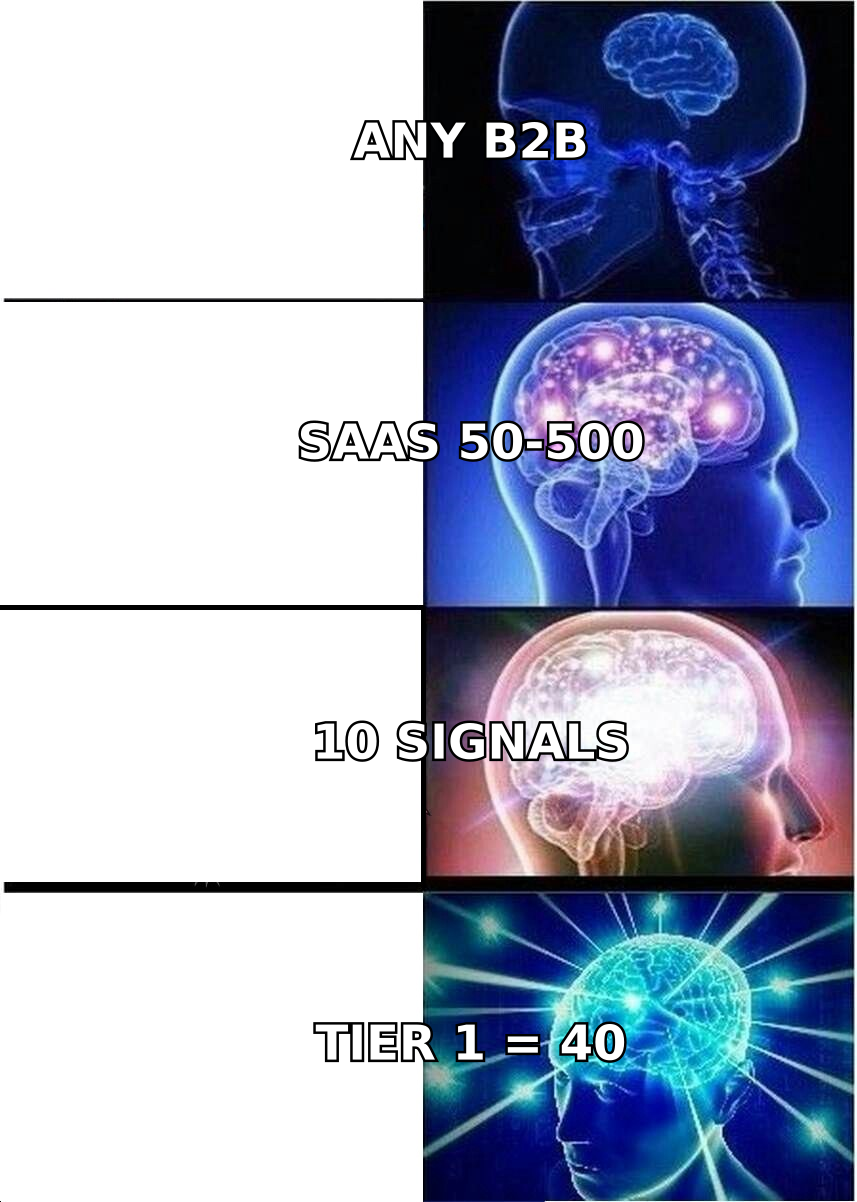
Tier 1 = 75+. Tier 2 = 50-74. Tier 3 = 30-49. Below 30, watchlist.
The reachability score is unusual, and that is on purpose. Most models treat data quality as an ops detail, not a scoring input. The result is a list of great-fit accounts that nobody can contact. Making reachability worth 20 points puts the data problem in the same room as the targeting problem, where it belongs.
Which tools do you need, and where does each one fit?#
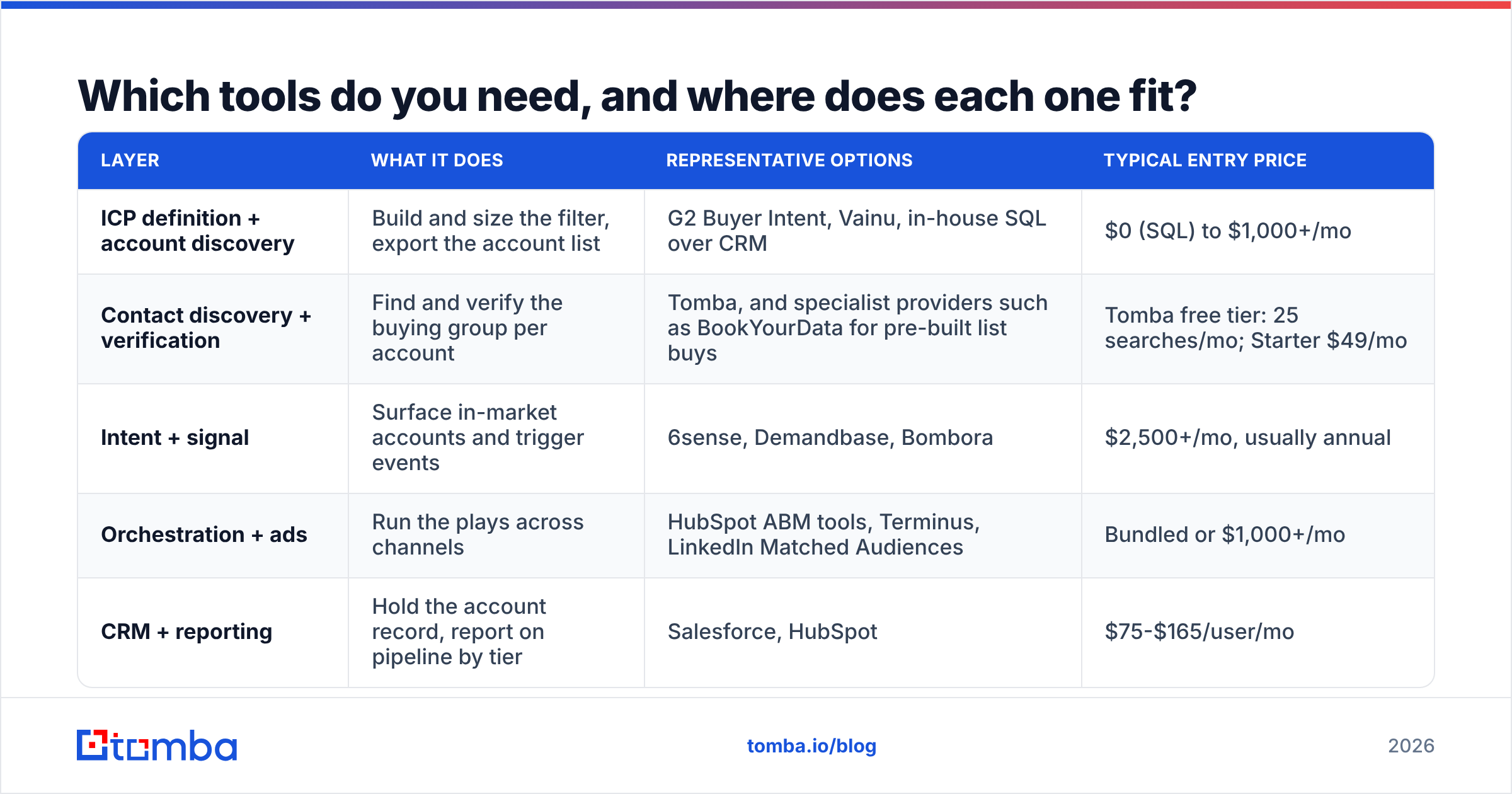
The ABM tool market has consolidated hard. The price spread is much wider than the feature spread. A rough map:
| Layer | What it does | Representative options | Typical entry price |
|---|---|---|---|
| ICP definition + account discovery | Build and size the filter, export the account list | G2 Buyer Intent, Vainu, in-house SQL over CRM | $0 (SQL) to $1,000+/mo |
| Contact discovery + verification | Find and verify the buying group per account | Tomba, and specialist providers such as BookYourData for pre-built list buys | Tomba free tier: 25 searches/mo; Starter $49/mo |
| Intent + signal | Surface in-market accounts and trigger events | 6sense, Demandbase, Bombora | $2,500+/mo, usually annual |
| Orchestration + ads | Run the plays across channels | HubSpot ABM tools, Terminus, LinkedIn Matched Audiences | Bundled or $1,000+/mo |
| CRM + reporting | Hold the account record, report on pipeline by tier | Salesforce, HubSpot | $75-$165/user/mo |
Two honest notes on this table.
First, the intent layer is where budgets go to die at small scale. Fewer than 200 target accounts? A $30k/year intent platform rarely pays back. Your reps can watch 200 accounts by hand with alerts. Buy intent when the list grows past what humans can watch, not before.
Second, contact data and intent data are different buys. Do not bundle them by default. Contact data is a per-account cost you incur once per quarter; intent is a subscription to a firehose. Teams that buy them together from one vendor usually overpay for one of them. Tomba sits in the contact-discovery layer. Tomba pricing starts with a free tier at 25 searches/month, then Starter at $49/mo, Growth at $99/mo, and Pro at $249/mo. Teams that want to run the verify step inside their own pipeline can use the Tomba API. Providers like BookYourData take a different route: pre-built, ready-to-download lists. That suits teams who would rather buy a segment outright than run discovery account by account.
How do you measure whether ICP ABM is working?#
Stop measuring ICP ABM work with demand-gen metrics. MQL counts and cost-per-lead tell you nothing about a motion designed around 40 accounts.
Measure these instead, cut by tier:
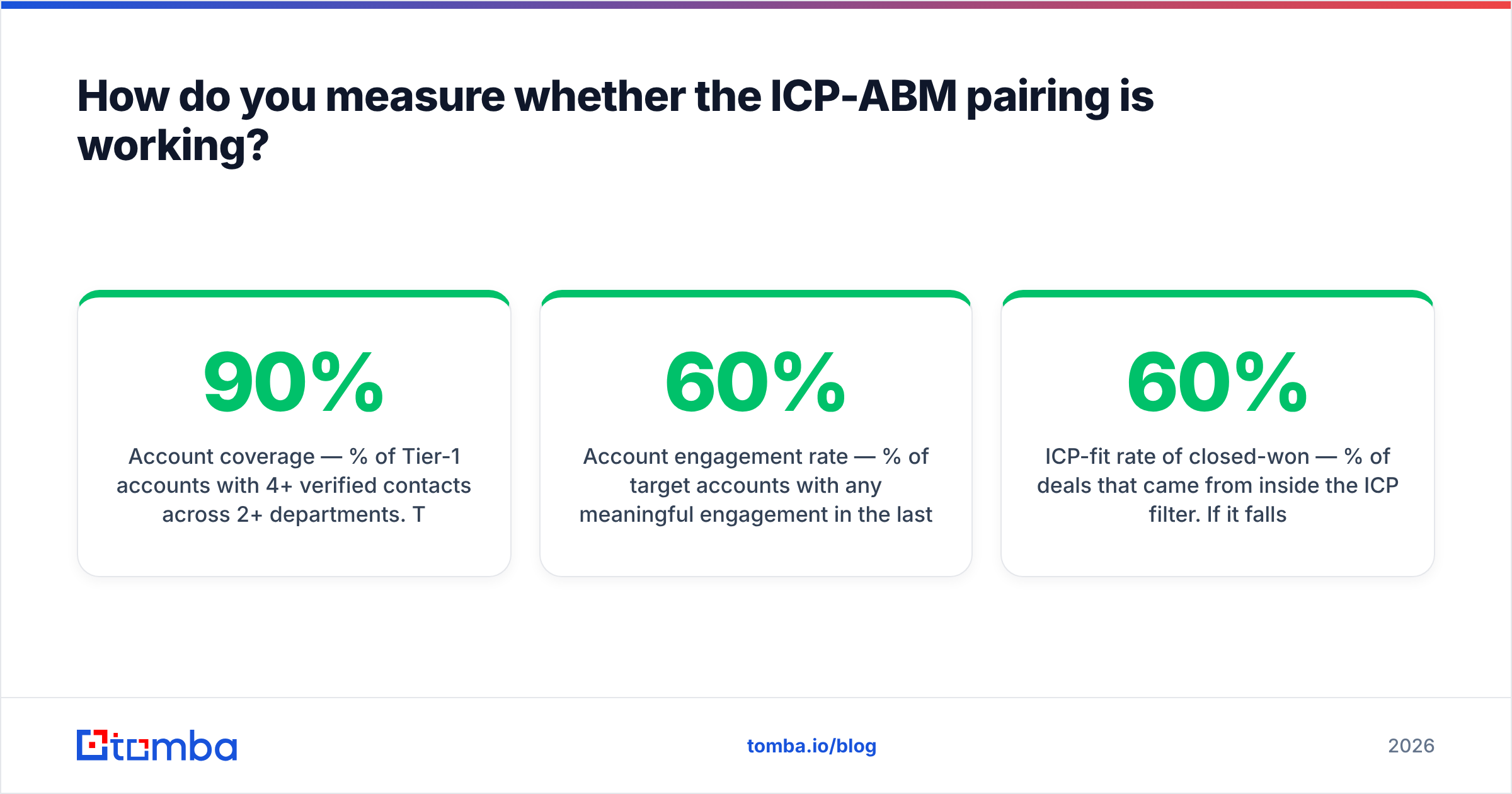
- Account coverage — % of Tier-1 accounts with 4+ verified contacts across 2+ departments. Target: 90%+. This is your leading indicator. It moves before anything else does.
- Account engagement rate — % of target accounts with any meaningful engagement in the last 90 days. Tier 1 should hit 60%+. If it does not, your ICP is wrong or your creative is.
- Pipeline per account by tier — the number that justifies the tier structure. If Tier 2 makes more pipeline per dollar than Tier 1, your tiering is upside down. Rebalance it.
Two more, and these are the ones that tell you whether the ICP itself is right:
- ICP-fit rate of closed-won — % of deals that came from inside the ICP filter. If it falls below 60%, the market is telling you your ICP is wrong. Listen to it.
- Win rate delta — in-ICP win rate versus out-of-ICP win rate. If the delta is under 1.5x, your ICP is not actually selective and you should tighten it.
That fourth metric is worth running every quarter. When a lot of your wins come from outside the ICP, one of two things is true. Your ICP is stale, or your reps are chasing accounts they should not. Both are worth knowing, and each has a different fix. Track the response rate on Tier-1 outreach on its own, too. It is the cleanest read on whether your one-to-one plays land or just cost money.
How often should you rebuild the ICP?#
Quarterly review, annual rebuild — with three forcing events that trigger an immediate rebuild regardless of calendar:
- A pricing change. New price points change who can afford you and who churns. Your ICP is stale the day pricing ships.
- A big product release. New features mean new buyers, and often a new champion team.
- A new segment or region. Do not stretch the current ICP. Build a second one. Two clean ICPs beat one blurry one every time.
The quarterly review is light. Re-run the closed-won and churn query. Check that the split fields still split. Check the ICP-fit rate of recent wins, and adjust the weights. That is ninety minutes with a RevOps analyst. The annual rebuild is the full six-step process from scratch.
One caution on drift. Teams tend to widen the ICP over time, because widening feels like growth and narrowing feels like retreat. In practice, most weak ABM programs target too broadly, not too narrowly. When in doubt, cut the list in half and double the spend per account. The math on revenue operations almost always favors focus.
Where should you start if you have nothing?#
If you are starting from zero and have one quarter, do this:
- Week 1 — Pull closed-won and churn. Derive 5-9 separating attributes. Write the query.
- Week 2 — Run the query against a data source. Size it. Cut to a target list. Tier it provisionally by fit score only.
- Week 3 — Contact coverage sprint. Domain search every Tier-1 and Tier-2 account, verify every address, load into CRM with timestamps. Demote any Tier-1 account you cannot cover.
- Week 4 — Re-tier with reachability included. Build one play per tier. Launch Tier 1 and Tier 3 only; Tier 2 waits until you have read on the other two.
- Weeks 5-12 — Run, measure account engagement weekly, review pipeline-per-account at the end of the quarter.
Week 3 is the one people compress, and it is the one that decides whether the rest works. An account list without verified contacts is a wish list.
Ready to make your account list reachable?#
The gap between a target account list and a working ABM program is almost always contact coverage. The accounts are picked, the creative is ready, and nobody can name four people to talk to. That is a data problem with a same-day fix.
The Tomba Email Finder finds work email addresses by domain, name, or company. Go account by account through your target list and build real buying-group coverage before you spend a dollar on ABM creative. Start on the free tier at 25 searches/month to test coverage on your Tier-1 accounts. Move to Starter at $49/mo when you are ready to run the full list. Verify everything, timestamp it, and let your tiering reflect who you can actually reach.
Related guides#
// get started
Find, verify and enrich your first contacts today
Start on the free plan with 25 searches a month, then scale when your team is ready.
Free plan · No credit card required · GDPR & CCPA
// about the author