ICP AI Agent: How to Automate Ideal Customer Profiles
An ICP AI agent turns your closed-won data into a living ideal customer profile and scores new accounts automatically. Here's how they work, what they cost, and where they still fail.
TL;DR
- An ICP AI agent is a piece of software that continuously rebuilds your ideal customer profile from closed-won, closed-lost, and churn data — instead of a slide deck someone wrote 18 months ago.
- The valuable part is not the LLM. It is the feedback loop: outcomes in, scored accounts out, weekly refresh.
- Most teams should start with a rules-based ICP plus enrichment, then add an agent once they have 100+ closed-won records to train on.
- Data quality is the ceiling. An agent scoring accounts on stale firmographics and bounced emails will confidently rank garbage.
- Expect $0 (build it yourself with an enrichment API) to $2,000+/mo (Keyplay, HockeyStack, 6sense-class platforms) depending on how much of the stack you buy.
What is an ICP AI agent?#
An ICP AI agent is an automated system that defines, scores, and refreshes your ideal customer profile without a human rewriting it each quarter.
Think of the difference between a paper map and a GPS with live traffic. The paper map was accurate the day it was printed. The GPS re-routes because it keeps ingesting new signal. A traditional ICP document is the paper map: "mid-market SaaS, 50-500 employees, US, Series B+, uses Salesforce." An ICP AI agent is the GPS — it watches which accounts actually closed, which churned in month four, which never replied, and adjusts the definition on its own.
Concretely, an ICP AI agent does four things in a loop:
- Ingest outcomes. Pull closed-won, closed-lost, churn, and expansion data from your CRM. This is the training signal — without it you have a chatbot, not an agent.
- Enrich the entities. Attach firmographics, technographics, headcount trends, hiring signals, funding, and verified contact data to every account in the set.
- Find the discriminating features. Determine which attributes actually separate your winners from your losers. Often it is not what the founder assumed.
- Score and route new accounts. Apply the learned profile to your inbound and outbound lists, push a tier or score into the CRM, and trigger the right play.
The word "agent" matters because of step 4. A model that outputs a report is analytics. A system that writes back to your CRM, launches enrichment jobs, and re-runs itself weekly is an agent.

Why do static ICPs decay so fast?#
Because the market moves and your product moves, and neither of them asks your ICP doc for permission.
Four decay mechanisms show up over and over:
- Product drift. You shipped an enterprise SSO feature in Q1. Your winning segment quietly shifted upmarket by 300 employees and nobody updated the targeting.
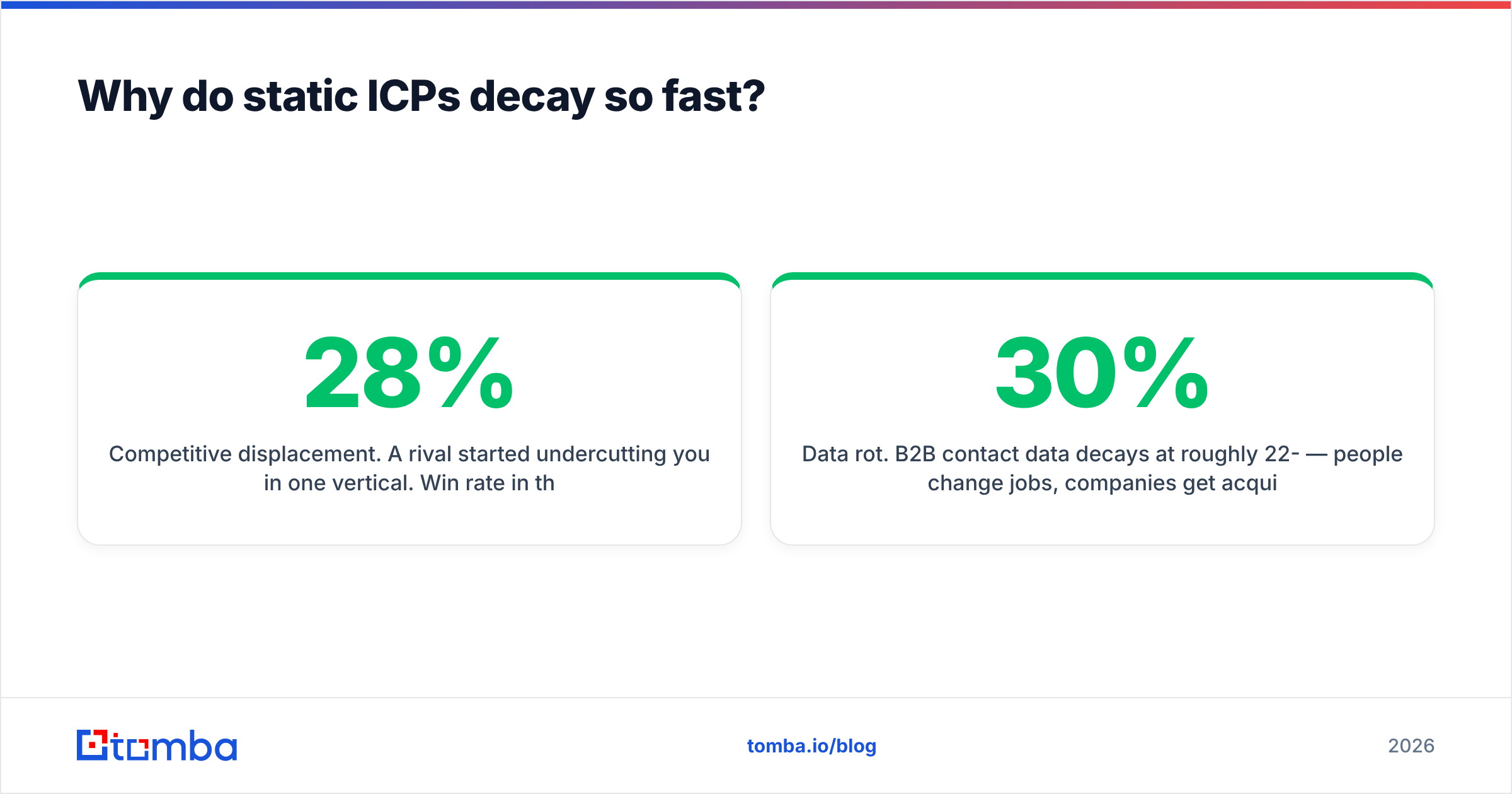
- Competitive displacement. A rival started undercutting you in one vertical. Win rate in that vertical fell from 28% to 9%, but reps keep prospecting it because it is in the playbook.
- Data rot. B2B contact data decays at roughly 22-30% per year — people change jobs, companies get acquired, domains get redirected. Your "ICP" list is partly fiction within a year.
- Survivorship bias. The original ICP was written from your first 20 customers, most of whom came from the founder's network. That is not a market, that is a friend group.
An agent does not fix bad judgment, but it does fix latency. Instead of noticing the vertical collapse two quarters late in a QBR, you notice it in the weekly score refresh.
How does an ICP AI agent actually work under the hood?#
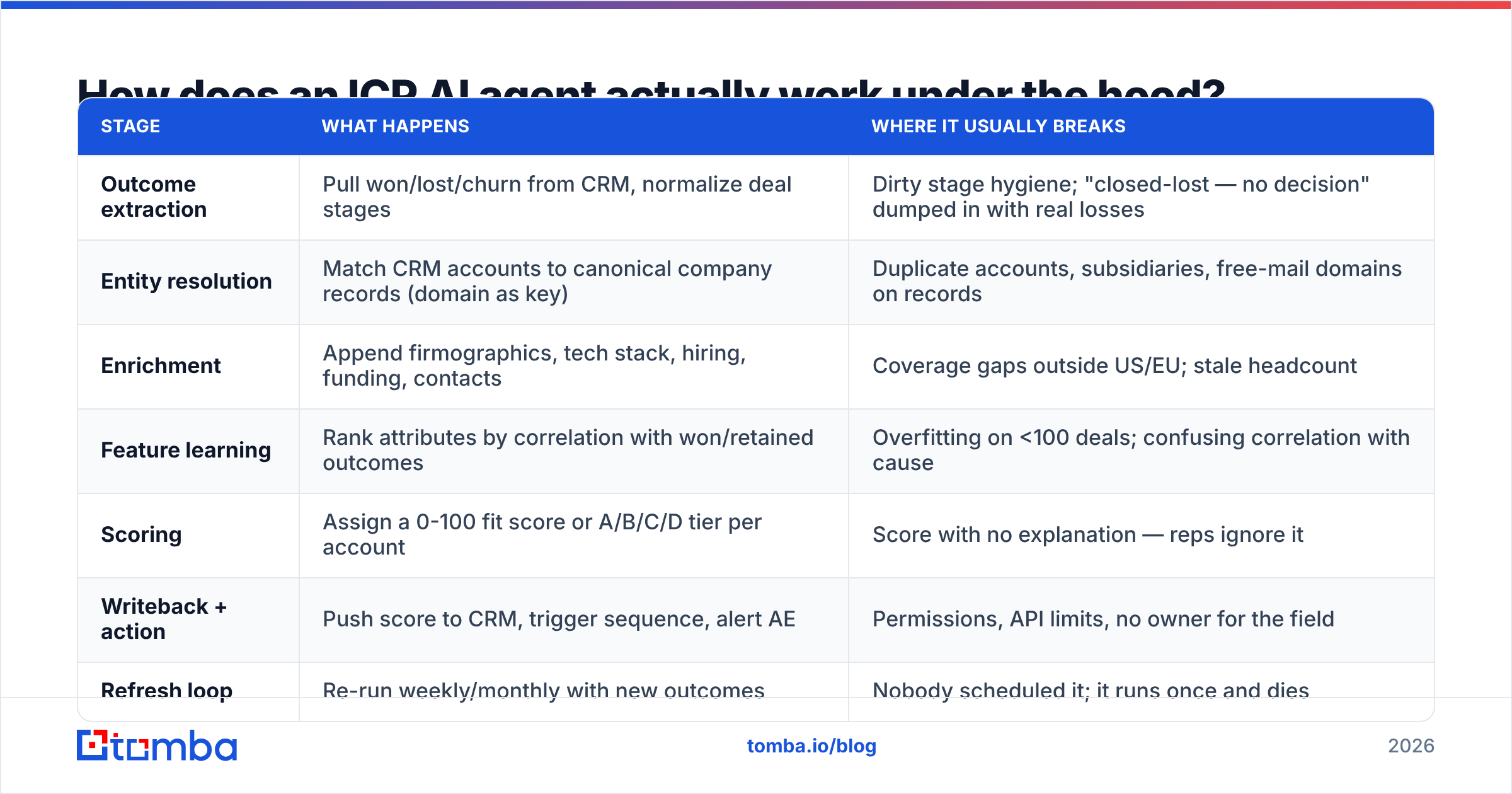
Here is the honest architecture. Most vendors dress this up, but the pipeline is consistent:
| Stage | What happens | Where it usually breaks |
|---|---|---|
| Outcome extraction | Pull won/lost/churn from CRM, normalize deal stages | Dirty stage hygiene; "closed-lost — no decision" dumped in with real losses |
| Entity resolution | Match CRM accounts to canonical company records (domain as key) | Duplicate accounts, subsidiaries, free-mail domains on records |
| Enrichment | Append firmographics, tech stack, hiring, funding, contacts | Coverage gaps outside US/EU; stale headcount |
| Feature learning | Rank attributes by correlation with won/retained outcomes | Overfitting on <100 deals; confusing correlation with cause |
| Scoring | Assign a 0-100 fit score or A/B/C/D tier per account | Score with no explanation — reps ignore it |
| Writeback + action | Push score to CRM, trigger sequence, alert AE | Permissions, API limits, no owner for the field |
| Refresh loop | Re-run weekly/monthly with new outcomes | Nobody scheduled it; it runs once and dies |
The interesting part is stage 4. With fewer than about 100 closed-won accounts, an LLM or a regression will happily find patterns that are noise. Three of your five best customers being in Colorado is not a geographic insight — it is a coincidence with a confidence score attached.
That is why serious implementations blend two things: a learned score and a hard-coded set of disqualifiers. The disqualifiers ("no company under 10 employees, no agencies, no .edu") are human judgment. The score handles the gradient inside the qualified pool.
What data does an ICP AI agent need to be useful?#
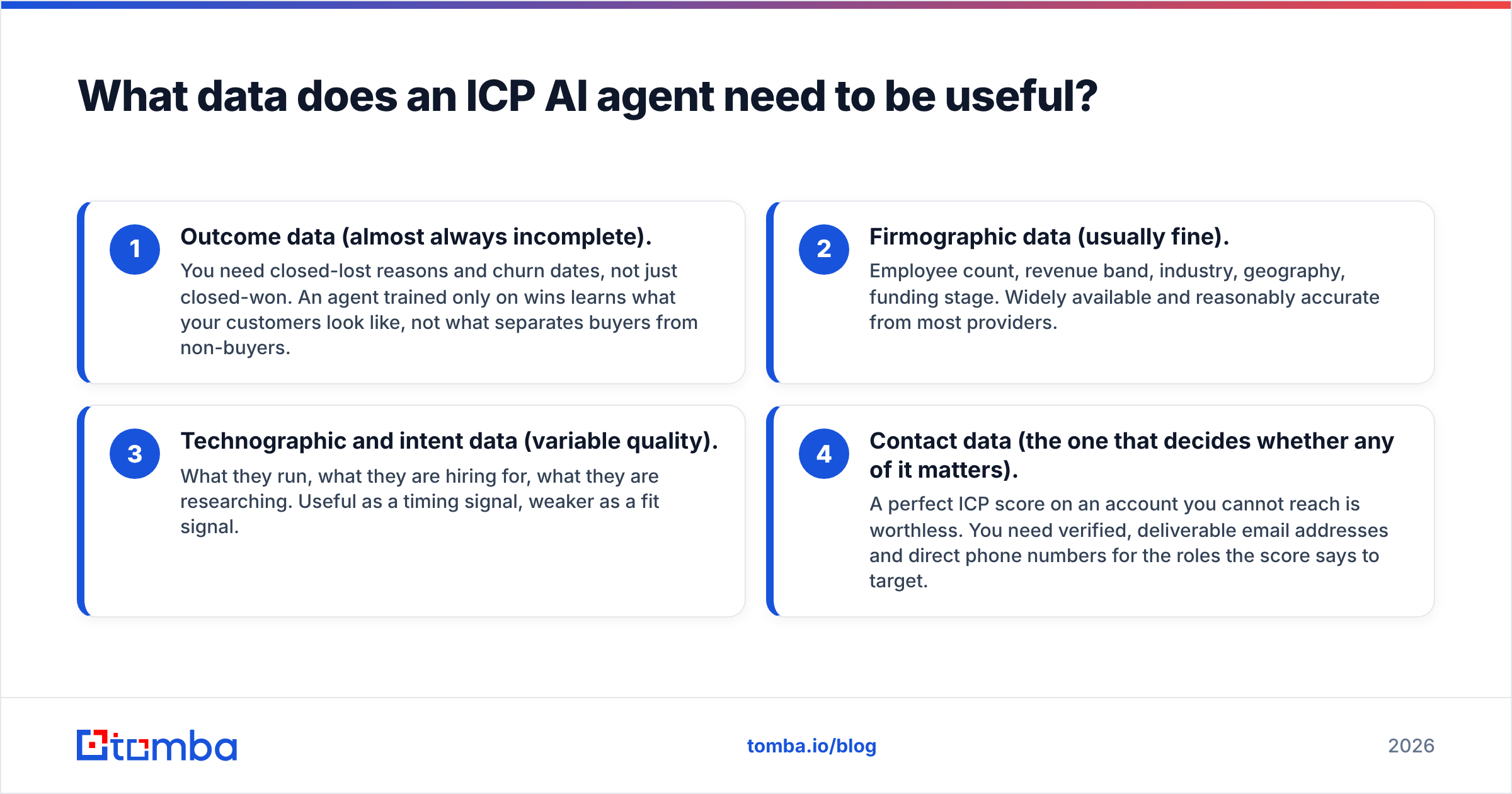
Four layers, in order of how often they are missing:
- Outcome data (almost always incomplete). You need closed-lost reasons and churn dates, not just closed-won. An agent trained only on wins learns what your customers look like, not what separates buyers from non-buyers.
- Firmographic data (usually fine). Employee count, revenue band, industry, geography, funding stage. Widely available and reasonably accurate from most providers.
- Technographic and intent data (variable quality). What they run, what they are hiring for, what they are researching. Useful as a timing signal, weaker as a fit signal.
- Contact data (the one that decides whether any of it matters). A perfect ICP score on an account you cannot reach is worthless. You need verified, deliverable email addresses and direct phone numbers for the roles the score says to target.
That fourth layer is where most ICP projects quietly die. The agent produces a beautiful tier-A list of 480 accounts and then the SDR spends three days hunting for contacts. This is a solved problem — a domain search pass over the scored account list returns the relevant contacts per company, and an email verifier pass strips the ones that will bounce before they ever hit a sequence. Run it as a bulk email finder job over the whole tier-A set and the handoff takes minutes instead of days.

Accuracy compounds here. If 18% of your contacts bounce, you are not just losing 18% of the list — you are degrading sender reputation for every campaign that follows, which silently suppresses the deliverability of your good contacts too.
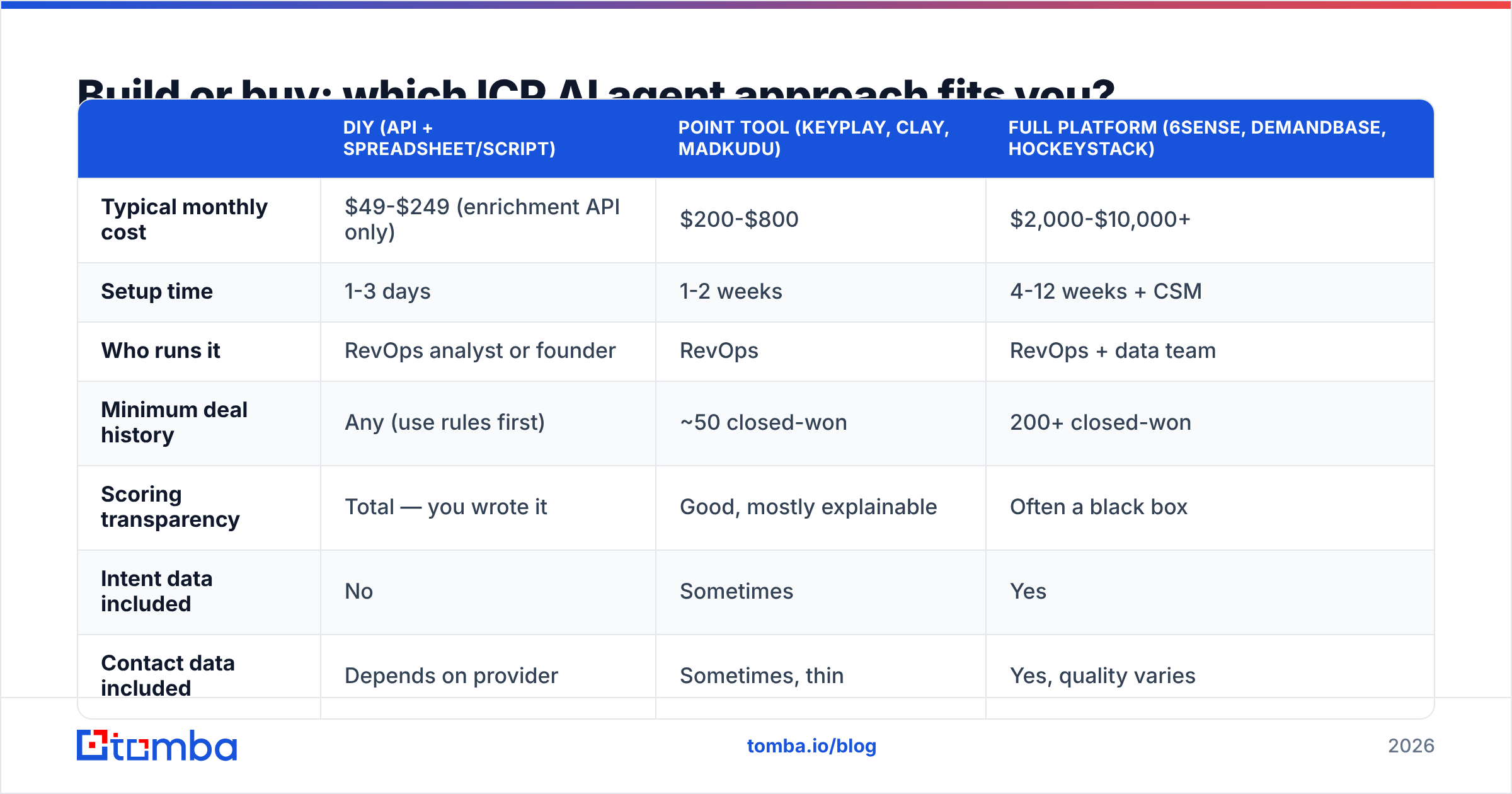
Build or buy: which ICP AI agent approach fits you?#
There are three realistic paths. Pick based on deal volume and engineering availability, not on which demo was shiniest.
| DIY (API + spreadsheet/script) | Point tool (Keyplay, Clay, MadKudu) | Full platform (6sense, Demandbase, HockeyStack) | |
|---|---|---|---|
| Typical monthly cost | $49-$249 (enrichment API only) | $200-$800 | $2,000-$10,000+ |
| Setup time | 1-3 days | 1-2 weeks | 4-12 weeks + CSM |
| Who runs it | RevOps analyst or founder | RevOps | RevOps + data team |
| Minimum deal history | Any (use rules first) | ~50 closed-won | 200+ closed-won |
| Scoring transparency | Total — you wrote it | Good, mostly explainable | Often a black box |
| Intent data included | No | Sometimes | Yes |
| Contact data included | Depends on provider | Sometimes, thin | Yes, quality varies |
| Best for | Seed to Series A, <$3M ARR | Series A-B, defined motion | Series C+, multi-product |
The DIY route is underrated. A weekly script that pulls closed-won from your CRM, calls an enrichment endpoint, applies eight weighted rules, and writes a score back covers maybe 70% of the value of a $4,000/mo platform. The Tomba API handles the enrichment and contact-discovery half of that loop, and Tomba pricing starts at a free tier with 25 searches/mo before the $49/mo Starter plan — cheap enough to prototype the loop before committing to a platform contract.
If you want a prebuilt B2B universe to score against rather than assembling one, providers like BookYourData sell pre-verified contact databases you can filter down by the firmographic criteria your agent surfaces. That is a legitimate shortcut when your CRM does not yet contain enough accounts to learn from.
How is an ICP AI agent different from lead scoring?#
They overlap, but they answer different questions and operate at different levels.
- Lead scoring answers "which of the people who already showed up should we call first?" It is person-level, behavior-heavy, and reactive to inbound.
- ICP scoring answers "which companies in the entire market should we go after at all?" It is account-level, firmographic-heavy, and drives outbound list building.
- Intent scoring answers "which of the right companies are in-market right now?" It is timing, not fit.
A working stack uses all three: ICP fit decides who enters the list, intent decides when they get worked, and lead scoring decides which individuals get prioritized once they engage. Collapsing them into a single number is a common mistake — a high-fit account with zero intent and a low-fit account with high intent both score "medium," and the rep learns to ignore the field.
What does a good ICP AI agent output look like?#
Not a number. A number plus a reason plus an action.
Compare two outputs for the same account:
Bad output:
Acme Robotics — Fit score: 78
Good output:
Acme Robotics — Tier A (82). Matches: 140 employees (band 50-500, +), Series B Jan 2026 (+), hiring 3 RevOps roles (+), runs HubSpot (+). Risks: no listed VP Sales (−). Suggested play: RevOps-lead sequence, 4 contacts found, 4/4 verified.
The second version survives contact with a skeptical AE. The first one gets ignored by week three, and once the field is ignored, the whole project is dead regardless of how good the model was.
Five things to demand from any ICP agent, vendor-built or homegrown:
- Explainability per account — which attributes drove the score, with direction and weight.
- A visible refresh date — so reps know whether they are looking at last week's or last quarter's judgment.
- Confidence bands — accounts scored on thin data should say so instead of guessing at 3 decimal places.
- Contactability attached — how many verified contacts exist for this account, not just how good a fit it is.
- A negative list — the agent should be as clear about who to skip as who to chase. Disqualification saves more time than prioritization.
What are the real limitations of ICP AI agents in 2026?#
Four that vendors tend to gloss over:
Small-sample overfitting. Below roughly 100 outcome records, correlations are unstable. Run the agent, then run it again excluding your five largest customers. If the profile changes materially, you are describing a handful of accounts, not a segment.
Causation blindness. The agent will tell you companies using a certain payroll tool close at 2x. It cannot tell you whether that tool causes the fit or whether both are downstream of "well-funded, 200-person, US tech company." Acting on the correlation is fine; believing the story is where money gets wasted.
Coverage bias. Enrichment providers have uneven coverage by geography and company size. If your provider is thin on 20-person European companies, those accounts will score low because of missing data, not poor fit. The agent then trains on outcomes from a list that already excluded them. This is a self-reinforcing blind spot — check your provider's data sources and coverage by region before trusting any regional conclusion.
The last-mile gap. Scoring is upstream of everything and touches nothing. The agent hands you 480 tier-A accounts. Someone still has to find the right people, verify the addresses, write something worth reading, and follow up. Teams that treat the score as the finish line get a very expensive report.
Independent research from firms like Gartner and peer reviews on G2 consistently show the same thing: the differentiator between teams that get value from account intelligence and teams that do not is execution discipline downstream of the score, not the sophistication of the model.
How do you implement one in 30 days?#
A realistic sequence for a team with a CRM and some deal history:
Week 1 — Clean the outcome data. Export closed-won, closed-lost, and churned accounts from the last 24 months. Normalize the loss reasons into four or five real buckets. Delete or merge duplicates. This is boring and it determines everything downstream.
Week 2 — Enrich and inspect. Append firmographics and contact counts to all three cohorts. Then just look at it. Compare median headcount of won vs. lost. Compare industry distribution. Half the insight shows up here, before any model runs.
Week 3 — Write the v1 scoring rules by hand. Eight to twelve weighted attributes and three hard disqualifiers. Score your current pipeline with it. If your best open deals score badly, the rules are wrong — fix them now, not after you have automated them.
Week 4 — Automate the loop and attach contacts. Schedule the enrichment and scoring to run weekly. Write scores back to the CRM with an explanation field. Then run every tier-A account through contact discovery and verification so the list is workable the moment it lands. Only after this loop is running reliably should you consider layering a learned model on top of the hand-written rules.
The reason the hand-written rules come first: they give you a baseline to beat. Without one, you cannot tell whether the AI is adding accuracy or just adding confidence.
Getting from scored accounts to booked meetings#
An ICP AI agent's output is only as valuable as the outreach it enables, and outreach dies on bad contact data. Once your agent has ranked the accounts, the Tomba Email Finder turns each of those company records into verified, deliverable contacts for the exact roles your scoring model says to target — by domain, by name, or in bulk across your whole tier-A list. Start on the free tier with 25 searches per month, confirm the contact quality on your own scored accounts, and scale up when the loop is proving itself.
Score the accounts. Then actually reach them.
Related guides#
// get started
Find, verify and enrich your first contacts today
Start on the free plan with 25 searches a month, then scale when your team is ready.
Free plan · No credit card required · GDPR & CCPA
Get the Tomba newsletter
Product and data updates
// about the author