What Is an ICP in Business? The 2026 Ideal Customer Profile Guide
Most B2B teams write an ICP once, paste it into a slide, and never use it again. Here is how to build an ICP business framework that actually changes who you prospect, what you score, and where budget goes.
TL;DR
- An ICP in business is a description of the companies that get the most value from what you sell and cost the least to win and keep. It is not a persona, and it is not your total addressable market.
- A usable ICP has three layers: firmographics (who they are), technographics and behavior (what they run and do), and value signals (why they buy and stay).
- The fastest way to build one is backwards: take your best 20-30 accounts, find what they share, then test whether that pattern predicts win rate and retention.
- An ICP only matters if it changes something operationally — list building, lead scoring, routing, disqualification. If it lives in a slide deck, it is decoration.
- Enrichment data is the bottleneck. A perfect ICP definition you cannot filter or verify against real contact data produces zero pipeline.
Quick disambiguation: this guide is about ICP as Ideal Customer Profile, the go-to-market concept. If you landed here looking for Internet Computer Protocol, wrong ICP.
What is an ICP in business?#
An Ideal Customer Profile is a written, data-backed definition of the type of organization that is the best possible fit for your product. Best possible means four things at once: they convert at above-average rates, they close faster than average, they expand, and they do not churn.
The common failure is treating the ICP as an aspiration ("enterprise fintech") instead of an observation ("US-based Series B fintechs with 80-250 employees and an in-house compliance lead, who already run Snowflake"). The first is a wish. The second is a filter you can run against a database tonight.
Think of it like a fishing chart. Your total addressable market is the ocean. Your ICP is the specific reef where the fish you can actually catch happen to congregate at a specific depth and season. Nobody gets rich by describing the ocean.
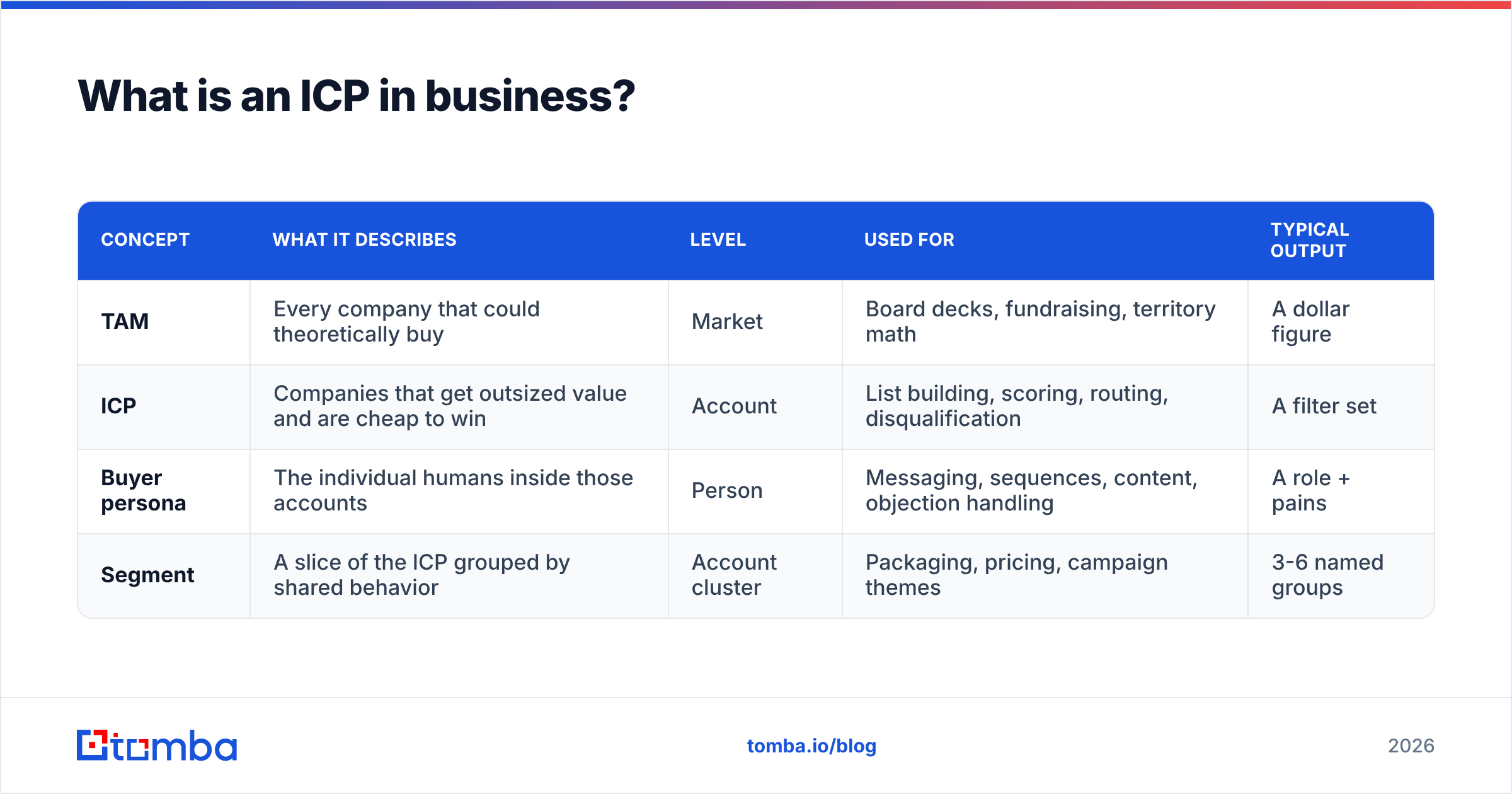
Three terms get blurred constantly, so pin them down before anything else:
| Concept | What it describes | Level | Used for | Typical output |
|---|---|---|---|---|
| TAM | Every company that could theoretically buy | Market | Board decks, fundraising, territory math | A dollar figure |
| ICP | Companies that get outsized value and are cheap to win | Account | List building, scoring, routing, disqualification | A filter set |
| Buyer persona | The individual humans inside those accounts | Person | Messaging, sequences, content, objection handling | A role + pains |
| Segment | A slice of the ICP grouped by shared behavior | Account cluster | Packaging, pricing, campaign themes | 3-6 named groups |
You need all four. But the ICP is the one that decides whether your sales team wastes Q1, because it is the only one that answers "should this account be in the list at all?"
Why does a vague ICP quietly destroy pipeline?#
Because the damage never shows up as a line item. It shows up as everything being slightly worse.
A loose ICP inflates your list, so reps work more accounts to hit the same number. Reply rates drop because the message is generic enough to cover a wider set of companies. Deliverability suffers, since larger unfiltered lists always contain more dead and role-based addresses. Marketing spends on content that speaks to nobody in particular. Customer success inherits accounts that were never going to succeed, and churn gets blamed on onboarding.
Research from Gartner on B2B buying has consistently found that buying groups have grown, decision cycles have lengthened, and buyers spend a small fraction of their time with any single vendor. That math punishes unfocused outreach twice: you get fewer shots, and each shot has more people to convince. Precision is not a nice-to-have anymore, it is the only way the arithmetic works.
The tell that your ICP is too vague: ask three reps to describe your ideal account without looking at a doc. If you get three different answers, you do not have an ICP. You have a mission statement.
What data actually belongs in an ICP business framework?#
Six data categories carry almost all the predictive weight. Anything else is usually noise you added to feel thorough.
- Firmographics — Industry (use a real taxonomy like NAICS or SIC, not adjectives), employee count band, revenue band, headquarters country, and legal structure. These are the coarse filters that cut your list by 80% in one pass.
- Technographics — What they already run. If your product plugs into Salesforce, "uses Salesforce" is worth more than industry. Tech stack is often the single strongest fit signal for software, because it proves both budget and architectural compatibility.
- Organizational structure — Does the buying role exist? A company with no RevOps function will not buy a RevOps tool no matter how well it fits on paper. Look for the presence of specific job titles, team size, and reporting lines.
- Trigger events — Funding rounds, leadership hires, office openings, layoffs, product launches, compliance deadlines. Triggers do not define fit, they define timing, and mixing the two is the most common ICP modeling error.
- Buying behavior — How they procure. Self-serve credit card, procurement committee, security review, or RFP. This determines cost-to-acquire more than deal size does, and cost-to-acquire is half the definition of "ideal".
- Value realization signals — What your happiest customers had in common before they bought. Data volume, team velocity, existing manual process, seat count. This is the layer most teams skip, and it is the one that separates an ICP from a demographic sketch.
Notice that only the first category is available from a basic company list. Categories 2 through 6 require enrichment, which is why data enrichment tends to become the practical constraint on how good your ICP can get.
How do you build an ICP from your existing data?#
Work backwards from wins, not forwards from ambition. Five steps, and the whole thing takes about a week if your CRM is not a disaster.
Step 1 — Pull your best accounts. Not your biggest. Your best. Define "best" with a composite: closed-won, above-median contract value, above-median retention or renewal, and a sales cycle at or below median. Twenty to thirty accounts is enough to see a pattern. Fewer than ten and you are reading tea leaves.
Step 2 — Pull your worst. Churned accounts, deals that died in late stage, and support-heavy customers with low expansion. The negative ICP is underrated. Knowing that manufacturing companies under 50 employees always churn at month nine is worth as much as any positive signal.
Step 3 — Enrich both cohorts identically. Append firmographics, tech stack, headcount by department, and funding history to every account in both lists. The comparison is meaningless unless both sides have the same fields filled. Tools like domain search let you go from a bare domain list to structured company and contact data without manual research.
Step 4 — Find the delta. Look for attributes that appear in 60%+ of the good cohort and under 25% of the bad one. Those are your ICP criteria. Attributes that appear everywhere are not criteria, they are background noise. Attributes that appear in three accounts are anecdotes.
Step 5 — Write it as a filter, then test it. The output should be executable: industry IN (...) AND employees BETWEEN 51 AND 200 AND country IN (...) AND tech_stack CONTAINS .... Run it against your open pipeline. If accounts that match the filter do not win at a higher rate than accounts that do not, your ICP is wrong. Redo step 4.
That last test is non-negotiable and almost nobody runs it. An ICP that does not predict win rate is a hypothesis, not a profile.
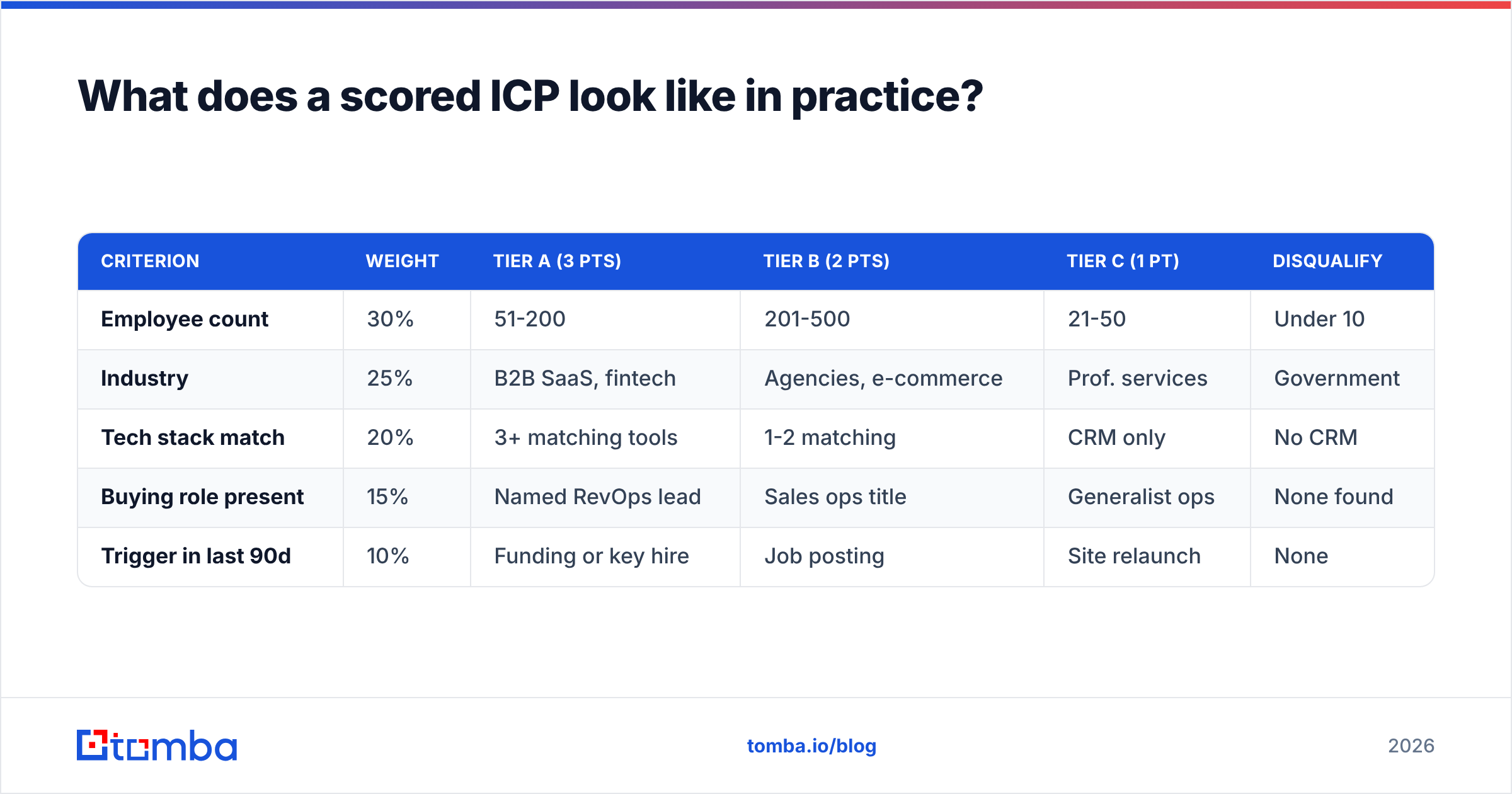
What does a scored ICP look like in practice?#
Binary fit ("in ICP / out of ICP") is too blunt once your list crosses a few thousand accounts. Weighted scoring gives your team a queue instead of a wall.
| Criterion | Weight | Tier A (3 pts) | Tier B (2 pts) | Tier C (1 pt) | Disqualify |
|---|---|---|---|---|---|
| Employee count | 30% | 51-200 | 201-500 | 21-50 | Under 10 |
| Industry | 25% | B2B SaaS, fintech | Agencies, e-commerce | Prof. services | Government |
| Tech stack match | 20% | 3+ matching tools | 1-2 matching | CRM only | No CRM |
| Buying role present | 15% | Named RevOps lead | Sales ops title | Generalist ops | None found |
| Trigger in last 90d | 10% | Funding or key hire | Job posting | Site relaunch | None |
Multiply, sum, and cut. Accounts above roughly 75% of the maximum go to outbound immediately. The 50-75% band goes to nurture. Below 50%, you do not build a list at all, and you certainly do not spend verification credits on it.
One warning about weights: they are guesses until you backtest them. Set them, run them against last year's closed-won data, and adjust until the model ranks your actual wins near the top. Two rounds of adjustment usually gets you 90% of the achievable accuracy.
What tools do you need to operationalize an ICP?#
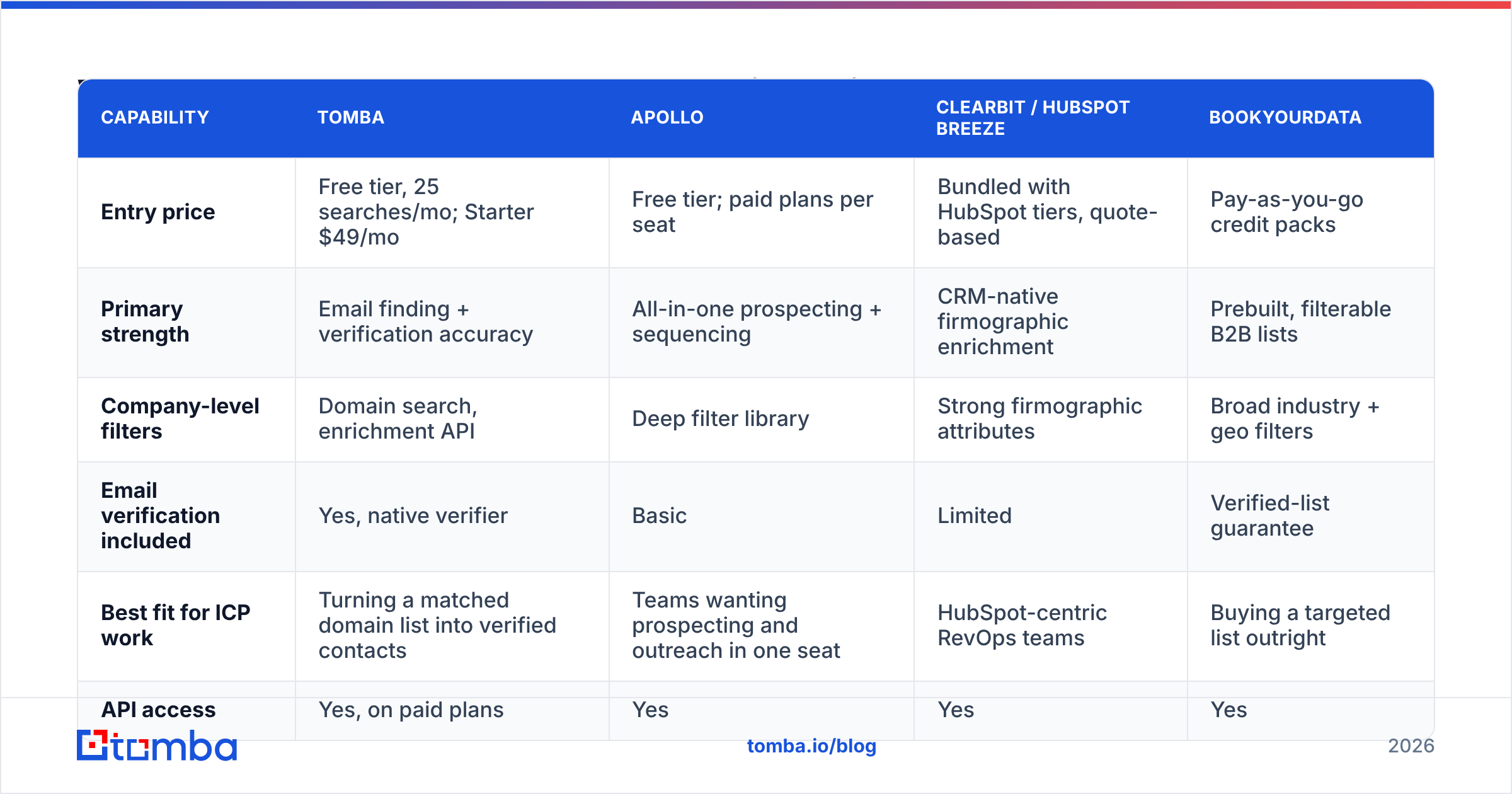
An ICP becomes real the moment you can turn the filter into a list of verified contacts. That requires three capabilities, and most teams buy them separately: company data (who matches), contact data (who to reach), and verification (does this address actually accept mail).
| Capability | Tomba | Apollo | Clearbit / HubSpot Breeze | BookYourData |
|---|---|---|---|---|
| Entry price | Free tier, 25 searches/mo; Starter $49/mo | Free tier; paid plans per seat | Bundled with HubSpot tiers, quote-based | Pay-as-you-go credit packs |
| Primary strength | Email finding + verification accuracy | All-in-one prospecting + sequencing | CRM-native firmographic enrichment | Prebuilt, filterable B2B lists |
| Company-level filters | Domain search, enrichment API | Deep filter library | Strong firmographic attributes | Broad industry + geo filters |
| Email verification included | Yes, native verifier | Basic | Limited | Verified-list guarantee |
| Best fit for ICP work | Turning a matched domain list into verified contacts | Teams wanting prospecting and outreach in one seat | HubSpot-centric RevOps teams | Buying a targeted list outright |
| API access | Yes, on paid plans | Yes | Yes | Yes |
There is no single winner here, and anyone telling you otherwise is selling something. Apollo makes sense if you want prospecting and sequencing under one login. HubSpot's enrichment layer makes sense if your entire GTM stack already lives in HubSpot — worth reading HubSpot's own documentation on how their data properties map to lifecycle stages before committing. BookYourData is a strong option when you would rather purchase a clean, pre-filtered list than assemble one. And Tomba fits the specific job of converting "here are 900 domains that match my ICP" into "here are 2,400 verified, deliverable contacts at those domains," at pricing that does not scale per seat.
Whatever you pick, check current user reviews on G2 before you sign an annual contract. Data vendors' coverage shifts quarterly, and last year's benchmark is not this year's reality.
How often should you revisit your ICP?#
Quarterly review, annual rebuild. That cadence holds for most B2B companies.
The quarterly review is cheap: re-run the win-rate test from step 5 against the last 90 days of closed deals. If the ICP still predicts wins, change nothing. If prediction quality is drifting, note which criterion is decaying.
The annual rebuild is the full exercise, and it is genuinely necessary because three things move underneath you:
- Your product changes. Every meaningful feature shipped either widens or narrows fit. A new enterprise SSO integration can move your ICP up-market by 200 employees overnight.
- The market changes. Categories consolidate, a competitor exits, a regulation creates a new buying trigger, budgets shift between departments.
- Your pricing changes. Raising prices removes the bottom of your ICP whether you intended it or not. Lowering them adds a segment your onboarding may not be built for.
There is one exception to the cadence: rebuild immediately after any pivot, repositioning, or acquisition. Continuing to prospect against a pre-pivot ICP is how companies spend two quarters wondering why the pipeline dried up.
What are the most common ICP mistakes?#
Confusing fit with intent. A company can be a perfect fit and have zero interest this year. Fit tells you whether to build the list. Intent tells you when to work it. Teams that merge these end up either ignoring perfect accounts with no current trigger or chasing high-intent accounts they cannot serve.
Defining the ICP from the loudest customer. One vocal enterprise logo distorts more ICPs than any other single factor. If your ICP was written the week after a marquee deal closed, rewrite it.
Writing it too broadly to avoid saying no. "Companies with 10-5,000 employees across all industries in North America and Europe" is not an ICP, it is a shrug. A good ICP should make you uncomfortable by excluding revenue you could theoretically win. That discomfort is the point.
Never encoding it in systems. If the ICP is not a saved filter in your CRM, a scoring rule in your MAP, and a routing condition in your lead assignment, it does not exist. Documented is not the same as operational.
Skipping verification. You can nail the ICP, build a flawless matched list, and still torch your domain reputation because 22% of the addresses bounce. Run every list through an email verifier before it touches a sending tool. On lists built from mid-market and enterprise domains, catch-all servers are common enough that a dedicated catch-all verifier step is worth the extra credits.
Treating the ICP as sales property. It should govern paid media targeting, content topics, partner selection, and even hiring. An ICP owned only by sales gets ignored by everyone who could amplify it.
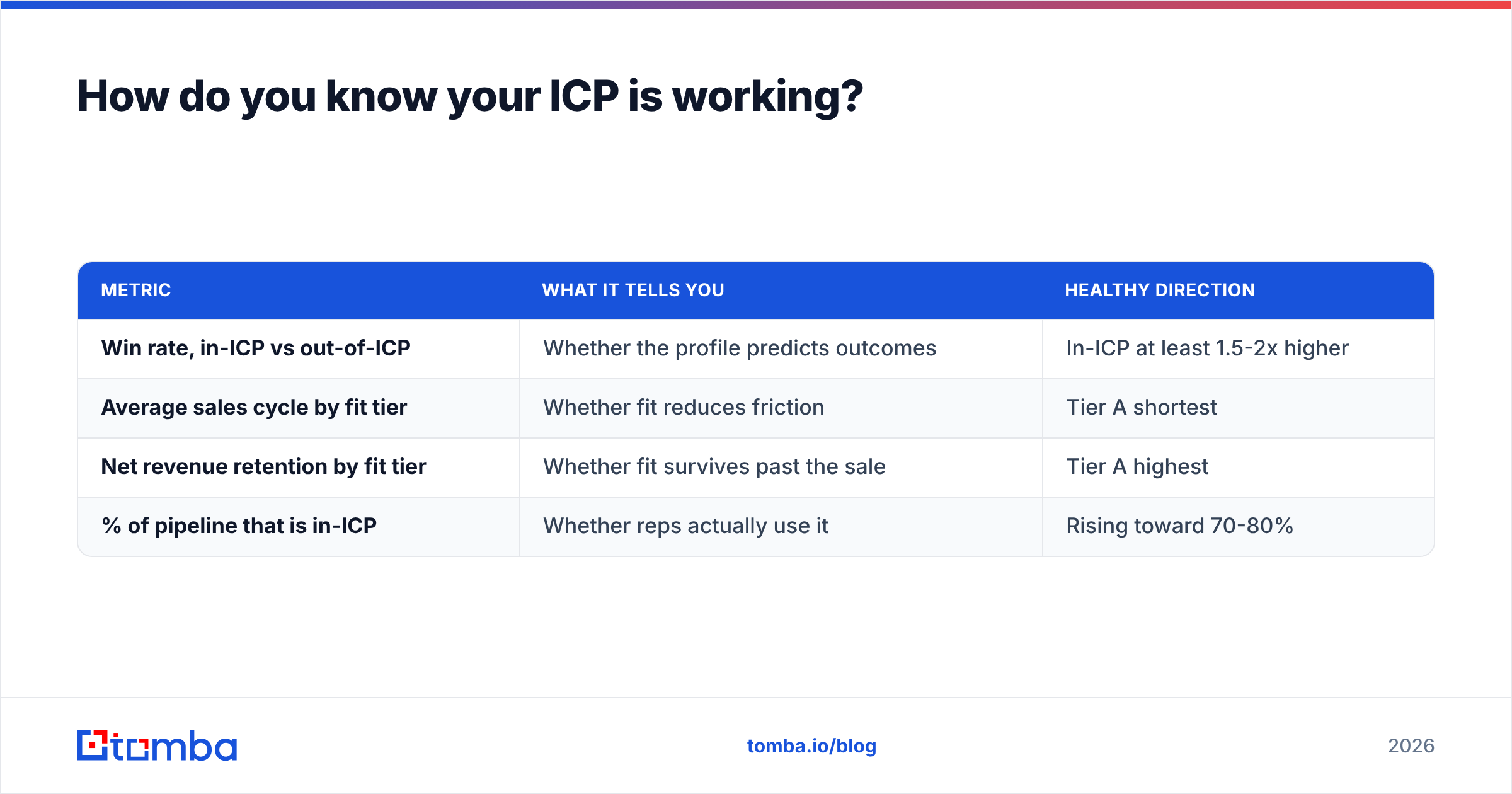
How do you know your ICP is working?#
Four metrics, tracked monthly, tell you almost everything:
| Metric | What it tells you | Healthy direction |
|---|---|---|
| Win rate, in-ICP vs out-of-ICP | Whether the profile predicts outcomes | In-ICP at least 1.5-2x higher |
| Average sales cycle by fit tier | Whether fit reduces friction | Tier A shortest |
| Net revenue retention by fit tier | Whether fit survives past the sale | Tier A highest |
| % of pipeline that is in-ICP | Whether reps actually use it | Rising toward 70-80% |
That last one is the discipline metric. If your ICP is well-built but only 30% of pipeline matches it, the problem is not the profile, it is enforcement. Fix routing and list-building rules before you touch the definition again.
Ready to turn your ICP into a real contact list?#
Defining the profile is the strategy work. Reaching the accounts inside it is the operational work, and that is where most ICP projects stall — you have 900 matching domains and no idea who to contact at any of them.
Start with the Tomba Email Finder. Feed it the domains and roles that match your scored ICP, and it returns verified professional email addresses with confidence scores, so you can move from filter to first-touch in the same afternoon. The free tier gives you 25 searches a month to sanity-check coverage against your own account list before you commit to anything, and paid plans start at $49/mo.
Build the profile from data you already own. Then go find the people inside it.
Related guides#
// get started
Find, verify and enrich your first contacts today
Start on the free plan with 25 searches a month, then scale when your team is ready.
Free plan · No credit card required · GDPR & CCPA
// about the author