ICP Marketing in 2026: How to Build and Use an ICP
Most ICPs are a slide nobody reads. This guide shows how to build an ICP marketing framework from real closed-won data, wire it into campaigns, and measure whether it actually moved pipeline.
TL;DR
- ICP marketing means narrowing your paid, content, and outbound spend to the accounts that actually renew and expand — not the ones that merely convert.
- Build the ICP from closed-won and churn data, not from a persona workshop. Five to eight firmographic and behavioral attributes is enough; more than twelve makes it unusable.
- The ICP only earns its keep when it becomes a filter in your ad platforms, your CRM fields, your content briefs, and your prospecting queries.
- Measure ICP marketing with fit-segmented metrics: pipeline from in-ICP accounts, win rate in vs. out, and CAC payback by tier. A rising MQL count means nothing if fit is falling.
- Data quality is the hidden failure point. An ICP definition your team can't operationalize against real contact records is a document, not a strategy.
What is ICP marketing?#
ICP marketing is the practice of concentrating your marketing budget, messaging, and channel mix on a precisely defined Ideal Customer Profile — the account type that buys fastest, stays longest, and expands most — rather than broadcasting to any company that vaguely resembles a buyer.
Think of it like fishing. Most B2B teams cast a wide net across an entire lake and celebrate the tonnage. ICP marketing means you first figure out which species pays your bills, learn which cove it feeds in and at what hour, then fish only there with the right bait. You catch less. You earn more.
The distinction that trips people up: an ICP describes an account, a persona describes a person. Your ICP might be "Series B vertical SaaS companies, 80–250 employees, North America, using HubSpot, with a named RevOps hire." Your personas inside that account are the VP of Sales, the RevOps lead, and the CFO who signs. You need both, but the ICP comes first — it determines which personas you'll ever meet.
Gartner's B2B buying research consistently shows buying groups of six to ten stakeholders per deal. That's the practical reason ICP-first beats persona-first: you're marketing to a committee inside an account, so account-level fit is the unit that matters.

Why do most ICP definitions never get used?#
Because they're built from the wrong inputs and stored in the wrong place.
The typical failure sequence: marketing runs a persona workshop, sales contributes anecdotes about their favorite three deals, someone builds a beautiful slide with a stock photo of "Marketing Mary," and the deck goes into a shared drive. Six weeks later the paid team is still bidding on the same broad keywords and SDRs are still working an unfiltered list.
Four specific reasons ICPs die:
- They're built on opinion, not closed-won data. Ask 10 people what a good customer looks like and you get 10 answers weighted by recency bias. Ask your billing system and you get one answer.
- They're too broad to exclude anything. "Mid-market B2B companies in North America" filters out roughly nothing. If your ICP doesn't disqualify a large majority of your TAM, it isn't an ICP — it's a market description.
- They live in a doc, not in fields. If "ICP tier" isn't a property on the account record in your CRM, nobody can segment by it, report on it, or route by it.
- Nobody owns the refresh. Product changes, pricing changes, a new competitor enters — and the ICP written 18 months ago now describes a segment you lose in.
The fix for all four is the same: derive the profile from revenue data, encode it as structured fields, and assign an owner who reviews it quarterly. That's the difference between an ICP artifact and ICP marketing as an operating discipline.
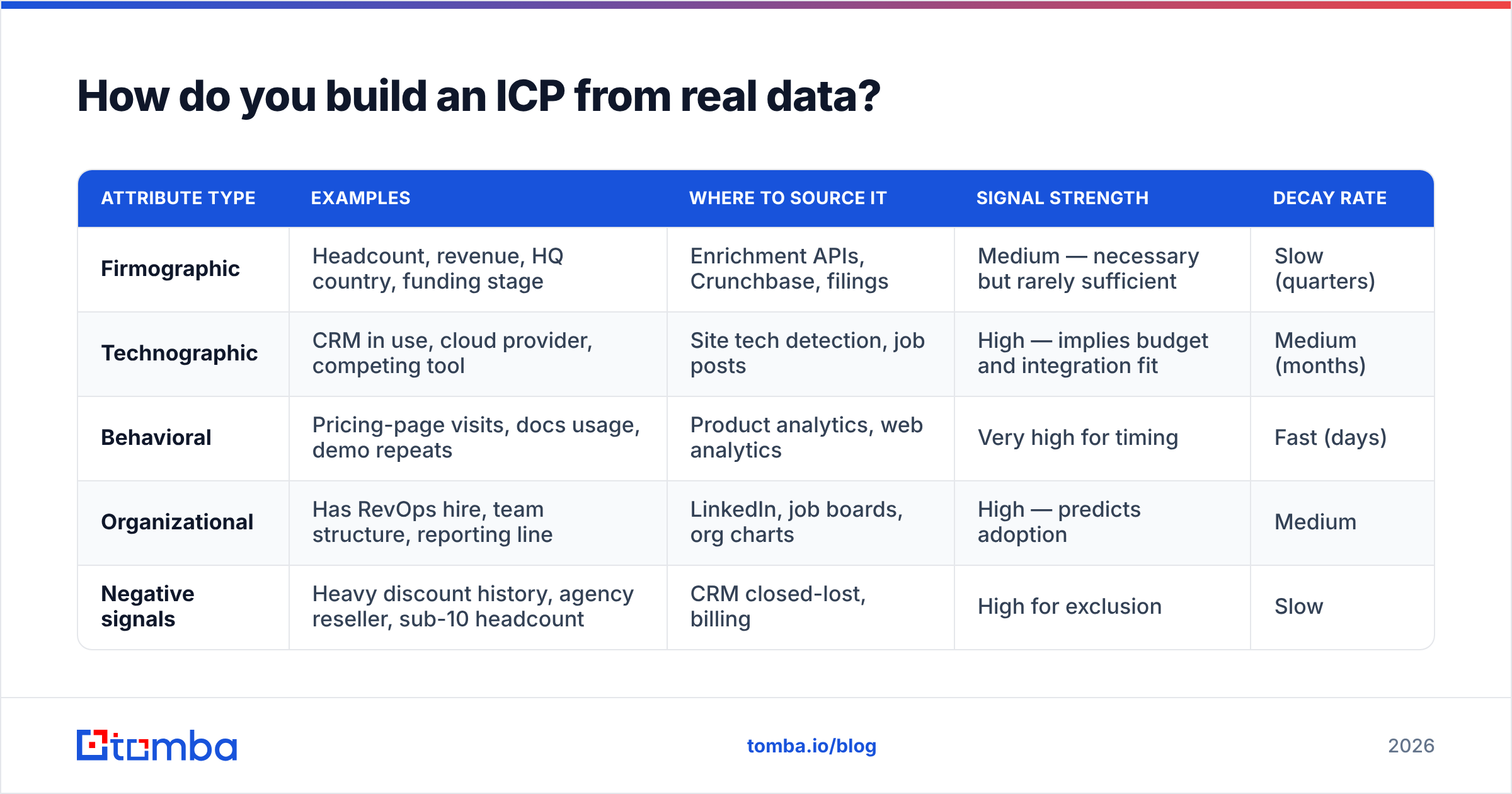
How do you build an ICP from real data?#
Start with the accounts you already won and kept. Everything else is downstream.
Step 1 — Pull your best-customer cohort. Take every account that has been a customer for at least 12 months, then rank by a composite of net revenue retention, gross margin, and support cost. Keep the top quartile. If you have fewer than 20 customers, use the top 10 by NRR and accept the sample is thin.
Step 2 — Pull your worst cohort too. Churned accounts, heavy-discount deals, and support black holes. The negative ICP is often more actionable than the positive one, because exclusions are easier to enforce in an ad platform than inclusions.
Step 3 — Find attributes that separate the two groups. Run through firmographics (employee count, revenue band, funding stage, geography, industry), technographics (what's in their stack), and behavioral signals (did they have a dedicated ops hire? did they arrive through a partner?). You're looking for attributes where the two cohorts diverge sharply — not attributes that describe both.
Step 4 — Cut to 5–8 attributes. Every attribute you add shrinks your addressable list and adds a field somebody has to populate. Discipline here is what makes the ICP usable.
Step 5 — Tier it. Tier 1 hits every attribute. Tier 2 hits most and is worth a lighter touch. Tier 3 is "will sell to if inbound." Tiering prevents the all-or-nothing trap where a near-perfect account gets ignored because it missed one box.
Step 6 — Encode and enrich. Write the tier onto every account record and enrich the gaps. This is where most teams stall: they know the definition but have no employee-count or tech-stack field on 60% of accounts. Automated data enrichment fills that in so the segmentation is real rather than theoretical.
Attribute types, compared#
| Attribute type | Examples | Where to source it | Signal strength | Decay rate |
|---|---|---|---|---|
| Firmographic | Headcount, revenue, HQ country, funding stage | Enrichment APIs, Crunchbase, filings | Medium — necessary but rarely sufficient | Slow (quarters) |
| Technographic | CRM in use, cloud provider, competing tool | Site tech detection, job posts | High — implies budget and integration fit | Medium (months) |
| Behavioral | Pricing-page visits, docs usage, demo repeats | Product analytics, web analytics | Very high for timing | Fast (days) |
| Organizational | Has RevOps hire, team structure, reporting line | LinkedIn, job boards, org charts | High — predicts adoption | Medium |
| Negative signals | Heavy discount history, agency reseller, sub-10 headcount | CRM closed-lost, billing | High for exclusion | Slow |
The pattern worth internalizing: firmographics tell you who, technographics tell you whether they can adopt, behavioral signals tell you when. An ICP built only on firmographics gives you a list with no timing, which is why so many ICP-driven campaigns feel like cold spray.
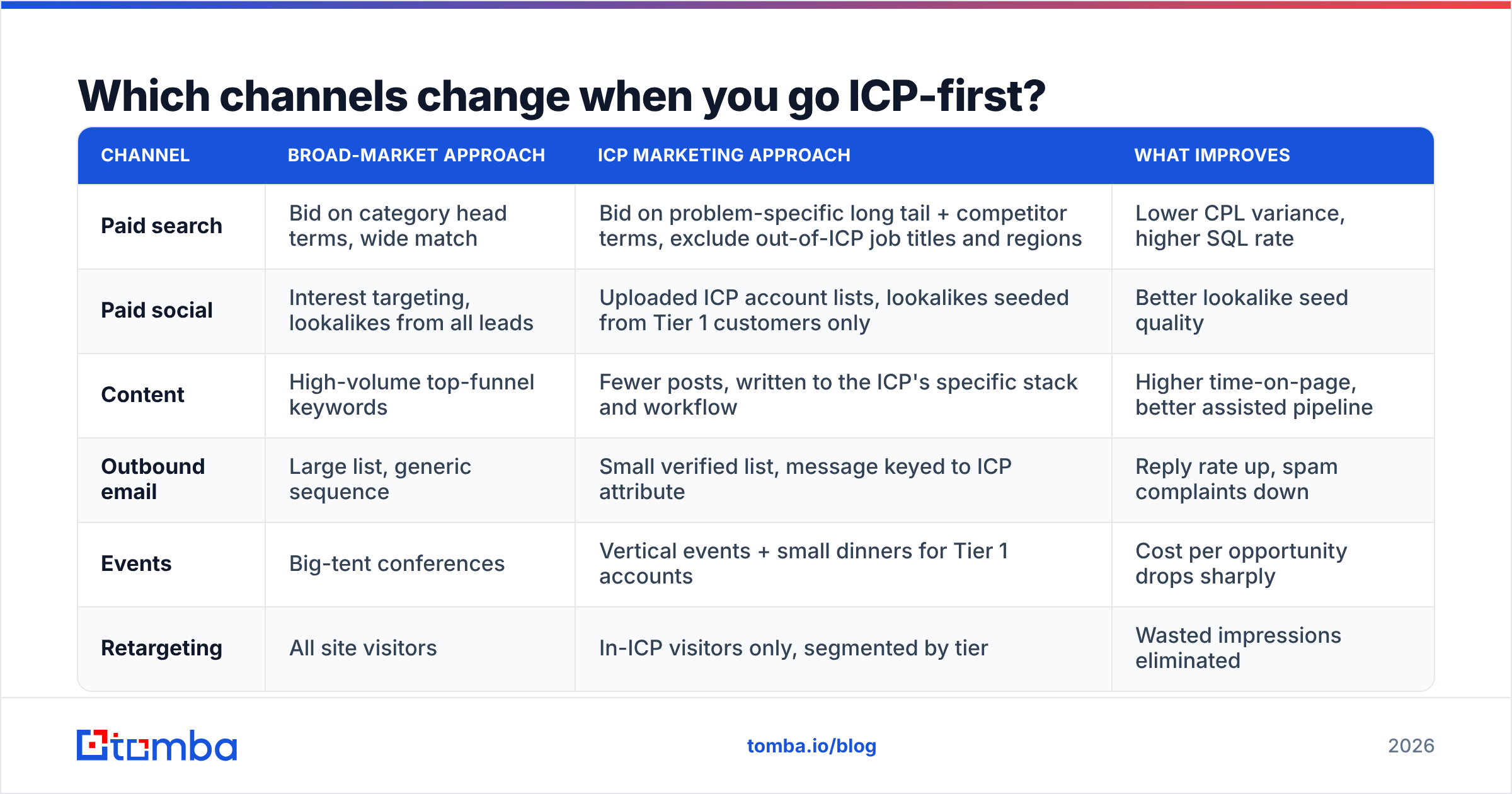
Which channels change when you go ICP-first?#
All of them, but in different directions. Here's the practical before/after.
| Channel | Broad-market approach | ICP marketing approach | What improves |
|---|---|---|---|
| Paid search | Bid on category head terms, wide match | Bid on problem-specific long tail + competitor terms, exclude out-of-ICP job titles and regions | Lower CPL variance, higher SQL rate |
| Paid social | Interest targeting, lookalikes from all leads | Uploaded ICP account lists, lookalikes seeded from Tier 1 customers only | Better lookalike seed quality |
| Content | High-volume top-funnel keywords | Fewer posts, written to the ICP's specific stack and workflow | Higher time-on-page, better assisted pipeline |
| Outbound email | Large list, generic sequence | Small verified list, message keyed to ICP attribute | Reply rate up, spam complaints down |
| Events | Big-tent conferences | Vertical events + small dinners for Tier 1 accounts | Cost per opportunity drops sharply |
| Retargeting | All site visitors | In-ICP visitors only, segmented by tier | Wasted impressions eliminated |
Two of these deserve extra attention.
Content. ICP marketing changes what you write, not just who sees it. A broad-market blog answers "what is lead scoring." An ICP-first blog answers "how to score leads in HubSpot when your SDR team is three people and your deal cycle is 40 days." The second ranks for less volume and converts a great deal better, because it names the reader's actual situation.
Outbound. This is where ICP definition meets data hygiene hardest. A tight ICP produces a smaller list, which means every record has to be right — you can't bury bad data under volume anymore. Running that list through an email verifier before send is no longer optional housekeeping; with a 400-account Tier 1 list, a 12% bounce rate is 48 accounts you may never get a second shot at. Pair that with a domain search to map who's actually reachable at each target account before you commit budget to the segment.
How do you measure whether ICP marketing is working?#
Segment every metric you already track by ICP fit. That single change surfaces problems that aggregate reporting hides.
The core scorecard:
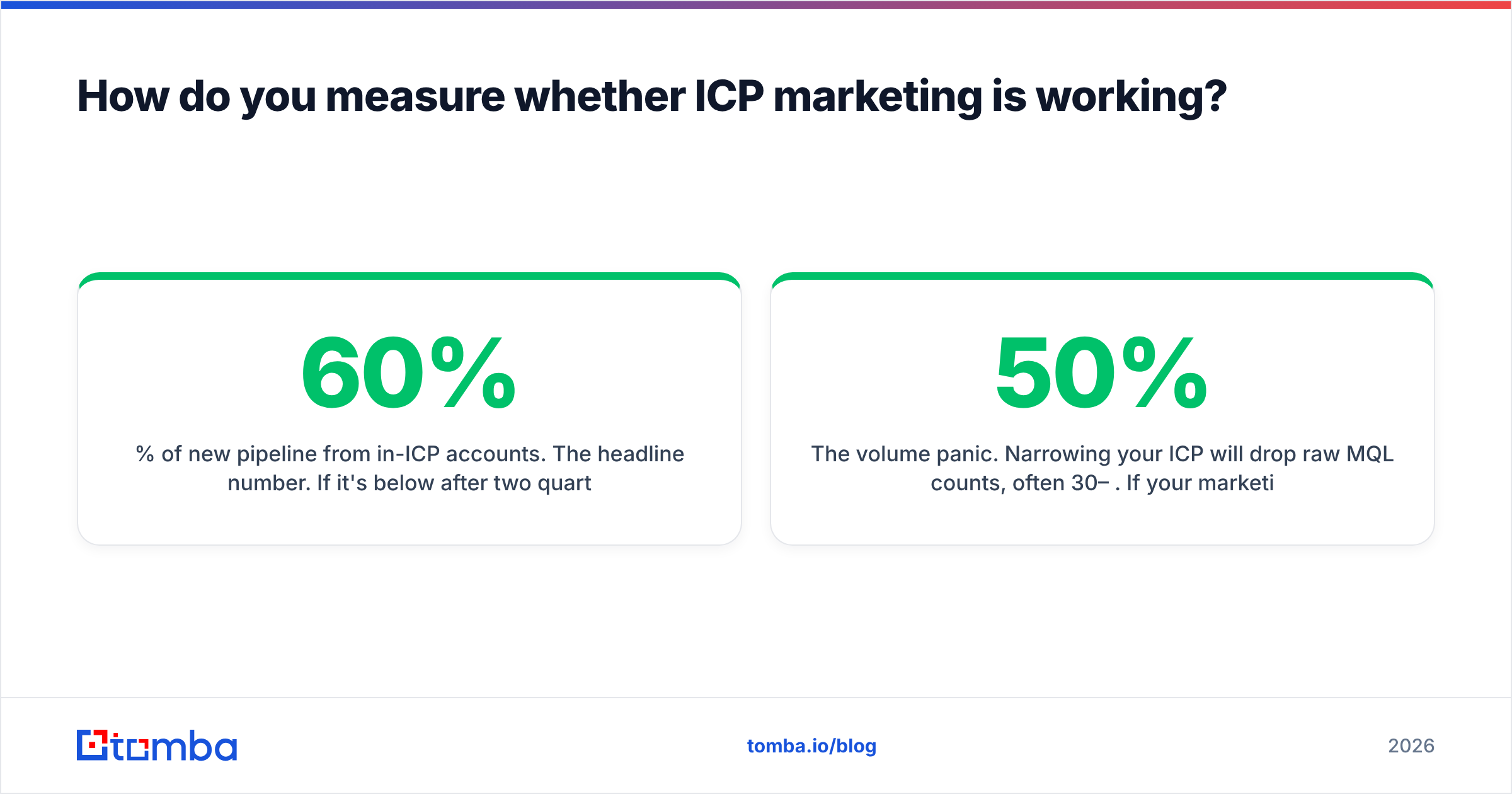
- % of new pipeline from in-ICP accounts. The headline number. If it's below 60% after two quarters of ICP-first work, your targeting isn't reaching the platforms.
- Win rate: in-ICP vs. out-of-ICP. If these are similar, your ICP definition isn't discriminating and needs rebuilding. A healthy gap is meaningful — often 1.5–2x.
- Sales cycle length by tier. In-ICP deals should close faster. If they don't, you've defined fit by who buys rather than who fits.
- CAC payback by segment. The number that justifies narrowing. Out-of-ICP customers frequently cost more to acquire and churn sooner, so their true payback is far worse than blended CAC suggests.
- Net revenue retention by cohort. The 18-month validator. Your ICP is correct when the accounts it predicted would expand actually expanded.
Two traps to avoid.
The volume panic. Narrowing your ICP will drop raw MQL counts, often 30–50%. If your marketing team is compensated on lead volume, ICP marketing will be sabotaged from inside the building before it gets a fair test. Change the comp metric first, or don't start.
The vanity ICP. Teams sometimes define the ICP as their aspirational enterprise buyer rather than their actual best customer. If your ICP says "Fortune 500" but your NRR champions are 120-person companies, you've written a fundraising slide, not a targeting instruction.
Forrester's B2B research has argued for years that account-level alignment between marketing and sales outperforms lead-level handoffs — ICP fit scoring is the mechanism that makes that alignment concrete rather than aspirational. Related: understanding what qualifies as a marketing qualified lead in an ICP-first model usually means rewriting your MQL definition to include a fit threshold, not just an activity score.
What does ICP marketing look like operationally, week to week?#
Here's the honest workflow, which is less glamorous than the frameworks suggest:
- Monday — list build. Pull accounts matching Tier 1 criteria from your data source. Enrich missing firmographic fields. Deduplicate against existing CRM accounts and open opportunities.
- Tuesday — contact mapping. For each account, identify the 3–5 buying-committee roles. Find and verify contact details. Anything unverified stays out of the send.
- Wednesday — message assembly. Group the list by the ICP attribute that triggered inclusion (stack, funding event, headcount jump) and write one message per group. Not per account — per attribute group. That's the sustainable middle ground between generic and hand-crafted.
- Thursday — channel sync. Push the account list into your ad platforms as a matched audience, tag it in the CRM, and give the SDR team the same list so paid and outbound hit the same accounts in the same window.
- Friday — measure and prune. Check reply rate and bounce rate by attribute group. Attribute groups with poor engagement get cut from next week's build. This is how your ICP self-corrects.
The bottleneck in that loop is almost always step 2. Building a clean list of 300 accounts is a spreadsheet exercise; finding verified contacts for 1,200 people inside those accounts is a data problem. Teams that automate it with a bulk email finder run the loop weekly. Teams that do it manually run it once a quarter and lose the compounding benefit.
For a sense of scale on why account-based approaches keep winning budget, G2's category data shows sustained growth in ABM tooling adoption — which is essentially ICP marketing with a bigger budget line and a software category attached.
What's the difference between ICP marketing and ABM?#
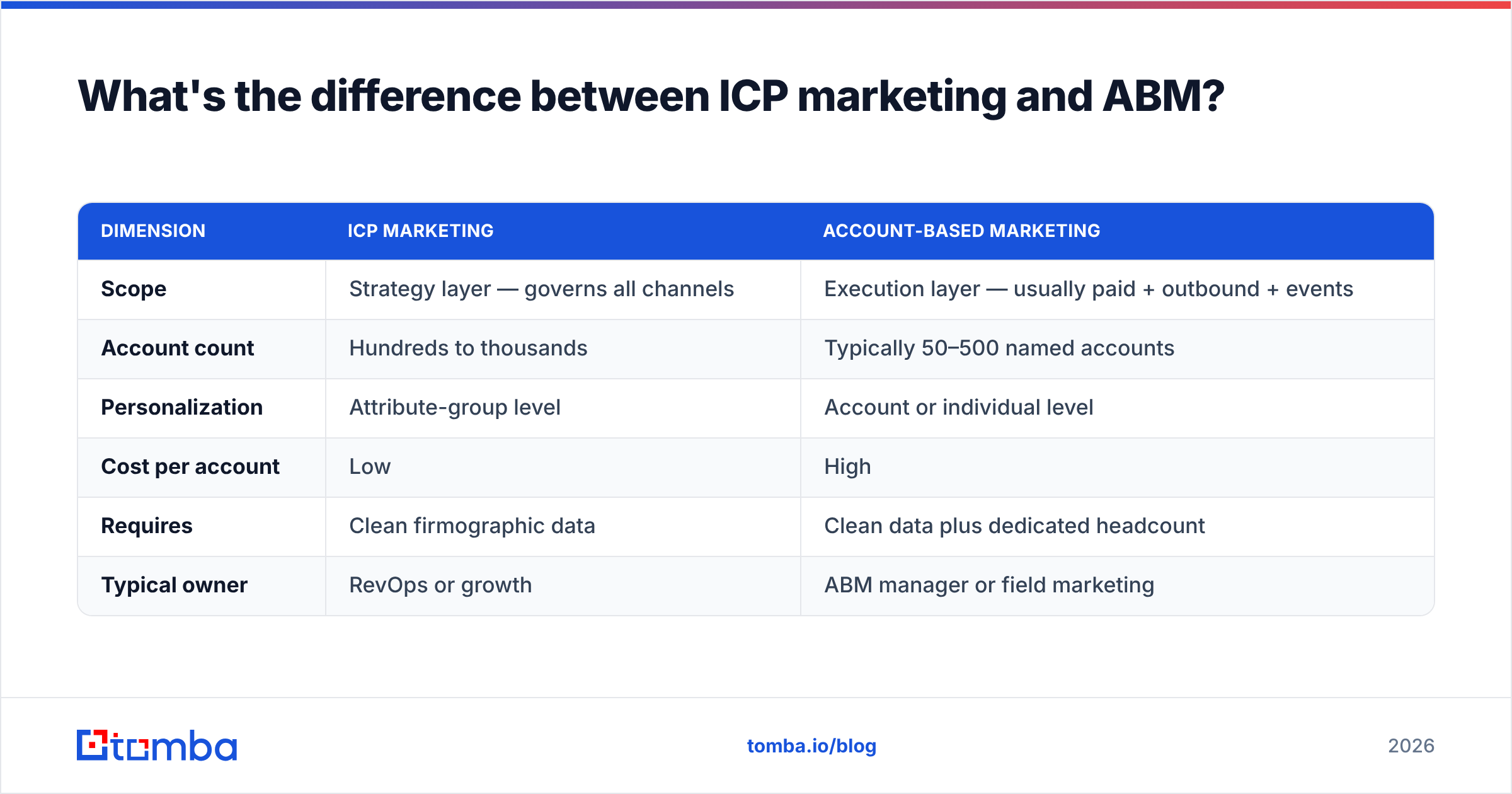
ABM is a subset. ICP marketing defines who deserves attention; ABM is one high-touch tactic for reaching them once defined.
| Dimension | ICP marketing | Account-based marketing |
|---|---|---|
| Scope | Strategy layer — governs all channels | Execution layer — usually paid + outbound + events |
| Account count | Hundreds to thousands | Typically 50–500 named accounts |
| Personalization | Attribute-group level | Account or individual level |
| Cost per account | Low | High |
| Requires | Clean firmographic data | Clean data plus dedicated headcount |
| Typical owner | RevOps or growth | ABM manager or field marketing |
You can run ICP marketing without ABM. You cannot run ABM well without an ICP — you'll just spend expensive personalization budget on the wrong logos. If you're building the discipline from scratch, sequence it: define ICP, encode tiers, run ICP-filtered demand gen, and only then layer ABM onto the Tier 1 slice.
This connects directly to your broader revenue operations practice. The ICP is a RevOps asset more than a marketing one, because RevOps owns the fields, the routing rules, and the reporting that make it enforceable across teams.
What should you do in your first 30 days?#
Week 1. Export closed-won and churned accounts. Identify the top and bottom cohorts. Resist the urge to define anything yet.
Week 2. Find the separating attributes. Cut to 5–8. Draft tier definitions with explicit thresholds — "80–250 employees," not "mid-market."
Week 3. Create the ICP tier field in your CRM. Enrich and backfill existing accounts. Accept that coverage will be incomplete on the first pass; fill the highest-value gaps first.
Week 4. Rebuild one campaign — just one — as ICP-filtered. Pick the channel with the clearest measurement, usually paid social or outbound. Run it for four weeks against your existing broad campaign and compare SQL rate, not lead volume.
If the ICP-filtered version wins on SQL rate and pipeline quality, you have the internal evidence to change the rest of the channel mix. If it doesn't, your attribute selection is wrong and you go back to week 2 — which is a far cheaper failure than rebuilding the whole funnel on a bad definition.
Getting the contact data your ICP depends on#
An ICP is only as operational as the records behind it. Once you know your Tier 1 profile, the work becomes mechanical: identify matching companies, find the buying-committee contacts inside them, verify those contacts, and push clean records into your campaigns each week.
Tomba's Email Finder is built for exactly that step — search by company domain, name, or role to pull verified professional email addresses for the accounts your ICP just qualified, then verify and enrich in the same workflow. The free tier gives you 25 searches a month to test the fit against your own account list; paid plans start at $49/mo for Starter and $99/mo for Growth when you're running weekly list builds at volume. Full Tomba pricing is public, and the Tomba API lets you wire enrichment directly into whatever your ICP scoring lives in — no manual export step, no stale fields, no ICP that only exists on a slide.
Related guides#
// get started
Find, verify and enrich your first contacts today
Start on the free plan with 25 searches a month, then scale when your team is ready.
Free plan · No credit card required · GDPR & CCPA
Get the Tomba newsletter
Product and data updates
// about the author