ICP Meaning Software Teams Use: Ideal Customer Profile
"ICP" means at least five different things in software. This guide untangles them, then shows you how to build the one that actually moves revenue: the Ideal Customer Profile.
The ICP meaning software teams need is short: ICP stands for Ideal Customer Profile. It names the company that gets the most value from your product. Four other meanings float around tech, so this guide clears those out of the way first.
TL;DR
- In B2B, the ICP meaning software teams need is Ideal Customer Profile — the company that gets the most value from your product fastest. It is not a persona, and it is not your TAM.
- Four other "ICP"s exist in tech (Internet Computer Protocol, China's ICP license, inductively coupled plasma software, in-circuit programming). Context tells you which one you're reading about in about three seconds.
- A usable ICP has five layers: firmographic, technographic, behavioural, economic, and operational. Anything with fewer than three layers is a segment, not an ICP.
- Build it from your existing best customers, not from a whiteboard. Twenty closed-won accounts beat any amount of planning.
- An ICP only pays off once it becomes a filter your data stack can execute — domain lists, tech signals, verified contacts.
The ICP meaning software teams need (and 4 others)#
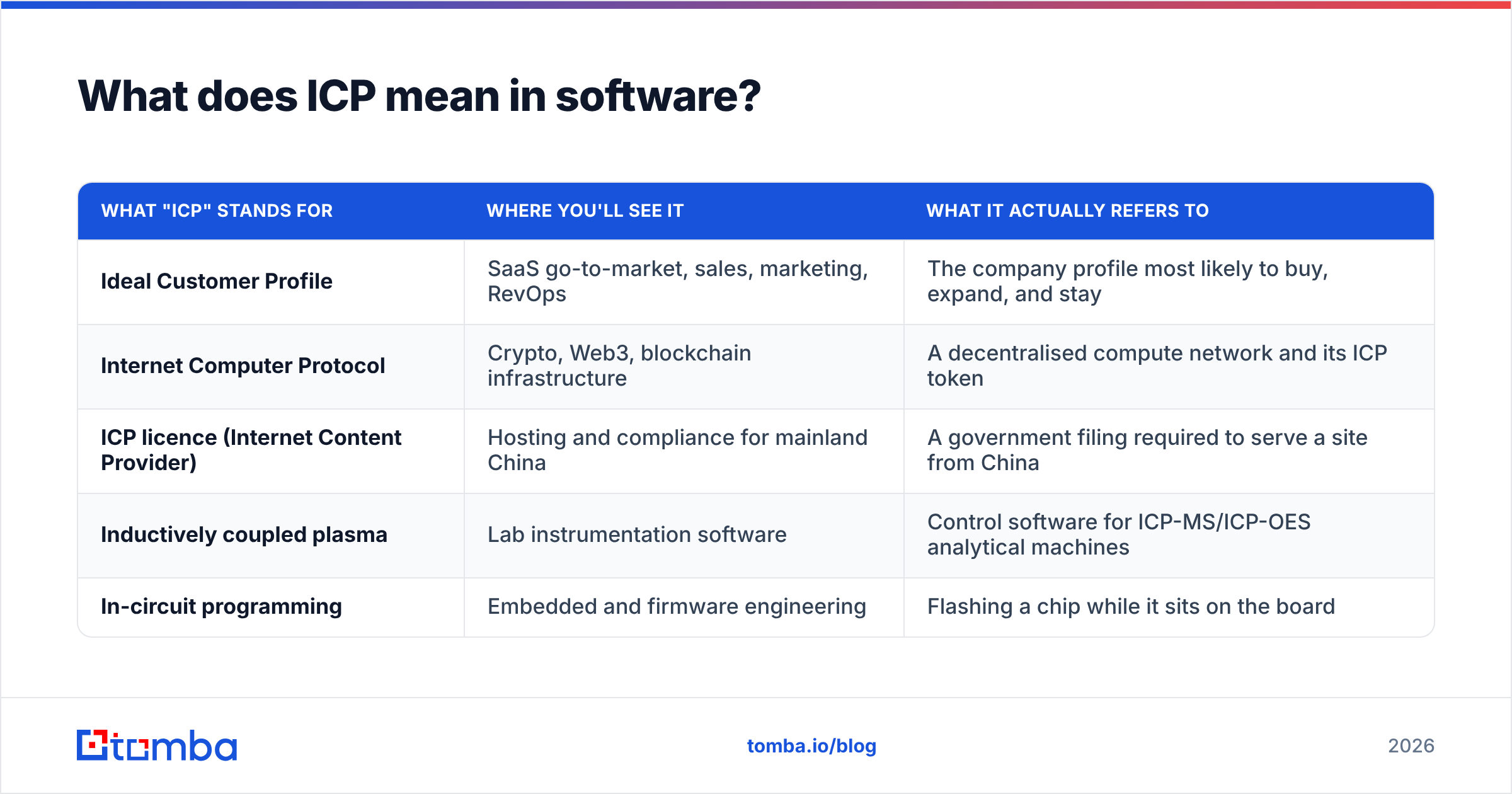
It depends on which corner of software you're standing in. The ICP meaning software sellers use is one of five, and mixing them up wastes a surprising amount of time in search results and internal docs.
| What "ICP" stands for | Where you'll see it | What it actually refers to |
|---|---|---|
| Ideal Customer Profile | SaaS go-to-market, sales, marketing, RevOps | The company profile most likely to buy, expand, and stay |
| Internet Computer Protocol | Crypto, Web3, blockchain infrastructure | A decentralised compute network and its ICP token |
| ICP licence (Internet Content Provider) | Hosting and compliance for mainland China | A government filing required to serve a site from China |
| Inductively coupled plasma | Lab instrumentation software | Control software for ICP-MS/ICP-OES analytical machines |
| In-circuit programming | Embedded and firmware engineering | Flashing a chip while it sits on the board |
If you landed here from a sales, marketing, or RevOps context, you want the first row. The rest of this guide is about that one. If you meant the blockchain, the Internet Computer's official site is the right place to go. If you meant the Chinese filing rule, Wikipedia's ICP licence page covers it.
Everyone else: stay. The Ideal Customer Profile is the highest-leverage document in a software company's go-to-market stack, and most teams write a bad one.
What is an Ideal Customer Profile in SaaS, exactly?#
An ICP is a description of the account — the company — that your product serves better than any alternative. It answers one question: if we could only sell to 500 companies on earth, which 500?
A real ICP has five layers. Miss three of them and you've written a market segment with extra steps.
- Firmographic fit — headcount, revenue band, industry, geography, funding stage. The boring layer, but the one your list-building runs on.
- Technographic fit — what they already run. A billing tool that only works on Stripe has a technographic ICP, whether the team admits it or not.
- Behavioural fit — signs that the pain is live right now: a new job post, a second office, a stack migration, a public complaint.
- Economic fit — can they pay without a committee? A $2,400/year tool is a card swipe at a 40-person company. The same tool at $60,000/year is a six-month procurement cycle.
- Operational fit — do they have the people to get value? Sell a data platform to a company with no analyst and you manufacture churn.
Write those five layers with concrete thresholds and you have an ICP. Write "mid-market B2B SaaS companies in North America" and you have a wish.

Is an ICP the same as a buyer persona or TAM?#
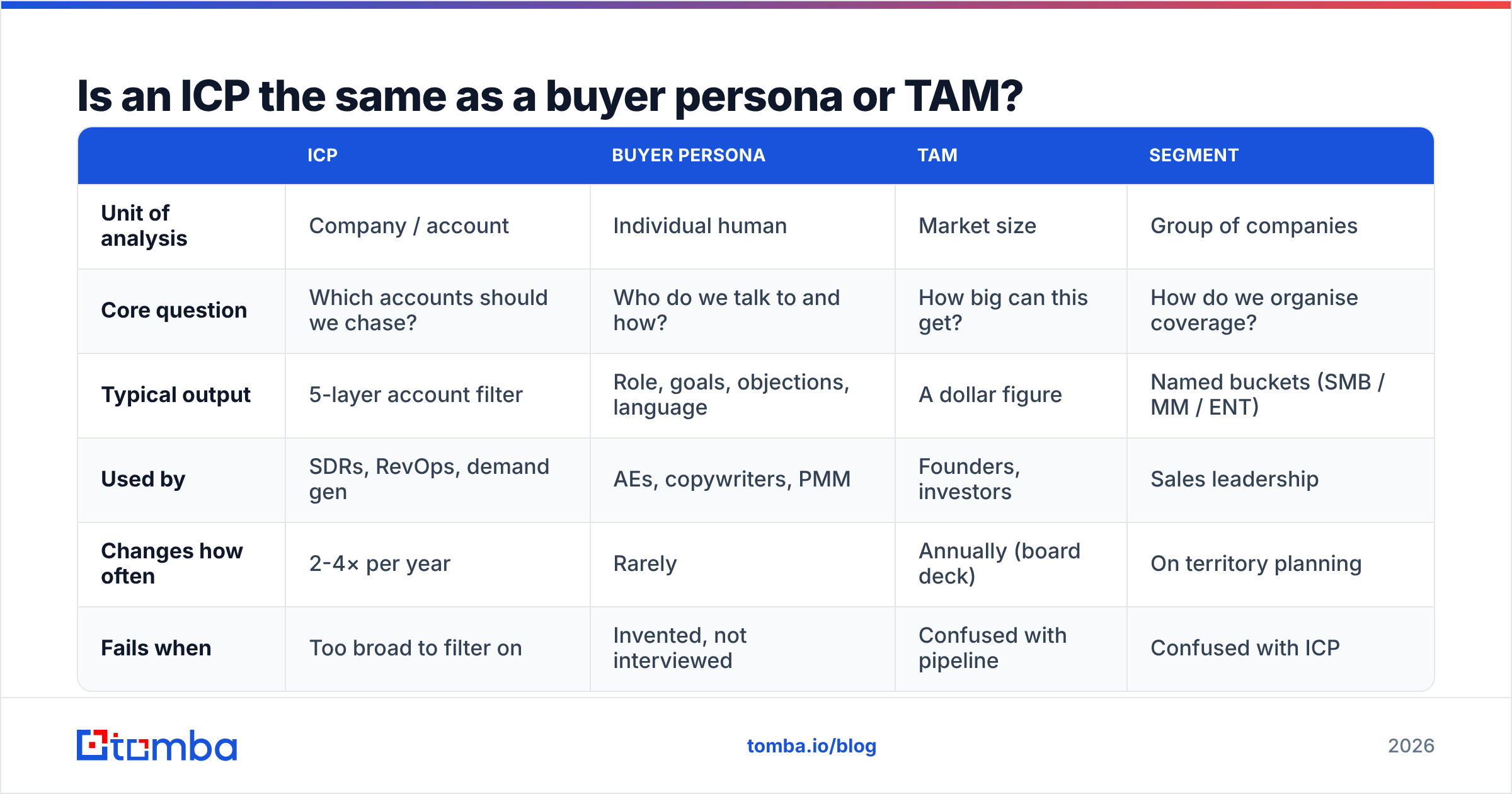
No. The ICP meaning software teams work with is account-level; a persona is one human inside that account. The mix-up is expensive, because these four artefacts answer four different questions and get used at four different moments.
| ICP | Buyer persona | TAM | Segment | |
|---|---|---|---|---|
| Unit of analysis | Company / account | Individual human | Market size | Group of companies |
| Core question | Which accounts should we chase? | Who do we talk to and how? | How big can this get? | How do we organise coverage? |
| Typical output | 5-layer account filter | Role, goals, objections, language | A dollar figure | Named buckets (SMB / MM / ENT) |
| Used by | SDRs, RevOps, demand gen | AEs, copywriters, PMM | Founders, investors | Sales leadership |
| Changes how often | 2-4× per year | Rarely | Annually (board deck) | On territory planning |
| Fails when | Too broad to filter on | Invented, not interviewed | Confused with pipeline | Confused with ICP |
The practical rule: ICP tells you which door to knock on, persona tells you what to say when it opens. You need both, in that order. HubSpot's ideal customer profile guide draws the same line. It is worth 10 minutes if your team keeps merging the two documents.
TAM is a fundraising number. It's fine that it's optimistic. Just never let it into your prospecting filters. TAM-shaped lists are how reps end up emailing 12,000 companies that will never buy.
How do you build an ICP for a software company?#
Start from evidence, not from a strategy offsite. The work takes about a week if you're honest about the data.
Step 1 — Pull your 20 best customers. Not your 20 biggest. Best means some mix of: fast to close, high net revenue retention, low support load, expanded at least once, and happy to be a reference. If you have fewer than 20 customers, use 10 and accept the wider error bars.
Step 2 — Pull your 20 worst. Churned inside 12 months, discounted heavily, or eating support hours out of all proportion to ARR. This list teaches you more than the first one, because ICPs are mostly defined by exclusions.
Step 3 — Diff the two lists across the five layers. Employee count, industry, stack, funding, buyer seniority, how they found you, how long buying took. Look for traits that show up in eight of the good accounts and zero of the bad ones. Those are your qualifiers.
Step 4 — Write thresholds, not adjectives. "50-400 employees, Series A-C, runs HubSpot or Salesforce, has at least two people with 'RevOps' or 'Sales Ops' in their title, US/UK/DACH" is executable. "Growth-stage companies that value data" is not.
Step 5 — Size it. Count how many companies actually match. If the answer is 90, your ICP is a target account list and you should sell it like one. If the answer is 400,000, you haven't finished narrowing.
Step 6 — Turn it into a query. This is where most ICP documents die. A profile that lives in a Notion page changes nothing. A profile encoded as a repeatable list-build changes everything.
What data do you need to run your ICP?#
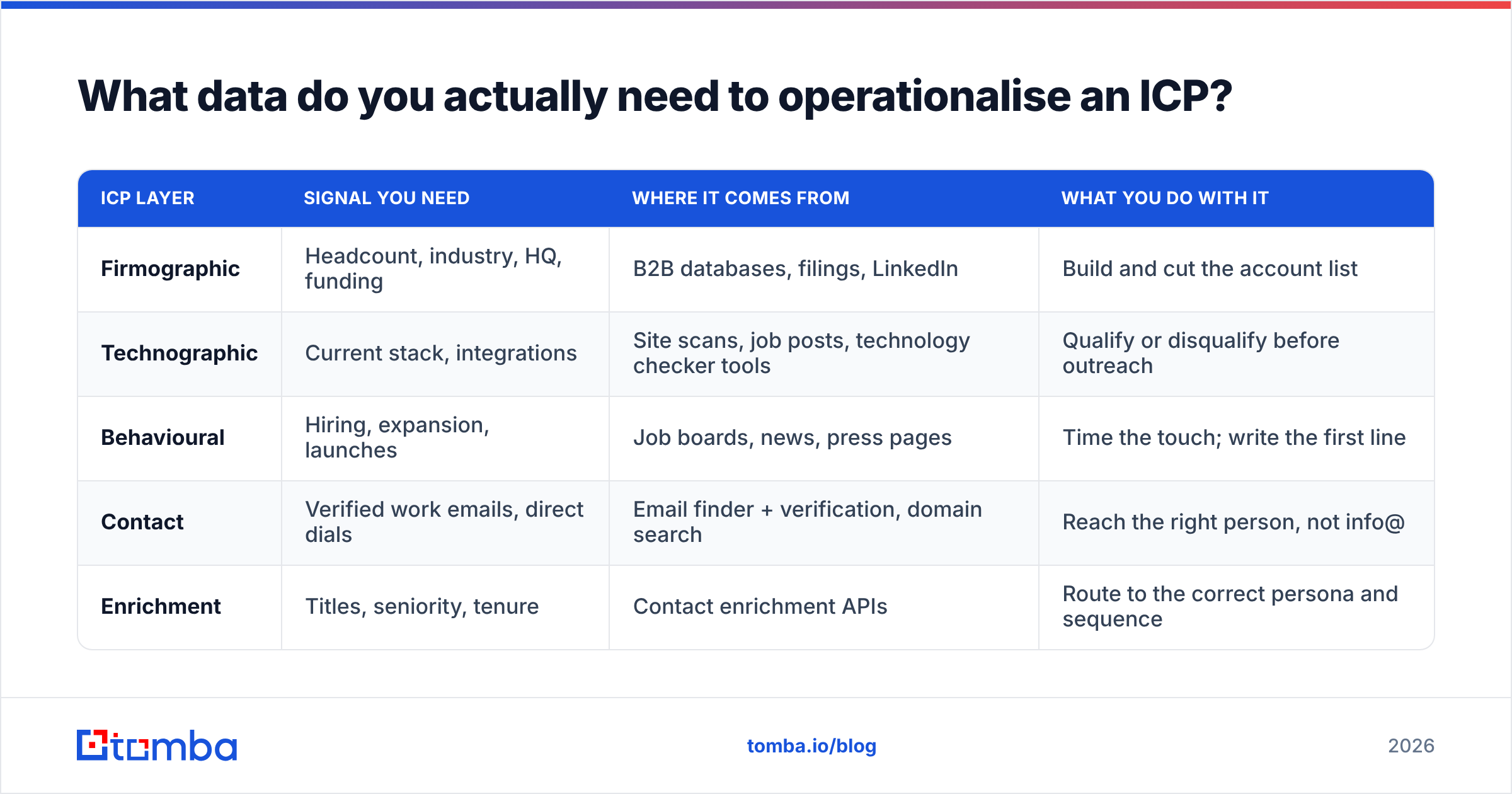
Every ICP layer maps to a signal, a source, and an action. If a layer has no source, it isn't a criterion — it's a hope.
| ICP layer | Signal you need | Where it comes from | What you do with it |
|---|---|---|---|
| Firmographic | Headcount, industry, HQ, funding | B2B databases, filings, LinkedIn | Build and cut the account list |
| Technographic | Current stack, integrations | Site scans, job posts, technology checker tools | Qualify or disqualify before outreach |
| Behavioural | Hiring, expansion, launches | Job boards, news, press pages | Time the touch; write the first line |
| Contact | Verified work emails, direct dials | Email finder + verification, domain search | Reach the right person, not info@ |
| Enrichment | Titles, seniority, tenure | Contact enrichment APIs | Route to the correct persona and sequence |
Two honest notes on tooling. First, no single vendor is best at all five rows. Most teams end up with a database for firmographics, a scanner for tech signals, and a dedicated finder-plus-verifier for contact data. Providers like BookYourData are strong on pre-built, filterable contact lists when you want volume by geography and industry. A search-and-verify tool is better when you already know the exact 800 domains you care about. Both work; the choice depends on whether your ICP is broad or surgical.
Second, verification isn't optional at this layer. An ICP list with a 22% bounce rate still torches your sender reputation. Once that's damaged, the quality of your targeting stops mattering.
What does a good software ICP look like in practice?#
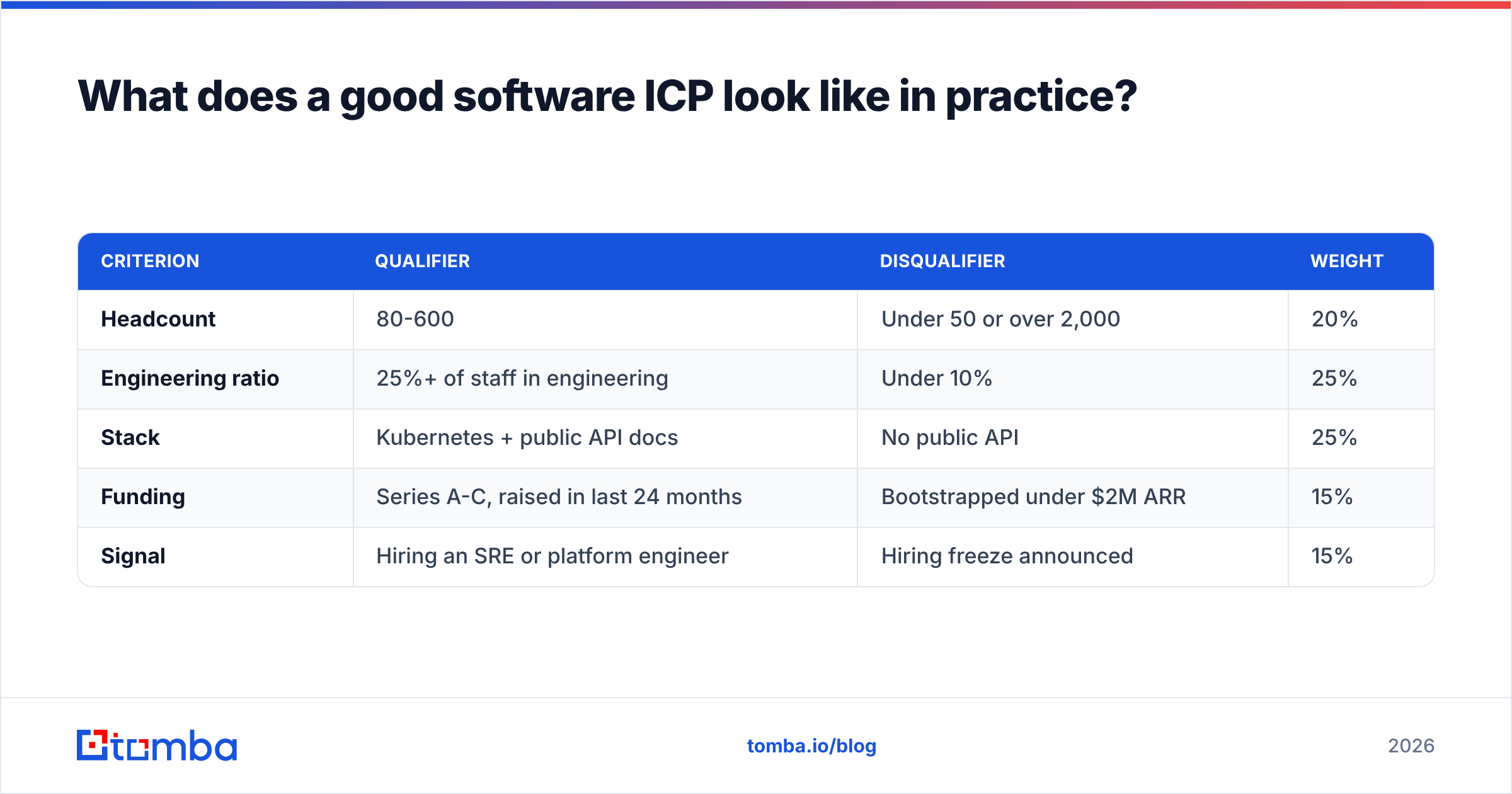
Here's a worked example for a fictional API observability product priced at $18,000 ACV. Notice that every line is checkable by a machine.
| Criterion | Qualifier | Disqualifier | Weight |
|---|---|---|---|
| Headcount | 80-600 | Under 50 or over 2,000 | 20% |
| Engineering ratio | 25%+ of staff in engineering | Under 10% | 25% |
| Stack | Kubernetes + public API docs | No public API | 25% |
| Funding | Series A-C, raised in last 24 months | Bootstrapped under $2M ARR | 15% |
| Signal | Hiring an SRE or platform engineer | Hiring freeze announced | 15% |
Score every account out of 100. Above 70 goes to the AE team with a custom first touch. Between 40 and 70 goes into a lighter nurture. Below 40 doesn't get contacted at all. That last rule is the one that produces the results. The biggest gain from an ICP isn't the accounts you add — it's the 60% of your list you delete.
Review sites help here too. Scan your competitors' recent reviews on G2 and you'll see which company sizes and industries are shopping in your category right now. It's a cheap stand-in for behavioural fit before you've built any signal tooling of your own.
How do you know your ICP is wrong?#
Five symptoms, in rough order of how often they show up:
- High reply rate, low meeting rate. People find your message interesting but the company can't act on it. Usually an economic or operational fit problem.
- Fast closes that churn in month seven. Your ICP describes who buys, not who succeeds. Add retention data to the diff in Step 3.
- Reps quietly building their own lists. The field has better ICP information than the document does. Interview them before you rewrite it.
- Win rates that vary 4× by segment. You have two ICPs pretending to be one. Split them and staff them differently.
- Every deal needs a custom demo. The product isn't ready for the profile you've chosen, or the profile is too wide.
None of these mean the exercise failed. An ICP is a hypothesis with a shelf life. The teams that treat it as one beat the teams that laminate it.
How often should you revisit your ICP?#
Quarterly review, annual rewrite — with two forced triggers in between: a pricing change and a major product release. Both shift economic and operational fit at once, and both get ignored until pipeline quality drops a quarter later.
Keep the review cheap. Re-run the good-20 / bad-20 diff on the last two quarters of closed deals, check whether your qualifiers still split the lists, and adjust thresholds. If they've stopped splitting anything, rebuild from scratch rather than tune.
One more habit worth adopting: log why an account was ruled out. Six months of those reasons is the best ICP research you will ever get, and it costs one dropdown field in your CRM.
Turning your ICP into an actual list#
The ICP meaning software teams should act on is the one that ships: a profile earns nothing until it produces contactable accounts. Once you've written your five layers and set your thresholds, the bottleneck moves to data. You need the companies that match, then the right humans inside them, at addresses that don't bounce.
That's the job Tomba Email Finder is built for. Feed it the domains your ICP filter produced, get verified work emails for the roles your persona work identified, and push them straight into your sequencer or CRM. The free tier gives you 25 searches a month to test list quality first. Paid plans start at $49/month for Starter, with Growth at $99/month and Pro at $249/month. Full Tomba pricing is on the site.
Define the profile once. Then let the data stack execute it every week.
Related guides#
// get started
Find, verify and enrich your first contacts today
Start on the free plan with 25 searches a month, then scale when your team is ready.
Free plan · No credit card required · GDPR & CCPA
// about the author