ICP Sales in 2026: How to Build an Ideal Customer Profile
Most ICP documents are firmographic wallpaper: company size, industry, region, done. Here is how high-performing teams build an ICP that actually predicts revenue, tier accounts against it, and keep it honest with closed-won data.
TL;DR
- ICP sales means selling against a defined Ideal Customer Profile — an account-level description of the companies that buy fastest, expand most, and churn least. It is not a persona and not your TAM.
- The single biggest failure mode is building the ICP from opinions instead of closed-won data. Pull your last 50 wins and your last 30 churns before you write a single criterion.
- A usable ICP has three layers: firmographic fit, operational fit (tech stack, team structure, workflow), and trigger fit (what changed recently). Layer one alone is why most ICP docs get ignored.
- Tier accounts into A/B/C instead of a binary in/out list. Tiering is what makes an ICP survive contact with a quota.
- Re-score the ICP quarterly. A profile built on 2024 win data is actively misleading by 2026.
What does ICP mean in sales?#
An Ideal Customer Profile is a description of the company that gets the most value from your product in the least amount of time — and therefore closes at the highest rate, at the best price, with the lowest churn risk.
Think of it like a restaurant deciding who to put on the reservation list on a Friday night. The buyer persona is the individual diner and what they order. The ICP is the table: party size, budget, how long they'll stay, whether they'll come back. You can love a diner and still know their party is wrong for your room.
Technically, an ICP is a weighted set of account-level attributes derived from historical revenue outcomes. It answers one question: given only what we can observe about a company before we talk to them, how likely is this to become a good customer?
That distinction matters because "ICP sales" as a practice is not a document exercise. It is a routing decision. Every ICP definition ends up controlling four things:
- Which accounts get sourced — what your SDRs and data providers are told to pull.
- Which inbound leads get worked — and which get a nurture sequence instead of a call.
- How territories get carved — account counts per rep, not just geography.
- What the forecast is allowed to include — off-ICP deals should be discounted, not celebrated.
If your ICP doesn't change at least one of those four, it's decoration.
How is an ICP different from a buyer persona or TAM?#
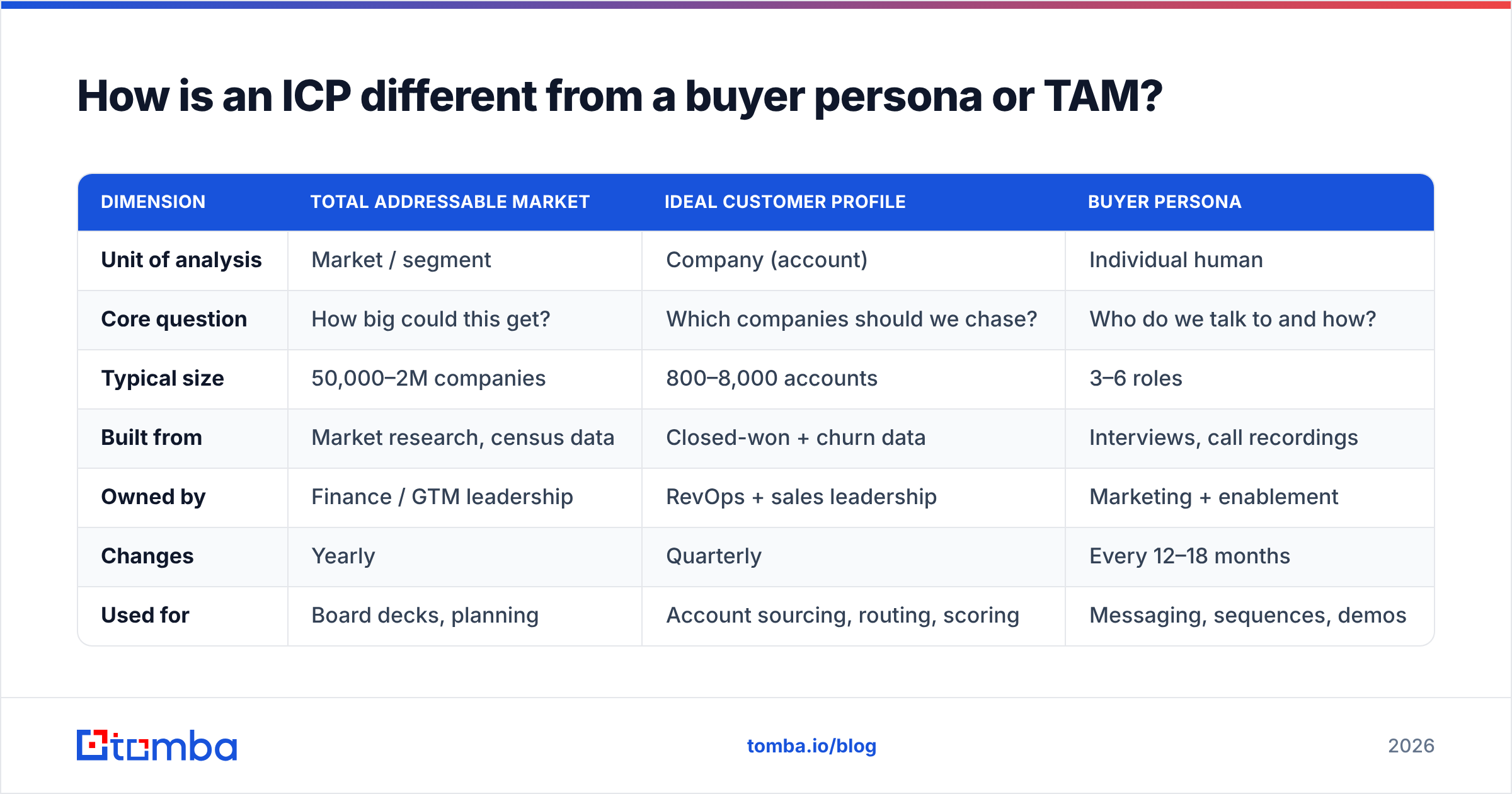
These three get used interchangeably in pipeline reviews, which is how teams end up with 40,000 "target accounts" and a 1.1% reply rate. They operate at different levels and answer different questions.
| Dimension | Total Addressable Market | Ideal Customer Profile | Buyer Persona |
|---|---|---|---|
| Unit of analysis | Market / segment | Company (account) | Individual human |
| Core question | How big could this get? | Which companies should we chase? | Who do we talk to and how? |
| Typical size | 50,000–2M companies | 800–8,000 accounts | 3–6 roles |
| Built from | Market research, census data | Closed-won + churn data | Interviews, call recordings |
| Owned by | Finance / GTM leadership | RevOps + sales leadership | Marketing + enablement |
| Changes | Yearly | Quarterly | Every 12–18 months |
| Used for | Board decks, planning | Account sourcing, routing, scoring | Messaging, sequences, demos |
The practical rule: TAM tells you the ceiling, ICP tells you the queue, persona tells you the script. Confusing the first two is what produces a "target list" that is really just a filtered database export.
A related trap is conflating ICP fit with lead quality. An account can be a perfect ICP match and still produce a terrible lead if the wrong contact fills out the form. Conversely, a strong marketing qualified lead from an off-ICP company is usually a distraction dressed as opportunity. Score them separately, then combine.
What data actually goes into an ICP?#
Three layers, in order of how much most teams neglect them.
Layer 1 — Firmographics (the part everyone does). Employee count, revenue band, industry or vertical, geography, funding stage, entity type. These are cheap to get and easy to filter on, which is exactly why they're overweighted. Firmographics narrow the field; they rarely predict the win.
Layer 2 — Operational fit (the part that predicts). Does the company run the systems your product attaches to? Do they have the role that owns your problem? Is the workflow you replace something they currently do manually? A 200-person company with a dedicated RevOps hire behaves nothing like a 200-person company where the VP Sales runs the CRM personally. Same firmographics, opposite outcomes.
Concrete operational signals worth tracking:
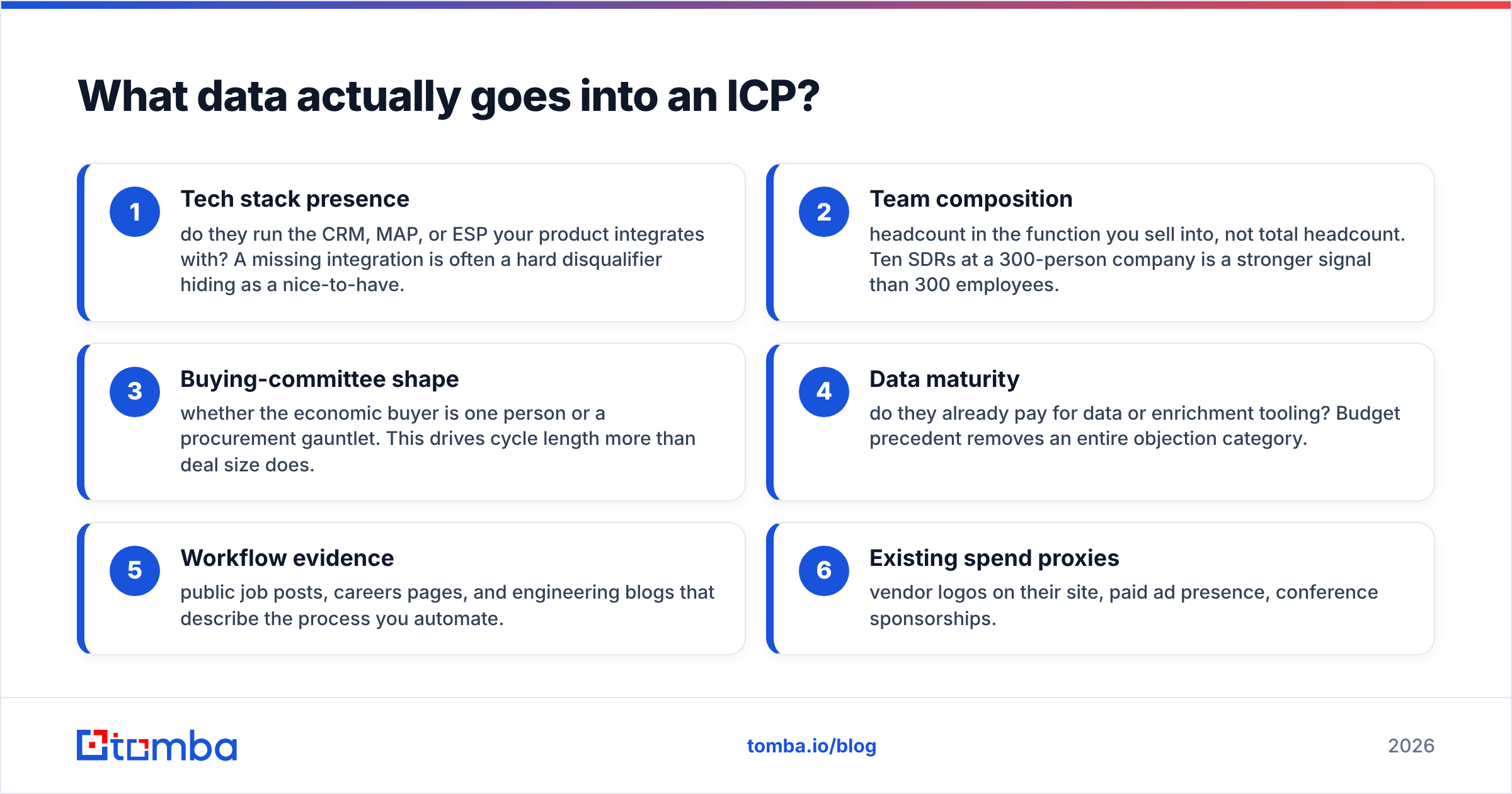
- Tech stack presence — do they run the CRM, MAP, or ESP your product integrates with? A missing integration is often a hard disqualifier hiding as a nice-to-have.
- Team composition — headcount in the function you sell into, not total headcount. Ten SDRs at a 300-person company is a stronger signal than 300 employees.
- Buying-committee shape — whether the economic buyer is one person or a procurement gauntlet. This drives cycle length more than deal size does.
- Data maturity — do they already pay for data or enrichment tooling? Budget precedent removes an entire objection category.
- Workflow evidence — public job posts, careers pages, and engineering blogs that describe the process you automate.
- Existing spend proxies — vendor logos on their site, paid ad presence, conference sponsorships.
Layer 3 — Triggers (the part that sets timing). ICP fit says whether; triggers say when. New funding, a leadership hire in your buying function, a merger, a compliance deadline, a competitor's price increase, a sudden hiring spike in the department you serve. A B-tier account with three live triggers outranks an A-tier account that's dormant.
Getting layers 2 and 3 at scale is a data problem, not a strategy problem. Firmographics come free with any provider; operational and trigger data usually requires stitching sources — a B2B database for the base record, data enrichment for the attributes you can't scrape, and technographic lookups for stack detection.
How do you build an ICP from your own data?#
Skip the workshop. Start with the ledger.
Step 1: Pull three cohorts. Your last 50 closed-won accounts, your last 30 churned or downgraded accounts, and your last 50 closed-lost accounts that reached at least stage 3. You need all three — wins alone create survivorship bias, and every ICP built only on wins over-indexes on whatever your best rep happened to prospect last year.
Step 2: Attribute every account. For each one, record the Layer 1 and Layer 2 attributes above, plus the outcome metrics: deal size, sales cycle length in days, time-to-first-value, net revenue retention at month 12, and support ticket volume. This is tedious. It is also the entire job. Budget a week.
Step 3: Look for separation, not correlation. You're hunting for attributes where the win cohort and the churn cohort look genuinely different. If 70% of your wins and 68% of your churns are both mid-market SaaS, "mid-market SaaS" is not an ICP criterion — it's a description of your existing pipeline habits.
Step 4: Weight and score. Assign points to the attributes that showed real separation. Keep it under ten criteria; scoring models with 30 inputs never get maintained. Then bucket the scores into tiers.
Step 5: Write the disqualifiers. The negative ICP is more useful than the positive one and takes ten minutes. Which company types have never worked? Write them down as hard exclusions so nobody re-litigates them in a pipeline review.
Step 6: Validate against a holdout. Score 30 accounts you didn't use to build the model and check whether the tiers actually sort by outcome. If A-tier and C-tier close at the same rate, your criteria are wrong. Rebuild before you roll out.
Gartner's sales research has been consistent on this point for years: the constraint on B2B growth is rarely activity volume, it's targeting precision. More dials against a bad list just accelerates the wrong outcome.
What does a good ICP tiering model look like?#
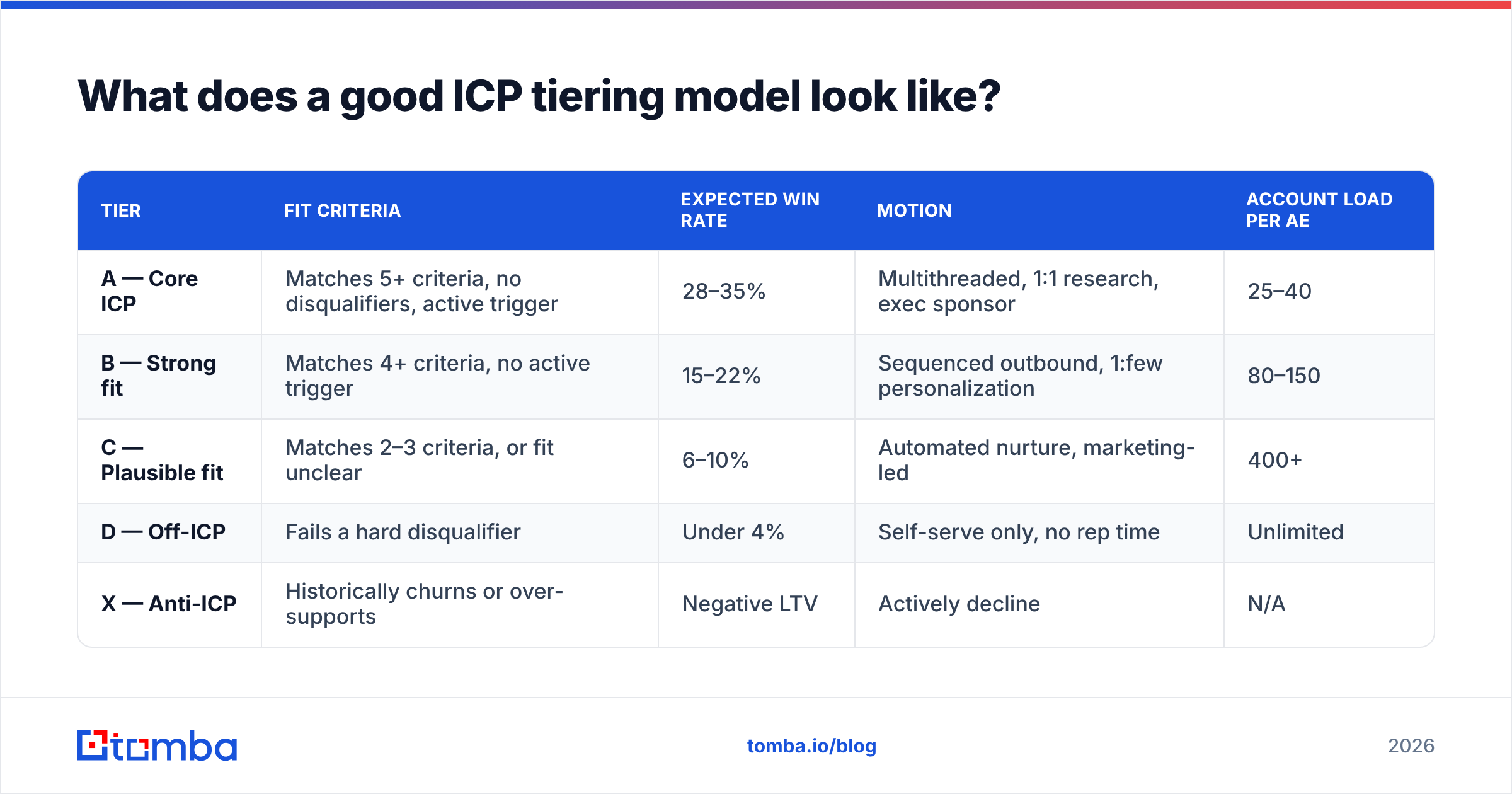
Binary in/out lists fail because reps ignore them. The moment a rep finds a promising account that's technically outside the profile, the whole document loses authority. Tiering solves this by giving every account a place.
| Tier | Fit criteria | Expected win rate | Motion | Account load per AE |
|---|---|---|---|---|
| A — Core ICP | Matches 5+ criteria, no disqualifiers, active trigger | 28–35% | Multithreaded, 1:1 research, exec sponsor | 25–40 |
| B — Strong fit | Matches 4+ criteria, no active trigger | 15–22% | Sequenced outbound, 1:few personalization | 80–150 |
| C — Plausible fit | Matches 2–3 criteria, or fit unclear | 6–10% | Automated nurture, marketing-led | 400+ |
| D — Off-ICP | Fails a hard disqualifier | Under 4% | Self-serve only, no rep time | Unlimited |
| X — Anti-ICP | Historically churns or over-supports | Negative LTV | Actively decline | N/A |
The X tier is the one most teams refuse to create, and it's the highest-leverage row in the table. Every company has a segment that buys enthusiastically, consumes disproportionate support, and leaves in month seven. Naming them out loud is worth more than any messaging refresh.
Notice that the tiers imply different data depth, not just different effort. A-tier accounts justify manual research and verified direct contacts. C-tier accounts justify a domain-level pull and nothing more. Spending A-tier data budget on C-tier accounts is the most common way ICP work quietly loses its ROI.
How do you turn an ICP into an actual account list?#
An ICP that lives in a Notion doc converts at zero percent. Operationalizing it means three concrete artifacts.
The sourcing filter. Translate your criteria into the exact query your data tooling accepts — employee range, SIC or NAICS codes, technologies detected, geography, funding recency. Run it and check the output count. If you get 200 accounts, your criteria are too tight for a full-time rep. If you get 90,000, you've written a TAM definition and called it an ICP.
The contact layer. Account fit is worthless without a reachable human. For each A-tier account, you need the two or three roles that make up the buying committee, with verified contact data attached. This is where domain search does the heavy lifting: you already know the company, you need the people and the email pattern. Then verify before sending — bounce rates on unverified B2B data routinely run 12–25%, which will wreck sender reputation faster than any subject line can save it. Run the list through an email verifier as a standing step, not an occasional one.
The scoring field in your CRM. Write the tier back to the account object as a real field, not a tag. Every routing rule, dashboard, and forecast filter should read from it. If your ICP tier isn't a queryable field, leadership can't measure whether ICP discipline is working — and unmeasured discipline decays in about a quarter.

Which data sources support ICP sales work?#
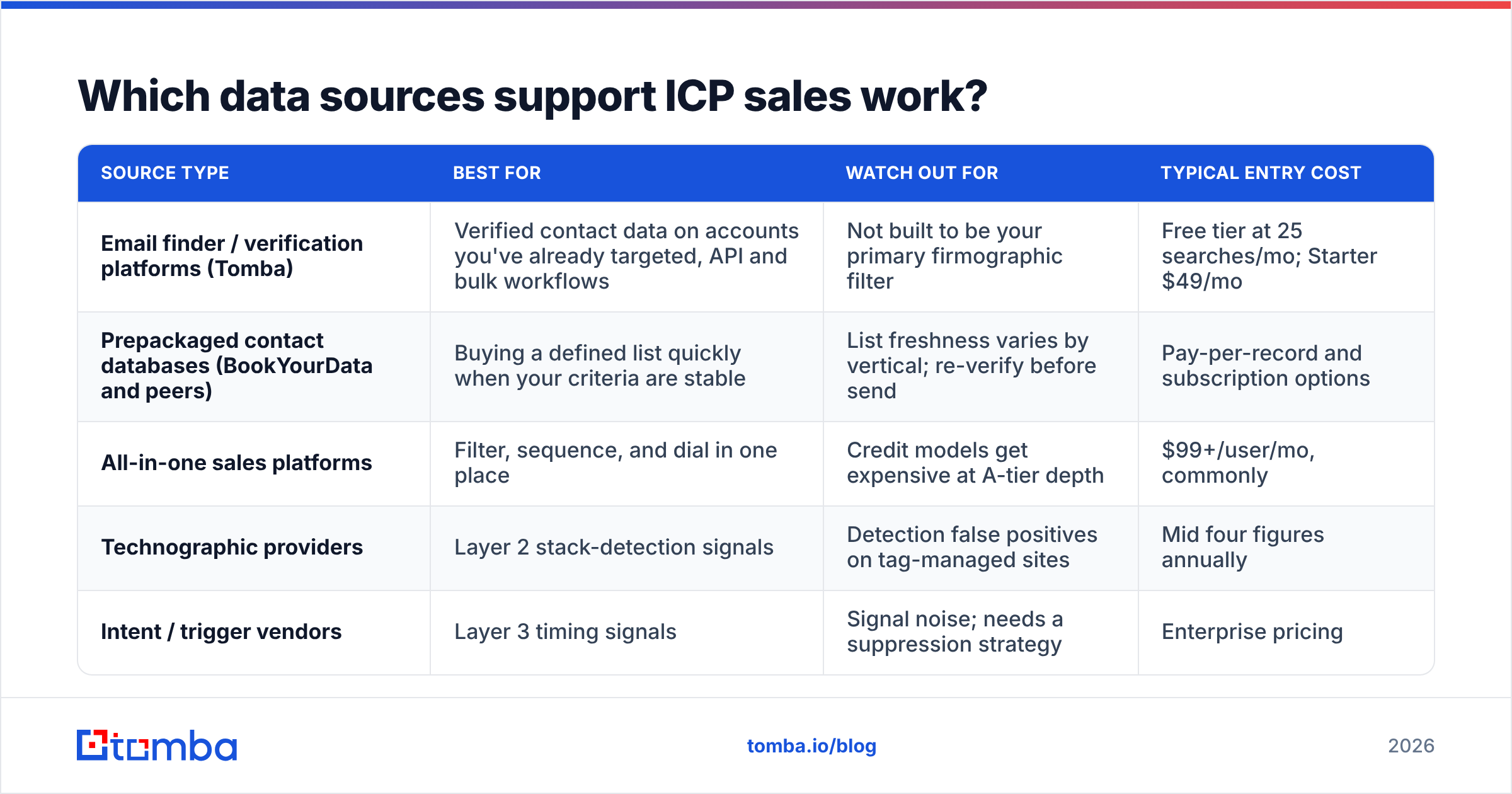
There is no single provider that covers firmographics, technographics, triggers, and verified contact data equally well. Most teams end up running two or three in combination, and the honest comparison is about coverage shape rather than a winner.
| Source type | Best for | Watch out for | Typical entry cost |
|---|---|---|---|
| Email finder / verification platforms (Tomba) | Verified contact data on accounts you've already targeted, API and bulk workflows | Not built to be your primary firmographic filter | Free tier at 25 searches/mo; Starter $49/mo |
| Prepackaged contact databases (BookYourData and peers) | Buying a defined list quickly when your criteria are stable | List freshness varies by vertical; re-verify before send | Pay-per-record and subscription options |
| All-in-one sales platforms | Filter, sequence, and dial in one place | Credit models get expensive at A-tier depth | $99+/user/mo, commonly |
| Technographic providers | Layer 2 stack-detection signals | Detection false positives on tag-managed sites | Mid four figures annually |
| Intent / trigger vendors | Layer 3 timing signals | Signal noise; needs a suppression strategy | Enterprise pricing |
A practical stack for most mid-market teams: one broad source for firmographic filtering, one contact-accuracy layer for the accounts that matter, and public signals (job boards, funding announcements, G2 category activity) for triggers. You do not need an intent vendor before you have a validated ICP — it will just make your bad list arrive faster.
If you're running the list-building step programmatically, the Tomba API handles the enrichment leg so your ICP scoring job can run on a schedule rather than as a quarterly manual export.
How often should you revisit your ICP?#
Quarterly review, annual rebuild.
The quarterly review is lightweight: pull the last 90 days of closed-won and closed-lost, score each against the current model, and check whether A-tier accounts actually outperformed B-tier. Two metrics matter — win rate by tier and cycle length by tier. If the spread has compressed, something in the market moved.
The annual rebuild is the full exercise from scratch, including the churn cohort. Products change, competitors reprice, and segments that were unprofitable in 2024 become viable once your onboarding improves. HubSpot's sales research and most vendor benchmark data point the same direction: teams that formally revisit targeting outperform teams that set it once, largely because the second group keeps optimizing messaging against a list that stopped being right.
Three signals that force an off-cycle rebuild:
- A pricing change. New price points move which company sizes can say yes.
- A major product release. If you shipped the feature that unblocked a segment, that segment's tier changed the day it went live.
- Two consecutive quarters of A-tier underperformance. That's not a rep problem, that's a model problem.
What are the most common ICP mistakes?#
Building it from the loudest customer. Your most vocal reference account is often an outlier — early adopter, unusual use case, personal relationship with a founder. One account is an anecdote, not a profile.
Making it aspirational. "Enterprise financial services" looks great on a slide and closes nothing if your last twelve wins were 80-person agencies. Build the ICP you have, then run a deliberate experiment to earn the one you want.
Ignoring the churn cohort. Wins tell you who buys. Churns tell you who shouldn't have. Only the second list protects net revenue retention.
Confusing fit with intent. A perfect-fit account with no trigger is a Q3 problem, not a Monday problem. Sequence them accordingly instead of burning your best contact data on accounts with nothing changing.
Letting the list rot. Contact data decays roughly 2–3% per month as people change roles. An ICP-perfect account list built nine months ago is a quarter of the way to useless. Re-verify before every major campaign, not after the bounces come back.
Where should you start this week?#
Pick the smallest version that produces a decision. Export your last 50 wins and 30 churns, attribute them against the three layers, and see whether any single criterion separates the cohorts. Most teams find one or two obvious splits in an afternoon — a headcount threshold, a missing integration, a role that has to exist for the deal to close. Those two criteria alone will out-target whatever list you're working from now.
Then attach real contacts to the accounts that survive. Fit without reachability is just a spreadsheet. Use the Tomba Email Finder to pull verified addresses for the buying committee at your A-tier accounts, run the rest through bulk verification, and keep the credits you'd have spent on C-tier volume for the accounts that actually score. The free tier covers 25 searches a month if you want to test the workflow on a single tier before committing; see Tomba pricing for the plan that matches your list volume.
A defined ICP doesn't make prospecting easy. It makes it shorter — and that's the only lever most teams have left.
Related guides#
// get started
Find, verify and enrich your first contacts today
Start on the free plan with 25 searches a month, then scale when your team is ready.
Free plan · No credit card required · GDPR & CCPA
// about the author