ICP Targeting in 2026: Build a Profile That Actually Converts
Most ICPs are a slide nobody uses. Here's how to build an ICP targeting model from closed-won data, score it with real firmographic signals, and turn it into a buildable list your reps can work Monday morning.
TL;DR
- An ICP is not a persona. The ICP is the account you sell to; the persona is the human inside it. Mixing them is why most targeting docs go stale in a quarter.
- Build your ICP from closed-won and closed-lost data, not from a whiteboard session. Ten to twenty of your best accounts contain more signal than any market-sizing exercise.
- A usable ICP has to be buildable: every attribute must map to a filter you can actually query in a data tool. "Innovative culture" is not a filter. "Series B, 50-200 employees, hiring 2+ AEs" is.
- Score accounts on fit (firmographic + technographic) and intent separately. Combining them into one number hides which lever is broken.
- The last mile kills more ICP work than the strategy does. If you can't get verified contact data for the accounts you targeted, you have a spreadsheet, not a pipeline.
What is ICP targeting, exactly?#
ICP targeting is the practice of defining the account-level characteristics of your best customers, then restricting your outbound, marketing, and sales capacity to accounts that match those characteristics.
The word "restricting" is doing the heavy lifting. An ICP that includes everyone is not an ICP — it's a market. The entire value of the exercise comes from what you agree not to chase.
Here's the split that most teams get wrong:
- Ideal Customer Profile (ICP) — account-level. Industry, headcount, revenue, funding stage, tech stack, geography, business model. Answers: which companies should we be in?
- Buyer persona — human-level. Title, seniority, department, responsibilities, pain, KPIs. Answers: who inside that company do we email?
- Total Addressable Market (TAM) — everyone who could theoretically buy. Almost always 10-100x larger than your ICP.
- Serviceable/target list — the actual named accounts, with contacts attached, that your reps will work this quarter.
You need all four, in that order. Teams that skip step 1 and jump straight to step 4 end up with a 40,000-row list, a 0.8% reply rate, and a domain reputation problem.
Why do most ICP definitions fail?#
Three failure modes, in order of frequency.
It was built from opinion, not data. Someone ran a workshop, the VP of Sales said "mid-market SaaS," and that became the ICP. No one checked whether mid-market SaaS accounts actually close faster, churn less, or expand more than the rest of the book.
It isn't buildable. The doc says "companies with a strong data culture and executive buy-in for automation." Great. Now go filter for that in any B2B database on the market. You can't. Every ICP attribute must correspond to a field you can query — otherwise it's a vibe.
It has no expiry date. Your ICP was accurate in 2024. You shipped three product lines since. Nobody re-ran the analysis. Now your SDRs are prospecting into a segment your product outgrew.

The fix for all three is the same discipline: derive the profile from revenue outcomes, express it in queryable fields, and re-run it every two quarters.
How do you build an ICP from closed-won data?#
Start with your CRM, not a blank slide.
Step 1 — Pull your top accounts by a composite metric. Not just ACV. Use a blend: ACV × retention months × expansion rate, minus a penalty for support load if you can measure it. Take the top 20. If you have fewer than 20 customers, take all of them and treat the output as a hypothesis rather than a conclusion.
Step 2 — Pull the mirror set. Twenty churned accounts, or twenty deals that reached proposal stage and died. This set is more valuable than most teams realize — it tells you which attributes look like fit but aren't.
Step 3 — Enrich both sets with the same firmographic fields. Headcount, headcount growth over 12 months, industry (use a real taxonomy, not free text), revenue band, funding stage and last-round date, HQ country, primary tech stack, and whether they have a dedicated function that owns your problem (a RevOps team, a security team, a demand-gen team — whatever applies).
Step 4 — Find the attributes that split the two sets. You're not looking for what your winners have in common. You're looking for what your winners have that your losers don't. Those are different questions and only the second one is predictive.
Step 5 — Write it as a filter string. Literally. If your ICP can't be pasted into a search tool as a set of boolean conditions, it isn't finished.
A finished ICP looks like this:
B2B SaaS or fintech, 50-400 employees, headcount growth ≥ 15% YoY, Series A-C funded within last 24 months, HQ in US/UK/DE/NL, using HubSpot or Salesforce, has at least one RevOps or Sales Ops title on staff.
Every clause there is queryable. That's the bar.
What attributes actually predict fit?#
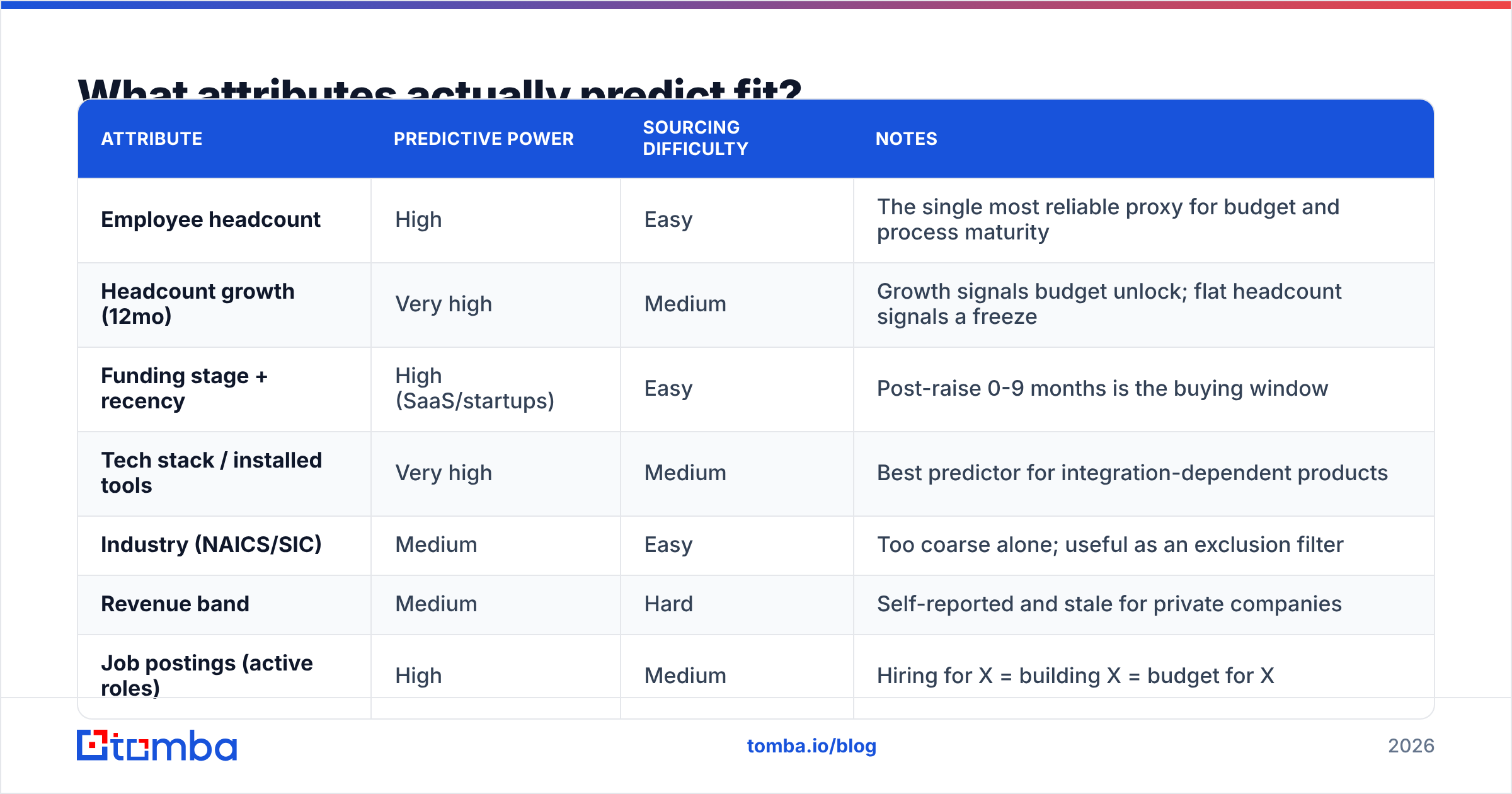
Not all ICP fields carry the same weight. Here's how the common ones stack up in practice, and how easy each is to source at scale.
| Attribute | Predictive power | Sourcing difficulty | Notes |
|---|---|---|---|
| Employee headcount | High | Easy | The single most reliable proxy for budget and process maturity |
| Headcount growth (12mo) | Very high | Medium | Growth signals budget unlock; flat headcount signals a freeze |
| Funding stage + recency | High (SaaS/startups) | Easy | Post-raise 0-9 months is the buying window |
| Tech stack / installed tools | Very high | Medium | Best predictor for integration-dependent products |
| Industry (NAICS/SIC) | Medium | Easy | Too coarse alone; useful as an exclusion filter |
| Revenue band | Medium | Hard | Self-reported and stale for private companies |
| Job postings (active roles) | High | Medium | Hiring for X = building X = budget for X |
| Geography / entity country | Medium | Easy | Matters mainly for compliance, pricing, and timezone coverage |
| "Culture" / "innovation" | None | Impossible | Delete it from your doc |
Two attributes deserve special mention.
Headcount growth beats absolute headcount in almost every dataset I've seen. A 90-person company that added 30 people this year behaves like a buyer. A 400-person company that shrank behaves like a cost-cutter.
Tech stack is the highest-leverage attribute for anyone selling software that plugs into something else. If your product integrates with Salesforce, "uses Salesforce" is a harder filter than "is a SaaS company" and it converts several times better.
How do you score accounts once you have the profile?#
Keep fit and intent in separate columns. Combining them into one score is the most common scoring mistake — you end up unable to explain why an account ranked high, and you can't diagnose which input is broken.
Fit score (0-100) — static, updates monthly. Weighted sum of your ICP attributes. A simple version:
- Headcount in range: 25 points
- Industry match: 20 points
- Tech stack match: 25 points
- Funding/growth signal: 20 points
- Geography match: 10 points
Intent score (0-100) — dynamic, updates daily or weekly. Site visits, content downloads, review-site activity on G2, job postings for relevant roles, executive hires in your buyer's function.
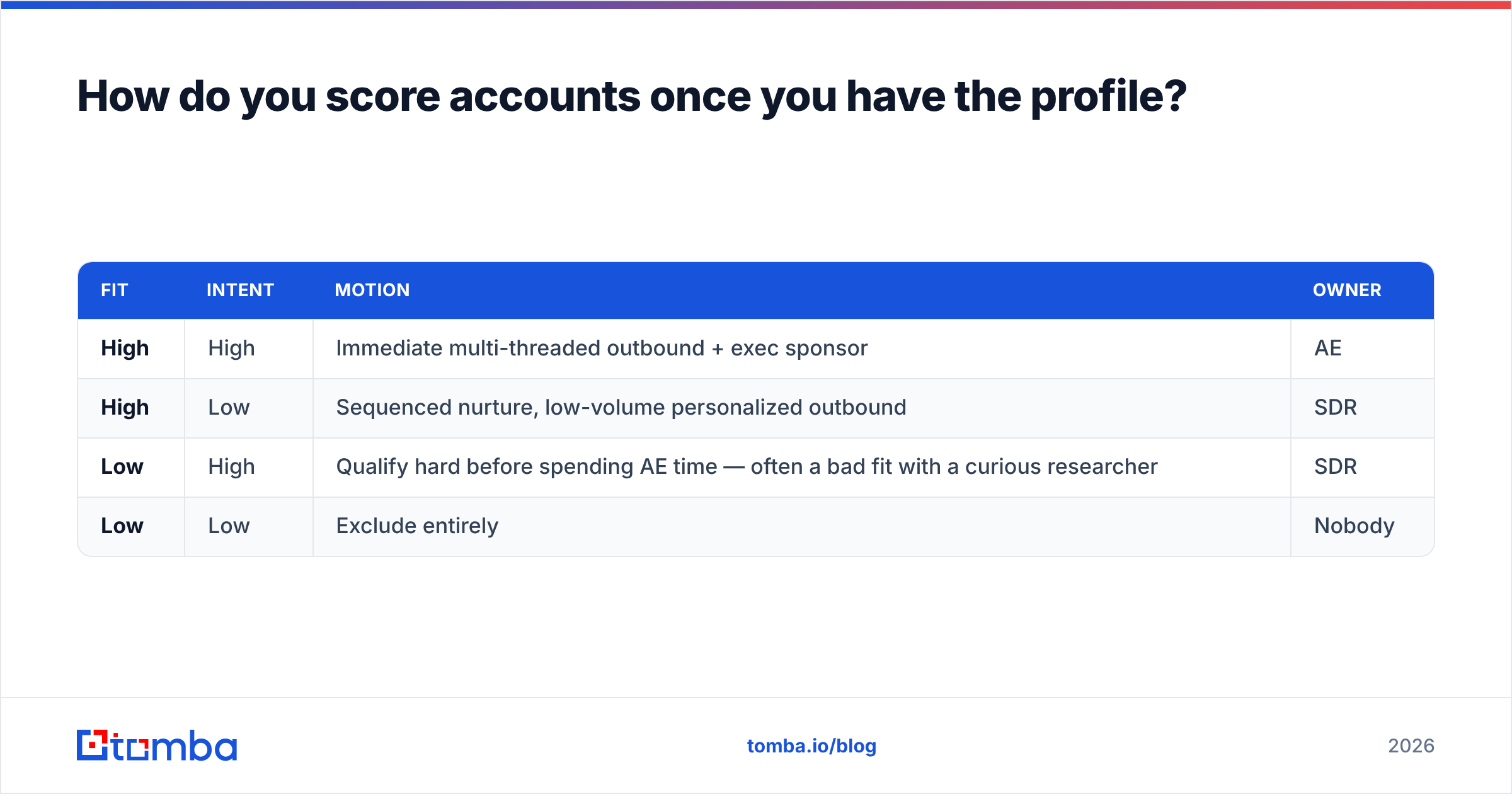
Then plot them on a 2x2 and route accordingly:
| Fit | Intent | Motion | Owner |
|---|---|---|---|
| High | High | Immediate multi-threaded outbound + exec sponsor | AE |
| High | Low | Sequenced nurture, low-volume personalized outbound | SDR |
| Low | High | Qualify hard before spending AE time — often a bad fit with a curious researcher | SDR |
| Low | Low | Exclude entirely | Nobody |
The "Low fit / High intent" quadrant is where undisciplined teams burn their quarter. Intent feels like a buying signal, and it is — just not a signal that this deal will close, renew, or expand. Hold the line on fit.
For a deeper treatment of how scoring thresholds map to handoff rules, the concept of a marketing qualified lead is worth aligning on with marketing before you set the numbers, not after.
How do you turn an ICP into an actual list?#
This is where strategy meets execution, and where most ICP projects quietly die.
You have a filter string. Now you need:
- A list of companies matching the filter. Sources: B2B databases, LinkedIn Sales Navigator saved searches, review-site category pages, conference attendee lists, funding announcement feeds, your own website visitor logs.
- The right people inside each company. This is your persona layer applied to the ICP layer. Usually 2-4 contacts per account — economic buyer, champion, and a technical evaluator.
- Verified contact data for those people. Email first, phone where the motion warrants it.
Step 3 is the one that breaks. You can nail the ICP definition, build a beautiful 800-account list, and still get nowhere because 30% of the emails bounce and your domain reputation tanks in week two.
A practical workflow that holds up:
- Use a domain search to pull every discoverable email at a target account, then filter by department and seniority rather than guessing individual addresses one at a time.
- For accounts where you already know the person but not the address, run a targeted email finder lookup on first name + last name + domain.
- Push everything through an email verifier before it touches a sending tool. Target sub-2% bounce. Anything above 3% and you're gambling with email deliverability.
- For catch-all domains — common in enterprise and in European mid-market — a standard verifier returns "unknown." Use a catch-all verifier to get an actual confidence signal instead of a shrug.
- Enrich the surviving rows with firmographics so your fit score stays current inside the CRM, not in a spreadsheet someone forgot about.

Which tools fit which stage of ICP targeting?#
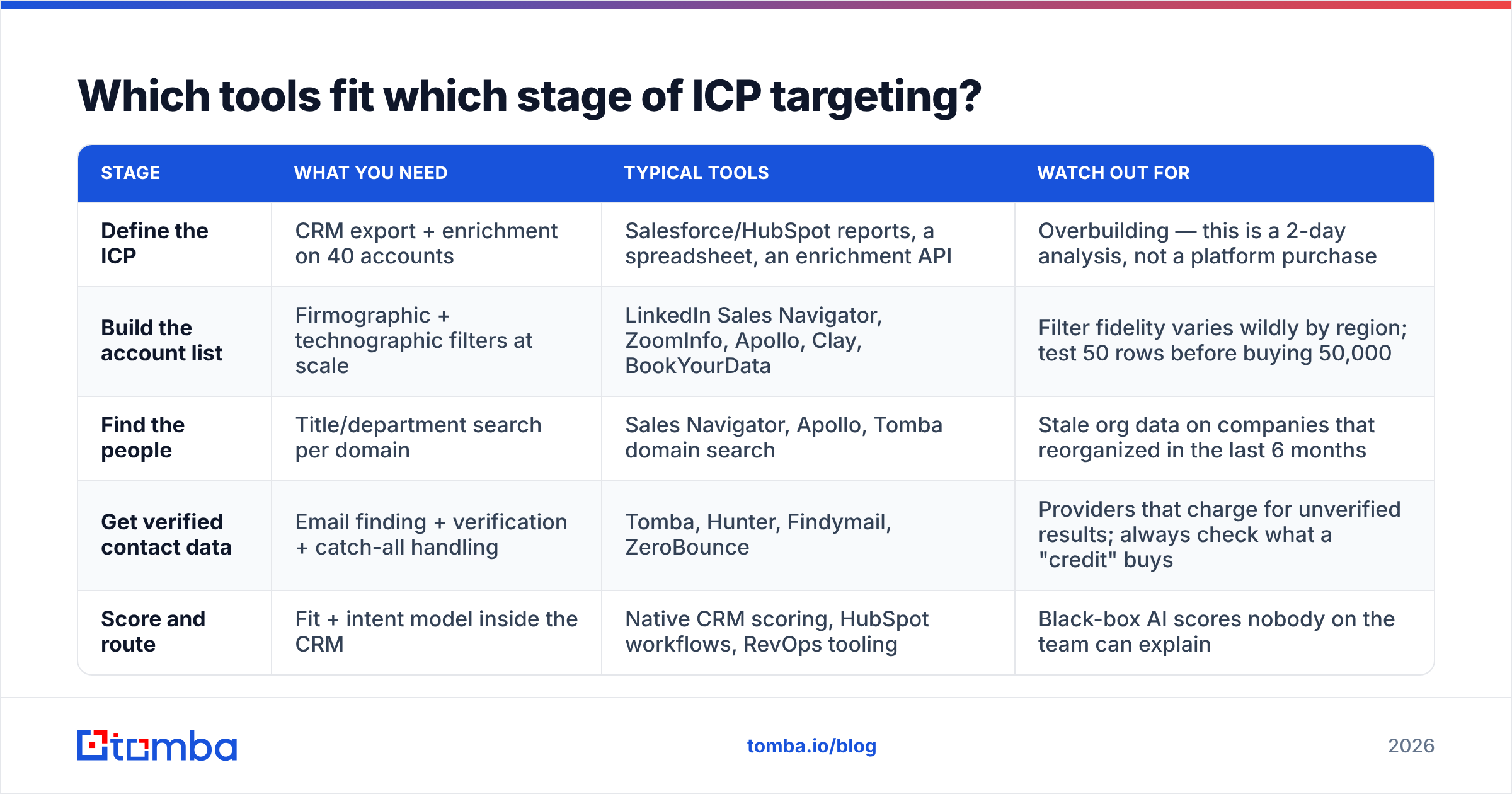
Different stages need different tools, and buying a single platform to do all of it usually means doing three of the four badly. Here's an honest split of what each category is actually good at.
| Stage | What you need | Typical tools | Watch out for |
|---|---|---|---|
| Define the ICP | CRM export + enrichment on 40 accounts | Salesforce/HubSpot reports, a spreadsheet, an enrichment API | Overbuilding — this is a 2-day analysis, not a platform purchase |
| Build the account list | Firmographic + technographic filters at scale | LinkedIn Sales Navigator, ZoomInfo, Apollo, Clay, BookYourData | Filter fidelity varies wildly by region; test 50 rows before buying 50,000 |
| Find the people | Title/department search per domain | Sales Navigator, Apollo, Tomba domain search | Stale org data on companies that reorganized in the last 6 months |
| Get verified contact data | Email finding + verification + catch-all handling | Tomba, Hunter, Findymail, ZeroBounce | Providers that charge for unverified results; always check what a "credit" buys |
| Score and route | Fit + intent model inside the CRM | Native CRM scoring, HubSpot workflows, RevOps tooling | Black-box AI scores nobody on the team can explain |
On the contact-data stage specifically, price per verified result matters more than headline price per credit. Tomba pricing starts with a free tier at 25 searches/month, then Starter at $49/mo, Growth at $99/mo, and Pro at $249/mo — with the email finder, verifier, domain search, and catch-all handling in the same account rather than split across three vendors and three invoices. If your motion also needs dials, adding a phone finder to the same workflow avoids a second data contract.
Worth being clear about scope: for pure static list purchase at volume, dedicated database vendors like BookYourData are a legitimate and often faster route — they sell you a file. Tools like Tomba are better when you're finding and verifying contacts continuously, per-account, as your ICP list refreshes. Those are different jobs and it's fine to run both.
How often should you revisit your ICP?#
Every two quarters as a baseline, and immediately after any of these four events:
- You ship a materially new product or module. Your ICP just changed whether you re-ran the analysis or not.
- You change pricing by more than ~25%. Price moves your fit band up or down the headcount curve.
- Win rate drops for two consecutive quarters with no change in rep headcount or process. That's usually a targeting problem wearing a sales-execution costume.
- A competitor repositions into your segment. Your differentiation in that band may no longer hold.
The re-run is cheap once you've done it once — same query, fresh 20/20 sample. Budget half a day. Compare the new attribute weights against the old ones and look for drift, especially in headcount band and tech stack, which move fastest.
One habit that pays: keep a "disqualified for cause" field on every closed-lost record with a controlled vocabulary — too small, no budget owner, wrong stack, competitor incumbent, no compelling event. After two quarters you'll have a disqualification histogram that's more useful for refining your ICP than any external market report. HubSpot's research on sales qualification covers the frameworks worth borrowing here if you don't already have one in place.
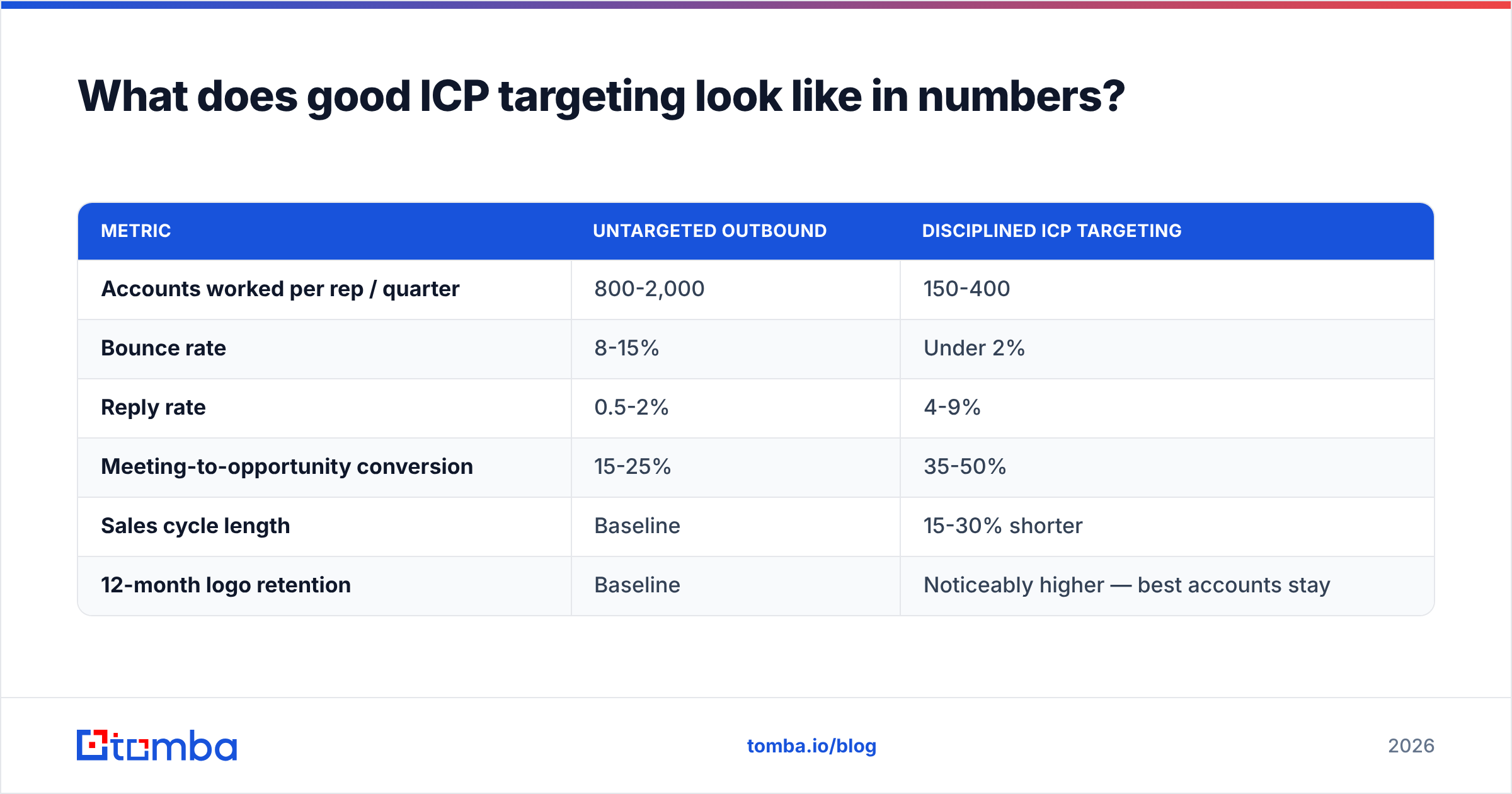
What does good ICP targeting look like in numbers?#
Set expectations before you start, so you can tell whether it worked.
| Metric | Untargeted outbound | Disciplined ICP targeting |
|---|---|---|
| Accounts worked per rep / quarter | 800-2,000 | 150-400 |
| Bounce rate | 8-15% | Under 2% |
| Reply rate | 0.5-2% | 4-9% |
| Meeting-to-opportunity conversion | 15-25% | 35-50% |
| Sales cycle length | Baseline | 15-30% shorter |
| 12-month logo retention | Baseline | Noticeably higher — best accounts stay |
The counterintuitive line is the first one. Good ICP targeting means your reps touch fewer accounts. If your list got bigger after the exercise, you didn't do the exercise — you did market sizing and called it an ICP.
The second line is the one nobody wants to own. Bounce rate isn't a data-quality footnote; it's the gate on everything below it. A perfectly targeted list sent to unverified addresses produces the same result as an untargeted one, plus a damaged sending domain. Run your list through verification before the first send, every time, and re-verify anything older than 90 days.
Where should you start this week?#
Pick 20 closed-won accounts and 20 closed-lost. Enrich both with the same eight fields. Find the three attributes that separate them. Write those three attributes as a filter string. Build a 100-account list against that string. Verify the contacts. Send.
That's a one-week loop, and it will teach you more than a quarter of workshops. Everything in this post is a refinement on that loop.
When you get to the contact-data step, Tomba Email Finder is built for exactly this shape of work — search by domain to map an account's org, find specific people by name, and verify every address before it hits your sequencer, all from one account. Start on the free tier at 25 searches per month, prove the loop works on your first 100 ICP-matched accounts, and scale the plan only once the model is earning its keep.
Related guides#
Ready to find emails that actually work?
Join 150,000+ professionals who stopped guessing and started sending. Free credits on signup — no credit card required.
Get the Tomba newsletter
Practical outbound tactics and product updates — once every two weeks.
About the author