ICP vs Persona: How to Use Both to Target Better in 2026
An ICP tells you which companies to chase. A persona tells you which human to email. Confusing the two is why most outbound lists look busy and convert like noise.
TL;DR
- An ICP (ideal customer profile) describes the company worth selling to. A buyer persona describes the person inside that company you actually talk to.
- ICP is account-level and mostly firmographic/technographic: size, industry, region, stack, funding, growth rate. Persona is human-level: role, goals, objections, language, channel preference.
- Build the ICP first. A perfect persona inside a company that will never buy is a very well-researched waste of time.
- Both are worthless until they're operational — meaning every field maps to something you can filter, enrich, or search for at list-build time.
- Most "our outbound doesn't work" problems are ICP problems wearing a persona costume: right message, wrong accounts.
What is the difference between an ICP and a persona?#
Think of it like renting an apartment building versus knowing which tenant answers the door. The ICP is the building — location, size, condition, whether anyone there can afford your rent. The persona is the tenant — what they care about, what annoys them, when they're home.
You need both, but they answer different questions and they fail in different ways.
An ideal customer profile is a description of the accounts that get the most value from your product and cost the least to serve. It is a filter. Its job is to shrink a market of 400,000 companies to 3,000 that are worth your team's time. It is written in attributes a database can understand: employee count, industry code, HQ country, revenue band, tech stack, headcount growth in a specific department, funding stage, compliance requirements.
A buyer persona is a semi-fictional composite of a specific role in the buying process. It is a message brief. Its job is to tell you what to say once you've decided the account is worth contacting: what this person is measured on, what breaks their week, what they've already tried, which words make them close the tab.
The failure modes are different, and that's the practical reason to keep them separate:
- A bad ICP produces high-volume, low-reply campaigns. Your copy might be excellent. The accounts simply have no reason to buy.
- A bad persona produces decent open rates, low replies, and dead threads after the first response. The accounts are right; you're talking about the wrong problem, or to the wrong seat.
If your reply rate is 0.4% across every campaign regardless of copy, stop rewriting subject lines. Fix the ICP.
What actually goes into an ICP?#
An ICP is only useful if every line is a filterable attribute. "Companies that value innovation" is not an ICP. Here are the five layers that survive contact with a real list-building session:
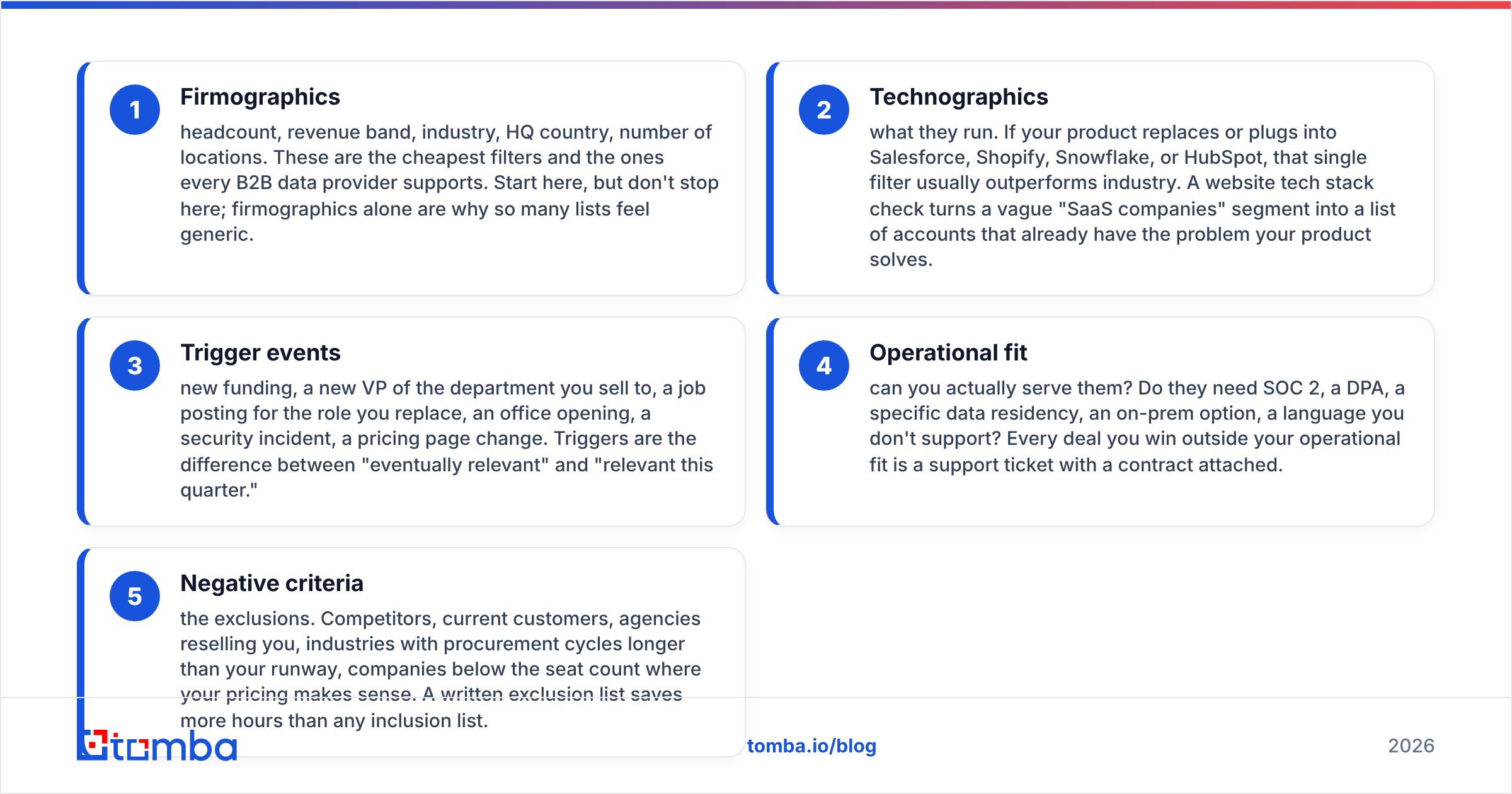
- Firmographics — headcount, revenue band, industry, HQ country, number of locations. These are the cheapest filters and the ones every B2B data provider supports. Start here, but don't stop here; firmographics alone are why so many lists feel generic.
- Technographics — what they run. If your product replaces or plugs into Salesforce, Shopify, Snowflake, or HubSpot, that single filter usually outperforms industry. A website tech stack check turns a vague "SaaS companies" segment into a list of accounts that already have the problem your product solves.
- Trigger events — new funding, a new VP of the department you sell to, a job posting for the role you replace, an office opening, a security incident, a pricing page change. Triggers are the difference between "eventually relevant" and "relevant this quarter."
- Operational fit — can you actually serve them? Do they need SOC 2, a DPA, a specific data residency, an on-prem option, a language you don't support? Every deal you win outside your operational fit is a support ticket with a contract attached.
- Negative criteria — the exclusions. Competitors, current customers, agencies reselling you, industries with procurement cycles longer than your runway, companies below the seat count where your pricing makes sense. A written exclusion list saves more hours than any inclusion list.
Two of these — technographics and triggers — are where mid-market teams get an edge, because they're the ones most competitors skip.
What actually goes into a persona?#
A persona is a message brief, so every field should change a sentence you write. The classic marketing persona — "Marketing Mary, 34, enjoys yoga and podcasts" — changes nothing. Drop it.
The fields that earn their place:
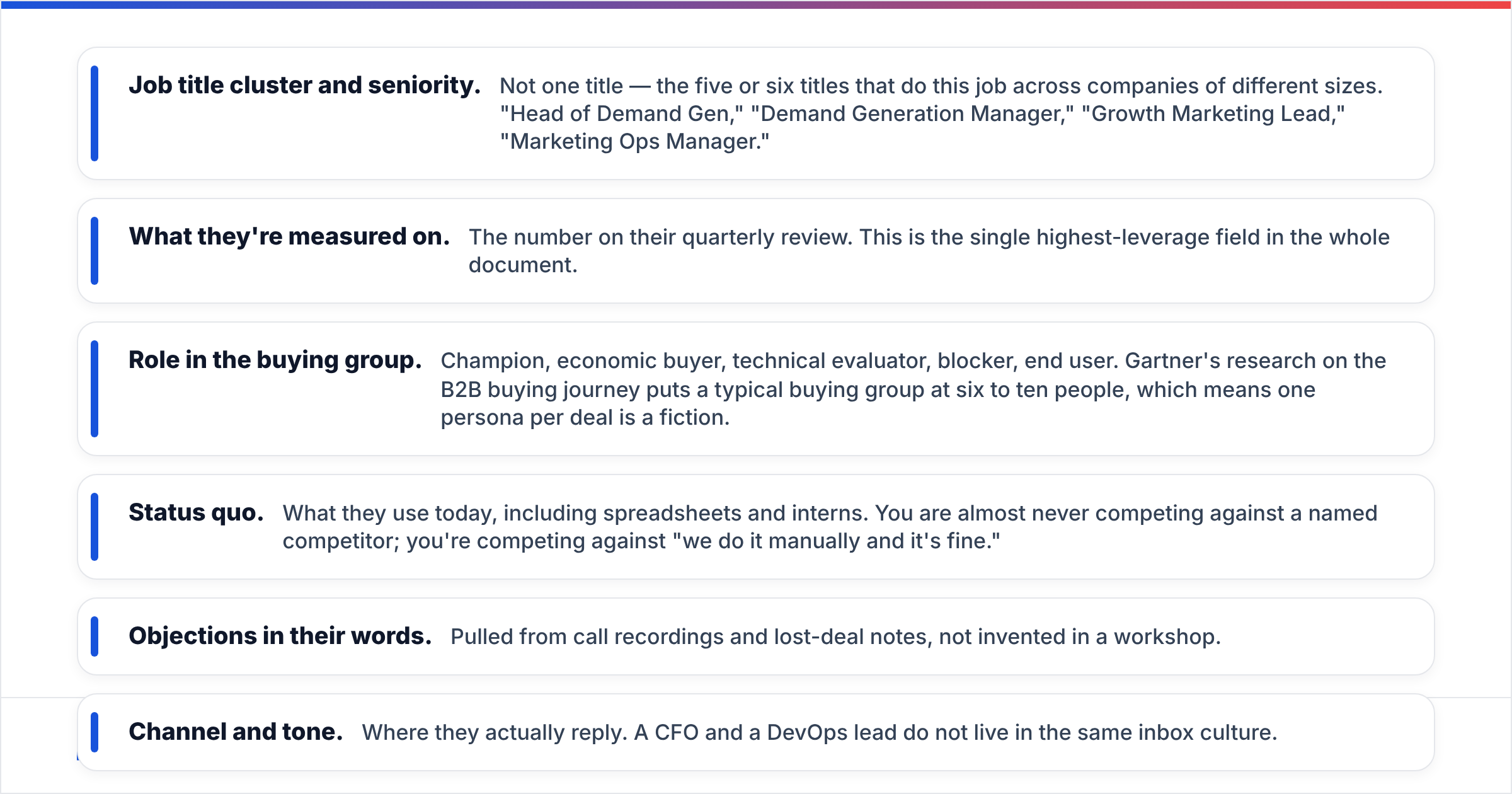
- Job title cluster and seniority. Not one title — the five or six titles that do this job across companies of different sizes. "Head of Demand Gen," "Demand Generation Manager," "Growth Marketing Lead," "Marketing Ops Manager."
- What they're measured on. The number on their quarterly review. This is the single highest-leverage field in the whole document.
- Role in the buying group. Champion, economic buyer, technical evaluator, blocker, end user. Gartner's research on the B2B buying journey puts a typical buying group at six to ten people, which means one persona per deal is a fiction.
- Status quo. What they use today, including spreadsheets and interns. You are almost never competing against a named competitor; you're competing against "we do it manually and it's fine."
- Objections in their words. Pulled from call recordings and lost-deal notes, not invented in a workshop.
- Channel and tone. Where they actually reply. A CFO and a DevOps lead do not live in the same inbox culture.
HubSpot's buyer persona research guide is a reasonable starting template, and the UX definition of a persona is worth reading for where the concept came from — it was invented to design software, not to write cold email, which explains a lot of the fluff that comes with it.
ICP vs persona: which one should you build first?#
The ICP. Always the ICP.
Sequence matters because persona work is expensive — interviews, call reviews, message testing — and its value is capped by the quality of the account list it runs against. Build a persona first and you end up writing beautiful copy for a segment that churns in five months.
The practical order:
- Pull your last 12–24 months of closed-won deals.
- Rank them by a value metric that combines contract size, gross margin, time-to-close, and retention. Not just ACV.
- Look at the top quartile and find the shared attributes. Ignore anything you can't filter for.
- Check the bottom quartile and your churned accounts for shared attributes too — that's your exclusion list, and it's usually more obvious than the inclusion list.
- Now interview the humans in those top-quartile accounts to build personas.
If you have fewer than 20 closed-won deals, you don't have an ICP yet — you have a hypothesis. Write it down, put a review date on it, and treat your first two quarters of outbound as the experiment that proves or kills it.
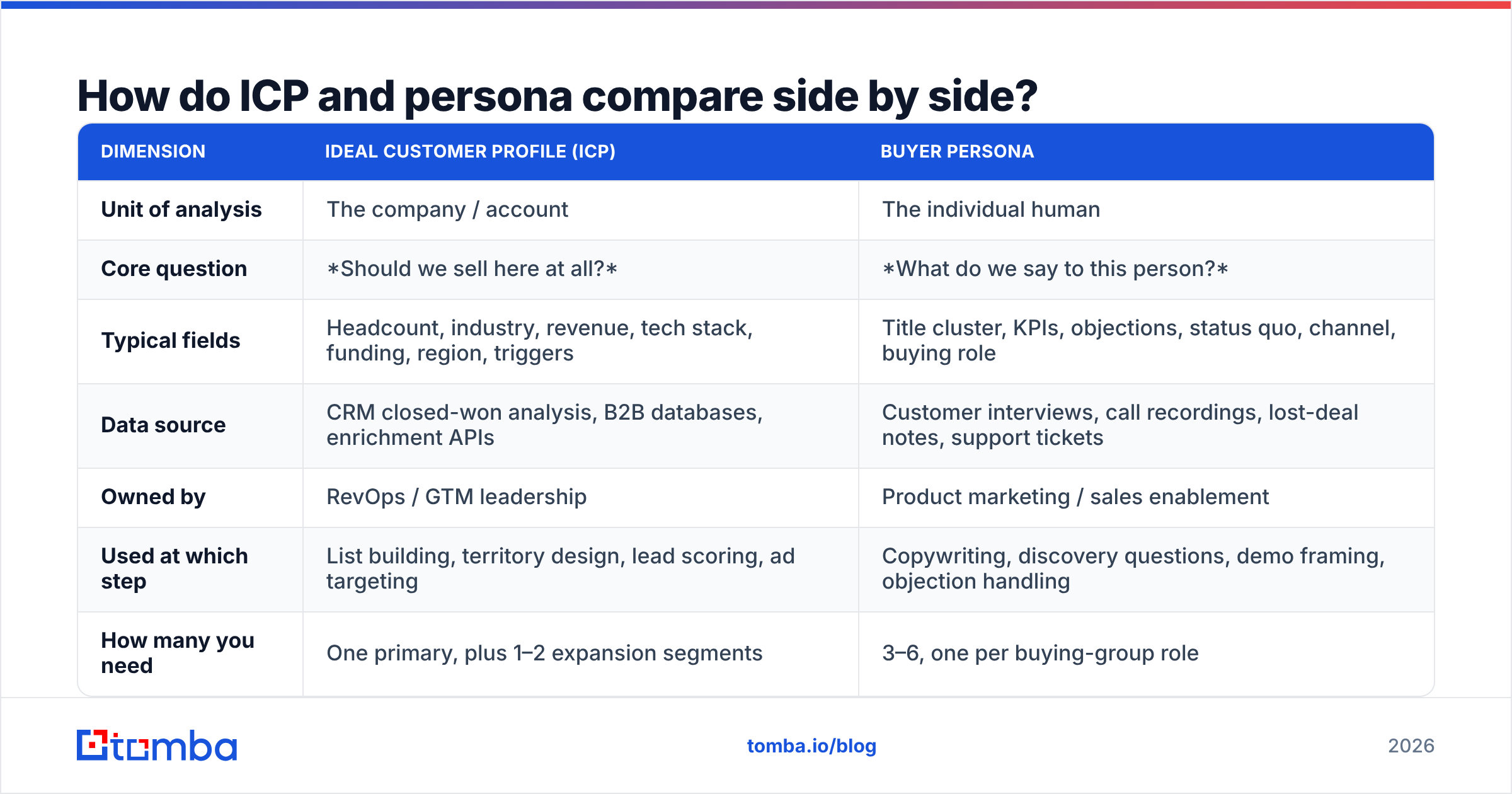
How do ICP and persona compare side by side?#
| Dimension | Ideal Customer Profile (ICP) | Buyer Persona |
|---|---|---|
| Unit of analysis | The company / account | The individual human |
| Core question | Should we sell here at all? | What do we say to this person? |
| Typical fields | Headcount, industry, revenue, tech stack, funding, region, triggers | Title cluster, KPIs, objections, status quo, channel, buying role |
| Data source | CRM closed-won analysis, B2B databases, enrichment APIs | Customer interviews, call recordings, lost-deal notes, support tickets |
| Owned by | RevOps / GTM leadership | Product marketing / sales enablement |
| Used at which step | List building, territory design, lead scoring, ad targeting | Copywriting, discovery questions, demo framing, objection handling |
| How many you need | One primary, plus 1–2 expansion segments | 3–6, one per buying-group role |
| Refresh cadence | Quarterly, or after any pricing/product change | Twice a year, or after a positioning shift |
| Failure symptom | Low reply rate across all copy variants | Good opens, replies that die after one exchange |
| Hardest part | Being honest about who isn't a fit | Getting real quotes instead of invented ones |
Read that table as a division of labor, not a competition. RevOps decides where the darts get thrown; product marketing decides what's written on them.
How do you turn an ICP and a persona into an actual list?#
This is where most documents die. A beautiful ICP in a Notion page that nobody can execute is a hallucination with a nice font.
The translation layer looks like this:
Step 1 — Convert ICP fields into query filters. Every attribute needs a source. Headcount and industry come from a B2B database or your data provider. Tech stack comes from a site scan. Funding and headcount growth come from public sources or a news trigger feed. If an attribute has no source, either find a proxy or delete the attribute.
Step 2 — Resolve the account list to domains. Company names are ambiguous; domains are not. Normalize everything to a root domain early, and deduplicate before you spend a single credit. This one step routinely removes 10–20% of a scraped list.
Step 3 — Map persona titles to real people at those domains. This is the join between the two documents. A domain search returns the people at a company along with their roles and the company's email pattern, so you can pull the three titles in your persona cluster instead of emailing whoever happens to be listed first.
Step 4 — Enrich, then verify. Contact enrichment fills in seniority, department, LinkedIn, and location so your persona logic has something to branch on. Verification then removes the addresses that would bounce. Skipping verification is how a correct ICP still produces a deliverability incident.
Step 5 — Score and route. Combine account fit (ICP) with contact fit (persona) into a single score. A CFO at a perfect-fit account and a junior analyst at a perfect-fit account are not the same lead, and neither is a perfect-title contact at a company that will never buy. If you're formalizing this, it's worth aligning the thresholds with how your team defines a marketing qualified lead so sales and marketing argue less.
What are the most common ICP vs persona mistakes?#
Treating job title as the ICP. "We sell to Heads of Sales" is a persona statement, not an ICP. There's a Head of Sales at a 4-person agency and at a 40,000-person enterprise. One of them is not your customer.
Writing an ICP that describes your best customer instead of your best segment. Your favorite logo may be an outlier — an unusually good champion, a lucky timing, a discount you'll never repeat. Look for repeatable patterns across a quartile, not a portrait of one account.
One persona for a six-person buying committee. If your deal needs security review, finance sign-off, and an end-user champion, you need three messages, three proof points, and probably three sequences.
Never writing exclusions. Teams love the inclusion list and skip the exclusion list, then wonder why 30% of pipeline is deals that will die in procurement.
Letting both documents go stale. Your product shipped three features and raised prices; your ICP still describes the company you were 18 months ago. Put a calendar reminder on it.
Confusing persona research with market research. Persona work is qualitative and specific. Twenty real customer calls beat a 2,000-response survey for this purpose, every time.
How do you know your ICP is wrong?#
Watch four signals:
- Flat reply rates across very different copy. If a warm referral-style email and a hard-hitting problem email both land at 0.5%, the copy isn't the variable.
- Wins that don't look like your ICP. If half your closed-won deals fail your own ICP filter, your filter is describing a market that doesn't exist.
- Fast churn in a specific segment. Churn concentrated in one industry or size band is an exclusion criterion trying to get your attention.
- Sales reps quietly ignoring the list. Reps have the fastest feedback loop in the company. If they're building their own lists, they've already found the real ICP — go ask them what it is.
Review quarterly. Re-run the closed-won analysis, check whether the top-quartile pattern moved, and update the exclusion list first.
How should you measure ICP and persona performance separately?#
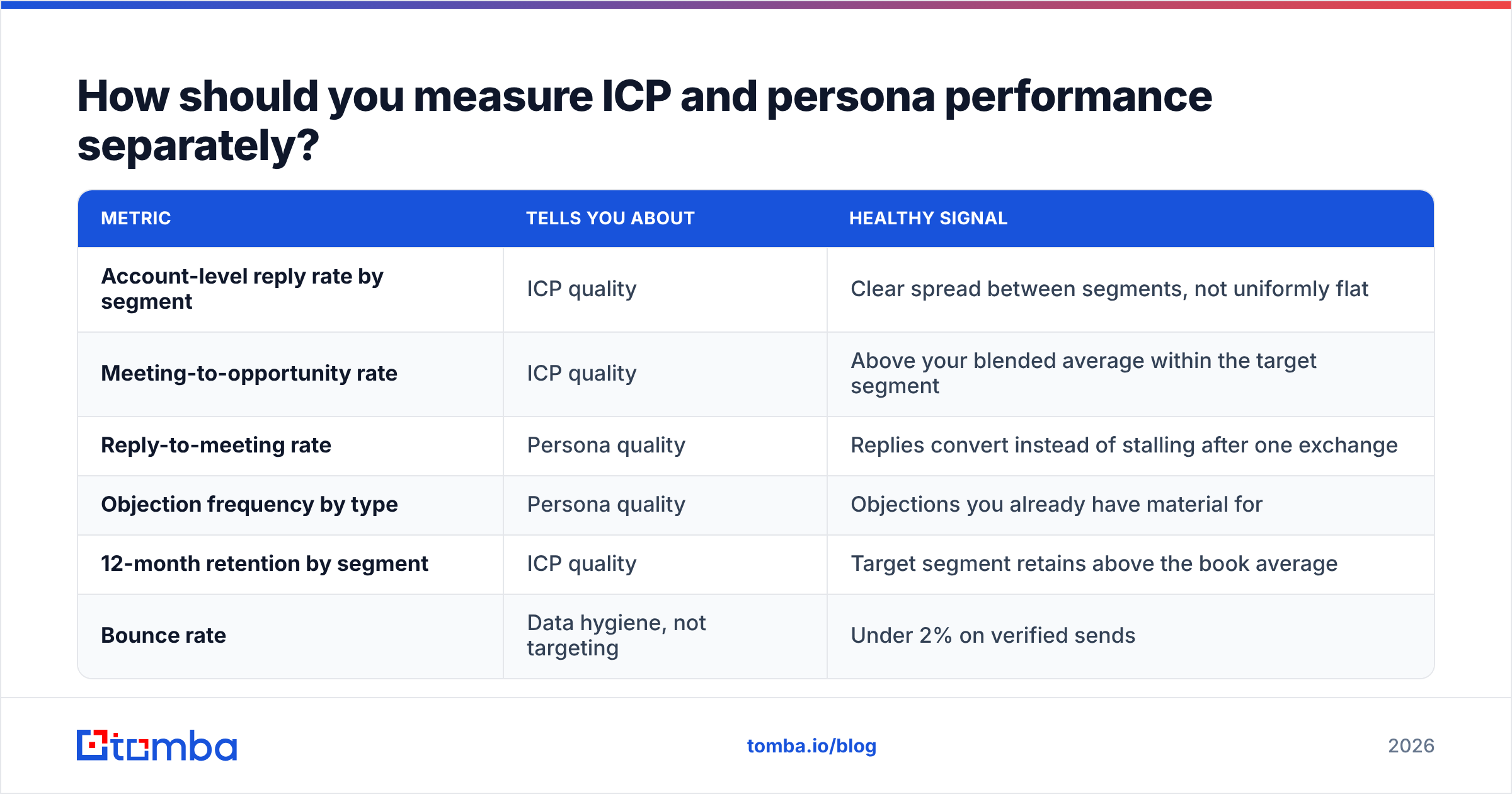
Keep the metrics on different lines so you know which document to fix.
| Metric | Tells you about | Healthy signal |
|---|---|---|
| Account-level reply rate by segment | ICP quality | Clear spread between segments, not uniformly flat |
| Meeting-to-opportunity rate | ICP quality | Above your blended average within the target segment |
| Reply-to-meeting rate | Persona quality | Replies convert instead of stalling after one exchange |
| Objection frequency by type | Persona quality | Objections you already have material for |
| 12-month retention by segment | ICP quality | Target segment retains above the book average |
| Bounce rate | Data hygiene, not targeting | Under 2% on verified sends |
Note the last row. Bounce rate is not a targeting metric — it's a data-quality metric, and mixing the two sends teams rewriting personas when the real problem was an unverified list.
Where should you start this week?#
Pick one hour and do this: export closed-won, sort by 12-month retained revenue, and write down the three attributes shared by your top ten accounts and absent from your bottom ten. That's a draft ICP. Then open three recorded calls from the top ten and write down the exact sentence each champion used to describe the problem. That's a draft persona. Everything after that is refinement.
Then make the list real. Turn your ICP filters into a domain list, use Tomba's Email Finder to pull verified addresses for the specific persona titles at each of those domains, and start with 50 accounts instead of 5,000. The free tier gives you 25 searches a month to test the workflow, Starter runs $49/mo, and Growth is $99/mo when the list outgrows the experiment — full details on Tomba pricing. Precision first, volume second. That order is the whole point of separating the two documents in the first place.
Related guides#
// get started
Find, verify and enrich your first contacts today
Start on the free plan with 25 searches a month, then scale when your team is ready.
Free plan · No credit card required · GDPR & CCPA
Get the Tomba newsletter
Product and data updates
// about the author