Ideal Client Profile: How to Build One That Actually Works
Most ICPs are a slide nobody reads. Here's how to build an ideal client profile from real closed-won data, test it against your pipeline, and use it to cut prospecting waste.
TL;DR
- An ideal client profile describes the company worth selling to. A buyer persona describes the human inside it. You need both, and confusing them is why most targeting docs fail.
- Build your ICP from closed-won and closed-lost data you already have — not from a whiteboard session about who you wish would buy.
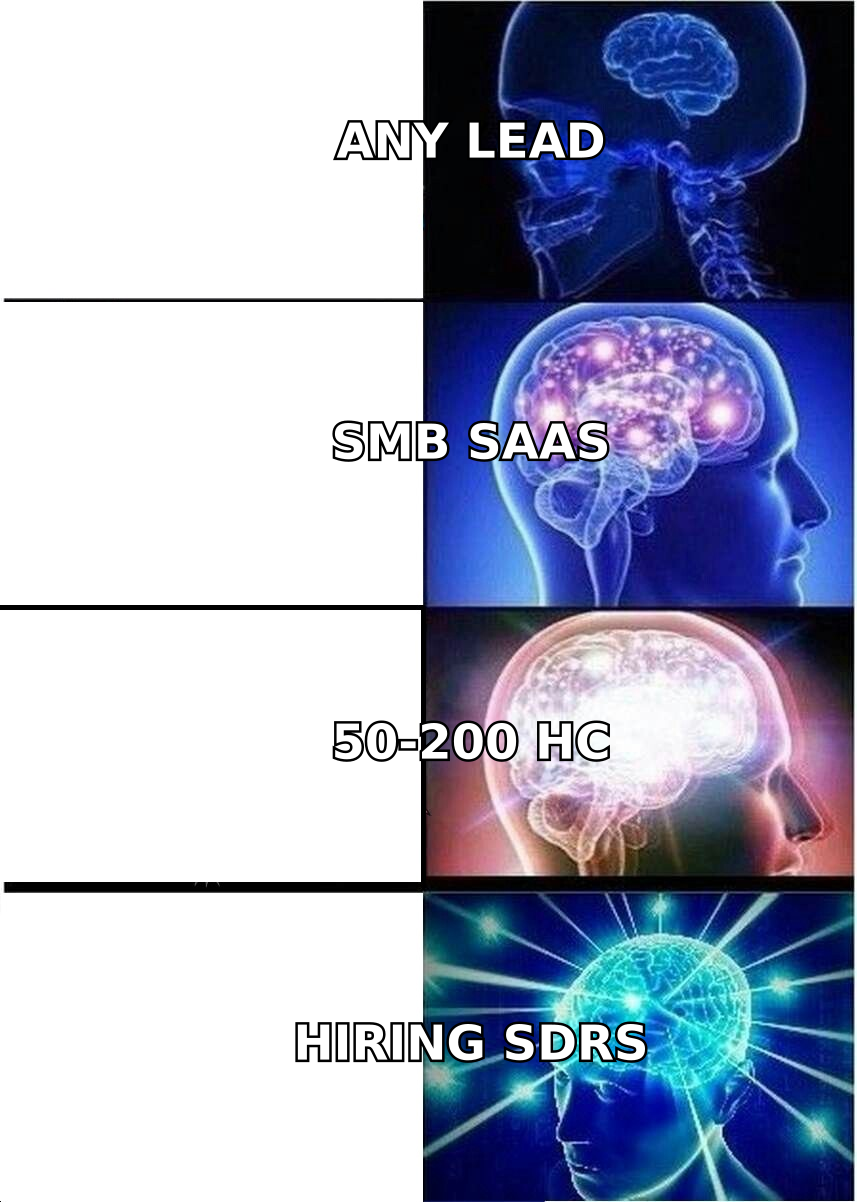
- The only ICP attributes worth keeping are ones you can filter a list by. "Innovative culture" is not an attribute. "Uses HubSpot, 50-200 employees, hiring 2+ SDRs" is.
- Score accounts on fit signals (firmographic, technographic, behavioral) and re-run the scoring every quarter — ICPs decay faster than most teams admit.
- The ICP is worthless until it becomes a list. Turn the attribute set into a filterable account list, then enrich it with verified contact data before your reps touch it.
What is an ideal client profile?#
An ideal client profile (ICP) is a written description of the type of company that gets the most value from your product, closes fastest, churns least, and expands most. It is a filter, not a fantasy.
Think of it like a fishing license that specifies water, season, and species. It doesn't tell you which individual fish to catch — it tells you where to stop wasting your boat fuel.
A useful ICP contains only attributes you can actually query. If you can't type it into a search filter, a database query, or a data provider's API, it isn't an ICP attribute — it's a vibe. This is the single most common failure mode: teams produce a beautiful two-page narrative about "forward-thinking mid-market companies that value efficiency," which is unusable the moment a rep opens their prospecting tool on Monday morning.
Here's the practical test. Read each line of your ICP and ask: could I sort a list of 10,000 companies by this? Employee count — yes. Funding stage — yes. Uses Salesforce — yes. Values customer success — no. Delete it.
How is an ICP different from a buyer persona?#
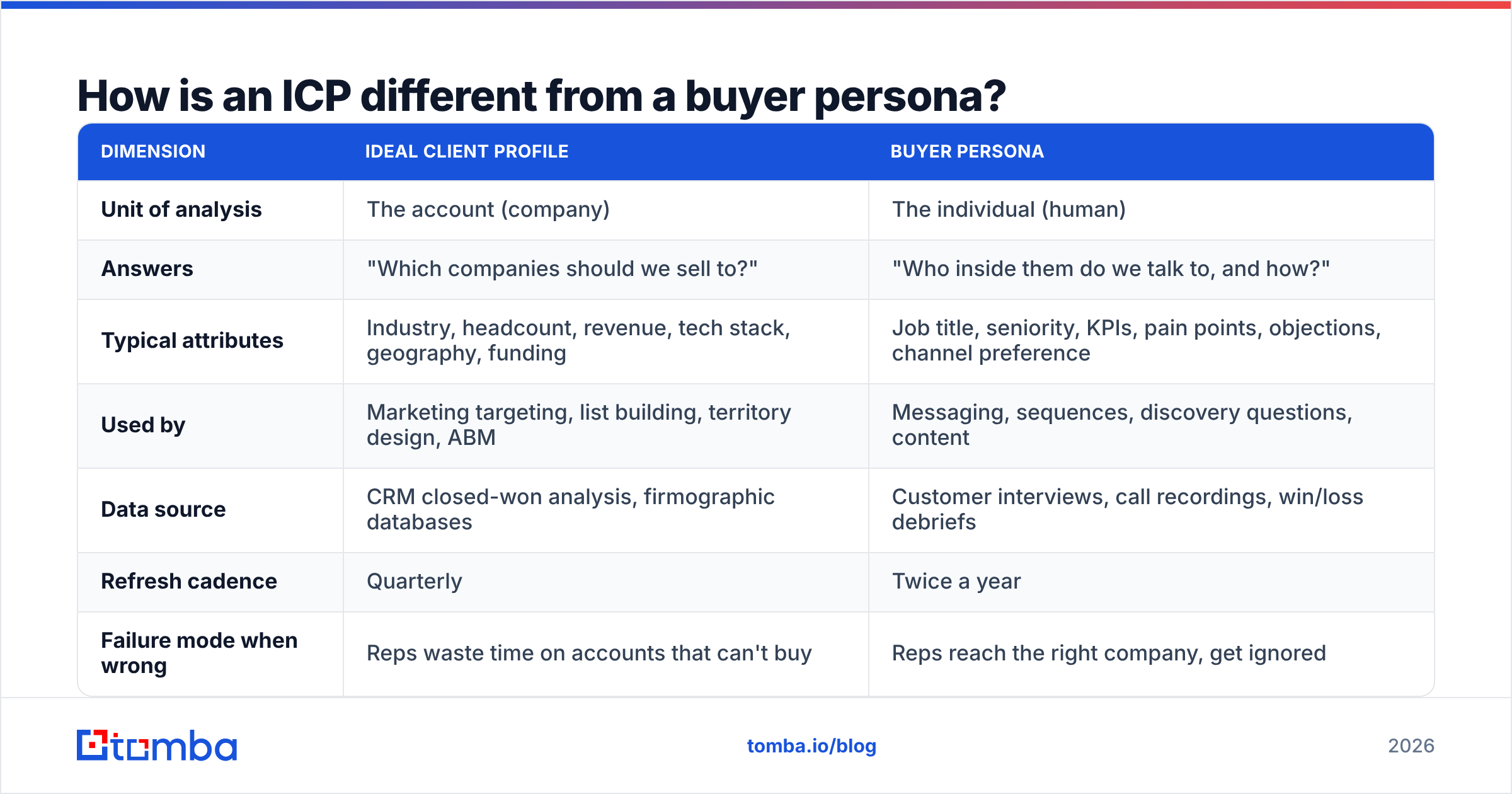
They operate at different altitudes and answer different questions. Mixing them produces targeting that's simultaneously too broad and too vague.
| Dimension | Ideal client profile | Buyer persona |
|---|---|---|
| Unit of analysis | The account (company) | The individual (human) |
| Answers | "Which companies should we sell to?" | "Who inside them do we talk to, and how?" |
| Typical attributes | Industry, headcount, revenue, tech stack, geography, funding | Job title, seniority, KPIs, pain points, objections, channel preference |
| Used by | Marketing targeting, list building, territory design, ABM | Messaging, sequences, discovery questions, content |
| Data source | CRM closed-won analysis, firmographic databases | Customer interviews, call recordings, win/loss debriefs |
| Refresh cadence | Quarterly | Twice a year |
| Failure mode when wrong | Reps waste time on accounts that can't buy | Reps reach the right company, get ignored |
The sequence matters: ICP first, persona second. An excellent persona aimed at the wrong account type is a well-crafted email nobody with budget will read. Once you know which companies qualify, personas tell you whether to approach the VP of Sales, the RevOps lead, or the founder — and what each of them actually cares about.
Where does the data for an ideal client profile come from?#
Your CRM, first. Everything else is supporting evidence.
Pull every closed-won deal from the last 12-24 months and lay them next to your closed-lost and churned accounts. You're looking for attributes that appear disproportionately on the won side. Five sources, in priority order:
- Closed-won account records. Export company name, industry, employee count, revenue band, deal size, sales cycle length, and acquisition channel. This is your ground truth.
- Retention and expansion data. A segment that closes fast but churns in six months is not your ICP — it's a leak. Weight logo retention and net revenue retention at least as heavily as win rate.
- Closed-lost reasons. Losses tagged "no budget" or "not a priority" cluster around a segment boundary. Find that boundary and make it explicit.
- Win/loss interviews. Fifteen-minute calls with recent wins and losses surface the trigger events firmographics can't see — a new VP hired, a compliance deadline, a tool being sunset.
- Product usage telemetry. Which account types hit activation milestones fastest? Time-to-value is a leading indicator of ICP fit long before renewal.
If you're pre-revenue or under roughly 20 closed deals, you don't have enough data for a statistical ICP. Build a hypothesis instead, label it as such, and commit to revisiting it after the next 25 deals. A hypothesis you'll revise beats a fabricated profile you'll defend.
What attributes belong in an ideal client profile?#
Group them into four buckets. Each bucket answers a different question about whether the account can and will buy.
Firmographic — can they afford it and do they have the shape of a customer? Industry or vertical (use NAICS/SIC codes so it's filterable), employee headcount range, annual revenue band, geography and legal jurisdiction, company age, ownership structure (VC-backed, PE-owned, bootstrapped, public).
Technographic — does your product fit their stack? CRM in use, marketing automation platform, data warehouse, competing or complementary tools, and — critically — tools that signal a workflow you replace. A company running three overlapping point solutions is a better prospect than one running none.
Behavioral and intent — are they in market right now? Hiring signals (open roles for the function you serve), funding events in the last 90 days, leadership changes in the buying center, website visits, content downloads, review-site activity on G2, and job-posting language that mentions your category.
Operational — will this be a good customer to have? Sales cycle length you can tolerate, procurement complexity (does this segment require SOC 2 and a 60-day legal review?), support burden per account, and expansion headroom.
Cap the whole thing at 8-12 attributes. Beyond that you're describing a single customer, not a segment, and your addressable list shrinks to something a single rep can burn through in a week.
How do you turn an ICP into a scored account list?#
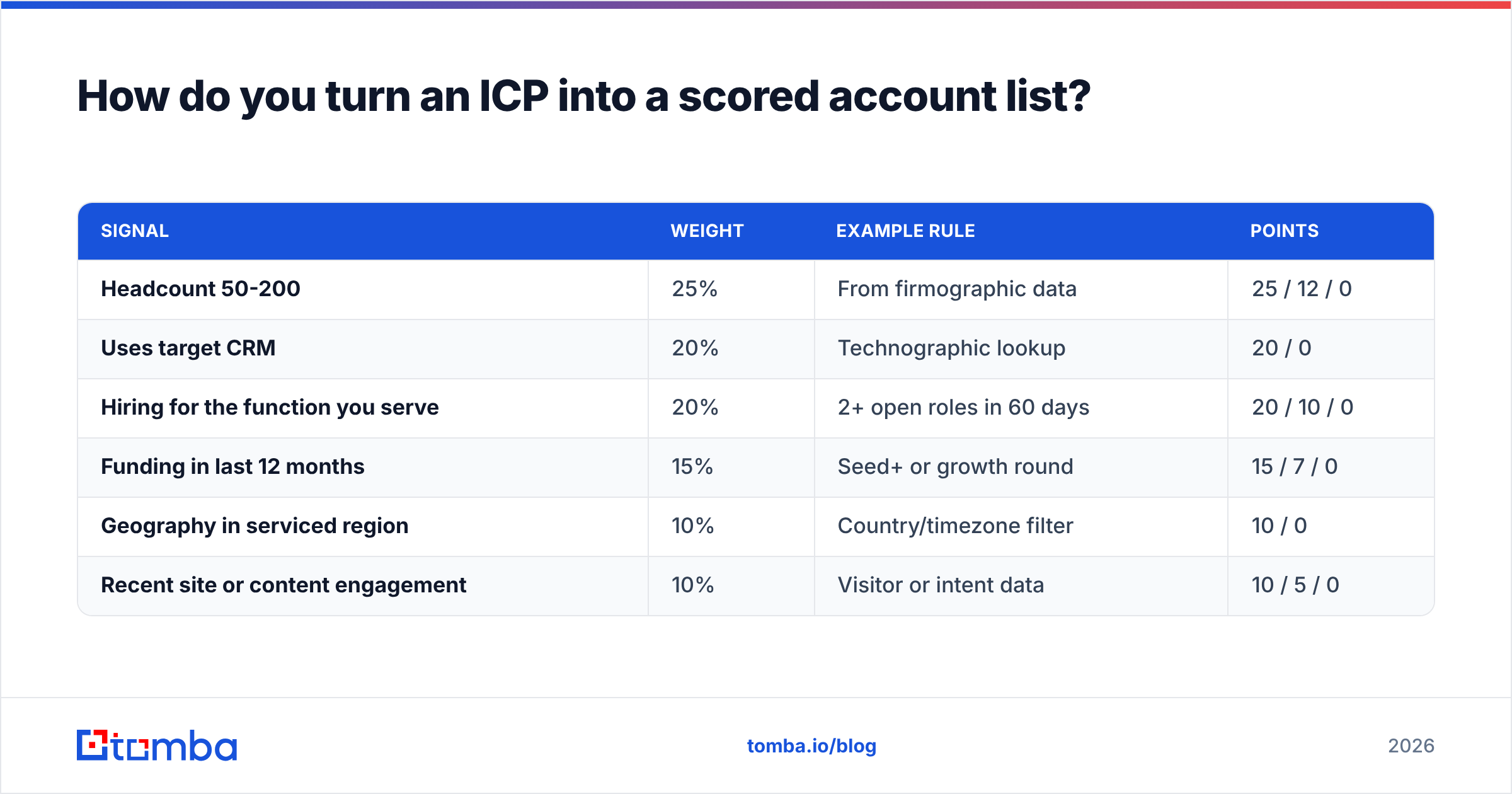
Weight the attributes, score every account, and let the score decide who gets a rep's time. Here's a working scoring frame you can copy.
| Signal | Weight | Example rule | Points |
|---|---|---|---|
| Headcount 50-200 | 25% | From firmographic data | 25 / 12 / 0 |
| Uses target CRM | 20% | Technographic lookup | 20 / 0 |
| Hiring for the function you serve | 20% | 2+ open roles in 60 days | 20 / 10 / 0 |
| Funding in last 12 months | 15% | Seed+ or growth round | 15 / 7 / 0 |
| Geography in serviced region | 10% | Country/timezone filter | 10 / 0 |
| Recent site or content engagement | 10% | Visitor or intent data | 10 / 5 / 0 |
Accounts scoring 70+ go to outbound immediately. 40-69 go to nurture and marketing. Under 40 gets filtered out of the list entirely — and yes, you have to actually delete them, or they'll reappear in someone's sequence by Q3.
The scoring model only works if it's applied at list-build time, not after a rep has already spent an hour researching. That means your ICP attributes need to map to fields your data provider can return. Firmographic and technographic filters are table stakes across the category — BookYourData and similar providers do this well for pre-built list buying, while a B2B database with API access lets you rebuild the list programmatically as your ICP shifts.
Once the account list exists, it's contact data that decides whether any of it converts. A perfectly scored account list with 40% bounce rates on the email column is a scored list you can't use. Run every address through an email verifier before it enters a sequence, and treat catch-all domains as a separate track rather than pretending they're deliverable.
Is a narrow ICP better than a broad one?#
Narrow, almost always — with one honest caveat.
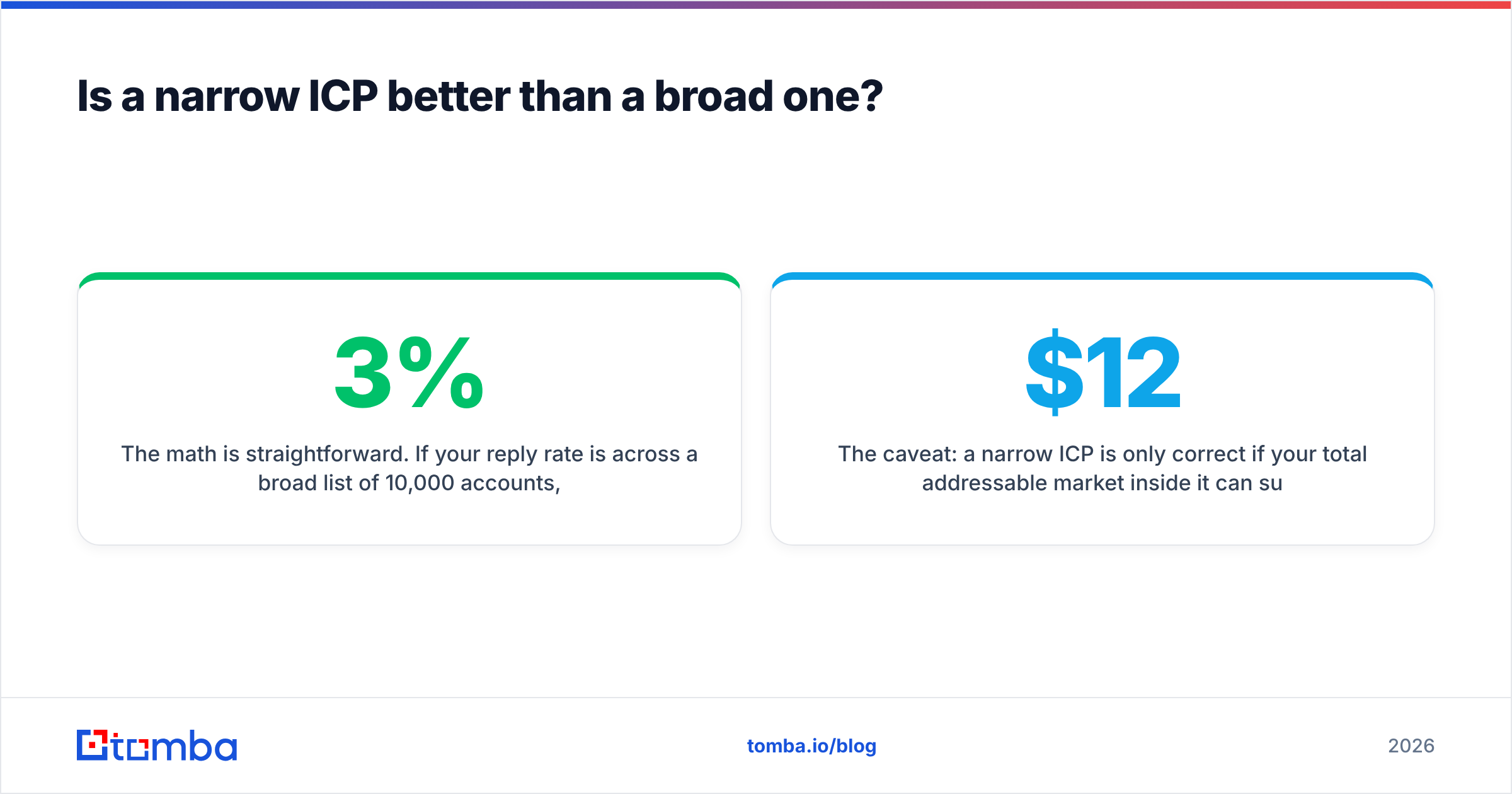
The math is straightforward. If your reply rate is 3% across a broad list of 10,000 accounts, you get 300 replies from 10,000 touches. If tightening the ICP to 2,000 accounts lifts reply rate to 9% because the message finally lands, you get 180 replies from a fifth of the effort. Fewer replies in absolute terms, but roughly triple the efficiency — and the replies are from accounts that can actually close. HubSpot's research on sales productivity has consistently pointed the same direction: rep time spent on non-fit accounts is the largest recoverable loss in most outbound orgs.
The caveat: a narrow ICP is only correct if your total addressable market inside it can support your growth target. Do the arithmetic before you commit. If your ICP contains 1,800 companies worldwide, average contract value is $12,000, and you need $6M in new ARR, you need 500 wins — 28% of the entire market — in one year. That's not a targeting strategy, it's a math error. Widen a tier, or add a second ICP segment with its own scoring model.
Two ICP segments is manageable. Four is a sign that nobody has made a decision.
How often should you refresh your ideal client profile?#
Quarterly for the scoring model, annually for the underlying definition.
ICPs decay for reasons outside your control. Your product ships a feature that opens a new segment. A competitor exits the market and their customers become winnable. A macro shift kills budget in a vertical you depended on. Analysts at Gartner have documented how quickly B2B buying-group composition changes — and every change in who sits in the buying center changes what "ideal" means.
Run this check every quarter:
- Win-rate delta by segment. Which ICP attributes had win rates move more than 10 points, up or down?
- Churn by segment. Any segment churning above blended average gets demoted or removed.
- Sales cycle drift. A segment whose cycle stretched from 45 to 90 days is telling you something about fit or about a new competitor.
- Source of surprise wins. List every closed-won deal that fell outside your ICP. Three or more from the same non-ICP segment is a signal, not noise.
- List exhaustion. If reps report "we've touched everyone," the ICP is too narrow or your data provider's coverage is too thin. Check which before you widen.
That fifth check catches a problem teams misdiagnose constantly. "We ran out of accounts" usually means "our data source only had 30% coverage of the segment," not "the segment is small." Before you loosen a perfectly good ICP, verify your coverage against a second source — run the same filter through a domain search or check what a different provider returns for identical criteria.
What does a finished ideal client profile look like?#
One page. Filterable. Signed off by sales, marketing, and RevOps — with a date on it.
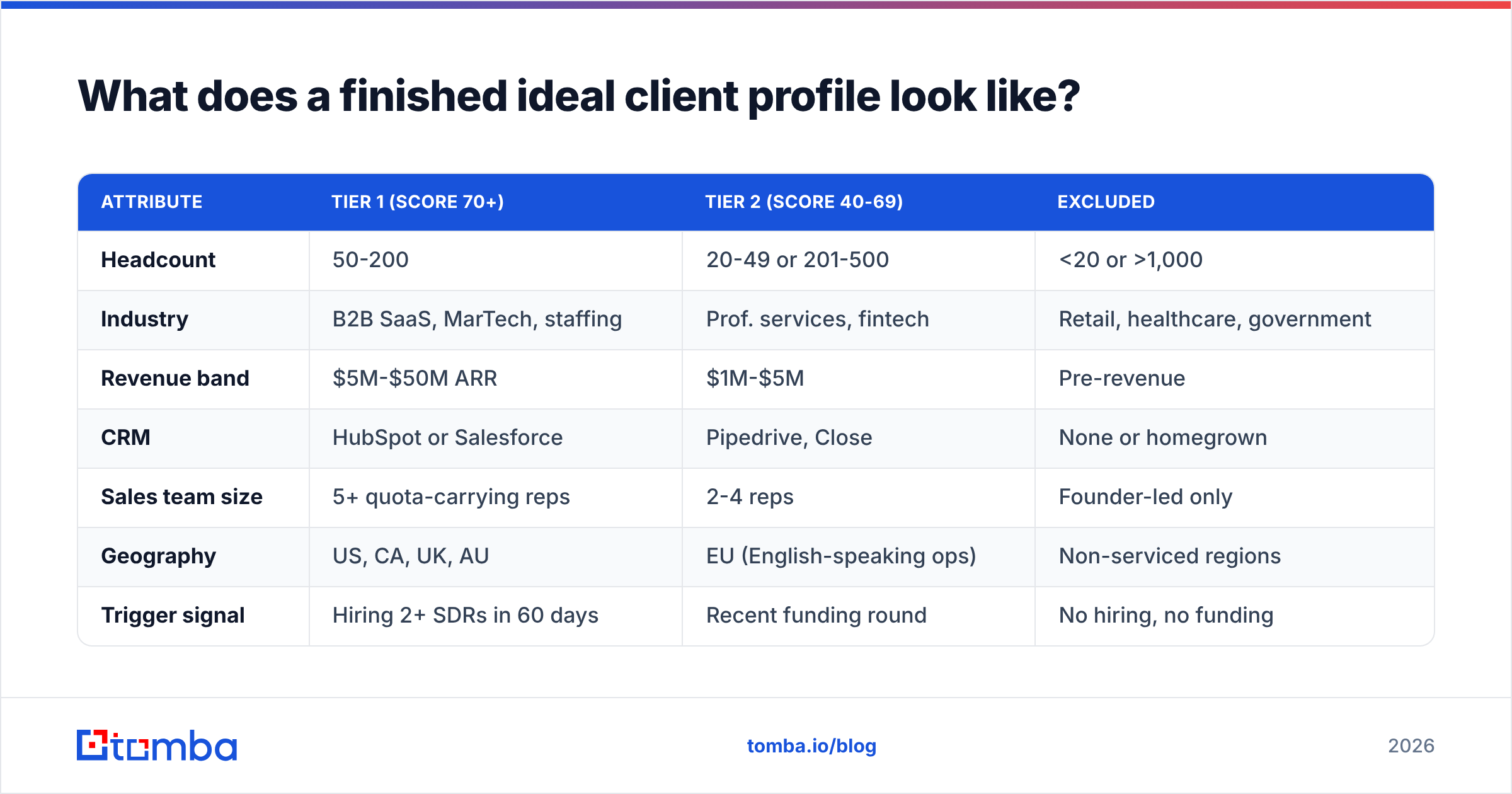
Here's a realistic worked example for a mid-market sales-engagement platform:
| Attribute | Tier 1 (score 70+) | Tier 2 (score 40-69) | Excluded |
|---|---|---|---|
| Headcount | 50-200 | 20-49 or 201-500 | <20 or >1,000 |
| Industry | B2B SaaS, MarTech, staffing | Prof. services, fintech | Retail, healthcare, government |
| Revenue band | $5M-$50M ARR | $1M-$5M | Pre-revenue |
| CRM | HubSpot or Salesforce | Pipedrive, Close | None or homegrown |
| Sales team size | 5+ quota-carrying reps | 2-4 reps | Founder-led only |
| Geography | US, CA, UK, AU | EU (English-speaking ops) | Non-serviced regions |
| Trigger signal | Hiring 2+ SDRs in 60 days | Recent funding round | No hiring, no funding |
| Estimated TAM | ~4,200 accounts | ~11,000 accounts | — |
Notice what's absent: no adjectives, no aspirations, no "companies that care about growth." Every row is something a filter can evaluate, which means this document converts directly into a list rather than into a debate.
Attach two things to it. First, the evidence — a short appendix showing win rate, churn, and average deal size per attribute, so anyone challenging the ICP has to argue with data rather than opinion. Second, the exclusion list, because knowing who you won't sell to saves more rep hours than knowing who you will.
How do you operationalize the ICP across the team?#
Push it into the systems reps actually touch, or it dies as a slide.
- CRM fields. Add ICP tier as a required picklist on the account object. Report on pipeline by tier every week. What gets reported on gets respected.
- Lead routing. Tier 1 inbound goes to an AE within minutes. Tier 3 goes to self-serve or a nurture track. Don't let routing rules contradict the ICP you just ratified.
- List-building templates. Save the ICP as a reusable filter in whatever prospecting tool your team uses, so a new SDR builds a compliant list on day one instead of inventing their own criteria.
- Sequence gating. No account enters an outbound sequence without a tier score and verified contact data. This one rule prevents most deliverability disasters, because unverified lists are how sender reputation gets destroyed.
- QBR scorecard. Report percentage of pipeline sourced from Tier 1. If that number is below 60%, your reps have quietly reverted to spraying, regardless of what the doc says.
The enforcement layer matters more than the document. Every org that has "a great ICP nobody follows" has a policy problem, not a research problem — the ICP was never wired into routing, reporting, or list-building, so following it was optional and slower than not following it.
Get the contact data your ICP list deserves#
A scored account list is a plan. It becomes revenue only when your reps can reach the right person at each of those accounts without burning credits on guesses and bounces.
Once you've defined your ideal client profile and built the account list, use the Tomba Email Finder to pull verified professional email addresses for the exact roles your persona work identified — by domain, by name, or in bulk across the entire list. The free tier gives you 25 searches a month to test coverage against your ICP before committing; Starter is $49/mo and Growth $99/mo when you're running full outbound volume. Check current Tomba pricing for the full tier breakdown.
Define the profile from data. Score the list. Verify the contacts. Then let your reps spend their hours on accounts that can actually say yes.
Related guides#
// get started
Find, verify and enrich your first contacts today
Start on the free plan with 25 searches a month, then scale when your team is ready.
Free plan · No credit card required · GDPR & CCPA
// about the author