Ideal Client Profile Example: 5 ICP Templates That Actually Work
Most ICPs are a slide nobody uses. Here's a complete ideal client profile example with real fields, a scoring model, and the exact steps to turn it into a working prospect list.
TL;DR
- An ideal client profile (ICP) describes the company you should sell to. A buyer persona describes the person inside it. Confusing the two is why most ICP documents never get used.
- A usable ICP is a filter, not a slide. Every field must be something you can actually query, score, or search for — headcount, tech stack, funding stage, hiring signals, not "values innovation."
- The worked example below has 14 fields split into firmographic, technographic, behavioral, and disqualifier buckets, plus a 100-point scoring model.
- Build it from your own closed-won data, not from a whiteboard. Ten customer interviews plus your CRM export beats any workshop.
- The ICP is worthless until it becomes a list. The last section covers turning the profile into verified contacts you can email this week.
What is an ideal client profile, exactly?#
An ideal client profile is a written description of the company that gets the most value from your product, in the shortest time, at the highest margin, and stays the longest.
Think of it like a fishing chart rather than a fish. The chart tells you which stretch of water holds the species you want, at what depth, in which season. It doesn't tell you what any individual fish is thinking. That's the buyer persona's job.
Technically: an ICP is a set of firmographic, technographic, and behavioral attributes that correlate with your best retention and expansion revenue. It operates at the account level. It drives territory design, list building, lead scoring, ad targeting, and — most importantly — disqualification.
Most teams get this backwards. They write an aspirational ICP ("enterprise fintechs in North America") based on where they wish they sold, then wonder why win rates stay flat. Your ICP is a description of reality, discovered from data you already own, not a target you invent.
What does a complete ideal client profile example look like?#
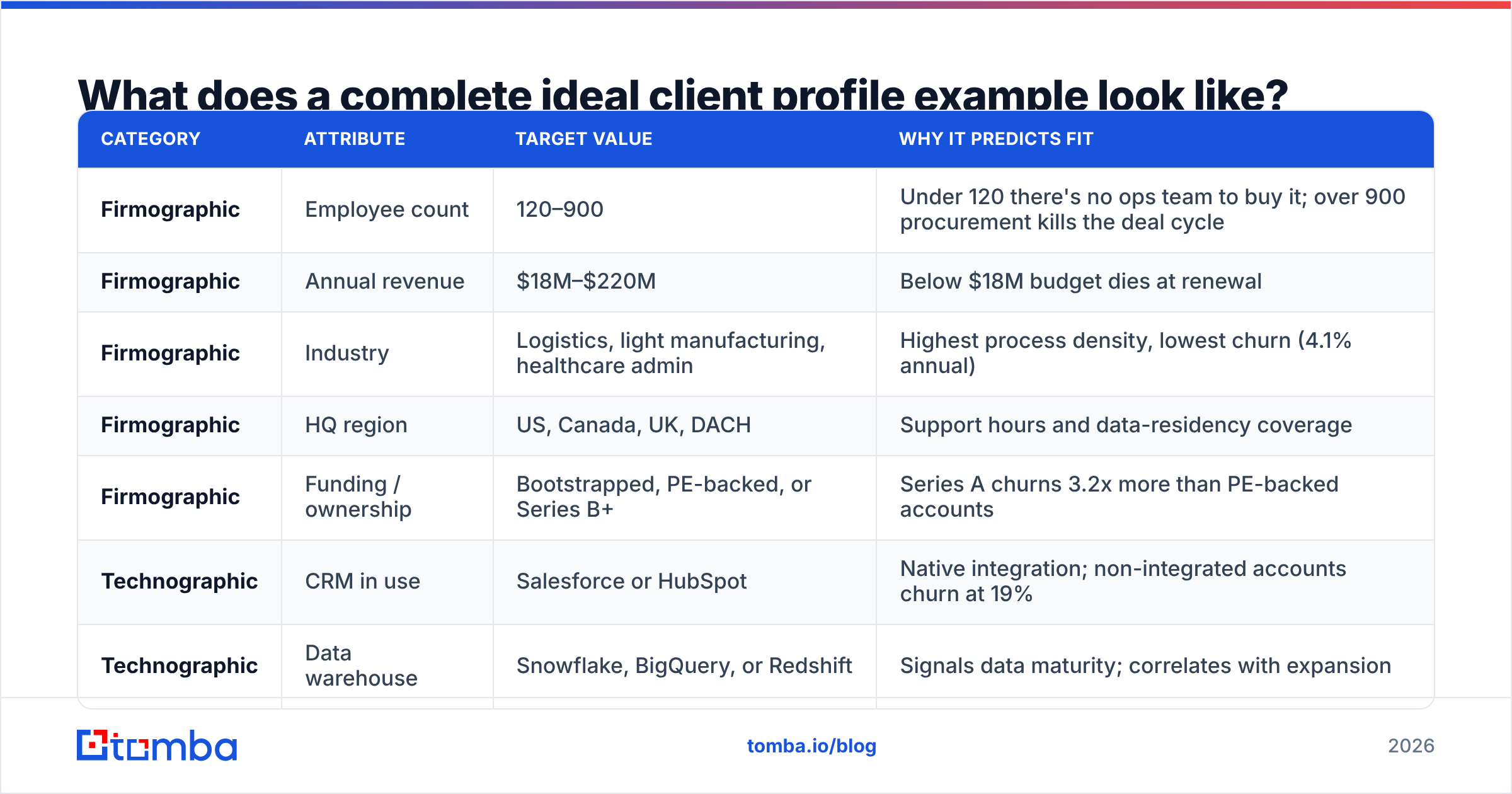
Here's a full ICP for a fictional but realistic company: Latchkey, a $2.4M ARR workflow-automation platform for mid-market operations teams. This is the format to copy.
Company: Latchkey — Ideal Client Profile v4 (Q1 2026)
| Category | Attribute | Target value | Why it predicts fit |
|---|---|---|---|
| Firmographic | Employee count | 120–900 | Under 120 there's no ops team to buy it; over 900 procurement kills the deal cycle |
| Firmographic | Annual revenue | $18M–$220M | Below $18M budget dies at renewal |
| Firmographic | Industry | Logistics, light manufacturing, healthcare admin | Highest process density, lowest churn (4.1% annual) |
| Firmographic | HQ region | US, Canada, UK, DACH | Support hours and data-residency coverage |
| Firmographic | Funding / ownership | Bootstrapped, PE-backed, or Series B+ | Series A churns 3.2x more than PE-backed accounts |
| Technographic | CRM in use | Salesforce or HubSpot | Native integration; non-integrated accounts churn at 19% |
| Technographic | Data warehouse | Snowflake, BigQuery, or Redshift | Signals data maturity; correlates with expansion |
| Technographic | Existing automation | Zapier or homegrown scripts | Proven pain, no entrenched competitor |
| Behavioral | Ops headcount | 3+ dedicated ops/RevOps staff | Someone has to own the rollout |
| Behavioral | Hiring signal | Open "Operations Manager" or "RevOps" req in last 90 days | Best single leading indicator in our data |
| Behavioral | Multi-site | 2+ physical locations or entities | Complexity drives seat expansion |
| Disqualifier | Headcount | Under 60 | Never once renewed |
| Disqualifier | Regulatory | FedRAMP or HIPAA BAA required | We can't sign it yet |
| Disqualifier | Buying process | Mandatory RFP over 40 pages | Average 11-month cycle, 12% win rate |
Notice what's absent: no adjectives. No "forward-thinking." No "companies that care about efficiency." Every row is something a rep can verify in under two minutes, or a system can filter on automatically.
Notice also the disqualifier block. It is the most valuable section of any ICP and the one almost everybody omits. Knowing who to walk away from protects more pipeline hours than knowing who to chase.

Which fields actually belong in an ICP?#
Use these six buckets. If a field doesn't fit one of them, it probably belongs in a persona doc instead.
- Firmographics — headcount, revenue, industry (use SIC/NAICS codes, not vibes), geography, ownership structure, growth rate. These are the coarse filters that cut a 400,000-company universe down to a few thousand.
- Technographics — the software they already run. CRM, marketing automation, cloud provider, payment stack, analytics. Technographics are the single most underused ICP dimension in B2B and usually the most predictive, because software choices reveal budget, maturity, and integration surface all at once.
- Behavioral / trigger signals — recent funding, new executive hires, open job requisitions, office expansion, security incidents, product launches. These don't define whether an account fits; they define when to reach out. A perfect-fit account with no trigger is a nurture target. A perfect-fit account with a fresh VP Ops hire is a call today.
- Economic profile — willingness to pay, average deal size, payment terms, expansion path. If your best-fit accounts on paper close at $4K ACV and churn in nine months, they are not best-fit accounts.
- Operational fit — do they have the internal capacity to implement? A company with the budget but no owner for your product is a future churn statistic wearing a closed-won badge.
- Disqualifiers — the hard nos. Regulatory requirements you can't meet, competitors with an entrenched multi-year contract, business models your pricing punishes, regions you can't support.
Rank the buckets by how much they move win rate in your own data. For most SMB-focused products, firmographics dominate. For technical infrastructure products, technographics dominate. For services businesses, triggers dominate.
ICP vs buyer persona vs TAM — what's the difference?#
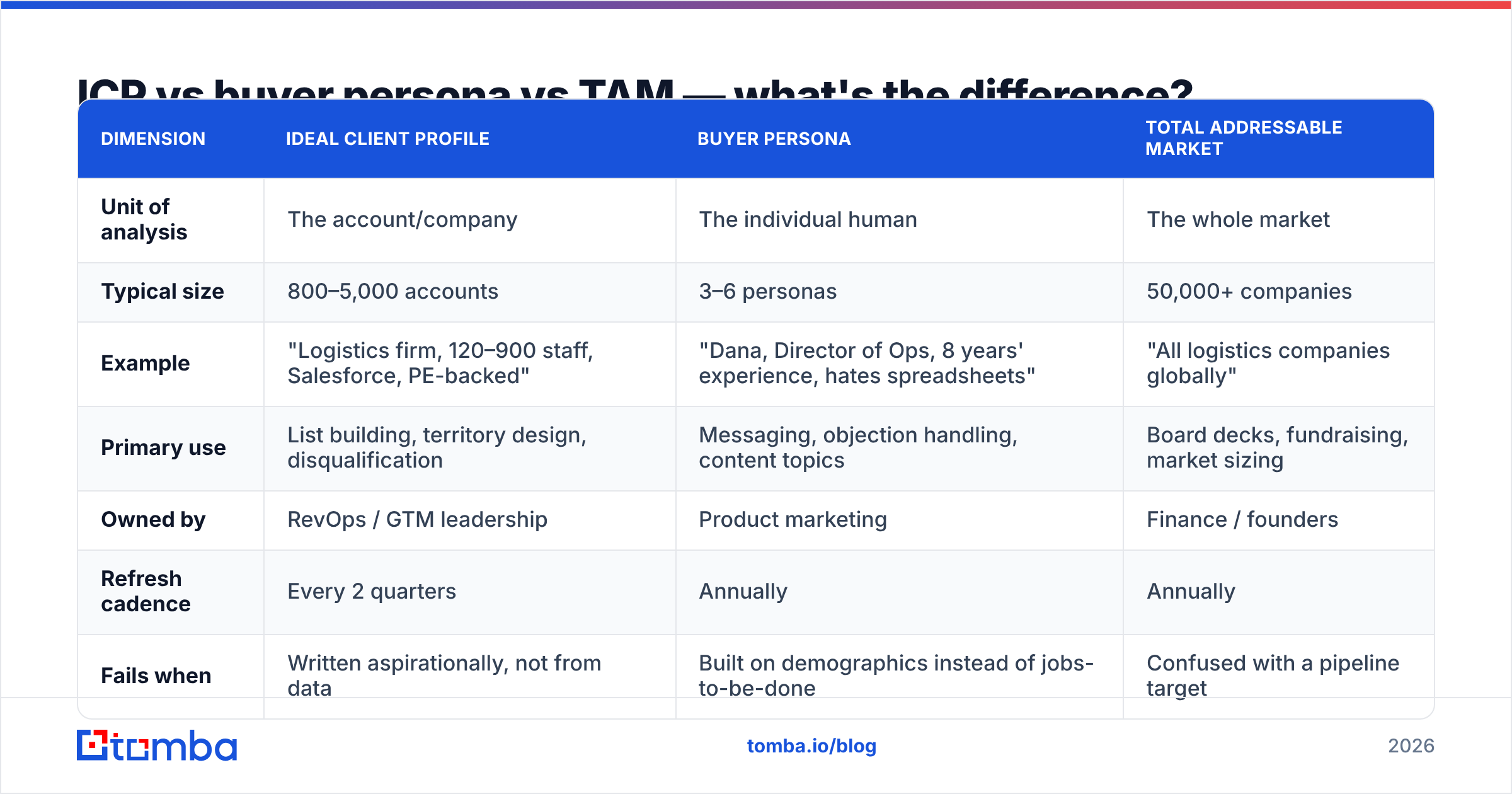
These three get used interchangeably in meetings, and the confusion costs real money. Here's the split:
| Dimension | Ideal Client Profile | Buyer Persona | Total Addressable Market |
|---|---|---|---|
| Unit of analysis | The account/company | The individual human | The whole market |
| Typical size | 800–5,000 accounts | 3–6 personas | 50,000+ companies |
| Example | "Logistics firm, 120–900 staff, Salesforce, PE-backed" | "Dana, Director of Ops, 8 years' experience, hates spreadsheets" | "All logistics companies globally" |
| Primary use | List building, territory design, disqualification | Messaging, objection handling, content topics | Board decks, fundraising, market sizing |
| Owned by | RevOps / GTM leadership | Product marketing | Finance / founders |
| Refresh cadence | Every 2 quarters | Annually | Annually |
| Fails when | Written aspirationally, not from data | Built on demographics instead of jobs-to-be-done | Confused with a pipeline target |
The practical rule: TAM tells you the size of the ocean, ICP tells you where to fish, persona tells you which bait to use. You need all three, but only the ICP touches your prospecting workflow daily.
How do you build an ICP from your own data in five steps?#
Skip the workshop. Do this instead — it takes about a week.
Step 1 — Export closed-won accounts from the last 24 months. Pull account name, domain, ACV, close date, sales cycle length, current status, expansion revenue, and support ticket volume. Twenty-four months is long enough to see who renewed and who quietly left.
Step 2 — Rank them by a composite value score. Don't rank by ACV alone. A workable formula: (lifetime revenue) × (retention months / 24) ÷ (implementation hours + support hours). Now sort. The top quartile is your source of truth. The bottom quartile is your disqualifier research.
Step 3 — Enrich both ends. Take the top 25% and the bottom 25% and append firmographic and technographic data to every domain. This is where most ICP projects stall, because CRM data is incomplete — half your accounts have no headcount, industry, or tech stack recorded. Run the domains through a data enrichment pass to fill the gaps before you analyze anything. Analyzing 40% coverage produces confident nonsense.
Step 4 — Find the separating variables. For each attribute, compare the frequency in your top quartile versus your bottom quartile. You're looking for spreads, not averages. If 71% of top-quartile accounts run Snowflake versus 12% of bottom-quartile accounts, you've found a real signal. If both groups are 40% US-based, geography isn't predictive for you — drop it, however tempting it is to include.
Step 5 — Interview eight to twelve customers. Split them: six from the top quartile, four from the bottom, two who churned. Ask what triggered the purchase, who else was in the room, what almost stopped the deal, and what would have to change for them to leave. Interviews explain why the quantitative spreads exist, which is what makes the ICP defensible when a rep pushes back on it. Both HubSpot and Gartner publish solid frameworks for structuring these conversations if you want a script to start from.
Write the result as one page. If it doesn't fit on one page, it won't be used.
What do four more ideal client profile examples look like?#
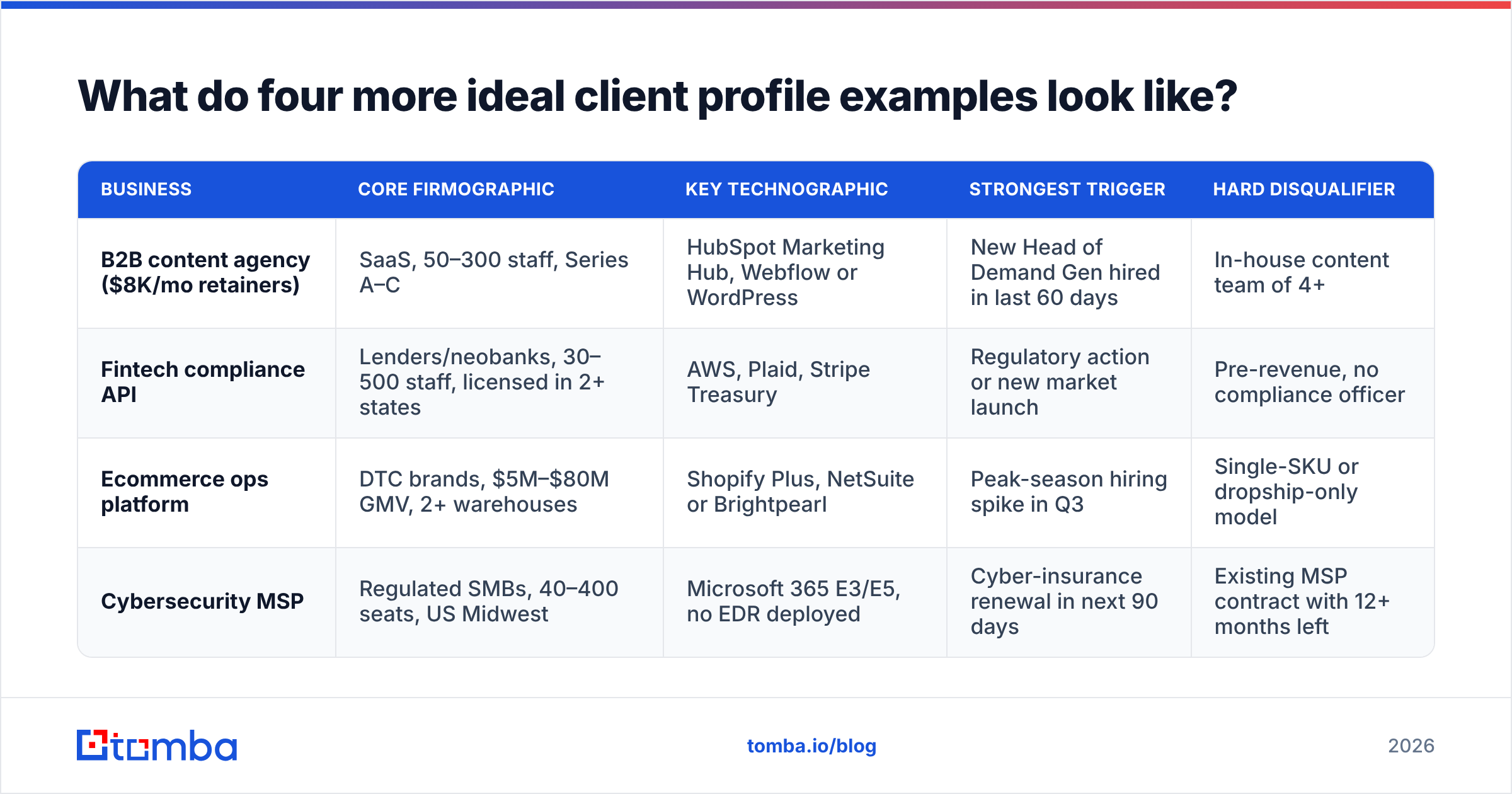
Different business models produce very different ICPs. Here's the same structure applied across four more companies, condensed to the fields that matter most in each case:
| Business | Core firmographic | Key technographic | Strongest trigger | Hard disqualifier |
|---|---|---|---|---|
| B2B content agency ($8K/mo retainers) | SaaS, 50–300 staff, Series A–C | HubSpot Marketing Hub, Webflow or WordPress | New Head of Demand Gen hired in last 60 days | In-house content team of 4+ |
| Fintech compliance API | Lenders/neobanks, 30–500 staff, licensed in 2+ states | AWS, Plaid, Stripe Treasury | Regulatory action or new market launch | Pre-revenue, no compliance officer |
| Ecommerce ops platform | DTC brands, $5M–$80M GMV, 2+ warehouses | Shopify Plus, NetSuite or Brightpearl | Peak-season hiring spike in Q3 | Single-SKU or dropship-only model |
| Cybersecurity MSP | Regulated SMBs, 40–400 seats, US Midwest | Microsoft 365 E3/E5, no EDR deployed | Cyber-insurance renewal in next 90 days | Existing MSP contract with 12+ months left |
Read across the rows and a pattern emerges: the sharpest ICPs pair a structural filter (who they permanently are) with a temporal filter (what just happened to them). Structure tells you the account belongs on the list. Timing tells you which week to work it.

How do you turn the ICP into an actual prospect list?#
This is the step where ICP documents go to die. The profile exists, it's beautiful, and the SDR team still runs the same generic list they ran last quarter. Here's the handoff that works.
1. Convert every attribute into a filter or a search string. "Logistics, 120–900 staff, US/UK" becomes a saved search. "Runs Salesforce" becomes a technographic filter. "Hiring an Ops Manager" becomes a job-board alert. Anything you can't express as a query gets rewritten or dropped.
2. Build the account list first, contacts second. Resist the urge to buy a contact list and filter afterward. Start from a company universe that already matches the ICP, then find people inside it. Pulling contacts by domain search across your matched account list keeps the ordering correct and stops junk from entering the funnel.
3. Map the buying committee per account. Your ICP said "3+ ops staff," so find them. For a mid-market deal you typically need an economic buyer, a champion, and a technical evaluator. Three contacts per account beats one contact across three accounts — multi-threaded accounts close at meaningfully higher rates in most B2B benchmarks tracked on G2.
4. Verify before you send. ICP-matched contacts on a stale list still bounce. Run every address through an email verifier before the first send, and route catch-all domains through separate handling rather than deleting them — in mid-market logistics and manufacturing, catch-all configurations are common and you'd be throwing away good accounts.
5. Score and route. Assign points per attribute — say 30 for headcount band, 25 for technographic match, 25 for an active trigger, 20 for multi-site — and route anything over 70 to outbound, 40–70 to nurture, and under 40 to nothing at all. The "nothing at all" bucket is the point of the exercise.
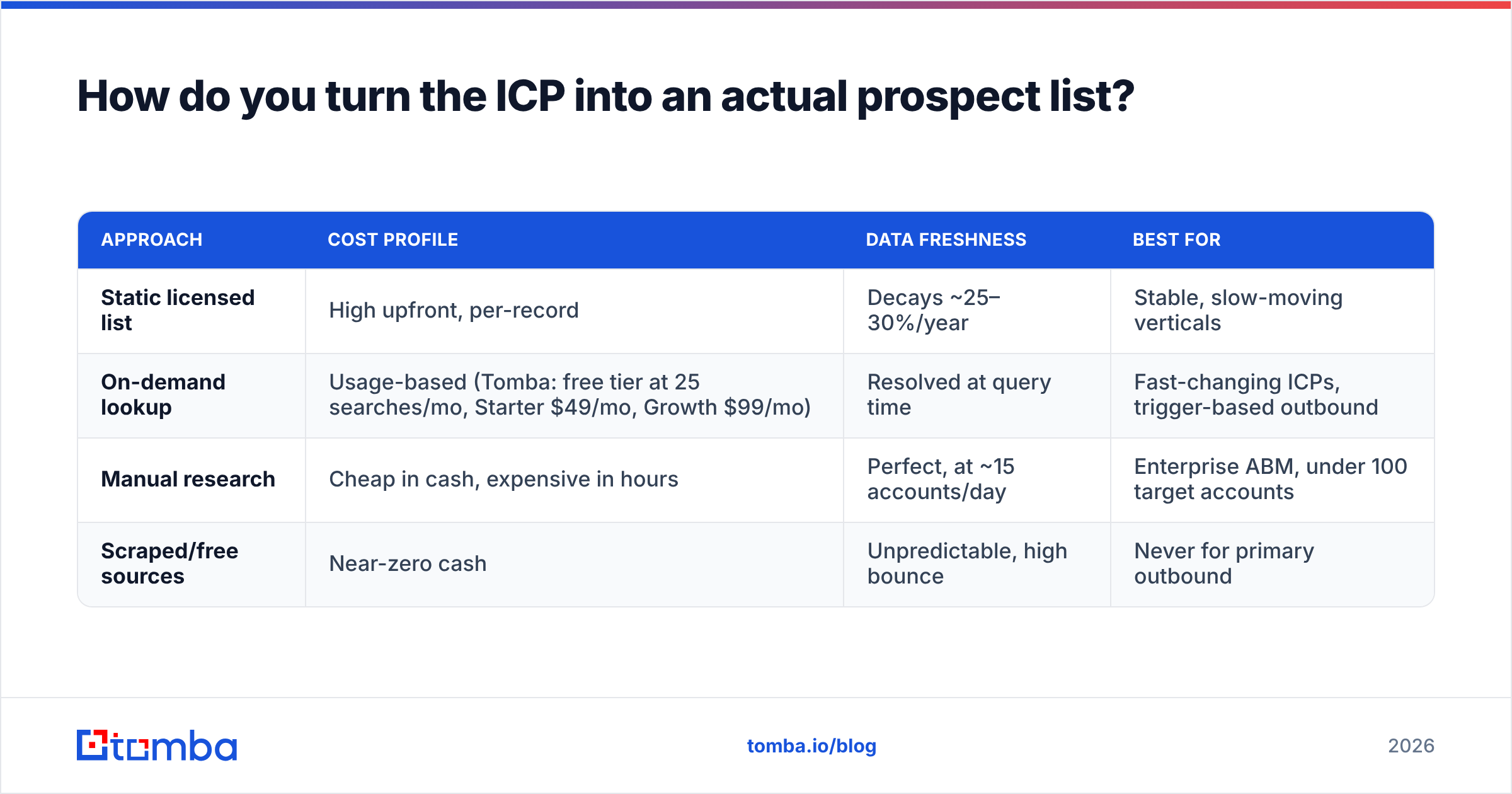
Where you source the underlying data is a build-or-buy call. Some teams license a static list from a provider like BookYourData or another established vendor and refresh quarterly; others prefer to generate contacts on demand against a live B2B database so the data is fresh at the moment of outreach. Both work. What doesn't work is a two-year-old CSV that nobody has touched since the last ICP revision.
| Approach | Cost profile | Data freshness | Best for |
|---|---|---|---|
| Static licensed list | High upfront, per-record | Decays ~25–30%/year | Stable, slow-moving verticals |
| On-demand lookup | Usage-based (Tomba: free tier at 25 searches/mo, Starter $49/mo, Growth $99/mo) | Resolved at query time | Fast-changing ICPs, trigger-based outbound |
| Manual research | Cheap in cash, expensive in hours | Perfect, at ~15 accounts/day | Enterprise ABM, under 100 target accounts |
| Scraped/free sources | Near-zero cash | Unpredictable, high bounce | Never for primary outbound |
Compare the usage-based option against your current per-record spend on Tomba pricing before committing to an annual list contract — for teams with an ICP under about 3,000 accounts, on-demand almost always comes out cheaper.
What are the most common ICP mistakes?#
- Writing it aspirationally. If you've closed two enterprise deals ever, enterprise is not your ICP. It's a hypothesis.
- Making it too broad. "B2B SaaS companies in North America" is not an ICP, it's a TAM with a haircut. If your ICP matches more than 5,000 accounts, tighten it.
- Making it too narrow. If it matches under 300 accounts, you don't have a repeatable motion, you have an ABM list. That's fine — just don't build a team of eight SDRs around it.
- No disqualifiers. Without them, the ICP only adds accounts. It never removes any, so nothing changes.
- Never revisiting it. Product changes, pricing changes, and competitors' moves all shift fit. Re-run steps 1 through 4 every two quarters; the interviews can wait for the annual pass.
- Keeping it in marketing's drive. If the ICP isn't encoded in your CRM fields, your lead-scoring rules, and your SDR's saved searches, it doesn't exist.
How often should you update your ICP?#
Every six months, with a lightweight check each quarter. The quarterly check is one question: did any account we closed this quarter fall outside the ICP and still perform well? If two or more did, you have a new segment worth investigating. If a third of your closed-won is out-of-profile, your ICP is already stale and the full rebuild can't wait.
Version it. Date it. Put the changelog at the bottom so reps can see what moved and why. An ICP that silently changes is one nobody trusts.
Ready to turn your profile into pipeline? An ICP only pays off when it becomes verified contacts in a sequence. Use the Tomba Email Finder to pull decision-maker addresses across every account that matches your profile — by name, role, or whole domain — with verification built into the same step. Start on the free tier at 25 searches a month, test it against a slice of your ICP list, and scale up only once the match rate proves out.
Related guides#
Ready to find emails that actually work?
Join 150,000+ professionals who stopped guessing and started sending. Free credits on signup — no credit card required.
Get the Tomba newsletter
Practical outbound tactics and product updates — once every two weeks.
About the author