Ideal Customer Criteria: How to Define Your ICP in 2026
Most ICPs are wishful thinking dressed up as a slide. Here is how to build ideal customer criteria from closed-won data, score accounts against them, and cut wasted outbound.
TL;DR
- Ideal customer criteria are the specific, checkable attributes that separate accounts who buy and stay from accounts who ghost, churn, or grind your team down.
- Build them backwards from closed-won and churned data — not from a whiteboard brainstorm. Your best 20 customers already wrote the spec.
- A usable ICP has four layers: firmographic, technographic, operational, and situational. Miss the last two and you get a list of companies, not a list of buyers.
- Score accounts 0-100 against weighted criteria, then only prospect Tier A and B. Most teams find 60-70% of their current list fails their own bar.
- Criteria decay. Re-run the analysis every two quarters or you'll be prospecting for the company you were in 2024.
What are ideal customer criteria?#
Ideal customer criteria are the filters an account must pass before it's worth your team's time. Think of them like the requirements list for a mortgage: the bank doesn't ask whether you seem trustworthy, it checks income, debt ratio, and credit history — specific, verifiable, and predictive of the outcome it cares about.
Your ICP works the same way. "Mid-market SaaS companies that value innovation" is a vibe. "B2B SaaS, 80-400 employees, Series B or later, running HubSpot, with 3+ open SDR roles posted in the last 60 days" is a criteria set. The second one you can query. The first one you can only argue about.
The distinction matters because criteria are what your prospecting tooling consumes. A domain search takes a domain and returns contacts. It doesn't take "companies that value innovation." Every hour spent making your ICP vaguer is an hour of manual list-building later.
ICP vs buyer persona vs target account list#
These three get blended constantly, and blending them is how you end up with a 12,000-row list nobody trusts.
- Ideal customer profile (ICP) — describes the company. Size, sector, tech, stage, geography, trigger events. Answers: should we sell to this account at all?
- Buyer persona — describes the person inside that company. Role, seniority, pains, buying authority, what they read. Answers: who do we email, and about what?
- Target account list (TAL) — the finite, named output. Answers: which 400 companies are we working this quarter?
- Account scoring model — the math that ranks the TAL. Answers: which 40 of those 400 do we work first?
Criteria feed all four. Get them wrong and the error compounds down the chain — bad ICP produces a bad TAL, which makes your reps distrust the scoring, which makes them build their own lists, which kills any chance of measuring what works.
Why do most ideal customer profiles fail?#
Because they're written aspirationally by people who want a bigger TAM, not descriptively by people looking at closed-won data.
Four failure patterns show up over and over:
The TAM-inflation ICP. Someone on the leadership team notices that a narrow ICP shrinks the addressable market on the board deck, so the criteria get loosened until the market looks big. Now your SDRs are emailing 40,000 companies with a 0.4% reply rate instead of 2,000 with a 9% one.
The single-variable ICP. "We sell to companies with 50-500 employees." That's a headcount band, not a profile. Headcount alone is one of the weakest predictors of fit in most B2B categories — a 200-person law firm and a 200-person dev-tools startup share nothing that matters to you.
The never-updated ICP. Written during the seed round, still on the wiki three years later, while the product has shipped an enterprise SSO tier and the pricing has doubled.
The un-queryable ICP. Criteria like "growth-minded" or "digitally mature" that no database can filter on. If you can't turn a criterion into a filter, a scrape, or a signal, it's decoration.

The cost is concrete. If your team sends 8,000 emails a quarter and 65% go to accounts outside your real ICP, you burned 5,200 sends, torched some sender reputation, and produced pipeline noise your forecast now has to absorb.
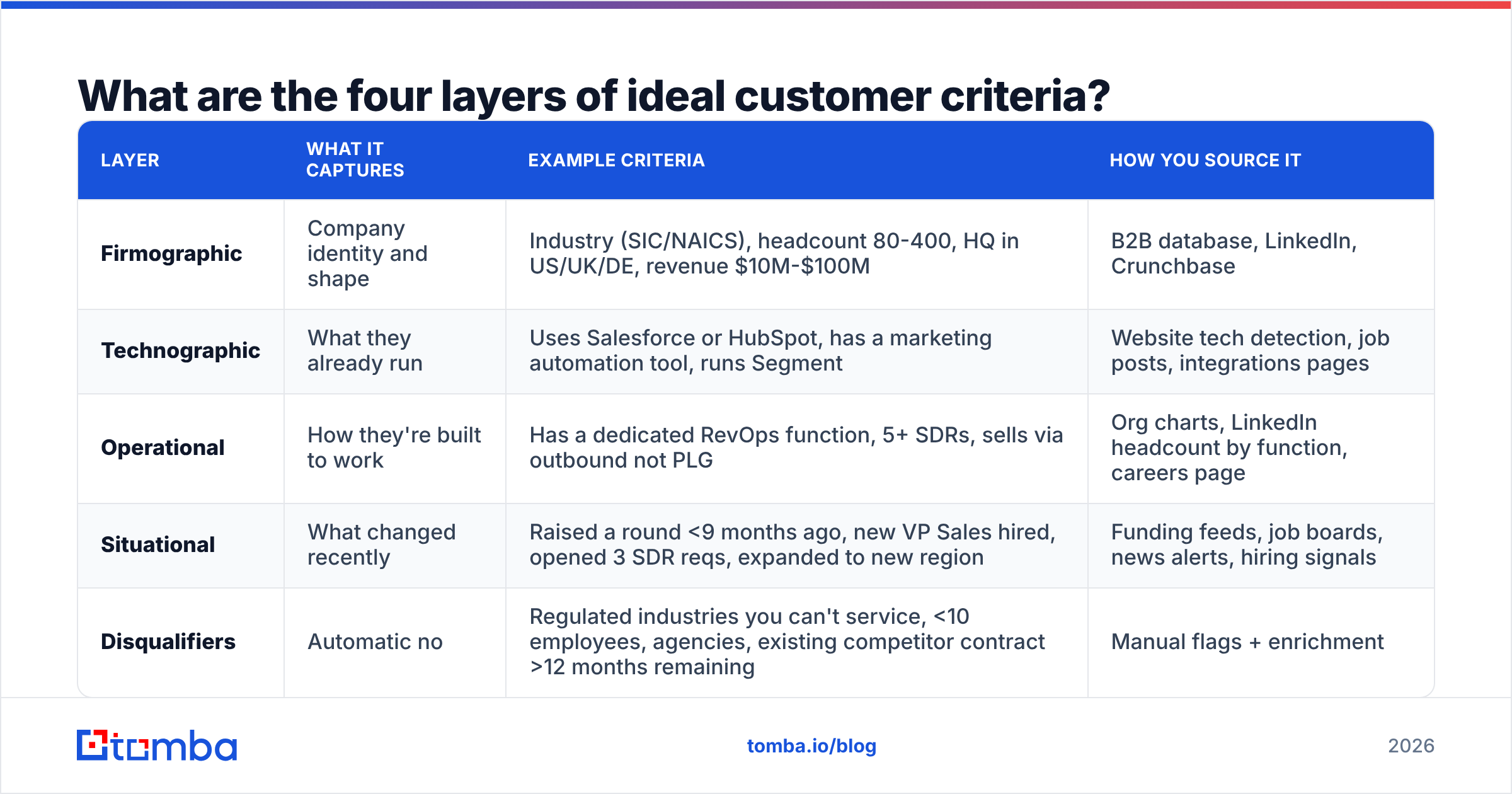
What are the four layers of ideal customer criteria?#
Strong criteria stack in four layers. Each layer narrows the funnel and each is independently checkable.
| Layer | What it captures | Example criteria | How you source it |
|---|---|---|---|
| Firmographic | Company identity and shape | Industry (SIC/NAICS), headcount 80-400, HQ in US/UK/DE, revenue $10M-$100M | B2B database, LinkedIn, Crunchbase |
| Technographic | What they already run | Uses Salesforce or HubSpot, has a marketing automation tool, runs Segment | Website tech detection, job posts, integrations pages |
| Operational | How they're built to work | Has a dedicated RevOps function, 5+ SDRs, sells via outbound not PLG | Org charts, LinkedIn headcount by function, careers page |
| Situational | What changed recently | Raised a round <9 months ago, new VP Sales hired, opened 3 SDR reqs, expanded to new region | Funding feeds, job boards, news alerts, hiring signals |
| Disqualifiers | Automatic no | Regulated industries you can't service, <10 employees, agencies, existing competitor contract >12 months remaining | Manual flags + enrichment |
Most teams do layer one, half of layer two, and skip three and four entirely. Layers three and four are where the conversion lift lives, because they answer why now rather than why them. A perfectly firmographic-fit company with no trigger is a company that will politely archive your email.
The disqualifier list is underrated#
Write down what makes an account an automatic no, and make it as specific as the yes-criteria. Teams that skip this end up with reps quietly working accounts they know won't close, because nothing in the system told them to stop. A clean disqualifier list also gives you something to hold your data vendor to — you can measure how much of a purchased list violates it.
How do you build criteria from your own data?#
Backwards, from outcomes. Here's the sequence that works in a week, not a quarter.
Step 1 — Pull three cohorts. Export your last 12-24 months of (a) closed-won accounts that renewed or expanded, (b) closed-lost accounts that reached at least stage two, and (c) churned accounts. You need all three. Won-only analysis tells you what you sold, not what you should sell.
Step 2 — Enrich every row identically. Append firmographic and technographic fields to all three cohorts from the same source, so you're comparing like with like. Inconsistent enrichment is the most common way this analysis produces garbage. Contact enrichment at the account level gets you employee count, industry, domain age, and tech stack in one pass.
Step 3 — Find the separators. For each attribute, compare the distribution in cohort A against cohorts B and C. You're not looking for what's common in your winners — you're looking for what's common in winners and rare in losers. Industry might be evenly spread across all three (not a criterion). "Has an in-house RevOps hire" might be 71% in won and 18% in churned (strong criterion).
Step 4 — Check the economics, not just the logo. Segment by net revenue retention, gross margin, support ticket volume, and sales cycle length. An account type that closes fast and churns in nine months is a false positive your ICP should exclude. Gartner's research on customer retention consistently finds that expansion revenue concentrates in a narrower band than initial acquisition — your criteria should reflect the retention band, not the acquisition band.
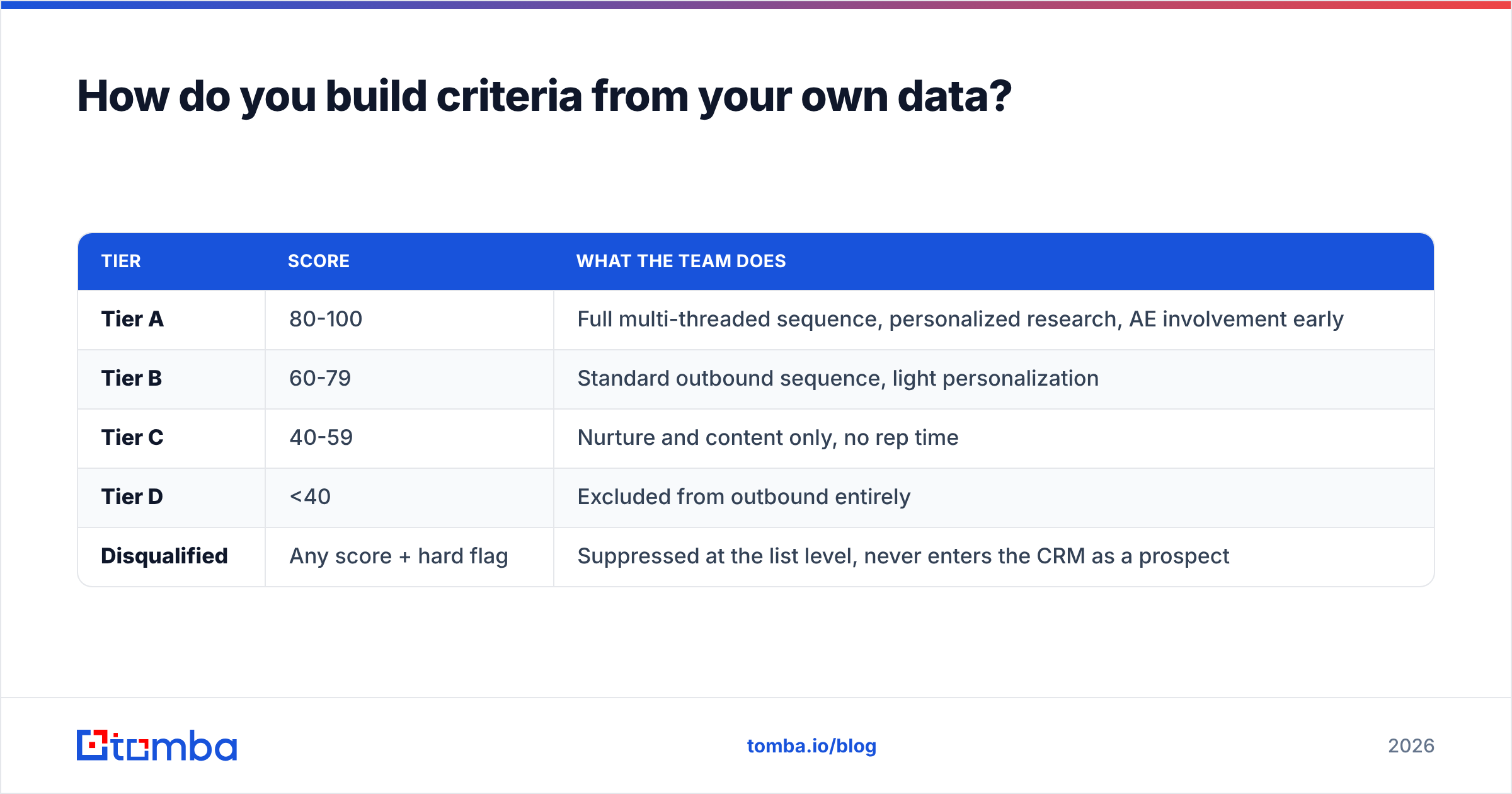
Step 5 — Weight and threshold. Assign points per criterion based on how strongly it separated, then set tier cutoffs. Something like:
| Tier | Score | What the team does |
|---|---|---|
| Tier A | 80-100 | Full multi-threaded sequence, personalized research, AE involvement early |
| Tier B | 60-79 | Standard outbound sequence, light personalization |
| Tier C | 40-59 | Nurture and content only, no rep time |
| Tier D | <40 | Excluded from outbound entirely |
| Disqualified | Any score + hard flag | Suppressed at the list level, never enters the CRM as a prospect |
Step 6 — Validate against a holdout. Score last quarter's closed-won accounts with the new model. If most of them land in Tier C, your weights are wrong. Fix them before the model ships.
How do you turn criteria into an actual prospect list?#
Criteria are useless until they produce named humans with reachable inboxes. The pipeline runs in four moves.
- Define the account universe. Use your firmographic and technographic filters against a B2B database or a scraped source to produce a list of qualifying domains. Output: domains, not people.
- Layer in situational signals. Filter or re-rank that domain list by triggers — funding, hiring, leadership changes, tech adoption. This is what turns a static list into a prioritized one.
- Map the buying committee. For each surviving domain, identify the 2-4 roles who matter. B2B purchases involve multiple stakeholders, and HubSpot's sales research has repeatedly shown deals with multiple engaged contacts close at meaningfully higher rates than single-threaded ones.
- Resolve and verify contact data. Turn names and domains into deliverable addresses, then verify before you send. This is the step where sloppy execution undoes good targeting — a perfectly-scored Tier A account you can't actually reach is worth zero.
For step four, a domain search gets you every discoverable address at a qualifying company along with the email pattern; an email verifier then strips the invalid and risky ones before your sequencer ever touches them. If your criteria produce thousands of accounts, run it through a bulk email finder rather than one-by-one lookups.
Where the data comes from matters#
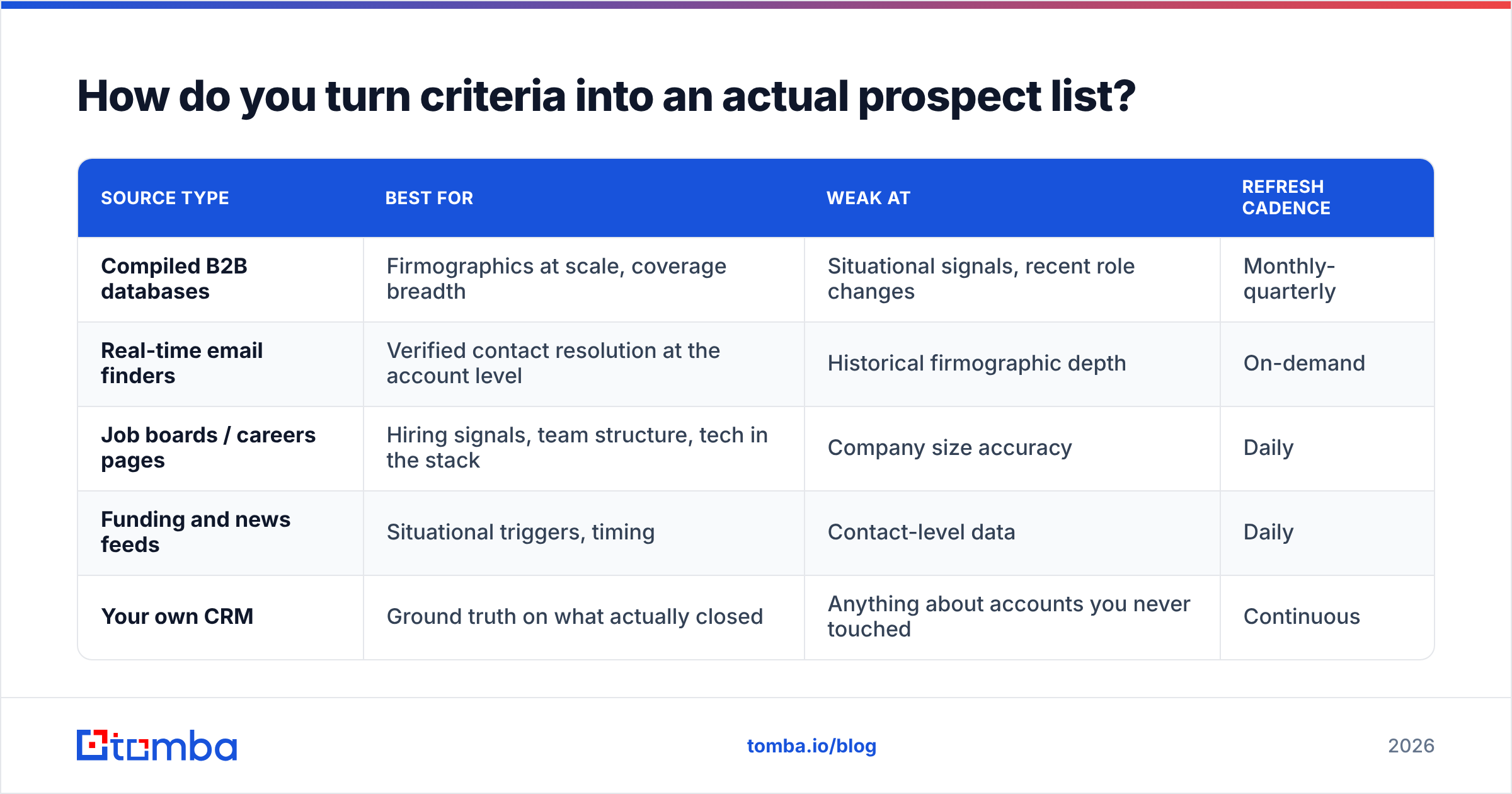
Different sources are honest about different things, and mixing them without normalizing is how you get a scoring model that ranks noise.
| Source type | Best for | Weak at | Refresh cadence |
|---|---|---|---|
| Compiled B2B databases | Firmographics at scale, coverage breadth | Situational signals, recent role changes | Monthly-quarterly |
| Real-time email finders | Verified contact resolution at the account level | Historical firmographic depth | On-demand |
| Job boards / careers pages | Hiring signals, team structure, tech in the stack | Company size accuracy | Daily |
| Funding and news feeds | Situational triggers, timing | Contact-level data | Daily |
| Your own CRM | Ground truth on what actually closed | Anything about accounts you never touched | Continuous |
Vendors like BookYourData lean into pre-built, filterable lists that map cleanly onto firmographic criteria, which is useful when you want an account universe fast. Real-time finders are better when your criteria are narrow enough that you already know the target domains and just need reachable contacts at each one. Most teams that run this well use both: a compiled source to define the universe, a real-time source to resolve the people. Check Tomba pricing against your list volume — the free tier covers 25 searches a month, which is enough to test whether your criteria produce findable contacts before you commit budget.
How do you know your criteria are working?#
Measure the criteria, not just the campaign. Four metrics separate a real ICP from a documented guess:
- Tier A reply rate vs Tier C reply rate. If they're within a couple of points of each other, your scoring model isn't predicting anything. That gap is the single cleanest proof your criteria have signal.
- Win rate by tier. Tier A should win at 2-3x Tier C. Track it in the CRM as a first-class field, not a note.
- Sales cycle length by tier. Good fit shortens cycles. If Tier A takes longer to close than Tier B, you may have confused "big" with "ideal."
- 12-month NRR by tier. The one that catches false positives. Accounts that close easily and churn quietly are the most expensive mistake in the list.
Also track coverage: what percentage of your closed-won deals came from accounts that scored Tier A or B at the time of first touch? If it's under 60%, your reps are finding good business your criteria are blind to — which is a signal to go re-run the analysis, not to ignore the reps.
How often should you refresh ideal customer criteria?#
Every two quarters, with a lightweight check monthly. Criteria decay for predictable reasons: your product ships features that open a new segment, your pricing moves and prices out your old sweet spot, a competitor exits and their customers become winnable, or a macro shift changes who has budget.
A practical cadence:
- Monthly (30 minutes): Review closed-won from the month. Did any deals come from accounts scored Tier C or below? Log them.
- Quarterly (half a day): Recompute reply, win, and cycle-length rates by tier. Adjust weights if any criterion stopped separating.
- Semi-annually (two days): Full re-run of the cohort analysis with fresh enrichment. Retire dead criteria, add new ones, rewrite the disqualifier list.
- On any major change: New pricing tier, new product line, new geography — re-run immediately, don't wait for the calendar.
Version the document. When someone asks why an account is Tier D, you want to be able to point at a dated rule, not re-litigate the whole model.
What does a finished criteria set look like?#
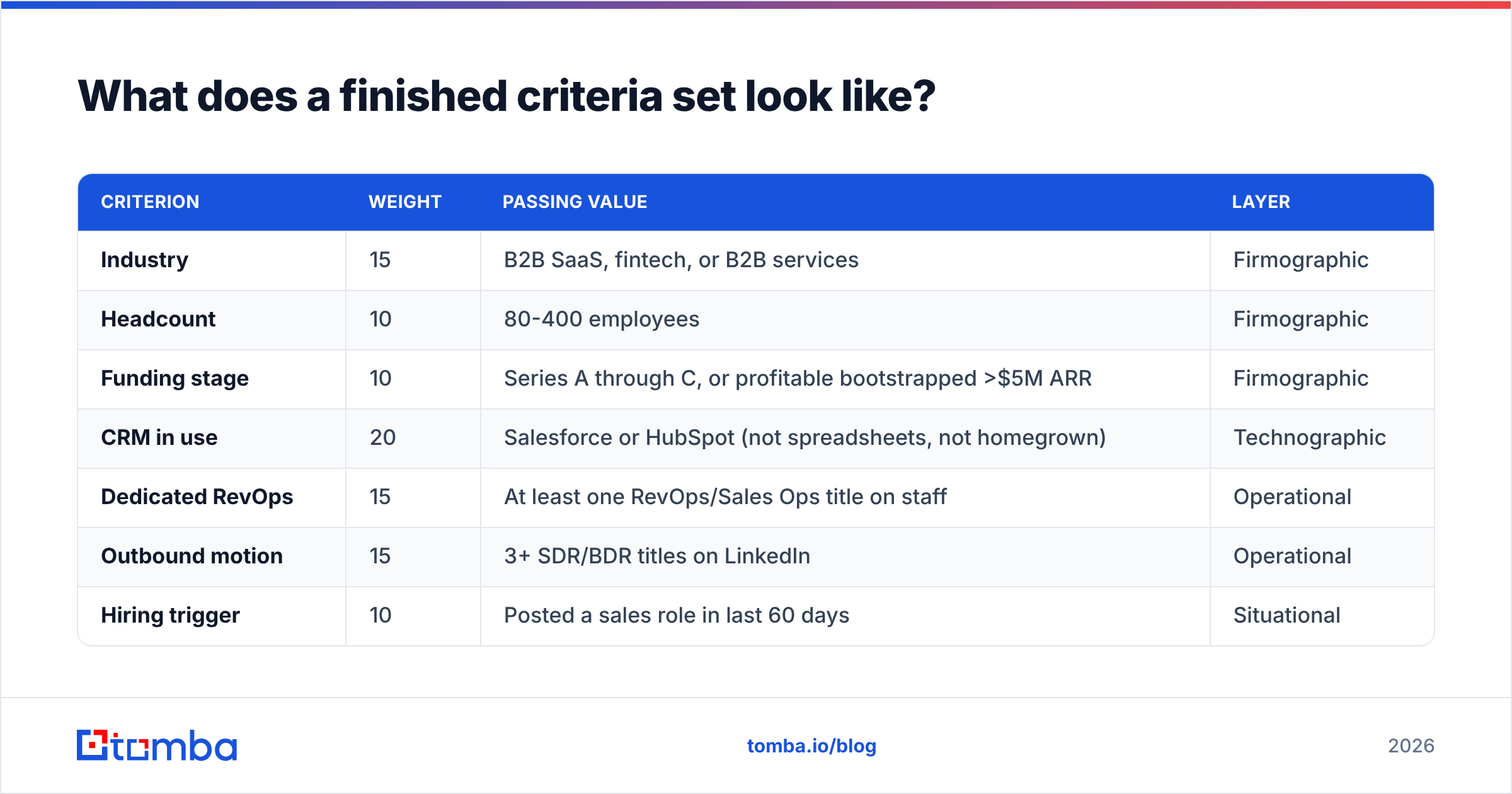
Concrete example for a fictional revenue-intelligence tool selling at $2K/month:
| Criterion | Weight | Passing value | Layer |
|---|---|---|---|
| Industry | 15 | B2B SaaS, fintech, or B2B services | Firmographic |
| Headcount | 10 | 80-400 employees | Firmographic |
| Funding stage | 10 | Series A through C, or profitable bootstrapped >$5M ARR | Firmographic |
| CRM in use | 20 | Salesforce or HubSpot (not spreadsheets, not homegrown) | Technographic |
| Dedicated RevOps | 15 | At least one RevOps/Sales Ops title on staff | Operational |
| Outbound motion | 15 | 3+ SDR/BDR titles on LinkedIn | Operational |
| Hiring trigger | 10 | Posted a sales role in last 60 days | Situational |
| Disqualifier: agency | — | Automatic exclusion | Disqualifier |
| Disqualifier: <10 staff | — | Automatic exclusion | Disqualifier |
Notice what's absent: no "innovative," no "growth-focused," no "values data." Every row is something you can check with a query or a scrape, and every weight traces back to how strongly that attribute separated won from churned. That's the whole bar. If a criterion can't clear it, it belongs in a positioning doc, not a scoring model.
Two more things worth writing down alongside the table: the evidence behind each weight (one line — "71% of won vs 18% of churned"), and the review date. Criteria without provenance get argued about; criteria without a review date get stale.
Ready to turn your criteria into a contactable list?#
Good ideal customer criteria only pay off when they end in verified inboxes. Once you know which accounts qualify, the Tomba Email Finder resolves names and domains into deliverable professional addresses, with domain-level search for mapping full buying committees and verification built in so your Tier A accounts don't die at the SMTP layer. Start on the free tier — 25 searches a month is enough to pressure-test whether your criteria actually produce reachable people before you scale the list.
Related guides#
// get started
Find, verify and enrich your first contacts today
Start on the free plan with 25 searches a month, then scale when your team is ready.
Free plan · No credit card required · GDPR & CCPA
Get the Tomba newsletter
Product and data updates
// about the author