Ideal Customer Persona: How to Build One That Converts
Most persona docs are fiction with a stock photo attached. Here's how to build an ideal customer persona from real firmographic and contact data — and turn it into a prospect list that actually books meetings.
TL;DR
- An ideal customer persona is only useful if it produces a filterable list. If you can't turn it into a query — industry, headcount, tech stack, job title, seniority — it's a mood board, not a targeting document.
- Separate the three layers most teams smash together: ICP (which companies), persona (which humans inside them), trigger (why now).
- Build it from closed-won data first, lost-deal data second, and interviews third. Not from a brainstorm whiteboard.
- The persona document should end with a contact-acquisition spec: exact titles, exact seniority, exact exclusions, and where you'll source verified emails and phone numbers.
- Re-score your personas every quarter. A persona built on 2024 buying committees is already wrong for 2026 — AI budget owners moved.
What is an ideal customer persona?#
An ideal customer persona is a data-backed profile of the specific human who buys, uses, or blocks your product inside your best-fit accounts. It combines role, responsibilities, buying authority, pain, and the language that person actually uses — plus the firmographic context of the company they sit in.
Here's the analogy: your ICP is the neighborhood you're house-hunting in. Your persona is the person who answers the door. Your trigger is the reason they're willing to talk to you today instead of next year. Most teams write a beautiful description of the neighborhood, then knock on random doors.
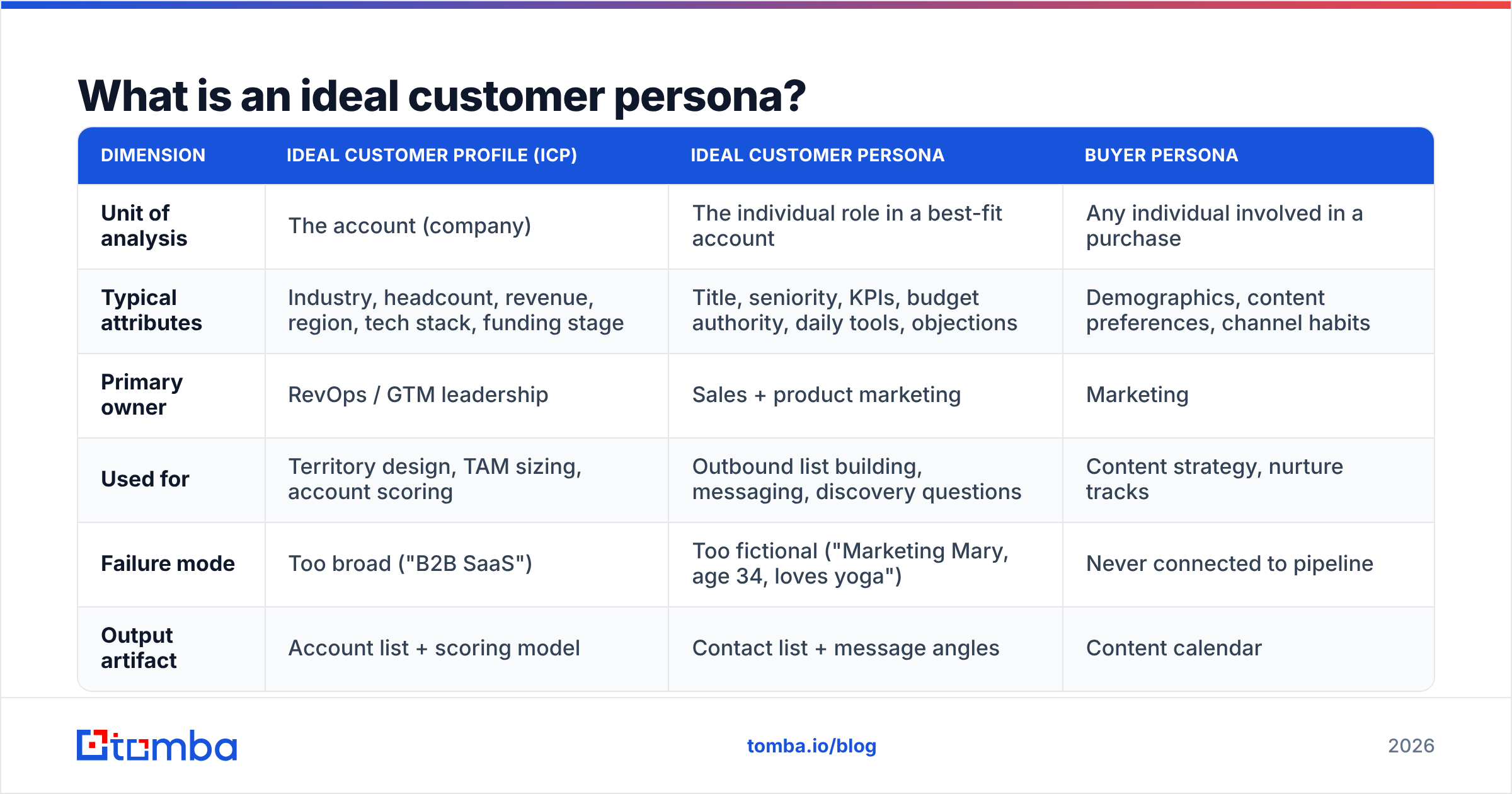
The three terms get used interchangeably, and that confusion is expensive. This table is the version worth pinning to your wall:
| Dimension | Ideal Customer Profile (ICP) | Ideal Customer Persona | Buyer Persona |
|---|---|---|---|
| Unit of analysis | The account (company) | The individual role in a best-fit account | Any individual involved in a purchase |
| Typical attributes | Industry, headcount, revenue, region, tech stack, funding stage | Title, seniority, KPIs, budget authority, daily tools, objections | Demographics, content preferences, channel habits |
| Primary owner | RevOps / GTM leadership | Sales + product marketing | Marketing |
| Used for | Territory design, TAM sizing, account scoring | Outbound list building, messaging, discovery questions | Content strategy, nurture tracks |
| Failure mode | Too broad ("B2B SaaS") | Too fictional ("Marketing Mary, age 34, loves yoga") | Never connected to pipeline |
| Output artifact | Account list + scoring model | Contact list + message angles | Content calendar |
A working persona has five components, and every one of them has to be observable in data or in a recorded call. If you can't source it, cut it.
- Role definition and title variants. Not "Head of Growth" — the twelve title strings that mean Head of Growth across your market, including the ones that don't contain the word "growth."
- Scope of authority. Can this person sign, or only recommend? What dollar threshold flips them from decision-maker to influencer? This single field changes your entire sequence.
- Measured KPIs. The two or three numbers this person is reviewed on. Your value proposition must move one of them, or you're a nice-to-have.
- Status quo and switching cost. What tool, spreadsheet, or agency owns this job today, and what breaks when they change it.
- Objection library. The real reasons deals with this persona stall, pulled verbatim from lost-deal notes and call recordings — not the polite reasons people give on email.
Sorry — that renders as:

Why do most ideal customer persona documents fail?#
Because they're written to be read, not queried.
The classic failure looks like a one-pager with a stock headshot, a name like "Ops Olivia," a bulleted list of pain points that could apply to any company on earth, and a quote nobody actually said. It gets presented once, applauded, saved to a shared drive, and never opened again. Six months later the SDR team is buying lists by "industry = software, size = 50-500" and wondering why reply rates are 1.4%.
Four specific breakdowns account for most of it:
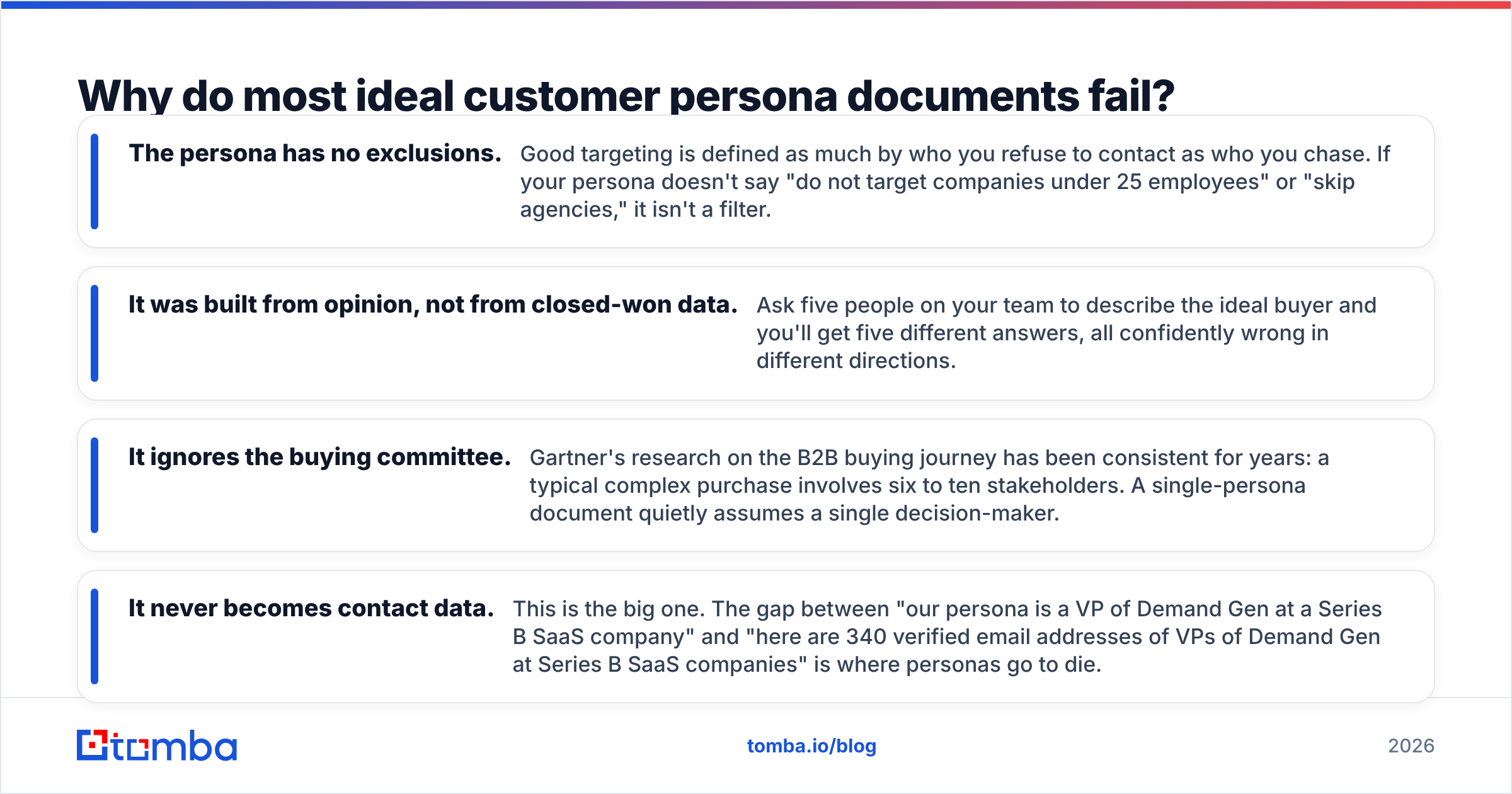
- The persona has no exclusions. Good targeting is defined as much by who you refuse to contact as who you chase. If your persona doesn't say "do not target companies under 25 employees" or "skip agencies," it isn't a filter.
- It was built from opinion, not from closed-won data. Ask five people on your team to describe the ideal buyer and you'll get five different answers, all confidently wrong in different directions.
- It ignores the buying committee. Gartner's research on the B2B buying journey has been consistent for years: a typical complex purchase involves six to ten stakeholders. A single-persona document quietly assumes a single decision-maker.
- It never becomes contact data. This is the big one. The gap between "our persona is a VP of Demand Gen at a Series B SaaS company" and "here are 340 verified email addresses of VPs of Demand Gen at Series B SaaS companies" is where personas go to die.
What data do you actually need to build one?#
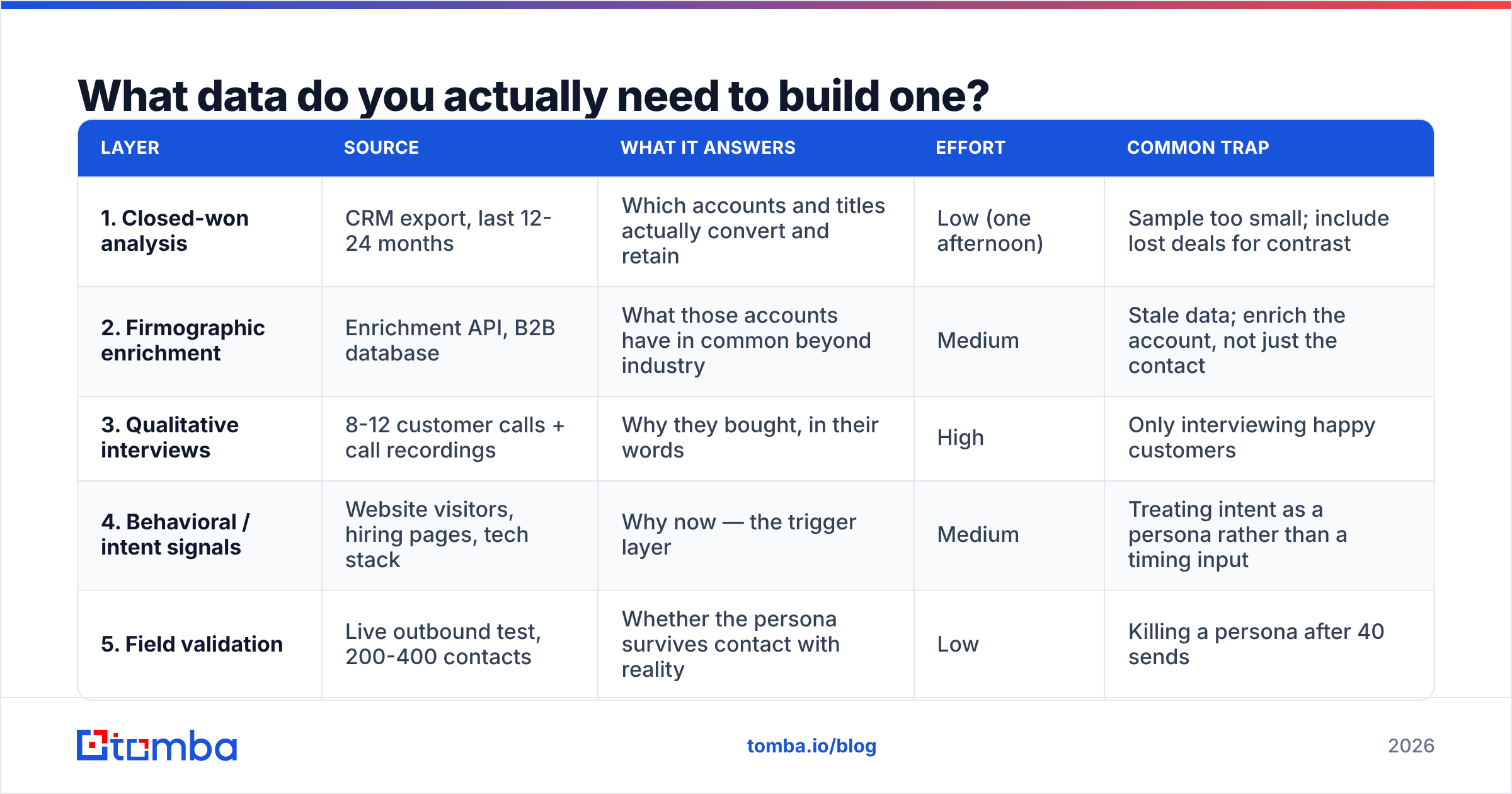
Three layers, sourced in this order. Skipping straight to layer three is the most common mistake — interviews are great at explaining patterns and terrible at finding them.
| Layer | Source | What it answers | Effort | Common trap |
|---|---|---|---|---|
| 1. Closed-won analysis | CRM export, last 12-24 months | Which accounts and titles actually convert and retain | Low (one afternoon) | Sample too small; include lost deals for contrast |
| 2. Firmographic enrichment | Enrichment API, B2B database | What those accounts have in common beyond industry | Medium | Stale data; enrich the account, not just the contact |
| 3. Qualitative interviews | 8-12 customer calls + call recordings | Why they bought, in their words | High | Only interviewing happy customers |
| 4. Behavioral / intent signals | Website visitors, hiring pages, tech stack | Why now — the trigger layer | Medium | Treating intent as a persona rather than a timing input |
| 5. Field validation | Live outbound test, 200-400 contacts | Whether the persona survives contact with reality | Low | Killing a persona after 40 sends |
Layer one is deceptively powerful. Export every closed-won opportunity from the last two years, pull the primary contact's title and the account's headcount, revenue band, and region, then sort by average contract value and by retention. Patterns show up fast, and they're usually narrower than anyone expected. Teams routinely discover that 70% of their revenue comes from a slice they'd never describe as their target market.
For layer two, data enrichment does the heavy lifting: you hand over a domain and get back headcount, technologies, location, and social profiles, so you can compare your best accounts against your worst on the same attributes. Layer four is where a website visitor reveal tool earns its keep — the companies already reading your pricing page are the cleanest available evidence of who thinks they're your customer.
How do you build an ideal customer persona step by step?#
Six steps. Budget a week, not a quarter.
Step 1 — Define the account boundary first. Write the ICP as a set of hard filters with numbers: headcount range, revenue range, geography, required tech, funding stage, and at least three exclusions. If a filter can't be applied to a database query, rewrite it until it can.
Step 2 — Extract title clusters from won deals. List every title that appears on a closed-won deal, then group them. You'll typically end up with three clusters: the champion, the economic buyer, and the technical or operational blocker. Each becomes its own persona sheet.
Step 3 — Interview eight to twelve people. Four recent customers, four recent losses, four churned. Ask what they were trying to fix, what they tried before you, who else had to approve, and what nearly killed the deal. Record everything. HubSpot's persona research framework is a reasonable interview scaffold if you want a starting question set.
Step 4 — Write the sheet in operational language. Every line should be actionable by an SDR at 9am on a Monday. "Cares about efficiency" is not actionable. "Reports on cost-per-SQL monthly and gets asked about it in the Monday exec meeting" is.
Step 5 — Convert it to a sourcing spec. Exact title strings to match, exact strings to exclude, seniority floor, department, and required contact fields (work email, verified; direct dial, optional). This is the handoff artifact between strategy and execution.
Step 6 — Run a 300-contact validation test. One persona, one message angle, one channel, 300 contacts, two weeks. Measure reply rate and, more importantly, meeting-held rate. A persona that produces replies but no meetings is a messaging problem. A persona that produces neither is a targeting problem.
How do you turn an ideal customer persona into a real prospect list?#
This is the step that separates a strategy deck from pipeline. The translation has three moves.
Move one: convert filters into a company list. Start from your ICP filters and build the account universe. A B2B database with firmographic filters gets you there fastest; scraping a conference attendee list or an industry directory works too if your niche is narrow. Vendors like BookYourData are a solid option when you want a pre-built, filtered list handed to you rather than assembled in-house — different workflow, same destination.
Move two: find the humans. For each account, you need the specific people matching your persona's title cluster. Domain search returns every discoverable address at a company along with names and roles, so you can pick the two or three that fit rather than blasting a generic inbox. Where you already have a first name, last name, and domain, an email finder resolves the exact address from the company's pattern.
Move three: verify before you send. Persona work is worthless if 18% of your sends bounce and your domain reputation tanks in week two. Run the list through an email verifier and handle catch-all domains explicitly instead of hoping. This is unglamorous and it's the difference between a campaign that lands and one that trains Gmail to filter you.
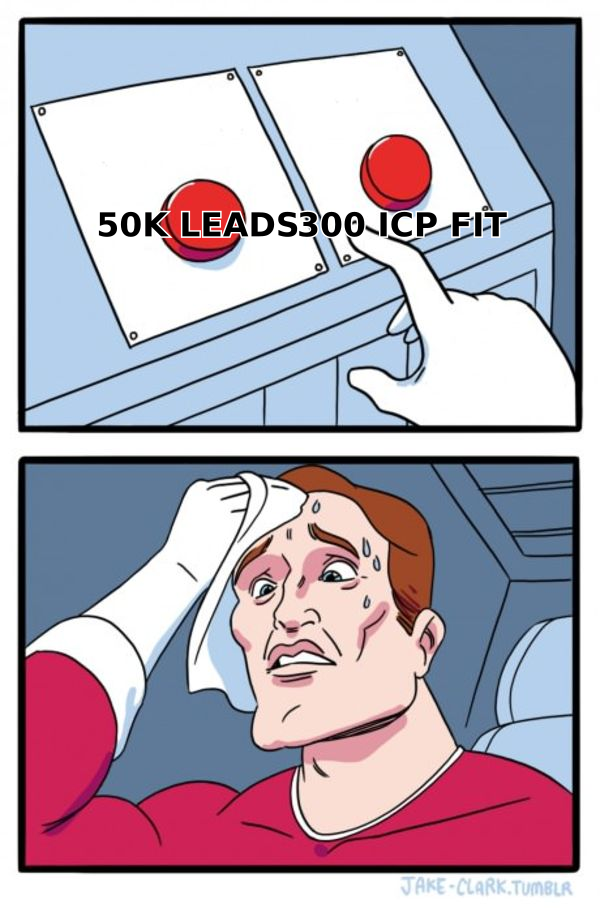
A useful sanity check at this stage: if your persona produced 40,000 matching contacts, your filters are too loose and your messaging will have to be generic to fit them all. If it produced 60, you've over-specified. A first-pass persona for a mid-market B2B product usually lands somewhere between 800 and 5,000 contacts.
How do you know your ideal customer persona is working?#
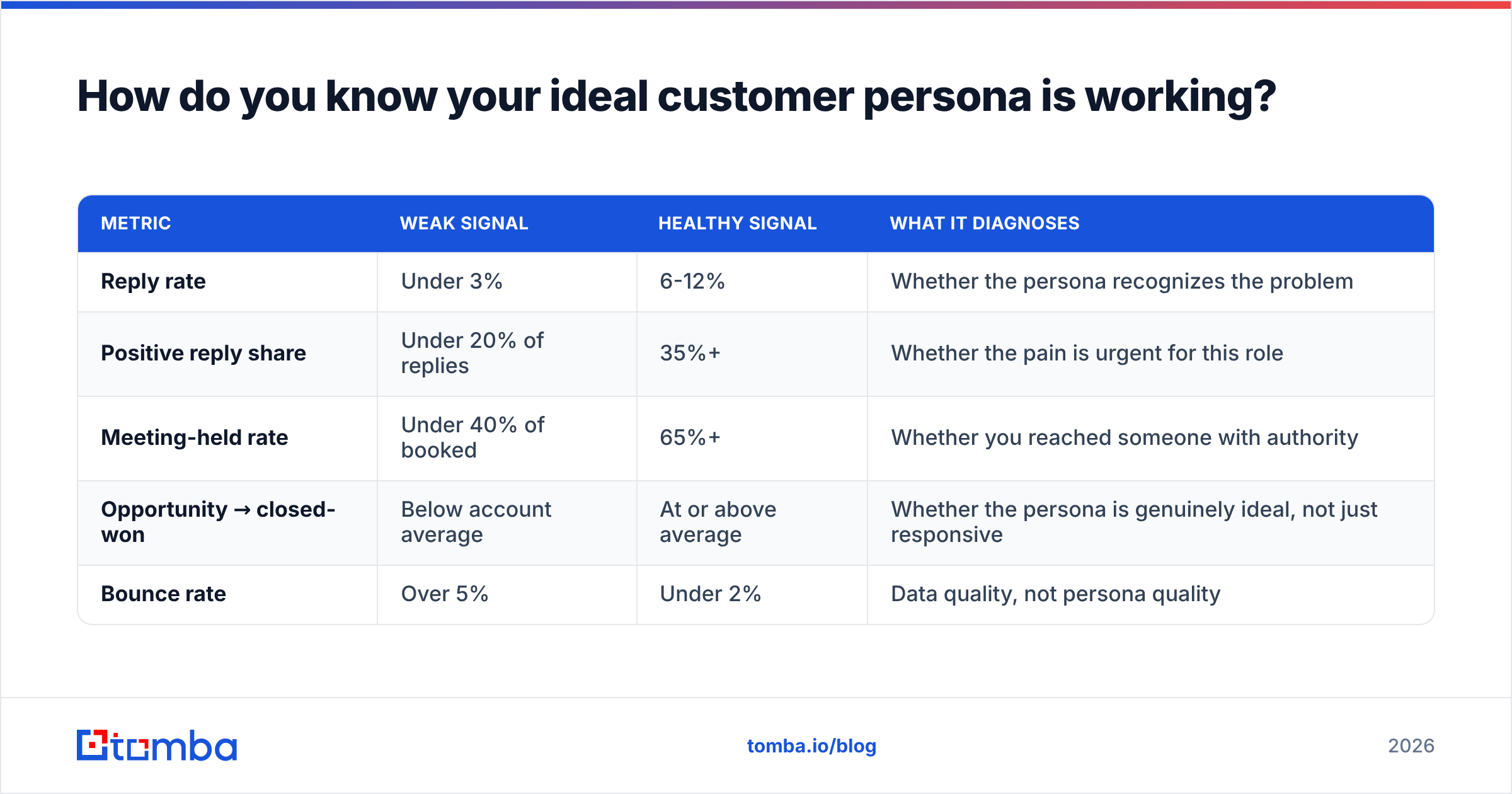
Track four numbers per persona, not per campaign. Campaign metrics tell you whether the copy worked. Persona metrics tell you whether you're talking to the right people at all.
| Metric | Weak signal | Healthy signal | What it diagnoses |
|---|---|---|---|
| Reply rate | Under 3% | 6-12% | Whether the persona recognizes the problem |
| Positive reply share | Under 20% of replies | 35%+ | Whether the pain is urgent for this role |
| Meeting-held rate | Under 40% of booked | 65%+ | Whether you reached someone with authority |
| Opportunity → closed-won | Below account average | At or above average | Whether the persona is genuinely ideal, not just responsive |
| Bounce rate | Over 5% | Under 2% | Data quality, not persona quality |
The fourth row is the one teams skip and the one that matters most. A persona can generate great reply rates and terrible win rates — that's the signature of talking to influencers who love the idea and can't buy it. When you see it, move your persona one level up in seniority and rewrite the angle around budget, not workflow.
Watch the response rate trend across quarters too. Persona decay is real: titles get renamed, responsibilities get consolidated, and the person who owned a budget in 2024 may report to someone new in 2026.
When should you rebuild versus refine your persona?#
Refine quarterly. Rebuild when one of these fires:
- You launch a product that serves a different job-to-be-done.
- You move up or down market by more than one segment band.
- Win rate for a persona drops by a third or more over two consecutive quarters.
- The buying committee changes shape — for example, security or AI governance review entering deals that previously closed without them.
- More than 25% of your target titles no longer exist as written. The concept of a persona in user experience came from product design, where personas were expected to be revised continuously; B2B teams inherited the artifact and dropped the maintenance habit.
Between rebuilds, the cheapest maintenance ritual is a monthly 30-minute review of the last 10 closed-won and 10 closed-lost deals against the persona sheet. Anything that repeats twice gets added. Anything that hasn't appeared in six months gets cut.
What should you do first this week?#
Pick your single highest-ACV closed-won segment, write one persona sheet for it, and build a 300-contact validation list. One persona done properly beats five documented and none tested.
When you get to the sourcing step, Tomba Email Finder is built for exactly that handoff: give it a name and a domain and it returns the verified work email with a confidence score and the sources it was found on, so your validation test measures your persona instead of your data quality. The free tier covers 25 searches a month for a first pass, and paid plans start at $49/mo on the Starter tier — see Tomba pricing for the full breakdown. Build the persona, source the list, verify it, and let the reply data tell you whether you were right.
Related guides#
// get started
Find, verify and enrich your first contacts today
Start on the free plan with 25 searches a month, then scale when your team is ready.
Free plan · No credit card required · GDPR & CCPA
// about the author