Ideal Customer Profile B2B Examples: 7 Real ICPs for 2026
Seven real ideal customer profile B2B examples, broken down by firmographics, trigger signals, and disqualifiers, plus the sourcing checklist that turns each ICP into a working prospect list.
TL;DR
- An ideal customer profile describes the company you should sell to. A buyer persona describes the human inside it. Confusing the two is the single most common ICP mistake.
- A usable B2B ICP has five layers: firmographics, technographics, trigger signals, economic qualifiers, and explicit disqualifiers. Anything less is a wish list.
- The seven examples below are written the way a RevOps lead would actually write them: attributes you can filter on, not adjectives.
- Your ICP is only real if you can source it. If you cannot turn the definition into a list of named accounts with contact data, it is a positioning statement, not a targeting document.
- Rebuild the ICP every two quarters using closed-won data, not opinions. Most teams drift 20-30% within a year.
What is an ideal customer profile in B2B?#
An ideal customer profile (ICP) is a description of the company that gets the most value from your product in the shortest time, at the lowest cost to serve, and renews without a fight.
Think of it like a fishing chart rather than a fish. The chart tells you which water to drop the line in: depth, temperature, season, structure. It does not tell you what the individual fish looks like. That is the persona's job. Teams that skip the chart end up casting everywhere and calling the result "top of funnel."
Technically, an ICP is a set of filterable attributes. That word matters. "Innovative mid-market companies who care about data quality" is not an ICP because you cannot query a database for "cares about data quality." "US-based B2B SaaS companies, 50-200 employees, Series A or B, running HubSpot, with 3+ open SDR roles" is an ICP, because every clause maps to a field you can actually retrieve.
Gartner's research on the B2B buying journey has consistently shown that buying groups have grown to six to ten people, and that most of the buying cycle happens before a rep is contacted. That is exactly why account-level targeting beats contact-level spraying now: you need to reach several people in the same account, in the same window, with the same story.
What does a complete B2B ICP actually contain?#
Most ICP documents fail because they stop at company size and industry. A complete one has five layers, and each layer narrows the list further:
- Firmographics — headcount, revenue band, geography, industry or vertical, entity type, funding stage. This is the coarse filter. See firmographics for the formal segmentation definition.
- Technographics — the tools already in the stack. A company running Salesforce and Outreach has a different buying motion than one running a spreadsheet and Gmail. Technographics also reveal budget maturity better than revenue does.
- Trigger signals — the time-sensitive events that make now the right moment: new funding, a new VP of Sales, a job posting for a role your product supports, a G2 category visit, an office opening, a compliance deadline.
- Economic qualifiers — deal size potential, expansion path, expected cost to serve, and whether the buyer has discretionary budget or needs a board sign-off.
- Disqualifiers — the explicit "do not sell to" list. Agencies buying on behalf of clients, companies below a seat threshold, regions you cannot support, industries your legal team refuses. This layer saves more money than the other four combined.
If your ICP document does not contain a disqualifier section, it is not finished. The fastest revenue improvement most teams make is not finding better accounts, it is stopping the bad ones from entering the pipeline at all.
How is an ICP different from a buyer persona or TAM?#
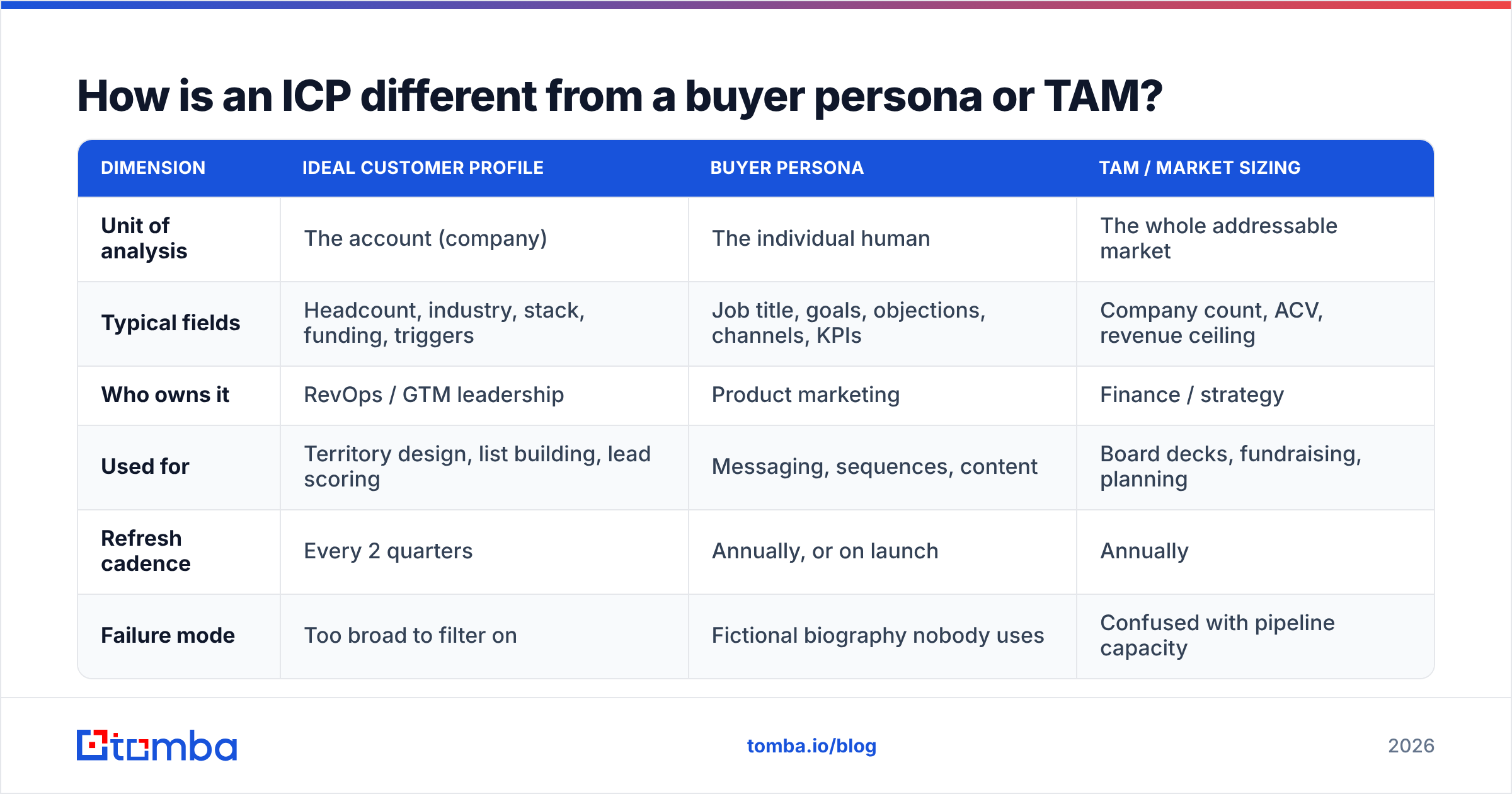
These three get used interchangeably in meetings and they are not the same object. Here is the practical split:
| Dimension | Ideal Customer Profile | Buyer Persona | TAM / Market Sizing |
|---|---|---|---|
| Unit of analysis | The account (company) | The individual human | The whole addressable market |
| Typical fields | Headcount, industry, stack, funding, triggers | Job title, goals, objections, channels, KPIs | Company count, ACV, revenue ceiling |
| Who owns it | RevOps / GTM leadership | Product marketing | Finance / strategy |
| Used for | Territory design, list building, lead scoring | Messaging, sequences, content | Board decks, fundraising, planning |
| Refresh cadence | Every 2 quarters | Annually, or on launch | Annually |
| Failure mode | Too broad to filter on | Fictional biography nobody uses | Confused with pipeline capacity |
The clean mental model: TAM says how big the pond is. The ICP says which part of the pond to fish. The persona says what bait to use.

What do real ideal customer profile B2B examples look like?#
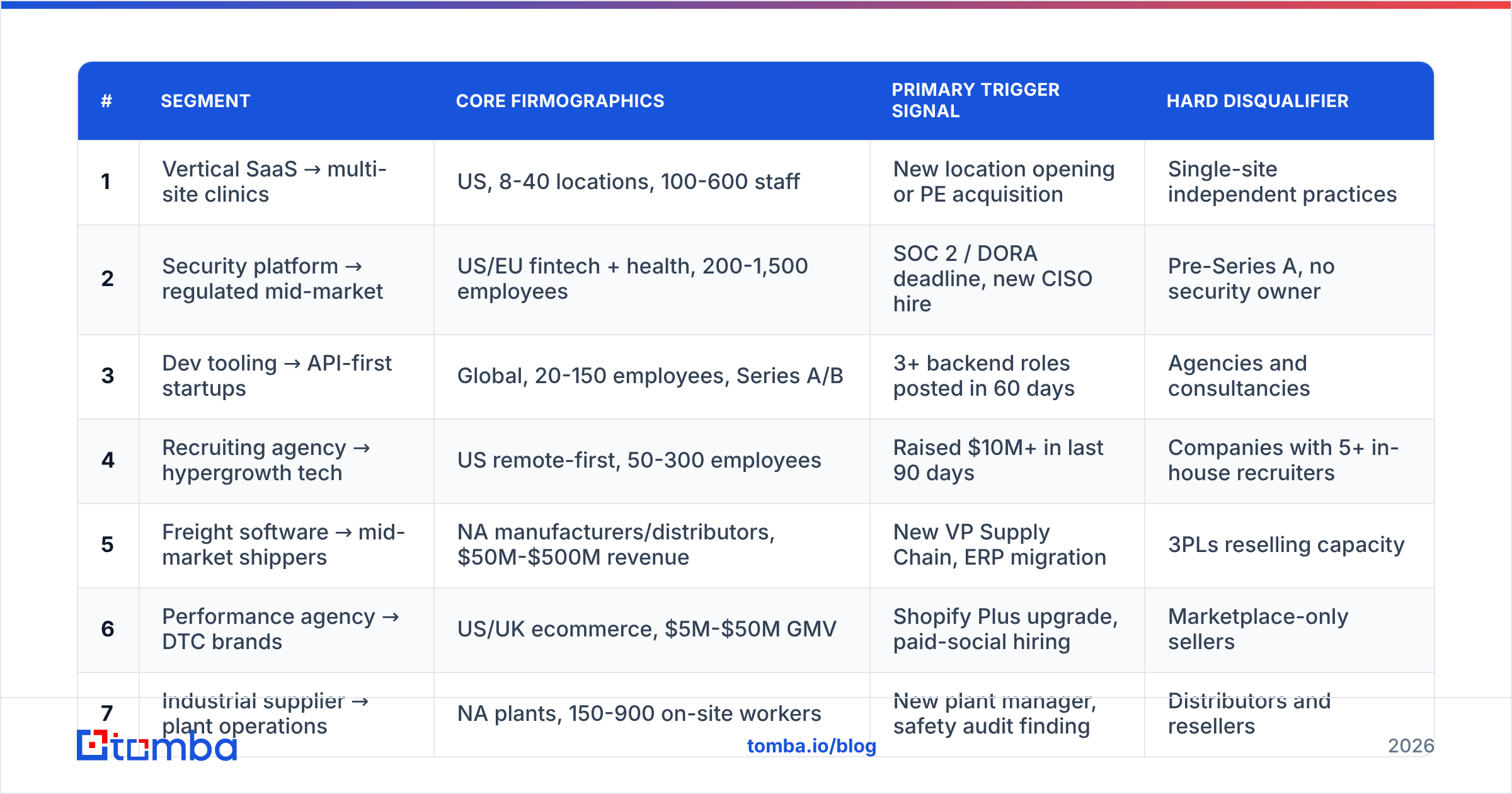
Below are seven ICPs written in the format a prospecting team can execute against the same day. Each one includes firmographics, a trigger, and a disqualifier, because those three together are what make a list buildable.
| # | Segment | Core firmographics | Primary trigger signal | Hard disqualifier |
|---|---|---|---|---|
| 1 | Vertical SaaS → multi-site clinics | US, 8-40 locations, 100-600 staff | New location opening or PE acquisition | Single-site independent practices |
| 2 | Security platform → regulated mid-market | US/EU fintech + health, 200-1,500 employees | SOC 2 / DORA deadline, new CISO hire | Pre-Series A, no security owner |
| 3 | Dev tooling → API-first startups | Global, 20-150 employees, Series A/B | 3+ backend roles posted in 60 days | Agencies and consultancies |
| 4 | Recruiting agency → hypergrowth tech | US remote-first, 50-300 employees | Raised $10M+ in last 90 days | Companies with 5+ in-house recruiters |
| 5 | Freight software → mid-market shippers | NA manufacturers/distributors, $50M-$500M revenue | New VP Supply Chain, ERP migration | 3PLs reselling capacity |
| 6 | Performance agency → DTC brands | US/UK ecommerce, $5M-$50M GMV | Shopify Plus upgrade, paid-social hiring | Marketplace-only sellers |
| 7 | Industrial supplier → plant operations | NA plants, 150-900 on-site workers | New plant manager, safety audit finding | Distributors and resellers |
Example 1: Vertical SaaS selling to multi-site clinics#
The ICP: US healthcare groups running 8 to 40 physical locations, 100-600 total staff, already using a modern EHR, with a centralized operations lead. Trigger: a new location announcement, a private-equity roll-up, or a posted "Director of Practice Operations" role. Disqualifier: single-site independent practices, which churn at roughly three times the rate and generate the most support tickets per dollar.
Why the location count matters more than revenue here: the pain your product solves (coordination across sites) does not exist at one site. Below eight locations, the customer solves it with a group chat.
Example 2: Security platform selling into regulated mid-market#
The ICP: fintech and digital-health companies in the US and EU, 200-1,500 employees, with at least one named security or compliance owner, already running an identity provider like Okta. Trigger: an upcoming SOC 2 Type II window, a DORA or HIPAA deadline, or a first CISO hire. Disqualifier: pre-Series A companies with no dedicated security headcount. They will take the demo, ask for a discount, and buy nothing.
The identity-provider technographic is doing real work in this ICP. It is a proxy for "has already accepted that security is a line item."
Example 3: Dev tooling selling to API-first startups#
The ICP: 20-150 employee product companies, Series A or B, with a public API or SDK, engineering-led purchasing, and no procurement gate. Trigger: three or more backend or platform engineering roles posted within 60 days, which signals a scaling event. Disqualifier: agencies and consultancies. They evaluate on behalf of clients, never standardize, and generate seat churn every project cycle.
Example 4: Recruiting agency selling to hypergrowth tech#
The ICP: remote-first US tech companies, 50-300 employees, that raised $10M or more in the last 90 days, hiring in at least two functions simultaneously. Trigger: the funding announcement itself, plus a spike in job postings. Disqualifier: companies with five or more in-house recruiters. They have already made the build decision.
This is the clearest example of an ICP where the trigger has a short shelf life. A funding round is a 60-day window. Miss it and the roles are filled.
Example 5: Freight and logistics software selling to shippers#
The ICP: North American manufacturers and distributors, $50M-$500M in revenue, shipping 200+ loads per month, running an ERP such as NetSuite or Dynamics. Trigger: a new VP of Supply Chain, an announced ERP migration, or a new distribution center. Disqualifier: 3PLs and freight brokers, whose margin model conflicts with the product.
Example 6: Performance agency selling to DTC brands#
The ICP: US and UK ecommerce brands doing $5M-$50M GMV, spending at least $50K per month on paid media, with an in-house marketing team of three to fifteen. Trigger: a Shopify Plus upgrade, a new Head of Growth, or a posted paid-social role. Disqualifier: marketplace-only sellers with no owned storefront, where the agency cannot control the funnel.
Example 7: Industrial supplier selling to plant operations#
The ICP: North American manufacturing plants with 150-900 on-site workers, in food processing, automotive, or building products, with a named EHS or maintenance manager on site. Trigger: a new plant manager, a published safety audit finding, or a capital expansion. Disqualifier: distributors and resellers who would compete on the same catalog.
Notice what all seven have in common: no adjectives. No "forward-thinking," no "growth-minded." Every clause is a field, a range, or an event.
How do you build your own ICP in an afternoon?#
You do not need a quarter-long project. You need your closed-won data and about four hours.
- Pull your last 30-50 closed-won accounts. Exclude anything that churned inside 90 days. You want revenue that survived.
- Add three columns: time to close, cost to serve, and net revenue retention. Sort by NRR descending. The top third is your training set.
- Find the shared attributes across that top third. Headcount band, industry, region, stack, buying committee shape. Anything that appears in 60%+ of them is a candidate ICP attribute.
- Do the same for your worst 10 accounts. Long sales cycles, heavy support load, flat or negative expansion. Whatever those share becomes your disqualifier list. This step is the one people skip, and it is the highest-leverage one.
- Identify one to three trigger events that preceded the good deals. Check the account's news, hiring page, and funding history in the 90 days before first contact.
- Write it as a query, not a paragraph. If you cannot hand the definition to an analyst and get a list of named companies back, rewrite it until you can.
HubSpot's sales research and playbooks are a useful sanity check on step 3 if your sample size is small, but your own closed-won data always beats a benchmark. Benchmarks describe the average company. You are not the average company.
Which ICP data points can you actually source at scale?#
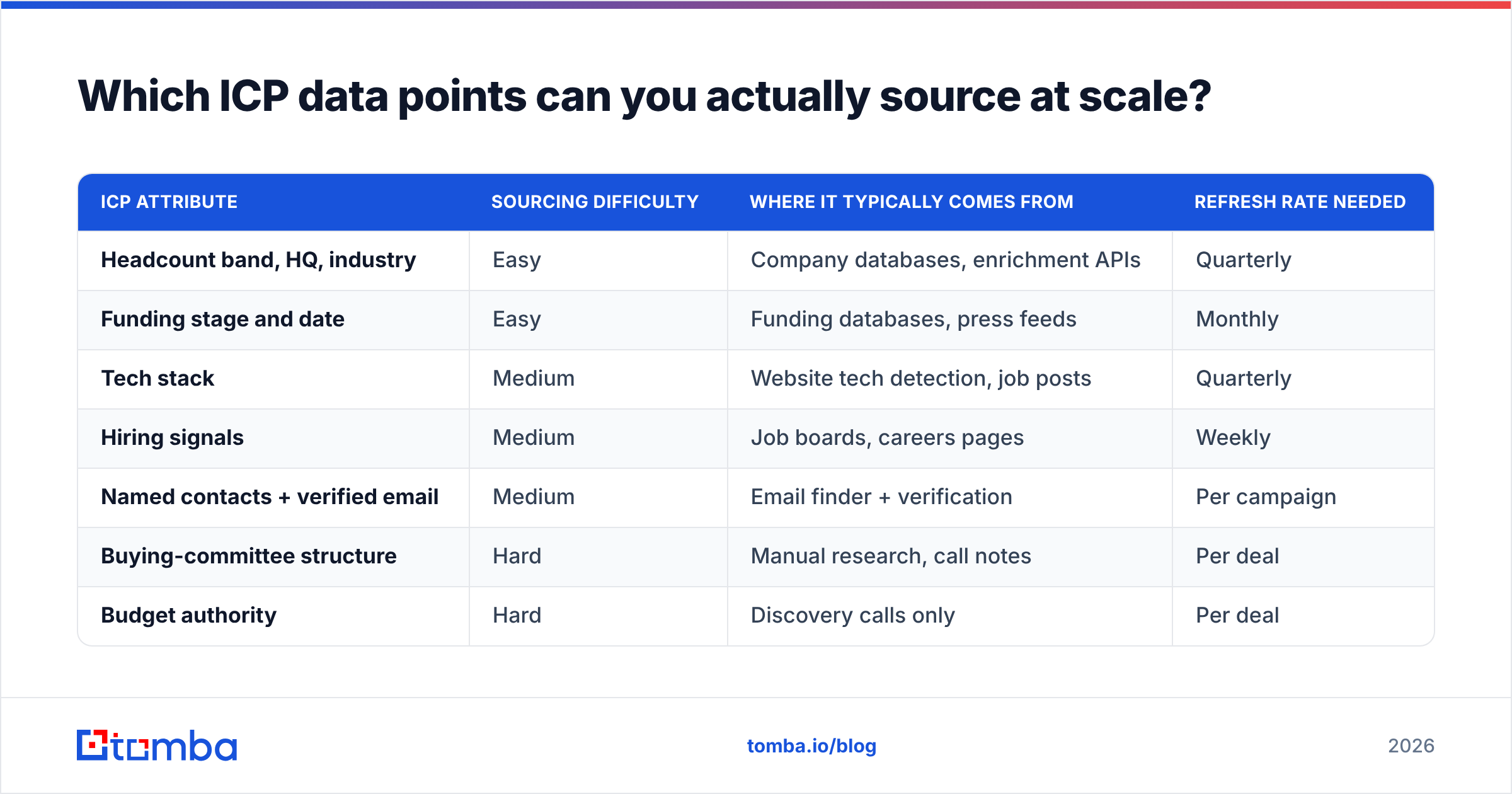
An ICP is only as good as your ability to populate it. Here is the honest sourcing picture for the attributes in the examples above:
| ICP attribute | Sourcing difficulty | Where it typically comes from | Refresh rate needed |
|---|---|---|---|
| Headcount band, HQ, industry | Easy | Company databases, enrichment APIs | Quarterly |
| Funding stage and date | Easy | Funding databases, press feeds | Monthly |
| Tech stack | Medium | Website tech detection, job posts | Quarterly |
| Hiring signals | Medium | Job boards, careers pages | Weekly |
| Named contacts + verified email | Medium | Email finder + verification | Per campaign |
| Buying-committee structure | Hard | Manual research, call notes | Per deal |
| Budget authority | Hard | Discovery calls only | Per deal |
The first five are automatable. The last two are not, and no vendor that claims otherwise is being straight with you. Vendors across the sales intelligence category on G2 differ mostly on coverage and freshness of the first five, and providers such as BookYourData, Clearbit, and Tomba each index different slices of the same underlying web. Comparing them on a sample of your ICP rather than on total database size is the only test that matters.
Once the account list exists, the contact layer is a separate job. You have a company domain and a target title; you need a deliverable inbox. A domain search returns the addresses and patterns already associated with the company, and running the result through an email verifier before it reaches your sequencing tool keeps bounce rates from wrecking the sender reputation you spent months building. For account lists in the hundreds or thousands, bulk email finder processing handles the whole CSV in one pass, and data enrichment fills the firmographic and technographic columns you need for scoring.
How do you know your ICP is wrong?#
Four symptoms, in order of how early they show up:
- Reply rates are fine but demos do not convert. Your messaging is working on people outside the buying committee. Persona problem masquerading as an ICP problem.
- Deals close but expansion is flat. You are selling to companies that can afford you but do not grow into you. Your economic qualifiers are too loose.
- Support tickets cluster in one segment. That segment belongs in the disqualifier list, regardless of what it contributes to bookings.
- Your reps quietly ignore the list. When a target list gets worked at under 40%, the reps have already decided it is wrong. Ask them before you ask the dashboard.
Set a calendar reminder for every second quarter. Pull the same closed-won analysis and compare the attributes against the current ICP document. In most companies, one or two attributes drift each cycle, usually headcount band moving up as pricing changes. Catching that early is the difference between a targeting document and a historical artifact. If you track response rate by ICP segment rather than in aggregate, the drift becomes visible a quarter earlier.
What should you do next?#
Write the seven-line version of your ICP today: geography, headcount band, industry, stack signal, trigger event, economic qualifier, disqualifier. Then test whether it produces a list. If it does not, the definition is still an opinion.
When you are ready to turn the definition into named accounts with reachable contacts, the Tomba Email Finder takes a domain and a name and returns a verified professional address, with a free tier of 25 searches per month to test on your own ICP sample before committing. Paid plans start at $49/mo for Starter, $99/mo for Growth, and $249/mo for Pro, and full Tomba pricing breaks down the credit allocation per tier. Run 20 accounts from your new ICP through it, check the hit rate against your own list, and let the result decide.
Related guides#
// get started
Find, verify and enrich your first contacts today
Start on the free plan with 25 searches a month, then scale when your team is ready.
Free plan · No credit card required · GDPR & CCPA
Get the Tomba newsletter
Product and data updates
// about the author