Ideal Customer Profile Examples: 7 Real ICPs for B2B Teams
Most ICP documents are useless because they describe a company, not a buying trigger. Here are 7 real ideal customer profile examples, the fields that matter, and how to turn each one into a filterable prospecting list.
TL;DR
- An ideal customer profile describes the company you sell to best, not the person. Buyer personas come after.
- Most ICP docs fail because they stop at "SaaS, 50-200 employees, US." That is not filterable, and it does not predict who buys.
- A working ICP has four layers: firmographic, technographic, behavioral trigger, and economic fit. Skip any one and your list quality collapses.
- The seven examples below are written the way a RevOps lead would actually store them — as field-value pairs you can push into a search filter.
- The test of an ICP is simple: can someone build a 500-account list from it without asking you a single follow-up question? If not, it is a mission statement, not an ICP.
What is an ideal customer profile, exactly?#
An ideal customer profile (ICP) is a description of the type of organization that gets the most value from your product, in the shortest time, at the lowest cost to serve, and stays the longest.
Think of it like a fishing license. It does not tell you which fish to catch — it tells you which lake you are allowed to fish in. The buyer persona is the fish. The ICP is the lake. Reps who confuse the two end up casting perfect bait into an empty pond.
The confusion matters commercially. A persona says "VP of Engineering, 35-50, cares about developer velocity." An ICP says "Series B-C software company, 120-400 employees, 15+ engineers, running Kubernetes, hired a platform engineer in the last 90 days, US or UK headquartered." One of those is a list. The other is a vibe.
Here is what separates the two in practice:
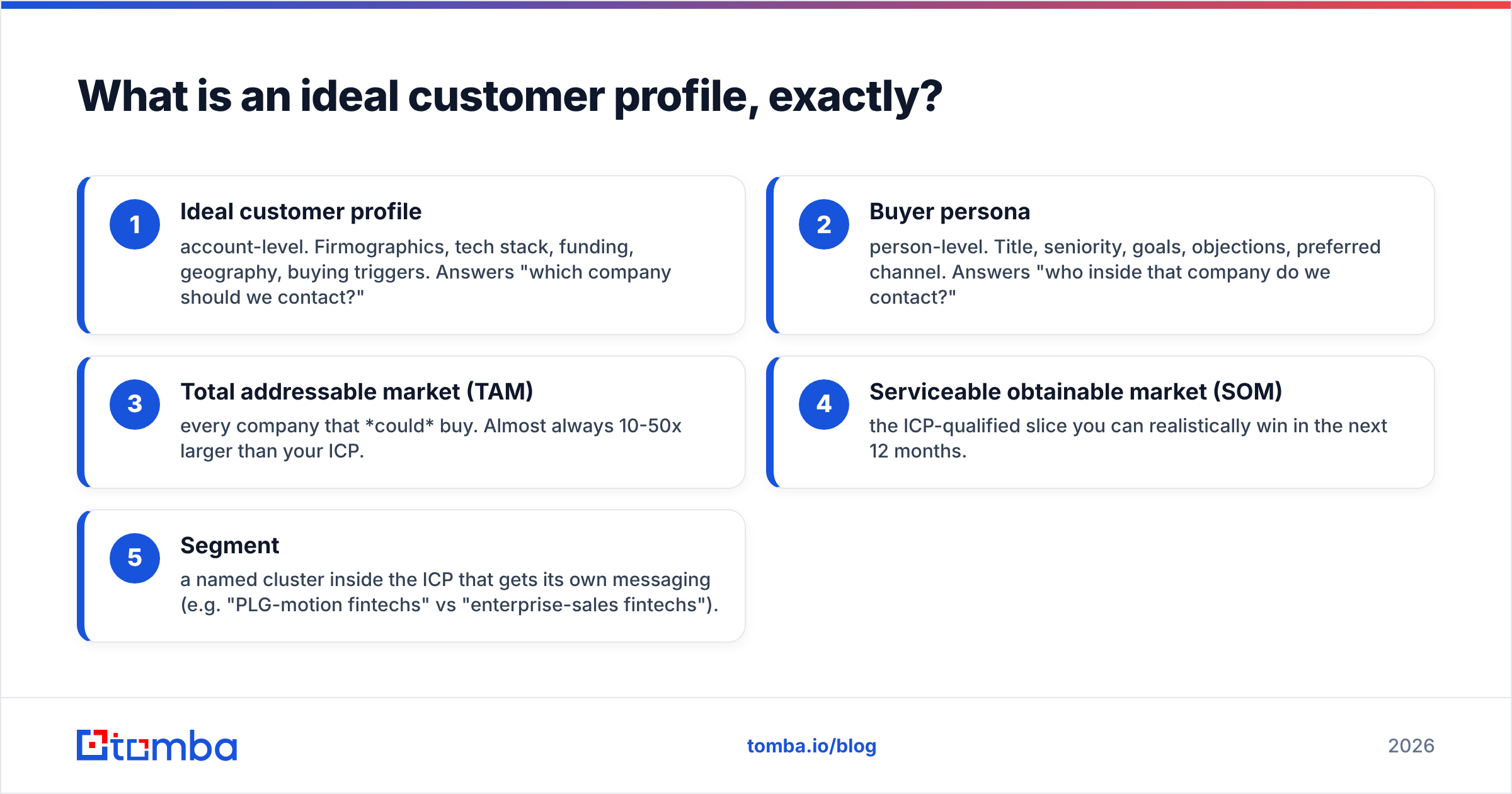
- Ideal customer profile — account-level. Firmographics, tech stack, funding, geography, buying triggers. Answers "which company should we contact?"
- Buyer persona — person-level. Title, seniority, goals, objections, preferred channel. Answers "who inside that company do we contact?"
- Total addressable market (TAM) — every company that could buy. Almost always 10-50x larger than your ICP.
- Serviceable obtainable market (SOM) — the ICP-qualified slice you can realistically win in the next 12 months.
- Segment — a named cluster inside the ICP that gets its own messaging (e.g. "PLG-motion fintechs" vs "enterprise-sales fintechs").
Get these four straight and the rest of this post is copy-paste work.
Why do most ideal customer profile examples you find online fail?#
Because they are written for a deck, not for a database.
Search "ideal customer profile template" and you will get a slide with five bullets: industry, company size, revenue, location, pain point. That is a reasonable starting schema and a terrible finishing one. The reason is that every one of your competitors' ICPs looks identical at that resolution. "B2B SaaS, 50-200 employees, North America, struggling with pipeline" describes roughly 40,000 companies and predicts nothing.
Three specific failure modes show up over and over:
Failure 1 — the ICP is reverse-engineered from all customers, not good ones. Teams export every closed-won account and average the attributes. That mixes your 14-month, high-NPS, expansion-heavy accounts with the ones that churned at month 5. The average of a good customer and a bad customer is a mediocre customer. Filter to accounts above your median LTV and below your median support cost first, then look at what they have in common.
Failure 2 — no negative criteria. A strong ICP says what disqualifies an account as loudly as what qualifies it. "Fewer than 3 people in the target function" or "already runs a competing homegrown system" saves more rep hours than any positive attribute you add.
Failure 3 — no observable trigger. Firmographics tell you who fits. Triggers tell you who is in-market this quarter. A company that fit your ICP for three years and never bought is not a lead; it is furniture. Hiring signals, funding rounds, tech-stack changes, and leadership hires are what convert a static list into a queue.
According to Gartner's B2B buying research, buying groups now average 6-10 stakeholders and spend the majority of the journey researching independently. That has a direct ICP implication: if your profile does not include "has at least N people in the relevant function," you are targeting accounts that structurally cannot form a buying group for your product.
What fields belong in a strong ICP?#
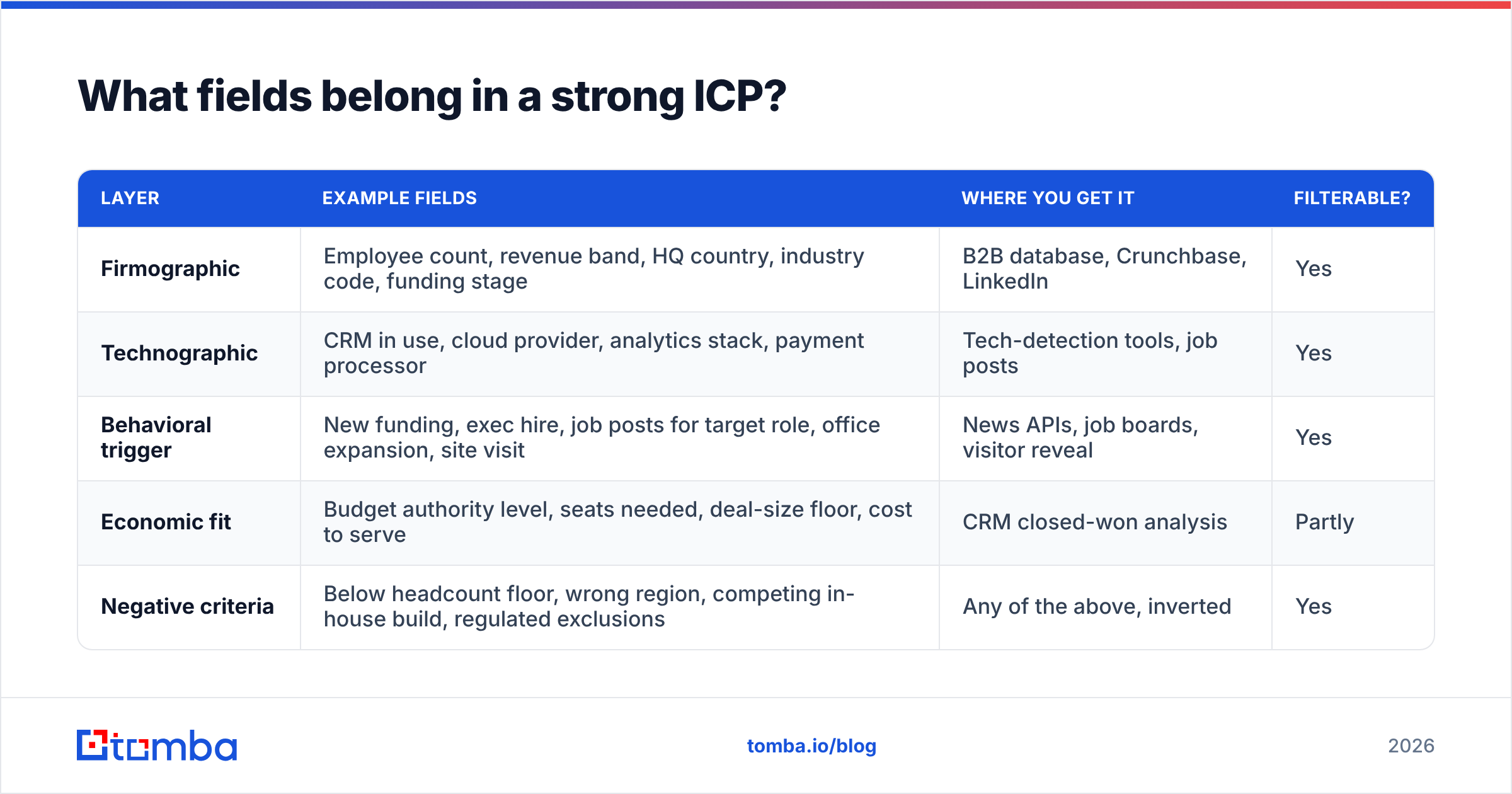
Four layers. Every field should be something you can filter on in a data tool, not something you can only assess after a discovery call.
| Layer | Example fields | Where you get it | Filterable? |
|---|---|---|---|
| Firmographic | Employee count, revenue band, HQ country, industry code, funding stage | B2B database, Crunchbase, LinkedIn | Yes |
| Technographic | CRM in use, cloud provider, analytics stack, payment processor | Tech-detection tools, job posts | Yes |
| Behavioral trigger | New funding, exec hire, job posts for target role, office expansion, site visit | News APIs, job boards, visitor reveal | Yes |
| Economic fit | Budget authority level, seats needed, deal-size floor, cost to serve | CRM closed-won analysis | Partly |
| Negative criteria | Below headcount floor, wrong region, competing in-house build, regulated exclusions | Any of the above, inverted | Yes |
The economic-fit row is the one teams skip. It is also the one that decides whether your ICP is profitable. If your product needs 20 seats to justify the implementation effort and half your list has 6 employees in that function, you have built a churn factory with excellent targeting.
For the technographic and trigger layers, a B2B database with company-level attributes will get you most of the way; layering data enrichment on top fills in the fields your CRM is missing.
What do real ideal customer profile examples look like?#
Seven profiles below, written in the format you would actually store them. Each has positive criteria, negative criteria, and at least one trigger. Numbers are illustrative — replace them with yours.
Example 1 — Vertical SaaS selling to dental practices#
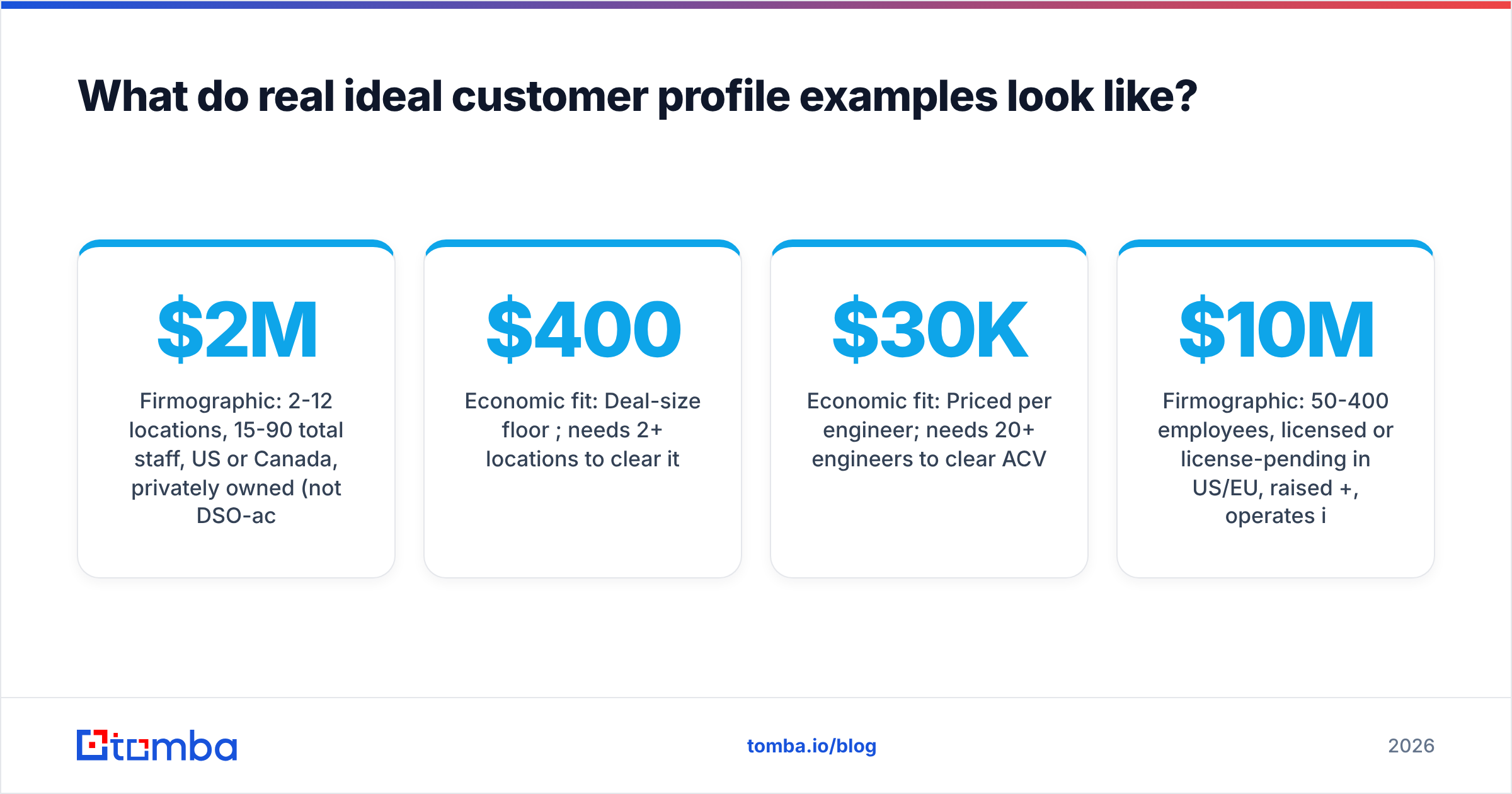
- Firmographic: 2-12 locations, 15-90 total staff, US or Canada, privately owned (not DSO-acquired), annual revenue $2M-$25M
- Technographic: Running Dentrix or Eaglesoft; no existing patient-communication platform
- Trigger: Opened a new location in the last 6 months, or posted a job for "practice manager"
- Economic fit: Deal-size floor $400/mo; needs 2+ locations to clear it
- Negative: Single-location practices, any practice already owned by a DSO with a mandated stack
- Why it works: Multi-location is the seat driver and the pain driver. Single-location practices fit the industry filter but fail the economics.
Example 2 — Developer infrastructure tool#
- Firmographic: Series B-D, 120-600 employees, 20+ engineers, US/UK/DE/NL
- Technographic: Kubernetes in production, GitHub Actions or CircleCI, Datadog or Grafana
- Trigger: Hired a Platform/DevEx engineer in the last 90 days; or migrated from Heroku (detectable via DNS/job posts)
- Economic fit: Priced per engineer; needs 20+ engineers to clear $30K ACV
- Negative: Agencies and consultancies (headcount looks right, engineering org does not), companies with a dedicated internal platform team of 8+ (they build)
- Why it works: The platform-engineer hire is the single highest-converting signal — it means someone was given a budget and a mandate.
Example 3 — Compliance software for fintech#
- Firmographic: 50-400 employees, licensed or license-pending in US/EU, raised $10M+, operates in 2+ jurisdictions
- Technographic: Uses a modern KYC vendor (Persona, Alloy) — indicates compliance maturity and budget
- Trigger: New Head of Compliance or MLRO hire; new market launch announcement; regulatory action in their category
- Economic fit: $50K+ ACV floor; single-jurisdiction operators cannot justify it
- Negative: Crypto-native firms without a banking partner, pre-license startups, single-jurisdiction operators
- Why it works: Multi-jurisdiction is a hard economic gate. The compliance-hire trigger is close to a purchase order.
Example 4 — Field-service management for HVAC contractors#
- Firmographic: 8-60 field technicians, $2M-$30M revenue, 1-4 branches, US Sun Belt states
- Technographic: Still on paper, QuickBooks-only, or a legacy desktop scheduler
- Trigger: Fleet expansion (new vehicle registrations), hiring 3+ technicians simultaneously, acquired by a PE roll-up
- Economic fit: Per-technician pricing; 8-tech floor
- Negative: Under 8 technicians, owner-operators, companies already on ServiceTitan
- Why it works: Technician count is both the seat count and the pain threshold. Below 8, a whiteboard genuinely works.
Example 5 — B2B data / email-finding tool (the meta example)#
- Firmographic: 20-500 employees, 3+ SDRs or a founder running outbound, any industry with a B2B ACV above $5K
- Technographic: Running a sequencer (Instantly, Smartlead, Outreach, Salesloft) and a CRM (HubSpot, Pipedrive, Salesforce)
- Trigger: Posted an SDR/BDR job in the last 60 days; announced a new market or product line; recently raised
- Economic fit: Needs 2,000+ verified contacts per month to justify a paid tier
- Negative: Local service businesses, B2C, companies whose entire pipeline is inbound-referral
- Why it works: The sequencer signal is decisive. A company that bought a sending tool has already committed to outbound and now has an empty database problem.
Example 6 — Enterprise HR platform#
- Firmographic: 1,000-10,000 employees, multi-country payroll, Fortune 2000 or equivalent, HQ in US/EU
- Technographic: Workday or SAP SuccessFactors core HR (you integrate, not replace)
- Trigger: New CHRO or CPO appointment; announced restructure; M&A activity requiring HR-system consolidation
- Economic fit: $150K+ ACV; 12-18 month sales cycle acceptable
- Negative: Single-country operations, companies mid-migration on their core HRIS (they will not add a second project)
- Why it works: M&A is the strongest enterprise HR trigger there is — two employee databases must become one, on a deadline.
Example 7 — Agency selling paid-media management to e-commerce#
- Firmographic: $3M-$40M annual online revenue, DTC brand, 10-120 employees, US/UK/AU
- Technographic: Shopify Plus, Klaviyo, running Meta + Google ads (detectable via pixel presence)
- Trigger: Raised a round, launched a second product line, hired a Head of Growth, or increased ad spend visibly in the ad library
- Economic fit: Retainer floor $8K/mo — requires roughly $200K/mo in ad spend to be rational for the client
- Negative: Brands under $3M revenue, marketplace-only sellers, brands with a 4+ person in-house paid team
- Why it works: Ad-spend level is directly observable and maps one-to-one to retainer viability.
How do you turn an ICP into an actual prospect list?#
This is where most ICP work dies. The document gets approved, gets a nice Notion page, and nobody builds the list.
The mechanical version, in order:
- Translate each field into a filter that exists. If your data tool has no "hired a platform engineer" field, your proxy is a job-board search. If no field and no proxy exists, cut the criterion — an unfilterable criterion is a wish.
- Build the account list first, contacts second. Get to 300-800 accounts that pass every hard filter. Resist adding contacts until the account list survives a manual spot-check of 20 rows.
- Find the people. Use domain search to pull every discoverable address at each qualified domain, then narrow by department and seniority rather than guessing individual names.
- Verify before you send. An ICP-perfect list with 22% invalid addresses will still torch your sender reputation. Run the list through an email verifier and drop anything that is not deliverable.
- Instrument the feedback loop. Tag every account with which ICP variant it came from. Ninety days later, compare reply rate, meeting rate, and close rate per variant. That comparison is what upgrades your ICP from a guess to a model.

Step 5 is the one that compounds. Most teams write their ICP once and never revise it. The teams with the best pipeline treat the ICP like a hypothesis with a quarterly review date attached.
How do ICP approaches compare across company stages?#
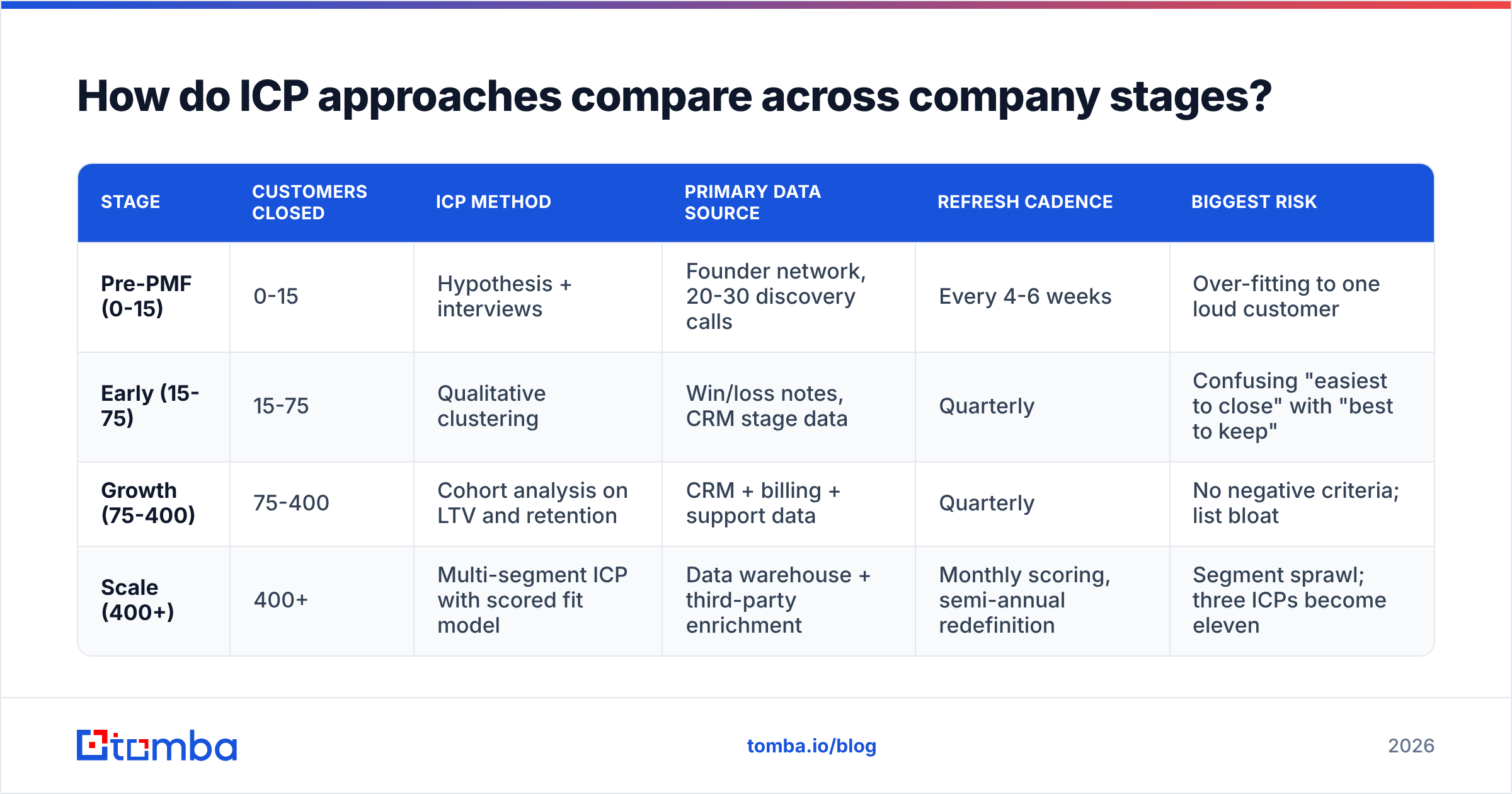
The right amount of ICP rigor depends on how much closed-won data you have. Applying enterprise-grade segmentation at 12 customers is theater; applying founder intuition at 800 customers is negligence.
| Stage | Customers closed | ICP method | Primary data source | Refresh cadence | Biggest risk |
|---|---|---|---|---|---|
| Pre-PMF (0-15) | 0-15 | Hypothesis + interviews | Founder network, 20-30 discovery calls | Every 4-6 weeks | Over-fitting to one loud customer |
| Early (15-75) | 15-75 | Qualitative clustering | Win/loss notes, CRM stage data | Quarterly | Confusing "easiest to close" with "best to keep" |
| Growth (75-400) | 75-400 | Cohort analysis on LTV and retention | CRM + billing + support data | Quarterly | No negative criteria; list bloat |
| Scale (400+) | 400+ | Multi-segment ICP with scored fit model | Data warehouse + third-party enrichment | Monthly scoring, semi-annual redefinition | Segment sprawl; three ICPs become eleven |
A practical rule from the growth row: once you can cohort by retention, run the analysis on net revenue retention, not logo count. The accounts that expand tell you more about your ICP than the accounts that merely renew. HubSpot's research on customer segmentation makes the same point from the marketing side — behavior-based segments outperform demographic ones consistently.
What about ICPs for account-based and multi-vendor sourcing?#
Two wrinkles worth naming.
ABM inverts the order. In a classic outbound motion you define the ICP, then generate a list. In account-based marketing you often start with a named target list from leadership and reverse-engineer the ICP to justify it. That is fine as long as you validate: run your fit criteria against the named list and report honestly on how many accounts actually pass. If 40% fail, say so before the campaign, not after.
Data source diversity matters more than people admit. No single provider has complete coverage of any ICP. Coverage varies wildly by geography, company size, and industry — a provider that is excellent for US mid-market tech may be thin on EU manufacturing. Practical teams run two sources: one broad database for account discovery, one accuracy-focused finder for contact data. Providers like BookYourData offer strong pay-as-you-go list coverage for teams that want to buy a defined segment outright, while a bulk email finder is better suited to enriching an account list you have already built and filtered yourself. Different jobs, and worth using both rather than forcing one tool to do everything.
Whichever route you take, check the vendor's own data sources documentation and independent reviews on G2 before committing budget. Coverage claims are marketing; sample tests are evidence. Pull 100 accounts from your actual ICP, run them through a free tier, and measure hit rate yourself.
How do you know your ICP is working?#
Four metrics, checked quarterly:
- List-to-meeting rate. If ICP-sourced accounts do not book meetings at a meaningfully higher rate than a random industry list, your criteria are not doing anything.
- Win rate by ICP-fit tier. Score accounts A/B/C on fit at creation. A-tier should win at 2x+ the C-tier rate. If it does not, your criteria are wrong, not your reps.
- 12-month retention by fit tier. The strongest ICP validation. Fit should predict retention better than deal size does.
- Sales cycle length by tier. Good fit shortens cycles because fewer stakeholders need convincing that the problem is real.
If all four look flat across tiers, your ICP has no predictive power. That is not a failure — it is a measurement telling you to go re-run the cohort analysis with different variables. Try firmographics you have been ignoring: funding stage, growth rate, or the presence of a specific role on the org chart.
One caveat on measurement honesty: do not compare your ICP list against no list at all. Compare it against your previous targeting. The relevant question is not "did outbound work?" but "did this definition beat the last one?"
Where should you start if you have no ICP today?#
Start with 15 customer interviews and one spreadsheet, in that order.
Export your closed-won accounts. Add three columns: months retained, net revenue change, and support tickets per month. Sort by a composite of those three. Look at the top decile and write down everything they share that a data tool could filter on — headcount, stack, funding, geography, role composition. Then look at the bottom decile and write down what disqualifies them. You now have positive and negative criteria grounded in outcomes rather than opinions.
Then call ten of the top-decile accounts and ask what was happening in their business the month before they contacted you. Their answers are your triggers. This is the single highest-return hour in the whole exercise, and almost nobody does it.
Turn the result into filters, build the account list, enrich it, verify it, and put a review date on the calendar for 90 days out.
Ready to turn your ICP into a real contact list? Once your account criteria are locked, the bottleneck is finding verified, deliverable addresses at every qualified domain. Tomba's Email Finder resolves professional emails by domain, name, or company with verification built in — start on the free tier at 25 searches a month to sample your list quality before committing, then scale up through Tomba pricing plans starting at $49/mo when the hit rate proves itself. Test it against 100 accounts from your own ICP before you spend a dollar; that is the only benchmark that matters.
Related guides#
Ready to find emails that actually work?
Join 150,000+ professionals who stopped guessing and started sending. Free credits on signup — no credit card required.
Get the Tomba newsletter
Practical outbound tactics and product updates — once every two weeks.
About the author