32 Ideal Customer Profile Questions That Sharpen Your ICP
Most ICP docs are a wish list dressed up as strategy. These 32 ideal customer profile questions pull the real pattern out of your closed-won data — and turn it into a prospecting filter you can actually search on.
TL;DR
- An ICP is not a description of who you want to sell to. It is a pattern extracted from accounts that already bought, stayed, and expanded.
- The 32 questions below split into five blocks: firmographic, operational/technographic, trigger, value, and negative-fit. Answer them in that order.
- Every answer must end as a filter you can search on — headcount range, tech installed, hiring signal, domain list. If it can't be queried, it's a slogan.
- Build a negative ICP with the same rigor. Disqualifying 40% of your list is usually worth more than adding 40% more names.
- Rerun the exercise every two quarters, or immediately after a pricing change, a new segment win, or a churn spike.
What is an ideal customer profile, and why do the questions matter more than the template?#
An ICP is a description of the company most likely to buy quickly, stay long, and expand — not the person. Think of it like a restaurant figuring out its regulars: the useful question isn't "who do we wish came in?" but "who actually comes back on Tuesdays, spends the most, and never complains?" You look at the receipts, not the mood board.
Most teams get this backwards. They open a template, fill in "mid-market SaaS companies in North America," and call it done. That statement matches roughly 60,000 companies and disqualifies nobody. The reason ideal customer profile questions outperform templates is that questions force you back to evidence — specific accounts, specific renewal dates, specific reasons a deal stalled.
Before you start, pull three lists:
- Closed-won, still active, 12+ months. Your ground truth. Aim for 20–40 accounts minimum.
- Closed-won, churned or downgraded. The most instructive list you own, and the one nobody reads.
- Closed-lost at late stage. Deals that reached proposal and died tell you about fit; deals that died at first call tell you about targeting.
Run every question against those three lists. If an answer only exists in your head, mark it as a hypothesis, not a criterion.
What questions define your ICP's firmographics?#
Firmographics are the coarse filter — cheap to check, easy to search, and the layer most likely to be lazily copied from a competitor's website.
- What is the headcount band where your closed-won accounts cluster — not the range you'll accept, but where the median sits?
- What revenue range correlates with your fastest sales cycles?
- Which industries or sub-verticals appear more than twice in your active-customer list?
- What geography actually closes, accounting for support hours, data residency, and payment terms?
- What is the company age or funding stage of your best accounts (seed, Series B, bootstrapped-profitable, PE-owned)?
- How many locations or legal entities does a typical winning account run? Multi-entity buyers often need features you may not have.
- What is the department size of the team that uses you — not total headcount, but the seat pool?
- Does your best-fit account sell to businesses, consumers, or both, and does that change your value story?
Two traps here. First, averages lie: if you have three 5,000-person logos and thirty 60-person logos, the "average" of 550 describes no one. Use the median and the cluster. Second, don't confuse served with ideal — plenty of teams describe their ICP using the biggest logo they ever landed, which was a fluke referral.
Which questions reveal operational and technographic fit?#
This is where an ICP stops being a demographic sketch and becomes predictive. Two 200-person software companies can look identical on paper and behave nothing alike once you look at how they operate.
- What software is already installed at your best accounts — CRM, marketing automation, data warehouse, sequencer?
- Which integration do winning accounts ask about on the first call?
- Is there a dedicated owner for the problem you solve (a RevOps lead, a demand-gen manager, a head of SDRs), or is it a side job?
- What team structure predicts adoption — centralized ops, distributed reps, agency-run?
- How data-mature is the account? Do they run reporting on pipeline sources, or are they still in spreadsheets?
- What compliance or procurement gates do they have — SOC 2 review, security questionnaire, legal redlines, vendor portal?
Technographics are the highest-signal, lowest-effort filter most teams ignore. If your product replaces or plugs into a specific stack, the presence of that stack is a stronger buying signal than industry ever will be. A company running a modern warehouse and a sequencer is a different animal from one running email out of a shared inbox, regardless of what their SIC code says.
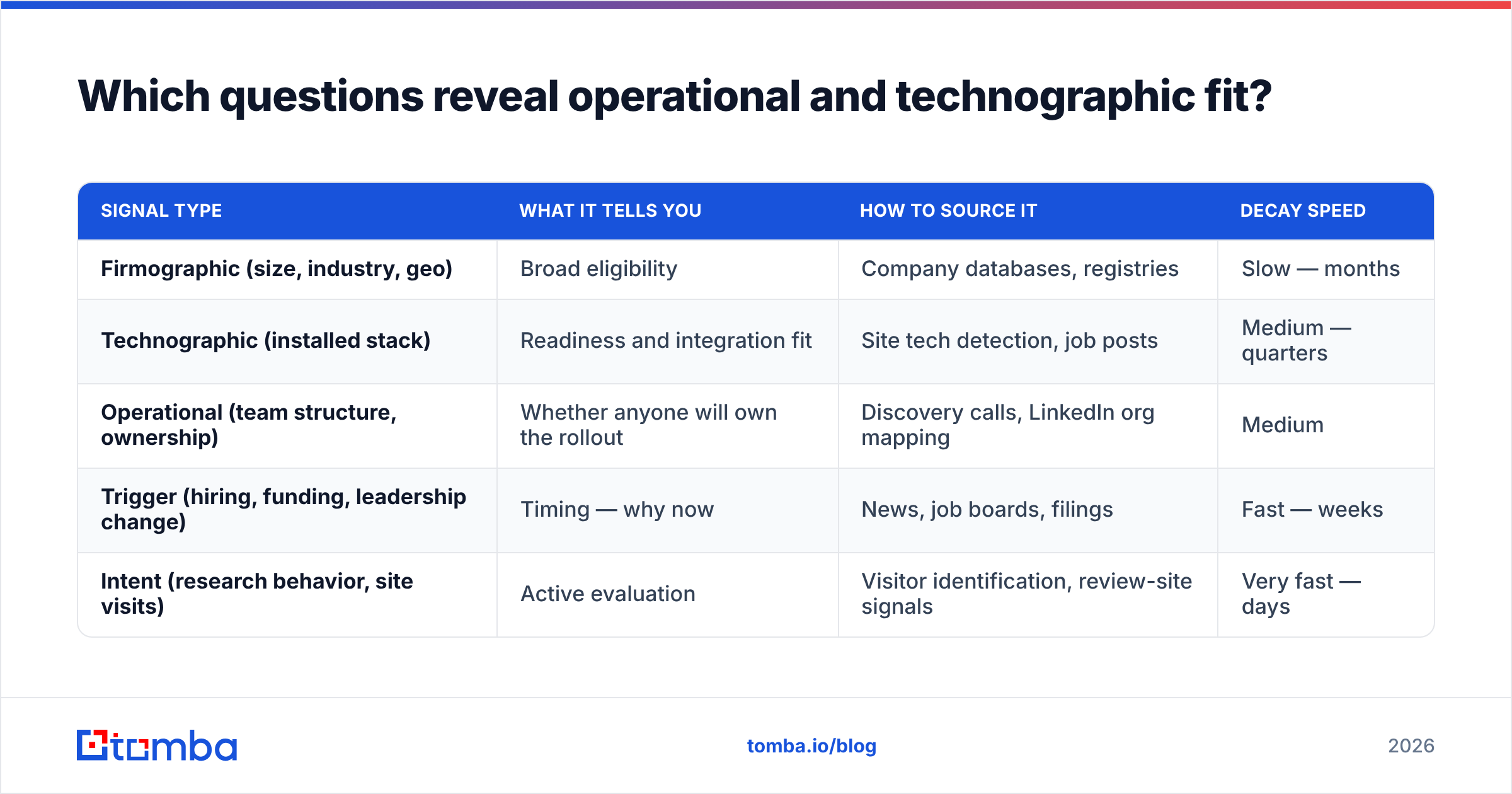
| Signal type | What it tells you | How to source it | Decay speed |
|---|---|---|---|
| Firmographic (size, industry, geo) | Broad eligibility | Company databases, registries | Slow — months |
| Technographic (installed stack) | Readiness and integration fit | Site tech detection, job posts | Medium — quarters |
| Operational (team structure, ownership) | Whether anyone will own the rollout | Discovery calls, LinkedIn org mapping | Medium |
| Trigger (hiring, funding, leadership change) | Timing — why now | News, job boards, filings | Fast — weeks |
| Intent (research behavior, site visits) | Active evaluation | Visitor identification, review-site signals | Very fast — days |
The practical takeaway: firmographics build the list, technographics rank it, triggers time it. Teams that skip the middle two rows end up with a large, evenly-bad list and blame the copy.
What questions uncover the trigger events that make deals move?#
Fit tells you who. Triggers tell you when — and when is where most outbound dies.
- What event happened 30–90 days before your best deals started? Check the account's news, job posts, and org changes.
- Which role change precedes a purchase — a new VP of Sales, a first RevOps hire, a marketing leader in month two?
- Does hiring for a specific role (SDR, growth marketer, data analyst) correlate with a buying window?
- Do funding rounds matter, or do they just create noise and a hiring freeze six months later?
- Does a competitor's renewal date or a public tool migration create the opening?
- What internal metric breaking — reply rates falling, bounce rates spiking, pipeline coverage under 3x — makes the pain urgent?
Write triggers as observable events, not feelings. "They're frustrated with data quality" is not a trigger. "They posted a job for a demand-gen manager and their careers page lists three open SDR seats" is. The first can't be queried; the second can, at scale, every Monday morning.
Gartner's research on B2B buying behavior consistently shows buying groups spend the majority of their journey off your radar, gathering information independently. Triggers are the cheapest way to catch that group early enough to shape the criteria instead of responding to an RFP someone else wrote.
What questions expose your negative ICP?#
The negative ICP — the accounts you should actively refuse — is the highest-ROI half of this exercise and the part almost nobody documents.
- Which accounts churned within 12 months, and what did they have in common at signup?
- Which deals consumed more than 2x the average sales cycle and closed anyway? (These are often worse than losses.)
- Which segment generates the most support tickets per seat?
- What budget or procurement pattern predicts a stalled deal — annual-only budgeting, mandatory three-vendor bids, sub-$X spend authority?
- Which use case looks adjacent but ends in disappointment because you solve a different problem?
- Which buyer title, when they're the only champion, correlates with a deal dying after the demo?
Run those six questions honestly and you'll usually find a segment your team keeps prospecting out of habit. Killing it frees capacity immediately — no new tooling, no new headcount.
What questions turn the ICP into value language?#
The last block converts fit into words a rep can say out loud.
- What specific outcome did your best accounts get, with a number attached?
- What were they doing instead before you — a manual process, a competitor, nothing at all?
- What objection shows up in nearly every winning deal, and what answer actually resolved it?
- Who was the economic buyer versus the champion, and did those roles ever collapse into one person?
- What did the account stop doing after adopting you? (Removal is easier to sell than addition.)
- If your best customer wrote your outbound email, what would the first sentence be?
Question 32 sounds like a workshop gimmick. It isn't. Pull three real quotes from renewal calls or G2 reviews and compare them with your current opener. The gap between the two is usually the reason your reply rate is stuck.
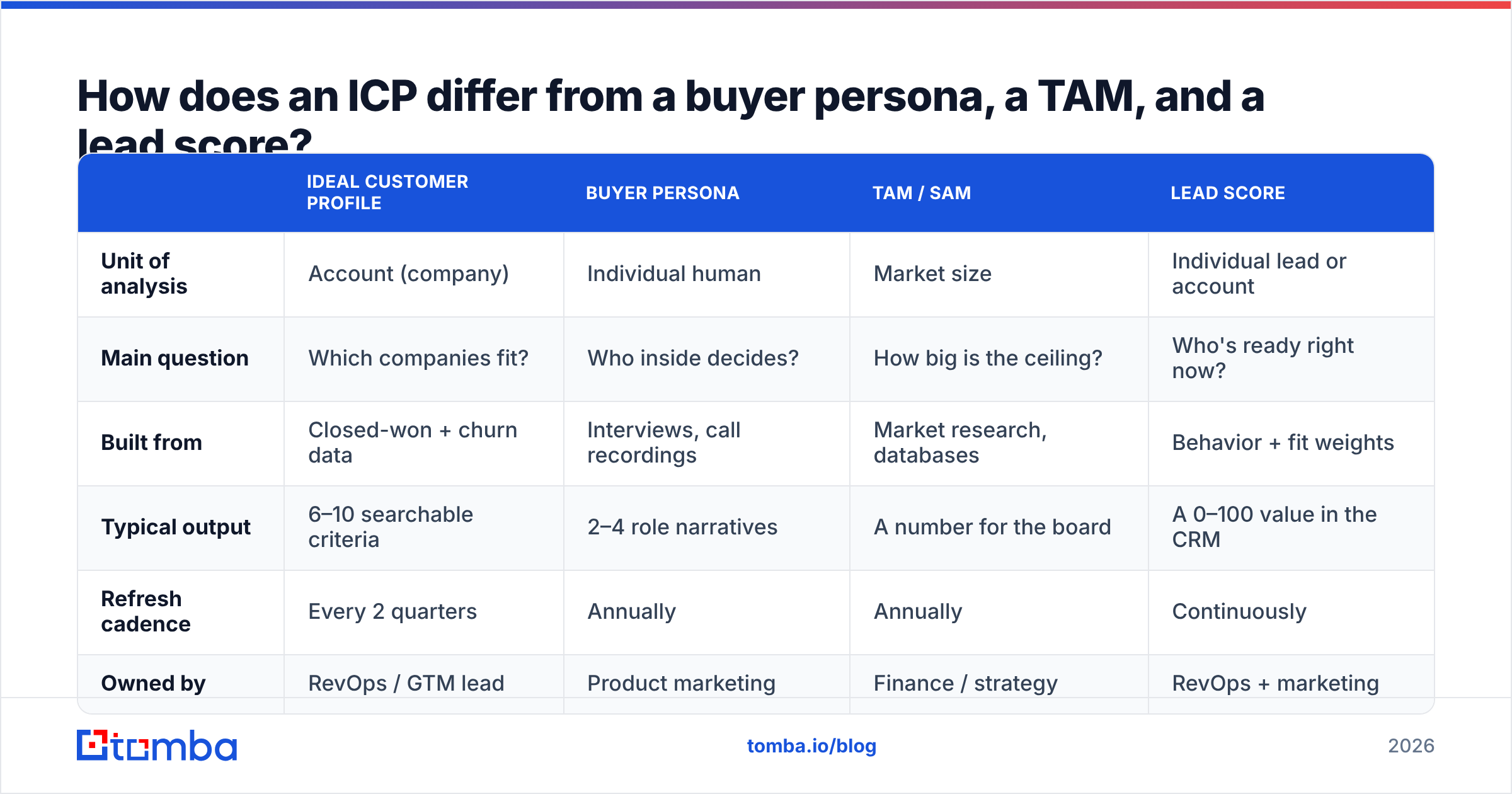
How does an ICP differ from a buyer persona, a TAM, and a lead score?#
These four get used interchangeably in meetings and they are not the same object. Confusing them is why ICP documents drift into 20-page personas nobody opens.
| Ideal customer profile | Buyer persona | TAM / SAM | Lead score | |
|---|---|---|---|---|
| Unit of analysis | Account (company) | Individual human | Market size | Individual lead or account |
| Main question | Which companies fit? | Who inside decides? | How big is the ceiling? | Who's ready right now? |
| Built from | Closed-won + churn data | Interviews, call recordings | Market research, databases | Behavior + fit weights |
| Typical output | 6–10 searchable criteria | 2–4 role narratives | A number for the board | A 0–100 value in the CRM |
| Refresh cadence | Every 2 quarters | Annually | Annually | Continuously |
| Owned by | RevOps / GTM lead | Product marketing | Finance / strategy | RevOps + marketing |
The chain runs in one direction: TAM sets the ceiling, the ICP narrows it into a workable list, personas tell reps who to talk to inside those accounts, and the lead score ranks the resulting names by readiness. Skip the ICP and your lead score is just ranking noise faster. HubSpot's own guidance on building an ICP makes the same point from the inbound side: without account-level criteria, scoring models optimize for engagement rather than fit.
How do you turn ICP answers into a list you can actually build?#
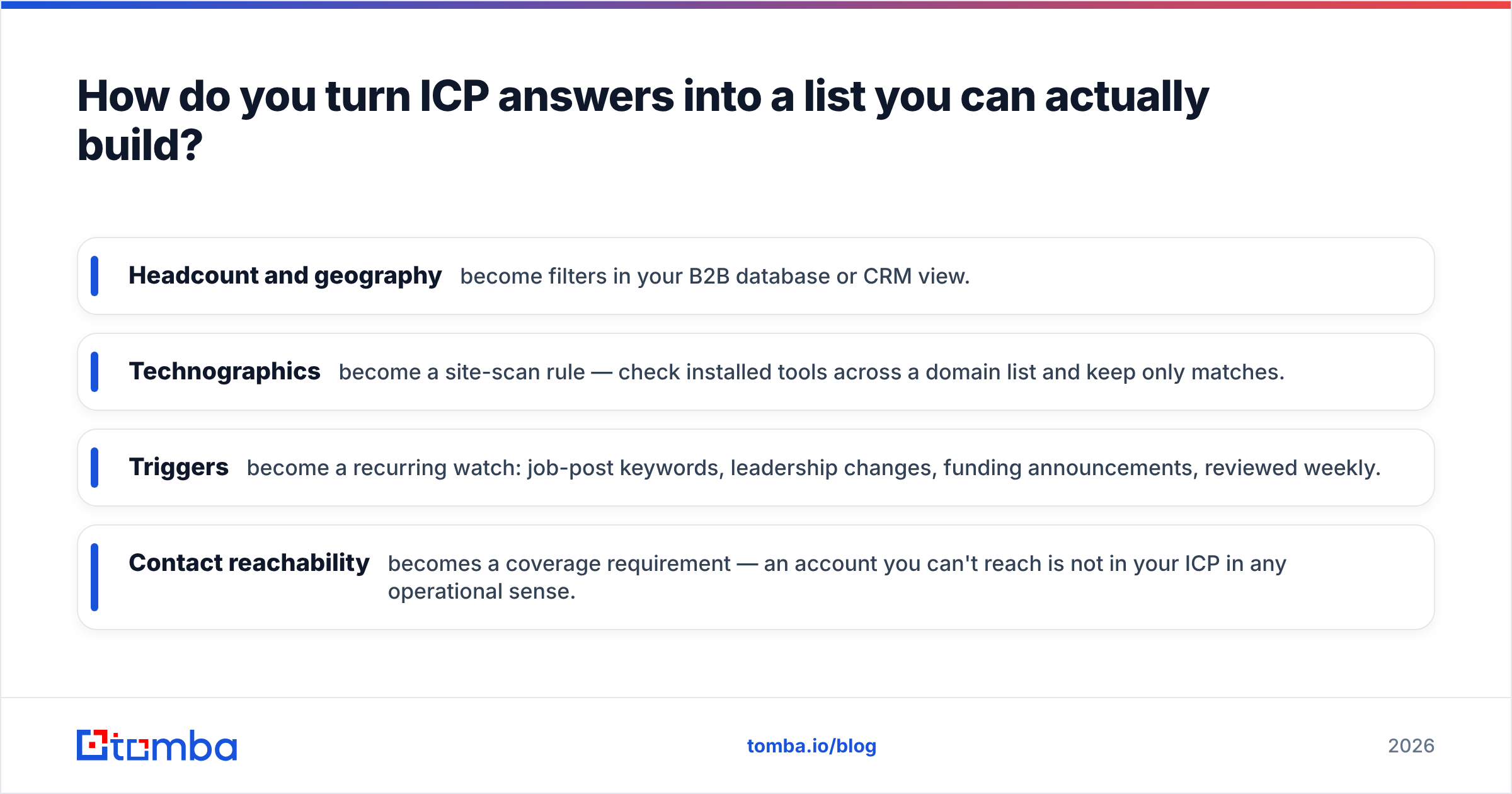
An ICP that lives in a slide deck changes nothing. The test is whether a rep can reproduce your target list on a Monday without asking you a question. Convert each answer into a query.
- Headcount and geography become filters in your B2B database or CRM view.
- Technographics become a site-scan rule — check installed tools across a domain list and keep only matches.
- Triggers become a recurring watch: job-post keywords, leadership changes, funding announcements, reviewed weekly.
- Contact reachability becomes a coverage requirement — an account you can't reach is not in your ICP in any operational sense.
That last point gets underrated. Two accounts can score identically on fit while one has a verified, mailbox-tested contact for the exact buying role and the other has a generic info@ address behind a catch-all domain. Your pipeline math only counts the first one.
This is where the ICP work meets data work. Use domain search to map who exists at each target account and which pattern their addresses follow, then enrich leads with title, seniority, and location so your firmographic filters apply at the contact level too. Finally, verify before sending — an ICP-perfect list that bounces at 12% will damage the sending domain you need for the next quarter's campaigns.
A reasonable accuracy bar: if more than one in twenty verified addresses bounces, your list-building step is the bottleneck, not your ICP. Fix the data layer before you rewrite the messaging again.
How often should you rerun these ideal customer profile questions?#
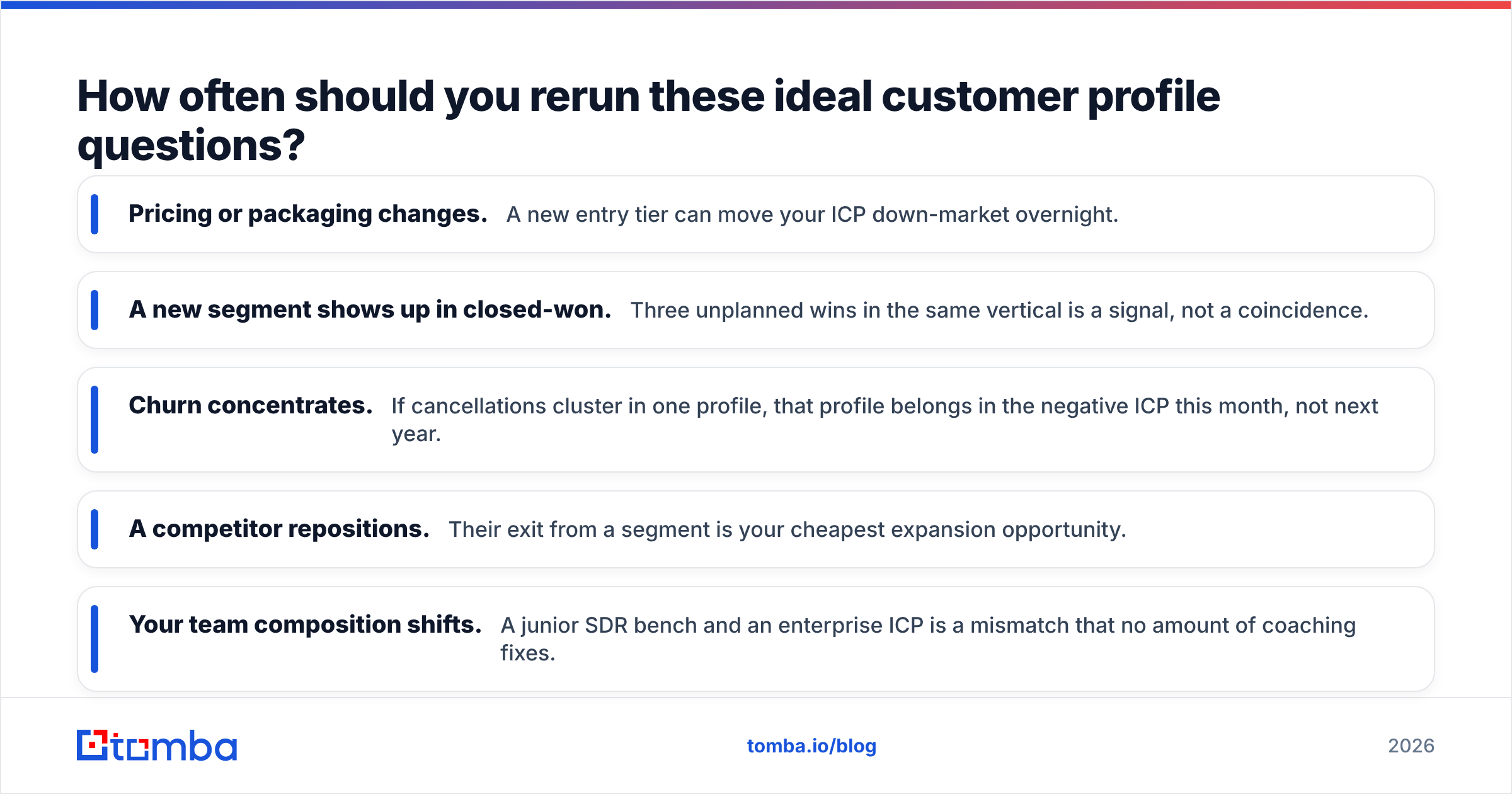
Twice a year as a default, and immediately when any of these happen:
- Pricing or packaging changes. A new entry tier can move your ICP down-market overnight.
- A new segment shows up in closed-won. Three unplanned wins in the same vertical is a signal, not a coincidence.
- Churn concentrates. If cancellations cluster in one profile, that profile belongs in the negative ICP this month, not next year.
- A competitor repositions. Their exit from a segment is your cheapest expansion opportunity.
- Your team composition shifts. A junior SDR bench and an enterprise ICP is a mismatch that no amount of coaching fixes.
Keep the document short — one page, six to ten criteria, a negative list, and three trigger definitions. Anything longer gets read once and archived.
Where should you start?#
Start with your last 20 closed-won accounts and questions 1–8. That takes an afternoon and will already contradict at least one assumption in your current targeting. Then do the negative ICP block, because it's the fastest way to give your reps back hours this week.
Once the criteria are written, the work becomes mechanical: find the accounts that match, find the right people inside them, and confirm you can actually reach those people. That's exactly what the Tomba Email Finder is built for — turn a name and a domain into a verified, deliverable address, in bulk or through the API, so your ICP filters end in a list your team can email today. The free tier covers 25 searches a month if you want to test it against your own closed-won list first; paid plans start at $49/mo on Tomba pricing when you're ready to build at volume.
Related guides#
// get started
Find, verify and enrich your first contacts today
Start on the free plan with 25 searches a month, then scale when your team is ready.
Free plan · No credit card required · GDPR & CCPA
// about the author