Ideal Customer Profile SaaS Guide: Build an ICP for 2026
Most SaaS ICPs are a slide nobody opens. Here is how to build one from retention data, score accounts against it, and turn it into a target list your reps can actually email this quarter.
Building an ideal customer profile SaaS reps will actually use starts with your own retention data. Not a workshop. Not a persona doc. This guide shows you where to pull the data, how to score accounts against it, and how to turn the result into a list you can email this quarter.
TL;DR
- An ideal customer profile (ICP) describes the account you sell to, not the person. It covers firmographics, tech stack, trigger events, and unit economics.
- Build it from your own retention and expansion data, not from a whiteboard session. Your top decile by net revenue retention is the training set.
- Three traits predict SaaS retention best: team size in the buying department, nearby tooling, and a buyer who already owns a budget line for your category.
- An ICP that does not name domains and reachable contacts is a slide, not a go-to-market asset.
- Refresh it each quarter. Most SaaS ICPs drift within two product releases.
What is an ideal customer profile SaaS teams actually use?#
An ideal customer profile describes the type of company that gets the most from your product. Those companies renew, expand, and cost the least to serve. It works at the account level. A buyer persona sits inside it and describes a human.
The everyday version: an ICP is the guest list, and a persona is the seating chart. You decide who gets invited before you worry about where they sit.
In SaaS, the ICP carries more weight than in most industries, because your revenue is recurring. A bad-fit customer in a one-off business is just a weak deal. In SaaS, the same customer closes, eats onboarding hours, files support tickets, drags your NPS down, and churns at month eleven. By then you have already paid to win them. Gartner's sales strategy research has made versions of this point for years. Cheap growth starts with tight targeting.
So use a tighter definition than the textbook one:
Your ideal customer profile is the set of account traits that come with above-median net revenue retention and below-median cost to serve.
The rest is decoration. Industry lists. "Companies that care about innovation." Logos you wish you had.
What is the difference between an ICP, a buyer persona, and TAM?#
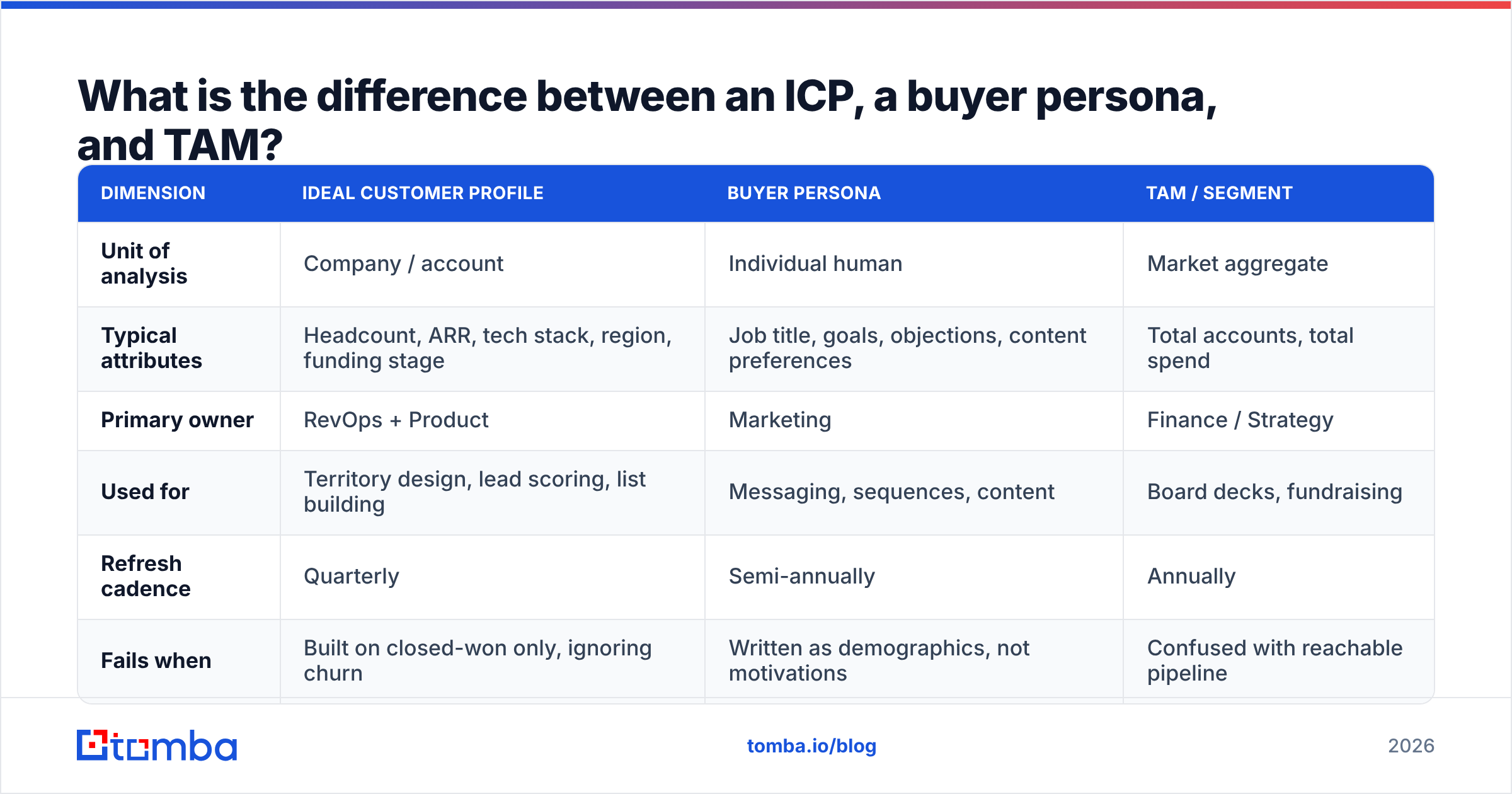
Teams use these three terms as if they mean the same thing. They do not. Here is the split that keeps a pipeline review honest:
| Dimension | Ideal Customer Profile | Buyer Persona | TAM / Segment |
|---|---|---|---|
| Unit of analysis | Company / account | Individual human | Market aggregate |
| Typical attributes | Headcount, ARR, tech stack, region, funding stage | Job title, goals, objections, content preferences | Total accounts, total spend |
| Primary owner | RevOps + Product | Marketing | Finance / Strategy |
| Used for | Territory design, lead scoring, list building | Messaging, sequences, content | Board decks, fundraising |
| Refresh cadence | Quarterly | Semi-annually | Annually |
| Fails when | Built on closed-won only, ignoring churn | Written as demographics, not motivations | Confused with reachable pipeline |
The most common and most costly mistake is to build the ICP from closed-won data alone. Closed-won tells you who bought. It says nothing about who stayed. Train your targeting on deals that closed and then churned, and you build a machine that makes churn faster.

What data actually belongs in a SaaS ICP?#
Six groups of traits carry almost all the weight. Work down them in order. Stop when the signal gets thin.
Scale of the buying team — not company headcount. If you sell a support tool, count support agents. Total employees tell you little. This is the strongest fit signal in most SaaS categories, and teams keep trading it for a lazy "50–500 employees" filter.
Tech stack next door — which systems do you sit beside? A company on Salesforce and Outreach is a different buyer from one on HubSpot and Instantly, even at the same headcount. Stack data also flags integration risk before the sales call.
Budget ownership — does someone already own a line item for your category? Or are you asking them to create one? Category-creation deals close 30–50% slower in most SaaS benchmarks. They also need their own motion.
Trigger events — a funding round, a new leader, a compliance deadline, a hiring spike in the buying team. Triggers do not set fit. They set timing. Keep them in their own column so you never mix the two.
Geography and rules — data residency, language coverage, and support-hours overlap. A perfect-fit account in a region you cannot support is not a perfect fit at all.
Unit economics — likely seat count, contract length, and support load. This column turns an ICP from a marketing artifact into one your CFO will defend.
Notice what is missing: industry vertical. Vertical is a useful proxy when you have nothing better. As a direct predictor in horizontal SaaS, it is weak. Many teams find their real ICP cuts across six SIC codes and drops half of the vertical they thought they owned.
How do you build an ICP from your existing customers?#
You need about 40 paying accounts with a year of history. Below that, run the exercise anyway. Just treat the output as a hypothesis.
Step 1 — Pull the cohort. Export every account with 12 or more months of tenure. Include the churned ones. Churned accounts are the most useful rows in the file, and teams keep deleting them.
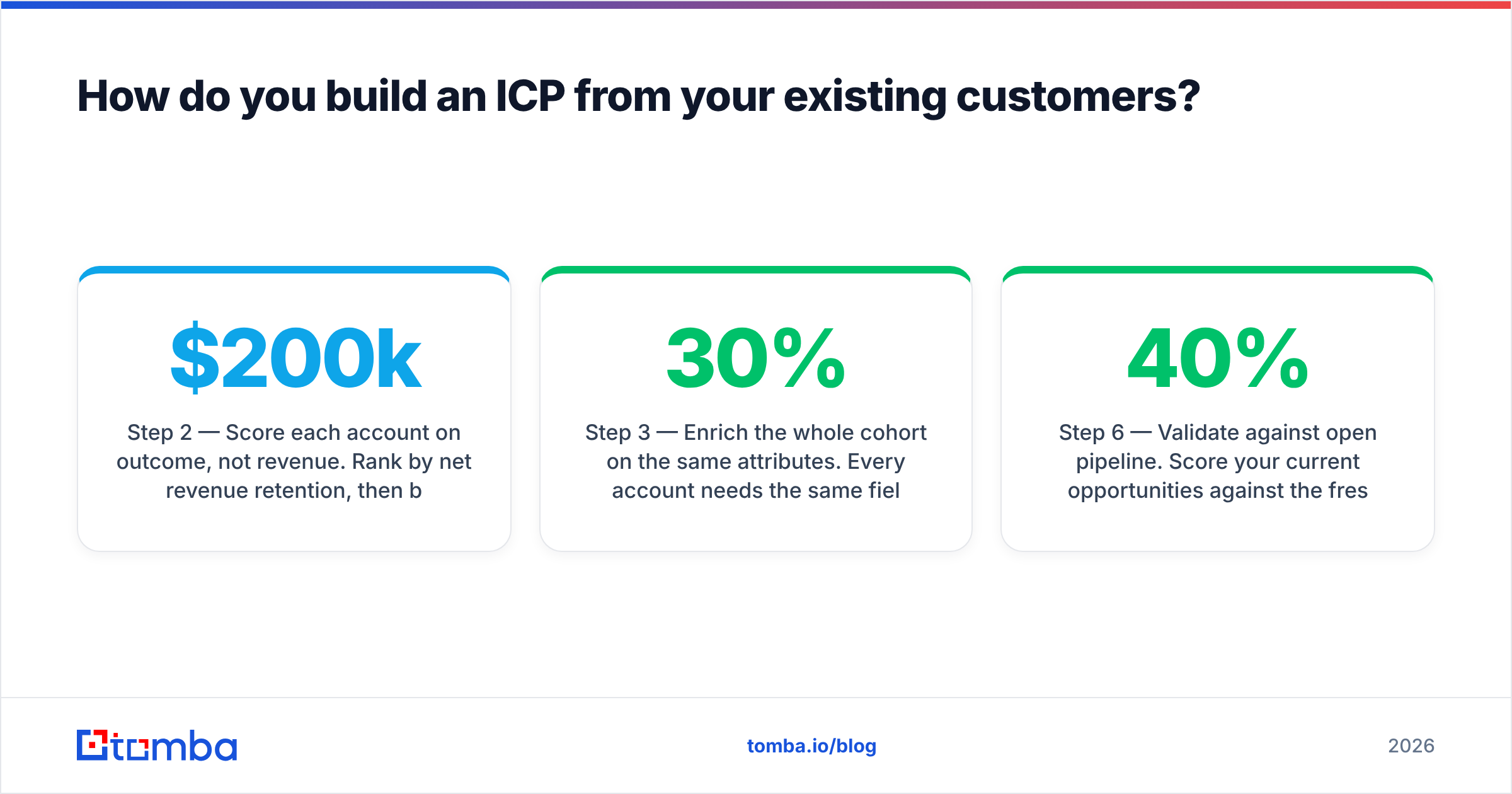
Step 2 — Score on outcome, not revenue. Rank by net revenue retention. Break ties with support tickets per seat. A $200k account that ate 400 support hours is not in your top decile.
Step 3 — Enrich the whole cohort the same way. Every account needs the same fields from the same source. Otherwise you are measuring data quality, not fit. This is where most in-house ICP projects stall, because the CRM has firmographics on 30% of rows. Run the list through contact enrichment or a comparable provider first. Then look for patterns.
Step 4 — Compare the top decile with the bottom decile. Not with the average. The average hides everything. Look for traits where the two groups split cleanly. A 60/10 split is a real signal. A 55/45 split is not.
Step 5 — Write the profile as rules for in and out. Exclusions matter more, and almost nobody writes them down. "Not a fit: agencies reselling to end clients, teams under four seats in the buying department, accounts that need on-prem." Give your SDRs permission to disqualify.
Step 6 — Test it against open pipeline. Score today's opportunities with the fresh ICP. If more than 40% of open pipeline scores as poor fit, you have found this quarter's forecast problem.
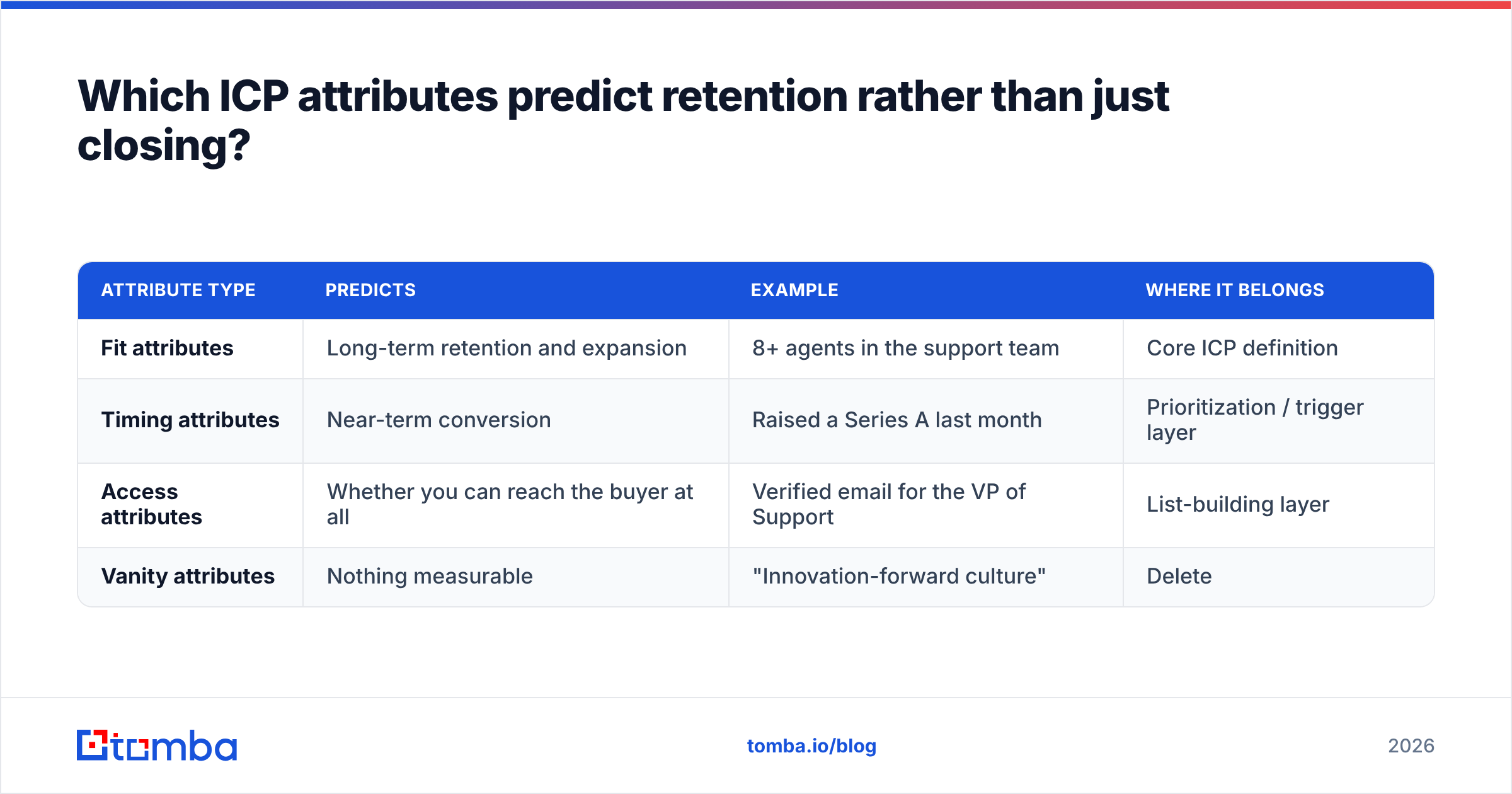
Which ICP attributes predict retention rather than just closing?#
Fit traits split into two families. Mixing them is why so many ICPs look right and perform badly.
| Attribute type | Predicts | Example | Where it belongs |
|---|---|---|---|
| Fit attributes | Long-term retention and expansion | 8+ agents in the support team | Core ICP definition |
| Timing attributes | Near-term conversion | Raised a Series A last month | Prioritization / trigger layer |
| Access attributes | Whether you can reach the buyer at all | Verified email for the VP of Support | List-building layer |
| Vanity attributes | Nothing measurable | "Innovation-forward culture" | Delete |
Timing traits are seductive, because they track speed. Funded companies buy faster. They also track churn in several categories. A freshly funded team buys eight tools in a quarter and cancels five the next year. Keep timing separate, weight it lower, and never let a trigger override a fit exclusion.
Access traits are the ones nobody scores and everybody needs. Say your ICP holds 800 accounts, but you can only reach decision-makers at 300 of them. That is really an ICP of 300 accounts. Score reachability on its own.
How do you turn an ICP into a target list you can actually email?#
This step separates a working ICP from a slide deck. Your ICP work should end in a CSV. Named domains, named people, verified contact details — not a paragraph.
The sequence that works:
Resolve the profile to domains. Filter a B2B database or your enrichment provider on your inclusion rules. Expect to over-collect by 3–4x. You will prune hard.
Apply exclusions by rule. Agencies, resellers, sub-threshold teams, unsupported regions. Do this in the spreadsheet, not in the rep's head.
Map the buying committee per account. For each surviving domain, pull the two or three roles in your persona set. A domain search returns a company's addresses and role patterns in one call. That beats rebuilding formats by hand.
Verify before you send. Fit means nothing if 22% of your list bounces and your sending domain takes the damage. Run the list through an email verifier and drop anything that comes back risky.
Write the score back into the CRM. ICP fit belongs on the account object, refreshed on a schedule and visible in every pipeline review. Leave it in a spreadsheet and it stops existing within a month.
For lists over a few thousand rows, run steps 3 and 4 in batch. A bulk email finder working overnight turns a list-building fortnight into an afternoon.
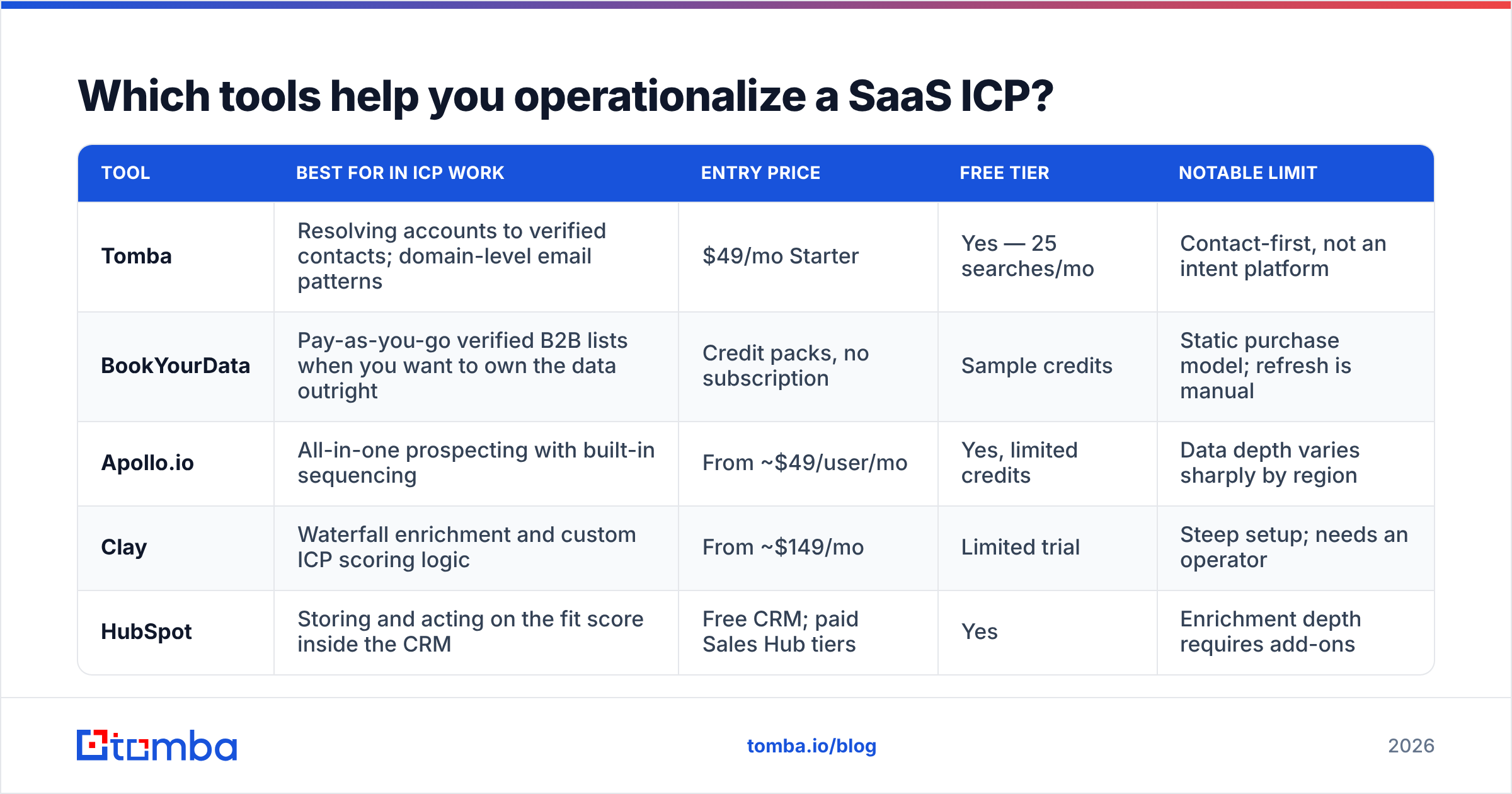
Which tools help you operationalize a SaaS ICP?#
An ideal customer profile SaaS stack needs four things: account data, contact data, verification, and a place to store the score. No single tool does all of it. Here is how the common building blocks compare on what matters for ICP work. Prices reflect public plans in early 2026, so confirm current tiers with each vendor.
| Tool | Best for in ICP work | Entry price | Free tier | Notable limit |
|---|---|---|---|---|
| Tomba | Resolving accounts to verified contacts; domain-level email patterns | $49/mo Starter | Yes — 25 searches/mo | Contact-first, not an intent platform |
| BookYourData | Pay-as-you-go verified B2B lists when you want to own the data outright | Credit packs, no subscription | Sample credits | Static purchase model; refresh is manual |
| Apollo.io | All-in-one prospecting with built-in sequencing | From ~$49/user/mo | Yes, limited credits | Data depth varies sharply by region |
| Clay | Waterfall enrichment and custom ICP scoring logic | From ~$149/mo | Limited trial | Steep setup; needs an operator |
| HubSpot | Storing and acting on the fit score inside the CRM | Free CRM; paid Sales Hub tiers | Yes | Enrichment depth requires add-ons |
A practical stack for a Series A company looks like this. Use HubSpot or your existing CRM as the system of record. Add one enrichment source to fill firmographics across the customer base. Add one contact-and-verification layer to turn the account list into deliverable email. Check current Tomba pricing and the same tiers on G2 before you sign anything annual. Most teams overbuy seats in year one.
For the messaging layer that sits on top of the profile, HubSpot's sales blog has plenty of persona-writing material. Vendors like BookYourData publish useful breakdowns of how list filters map to buying committees.
How do you know your ICP is wrong?#
Five symptoms, roughly in the order they show up:
Win rate is fine, but time-to-value is long. You are selling to companies that can buy but cannot implement. Your ICP is missing a readiness trait.
Sales and CS disagree about which logos are good. CS is usually right. They see month thirteen. Sales sees month zero.
Your best expansion accounts were inbound accidents. If your fastest-growing customers came from a channel you do not target, your ICP describes who you chased, not who you serve.
Reps work outside the profile and still hit quota. Field behaviour beats documentation. Go find out what they know.
Churn clusters on a trait you left out. Run the churn cohort on its own each quarter. Look for the variable your model does not contain.
The fix is the same every time. Re-run the top-decile-versus-bottom-decile comparison with fresh data. An ICP is a hypothesis with a shelf life, not a constitution. Most profiles narrow over the first two years, then widen again as the product matures. That pattern is healthy, and you cannot see it if you only look once.
One more habit worth keeping: version your ICP. Save ICP v3 — Q1 2026 with a change log of what moved and why. Then, when the board asks why you stopped targeting sub-20-person teams, you have the retention chart instead of a memory.
Ready to turn your ICP into a contactable list?#
An ideal customer profile SaaS teams can act on ends as a list, not a doc. Take your inclusion rules, resolve them to domains, and pull the buying committee for each one. Verified, deduplicated, ready for your sequencer. The Tomba Email Finder handles the account-to-contact step at scale. The free tier gives you 25 searches a month to test your list, and Starter runs $49/mo when you are ready for the whole cohort. Build the profile from your retention data, then let the tooling handle the last mile.
Related guides#
Ready to find emails that actually work?
Join 150,000+ professionals who stopped guessing and started sending. Free credits on signup — no credit card required.
Get the Tomba newsletter
Practical outbound tactics and product updates — once every two weeks.
About the author