Ideal Customer Profile Slide: How to Build One That Works
Most ICP slides are a list of adjectives nobody can act on. Here is the exact structure, data sources, and disqualifier logic that turn one slide into a targeting decision your reps can execute Monday morning.
TL;DR
- An ideal customer profile slide describes accounts, not people. If your slide says "VP of Marketing, 35-45, cares about ROI," you built a persona slide and labeled it wrong.
- The failure mode is adjectives without evidence. "Mid-market SaaS companies that value data" is not a filter — nobody can query it.
- A working slide has four parts: firmographic filters, behavioral triggers, an explicit disqualifier row, and the surviving account count.
- Build it from closed-won and churn data, not from the founder's memory of the three best customers.
- Refresh it quarterly. An ICP that hasn't moved in two years is decoration, not strategy.
What is an ideal customer profile slide?#
An ideal customer profile slide is the single page in a GTM deck, board deck, or sales kickoff that answers one question: which accounts are we allowed to spend money on?
Think of it like a bouncer's clipboard at a club door. The clipboard doesn't describe what a great night out feels like. It lists names and rules — who gets in, who doesn't, and what to do with the ambiguous cases. Most ICP slides describe the vibe of the party instead of listing the rules, which is why nobody's behavior changes after the meeting.
The distinction matters because the slide has a downstream job. Your SDR team turns it into a search query. Your paid team turns it into an audience. Your RevOps lead turns it into lead-scoring rules and routing logic. If the slide can't be translated into a filter — an industry code, an employee band, a tech-stack signal, a funding event — it produces nothing but agreement in the room and chaos in the pipeline.
HubSpot's working definition is a useful baseline: the ICP is a description of the company that gets the most value from your product and gives you the most value in return. The slide is where that description becomes operational.
Why do most ICP slides fail?#
Four recurring reasons, in rough order of how often they show up in real decks.
- They describe people instead of companies. Job title, seniority, and pain points belong on a buyer persona slide. The ICP slide is the account layer above it. Collapsing them means your targeting logic has no unit — you can't build an account list out of "curious, data-driven leaders."
- They have no disqualifiers. A profile with only inclusion criteria expands to fit whatever the rep wants to prospect. Every strong ICP slide has a row that says we do not sell to X and survives the executive who objects that "we could technically serve them."
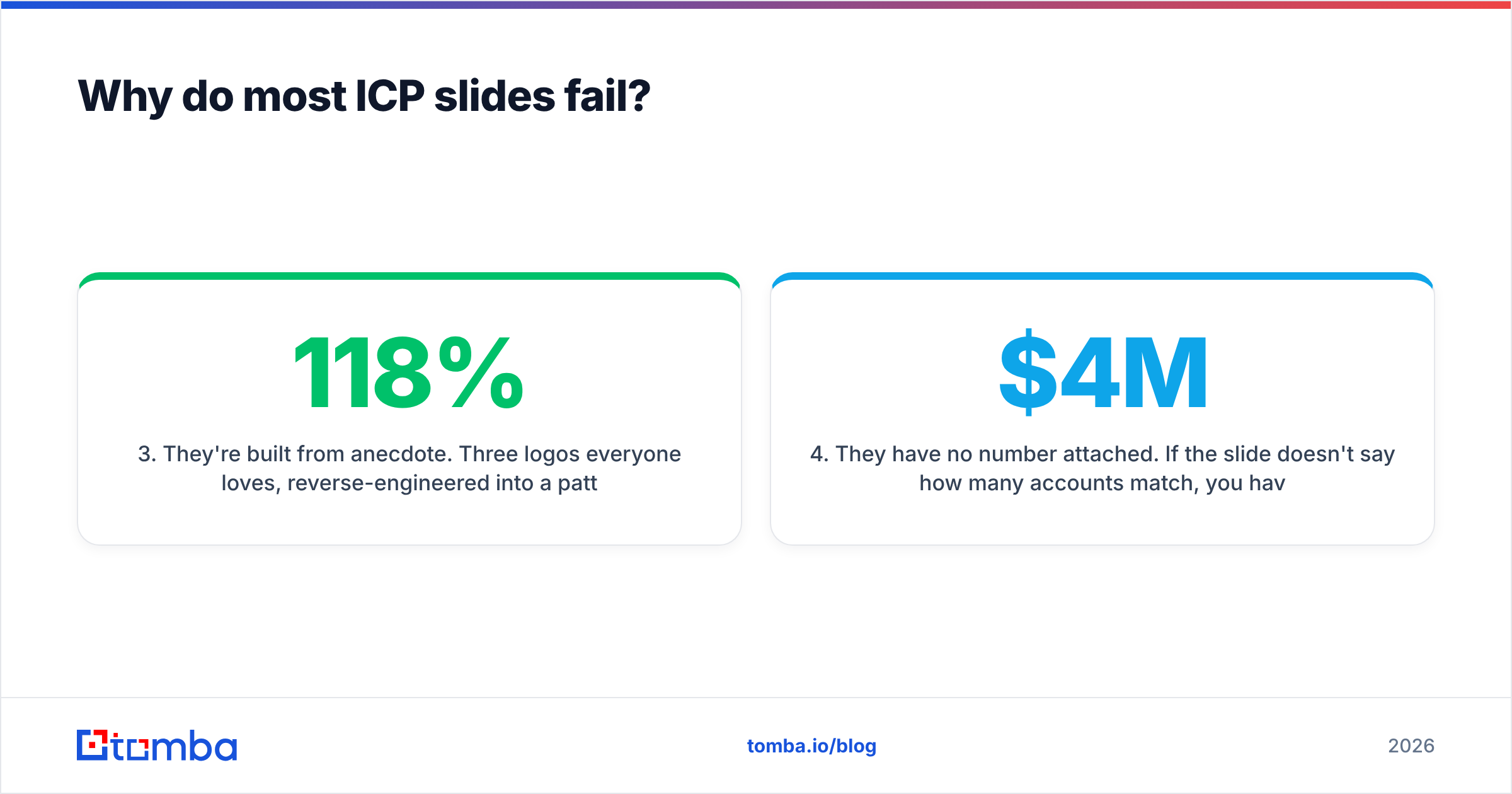
- They're built from anecdote. Three logos everyone loves, reverse-engineered into a pattern. Sample size three, selection bias total. Meanwhile the 40 quiet accounts that renew at 118% net revenue retention never get analyzed.
- They have no number attached. If the slide doesn't say how many accounts match, you have no idea whether you just defined a $4M market or a $400M one. The count is the reality check.

There's also a quieter failure: the slide is technically correct but unusable because none of the criteria are available as data. "Companies with a dedicated RevOps function" is a genuinely predictive signal and completely useless if you have no way to detect it at scale. Every criterion needs a lookup path — a database field, a scraped signal, an enrichment call. Criteria without a lookup path are hypotheses, and hypotheses belong in an appendix.
What belongs on the slide, and what should be cut?#
Keep the slide to four blocks. Anything else goes in the appendix.
- Firmographic filters (4-6 max). Industry or vertical, employee count band, revenue band, geography, funding stage. These are the hard gates — an account either passes or it doesn't. Resist the urge to add a seventh; each additional filter compounds and shrinks your addressable list faster than people expect.
- Behavioral and technographic triggers (2-3). What the account is doing right now: hiring for a role you sell into, adopting a competing or complementary tool, opening a new region, raising a round. Triggers are what turn a static list into a prioritized queue.
- Disqualifiers (explicit, 2-4 items). Companies you refuse. Common ones: below a revenue floor where CAC never recovers, regulated verticals your security posture can't serve, geographies with unsupported data-residency requirements, or existing logos with a history of high-touch churn.
- The number. How many accounts survive all of the above, and what the blended ACV is. One line: "1,840 accounts, $18.4K median ACV, $34M realistic ceiling at 12% penetration."
- Evidence footer. One line naming the data set: "n = 214 closed-won + 61 churned, trailing 18 months." This is what stops the slide from being re-litigated every quarter by whoever is loudest.
Cut: mission statements, buyer emotions, generic pain bullets ("wants to grow faster"), and stock persona photos. They belong in enablement material, not the targeting slide.
Is the ICP slide the same as a persona or TAM slide?#
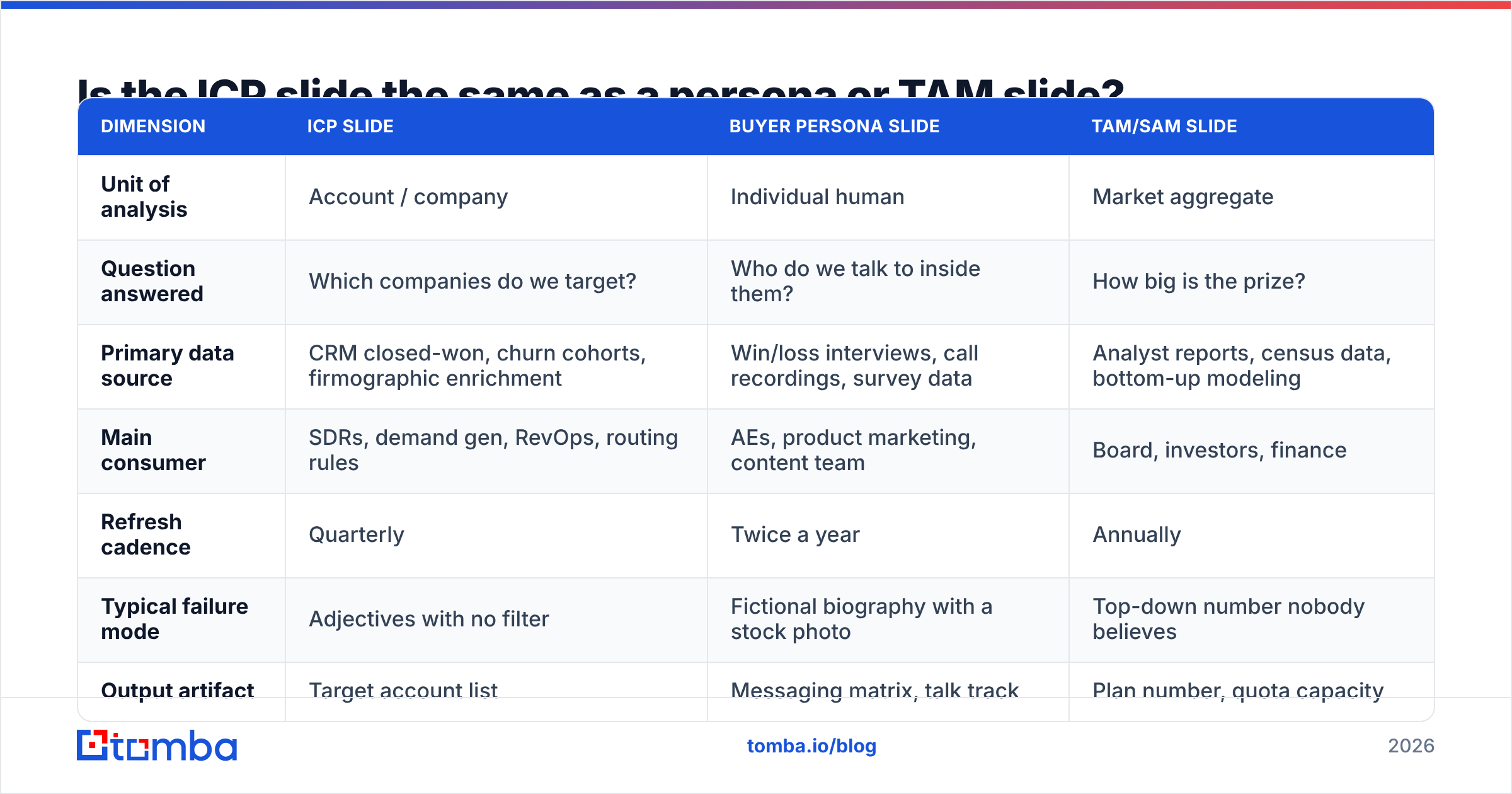
No, and conflating them is the most common structural error in GTM decks. Here's how the three differ:
| Dimension | ICP slide | Buyer persona slide | TAM/SAM slide |
|---|---|---|---|
| Unit of analysis | Account / company | Individual human | Market aggregate |
| Question answered | Which companies do we target? | Who do we talk to inside them? | How big is the prize? |
| Primary data source | CRM closed-won, churn cohorts, firmographic enrichment | Win/loss interviews, call recordings, survey data | Analyst reports, census data, bottom-up modeling |
| Main consumer | SDRs, demand gen, RevOps, routing rules | AEs, product marketing, content team | Board, investors, finance |
| Refresh cadence | Quarterly | Twice a year | Annually |
| Typical failure mode | Adjectives with no filter | Fictional biography with a stock photo | Top-down number nobody believes |
| Output artifact | Target account list | Messaging matrix, talk track | Plan number, quota capacity |
Read that table left to right and the sequencing becomes obvious: TAM sets the ceiling, ICP picks the slice, persona decides who to email inside the slice. Decks that lead with persona work backwards and produce campaigns targeting the right title at the wrong company — which is exactly how you end up with high reply rates and no pipeline.
How do you build the slide from real data in one week?#
You don't need a data science team. You need your CRM export and about four working days.
Day 1 — Pull the cohort. Export every closed-won deal from the trailing 12-18 months, plus every churn and every closed-lost where the stated reason was fit. You want both signals; the churn list is where disqualifiers come from and it's the half everyone skips.
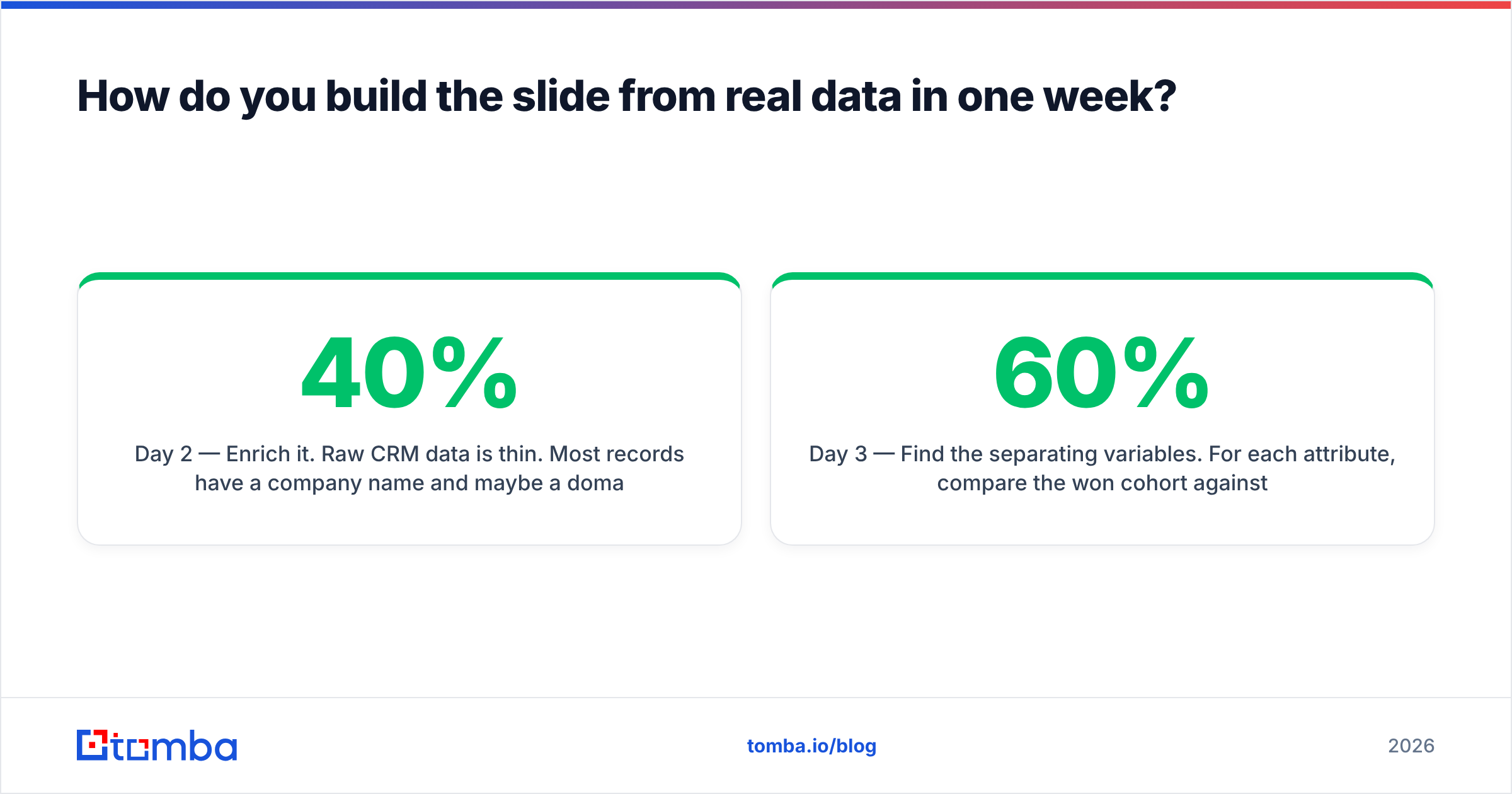
Day 2 — Enrich it. Raw CRM data is thin. Most records have a company name and maybe a domain. Push the list through data enrichment to attach employee count, industry, tech stack, funding, and headquarters — otherwise you're clustering on fields that are 40% blank. Consistency matters more than depth here: one enrichment source across the whole cohort beats a patchwork of three that disagree on employee bands.
Day 3 — Find the separating variables. For each attribute, compare the won cohort against the churned cohort and against your total pipeline. You're looking for attributes where the distributions actually diverge. If 60% of everything you touch is SaaS and 62% of your wins are SaaS, "SaaS" is not an ICP criterion — it's a description of your list-building habits. The variables that matter usually surprise people: contract length, number of integrations at onboarding, whether the buyer had a predecessor tool, whether the company had a dedicated ops hire.
Day 4 — Size it and pressure-test it. Apply the surviving filters to a market database and count. If the number is under a few hundred accounts you've over-filtered; loosen the weakest criterion. If it's over 50,000 you've under-filtered and the slide provides no guidance. Then run the honesty check: pull ten accounts that match the profile perfectly and ten that fail it, and ask two AEs to rank them blind. If they can't tell the difference, your criteria don't carry signal.
Day 5 — Write the slide. Four blocks, one number, one evidence footer.
The step teams skip is Day 3. It's tempting to go straight from "here are our best customers" to "here is our ICP," but without the comparison against losses you're describing your customer base, not your ideal one. Those are different things, and the gap between them is the entire point of the exercise.
What should the slide look like for each audience?#
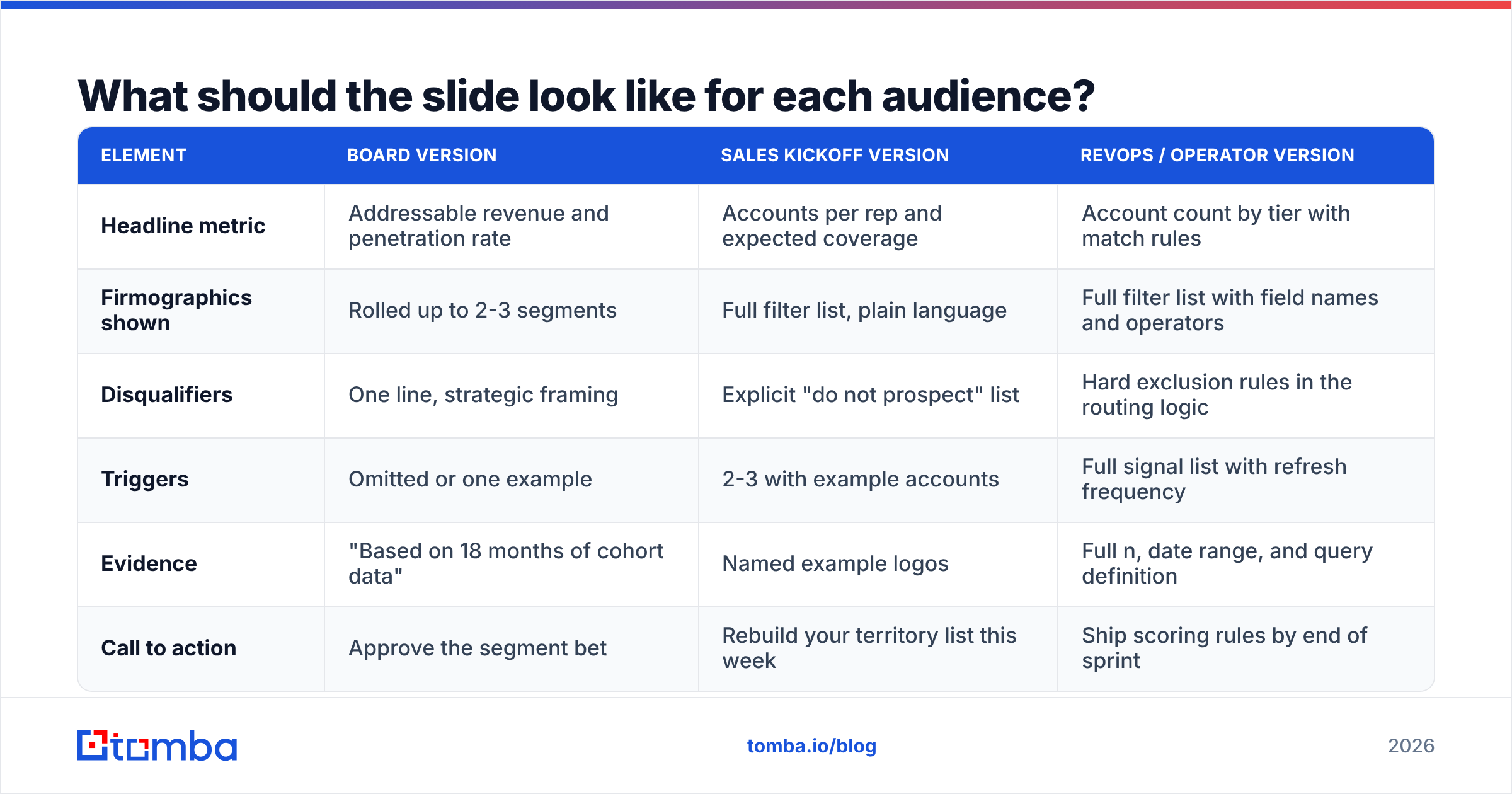
The same underlying analysis, three different renderings. Presenting the SDR version to a board is how you lose fifteen minutes to questions about ISO industry codes.
| Element | Board version | Sales kickoff version | RevOps / operator version |
|---|---|---|---|
| Headline metric | Addressable revenue and penetration rate | Accounts per rep and expected coverage | Account count by tier with match rules |
| Firmographics shown | Rolled up to 2-3 segments | Full filter list, plain language | Full filter list with field names and operators |
| Disqualifiers | One line, strategic framing | Explicit "do not prospect" list | Hard exclusion rules in the routing logic |
| Triggers | Omitted or one example | 2-3 with example accounts | Full signal list with refresh frequency |
| Evidence | "Based on 18 months of cohort data" | Named example logos | Full n, date range, and query definition |
| Call to action | Approve the segment bet | Rebuild your territory list this week | Ship scoring rules by end of sprint |
One rule across all three: never show a version without the disqualifiers. Executives will cut them for "optionality," and the moment they're gone the profile stops constraining anything.
How do you turn the slide into an actual target list?#
The slide is the specification. The list is the deliverable, and this is where most ICP work dies quietly.
Start by translating each criterion into a query. Employee band and industry are straightforward in any B2B database. Tech-stack signals need a detection layer. Funding events come from news APIs or a market-intelligence tool. Hiring signals come from job boards. Write the query down — literally, in the appendix — so the list is reproducible next quarter instead of hand-assembled by whoever has time.
Then get contactable. A list of 1,800 matching domains is not a target list; it's a research artifact. Run domain search across the matched accounts to pull the actual people in the roles your persona slide defines, then verify before anything gets loaded into a sequence. Bounce rates above 3% start damaging sender reputation, and an ICP exercise that ends in a deliverability incident has produced negative value. Verification is cheap; recovering a burned domain is not.
Finally, wire the criteria into scoring. If your ICP slide says funding stage matters, inbound leads from Series B companies should route differently than leads from bootstrapped ones. This is what separates a revenue operations practice from a slide library — the profile shows up in routing rules, lead scores, campaign audiences, and territory design, not just in the deck. Peer review helps here too: category pages on G2 tell you which company sizes and verticals actually review the tools you compete against, which is a useful sanity check against your own cohort analysis. Gartner's B2B sales research is worth a scan for how buying groups have shifted, since a profile built for a single-decision-maker world ages badly.
How often should you refresh the ICP slide?#
Quarterly for the numbers, annually for the structure.
The quarterly pass is mechanical: re-run the cohort analysis with the last three months of wins and churns appended, check whether any filter's separating power decayed, and update the account count. It takes half a day once the query is written down.
The annual pass is strategic and harder. You're asking whether the shape of the profile still holds — whether a new product line opened a segment, whether a pricing change moved the revenue floor, whether a competitor's collapse handed you a vertical. Watch for three staleness signals: your best new logos increasingly fail your own criteria, win rates inside the "ideal" segment are converging with everything else, or your reps have quietly stopped using the target list. That last one is the most honest indicator you'll get.
One caution: don't chase every quarter's noise. If you rewrite the profile every 90 days, territories churn, campaigns restart, and nobody's numbers compound. Change the structure when the evidence is durable, not when one large deal came from an unexpected vertical.
Build the list your ICP slide describes#
A profile that never becomes a contactable list is a decorative slide. Once you've settled the filters, use the Tomba Email Finder to pull verified business emails for the exact accounts and roles your slide defines — by domain, by name, or in bulk across the whole matched list. The free tier includes 25 searches a month if you want to test the match quality on a sample before committing, with paid plans starting at $49/mo; full Tomba pricing is on the site. Define the profile, then go work it.
Related guides#
// get started
Find, verify and enrich your first contacts today
Start on the free plan with 25 searches a month, then scale when your team is ready.
Free plan · No credit card required · GDPR & CCPA
// about the author