Ideal Customer Profile Template: How to Build Your ICP in 2026
Most ICP documents are a slide nobody opens. This is a fill-in ideal customer profile template built from closed-won data, plus the exact steps to turn it into a working prospect list.
TL;DR
- An ideal customer profile describes the company you should sell to, not the person. Personas come after.
- A usable ideal customer profile template has four layers: firmographic, technographic, behavioral, and economic. Most teams stop at the first one and wonder why their lists underperform.
- Build the ICP from your last 20-50 closed-won deals — not from a whiteboard session. Retention and expansion data beat opinion every time.
- The template is worthless until it becomes a query: a filter set your team can run against a data source and get contactable accounts back.
- Refresh it every two quarters, or immediately after any pricing change, new product line, or shift in win rate.
What is an ideal customer profile, exactly?#
An ideal customer profile (ICP) is a written description of the type of organization that gets the most value from your product, in the shortest time, at the lowest cost to serve — and therefore stays, expands, and refers.
Think of it like a fishing chart rather than a portrait. A portrait tells you what one fish looks like. A chart tells you which water to drop a line into, at what depth, in which season. Your ICP is the chart. Your buyer persona is the portrait of the fish.
That distinction matters because the two documents get confused constantly, and the confusion is expensive. When a rep says "our ICP is a VP of Marketing," they've named a persona and skipped the account-level criteria entirely — which means their list will include a VP of Marketing at a 12-person agency and a VP of Marketing at a 4,000-person insurer. One of those will churn in 90 days.
A well-built ICP does three jobs:
- It filters your list building. Every prospecting query starts from the ICP filters, not from "companies I've heard of."
- It routes your budget. Paid spend, events, and SDR headcount follow the tiers your ICP defines.
- It kills bad deals early. Reps get permission to disqualify, which is the single fastest lever on win rate.

Why do most ideal customer profile templates fail?#
Because they're written as adjectives instead of filters.
"Mid-market SaaS companies that value data quality and are growth-oriented" is a sentence you cannot execute. Nobody can run it. Compare it to: "B2B SaaS, 50-500 employees, Series A-C, US/UK/DE, running HubSpot or Salesforce, hiring for at least one SDR role in the last 90 days." That second version is a query. You can paste those filters into a data platform and get 3,000 accounts back this afternoon.
Three other common failure modes:
- Built from aspiration, not evidence. Teams describe the logo they want (enterprise, household name) instead of the account that actually renews. Your best customer is the one with the highest net revenue retention, not the biggest ACV.
- Never versioned. The ICP was written in 2023, the product shipped three new modules since, and nobody updated the doc. Stale ICPs quietly poison every downstream list.
- No disqualification criteria. A profile that only says who to target — and never who to reject — gets stretched by any rep under quota. Negative criteria are half the document.
Gartner's sales research has been making the same point for years: B2B buying groups have grown, cycles have lengthened, and precision at the account level now determines whether you get into a cycle at all. Broad targeting doesn't just waste budget — it actively lengthens the deals you do win.
What fields belong in an ideal customer profile template?#
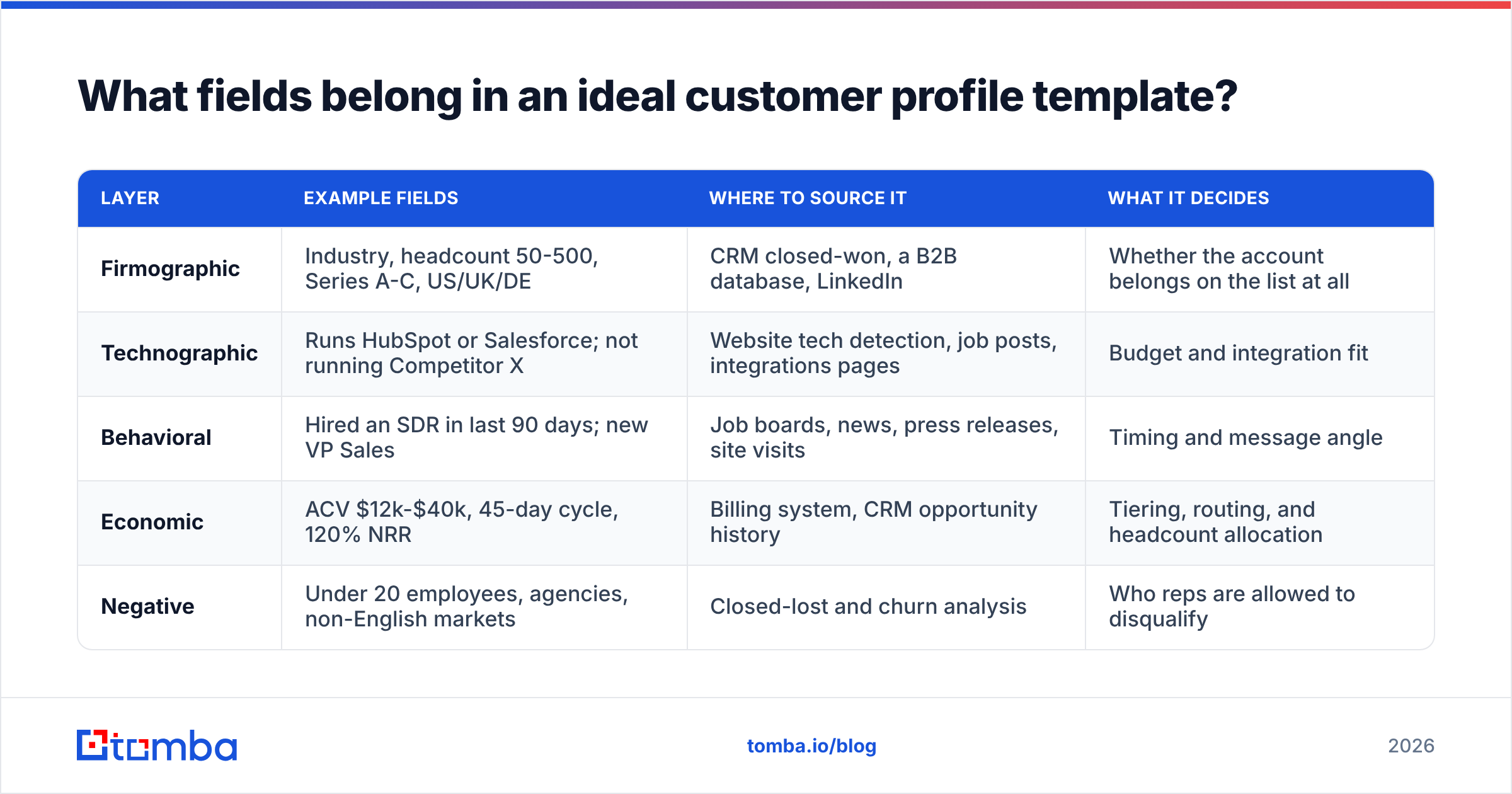
Four layers. Each answers a different question, and each is sourced differently.
- Firmographic — "what kind of company is it?" Industry/vertical, employee count, revenue band, funding stage, geography, HQ vs distributed, business model (B2B, B2B2C, marketplace).
- Technographic — "what does it already run?" CRM, marketing automation, data warehouse, competing tools, adjacent tools that imply readiness. Technographics are the strongest single predictor for most software products, because they prove budget and maturity in one signal.
- Behavioral / trigger — "why now?" Hiring for a relevant role, new exec in a relevant function, funding round, M&A, product launch, site migration, compliance deadline, visible pain (job posts, review sites, changelogs).
- Economic — "is it worth it?" Expected ACV, sales cycle length, cost to serve, expansion path, gross margin. This is the layer that turns a targeting list into a business case.
| Layer | Example fields | Where to source it | What it decides |
|---|---|---|---|
| Firmographic | Industry, headcount 50-500, Series A-C, US/UK/DE | CRM closed-won, a B2B database, LinkedIn | Whether the account belongs on the list at all |
| Technographic | Runs HubSpot or Salesforce; not running Competitor X | Website tech detection, job posts, integrations pages | Budget and integration fit |
| Behavioral | Hired an SDR in last 90 days; new VP Sales | Job boards, news, press releases, site visits | Timing and message angle |
| Economic | ACV $12k-$40k, 45-day cycle, 120% NRR | Billing system, CRM opportunity history | Tiering, routing, and headcount allocation |
| Negative | Under 20 employees, agencies, non-English markets | Closed-lost and churn analysis | Who reps are allowed to disqualify |
Notice the last row. If your ideal customer profile template has no negative criteria section, add one before you do anything else. Look at your churned accounts from the last 12 months and write down what they had in common. That list is usually short, obvious, and being ignored.
How do you build the ICP from closed-won data?#
Five steps. Budget half a day with someone who has CRM export access.
Step 1 — Pull the right sample. Export your closed-won accounts from the last 12-18 months. Then narrow to the ones that (a) renewed at least once, (b) expanded, or (c) have the highest product usage. If you have fewer than 20 such accounts, widen to all closed-won and treat the result as a hypothesis rather than a conclusion.
Step 2 — Enrich the sample. Raw CRM records are thin. Most rows will have a company name, a domain, and not much else. Run the domains through a data enrichment step so every account carries headcount, industry, location, and tech stack before you start looking for patterns. Pattern-finding on incomplete data produces confident nonsense.
Step 3 — Find the concentration. For each field, ask: what share of best-fit revenue sits in each bucket? You're looking for concentration, not averages. If 62% of your expansion revenue comes from companies between 100 and 400 employees, that's a boundary. If industry is spread evenly across nine verticals, industry is not a real ICP criterion for you — drop it rather than inventing one.
Step 4 — Interview five customers and five churned accounts. Data tells you what correlates; conversations tell you why. Ask the winners what problem they were solving the week they bought. Ask the churned accounts what they expected that never arrived. The gap between those two answers is your negative criteria section.
Step 5 — Write it as filters and publish it. One page. Filter syntax, not prose. Put it where reps actually look — the CRM, the prospecting tool, the SDR onboarding doc — not in a slide deck nobody opens after the QBR.
ICP vs buyer persona vs TAM — what's the difference?#
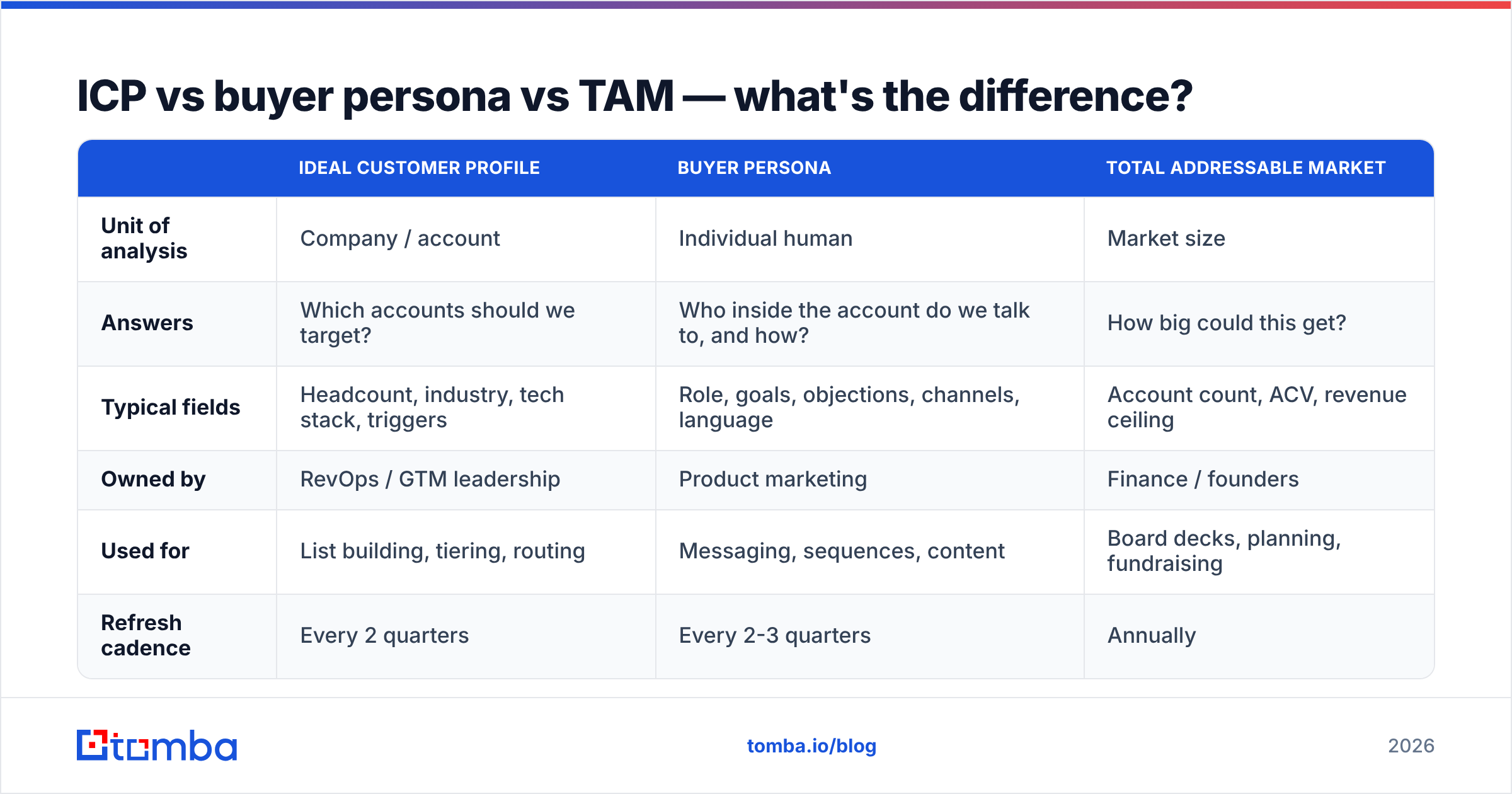
These three get used interchangeably in meetings and they are not the same object.
| Ideal customer profile | Buyer persona | Total addressable market | |
|---|---|---|---|
| Unit of analysis | Company / account | Individual human | Market size |
| Answers | Which accounts should we target? | Who inside the account do we talk to, and how? | How big could this get? |
| Typical fields | Headcount, industry, tech stack, triggers | Role, goals, objections, channels, language | Account count, ACV, revenue ceiling |
| Owned by | RevOps / GTM leadership | Product marketing | Finance / founders |
| Used for | List building, tiering, routing | Messaging, sequences, content | Board decks, planning, fundraising |
| Refresh cadence | Every 2 quarters | Every 2-3 quarters | Annually |
The dependency runs one way: TAM tells you the ceiling, the ICP carves the reachable slice out of it, and personas tell you what to say once you're inside. Skip the middle step and you're writing great emails to the wrong companies.
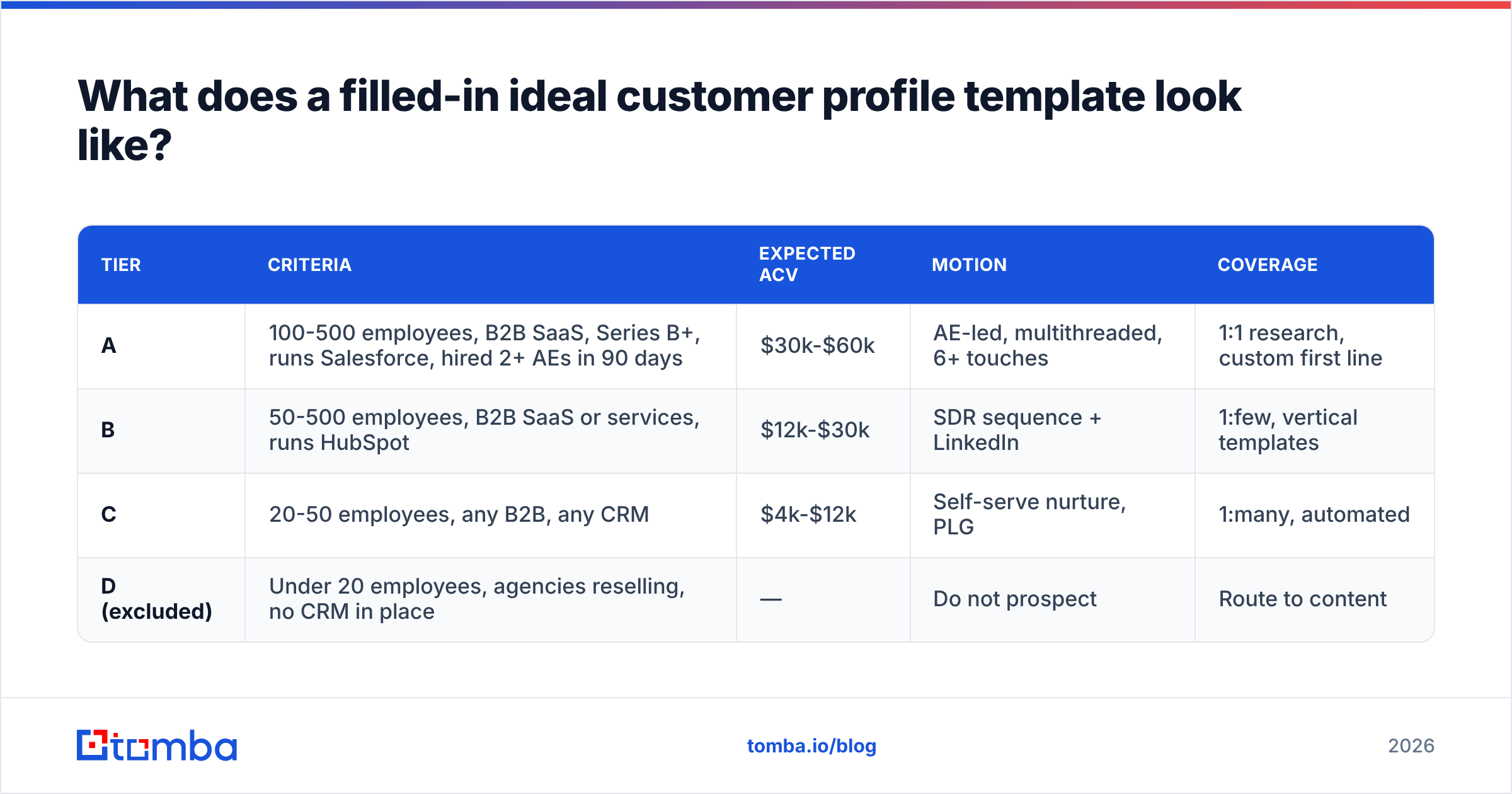
What does a filled-in ideal customer profile template look like?#
Here's a worked example for a mid-market sales-engagement product. Copy the structure, replace the values.
Account tier definitions:
| Tier | Criteria | Expected ACV | Motion | Coverage |
|---|---|---|---|---|
| A | 100-500 employees, B2B SaaS, Series B+, runs Salesforce, hired 2+ AEs in 90 days | $30k-$60k | AE-led, multithreaded, 6+ touches | 1:1 research, custom first line |
| B | 50-500 employees, B2B SaaS or services, runs HubSpot | $12k-$30k | SDR sequence + LinkedIn | 1:few, vertical templates |
| C | 20-50 employees, any B2B, any CRM | $4k-$12k | Self-serve nurture, PLG | 1:many, automated |
| D (excluded) | Under 20 employees, agencies reselling, no CRM in place | — | Do not prospect | Route to content |
Negative criteria (auto-disqualify): no CRM in place; headcount under 20; primary market outside supported languages; already running a direct competitor on a multi-year contract signed in the last six months; procurement requires SOC 2 Type II from vendors under 50 employees.
Trigger events that move an account up a tier: new VP of Sales or CRO; a funding round in the last 120 days; two or more open SDR/AE roles; migration to a supported CRM; public complaint about a competitor on G2.
That last section is the one teams forget. Triggers are what turn a static list of 3,000 accounts into a weekly working queue of 40.
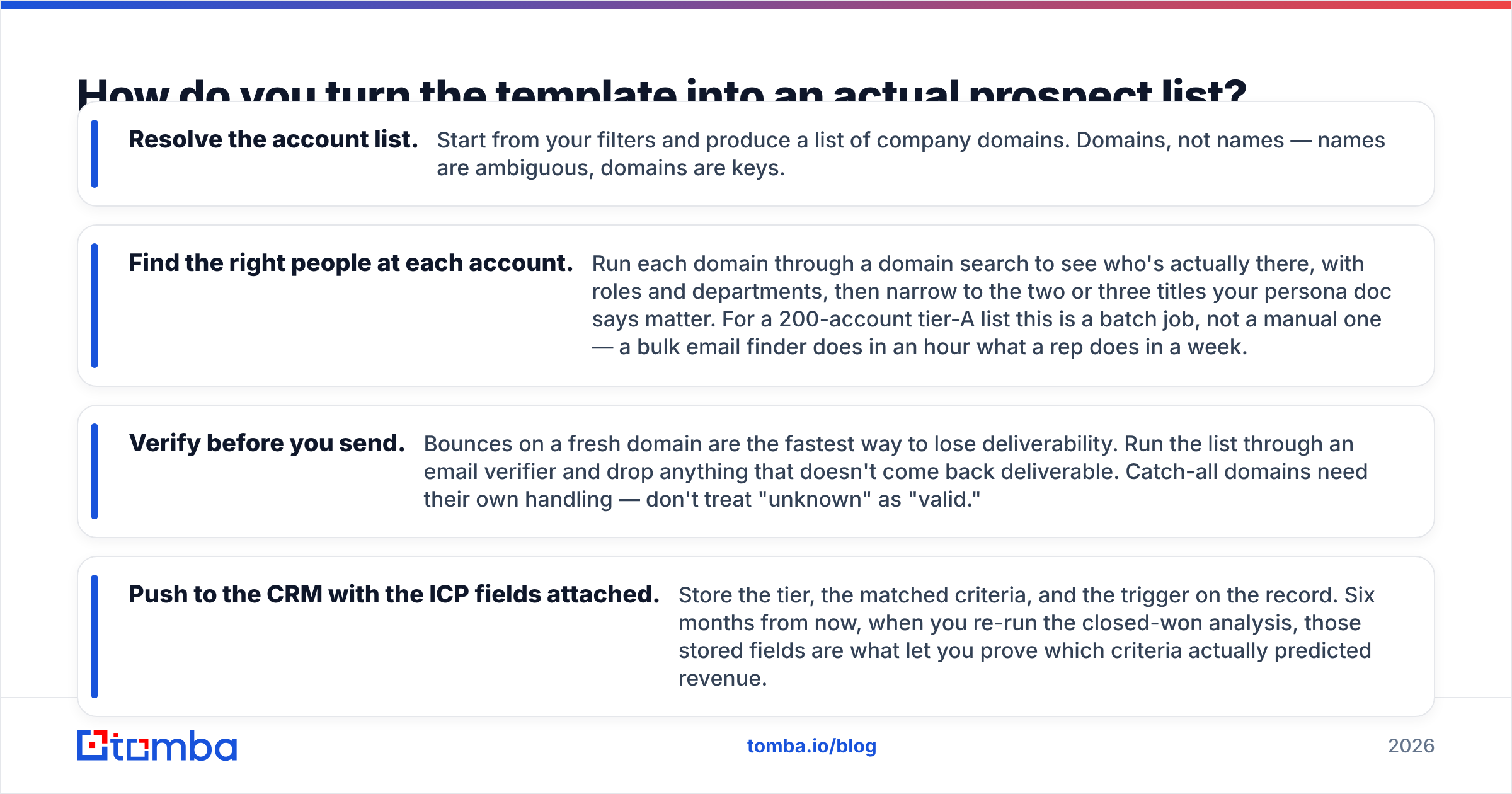
How do you turn the template into an actual prospect list?#
This is where most ICP work dies — a beautiful document and no contactable accounts.
The path from filters to inbox is mechanical:
- Resolve the account list. Start from your filters and produce a list of company domains. Domains, not names — names are ambiguous, domains are keys.
- Find the right people at each account. Run each domain through a domain search to see who's actually there, with roles and departments, then narrow to the two or three titles your persona doc says matter. For a 200-account tier-A list this is a batch job, not a manual one — a bulk email finder does in an hour what a rep does in a week.
- Verify before you send. Bounces on a fresh domain are the fastest way to lose deliverability. Run the list through an email verifier and drop anything that doesn't come back deliverable. Catch-all domains need their own handling — don't treat "unknown" as "valid."
- Push to the CRM with the ICP fields attached. Store the tier, the matched criteria, and the trigger on the record. Six months from now, when you re-run the closed-won analysis, those stored fields are what let you prove which criteria actually predicted revenue.
The teams that get compounding returns from an ICP are the ones that close this loop. Tier gets stamped on the record at creation, outcome gets stamped at close, and the next ICP refresh is an analysis of that table rather than another workshop. HubSpot's inbound methodology makes a similar argument from the marketing side: segmentation only pays off when the segment survives all the way to the reporting layer.
How often should you update your ideal customer profile?#
Twice a year on a schedule, plus immediately after any of these:
- A pricing or packaging change — new price points reshape which companies can afford you.
- A new product line or a major integration — technographic criteria shift overnight.
- A win-rate drop of more than 10 points in any segment — either the segment changed or your ICP was wrong about it.
- A churn cluster — three or more logos leaving for the same reason means a negative criterion is missing.
Keep a version history. When someone asks in Q3 why you stopped targeting 1,000+ employee accounts, "because Q1 analysis showed a 210-day cycle and 61% NRR" is a much better answer than a shrug.
What are the most common ICP mistakes?#
- Too narrow, too early. If you have 11 customers, you don't have an ICP — you have a hypothesis. Write it as one and say so out loud.
- Confusing loud customers with good ones. The account that files the most support tickets and speaks at your webinar may still be unprofitable. Check the margin.
- One ICP for a multi-product company. Two products with different buyers need two ICPs. Merging them produces a profile that describes nobody.
- Ignoring cost to serve. An account with a $50k ACV that consumes 40 hours of CS a month can be worth less than a $15k account that never calls.
- Letting the ICP live in a doc instead of a system. If the criteria aren't fields on the account record, they aren't real.
Ready to run your ICP against real contact data?#
Your ideal customer profile template is only as good as the list it produces. Once you have the filters written down, the bottleneck moves to a simple question: can you actually reach the right people at those accounts?
That's what Tomba Email Finder is built for — take your ICP-matched domains, get verified professional email addresses for the exact roles you care about, and push them straight into your sequence or CRM. The free tier gives you 25 searches a month to sanity-check your list before you commit; Starter is $49/mo and Growth is $99/mo when you're running full tier-A coverage. Check Tomba pricing for the full breakdown, or start with a single domain from your closed-won list and see how much of your ICP is already reachable.
Related guides#
// get started
Find, verify and enrich your first contacts today
Start on the free plan with 25 searches a month, then scale when your team is ready.
Free plan · No credit card required · GDPR & CCPA
// about the author