Identity Resolution Software in 2026: A Practical Buyer's Guide
Identity resolution software promises one clean profile per human. Here is how deterministic, probabilistic, and referential matching actually differ, what the 2026 tooling costs, and when a lighter enrichment layer beats a six-figure platform.
TL;DR
- Identity resolution software merges fragmented records — form fills, CRM rows, billing accounts, ad clicks, support tickets — into one profile per person or company.
- Three matching engines dominate: deterministic (exact keys), probabilistic (weighted similarity), and referential (a third-party identity graph). Most real deployments use all three in sequence.
- Enterprise platforms are quote-based and routinely land in the five- to six-figure annual range. A warehouse-native build is cheaper in license cost and far more expensive in engineering time.
- For B2B teams, the expensive part is usually not the matching algorithm — it's the missing and stale contact data feeding it. Fix the input first.
- If your "identity problem" is really 30% duplicate CRM rows and unverifiable email addresses, an enrichment and verification layer at $49–$99/mo solves more of it than a CDP migration.
What is identity resolution software?#
Identity resolution software takes many partial records that refer to the same entity and collapses them into a single, persistent profile with a stable ID. Think of it as the hotel front desk that recognizes that "R. Chen, room 402," "Rachel Chen, loyalty #88231," and "rchen@acme.io" are all the same guest walking through three different doors.
Academically this is called record linkage, and it has been studied since the 1950s. What changed is the volume and the sources. A mid-size B2B company now generates identity fragments across a CRM, a marketing automation platform, a product database, a support desk, a billing system, an ad platform, and three spreadsheets somebody maintains manually.
The software's job is to answer two questions at scale:
- Are these two records the same entity? (matching)
- What is the single best value for each field on the merged profile? (survivorship, sometimes called golden record logic)
The second question is where most implementations quietly fail. Matching is a solved-ish math problem. Deciding whether the job title from Salesforce beats the job title from the enrichment vendor — that's a governance decision nobody wants to own.
Why does identity fragmentation actually cost you money?#
The cost is rarely a line item, which is why it survives budget review for years. Here's where it leaks:
- Duplicate outreach. Two SDRs email the same prospect from the same domain in the same week because the CRM holds two contact rows. Prospect replies to neither.
- Broken attribution. A lead converts under a personal Gmail, buys under a corporate address, and renews under a procurement alias. Three profiles, one customer, and a revenue number your board doesn't trust.
- Wasted credits and sends. You pay to enrich, verify, and email records that are copies of records you already own.
- Inflated account counts. "Acme Corp," "Acme Corporation," and "ACME Corp." look like three accounts in your TAM report. Territory planning inherits the error.
- Compliance exposure. A deletion request you can only honor on one of five profiles is a deletion request you did not honor.
Note the pattern: none of these show up as "identity resolution" in a budget. They show up as low reply rates, disputed pipeline, and a data team that spends Fridays deduping.
How does identity resolution software match records?#
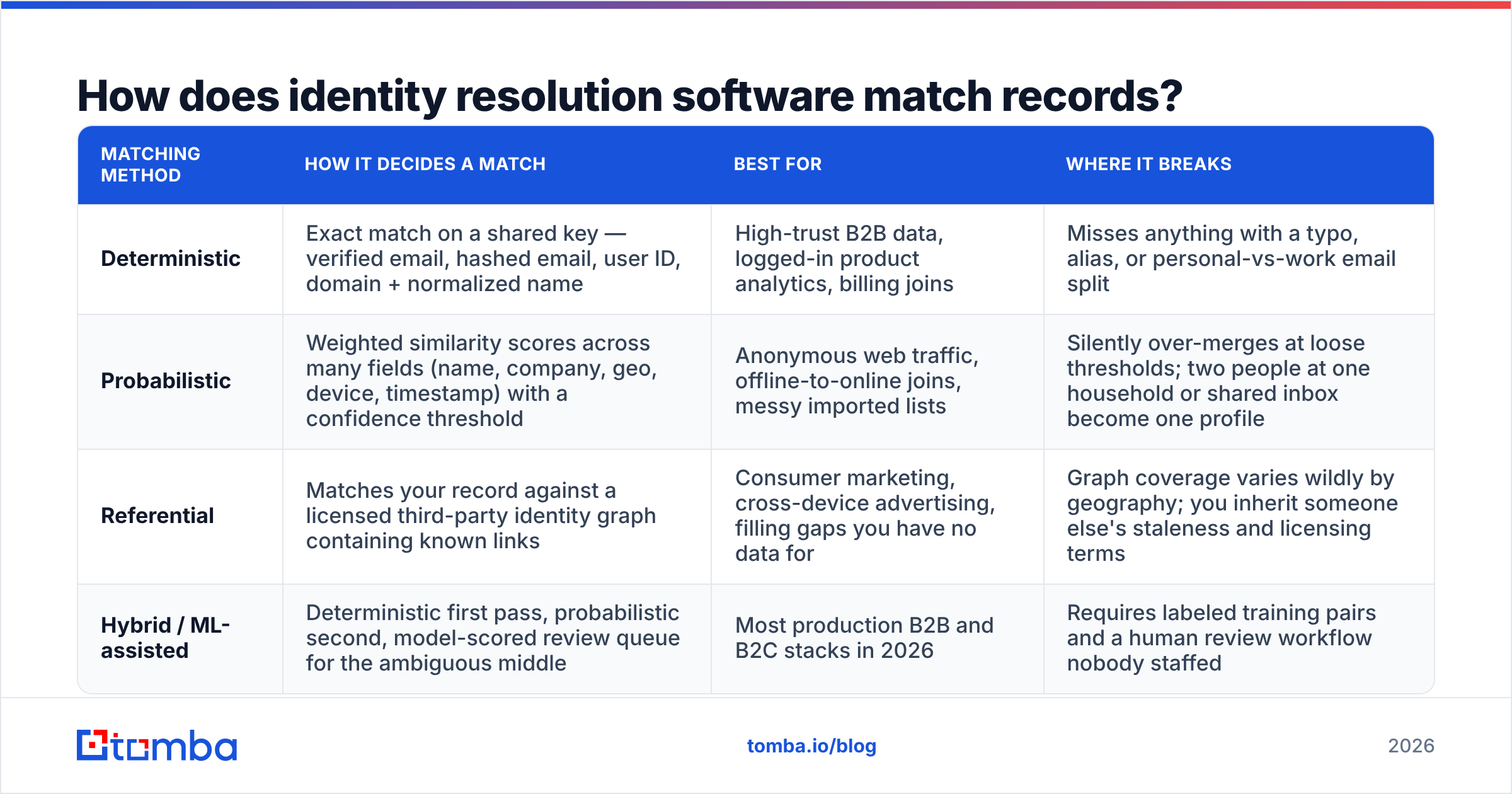
Three engines, and the difference matters more than any vendor logo on your shortlist.
| Matching method | How it decides a match | Best for | Where it breaks |
|---|---|---|---|
| Deterministic | Exact match on a shared key — verified email, hashed email, user ID, domain + normalized name | High-trust B2B data, logged-in product analytics, billing joins | Misses anything with a typo, alias, or personal-vs-work email split |
| Probabilistic | Weighted similarity scores across many fields (name, company, geo, device, timestamp) with a confidence threshold | Anonymous web traffic, offline-to-online joins, messy imported lists | Silently over-merges at loose thresholds; two people at one household or shared inbox become one profile |
| Referential | Matches your record against a licensed third-party identity graph containing known links | Consumer marketing, cross-device advertising, filling gaps you have no data for | Graph coverage varies wildly by geography; you inherit someone else's staleness and licensing terms |
| Hybrid / ML-assisted | Deterministic first pass, probabilistic second, model-scored review queue for the ambiguous middle | Most production B2B and B2C stacks in 2026 | Requires labeled training pairs and a human review workflow nobody staffed |
The practical rule: deterministic first, always. Every record you can join on a verified email or a normalized domain is a record the probabilistic layer never has to guess about. Teams that skip email verification and go straight to fuzzy matching are asking a statistical model to clean up a problem a $0.001 API call would have prevented. Running a list through an email verifier before it hits the matching engine measurably shrinks the ambiguous middle.

What are the categories of identity resolution software in 2026?#
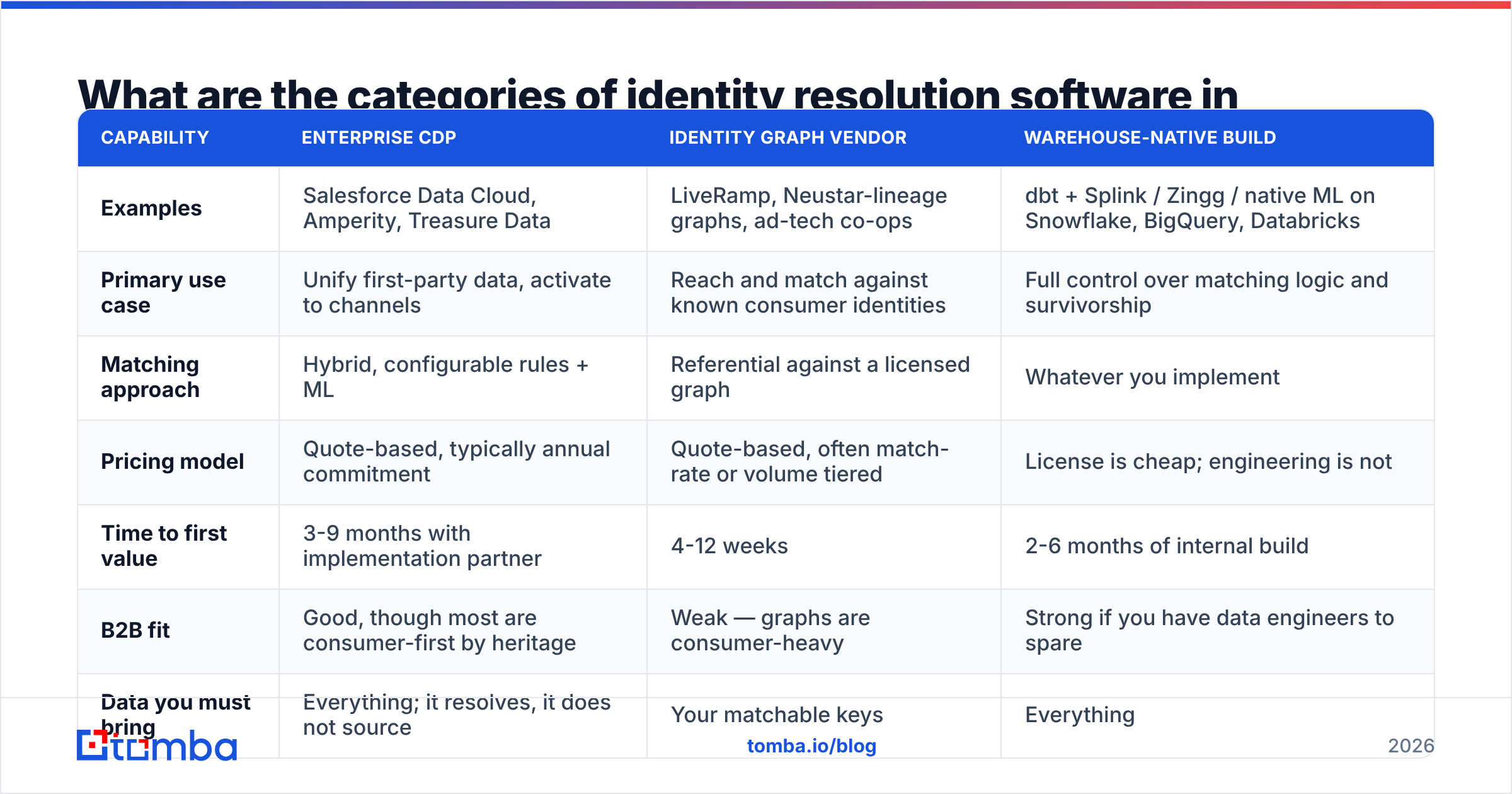
Vendors rarely describe themselves as being in a category, so buyers end up comparing a CDP against a data co-op against an open-source library. These are the four shapes actually on the market.
| Capability | Enterprise CDP | Identity graph vendor | Warehouse-native build |
|---|---|---|---|
| Examples | Salesforce Data Cloud, Amperity, Treasure Data | LiveRamp, Neustar-lineage graphs, ad-tech co-ops | dbt + Splink / Zingg / native ML on Snowflake, BigQuery, Databricks |
| Primary use case | Unify first-party data, activate to channels | Reach and match against known consumer identities | Full control over matching logic and survivorship |
| Matching approach | Hybrid, configurable rules + ML | Referential against a licensed graph | Whatever you implement |
| Pricing model | Quote-based, typically annual commitment | Quote-based, often match-rate or volume tiered | License is cheap; engineering is not |
| Time to first value | 3-9 months with implementation partner | 4-12 weeks | 2-6 months of internal build |
| B2B fit | Good, though most are consumer-first by heritage | Weak — graphs are consumer-heavy | Strong if you have data engineers to spare |
| Data you must bring | Everything; it resolves, it does not source | Your matchable keys | Everything |
| Ongoing owner | RevOps + data engineering | Martech | Data engineering, permanently |
Read the last two rows carefully. None of these categories create contact data. They resolve what you already have. If 40% of your CRM contacts have no verified email and no phone number, identity resolution software will faithfully produce one unified, unreachable profile per prospect.
For B2B specifically, that's the trap. Consumer identity resolution is a coverage problem solved by graphs. B2B identity resolution is a freshness problem: people change jobs, domains get acquired, and the linking key you resolved on last quarter now bounces. Independent review data on the identity resolution category on G2 shows the same complaint recurring across vendors — match rates look great in the pilot and decay in month nine.
Do you need a CDP, or just better B2B contact data?#
Ask three questions before you sign anything.
- Is your problem coverage or duplication? If you can't reach people, that's a sourcing problem. If you reach them twice, that's a resolution problem. Buy for the one you actually have.
- How many genuinely distinct sources feed your profiles? Under four systems, a warehouse job and disciplined keys usually beat a platform.
- Is anyone going to own survivorship rules? If no named person will arbitrate field conflicts, the platform will default to "most recent wins" and you will have bought expensive chaos.
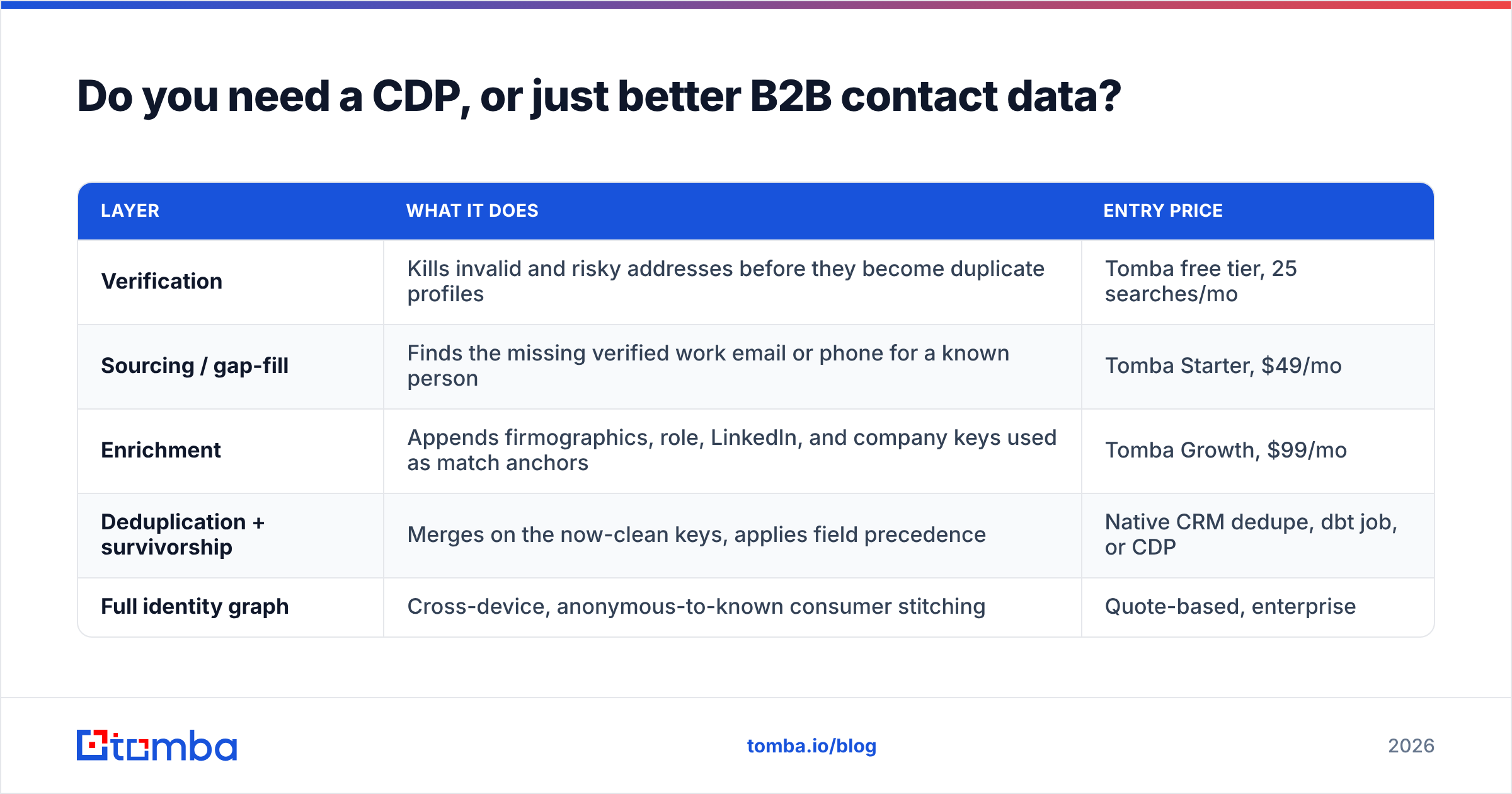
For a large share of B2B teams, the honest answer is that the identity layer they need is thinner and cheaper than the one they're being sold. A working minimum stack looks like this:
| Layer | What it does | Entry price |
|---|---|---|
| Verification | Kills invalid and risky addresses before they become duplicate profiles | Tomba free tier, 25 searches/mo |
| Sourcing / gap-fill | Finds the missing verified work email or phone for a known person | Tomba Starter, $49/mo |
| Enrichment | Appends firmographics, role, LinkedIn, and company keys used as match anchors | Tomba Growth, $99/mo |
| Deduplication + survivorship | Merges on the now-clean keys, applies field precedence | Native CRM dedupe, dbt job, or CDP |
| Full identity graph | Cross-device, anonymous-to-known consumer stitching | Quote-based, enterprise |
Most companies buy row five when their pain lives in rows one through three. Data enrichment and verification make every downstream matching engine work better, whichever one you eventually choose. On the sourcing side, providers differ in approach: Tomba builds from crawled and verified public sources, while a vendor like BookYourData sells curated prebuilt B2B lists — both are legitimate inputs, and plenty of teams use one for gap-fill and the other for net-new coverage.
How do you evaluate matching accuracy before you buy?#
Vendor-supplied match rates are close to meaningless because the vendor chooses the denominator. Run your own test.
- Build a golden set. Take 500 records you have manually verified as 250 true pairs and 250 true non-pairs. Include hard cases: two people with the same name at one company, one person with a personal and a work email, a company that rebranded.
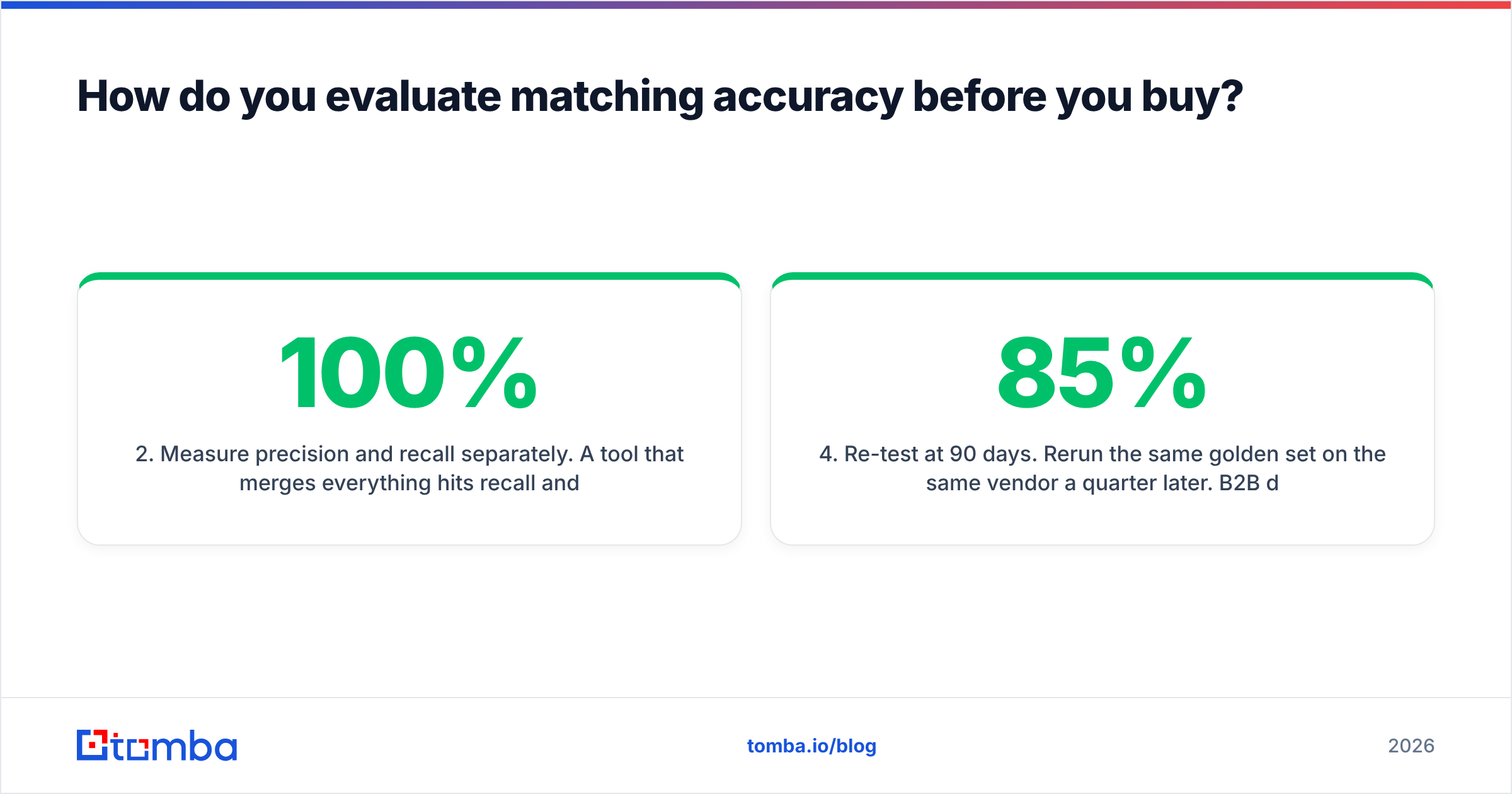
- Measure precision and recall separately. A tool that merges everything hits 100% recall and destroys your database. Ask for both numbers or compute them yourself.
- Test the over-merge rate explicitly. Feed it
info@,sales@, and other role addresses plus a shared family domain. Over-merging is the failure that generates angry customer emails, and it's the one that never appears in a demo. - Re-test at 90 days. Rerun the same golden set on the same vendor a quarter later. B2B decay is the whole ballgame; a tool that holds 85% precision after three months beats one that opened at 95% and slid to 70%.
- Check the review queue UX. Every serious system produces an ambiguous middle. If resolving one uncertain pair takes an analyst more than about ten seconds, the queue will be abandoned within a month.
- Verify how it handles catch-all domains. A large chunk of B2B domains accept everything, so "deliverable" is not proof of existence. A dedicated catch-all verifier prevents those addresses from being scored as high-confidence match keys.
If you're building rather than buying, pull the same primitives through an API and score them yourself. The Tomba API exposes finder, verifier, and enrichment endpoints, so the pre-match hygiene step can live inside your dbt or Airflow DAG rather than in a separate SaaS console.
What about privacy and compliance?#
Identity resolution is, by definition, the act of linking data about a person across contexts — which is exactly what GDPR, CCPA/CPRA, and their successors were written to govern. Three non-negotiables:
- Know your lawful basis per source. Referential graphs shift some risk onto you as the controller. "The vendor said it was compliant" is not a defense.
- Make deletion resolve too. If a deletion request only removes one of four linked records, your unified profile has become a compliance liability rather than an asset. Test the deletion path during the pilot, not after go-live.
- Separate B2B contact data from consumer behavioral data. The legal treatment differs by jurisdiction, and mixing them in one profile store means the strictest rule applies to everything.
Enterprise vendors publish their governance posture in detail — Salesforce's Data Cloud documentation is a reasonable reference point for what mature consent and lineage handling looks like, even if you never buy it. Hold smaller vendors to the same questions.
What should you actually do next?#
Conclusion first: clean your keys before you buy a matcher. Verified emails, normalized domains, and consistent company identifiers convert most of the fuzzy-matching problem into a boring deterministic join, and that's the version that stays accurate in month nine.
Run this sequence:
- Audit duplicate rate and missing-contactability rate in your CRM. Two numbers, one afternoon.
- Verify and enrich the existing base. Re-measure.
- If duplicates remain above roughly 10% after clean keys, then evaluate resolution platforms — with your own golden set, not the vendor's.
Start with the input layer. Tomba Email Finder locates verified work emails by name, domain, or company and returns confidence scores plus sources, so the records entering your identity graph are the ones worth resolving. The free tier gives you 25 searches a month to test match quality against your own golden set, and Tomba pricing starts at $49/mo when you're ready to run it across the whole database. Fix the data going in, and the resolution layer you eventually choose gets a much easier job.
Related guides#
// get started
Find, verify and enrich your first contacts today
Start on the free plan with 25 searches a month, then scale when your team is ready.
Free plan · No credit card required · GDPR & CCPA
// about the author