ikaun Pricing 2026: Reviews, Pros and Cons, and Real Costs
ikaun sells knowledge and experience management to professional services firms — but it never publishes a price. Here is how the quote is actually built, what reviewers praise, where it frustrates, and when a cheaper stack wins.
TL;DR
- ikaun pricing is quote-only. There is no public price list, and no free plan.
- Every quote is built from four parts: modules, user seats, setup, and data migration.
- The license is rarely the big line. Moving years of messy project data costs more.
Expect a long sales cycle before you see a number. Three more things to weigh:
- Reviewers praise the AI search. They also flag slow rollouts and dirty data.
- ikaun makes what your firm already knows easy to find. It does not find new buyers.
- If your problem is pipeline, buy outbound data first. That market posts real prices.
What is ikaun, and who actually buys it?#
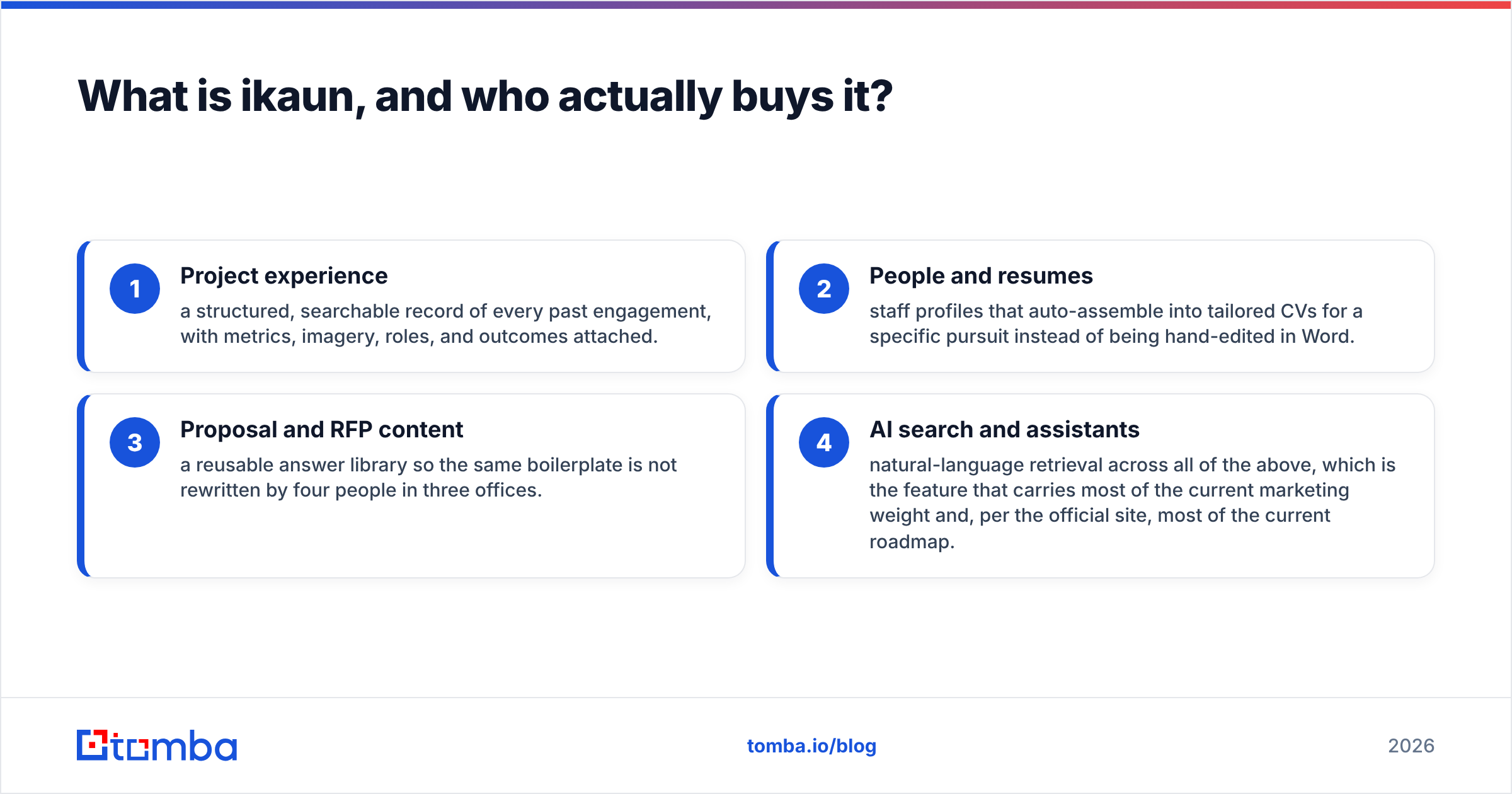
ikaun is a knowledge and experience platform for professional services firms. Think of it as a shared memory for the whole firm. The core buyers are architecture, engineering, and construction firms. Consulting, legal, and accounting firms are joining them.
The pain it targets is real. A 400-person firm has run thousands of projects. It has written thousands of proposals. Its staff hold hundreds of licenses. None of it is easy to find when a bid is due in nine days.
The product covers four jobs:
- Project experience. A searchable record of past work, with metrics, images, and roles.
- People and resumes. Staff profiles that build a tailored CV for each bid.
- Proposal content. A reuse library, so four people stop rewriting the same answer.
- AI search. Plain-language search across all of it. It carries most of the weight on the official site today.
The buyer is usually marketing or BD leadership, not sales ops. That shapes ikaun pricing. You are buying a system of record, and those get priced like enterprise software.

How does ikaun pricing work in 2026?#
Short answer: ikaun pricing is quote-only. There is no price page. There is no free plan. There is no self-serve tier.
You book a demo. You scope your modules and seat count. Then you get a proposal. Loopio, Responsive, OpenAsset, and Deltek all sell this way. It still means you cannot budget from the website.
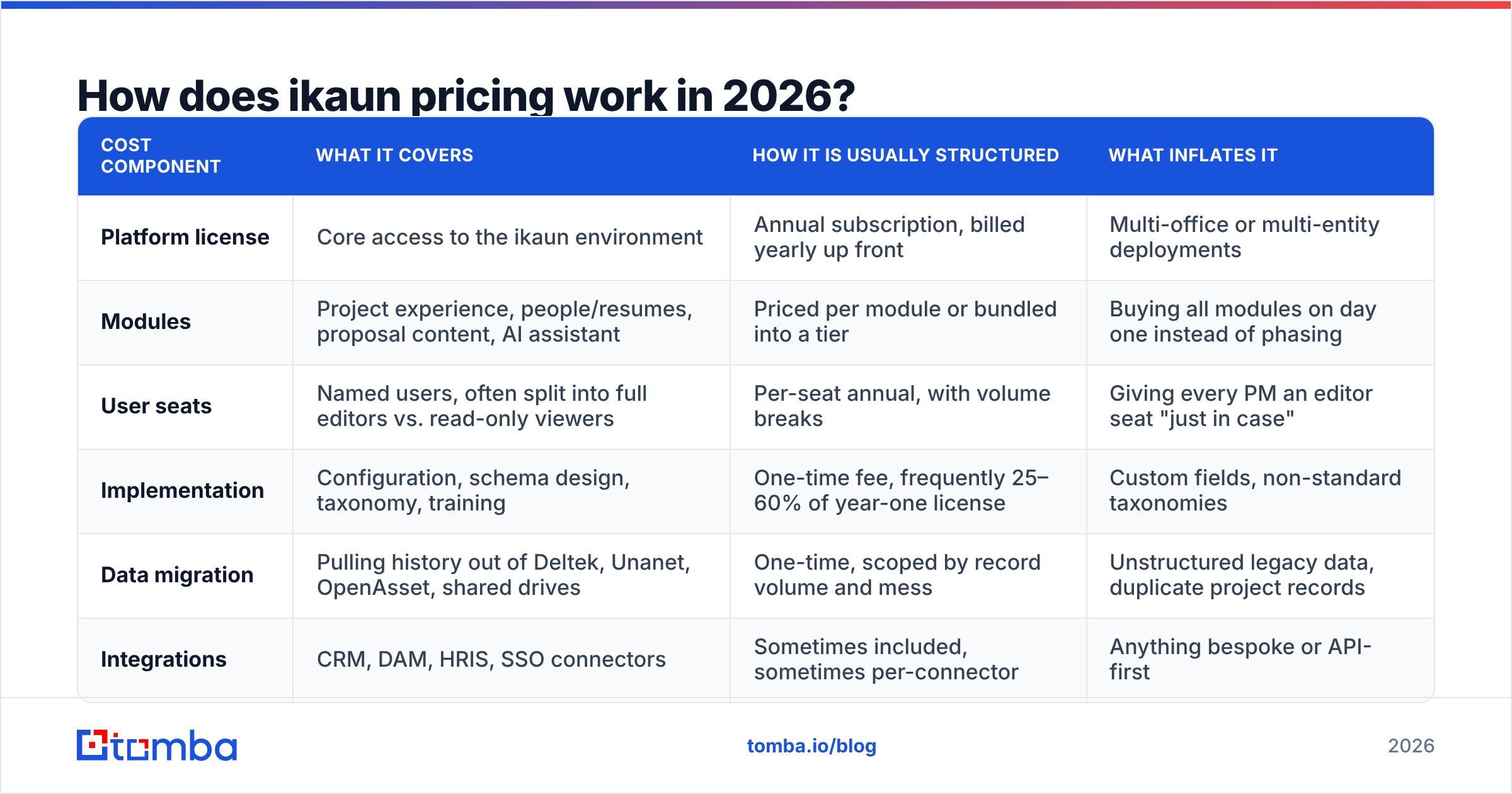
Treat the two tables below as a model of how quotes get built. They are not vendor prices. Check every line against your own quote.
These three lines repeat every year.
| Cost part | What it covers | How it is billed | What raises it |
|---|---|---|---|
| Platform license | Core access to ikaun | Yearly, paid up front | Extra offices or entities |
| Modules | Experience, resumes, content, AI | Per module or bundled | Buying every module on day one |
| User seats | Editors and viewers | Per seat, per year | Editor seats for every PM |
These three hit once, and they are where ikaun pricing gets lumpy.
| Cost part | What it covers | How it is billed | What raises it |
|---|---|---|---|
| Setup | Config, naming rules, training | One-time fee | Custom fields and odd data models |
| Data migration | History from Deltek, Unanet, OpenAsset, drives | One-time, scoped by volume | Messy or duplicate records |
| Integrations | CRM, DAM, HRIS, SSO | Included or per connector | Anything custom |
Three things follow from that shape.
Year one is not year two. Setup and migration hit once. So your first invoice looks worse than the true run rate. Ask for a three-year total, not a first-year price.
The renewal bump is the line people forget. Deals like this often carry a yearly increase. Cap it in the contract. It is the best clause you can win.
Seat rules are where money leaks. Ask what a user is. Does a PM who uploads one finished job need a full seat? Does a reviewer? Firms often overbuy editor seats by a third.
What do ikaun reviews actually say?#
Review volume is thin. You will find a few entries on G2 and Capterra, plus word of mouth in the AEC world.
Low counts are normal for a niche vendor. But it means reference calls beat star ratings. Ask for three firms your size, in your field, live for at least 18 months. Few reviewers discuss ikaun pricing in public, so those calls are your only benchmark.
What are the pros of ikaun?#
Two wins come up in almost every review:
- Search that understands your work. Ask for healthcare jobs over $20M in the Southeast with LEED Gold. You get real answers, not a file list.
- Resume building stops being a chore. Tailored CVs build from staff profiles. That cuts hours out of every bid.
Three more show up often:
- Built for AEC. The data model already knows projects, roles, and bids. Generic tools make you invent that, and most firms do it badly.
- One system, not six. Spreadsheets, templates, and old proposal folders collapse into one place. New hires ramp faster.
- The vendor answers. Support and roadmap response draw praise more often than not.
What are the cons and hidden costs?#
Three cons cost you money:
- Setup is a project, not a switch. Plan in months, not weeks. Name an internal owner. Firms that treat it as an IT task write the bad reviews.
- Bad data in, bad answers out. AI search returns what you feed it. Clean your records before migration, not after.
- ikaun pricing is opaque. No public price means no benchmark and a slower deal. Small firms rarely know if their quote is fair.
Two more cost you trust:
- Adoption needs people who hate data entry. PMs have to keep records current. Without a rule, the archive goes stale in a year.
- It is not a pipeline tool. ikaun improves how you answer bids. It does not create them. Buying it for a top-of-funnel problem is the priciest mistake here.

How does ikaun compare to the alternatives?#
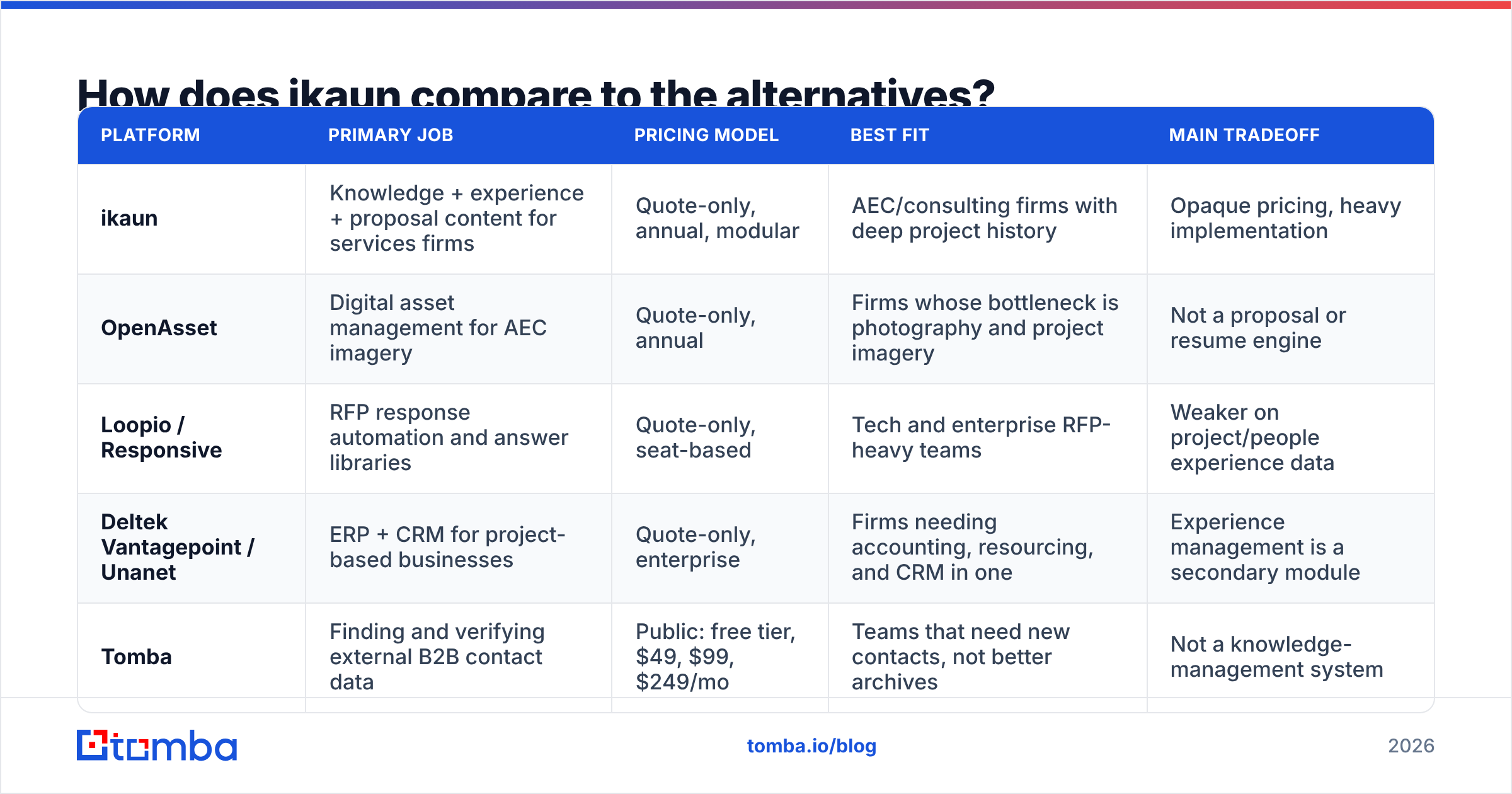
The field splits into three groups. Firms shop across them by mistake all the time.
| Platform | Main job | Pricing | Best fit |
|---|---|---|---|
| ikaun | Experience and proposal content | Quote-only, yearly | Firms with deep project history |
| OpenAsset | Image and asset library | Quote-only, yearly | Firms buried in project photos |
| Loopio / Responsive | RFP answer libraries | Quote-only, per seat | Tech teams with heavy RFP load |
| Deltek / Unanet | ERP and CRM in one | Quote-only, enterprise | Firms that need accounting too |
| Tomba | Verified B2B contact data | Free tier, $49, $99, $249/mo | Teams that need new contacts |
The tradeoffs are just as clean. OpenAsset does not write proposals. Loopio does not track your people. Deltek treats experience as a side module.
Now read the pricing column. Four of the five sell by quote, and ikaun pricing is one of them. Step into contact data and prices go public. That is why these two budgets should be judged on their own.
One more option is real: build it in SharePoint. It is cheap on paper. It works when you have an owner and strict naming rules. It fails when you have neither, and that failure costs two years.
Is ikaun worth it for your firm?#
Run four checks before you book the demo.
- Volume. How many bids do you write a year? Under 50, the license is hard to justify. Over 200, the math gets easy.
- Pain. Time the hunt for old content and CVs. Multiply by your loaded rate. If it is not several times the license, wait.
- Owner. Name the person who will own data hygiene for three years. If you cannot name them, do not sign.
- Bottleneck. Do you lose the bids you enter, or do you enter too few? Only the first is an ikaun problem.
That last check matters most. Say you win 45% of your bids but enter only 30 a year. That is not a proposal problem. That is a demand problem, and ikaun pricing buys you nothing there.
Where does ikaun stop and outbound data begin?#
ikaun looks backward. It makes past work easy to find. The other half of a revenue stack looks forward. You need firms you have never worked with, and the right person inside them.
That half is priced in the open. A B2B database plus a verified email finder covers sourcing for a fraction of an enterprise license. Got a list from a conference or a permit filing? Data enrichment turns company names into named buyers with real addresses.
Tomba pricing starts free with 25 searches a month. Paid plans run $49, $99, and $249 per month. No quote call needed, which is the sharp contrast with ikaun pricing.
Order matters here. Is your win rate healthy but your output slow? Then ikaun earns its place. Is your win rate fine but your pipeline thin? Fix sourcing first. It is cheaper, it ships faster, and it creates the bid volume that later justifies ikaun pricing.
What should you ask before signing an ikaun contract?#
Bring this list to the ikaun pricing call:
- What is in year one, and what is the renewal run rate?
- Is the yearly increase capped in writing?
- How are editor, contributor, and viewer seats billed?
- What is the fixed scope of data migration?
- Which integrations cost extra?
- If we leave, what format does our data come back in?
Vendors who answer all six are usually good partners. Vendors who dodge the last two are telling you something.
Build the pipeline that makes the knowledge base worth having#
ikaun can be a strong buy for a firm with deep history and a real proposal jam. It is the wrong first buy for a firm that just needs more at-bats.
If at-bats are the problem, start where prices are public. Tomba Email Finder turns a list of target firms into verified contacts for the people who issue the RFPs you want. Try it free with 25 searches a month. Move to $49 a month when you scale. Fill the funnel first. Then buy the system that helps you win it.
Related guides#
// get started
Find, verify and enrich your first contacts today
Start on the free plan with 25 searches a month, then scale when your team is ready.
Free plan · No credit card required · GDPR & CCPA
// about the author