Implication Questions in Sales: The 2026 SPIN Playbook
Implication questions are the part of SPIN most reps skip — and the reason so many discovery calls end in "send me some info." Here's how to build, sequence, and measure them without sounding like an interrogator.
TL;DR
- Implication questions are the third stage of SPIN. Their only job is to make the buyer quantify what an admitted problem is costing them — in money, time, risk, or headcount.
- Most reps stop at problem questions ("What's frustrating about your current process?"), hear a complaint, and start pitching. That's where deals stall into "send me some info."
- A good implication question is short, specific, and built from something the buyer just said. It never contains your product name.
- Three to five implication questions per discovery call is the working range. Ten turns a conversation into a deposition.
- The prep matters more than the phrasing: you cannot ask a sharp implication question about a company whose headcount, tech stack, and growth stage you didn't check first.
What are implication questions in sales?#
An implication question asks the buyer to spell out the consequences of a problem they've already admitted to. Not whether the problem exists — that's a problem question. Not whether your product would help — that's a need-payoff question. Just: and then what happens?
Think of a leaky pipe under the sink. A problem question is "Is it dripping?" An implication question is "How long until that warps the cabinet floor, and what does replacing it cost?" Same leak. Completely different level of urgency in the homeowner's mind — and crucially, the homeowner is the one who did the math, not you.
That last part is why the technique survives decades of sales-methodology churn. SPIN selling came out of Neil Rackham's research at Huthwaite, where observers sat in on thousands of live B2B calls and coded what high performers did differently. The finding that stuck: in larger, more complex sales, top reps asked significantly more implication questions than average reps. They didn't talk more. They just moved the buyer from "this is annoying" to "this is expensive."
The mechanics are simple. The discipline is not.

Where do implication questions fit in the SPIN sequence?#
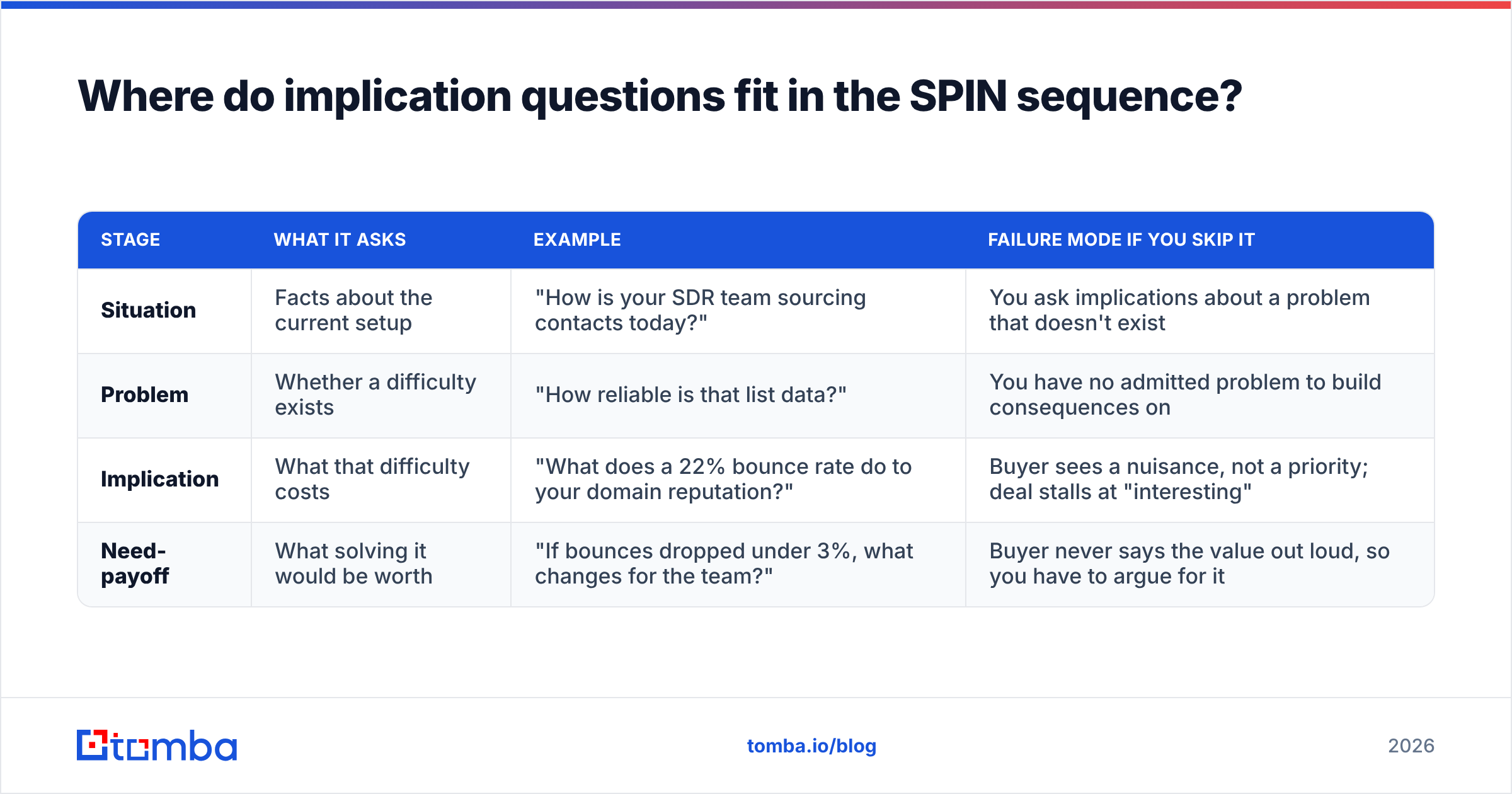
SPIN is four question types in a rough order. Rough, because real calls loop. But the order matters because each type only works if the previous one has landed.
| Stage | What it asks | Example | Failure mode if you skip it |
|---|---|---|---|
| Situation | Facts about the current setup | "How is your SDR team sourcing contacts today?" | You ask implications about a problem that doesn't exist |
| Problem | Whether a difficulty exists | "How reliable is that list data?" | You have no admitted problem to build consequences on |
| Implication | What that difficulty costs | "What does a 22% bounce rate do to your domain reputation?" | Buyer sees a nuisance, not a priority; deal stalls at "interesting" |
| Need-payoff | What solving it would be worth | "If bounces dropped under 3%, what changes for the team?" | Buyer never says the value out loud, so you have to argue for it |
The stage everyone under-invests in is implication. Situation questions feel productive because you're filling out the CRM. Problem questions feel productive because the buyer complains and you nod sympathetically. Implication questions feel awkward, because you're asking someone to admit that a thing they've tolerated for eighteen months has been quietly costing them money. Nobody enjoys that.
Do it anyway. A complaint the buyer hasn't priced is a complaint they'll keep tolerating.
Why do implication questions work better than pitching features?#
Because of who is doing the talking.
When you say "our verifier cuts bounces to under 2%," the buyer's job is to evaluate a claim from a vendor. Skepticism is the default. When the buyer says "if we keep bouncing at 20% we're going to get the main domain blacklisted, and that's the whole outbound motion gone," they are now defending a position they authored. You did not sell it to them. They arrived.
There's a second, less romantic reason: buying groups. Gartner's research on B2B buying has consistently put the typical enterprise purchase in front of six to ten stakeholders, most of whom will never take your call. Your champion has to re-run your argument internally, without you in the room. A feature list doesn't survive that trip. A number your champion calculated themselves does — because they remember it, and because it's theirs.
Implication questions are, functionally, a way of writing your champion's internal business case using their vocabulary and their finance team's assumptions.
What does a good implication question sound like?#
The pattern is: reference what they said → extend it one step → ask for a consequence, ideally a measurable one.
Bad: "Wouldn't it be a problem if that got worse?" (Leading, closed, obviously a setup.)
Better: "You mentioned reps spend about a day a week cleaning lists. What's not getting done on that day?"
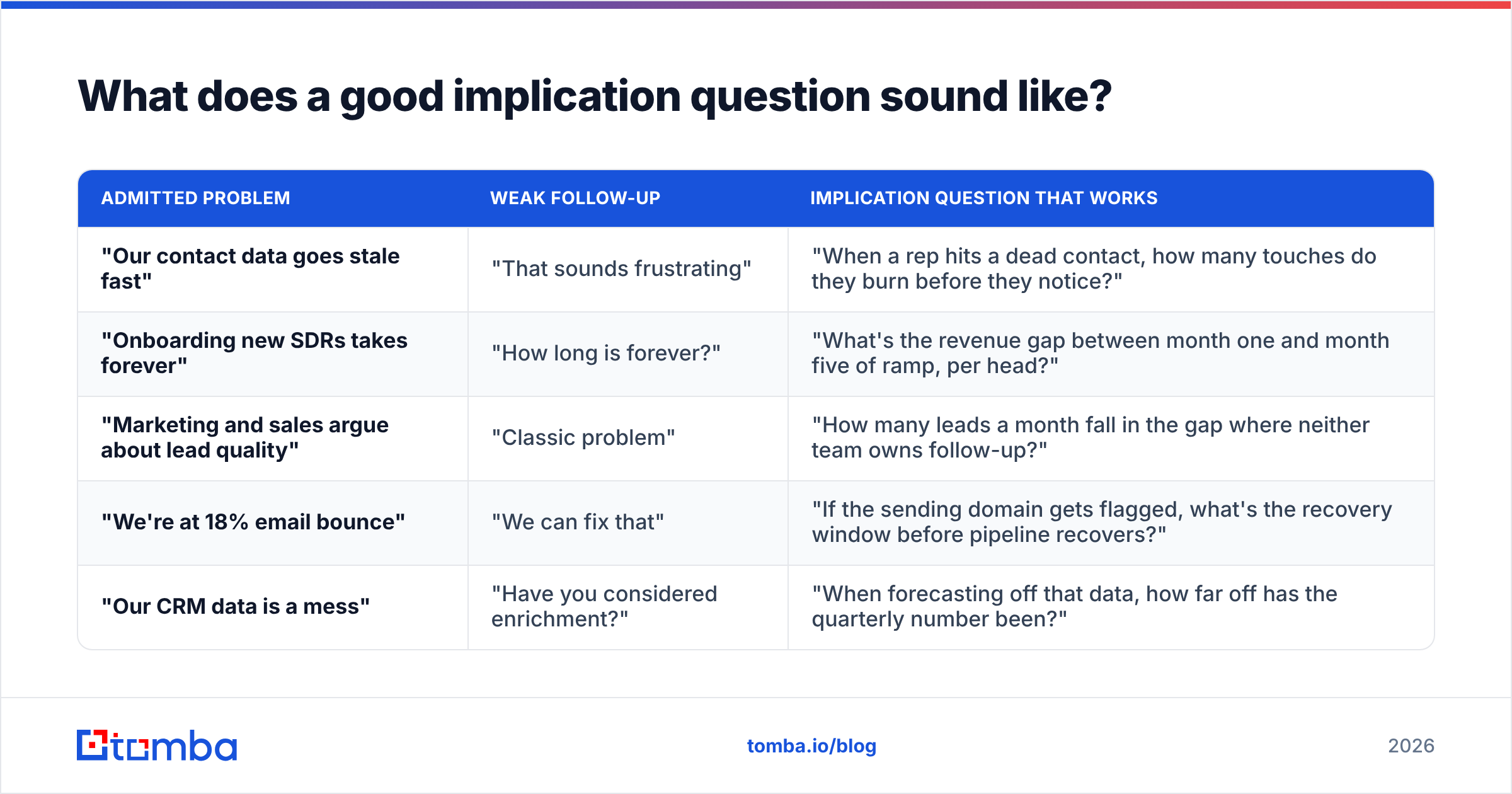
Here's a set mapped to common B2B pain, so you can see the shape rather than memorize scripts:
| Admitted problem | Weak follow-up | Implication question that works |
|---|---|---|
| "Our contact data goes stale fast" | "That sounds frustrating" | "When a rep hits a dead contact, how many touches do they burn before they notice?" |
| "Onboarding new SDRs takes forever" | "How long is forever?" | "What's the revenue gap between month one and month five of ramp, per head?" |
| "Marketing and sales argue about lead quality" | "Classic problem" | "How many leads a month fall in the gap where neither team owns follow-up?" |
| "We're at 18% email bounce" | "We can fix that" | "If the sending domain gets flagged, what's the recovery window before pipeline recovers?" |
| "Our CRM data is a mess" | "Have you considered enrichment?" | "When forecasting off that data, how far off has the quarterly number been?" |
Notice what's absent from the right-hand column: your product, your category, and any word that hints at a demo. The moment an implication question smells like a trap, the buyer stops calculating and starts deflecting. That's the whole risk of the technique — and the reason Rackham's original research warned against them in small, transactional sales, where making the buyer feel worse about a minor issue is just rude.
How do you build an implication question ladder in four steps?#
Don't improvise these live. Build a ladder before the call for the two or three problems you expect to hear, then pick the rung that matches what they actually say.
- Start from an admitted problem, never a suspected one. Write down the exact phrase you expect the buyer to use. If they haven't said it out loud yet, you're not at the implication stage — go back to problem questions.
- List the downstream victims. Who else feels this? The SDR wastes hours; the manager loses forecast accuracy; finance sees CAC drift; the CMO gets asked why pipeline missed. Each victim is a separate implication question.
- Attach one unit of measurement to each. Hours per week, dollars per rep, days of ramp, percentage of quota, number of reopened tickets. If you can't name a unit, the question will produce a vague answer and vague answers don't survive a procurement review.
- Write the question in under 20 words. Long implication questions read as monologues with a question mark bolted on. Cut to the consequence.
- Rank them by who's on the call. An ops lead will engage with process cost; a VP with pipeline cost; a CFO with cash. Same problem, three different ladders.
- Cap the call at five. Past that, you're not diagnosing, you're prosecuting. Move to need-payoff and let them describe the fixed state.
Step three is where most ladders collapse. "How does that affect the team?" is not an implication question — it's a mood survey. "How many hours a week does that add across the four SDRs?" is one.

What's the difference between implication and need-payoff questions?#
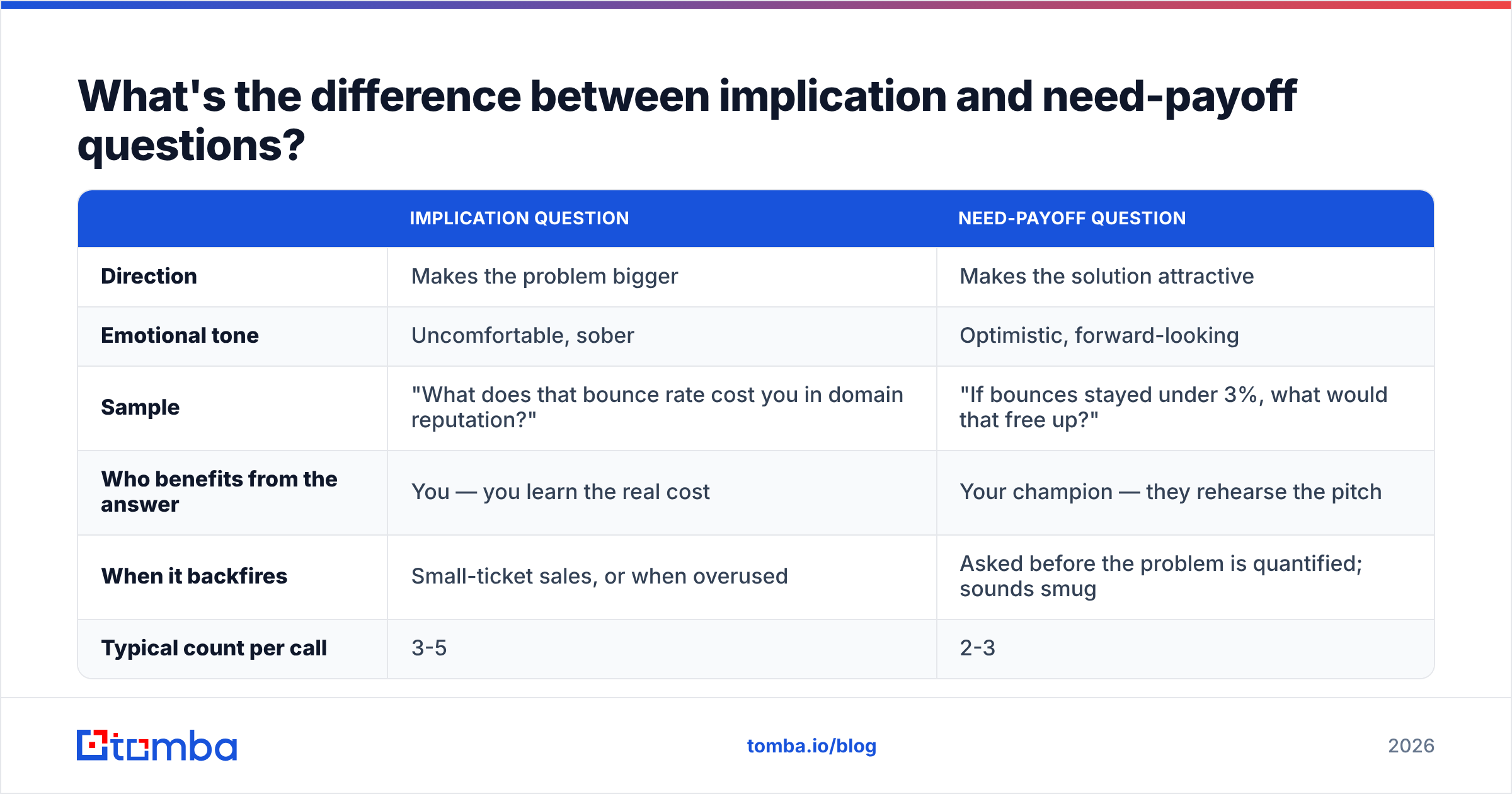
They're adjacent and constantly confused, so here's the clean split:
| Implication question | Need-payoff question | |
|---|---|---|
| Direction | Makes the problem bigger | Makes the solution attractive |
| Emotional tone | Uncomfortable, sober | Optimistic, forward-looking |
| Sample | "What does that bounce rate cost you in domain reputation?" | "If bounces stayed under 3%, what would that free up?" |
| Who benefits from the answer | You — you learn the real cost | Your champion — they rehearse the pitch |
| When it backfires | Small-ticket sales, or when overused | Asked before the problem is quantified; sounds smug |
| Typical count per call | 3-5 | 2-3 |
The sequencing rule: never ask a need-payoff question about a problem the buyer hasn't priced. "How valuable would it be to fix your data quality?" lands as a sales cliché when the buyer thinks data quality is a minor annoyance. Ask it after they've told you stale records cost four hours a week per rep, and it lands as arithmetic.
How do you prep implication questions before the call?#
You can't ask "what does that cost across your 14 SDRs?" if you don't know they have 14 SDRs.
The research floor for a discovery call in 2026 is roughly: headcount by function, funding stage or growth trajectory, tech stack, recent leadership hires, and whatever the company has publicly said about its go-to-market. Each of those turns a generic implication question into a specific one, and specificity is the entire difference between a buyer engaging and a buyer giving you a polite non-answer.
Practically, that means your prospecting layer and your discovery quality are the same problem. A contact record with a verified email, a confirmed title, and current company size gives you three usable variables. A scraped name and a guessed address gives you none — and worse, a bad address means the call never happens. Teams running contact enrichment ahead of outreach tend to walk into calls with the headcount and stack details already sitting in the CRM field, which is where an implication ladder gets its numbers.
The same discipline applies upstream. If your response rate on outbound is the bottleneck, no amount of question-craft helps — you're rehearsing for calls that never get booked. Fix deliverability and targeting first, then invest in discovery quality. HubSpot's sales research has repeatedly found discovery-call quality correlating with close rates more strongly than call volume does, but only for reps who are getting calls at all.
What mistakes kill implication questions?#
- Stacking three in a row. Buyer answers one, you fire the next, they feel cornered. Reflect what they said before the next question. One sentence is enough.
- Asking about a problem you invented. "How much is your poor pipeline hygiene costing you?" when they never mentioned pipeline hygiene. You've just told them you weren't listening.
- Using your product as the unit of measurement. "How much would you save with automated verification?" is a pitch wearing a question's clothes.
- Refusing to sit in the silence. The buyer needs three to five seconds to actually calculate. Reps fill that gap and destroy the answer. Don't.
- Skipping the write-down. If the buyer says "probably twelve hours a week," that number belongs in your notes verbatim, and in your proposal, and in the mutual action plan. It's the strongest asset the call produced.
- Running them on a $400/month deal. Rackham's own caution: in small sales, amplifying a minor problem reads as manipulation. Keep it for deals where the consequences are genuinely material.
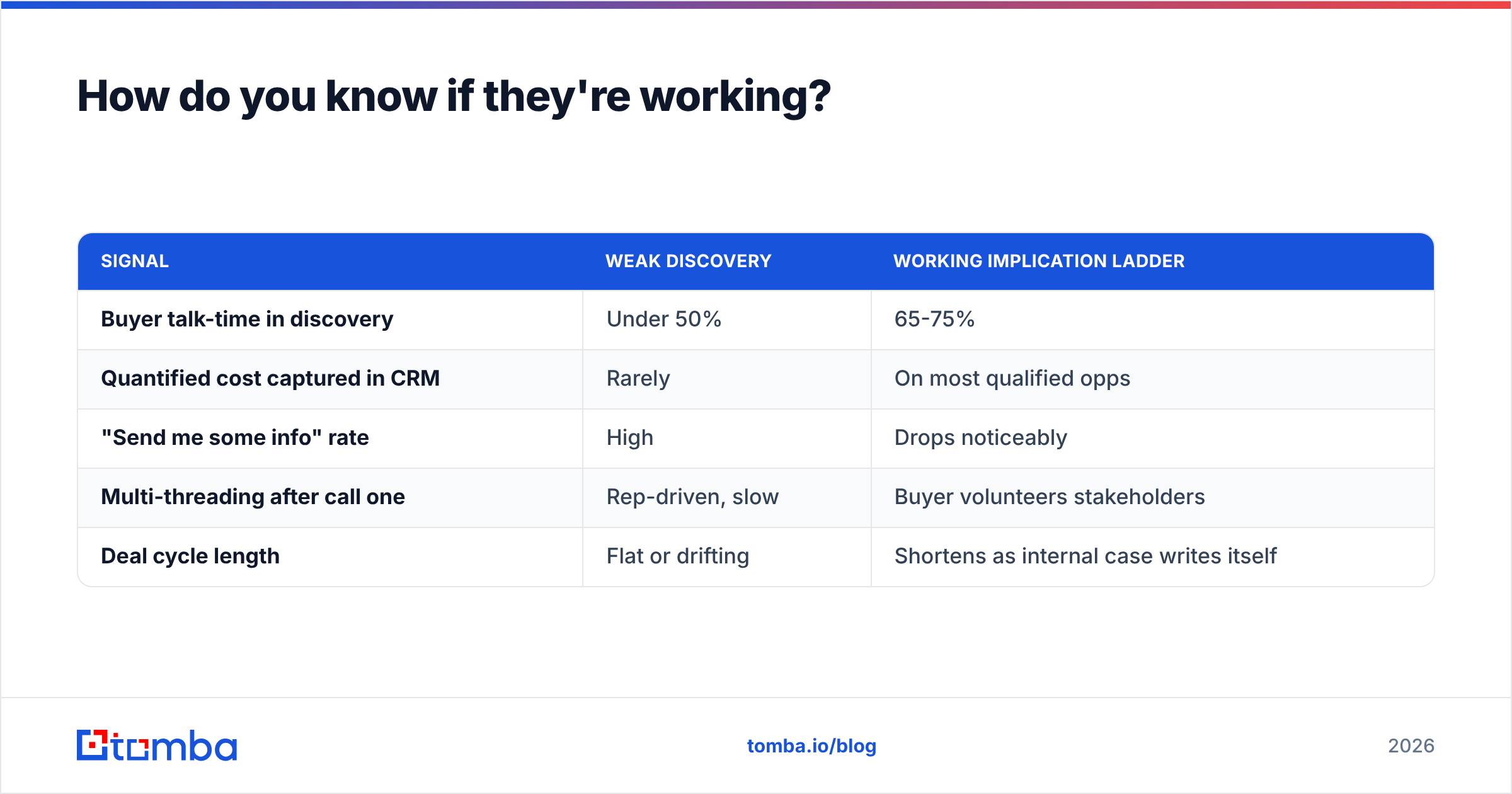
How do you know if they're working?#
Track four things across a quarter, not a week:
| Signal | Weak discovery | Working implication ladder |
|---|---|---|
| Buyer talk-time in discovery | Under 50% | 65-75% |
| Quantified cost captured in CRM | Rarely | On most qualified opps |
| "Send me some info" rate | High | Drops noticeably |
| Multi-threading after call one | Rep-driven, slow | Buyer volunteers stakeholders |
| Deal cycle length | Flat or drifting | Shortens as internal case writes itself |
The single cleanest indicator is the fourth row. When a buyer has priced their own problem, they start pulling other people into the conversation without being asked, because they now need budget. If that isn't happening, your implication questions probably produced sympathy rather than arithmetic.
Track your win rate alongside these, but give it two full cycles before drawing conclusions — discovery improvements show up in closed-won long after they show up in call recordings.
Where should you start?#
Pick your three most common buyer complaints. For each, write four implication questions using the ladder above — one per stakeholder type, each with a unit of measurement attached. Take them into your next five calls. Review the recordings and cut anything that produced a one-word answer.
Then fix the input side. Sharp implication questions need real facts about a real company, and those facts start with reaching the right person in the first place. Tomba's email finder gets you verified, current contacts by domain, name, or company, so your discovery prep starts with an accurate record instead of a guess — free tier at 25 searches a month, Starter at $49/mo, and full Tomba pricing if you're running a team. Get the contact right, do the homework, then ask the question that makes the buyer do the math.
Related guides#
// get started
Find, verify and enrich your first contacts today
Start on the free plan with 25 searches a month, then scale when your team is ready.
Free plan · No credit card required · GDPR & CCPA
// about the author