The Importance of Follow Up in Sales: A 2026 Playbook
Most deals die in the gap between the first touch and the fifth. Here's what the follow-up data actually says, how many touches you need, and how to build a cadence that doesn't annoy buyers.
TL;DR
- Roughly 80% of closed B2B deals require five or more follow-up touches, yet close to half of reps stop after one. That gap is where most pipeline quietly dies.
- Follow-up is not "checking in." Every touch needs a new reason to exist: a resource, a trigger event, a specific question, or a clean breakup.
- Cadence beats volume. A structured 8–12 touch sequence over 21–30 days across email, phone, and LinkedIn consistently outperforms random sporadic pings.
- Follow-up only works if your contact data is right. A perfect sequence sent to a dead inbox is a zero, so verification sits upstream of everything else.
- Track reply rate and meetings-per-100-contacts, not "emails sent." Activity metrics reward noise; outcome metrics reward relevance.
What does "follow-up" actually mean in sales?#
Follow-up is every deliberate contact you make after the first one, aimed at moving a specific decision forward.
Think of it like watering a plant. You don't dump a bucket on it once and declare it hydrated. You return on a schedule, in measured amounts, and you adjust based on what you see. Most reps run their pipeline like the bucket approach: one big effort, then silence, then confusion about why nothing grew.
Technically, follow-up spans two distinct motions that get conflated:
- Prospecting follow-up — the sequence you run against a cold or lightly-warm contact who has never replied. Goal: earn a first response.
- Deal follow-up — the touches between stages of an active opportunity, after a demo, after a proposal, after a stakeholder goes quiet. Goal: keep momentum and surface blockers.
- Post-close follow-up — onboarding check-ins, expansion triggers, referral asks. Goal: revenue after the signature.
- Reactivation follow-up — closed-lost and dormant accounts revisited when something changes (new exec, funding round, tech-stack shift). Goal: re-enter at a better moment.
Those four need different content, different timing, and different definitions of success. Running one generic "just circling back" template across all four is the single most common reason follow-up gets a bad reputation.
Why is the importance of follow up in sales so hard to overstate?#
Because the math is brutally one-sided.
Industry research consistently lands in the same range: the majority of B2B sales require between five and eight touchpoints before a meeting is booked, while a large share of reps stop at one or two. HubSpot's sales research has documented this persistence gap for years, and it hasn't closed. What has changed is buyer attention — inboxes are fuller, LinkedIn is noisier, and the cost of a single ignored email is higher because you have fewer chances to be relevant.
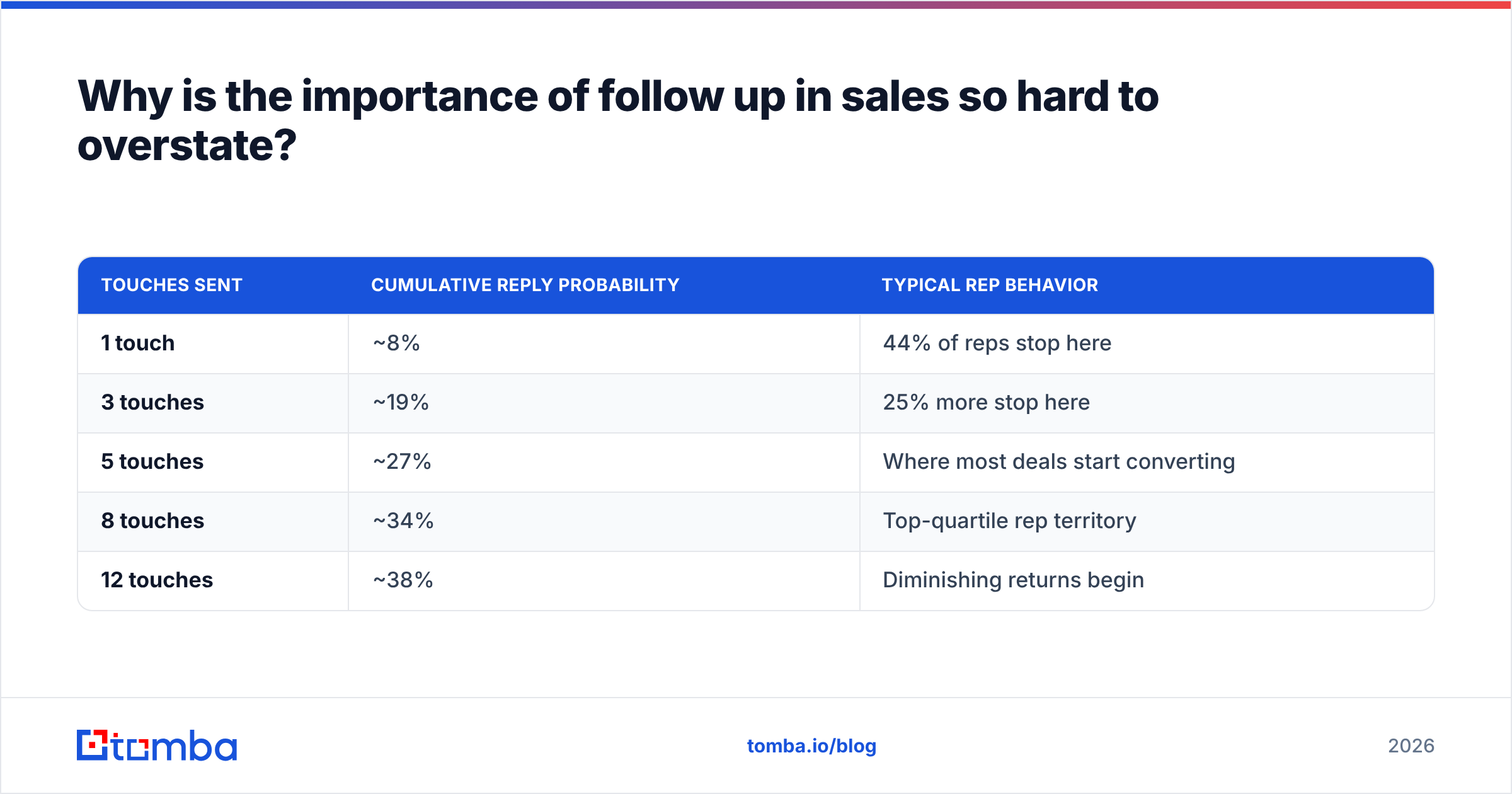
Here's the compounding effect in plain numbers. Assume a modest 8% reply rate per touch on a well-targeted list, with each subsequent touch performing slightly worse:
| Touches sent | Cumulative reply probability | Typical rep behavior |
|---|---|---|
| 1 touch | ~8% | 44% of reps stop here |
| 3 touches | ~19% | 25% more stop here |
| 5 touches | ~27% | Where most deals start converting |
| 8 touches | ~34% | Top-quartile rep territory |
| 12 touches | ~38% | Diminishing returns begin |
The jump from one touch to five roughly triples your outcome for the same list. That is not a marginal optimization. That is the difference between a quota-attaining quarter and a rebuild.
The second reason follow-up matters more in 2026 than in 2019: buying committees grew. Gartner's B2B buying research puts a typical enterprise purchase in front of six to ten stakeholders. Each of them enters the conversation at a different time. A single well-timed email cannot possibly reach all of them at their moment of readiness. Sustained follow-up is how you stay present across a buying cycle that isn't synchronized with your calendar.
How many follow-ups is too many?#
The honest answer: it depends far less on count than on whether each touch carries new information.
A useful test — the "would I forward this?" test. If the recipient could not plausibly forward your message to a colleague with the note "this is relevant," the touch is filler. Filler touches burn goodwill and sender reputation without buying you anything.
Practical guardrails that hold up across most B2B segments:
- Cold prospecting: 8–12 touches over 21–30 days, then a hard stop and a 90-day cooldown before re-entry.
- Post-demo: 4–6 touches over 14 days, with at least one phone call and one multi-threaded touch to a second stakeholder.
- Post-proposal: 3–5 touches over 10 days, then an explicit "should I close this out?" message.
- Dormant/reactivation: trigger-based only. No trigger, no touch.
Notice that every one of those has an endpoint. Sequences without a defined end are how reps end up emailing the same person for eight months and calling it persistence.
What does a follow-up cadence actually look like?#
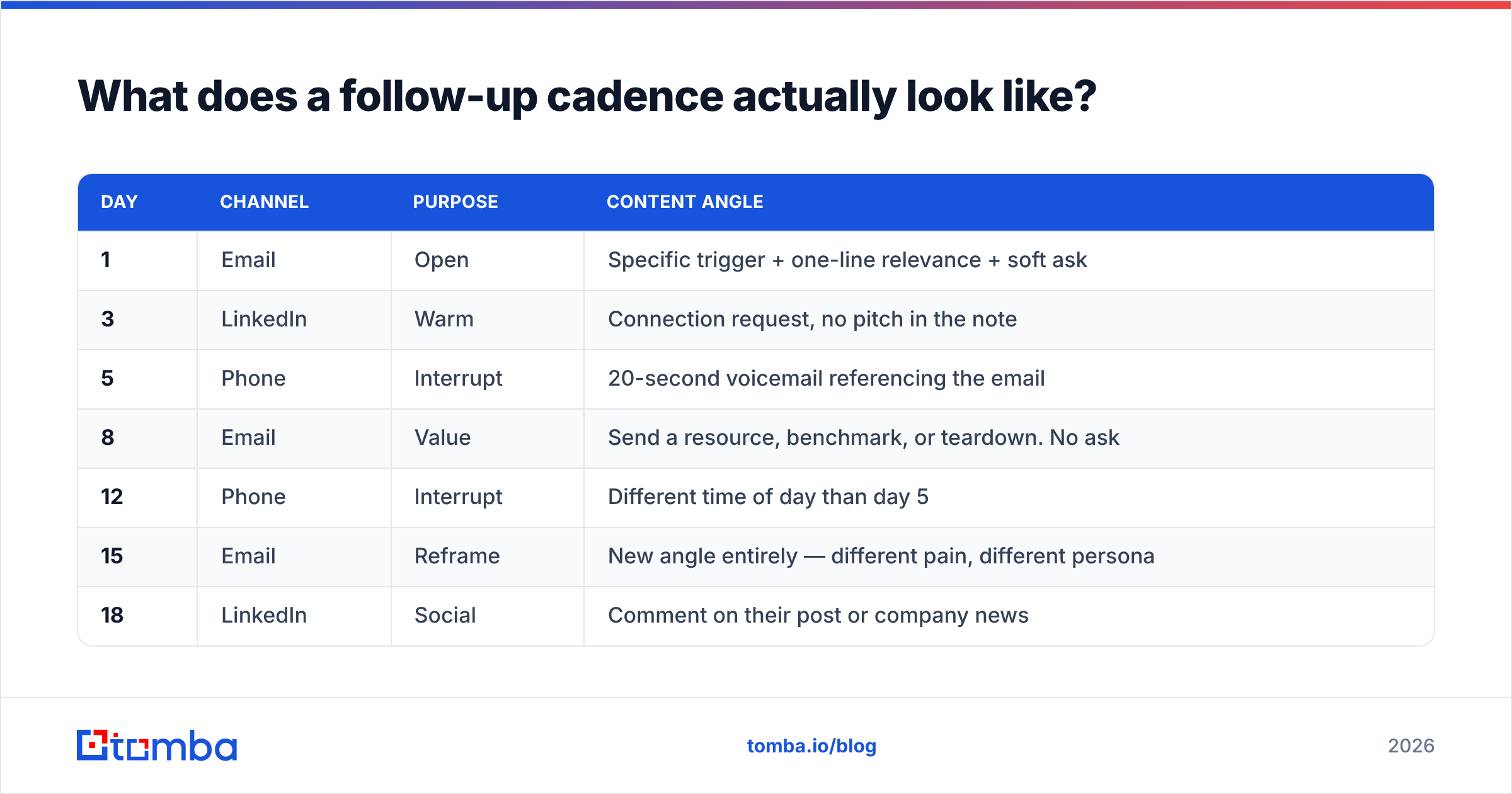
Here's a channel-mixed 21-day prospecting cadence that works well for mid-market B2B. Adjust the channel weighting to your buyer — technical buyers skew email, ops and finance skew phone, marketing and revenue leaders skew LinkedIn.
| Day | Channel | Purpose | Content angle |
|---|---|---|---|
| 1 | Open | Specific trigger + one-line relevance + soft ask | |
| 3 | Warm | Connection request, no pitch in the note | |
| 5 | Phone | Interrupt | 20-second voicemail referencing the email |
| 8 | Value | Send a resource, benchmark, or teardown. No ask | |
| 12 | Phone | Interrupt | Different time of day than day 5 |
| 15 | Reframe | New angle entirely — different pain, different persona | |
| 18 | Social | Comment on their post or company news | |
| 21 | Breakup | "Closing your file" — highest single-touch reply rate |
Two things people get wrong about this table.
First: the day-8 no-ask touch. Reps hate it because it feels passive. It is the highest-leverage message in the sequence because it's the only one that costs the prospect nothing to read. Send a genuinely useful thing — a competitor benchmark, a relevant G2 category grid, a two-paragraph teardown of their pricing page — and you convert from "vendor" to "person who knows something."
Second: the day-21 breakup. It reliably outperforms every middle-of-sequence email, often by 2–3x. The mechanism is loss aversion, not cleverness. Keep it short, make it genuinely final, and actually honor it. A breakup email followed by another email two days later is the fastest way to become spam.
Why does most follow-up fail before the first send?#
Because the contact data is wrong.
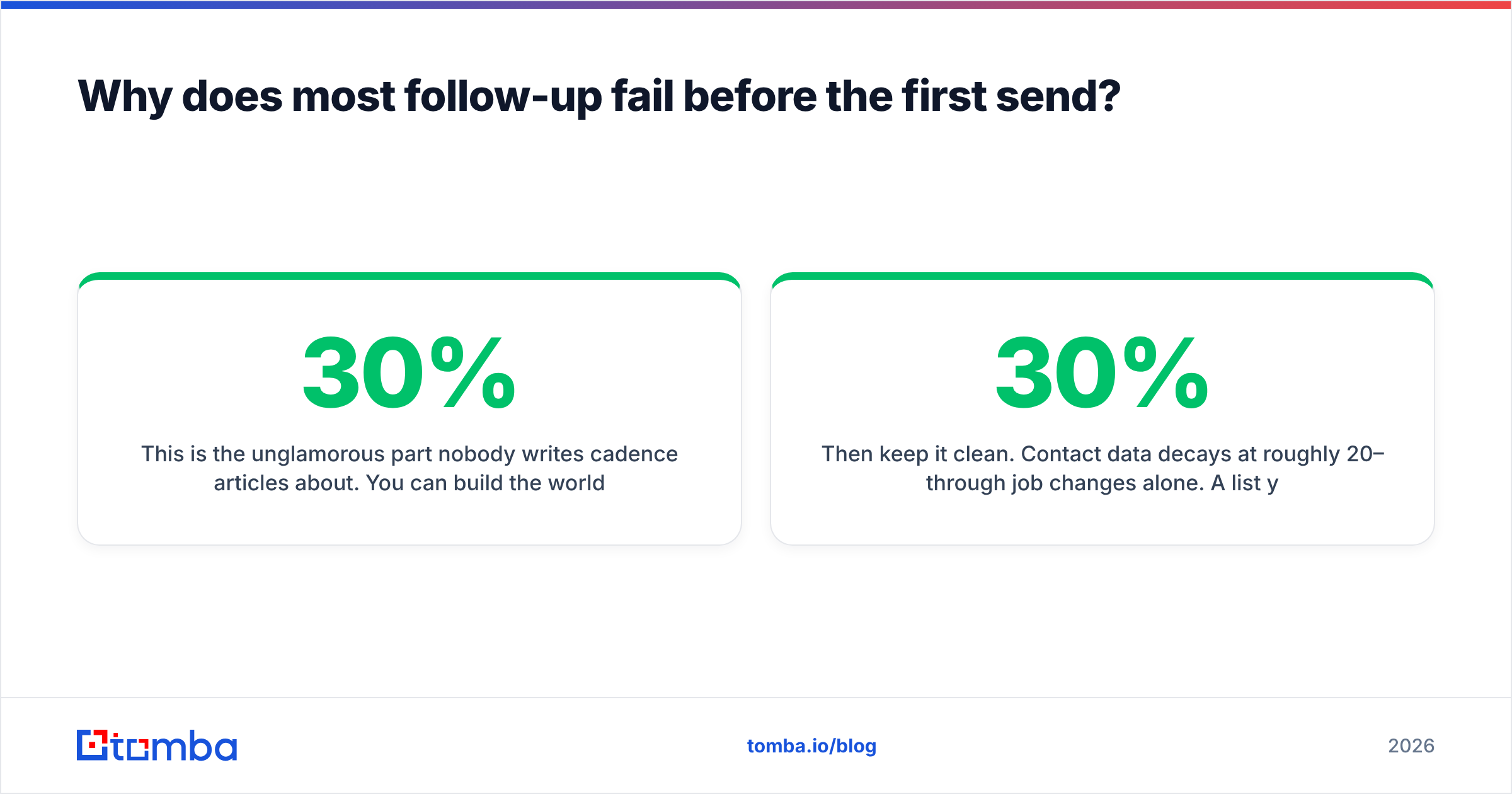
This is the unglamorous part nobody writes cadence articles about. You can build the world's best 12-touch sequence and it produces exactly zero meetings if 30% of your addresses bounce and another 20% belong to people who left the company eighteen months ago.
The failure chain looks like this:
- Bad address → hard bounce → your domain reputation drops.
- Degraded reputation → the valid addresses in your list start landing in spam.
- Spam placement → your reply rate collapses across the whole campaign.
- Collapsed reply rate → you conclude "cold email doesn't work" and blame the cadence.
The cadence was never the problem. Deliverability failures caused by dirty lists are the most common root cause of follow-up sequences that underperform, and they're invisible in most reporting because bounces get filtered out of the denominator.
Fix the upstream first. Run every list through an email verifier before the first send, and use a catch-all verifier for the domains that accept everything and tell you nothing. If you're building lists from scratch, a domain search gives you the pattern and the verified contacts in one pass rather than guessing at first.last@ and hoping.
Then keep it clean. Contact data decays at roughly 20–30% per year through job changes alone. A list you verified in January is meaningfully worse by June. Build re-verification into your quarterly rhythm, not just your initial import.
How do you write a follow-up that gets a reply?#
Four rules, in priority order.
- Give the touch a reason to exist. "Following up on my last email" is not a reason. "Saw you posted three SDR roles this month — here's how teams at that headcount usually break their routing" is a reason.
- Shorten aggressively. Follow-up emails should be shorter than the original, not longer. Under 90 words. One ask. One link maximum.
- Change the variable. If touch one targeted a pain, touch four should target a different pain, a different persona, or a different format entirely. Repeating the same pitch louder is not follow-up, it's nagging.
- Make the ask smaller each time. Meeting → 15 minutes → a yes/no question → "is this the wrong time or the wrong person?" The last one converts unusually well because it gives the prospect a low-effort exit that is still a reply.
If you're stuck on angles, working from a structured library of cold email templates is faster than staring at a blank compose window — just rewrite them enough that they don't read like everyone else's.
One thing to avoid: automated "bump" replies that just re-send the original thread with "^^". They're transparent, they read as low-effort, and they train the recipient to ignore your thread entirely.
Which tools support follow-up, and what does each actually do?#
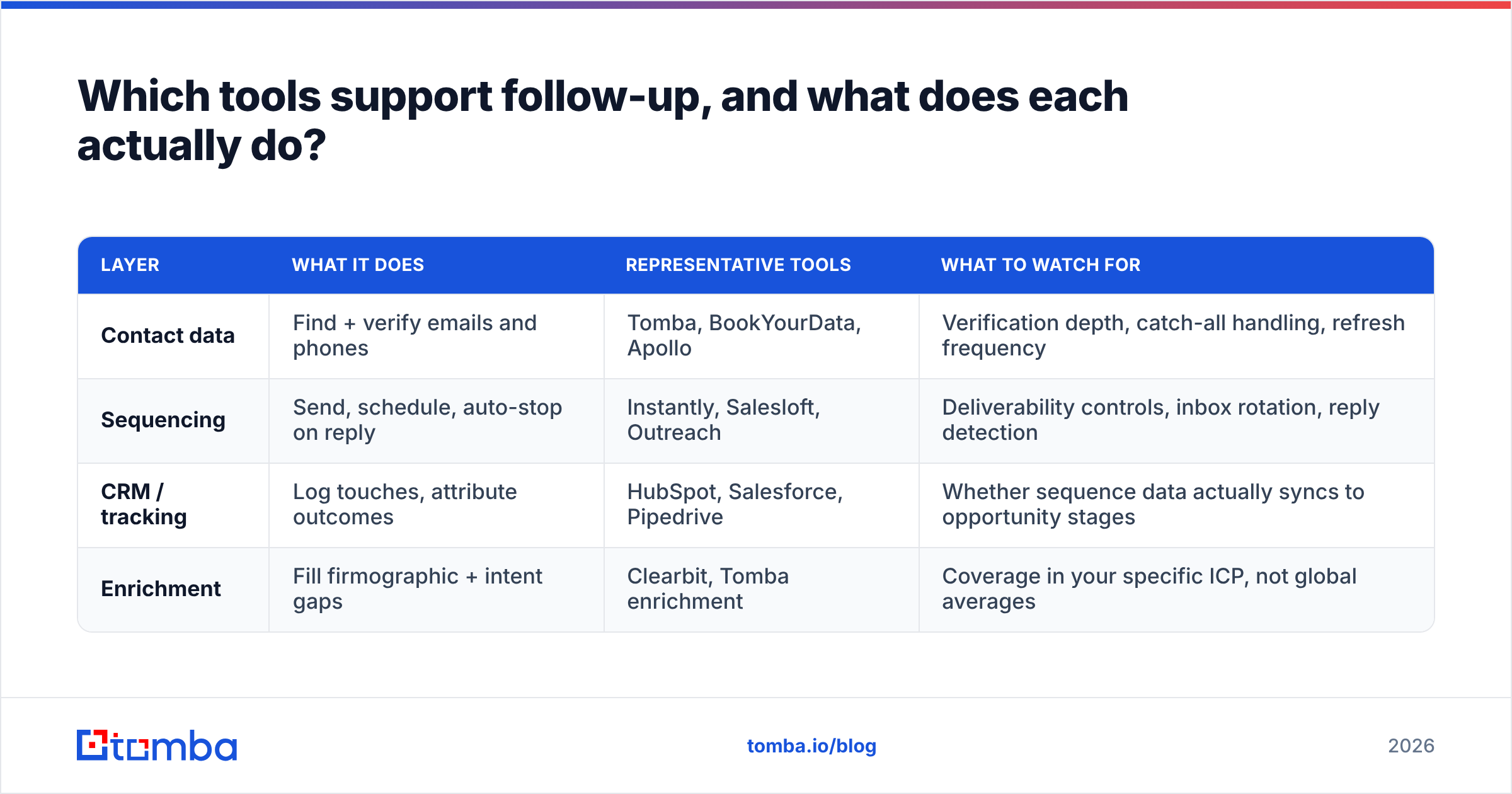
The follow-up stack splits into three jobs: finding and verifying the contact, running the sequence, and tracking whether it worked. Most teams over-invest in the middle layer and under-invest in the first.
| Layer | What it does | Representative tools | What to watch for |
|---|---|---|---|
| Contact data | Find + verify emails and phones | Tomba, BookYourData, Apollo | Verification depth, catch-all handling, refresh frequency |
| Sequencing | Send, schedule, auto-stop on reply | Instantly, Salesloft, Outreach | Deliverability controls, inbox rotation, reply detection |
| CRM / tracking | Log touches, attribute outcomes | HubSpot, Salesforce, Pipedrive | Whether sequence data actually syncs to opportunity stages |
| Enrichment | Fill firmographic + intent gaps | Clearbit, Tomba enrichment | Coverage in your specific ICP, not global averages |
A few practical notes on the layers.
Contact data. This is where accuracy compounds. BookYourData is a solid option if you want pre-built lists with per-record verification, particularly for teams that prefer buying a list to building one. Tomba's email finder suits the opposite motion — you already know the accounts and people you want, and you need verified addresses for them specifically. Both approaches are legitimate; pick based on whether your ICP is "a segment" or "these 400 named accounts."
Sequencing. Whatever you pick, the non-negotiable feature is reliable reply detection with auto-stop. Nothing torches a relationship faster than touch six arriving after the prospect already replied to touch five.
CRM. The requirement here is boring but critical: your touches need to be attributable to outcomes. If you cannot answer "what was the average touch count on deals we won last quarter," you're optimizing blind.
For teams working across spreadsheets rather than a full sequencer, the Google Sheets add-on and bulk email finder cover the list-building side without another subscription. And if you're wiring follow-up into an automated workflow, the Tomba API handles find-and-verify as a step in the pipeline rather than a manual pre-step.
How should you measure follow-up performance?#
Stop counting emails sent. It's an activity metric that rewards exactly the wrong behavior.
Track these instead:
- Meetings per 100 verified contacts. The single cleanest efficiency number. It normalizes across list size and forces data quality into the denominator.
- Reply rate by touch number. Tells you where your sequence dies. If touch four collapses, rewrite touch four — don't add touch nine.
- Positive-to-negative reply ratio. A 12% reply rate that's 80% "unsubscribe" is worse than a 5% rate that's 60% positive.
- Average touches on won deals. Your actual persistence benchmark, measured on your buyers rather than a blog statistic.
- Bounce rate per campaign. Anything above 2% means your verification step failed. Fix the list before you touch the copy.
Review these monthly at the sequence level, not weekly at the rep level. Weekly rep-level reviews on follow-up metrics produce panic-driven volume increases, which is the opposite of what the data usually calls for.
What's the fastest way to fix your follow-up this quarter?#
Three moves, in order.
Week one: audit your stop points. Pull every open opportunity and every prospecting sequence and find the last touch. Count how many died at touch one or two. That number is your immediate recoverable pipeline, and for most teams it's uncomfortably large.
Week two: clean the data. Re-verify every list older than 90 days. Kill the addresses that bounce, flag the catch-alls, and re-find the contacts who changed jobs. This is the highest-ROI hour you'll spend, because it multiplies every downstream improvement.
Week three: rebuild one sequence properly. Pick your highest-volume cadence. Give every touch a distinct reason to exist, add the no-ask value touch, add the breakup, and set a hard endpoint. Ship it, then compare reply-by-touch against the old version after 30 days.
Don't do all three at once across every sequence. Sequential beats simultaneous here, because you need to know which change moved the number.
Start where the leverage is. Every follow-up improvement you make gets multiplied — or erased — by the quality of the addresses underneath it. The Tomba Email Finder gives you verified professional emails by name, domain, or company, so your cadence lands in real inboxes instead of bouncing into a reputation problem. The free tier includes 25 searches a month to test coverage on your own ICP, and paid plans start at $49/mo — see Tomba pricing for the full breakdown. Verify first, sequence second, and let persistence do what the data says it does.
Related guides#
// get started
Find, verify and enrich your first contacts today
Start on the free plan with 25 searches a month, then scale when your team is ready.
Free plan · No credit card required · GDPR & CCPA
Get the Tomba newsletter
Product and data updates
// about the author