The Importance of Marketing Intelligence in B2B Sales 2026
Most B2B teams drown in dashboards and still guess who to call next. Here is what marketing intelligence actually is, the four layers that make it work, what a usable stack costs, and how to build the loop in 30 days.
TL;DR
- Marketing intelligence is the loop that turns raw signals (market, competitor, customer, contact) into a decision someone actually makes this week. Dashboards are not intelligence.
- The gap between "we have data" and "we act on data" is where most B2B budget dies. Collection is cheap in 2026; activation is the bottleneck.
- A workable stack has four layers — market, competitor, customer, and contact-level data. Skip the contact layer and your insights never reach a human inbox.
- A real starter stack runs roughly $150–$400/month for a small team, not the six-figure enterprise number vendors quote.
- The fastest ROI comes from the least glamorous layer: accurate contact data. A perfect ICP insight is worthless if 30% of your emails bounce.
What is marketing intelligence, exactly?#
Marketing intelligence is the continuous process of collecting, validating, and interpreting data about your market, your competitors, your customers, and the specific people inside your target accounts — then feeding that interpretation back into what you build, price, and send.
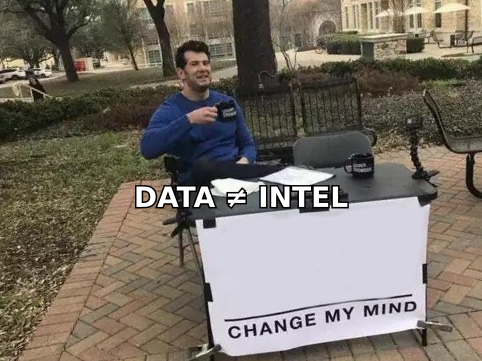
Think of it like a ship's navigation system versus a logbook. A logbook records where you have been. Navigation tells you to turn 12 degrees starboard in the next four minutes. Most B2B teams have built excellent logbooks — attribution reports, quarterly dashboards, a Looker instance nobody opens on a Tuesday — and almost no navigation.
The technical distinction matters because it changes what you buy. Market intelligence as a discipline is broad and strategic. Marketing intelligence is narrower and operational: it exists to make the next campaign, the next segment, and the next outbound sequence better than the last one.
Three properties separate intelligence from reporting:
- It is forward-looking. Reporting tells you last quarter's CAC. Intelligence tells you which segment's CAC is about to spike because a competitor just cut prices.
- It is decision-bound. Every intelligence artifact should name the decision it informs. If no decision is attached, it is trivia.
- It closes the loop. The output of one cycle becomes the input of the next. Without a feedback path you have a research project, not an intelligence function.
Why does the importance of marketing intelligence keep rising in 2026?#
Because the cost of being wrong went up while the cost of being right stayed flat.
Buying committees have grown. Gartner's research on B2B buying has been consistent for years: a typical enterprise purchase now involves six to ten stakeholders, each arriving with independently gathered information. You are not persuading one person. You are arming an internal champion with material that survives a committee they will never invite you to.
At the same time, three structural shifts have made intuition-driven marketing measurably worse:
- Signal fragmentation. Third-party cookies are gone, iOS mail privacy inflated open rates into noise, and dark social makes attribution partially unknowable. The teams that adapted rebuilt around first-party and firmographic signals instead of pixel trails.
- AI-flattened output. Everyone can now produce competent copy at volume. When execution quality converges, targeting quality becomes the only durable edge. Sending a mediocre email to exactly the right person beats sending a brilliant one to the wrong one.
- Budget scrutiny. CFOs stopped accepting "brand lift" as a line item. Marketing intelligence is increasingly how marketing defends its budget in the room, not a nice-to-have research function.
The blunt version: in a market where everybody has the same tools and the same LLM, the differentiator is knowing who to contact, when, and why now. That is intelligence work.
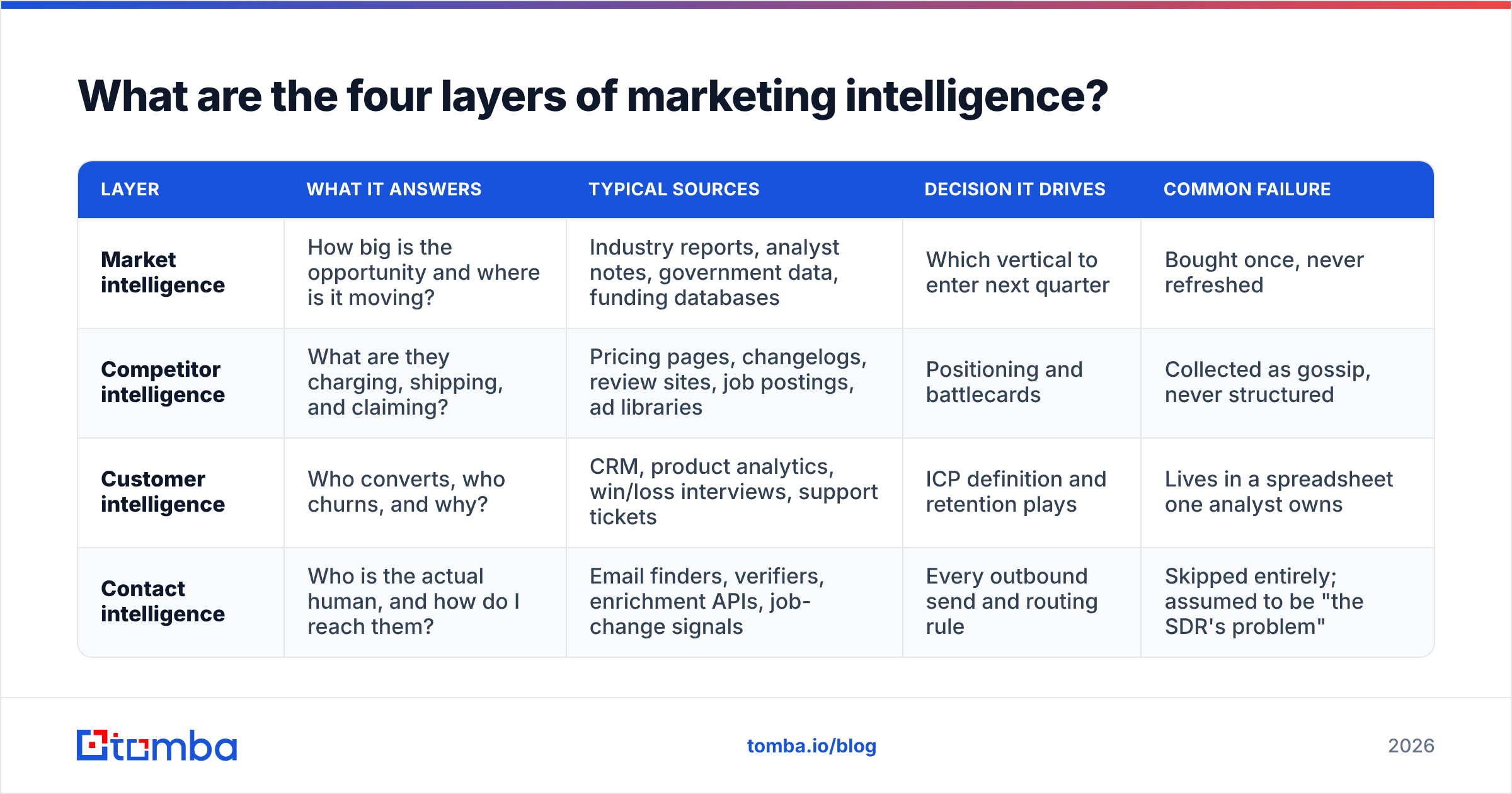
What are the four layers of marketing intelligence?#
Most stacks fail because they buy layer one and three, then wonder why nothing reaches a customer. Here is the full picture:
| Layer | What it answers | Typical sources | Decision it drives | Common failure |
|---|---|---|---|---|
| Market intelligence | How big is the opportunity and where is it moving? | Industry reports, analyst notes, government data, funding databases | Which vertical to enter next quarter | Bought once, never refreshed |
| Competitor intelligence | What are they charging, shipping, and claiming? | Pricing pages, changelogs, review sites, job postings, ad libraries | Positioning and battlecards | Collected as gossip, never structured |
| Customer intelligence | Who converts, who churns, and why? | CRM, product analytics, win/loss interviews, support tickets | ICP definition and retention plays | Lives in a spreadsheet one analyst owns |
| Contact intelligence | Who is the actual human, and how do I reach them? | Email finders, verifiers, enrichment APIs, job-change signals | Every outbound send and routing rule | Skipped entirely; assumed to be "the SDR's problem" |
That fourth row is where the theory meets an inbox. You can define a flawless ICP — Series B fintech, 50–200 employees, using Snowflake, hiring a Head of RevOps — and still send nothing, because you have 400 company names and zero verified email addresses. This is the most common and most expensive gap in the whole discipline.
Contact intelligence is also the layer with the fastest measurable payback. Fixing a 22% bounce rate down to 3% does not require a strategy offsite. It requires an email verifier and one afternoon.
How is marketing intelligence different from market research and BI?#
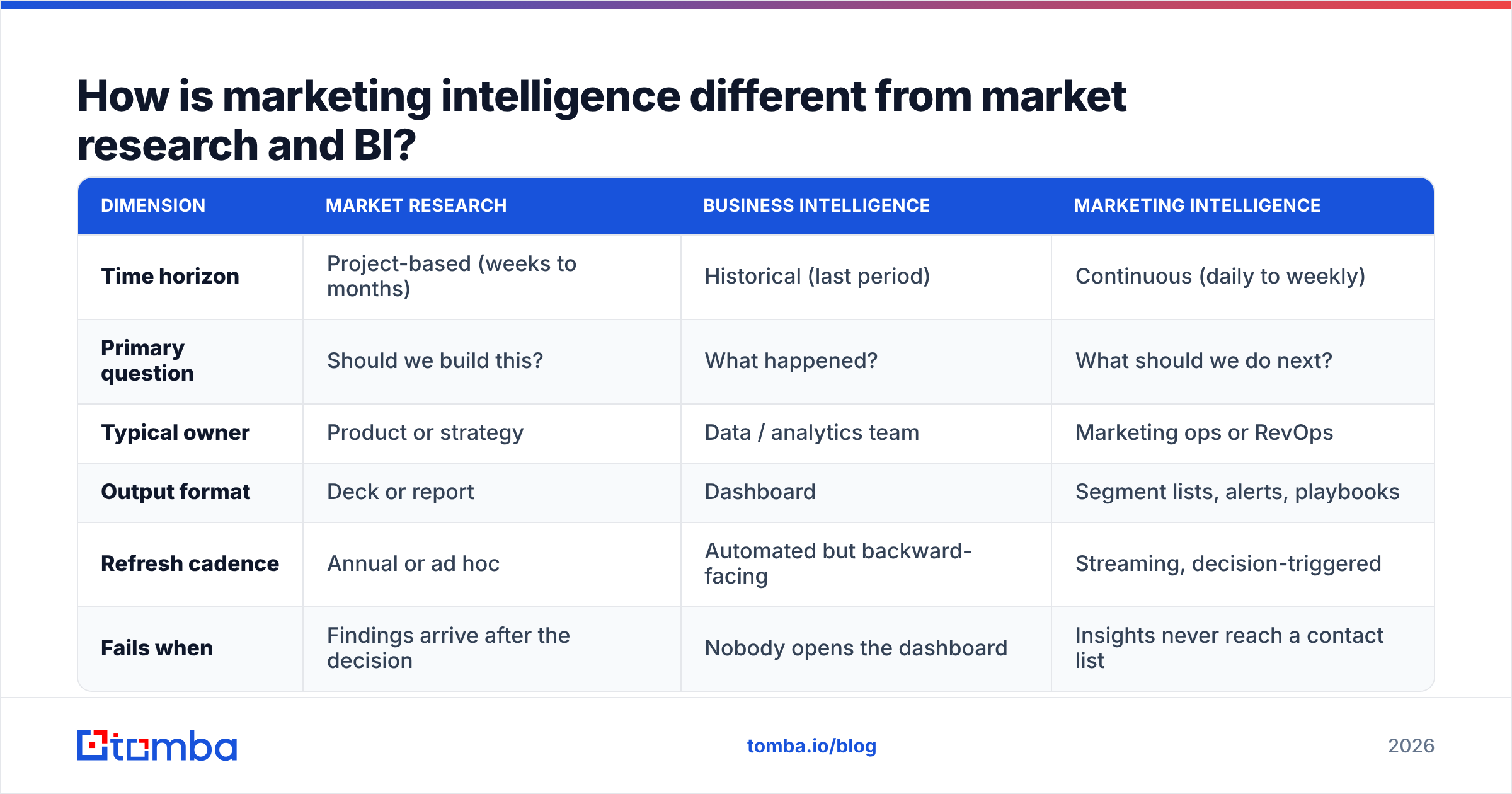
These three get used interchangeably in vendor decks, and the confusion leads to buying the wrong thing.
| Dimension | Market research | Business intelligence | Marketing intelligence |
|---|---|---|---|
| Time horizon | Project-based (weeks to months) | Historical (last period) | Continuous (daily to weekly) |
| Primary question | Should we build this? | What happened? | What should we do next? |
| Typical owner | Product or strategy | Data / analytics team | Marketing ops or RevOps |
| Output format | Deck or report | Dashboard | Segment lists, alerts, playbooks |
| Refresh cadence | Annual or ad hoc | Automated but backward-facing | Streaming, decision-triggered |
| Fails when | Findings arrive after the decision | Nobody opens the dashboard | Insights never reach a contact list |
The practical takeaway: BI tells you that the mid-market segment's win rate dropped 9 points. Market research tells you why mid-market buyers now prefer self-serve. Marketing intelligence tells you which 340 mid-market accounts to re-engage this month, who to contact at each, and what to say. You need all three. Only one of them ships work.
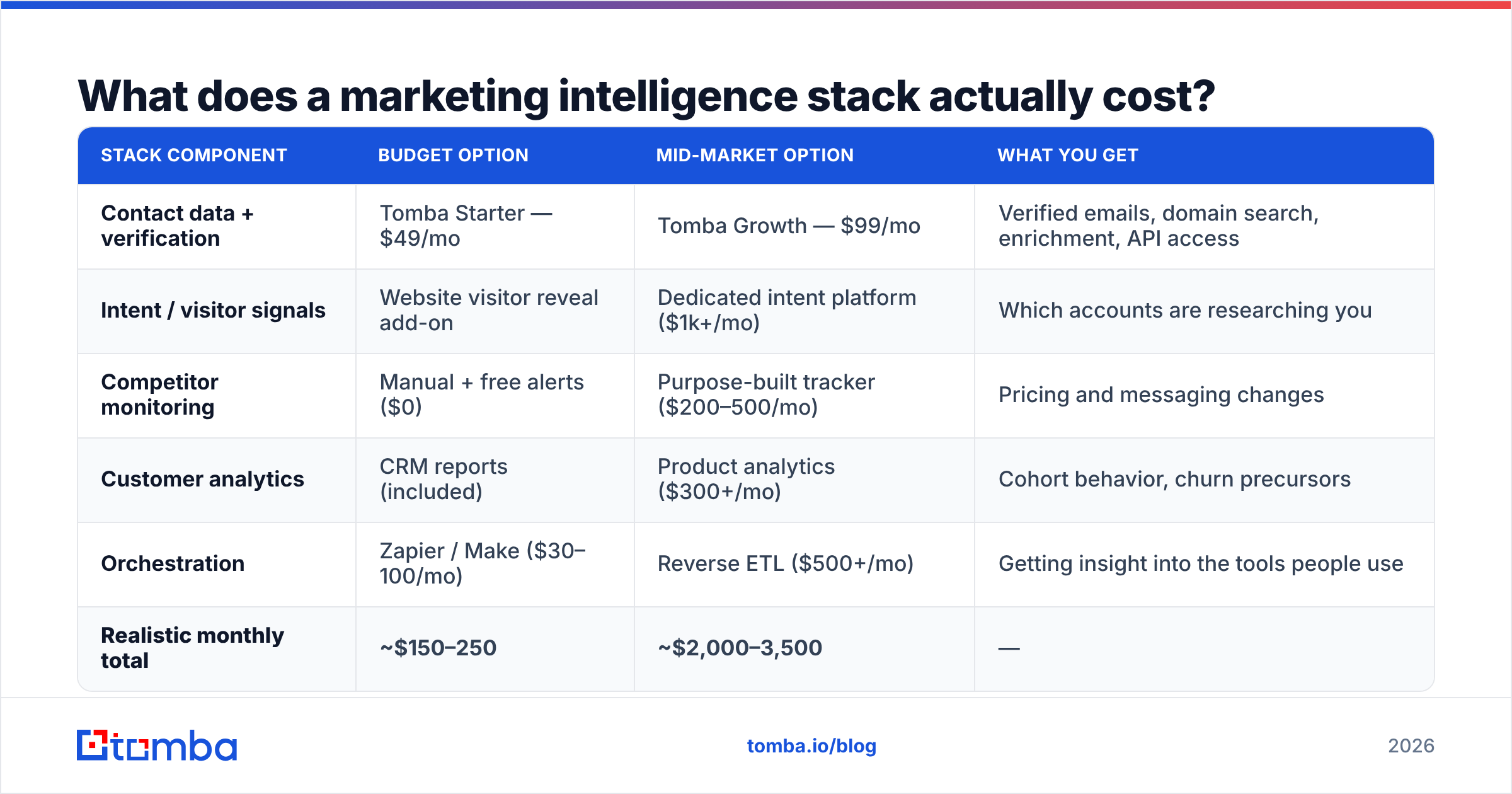
What does a marketing intelligence stack actually cost?#
Vendors quote enterprise numbers because enterprise numbers are where their margin is. A functional stack for a five-to-twenty-person go-to-market team is far cheaper than the sales narrative suggests.
| Stack component | Budget option | Mid-market option | What you get |
|---|---|---|---|
| Contact data + verification | Tomba Starter — $49/mo | Tomba Growth — $99/mo | Verified emails, domain search, enrichment, API access |
| Intent / visitor signals | Website visitor reveal add-on | Dedicated intent platform ($1k+/mo) | Which accounts are researching you |
| Competitor monitoring | Manual + free alerts ($0) | Purpose-built tracker ($200–500/mo) | Pricing and messaging changes |
| Customer analytics | CRM reports (included) | Product analytics ($300+/mo) | Cohort behavior, churn precursors |
| Orchestration | Zapier / Make ($30–100/mo) | Reverse ETL ($500+/mo) | Getting insight into the tools people use |
| Realistic monthly total | ~$150–250 | ~$2,000–3,500 | — |
Two things worth flagging. First, the free tier matters more than people admit — Tomba includes 25 searches per month at no cost, which is enough to validate whether contact enrichment moves your reply rate before you commit a card. Full Tomba pricing runs Free, Starter $49, Growth $99, Pro $249, and custom Enterprise.
Second, if your buying committee needs a bigger, more established B2B contact database with pre-built lists rather than a search-and-verify workflow, BookYourData is a solid, well-regarded option in that category and worth evaluating side by side. The two solve adjacent problems: one is a pay-as-you-go list source, the other is an API-first finder and verifier. Plenty of teams run both.
How do you build a marketing intelligence loop in 30 days?#
Skip the platform evaluation. Build the loop first, then buy tools that fit it.
Week 1 — Define one decision. Pick a single recurring decision that currently runs on instinct. "Which 200 accounts do we prospect next month?" is a good one. Write it down. Everything you build serves that sentence.
Week 2 — Wire the customer layer. Pull your last 12 months of closed-won and closed-lost from the CRM. Find the three firmographic attributes that separate them. Not ten. Three. If your data cannot support that analysis, that is itself the finding, and fixing CRM hygiene becomes week two.
Week 3 — Build the contact layer. Take your refined ICP, run it through domain search to pull every relevant contact at those companies, then verify before anything is imported. A list you have not verified is a liability, not an asset — bounces damage sender reputation for months, and reputation damage costs more than the data ever did.
Week 4 — Close the loop. Route the enriched list into the CRM or sequencer your reps already live in, then define one measurement: reply rate by segment. Review it in 14 days. Adjust the ICP. Run again.
That is the entire discipline. Everything else — intent scoring, propensity models, AI-generated account plans — is an optimization on top of a loop that has to exist first. Teams that buy the optimization before the loop end up with an expensive dashboard and the same instinct-driven decisions.
If you are running this at any volume, the bulk email finder workflow or the Tomba API will save you the manual step entirely — enrichment becomes something that happens on record creation, not something someone remembers to do.
What metrics prove your marketing intelligence is working?#
Vanity metrics are the enemy here. Track these instead:
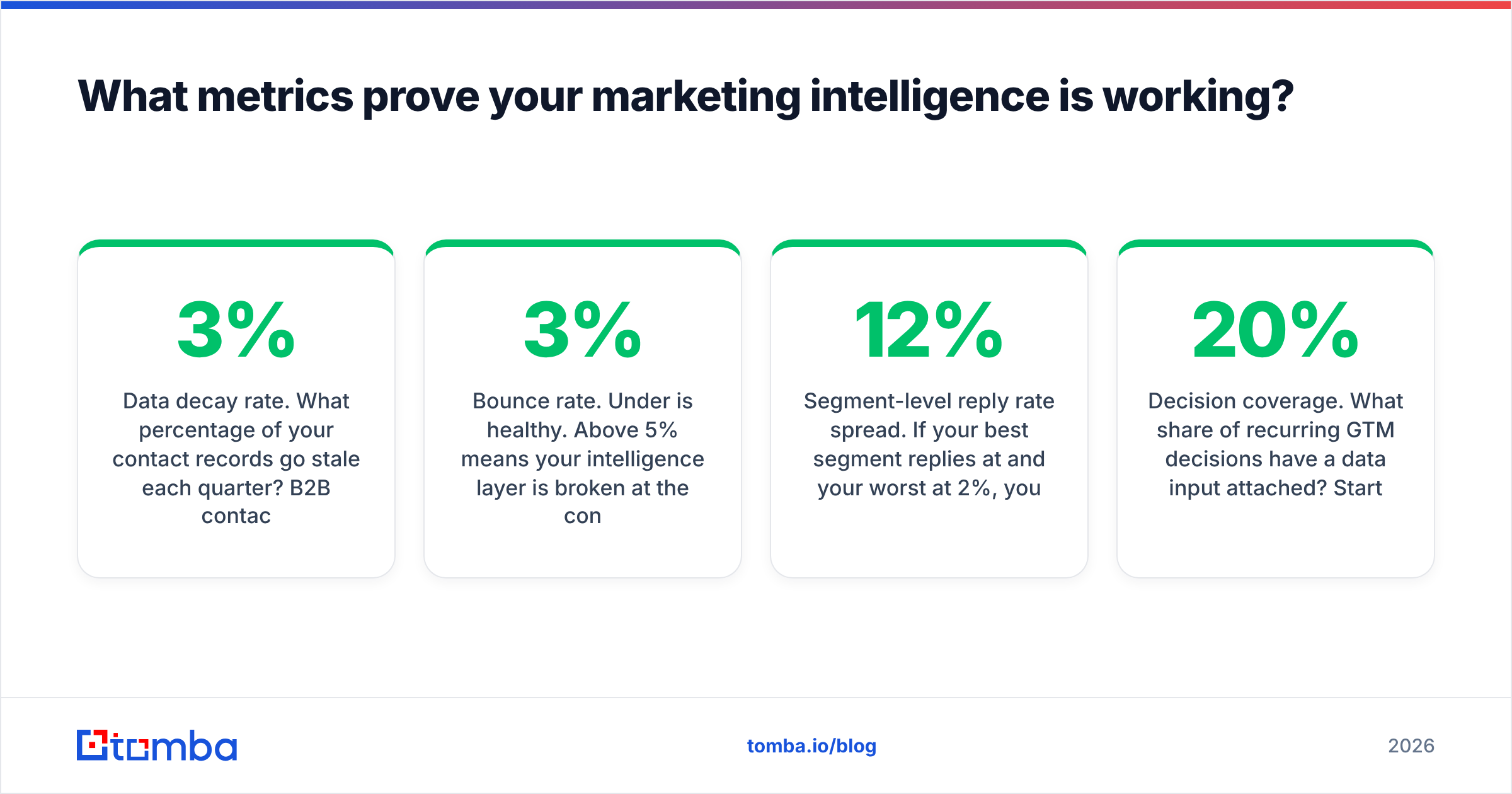
- Data decay rate. What percentage of your contact records go stale each quarter? B2B contact data decays somewhere around 2–3% per month through job changes alone. If you are not re-verifying, your database is quietly rotting.
- Bounce rate. Under 3% is healthy. Above 5% means your intelligence layer is broken at the contact level and everything upstream is academic.
- Segment-level reply rate spread. If your best segment replies at 12% and your worst at 2%, your intelligence is working — you now know where to spend. If every segment performs identically, your segmentation is not real.
- Time-to-list. How long between "we should target X" and "the list is in the sequencer"? Best-in-class is under an hour. Most teams are at two weeks.
- Decision coverage. What share of recurring GTM decisions have a data input attached? Start at 20%, aim for 60%. Nobody hits 100% and pretending otherwise is theater.
HubSpot's annual state of marketing research is a useful external benchmark for the first three, and Forrester publishes solid work on how B2B buying groups actually consume information if you need ammunition for an internal business case.
What are the most common marketing intelligence mistakes?#
Buying tools before defining decisions. The most expensive stack in the world produces nothing if no one has named the choice it informs. Decision first, always.
Treating enrichment as a one-time import. You enriched 5,000 records in January. By December, roughly a quarter of them are wrong. Enrichment is a subscription to accuracy, not a purchase.
Confusing volume with intelligence. Ten thousand unverified contacts is worse than 800 verified ones — worse for deliverability, worse for rep morale, worse for the forecast. More rows is not more signal.
Letting intelligence live only in marketing. If sales never sees the segment analysis, half the value evaporates. The loop must terminate in a tool a rep opens daily, usually the CRM.
Ignoring the catch-all problem. A meaningful share of B2B domains accept all mail, which makes standard verification return "unknown." Teams either drop these contacts (losing real prospects) or blast them (risking reputation). Neither is necessary — a proper catch-all verifier resolves most of them.
Where should you start?#
Start at the layer with the shortest distance between insight and action: contact data. Strategy decks can wait. If your team cannot reliably turn a company name into a verified, deliverable email address for the right person, every other layer of intelligence stops one step short of revenue.
The Tomba Email Finder handles exactly that step — search by domain, name, or company, verify before export, and push the result into your CRM through the API or a native integration. The free tier gives you 25 searches a month to test the workflow against your own ICP before spending anything, and Starter is $49/mo when you are ready to scale. Build the loop, verify the data, then let the strategy layers earn their keep on top of a foundation that actually reaches people.
Related guides#
// get started
Find, verify and enrich your first contacts today
Start on the free plan with 25 searches a month, then scale when your team is ready.
Free plan · No credit card required · GDPR & CCPA
// about the author