The Importance of Sales Forecasting: A 2026 Field Guide
Most sales forecasts miss because the pipeline data feeding them is stale, not because the math is wrong. Here is how to build a forecast your CFO will actually trust in 2026.
TL;DR
- The importance of sales forecasting is not prediction — it is the decision trigger. A forecast exists so you can hire, cut spend, or change coverage before the quarter ends, not explain the miss afterward.
- Most forecasts fail on inputs, not math. Stale contact data, ghost deals, and optimistic close dates poison every model you layer on top.
- Pick your method by deal count, not by sophistication. Under 40 deals per quarter, weighted-pipeline math is noise; you need judgment plus a strict definition of "committed."
- A realistic accuracy target is ±10% at the company level and ±15% per rep. Anyone promising 95% forecast accuracy is either selling something or forecasting a renewal book.
- Forecast hygiene compounds. Thirty minutes of pipeline cleanup per rep per week beats any AI scoring model running on rotten records.
What Is Sales Forecasting, Really?#
Sales forecasting is the process of estimating how much revenue your team will close in a defined period, using a defined method, with a stated confidence level. That last clause is the one everyone skips.
Think of it like a weather forecast for a wedding. The point is not to know the exact rainfall in millimetres. The point is to decide whether to rent the tent. A 60% chance of rain and a 20% chance of rain lead to different actions, and the forecast has done its job the moment the decision changes.
Sales forecasts work the same way. Finance uses them to plan cash and headcount. The CRO uses them to reallocate coverage. Marketing uses them to decide whether to spend into a pipeline gap. Your board uses them to decide whether you are a company that knows itself.
A forecast that never changes a decision is just a status report with decimals.
Three artifacts get confused constantly, so define them once and enforce it:
- Quota is what you promised. It is a commitment, set top-down, and it does not move because the pipeline got ugly.
- Pipeline is everything open, at every stage, with every close date. It is inventory, not a prediction.
- Forecast is what you actually believe will close, filtered through evidence. It should almost always be lower than weighted pipeline and higher than closed-won to date.
- Commit is the subset of forecast you would bet your credibility on. If commit slips more than once a quarter, your stage definitions are broken.
Why Is the Importance of Sales Forecasting Rising in 2026?#
Because the cost of being wrong went up.
In a zero-interest environment, a 20% forecast miss meant a slightly awkward board meeting. Capital was cheap, so you covered the gap and moved on. That era ended. Buying committees have grown, procurement scrutiny has tightened, and deal cycles in mid-market B2B have stretched noticeably since 2022. Gartner's sales research has documented the same trend from multiple angles: more stakeholders, longer consensus-building, more late-stage stalls.
Longer cycles mean your forecast is making a bet further into the future, on less information, with more people able to say no. The variance widens exactly when the tolerance for variance narrows.
Three specific pressures make forecasting a first-class discipline this year:
- Headcount decisions are slower to reverse. Hiring a rep costs you two to four quarters of ramp. If the forecast says you need capacity and it is wrong, you carry that cost for a year.
- Renewal and expansion revenue now sits inside the same forecast. Net revenue retention is a board metric. Churn risk has to be forecast, not discovered.
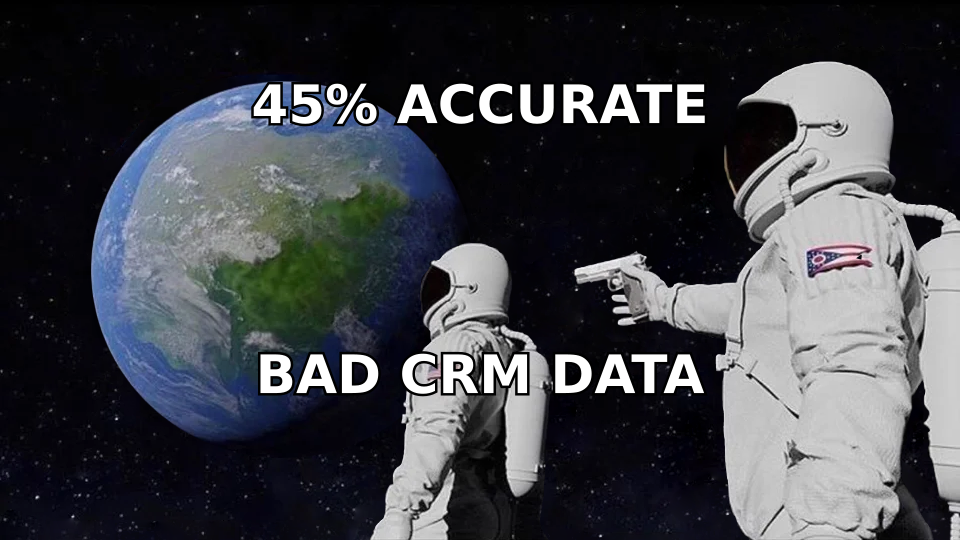
- AI scoring made bad data more dangerous, not less. A model trained on a CRM full of ghost contacts produces confident nonsense. Confidence without accuracy is worse than an honest shrug.
That last point is the one teams underrate. Automation amplifies whatever you feed it.
What Does a Bad Forecast Actually Cost You?#
Put a number on it and the conversation changes.
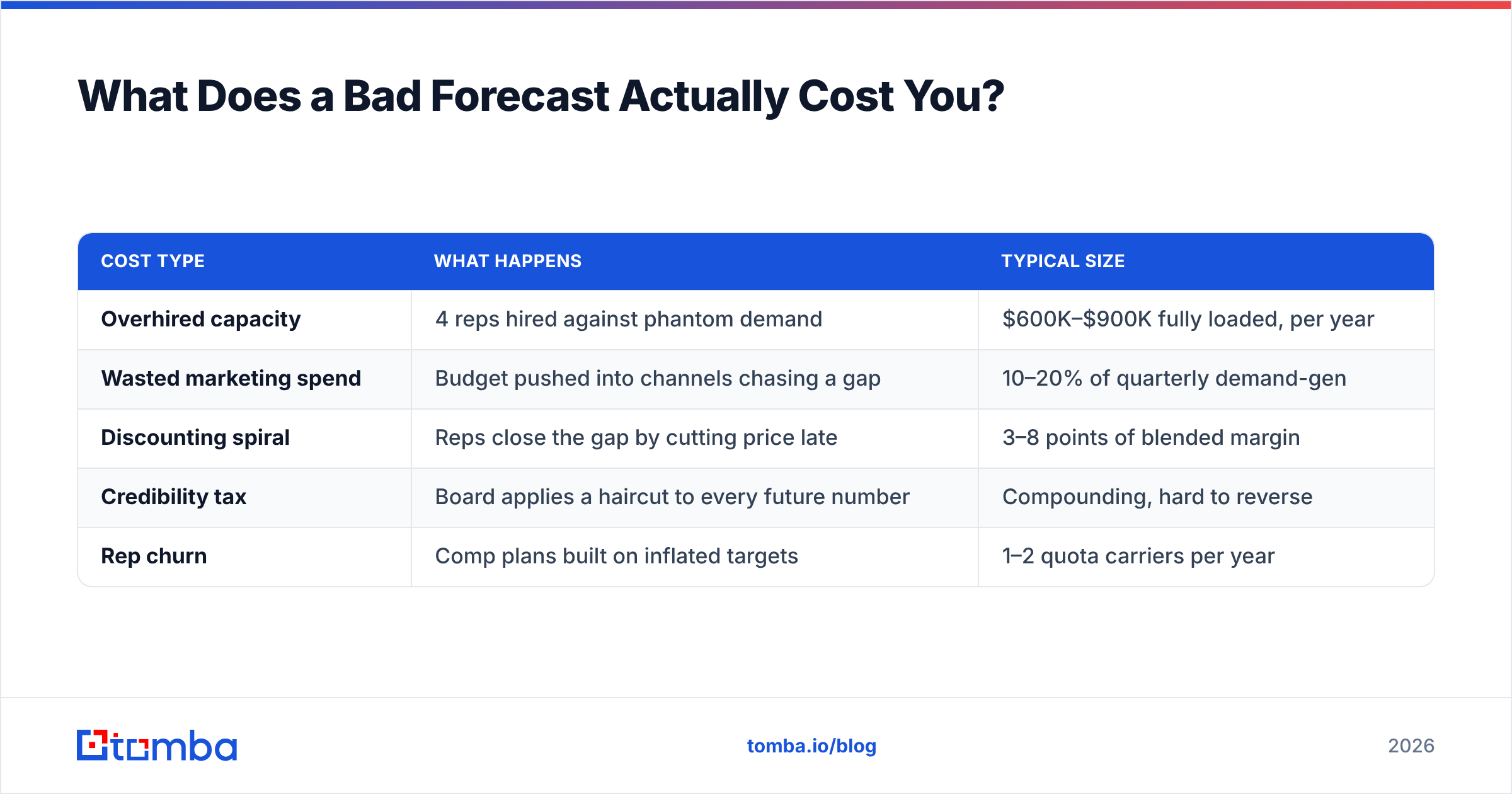
Take a company at $20M ARR forecasting $5M for the quarter and landing $4M. The obvious cost is the $1M gap. The hidden costs are larger:
| Cost type | What happens | Typical size |
|---|---|---|
| Overhired capacity | 4 reps hired against phantom demand | $600K–$900K fully loaded, per year |
| Wasted marketing spend | Budget pushed into channels chasing a gap | 10–20% of quarterly demand-gen |
| Discounting spiral | Reps close the gap by cutting price late | 3–8 points of blended margin |
| Credibility tax | Board applies a haircut to every future number | Compounding, hard to reverse |
| Rep churn | Comp plans built on inflated targets | 1–2 quota carriers per year |
The credibility tax is the killer. Once your board starts mentally subtracting 15% from every forecast you present, you lose the ability to signal urgency. When something genuinely is at risk, nobody believes you, because you cried wolf with a spreadsheet.
The inverse also costs money. Chronic sandbagging — forecasting $4M and landing $5M — feels safe, but it means you under-invested. You did not hire the rep, did not fund the campaign, did not open the territory. Underforecasting is just a slower way to lose growth.
Which Sales Forecasting Method Should You Use?#
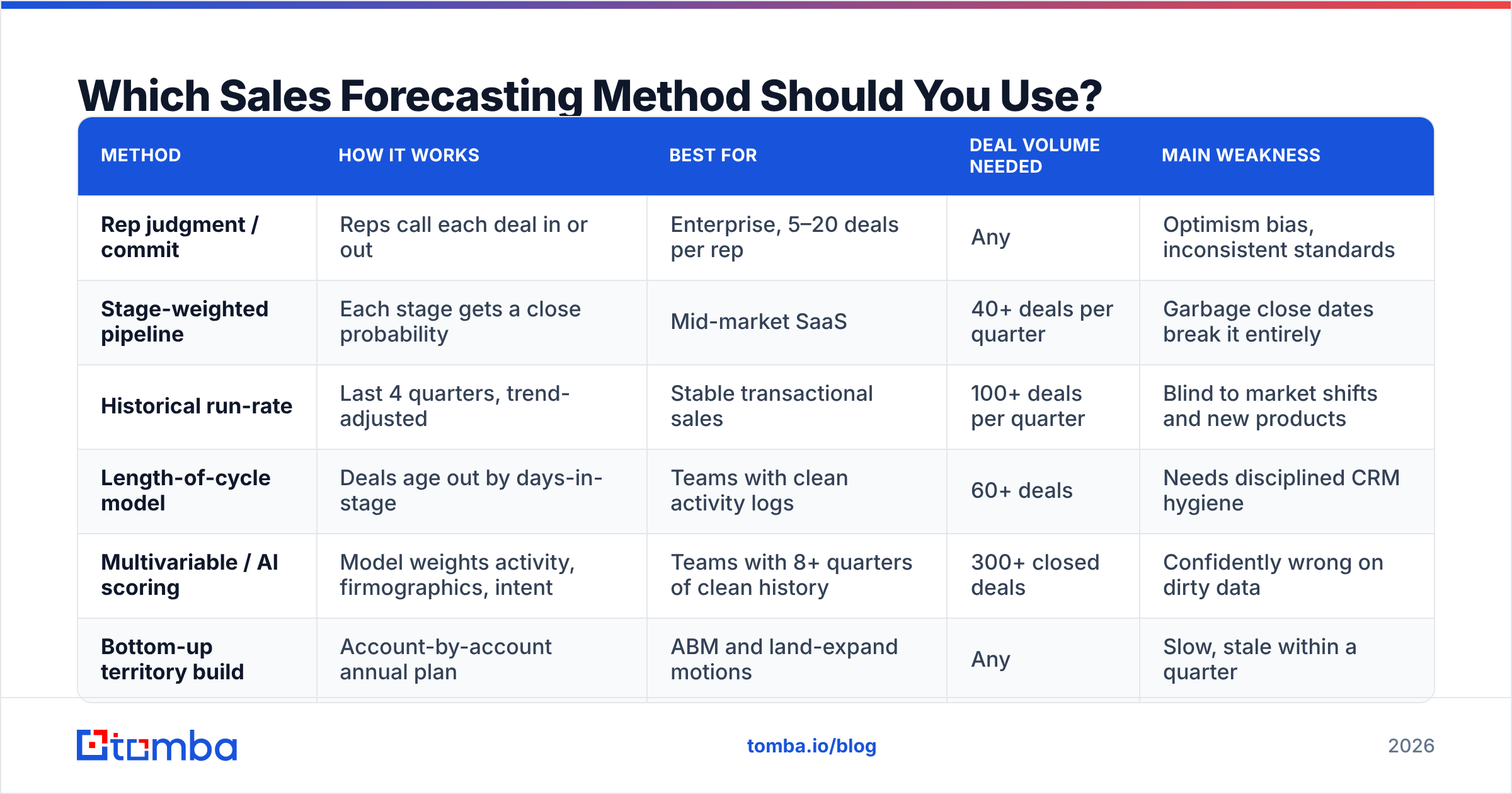
Match the method to your deal count and data maturity. Sophistication that outruns your data volume produces false precision.
| Method | How it works | Best for | Deal volume needed | Main weakness |
|---|---|---|---|---|
| Rep judgment / commit | Reps call each deal in or out | Enterprise, 5–20 deals per rep | Any | Optimism bias, inconsistent standards |
| Stage-weighted pipeline | Each stage gets a close probability | Mid-market SaaS | 40+ deals per quarter | Garbage close dates break it entirely |
| Historical run-rate | Last 4 quarters, trend-adjusted | Stable transactional sales | 100+ deals per quarter | Blind to market shifts and new products |
| Length-of-cycle model | Deals age out by days-in-stage | Teams with clean activity logs | 60+ deals | Needs disciplined CRM hygiene |
| Multivariable / AI scoring | Model weights activity, firmographics, intent | Teams with 8+ quarters of clean history | 300+ closed deals | Confidently wrong on dirty data |
| Bottom-up territory build | Account-by-account annual plan | ABM and land-expand motions | Any | Slow, stale within a quarter |
Most teams should run two methods in parallel and compare. Rep commit plus stage-weighted pipeline is the classic pairing: one captures human context the model cannot see, the other catches the deal a rep is emotionally attached to. When the two disagree by more than 15%, that gap is your review agenda for the week.
Skip the AI-scoring tier until you have at least two years of consistent stage definitions. If you renamed your stages last quarter, your model is learning from two different languages. G2's sales analytics category is a reasonable place to survey vendors once you actually clear that bar.
Why Do Most Sales Forecasts Break?#
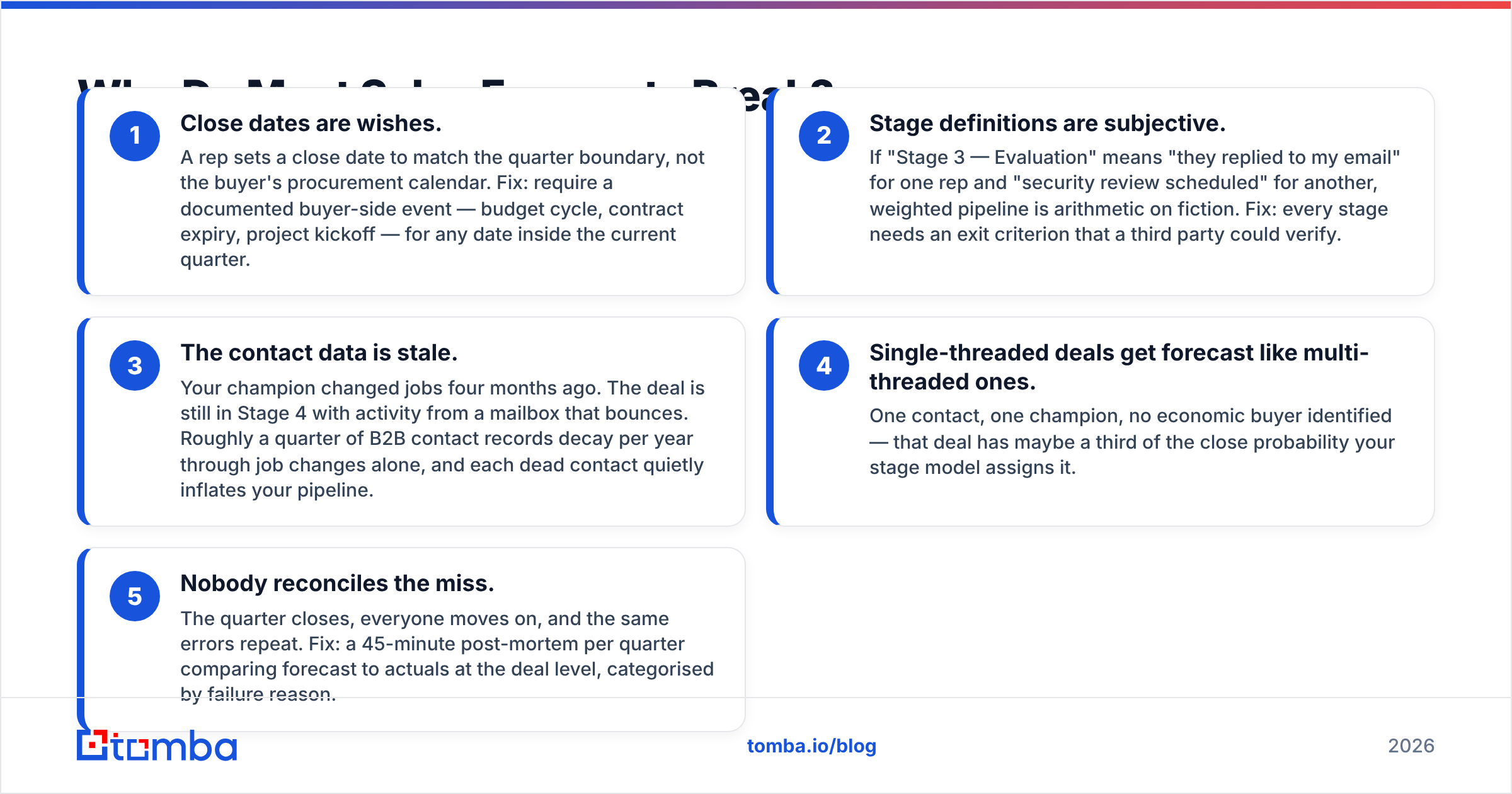
Five failure modes account for the overwhelming majority of misses, and only one of them is about math.
- Close dates are wishes. A rep sets a close date to match the quarter boundary, not the buyer's procurement calendar. Fix: require a documented buyer-side event — budget cycle, contract expiry, project kickoff — for any date inside the current quarter.
- Stage definitions are subjective. If "Stage 3 — Evaluation" means "they replied to my email" for one rep and "security review scheduled" for another, weighted pipeline is arithmetic on fiction. Fix: every stage needs an exit criterion that a third party could verify.
- The contact data is stale. Your champion changed jobs four months ago. The deal is still in Stage 4 with activity from a mailbox that bounces. Roughly a quarter of B2B contact records decay per year through job changes alone, and each dead contact quietly inflates your pipeline.
- Single-threaded deals get forecast like multi-threaded ones. One contact, one champion, no economic buyer identified — that deal has maybe a third of the close probability your stage model assigns it.
- Nobody reconciles the miss. The quarter closes, everyone moves on, and the same errors repeat. Fix: a 45-minute post-mortem per quarter comparing forecast to actuals at the deal level, categorised by failure reason.
Number three deserves extra attention because it is invisible on a dashboard. A deal with a dead champion looks identical to a healthy one in your pipeline report. The only way to catch it is to verify the underlying contact records on a schedule. Running an email verifier pass across active-opportunity contacts every 60 days surfaces exactly this rot, and it takes minutes. When a verification comes back invalid on a Stage 4 deal, that is not a data-quality ticket — that is a forecast correction.
How Accurate Should a Sales Forecast Be?#
Set the target before the quarter, and set it honestly.
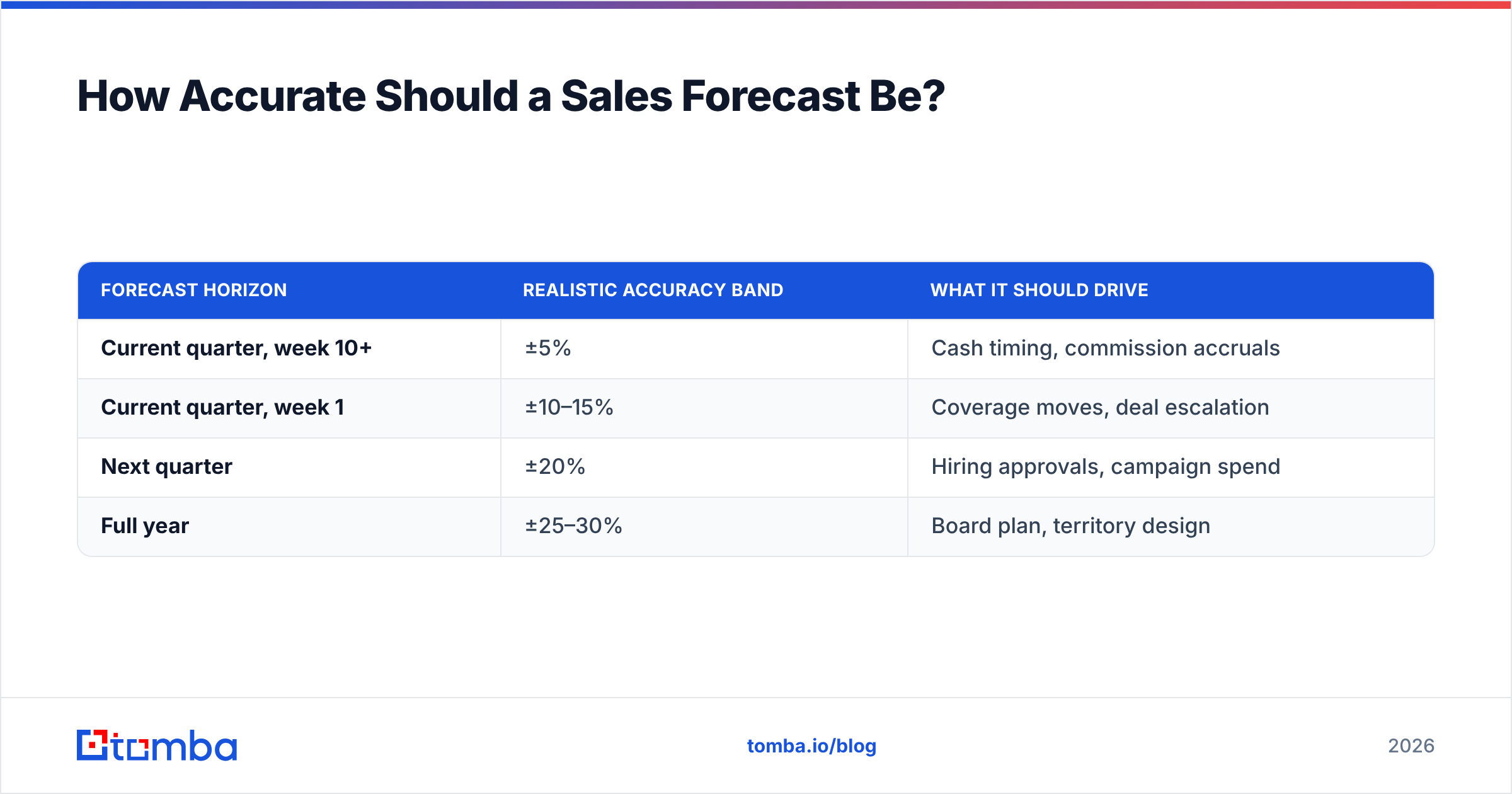
Reasonable benchmarks for a B2B team with disciplined process:
| Forecast horizon | Realistic accuracy band | What it should drive |
|---|---|---|
| Current quarter, week 10+ | ±5% | Cash timing, commission accruals |
| Current quarter, week 1 | ±10–15% | Coverage moves, deal escalation |
| Next quarter | ±20% | Hiring approvals, campaign spend |
| Full year | ±25–30% | Board plan, territory design |
Two rules keep these numbers honest.
First, measure accuracy as absolute variance, not net variance. A rep who missed three deals by $200K and beat two by $200K did not forecast accurately — they got lucky twice. Net-zero variance hides a broken process.
Second, track accuracy per rep and publish it. Forecast accuracy is a coachable skill and reps improve fast once it is visible. It also identifies the sandbagger and the dreamer, who need opposite coaching. HubSpot's sales blog has good practical material on running this cadence without turning it into a witch hunt.
Do not chase 95%. Teams that report near-perfect accuracy are usually forecasting a book of predictable renewals, or they are pulling deals forward and backward to hit the number — which is a much more expensive habit than a miss.
How Do You Build a Forecast You Can Defend?#
A defensible forecast is one where every number traces to evidence. Here is the operating rhythm that produces it.
Weekly, per rep (30 minutes). Every deal in the current-quarter forecast gets three checks: is the close date tied to a buyer event, is there a second contact engaged, and has the champion responded in the last 14 days? Any deal failing two of three drops out of commit.
Weekly, per manager (60 minutes). Compare rep commit against stage-weighted pipeline. Interrogate the gap, not the total. Managers who review the aggregate number learn nothing; managers who review the five deals causing the variance learn everything.
Monthly, RevOps. Refresh contact and account data across all open opportunities. Job changes, funding events, and acquisitions all change deal probability, and none of them show up in your CRM automatically. This is where contact enrichment earns its keep — you find out the VP who owned your evaluation left in March before the deal quietly rots to closed-lost.
Quarterly, leadership. Run the variance post-mortem. Bucket every missed deal into one of four reasons: lost to competitor, lost to no-decision, slipped to next quarter, or forecast error. If "slipped" is more than a third of the miss, your close-date discipline is the problem and no model will save you.
Annually. Re-baseline stage probabilities against actual conversion data. Most teams set stage weights once, in 2021, and never revisit them. Your Stage 3 probably does not convert at 40% anymore.
The connective tissue across all five is data freshness. You cannot forecast a pipeline whose contacts you cannot reach. Before a deal enters commit, the buying committee should be mapped and verified — economic buyer, champion, and at least one technical evaluator, each with a working address. Tools that resolve a company domain search into a verified contact list make multi-threading a five-minute task instead of a research project, which is the difference between it happening and it not.
What Should You Stop Doing?#
Three habits do more damage than any missing tool.
Stop forecasting in a spreadsheet that lives on someone's laptop. If the forecast is not derived from the CRM of record, the CRM stops being the source of truth, and within two quarters your data is unusable for anything.
Stop letting reps forecast deals they have never met the buyer for. A deal sourced from a list, worked entirely by email, with no live conversation, does not belong in commit no matter what the activity count says.
Stop treating forecast accuracy as a finance problem. It is a sales-process problem that finance happens to notice. The fix lives in stage definitions, data hygiene, and win rate analysis — not in a better model.
Where Does This Leave You?#
The importance of sales forecasting comes down to one thing: it is the mechanism that converts pipeline data into decisions early enough for those decisions to matter. Strip away the models and the dashboards and that is the whole job.
Which means the forecast is only as good as the records underneath it. Ghost contacts, dead champions, and unverified buying committees are not data-quality annoyances — they are forecast errors that have not surfaced yet.
Start there. Verify the contacts on every open opportunity, map the second and third stakeholder on every commit deal, and re-check quarterly. The Tomba Email Finder resolves company domains into verified, multi-threaded buying committees so your pipeline reflects people who actually exist and actually answer. Free tier covers 25 searches a month if you want to test it against your current commit list; paid plans start at $49/mo on the Starter tier, with full Tomba pricing published up front. Run it across your open deals this week and see how many of them survive contact.
Related guides#
// get started
Find, verify and enrich your first contacts today
Start on the free plan with 25 searches a month, then scale when your team is ready.
Free plan · No credit card required · GDPR & CCPA
Get the Tomba newsletter
Product and data updates
// about the author