Import.io Pricing, Reviews, Pros and Cons: 2026 Breakdown
Import.io hides its price behind a sales call. Here's what buyers report paying in 2026, what reviewers praise and complain about, and when a scraping platform is the wrong tool for B2B contact data.
Import.io pricing is not listed anywhere on its site. Here is what buyers report paying in 2026, what reviewers praise and complain about, and when a cheaper tool does the job better.
TL;DR
- Import.io pricing is not public. Every plan starts with a sales call. Buyers report entry points in the high hundreds per month, and five-figure annual deals once volume grows.
- It is a true enterprise web data extraction platform: managed crawlers, scheduling, and QA on the extracted data. It is not a self-serve scraper.
- Reviewers praise how it handles messy sites and the hands-on support. They complain about cost, unclear quotas, and a steep learning curve.
- If you actually need B2B contact data, a scraping platform is an expensive route. A purpose-built email finder starts at a published $49/mo.
- Buy Import.io when the data exists only as HTML. Buy a data provider when the data already sits in someone's index.
What is Import.io, and who actually uses it?#
Import.io is a web data extraction platform. You point it at pages you want turned into rows — product listings, pricing pages, job boards, directories, marketplace inventory. It then builds and runs extractors that deliver structured data on a schedule, via API, or as files dropped into your warehouse.
Think of it like hiring a translation firm instead of buying a phrasebook. The phrasebook (an open-source scraper) is cheap, but you do the work. The firm handles the messy dialects, keeps working when the source changes, and bills you for it.
The customer profile skews enterprise: retail and CPG price monitoring, travel fare tracking, market research firms, financial data teams, and consultancies that resell insight built on public web data. For these teams, the data feed is a line item in a business case, not a growth hack.
That context matters for the pricing discussion. Import.io does not compete on being the cheapest way to get 500 rows. It competes on not breaking when a source site redesigns, and on someone answering the phone when it does.
Import.io pricing in 2026: how much does it cost?#
Short answer: nobody outside a sales call knows exactly, and that is by design.
Import.io pricing moved off the public site years ago. As of 2026, the site routes you to a demo request rather than a checkout page. Here is what we can report honestly:
- No published tier list. There is no "$X/mo Starter" button. Quotes depend on volume, site complexity, and support level.
- Reported entry points sit in the high hundreds per month. Buyer comments on G2 and Capterra describe starting commitments in the several-hundred-dollars-per-month range for limited-volume work.
- Production contracts are usually annual and five-figure. Reviewers describe annual agreements rather than month-to-month billing once the extractors matter to the business.
- Volume is the main lever. Pages crawled, extraction frequency, and number of sources drive the number more than seat count does.
- Managed services cost extra. Having Import.io's team build and maintain your extractors is a separate line.
Treat every figure above as directional. It comes from public buyer commentary, not from a rate card. Get your own quote before you budget.
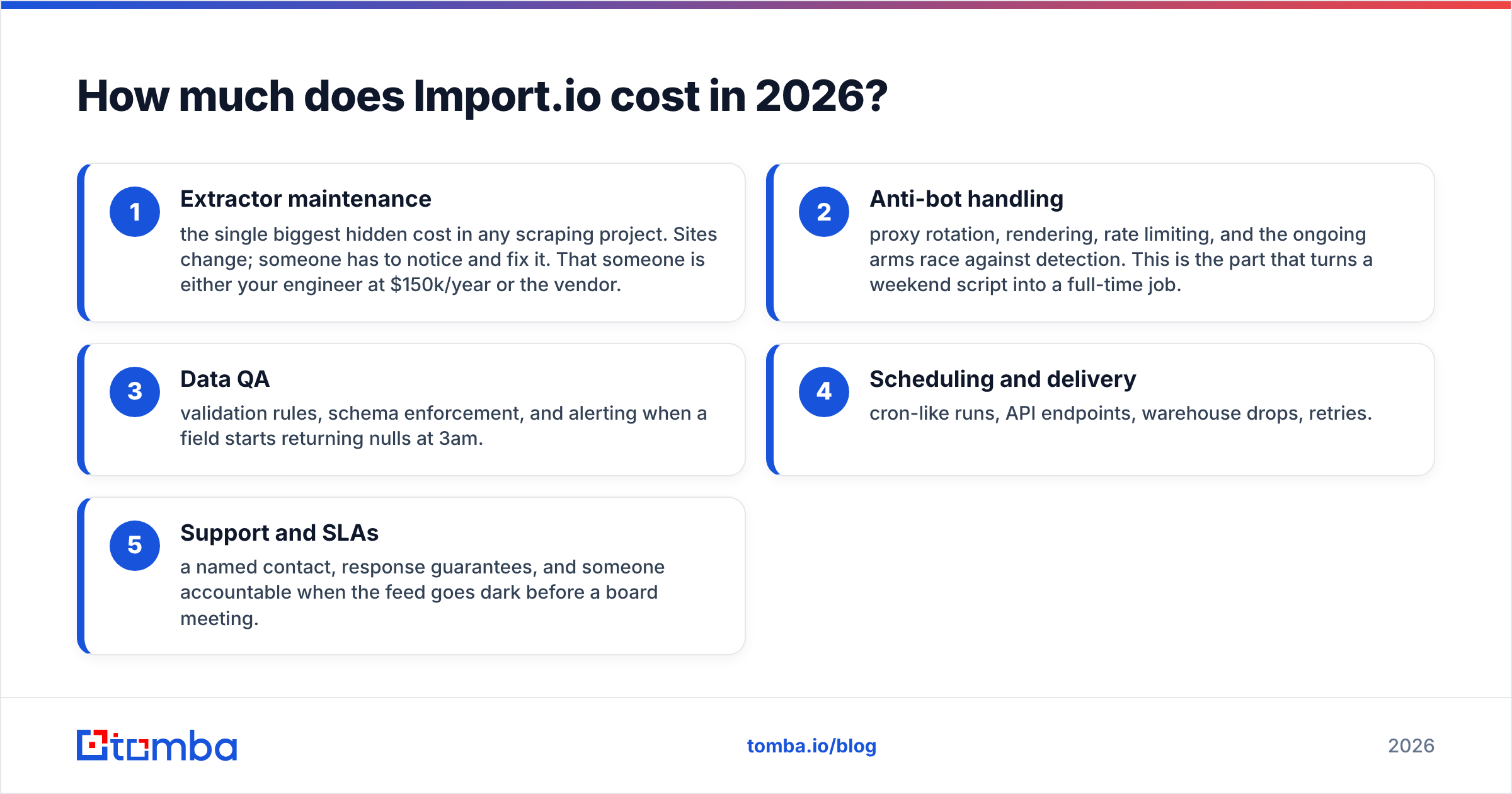
What are you actually paying for?#
- Extractor maintenance — the biggest hidden cost in any scraping project. Sites change, and someone has to notice and fix it. That someone is either your engineer at $150k a year or the vendor.
- Anti-bot handling — proxy rotation, rendering, rate limiting, and the arms race against detection. This is the part that turns a weekend script into a full-time job.
- Data QA — validation rules, schema enforcement, and alerts when a field starts returning nulls at 3am.
- Scheduling and delivery — cron-like runs, API endpoints, warehouse drops, retries.
- Support and SLAs — a named contact, response guarantees, and someone accountable when the feed goes dark before a board meeting.
If you only need items 1 and 2 for three sites, you are overpaying. If you need all five across forty sources, the quote starts to look reasonable.
What do Import.io reviews actually say?#
The same themes repeat across public review sites. The picture is consistent, and more nuanced than either the fans or the critics suggest.
What reviewers consistently praise:
- It handles hard sites. Login walls, heavy JavaScript, odd pagination, and infinite scroll are where DIY scripts die. Reviewers note that Import.io got data out of sources their own attempts could not.
- Support is hands-on. Several reviewers describe real people building or repairing extractors, not a ticket queue.
- Output is clean. The data lands structured and usable, not as raw HTML you still have to parse.
- Scheduling is dependable. Once a feed is configured, it runs.
What reviewers consistently complain about:
- Price relative to alternatives. This is the number-one theme. Smaller teams describe sticker shock after comparing self-serve scrapers.
- Opaque quotas. Some reviewers report confusion about what counts against their limits and how overages are billed.
- Learning curve. The point-and-click builder is fine for a table. Anything conditional or multi-step takes real effort.
- Contract rigidity. Annual terms are common, and reviewers note little room to scale down mid-term.
The honest read: Import.io scores well on capability and support, and poorly on cost and flexibility. That is the classic enterprise-tool profile. It is not a scam, and it is not a bargain.
How does Import.io compare to the alternatives?#
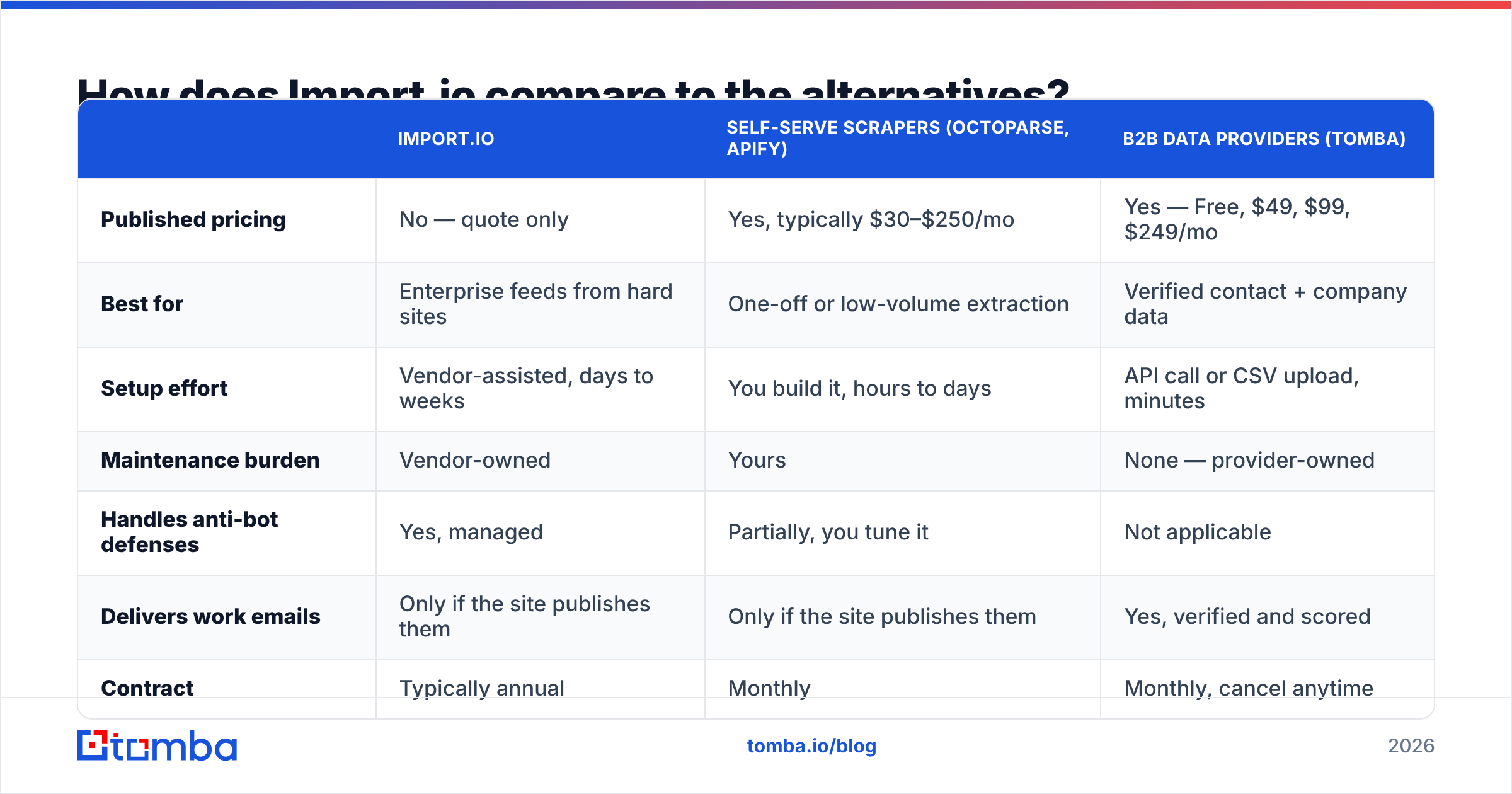
The most common mistake is comparing Import.io only to other scrapers. Half the people evaluating it do not need a scraper at all. They need contact data, and scraping is just the method they assumed they had to use.
| Import.io | Self-serve scrapers (Octoparse, Apify) | B2B data providers (Tomba) | |
|---|---|---|---|
| Published pricing | No — quote only | Yes, typically $30–$250/mo | Yes — Free, $49, $99, $249/mo |
| Best for | Enterprise feeds from hard sites | One-off or low-volume extraction | Verified contact + company data |
| Setup effort | Vendor-assisted, days to weeks | You build it, hours to days | API call or CSV upload, minutes |
| Maintenance burden | Vendor-owned | Yours | None — provider-owned |
| Handles anti-bot defenses | Yes, managed | Partially, you tune it | Not applicable |
| Delivers work emails | Only if the site publishes them | Only if the site publishes them | Yes, verified and scored |
| Contract | Typically annual | Monthly | Monthly, cancel anytime |
| Free tier | No | Usually limited free plan | 25 searches/mo |
Read the "delivers work emails" row twice. That row decides most evaluations. Public web pages almost never publish the direct work email of the VP of Operations you want to reach. No amount of crawl budget conjures data that is not on the page.
For the email-finding job, a domain search returns every discoverable address at a company, with pattern confidence and verification status. It solves in one request what a scraping project takes a quarter to solve, if ever.
Is Import.io worth it for B2B lead generation?#
Usually not — and that is not a knock on the product. It is a category mismatch.
Here is the distinction that saves budgets:
- Import.io answers "what is on these pages?" Prices, listings, inventory, job posts, review counts, regulatory filings. Data that exists publicly but unstructured.
- A contact data provider answers "how do I reach this person?" Work email, deliverability status, phone number, current role, company firmographics. Data that mostly does not exist on public pages in usable form.
Where scraping genuinely helps lead generation is signal capture, not contact capture. Crawl job boards to find companies hiring SDRs. Crawl G2 category pages to find companies reviewing your competitor. Crawl a conference site for the exhibitor list. Then hand those company domains to an email-finding layer to get the humans.
That two-stage pattern is the correct architecture, and it changes the buying question. You do not need a full enterprise feed to grab an exhibitor list once. You need it when the signal must refresh daily across dozens of sources, forever.

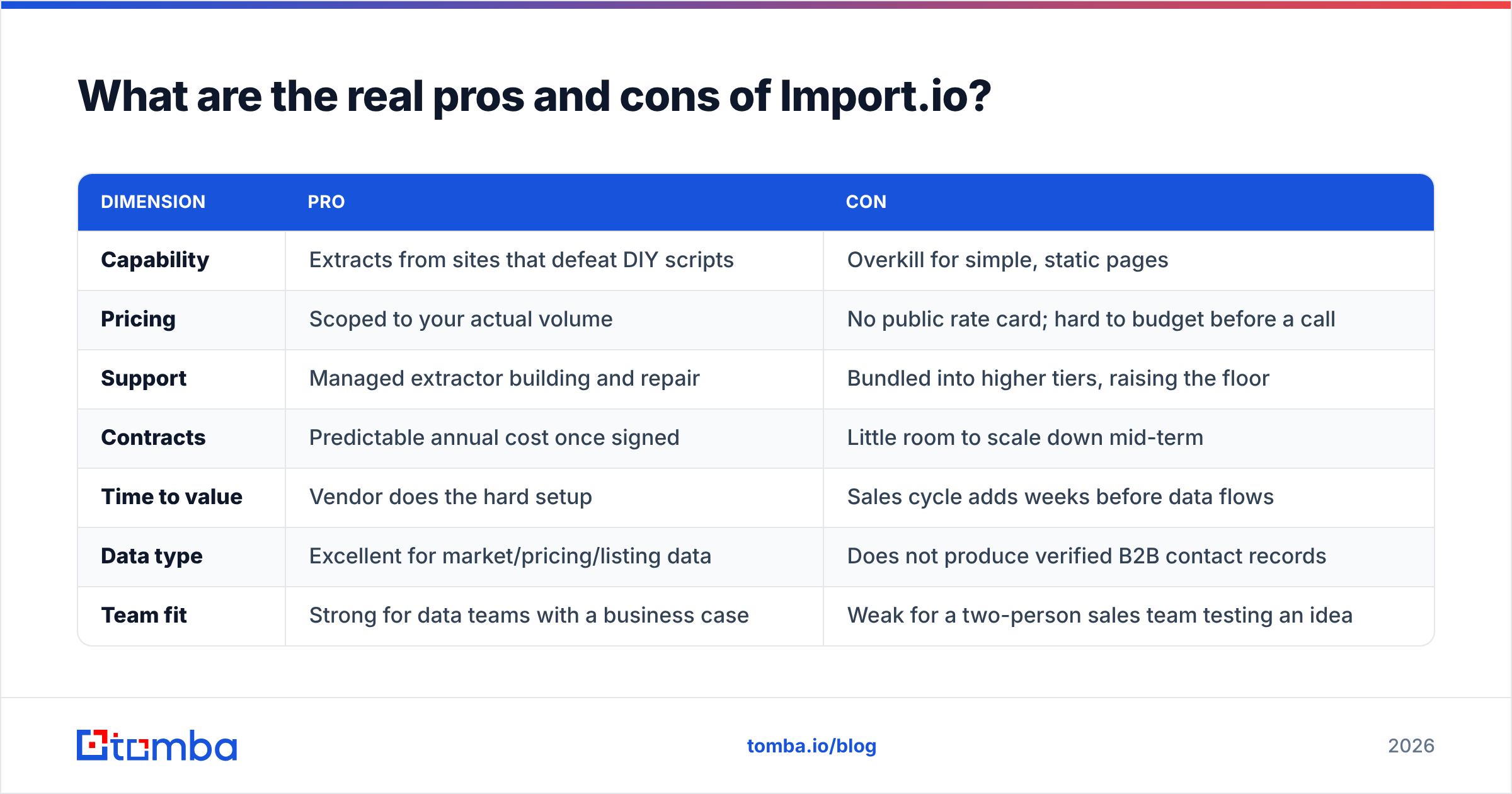
What are the real pros and cons of Import.io?#
| Dimension | Pro | Con |
|---|---|---|
| Capability | Extracts from sites that defeat DIY scripts | Overkill for simple, static pages |
| Pricing | Scoped to your actual volume | No public rate card; hard to budget before a call |
| Support | Managed extractor building and repair | Bundled into higher tiers, raising the floor |
| Contracts | Predictable annual cost once signed | Little room to scale down mid-term |
| Time to value | Vendor does the hard setup | Sales cycle adds weeks before data flows |
| Data type | Excellent for market/pricing/listing data | Does not produce verified B2B contact records |
| Team fit | Strong for data teams with a business case | Weak for a two-person sales team testing an idea |
If three or more of the "con" items are dealbreakers for you, you are probably not the buyer Import.io is built for. That is fine. The category has room for both a Bentley and a bicycle, and most outbound teams need the bicycle.
How do you get B2B contact data without a scraping contract?#
If your end goal is a list of reachable people at target accounts, skip the crawl. Work from identity outward.
- Start with the company domain. You almost always have it — from a CRM, a signal source, a conference list, or a crawl you already ran.
- Run a domain search to pull every discoverable address at that company, plus the org's email pattern. This step replaces most of what teams try to scrape.
- Find specific people by name. When you know who you want, resolve first name + last name + domain directly. Do not hope the address shows up on an about page.
Those three steps find the addresses. The next three make them safe to use.
- Verify before you send. Run every address through an email verifier so bounces do not wreck your sender reputation. Catch-all domains need their own handling, not a coin flip.
- Enrich the record. Add title, seniority, company size, and tech stack via data enrichment. Segmentation and personalization then have something to work with.
- Batch it. For list-scale work, push the whole file through a bulk email finder instead of looping API calls by hand.
Cost comparison in plain terms: Tomba's Free tier gives you 25 searches a month, so you can test the accuracy claim yourself. Starter is $49/mo, Growth is $99/mo, and Pro is $249/mo. Enterprise is custom. Every tier is listed openly on the Tomba pricing page with no demo gate. You can check whether the data works for your ICP before anyone asks for your phone number.
Some teams would rather buy a prebuilt list than run lookups. Providers like BookYourData occupy a legitimate middle ground: prepackaged, filterable contact sets with transparent per-record pricing. The evaluation question is the same one Import.io raises. Are you paying for data you will actually use, or for capability you will never fully deploy?
When should you actually buy Import.io?#
Buy it when all of these are true:
- The data only exists as HTML. No API, no vendor, no dataset — just pages.
- You need it repeatedly, on schedule. One-time extraction does not justify an annual contract.
- The sources fight back. Rate limits, rendering complexity, login walls, frequent redesigns.
- A break costs real money. If a dead feed stalls pricing decisions or a client deliverable, managed support is insurance, not luxury.
- You have a budget owner. Someone can defend a five-figure line item against the cost of an engineer maintaining scrapers full time. That comparison, honestly run, often favors the vendor.
Skip it when your "scraping project" is really a prospecting project in disguise. That is the most common misdiagnosis in this evaluation, and it costs teams a quarter of runway and a contract they cannot exit.
The bottom line#
Import.io is a competent enterprise web data extraction platform. Its strengths are real on difficult sources, and so is the friction on price transparency. If public web content is your raw material and reliability is worth paying for, get a quote. Then compare it honestly against the fully loaded cost of doing it in-house, including the engineer-hours nobody puts in the spreadsheet.
But if you landed here because you need work emails and phone numbers for a target account list, you are evaluating the wrong category. Scrapers find pages. Contact data platforms find people.
Start with the Tomba Email Finder. Drop in a name and a company domain. You get a verified professional email back with a confidence score in seconds — no demo call, no annual commitment, no crawl budget. The free tier covers 25 searches a month. That is enough to test the data against accounts you already know. If it works there, scale to $49/mo and put the scraping budget toward something only scraping can do.
Related guides#
// get started
Find, verify and enrich your first contacts today
Start on the free plan with 25 searches a month, then scale when your team is ready.
Free plan · No credit card required · GDPR & CCPA
// about the author