Improv for Sales: How Comedy Training Fixes Sales Calls
Improv training gets pitched as a personality fix. It isn't. It's a listening and adaptability drill — and only some of it transfers to quota. Here's what works, what to skip, and how to run it in 30 minutes.
TL;DR
- Improv for sales is not about being funny. It's structured practice in listening, accepting information you didn't plan for, and building on it in real time — the exact skills a script kills.
- Three principles carry almost all the value: "yes, and," commit to a choice, and make your partner look good. The rest is theater craft you don't need.
- Improv training beats script drilling on discovery quality and objection handling; script drilling still wins on compliance, pricing accuracy, and new-hire ramp speed. Run both.
- Thirty minutes a week is enough. Long offsites feel great and change nothing you can measure two weeks later.
- Improv can't fix a bad list. If half your calls go to the wrong person, the problem is data, not delivery.
What is improv for sales?#
Improv for sales is the practice of borrowing rehearsal techniques from improvisational theater — no script, no predetermined ending, everything built from what your partner just said — and using them to train sales conversations.
Think of it like a jazz musician versus someone playing sheet music. Both know scales. Both practiced for years. The difference is that when the drummer changes the tempo mid-song, the jazz player follows and the sheet-music player loses their place. Technically, improv training builds a reflex: hear the unexpected input, accept it as true, and add to it rather than resetting to your prepared position.
That reflex is the thing sales teams are actually missing. Most reps are not short on product knowledge. They're short on the ability to hear "we already tried something like this and it failed" and do anything other than pivot back to slide four.
Improvisational theater has had a formal training curriculum for over sixty years, and the corporate arm of it is mature — Second City has been running business workshops for decades, and most large enablement teams have at least experimented with a session. The reason it keeps coming back is simple: the failure mode it addresses (talking past the buyer) is the most expensive failure mode in B2B selling.
Why do scripted sales calls stall?#
A script is a prediction. It assumes the buyer will raise objection A, then objection B, then ask about pricing. Real calls don't do that.
Here's what goes wrong mechanically:
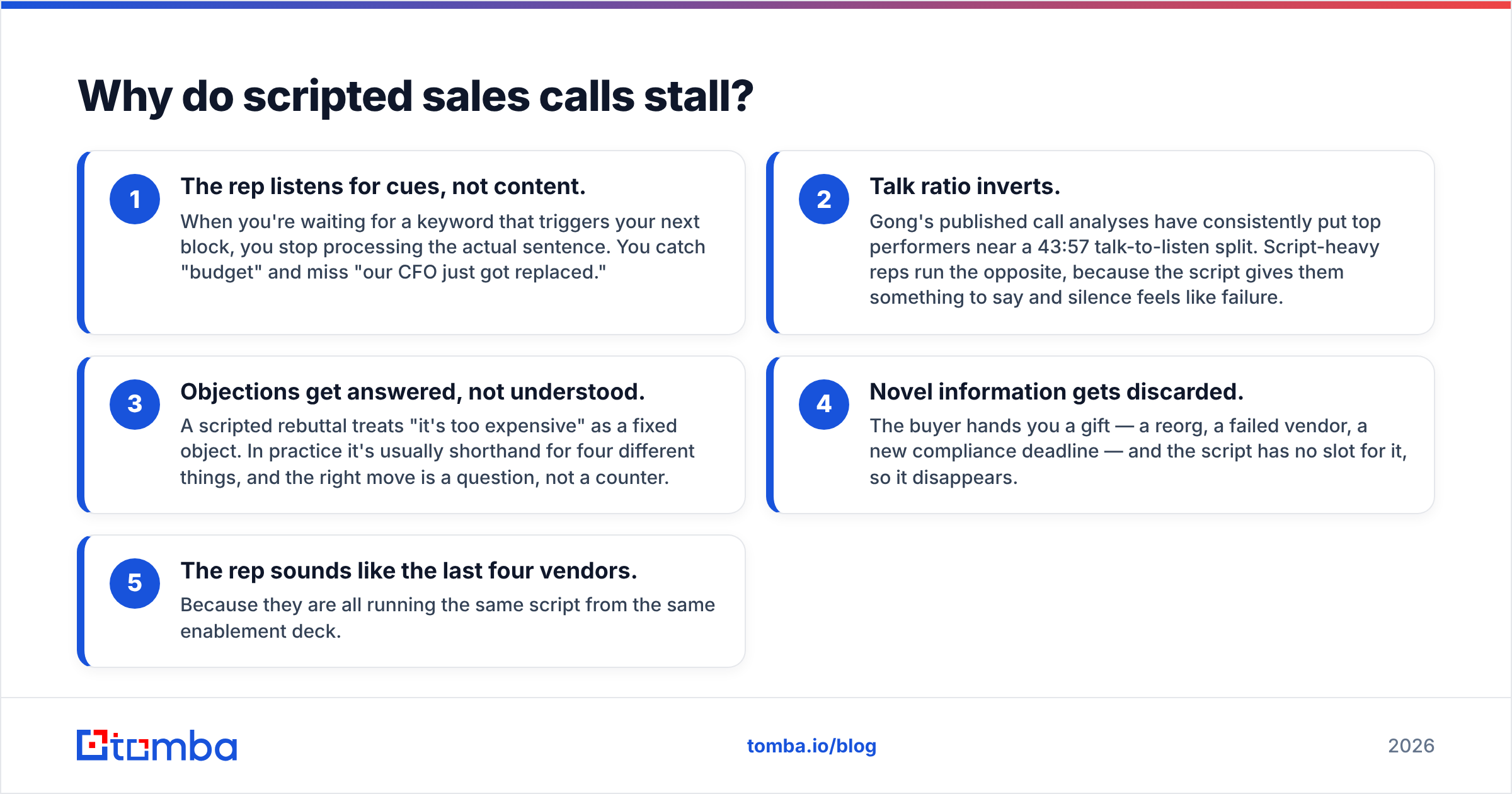
- The rep listens for cues, not content. When you're waiting for a keyword that triggers your next block, you stop processing the actual sentence. You catch "budget" and miss "our CFO just got replaced."
- Talk ratio inverts. Gong's published call analyses have consistently put top performers near a 43:57 talk-to-listen split. Script-heavy reps run the opposite, because the script gives them something to say and silence feels like failure.
- Objections get answered, not understood. A scripted rebuttal treats "it's too expensive" as a fixed object. In practice it's usually shorthand for four different things, and the right move is a question, not a counter.
- Novel information gets discarded. The buyer hands you a gift — a reorg, a failed vendor, a new compliance deadline — and the script has no slot for it, so it disappears.
- The rep sounds like the last four vendors. Because they are all running the same script from the same enablement deck.
Improv attacks all five at once, because every drill punishes the same behavior: ignoring your partner.

What are the core improv principles that transfer to selling?#
Most improv curricula have twenty-plus concepts. Five transfer cleanly to revenue work. The rest is stagecraft.
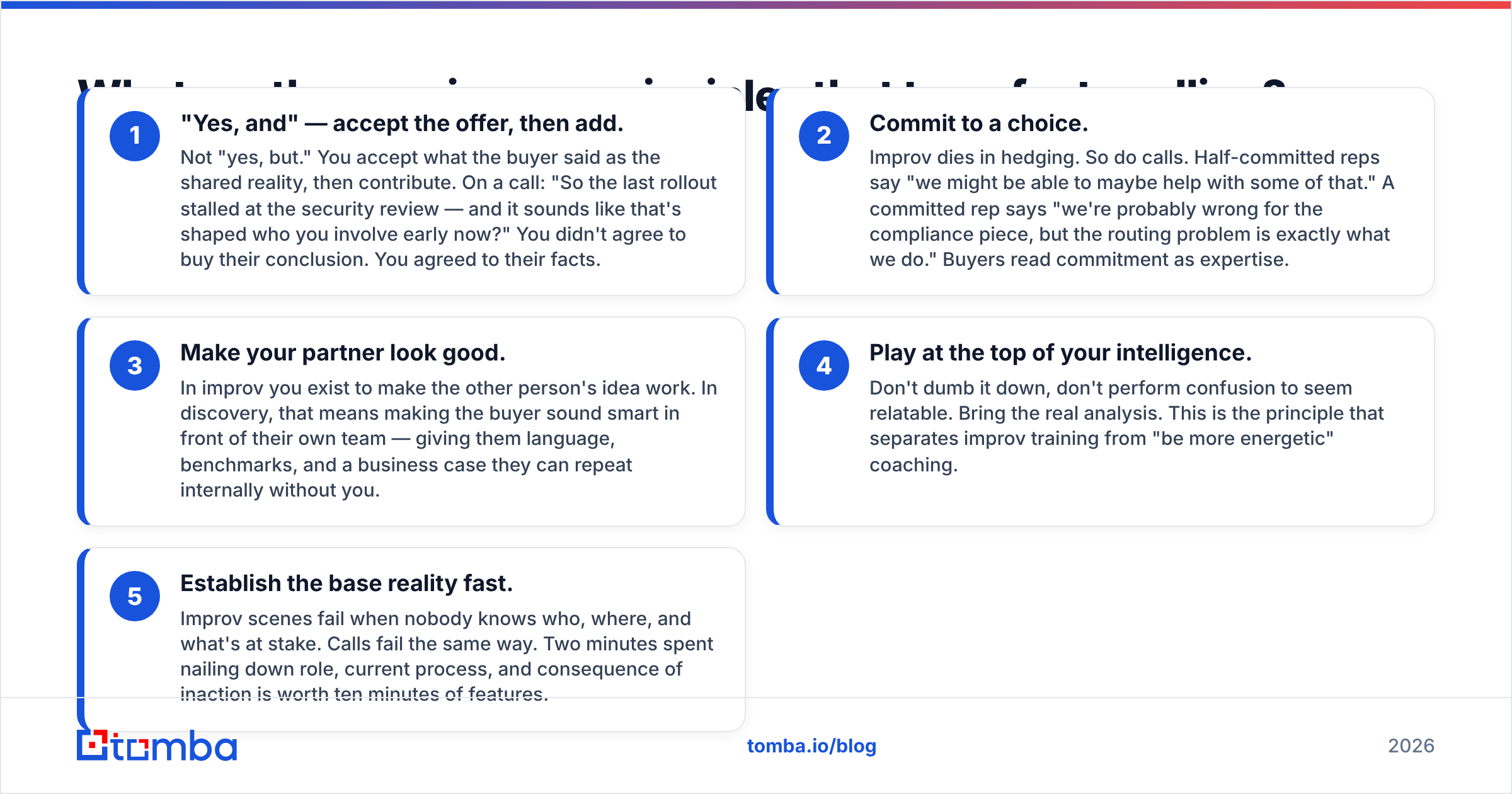
- "Yes, and" — accept the offer, then add. Not "yes, but." You accept what the buyer said as the shared reality, then contribute. On a call: "So the last rollout stalled at the security review — and it sounds like that's shaped who you involve early now?" You didn't agree to buy their conclusion. You agreed to their facts.
- Commit to a choice. Improv dies in hedging. So do calls. Half-committed reps say "we might be able to maybe help with some of that." A committed rep says "we're probably wrong for the compliance piece, but the routing problem is exactly what we do." Buyers read commitment as expertise.
- Make your partner look good. In improv you exist to make the other person's idea work. In discovery, that means making the buyer sound smart in front of their own team — giving them language, benchmarks, and a business case they can repeat internally without you.
- Play at the top of your intelligence. Don't dumb it down, don't perform confusion to seem relatable. Bring the real analysis. This is the principle that separates improv training from "be more energetic" coaching.
- Establish the base reality fast. Improv scenes fail when nobody knows who, where, and what's at stake. Calls fail the same way. Two minutes spent nailing down role, current process, and consequence of inaction is worth ten minutes of features.
Notice what's missing: nothing here is about jokes. If your training vendor spends the session on punchlines, you bought entertainment.
Is improv training better than script drilling or role-play?#
No — it's better at different things. The teams that get results run all three and assign each a job. Here's the honest breakdown.
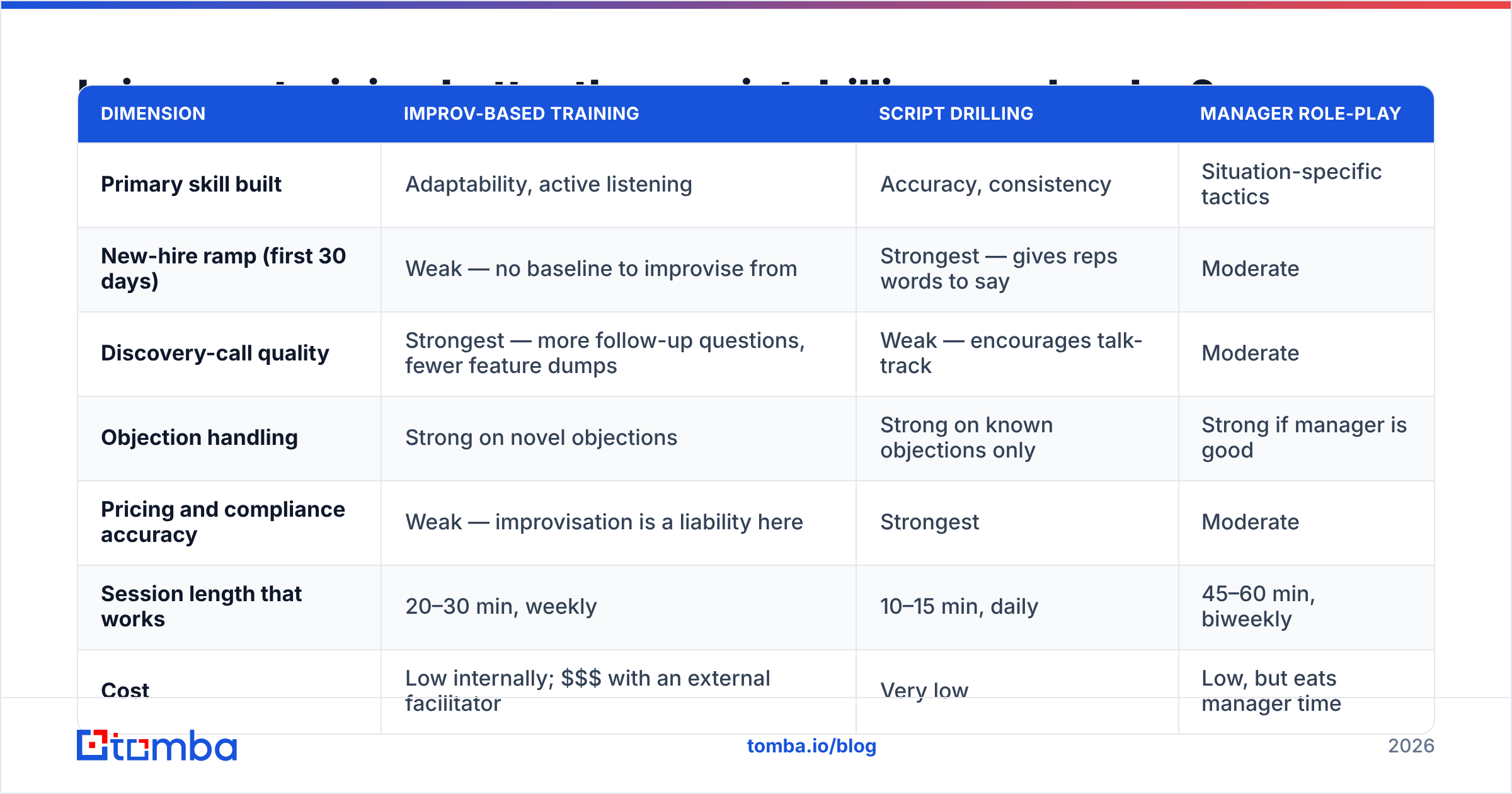
| Dimension | Improv-based training | Script drilling | Manager role-play |
|---|---|---|---|
| Primary skill built | Adaptability, active listening | Accuracy, consistency | Situation-specific tactics |
| New-hire ramp (first 30 days) | Weak — no baseline to improvise from | Strongest — gives reps words to say | Moderate |
| Discovery-call quality | Strongest — more follow-up questions, fewer feature dumps | Weak — encourages talk-track | Moderate |
| Objection handling | Strong on novel objections | Strong on known objections only | Strong if manager is good |
| Pricing and compliance accuracy | Weak — improvisation is a liability here | Strongest | Moderate |
| Session length that works | 20–30 min, weekly | 10–15 min, daily | 45–60 min, biweekly |
| Cost | Low internally; $$$ with an external facilitator | Very low | Low, but eats manager time |
| Fails when | Team treats it as a game with no debrief | Market or product shifts | Manager plays an unrealistically easy buyer |
The practical sequencing: script drilling for weeks one to four so the rep has raw material, improv from week five onward so they stop reciting it, role-play forever for named-account prep.
One caveat worth stating plainly. Improv training has almost no published, controlled outcome data in a sales context. The mechanism is well documented in performance and communication research; the "improv lifts win rate 23%" numbers floating around vendor decks are self-reported and should be treated as marketing. Run it because the behavior change is observable on your own call recordings, not because someone promised you a percentage.
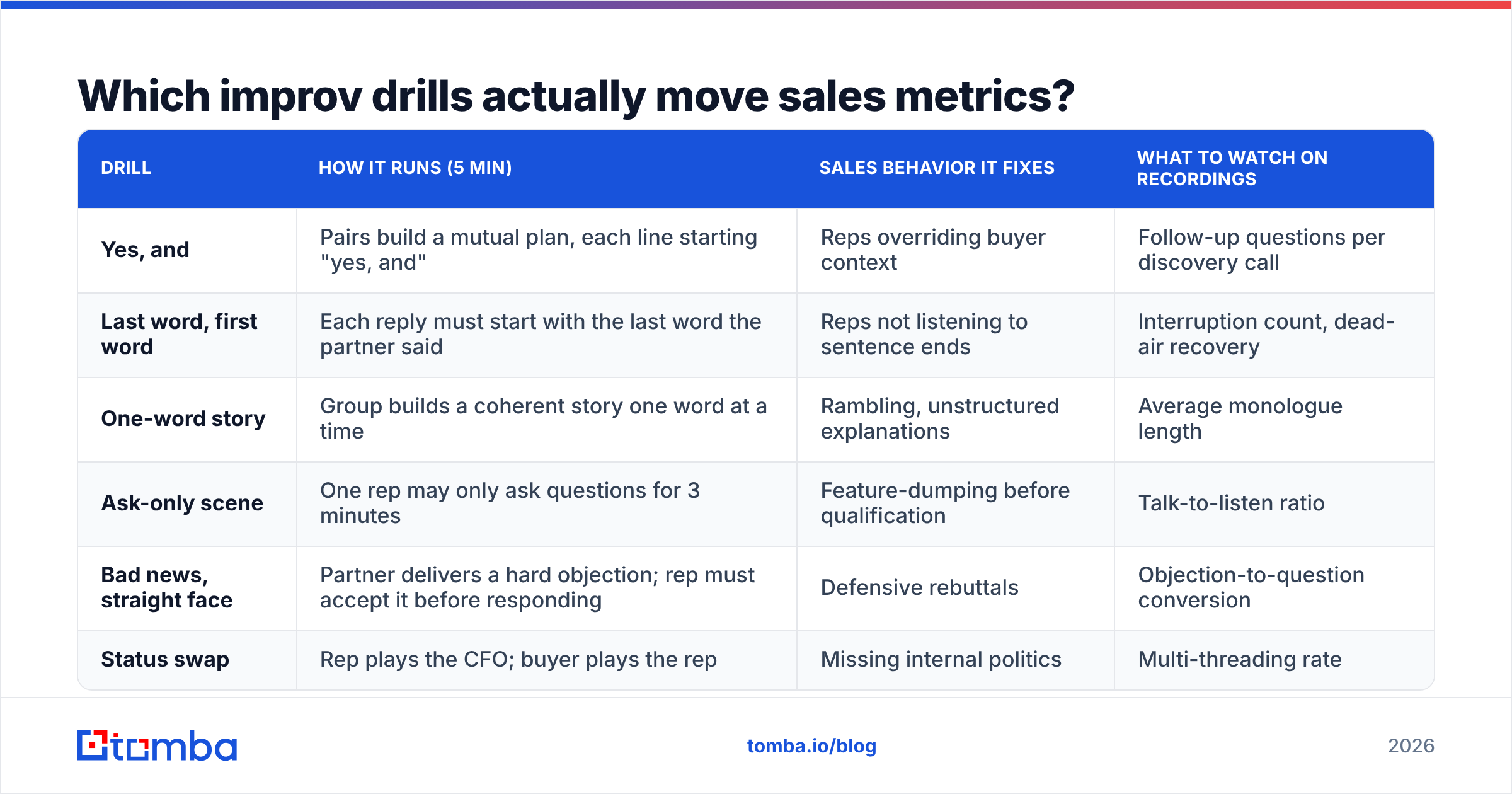
Which improv drills actually move sales metrics?#
These six are the ones worth your team's time. Each maps to a specific call behavior and a specific thing you can watch for in recordings afterward.
| Drill | How it runs (5 min) | Sales behavior it fixes | What to watch on recordings |
|---|---|---|---|
| Yes, and | Pairs build a mutual plan, each line starting "yes, and" | Reps overriding buyer context | Follow-up questions per discovery call |
| Last word, first word | Each reply must start with the last word the partner said | Reps not listening to sentence ends | Interruption count, dead-air recovery |
| One-word story | Group builds a coherent story one word at a time | Rambling, unstructured explanations | Average monologue length |
| Ask-only scene | One rep may only ask questions for 3 minutes | Feature-dumping before qualification | Talk-to-listen ratio |
| Bad news, straight face | Partner delivers a hard objection; rep must accept it before responding | Defensive rebuttals | Objection-to-question conversion |
| Status swap | Rep plays the CFO; buyer plays the rep | Missing internal politics | Multi-threading rate |
The "ask-only scene" is the highest-leverage one for most teams and the most uncomfortable. Three minutes of questions only feels endless to the rep and completely normal to the buyer. That gap is the lesson.
Debrief matters more than the drill. Five minutes of "what did you notice you wanted to say and didn't?" is where the learning lands. Skip the debrief and you've run a warm-up, not training.
How do you run a 30-minute improv session for a sales team?#
You don't need a facilitator to start. Here's a format that survives contact with a real sales floor:
- Minutes 0–3: physical reset. One round of a fast, low-stakes group game. The point is to break the meeting-voice register, not to be fun.
- Minutes 3–10: one drill, in pairs. Pick from the table above. One drill per session. Rotating through four drills teaches nothing.
- Minutes 10–20: the same drill with real account context. Now the "partner" is a named prospect persona from your actual pipeline, and the constraint stays in place.
- Minutes 20–27: debrief. Two questions: what did you hear that you'd have missed last month, and where did you feel the urge to pitch?
- Minutes 27–30: one commitment each. Every rep names one behavior they'll run on their next three calls. Write it down. Check it next week against recordings.
Two failure modes to guard against. First, managers who don't participate — status asymmetry kills the exercise instantly, because nobody will risk looking foolish in front of someone who won't. Second, treating attendance as the metric. The metric is a change in call recordings within two weeks.
If you want a broader library of enablement mechanics to slot around this, HubSpot's sales blog is a reasonable free starting point, and it stays mostly vendor-neutral on coaching methodology.
Where does improv fail in sales?#
Four places, and being honest about them is what makes the program credible internally.
It doesn't fix pricing or legal conversations. Improvisation in a redline discussion is how you give away a discount you can't recover. Those conversations want scripts, approval matrices, and silence.
It doesn't fix a bad list. This is the big one. If your reps are improvising brilliantly at people who don't own the problem, you've made the wrong call better instead of making the right call. No amount of "yes, and" survives a wrong-persona dial. Fix targeting and contact accuracy first — a verified email finder and clean contact enrichment do more for a struggling outbound team in a week than a quarter of soft-skills work.
It doesn't fix a broken value proposition. Improv makes reps better at exploring the buyer's world. If the product genuinely doesn't solve the problem they find there, the training just helps reps discover that faster. Useful, but not what leadership thought they bought.
It can produce over-confidence in unqualified reps. A rep who's fluent and adaptable but shaky on product will happily improvise a commitment engineering can't ship. Sequence improv after product certification, never before.
What should you measure to know if it worked?#
Improv training is unusually easy to evaluate, because the behaviors it targets are all visible in call recordings. Pick three leading indicators and one lagging one.
Leading indicators, measured on recorded calls before and four weeks after:
- Talk-to-listen ratio on discovery calls. Directional target: rep talking under 50%.
- Follow-up questions per call — specifically questions that reference something the buyer just said, not questions from your discovery template.
- Objection-to-question conversion: what share of objections get a clarifying question before a rebuttal. This one moves fastest and is the clearest signal the drills are landing.
- Monologue length: longest uninterrupted rep stretch. Should shrink.
Lagging indicator: stage-two-to-stage-three conversion, or whatever your equivalent of "discovery led to a real evaluation" is. Don't measure improv against closed-won. Too many variables between the drill and the signature, and if you tie it to revenue you'll kill the program the first bad quarter. Track response rate separately for outbound, since that's driven far more by list quality and messaging than by conversational skill.
Give it a full quarter before you judge. Behavior change in the first two weeks is real but fragile; what you want to see is whether the new questioning habit survives a month of pipeline pressure.
Common questions about improv for sales#
Does my team need to be extroverted for this to work? No, and the assumption is backwards. Improv rewards listening, and reserved reps are often better at it. The drills that require volume — big physical games — are the ones you can drop.
How much does external improv training cost? Facilitator-led corporate workshops typically run in the low thousands per session, and full programs go higher. Starting internally with the drill table above costs a manager's prep time, which is why most teams should start there and buy facilitation only if weekly sessions stick.
Is this just role-play with a different name? No. Role-play has a defined scenario and a right answer. Improv removes both on purpose, which is what forces reps to work from what they actually hear rather than from what they prepared.
Where does this fit for cold calling? Well, with one condition. Improv sharply improves the first thirty seconds — the part where a script sounds most like a script. But it only helps if you're reaching the right person, so pair it with accurate B2B phone numbers rather than dialing whatever the CRM inherited three years ago.
Start with the input, then train the delivery#
Improv for sales is a genuinely good investment for a team whose calls are going to the right people and still going nowhere. It's a bad investment for a team whose calls are going to the wrong people, because it makes the wrong conversation more articulate.
So check the input first. If your reps are improvising at outdated contacts, bouncing addresses, and gatekeepers who were never the buyer, the drills will not save the quarter.
Fix the list, then run the drills. Tomba's Email Finder gets you verified, current contacts for the people who actually own the problem you solve — by domain, name, or company — so the conversational skill you're building lands on someone who can act on it. The free tier covers 25 searches a month if you just want to spot-check how stale your current list is; paid plans start at $49/mo, and you can see the full breakdown on Tomba pricing. Get the target right, then teach your team to listen once they're on the phone.
Related guides#
// get started
Find, verify and enrich your first contacts today
Start on the free plan with 25 searches a month, then scale when your team is ready.
Free plan · No credit card required · GDPR & CCPA
// about the author