How to Improve Sales Calls in 2026: A Practical Playbook
Most reps try to improve sales calls by dialing more. The teams that actually move their connect and conversion rates fix the data, the first 30 seconds, and the coaching loop instead. Here's the full playbook.
TL;DR
- The fastest way to improve sales calls is not more dials. It is fewer wrong numbers, a tighter first 30 seconds, and a coaching loop that reviews real recordings weekly.
- Bad phone data quietly caps your ceiling. If 30% of your numbers are stale, no script fixes the math.
- Openers that name a specific, observable trigger beat permission-based openers ("Did I catch you at a bad time?") in almost every team we've seen tested.
- Discovery quality, not talk time, predicts whether a call converts to a next step. Track question count and longest customer monologue.
- Measure connect rate, conversation rate, next-step rate, and show rate separately. Averaging them hides the actual broken step.
Why do most attempts to improve sales calls fail?#
Because they start at the script and end at the script.
Think of a sales call like a restaurant service. You can rewrite the menu wording all you want, but if the ingredients arrived spoiled and the kitchen never tastes the food before it goes out, the menu is irrelevant. The script is the menu. Your contact data is the ingredients. Your call review process is the tasting.
Teams that try to improve sales calls almost always jump to the middle layer — the words — because it is the only layer that feels like "selling." Then they run a two-week experiment, see no change, and conclude that cold calling is dead.
Here is the honest breakdown of where call performance actually leaks, in the order the leak happens:
- Data quality. Wrong number, disconnected line, or a person who left the company 14 months ago. Nothing downstream matters.
- Targeting. Right number, wrong person. You reached a manager who cannot sign, cannot champion, and does not own the problem.
- The first 30 seconds. You got a human. They decided within two sentences whether this was a peer conversation or a telemarketing call.
- Discovery depth. You held the line but never surfaced a problem worth a meeting.
- The next-step ask. You built interest and then asked "would you be open to learning more?" instead of proposing a time.
- Follow-through. Meeting booked, meeting no-showed, nobody sequenced the confirmation.
Fix these in order. Optimizing step 5 while step 1 is broken is the sales equivalent of repainting a car with no engine.
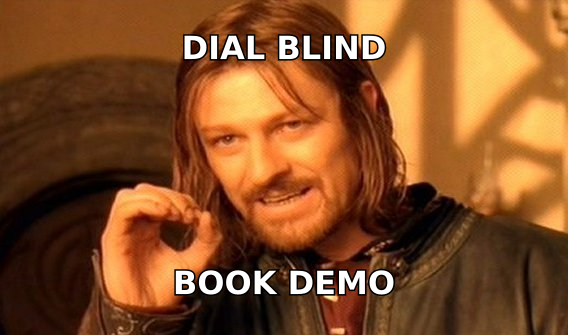
How much does bad phone data actually cost you?#
More than any script change can recover.
Run the arithmetic on a typical outbound week. A rep makes 400 dials. Industry-wide, B2B direct-dial connect rates in the high single digits to low teens are normal, and mobile numbers connect meaningfully better than switchboards. Now assume 25% of your list has decayed — people change jobs, companies restructure, direct dials get reassigned. That is 100 dials that were never going to connect regardless of how good the rep is.
The compounding part is worse than the raw number. Those 100 dead dials also consume:
- Roughly 45–70 minutes of rep time per week, per rep
- Dialer minutes and connectivity spend
- Manager review bandwidth, because failed calls still show up in the activity dashboard
- Rep morale, which is the input nobody puts in the spreadsheet and everybody feels
| Data problem | What it looks like on the call | Downstream cost |
|---|---|---|
| Disconnected number | Three rings, then a carrier tone | Pure waste; no learning signal |
| Wrong person, right company | "I don't handle that, try Priya" | Recoverable if you capture the referral |
| Switchboard instead of direct dial | Gatekeeper screen every time | 3–5x more attempts per conversation |
| Stale title | Pitch lands on the wrong pain | Call ends politely and permanently |
| Unverified mobile | Voicemail that is not theirs | Compliance and brand risk |
Two practical moves. First, validate numbers before they enter the dialer rather than discovering the failures live — a phone validator run against the list catches the obvious dead weight in bulk. Second, when you only have a name and a company, pull the direct contact rather than guessing at the switchboard; that is exactly what a phone finder is for. Pair either with contact enrichment so the rep sees title, seniority, and company context on the screen before the line picks up.
Data decay is not a one-time cleanup. Contact records go stale continuously, which is why a quarterly re-verification cadence beats an annual purge.
What does a good sales call actually look like in 2026?#
It looks like a peer diagnosing a problem, not a vendor reciting features.
Three structural things have changed since the pre-2020 playbook:
Buyers screen harder. Unknown numbers get ignored at rates that would have been unthinkable a decade ago. Carrier-level spam labeling means your number can get flagged before a human ever sees it. Rotating caller IDs and registering your numbers matter as much as tone of voice.
Buying committees got bigger. Research from analyst firms like Gartner has consistently put B2B buying groups in the range of six to ten stakeholders. One good call rarely closes anything. Its job is to recruit a guide.
Buyers arrive pre-researched. They have read the comparison posts. A call that leads with "let me tell you what we do" gets hung up on because it offers less information than the website already did.
So the shape of a strong 2026 call is:
- Contextual opener (0:00–0:20) — name the specific, observable reason you called this person today
- Permission through relevance (0:20–0:40) — not "is now a bad time" but "I'll be 30 seconds, then you tell me if it's worth more"
- One sharp problem hypothesis (0:40–1:30) — a claim about their world that they can confirm or correct
- Discovery (1:30–6:00) — open questions, long silences, no pitching
- Concrete next step (6:00–7:00) — a specific day and time, plus who else should be on it
- Written confirmation within five minutes — calendar invite with an agenda they can forward internally
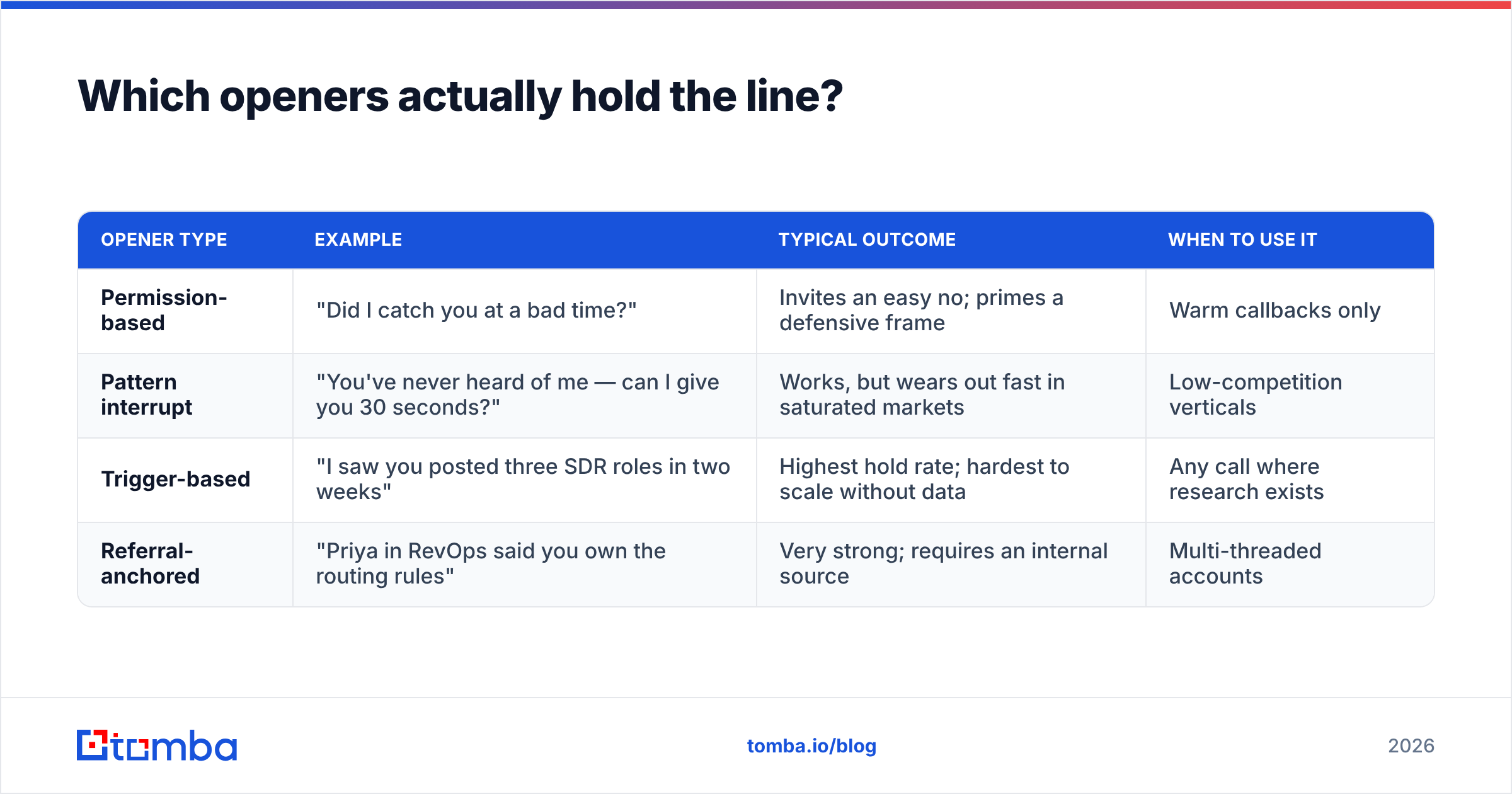
Which openers actually hold the line?#
Openers that trade information for attention.
Compare the four common patterns:
| Opener type | Example | Typical outcome | When to use it |
|---|---|---|---|
| Permission-based | "Did I catch you at a bad time?" | Invites an easy no; primes a defensive frame | Warm callbacks only |
| Pattern interrupt | "You've never heard of me — can I give you 30 seconds?" | Works, but wears out fast in saturated markets | Low-competition verticals |
| Trigger-based | "I saw you posted three SDR roles in two weeks" | Highest hold rate; hardest to scale without data | Any call where research exists |
| Referral-anchored | "Priya in RevOps said you own the routing rules" | Very strong; requires an internal source | Multi-threaded accounts |
Trigger-based openers win because they answer the buyer's real first question, which is never "what do you sell." It is "why are you calling me, and why now." A trigger answers both in one sentence.
The scaling problem is obvious: triggers require research, and research does not scale by hand. This is where enrichment stops being a data-ops nicety and becomes a call-quality lever. If the rep's screen shows headcount changes, tech stack signals, funding, and role tenure before the dial, the trigger writes itself. If the screen shows only a name and a number, the rep defaults to the generic opener and the call dies at 0:08.
How do you make discovery questions do real work?#
Ask fewer, deeper questions and then shut up.
The most common discovery failure is not asking bad questions. It is asking good questions and then answering them yourself two seconds into the silence. Call-recording platforms have published years of analysis on this, and the direction is consistent: on discovery calls that advance, the customer talks substantially more than the rep, and the rep's questions cluster into a small number of open-ended threads rather than a long checklist.
A workable discovery frame for a first call:
- Situation anchor: "Walk me through how your team handles X today." One question, then silence.
- Cost of the status quo: "When that breaks, who feels it first?" You want a named person and a consequence.
- Prior attempts: "What have you already tried?" This surfaces both budget history and your real competitor, which is often "a spreadsheet and a contractor."
- Decision mechanics: "If you decided this was worth solving, what happens next internally?" This is the win rate question disguised as curiosity.
- Timing reality: "Is this on a roadmap or is it a someday problem?" A clean "someday" is a gift; it saves you a quarter of forecast pollution.
Notice what is absent: no feature questions, no "what would it mean to you if we could solve that," no manufactured urgency. Buyers can feel scripted enthusiasm and it costs you credibility at exactly the moment you need it.
Two mechanical habits that improve discovery immediately:
Count your questions. Post-call, write down how many genuinely open questions you asked. Under five on a discovery call is usually a pitch wearing a costume.
Track longest customer monologue. If your buyer never speaks for 45 uninterrupted seconds, you did not find the thing that actually bothers them.
Which tools actually change call outcomes?#
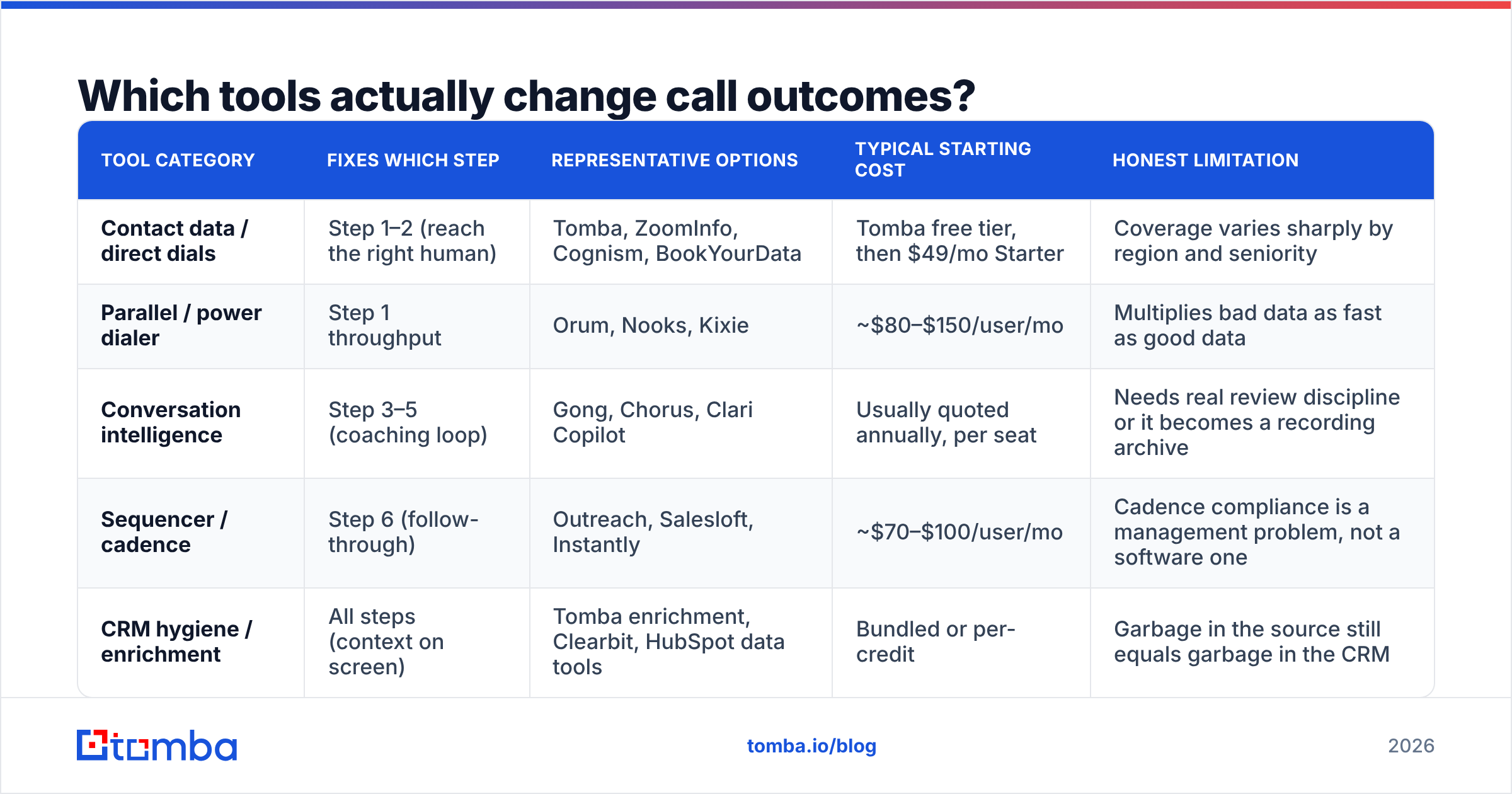
Different tools fix different steps, and buying the wrong one is why most "call improvement" budgets underperform.
| Tool category | Fixes which step | Representative options | Typical starting cost | Honest limitation |
|---|---|---|---|---|
| Contact data / direct dials | Step 1–2 (reach the right human) | Tomba, ZoomInfo, Cognism, BookYourData | Tomba free tier, then $49/mo Starter | Coverage varies sharply by region and seniority |
| Parallel / power dialer | Step 1 throughput | Orum, Nooks, Kixie | ~$80–$150/user/mo | Multiplies bad data as fast as good data |
| Conversation intelligence | Step 3–5 (coaching loop) | Gong, Chorus, Clari Copilot | Usually quoted annually, per seat | Needs real review discipline or it becomes a recording archive |
| Sequencer / cadence | Step 6 (follow-through) | Outreach, Salesloft, Instantly | ~$70–$100/user/mo | Cadence compliance is a management problem, not a software one |
| CRM hygiene / enrichment | All steps (context on screen) | Tomba enrichment, Clearbit, HubSpot data tools | Bundled or per-credit | Garbage in the source still equals garbage in the CRM |
The sequencing that works for most teams under 50 reps: fix data first, add conversation intelligence second, add a dialer third. Buying a parallel dialer before cleaning the list is how teams end up making 1,200 dials a week to reach the same number of humans they reached at 400.
For pricing transparency on the data layer, Tomba pricing runs a free tier at 25 searches per month, Starter at $49/mo, Growth at $99/mo, and Pro at $249/mo, with Enterprise quoted. That matters for smaller teams because the enterprise data vendors typically start in the five figures annually and lock you into a seat count you will not use in month one.
If your team lives inside a CRM, wire the data layer directly into it rather than exporting CSVs — see the HubSpot integration approach, or read HubSpot's own sales resources for the process side of call handling.
How do you build a call coaching loop that people actually use?#
Make it small, weekly, and specific.
Most coaching programs die because they are ambitious. "Review five calls per rep per week" becomes zero calls per rep per week by the third week. Shrink it until it survives contact with a real quarter:
- One call per rep, per week, reviewed live. Fifteen minutes. Manager and rep listen together.
- One skill in focus per month. Openers in January. Discovery silence in February. Next-step asks in March. Do not review "everything."
- A scorecard with five items, not twenty. Did the opener name a trigger? Did the rep go silent after the first question? Was the next step a specific time? Was a second stakeholder named? Was the confirmation sent within five minutes?
- Peer review once a month. Reps hear things in each other's calls that managers stop hearing after year three.
- A "greatest hits" library. Three-minute clips of real calls that worked, tagged by situation. This is the single highest-leverage asset a sales team can build and the one most teams never start.
The coaching loop is where sales enablement budgets either compound or evaporate. The difference is almost never content quality. It is cadence.
What should you measure to know it is working?#
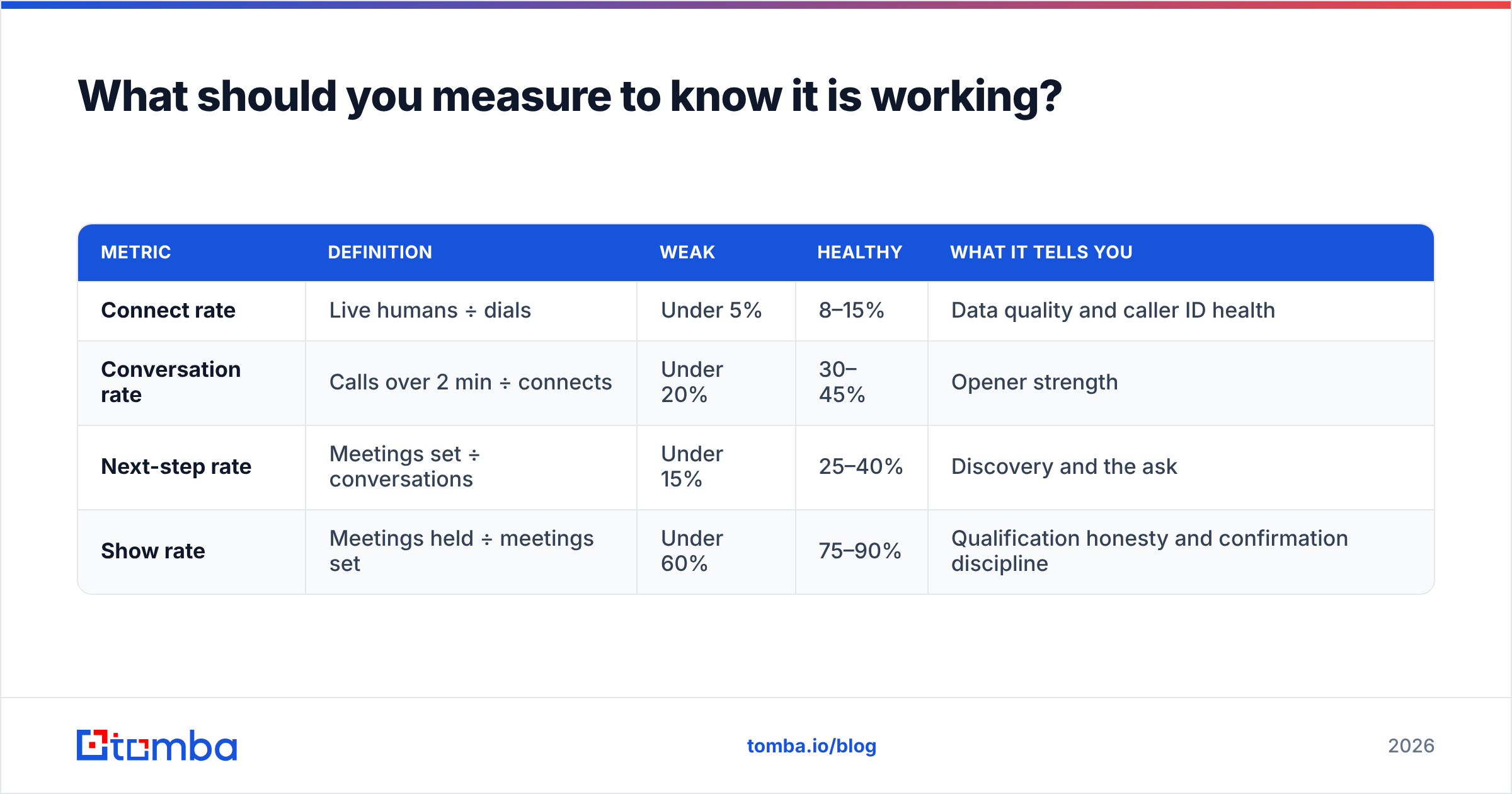
Break the funnel into four independent rates and watch them separately.
| Metric | Definition | Weak | Healthy | What it tells you |
|---|---|---|---|---|
| Connect rate | Live humans ÷ dials | Under 5% | 8–15% | Data quality and caller ID health |
| Conversation rate | Calls over 2 min ÷ connects | Under 20% | 30–45% | Opener strength |
| Next-step rate | Meetings set ÷ conversations | Under 15% | 25–40% | Discovery and the ask |
| Show rate | Meetings held ÷ meetings set | Under 60% | 75–90% | Qualification honesty and confirmation discipline |
Averaging these into a single "meetings per 100 dials" number is the most common reporting mistake in outbound. It tells you the machine is underperforming without telling you which gear is stripped. A team at 4% connect and 40% next-step has a data problem. A team at 14% connect and 8% next-step has a talk-track problem. The blended number is identical. The fix is completely different.
Track them weekly, per rep, and look at the trend rather than the absolute. Absolute benchmarks vary enormously by industry, deal size, and geography — a 6% connect rate in enterprise financial services may be excellent, while 6% in mid-market SaaS is a broken list.
What is the 30-day plan to improve sales calls?#
Week 1 — audit the ingredients. Export your active call list. Validate every number. Measure what percentage is dead. Do not change a single word of the script this week.
Week 2 — rebuild the opener around triggers. Enrich the surviving list so each record carries at least one observable trigger. Write three trigger-based openers. Assign one per rep and hold them to it for the full week.
Week 3 — install the silence rule. Every rep asks their first discovery question and then does not speak until the buyer does. Review one call per rep against this single criterion.
Week 4 — fix the ask and the follow-through. Replace "would you be open to" with a specific proposed time. Send the calendar invite before the call ends. Measure show rate separately from set rate.
Four weeks, four variables, one at a time. You will learn more from that than from a quarter of simultaneous changes you cannot attribute.
Where should you start?#
Start where the leak is largest, which for most teams is the list, not the language.
If your connect rate is under 8%, no amount of talk-track work will move your meeting count meaningfully. Pull a clean sample of your target accounts, verify the contacts, and re-run the same script against good data before you change anything else. The delta will tell you whether you have a data problem or a selling problem — and that single answer is worth more than a month of coaching aimed at the wrong layer.
When you are ready to rebuild the list underneath your calls, start with the Tomba Email Finder. It gives you verified, up-to-date professional contacts by domain, name, or company, so the multi-channel follow-up around every call lands on a real person instead of a bounce. Free tier covers 25 searches a month if you want to test coverage on your own accounts before committing to anything.
Related guides#
// get started
Find, verify and enrich your first contacts today
Start on the free plan with 25 searches a month, then scale when your team is ready.
Free plan · No credit card required · GDPR & CCPA
Get the Tomba newsletter
Product and data updates
// about the author