How to Improve Sales Close Rate in 2026: A Practical Guide
Most teams try to fix a bad close rate by adding more pipeline. That usually makes it worse. Here is the diagnostic order that actually moves the number, with benchmarks, frameworks, and a 90-day plan.
TL;DR
- Close rate is an output metric. You cannot coach it directly — you fix the four inputs underneath it: lead quality, qualification discipline, stage hygiene, and follow-up consistency.
- A typical B2B SaaS team closes 15-25% of qualified opportunities. If you are under 10%, the problem is almost always upstream of the demo, not inside it.
- Adding more pipeline to a broken close rate multiplies wasted rep hours. Fix the conversion math first, then scale volume.
- Contact data quality is the least glamorous and highest-leverage fix: bad emails and wrong-title contacts inflate your opportunity count and deflate your close rate at the same time.
- Measure by cohort, not by month. Monthly close rate moves for reasons that have nothing to do with your reps.
What is a sales close rate, and how do you calculate it?#
Close rate is the percentage of qualified opportunities that end in a signed deal within a defined window.
Close rate = (Deals won ÷ Qualified opportunities created) × 100The trap is in the denominator. Three teams can report wildly different close rates on identical performance because they define "qualified opportunity" differently. One counts every discovery call. One counts every deal that reached proposal. One counts every lead that replied to an email.
Pick a definition, write it down, and enforce it in your CRM stage criteria. Until you do that, your close rate is a mood, not a metric.
Two related numbers people confuse with it:
- Win rate — often used interchangeably, but many orgs calculate win rate only against deals that reached a decision (won ÷ [won + lost]), excluding deals still open. That number is always flattering. Know which one your board is reading.
- Lead-to-close rate — deals won ÷ all raw leads. Much lower, usually 1-3%, and far more useful for judging your top-of-funnel sources than judging your reps.
Report both. If close rate is healthy but lead-to-close is terrible, your marketing and prospecting are the problem. If both are bad, look at the sales motion itself.
What is a good close rate in 2026?#
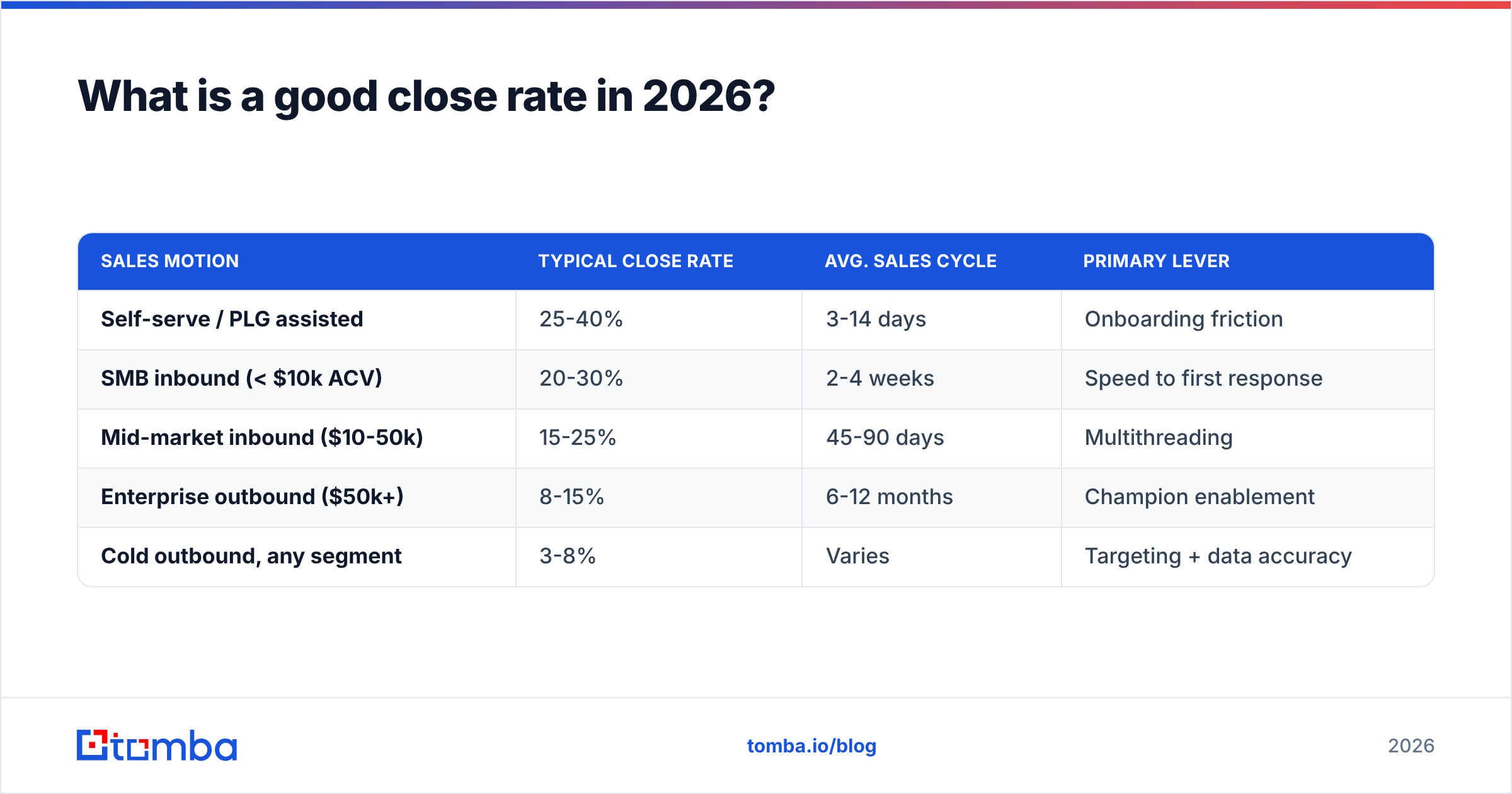
There is no universal benchmark, but there are defensible ranges by motion. Deal size and buying-committee size drive most of the variance.
| Sales motion | Typical close rate | Avg. sales cycle | Primary lever |
|---|---|---|---|
| Self-serve / PLG assisted | 25-40% | 3-14 days | Onboarding friction |
| SMB inbound (< $10k ACV) | 20-30% | 2-4 weeks | Speed to first response |
| Mid-market inbound ($10-50k) | 15-25% | 45-90 days | Multithreading |
| Enterprise outbound ($50k+) | 8-15% | 6-12 months | Champion enablement |
| Cold outbound, any segment | 3-8% | Varies | Targeting + data accuracy |
Two things to notice. First, cold outbound close rates look catastrophic next to inbound — that is expected, and comparing them is how managers end up firing good outbound reps. Second, the lever changes by motion. Coaching enterprise sellers on "speed to lead" is wasted breath; coaching SMB reps on multithreading a nine-person buying committee is equally wasted.
Industry analyst coverage from firms like Gartner has been consistent for years on one point: buying committees keep growing, and larger committees suppress close rates unless sellers deliberately expand contact coverage inside the account.
Why is your close rate stuck?#
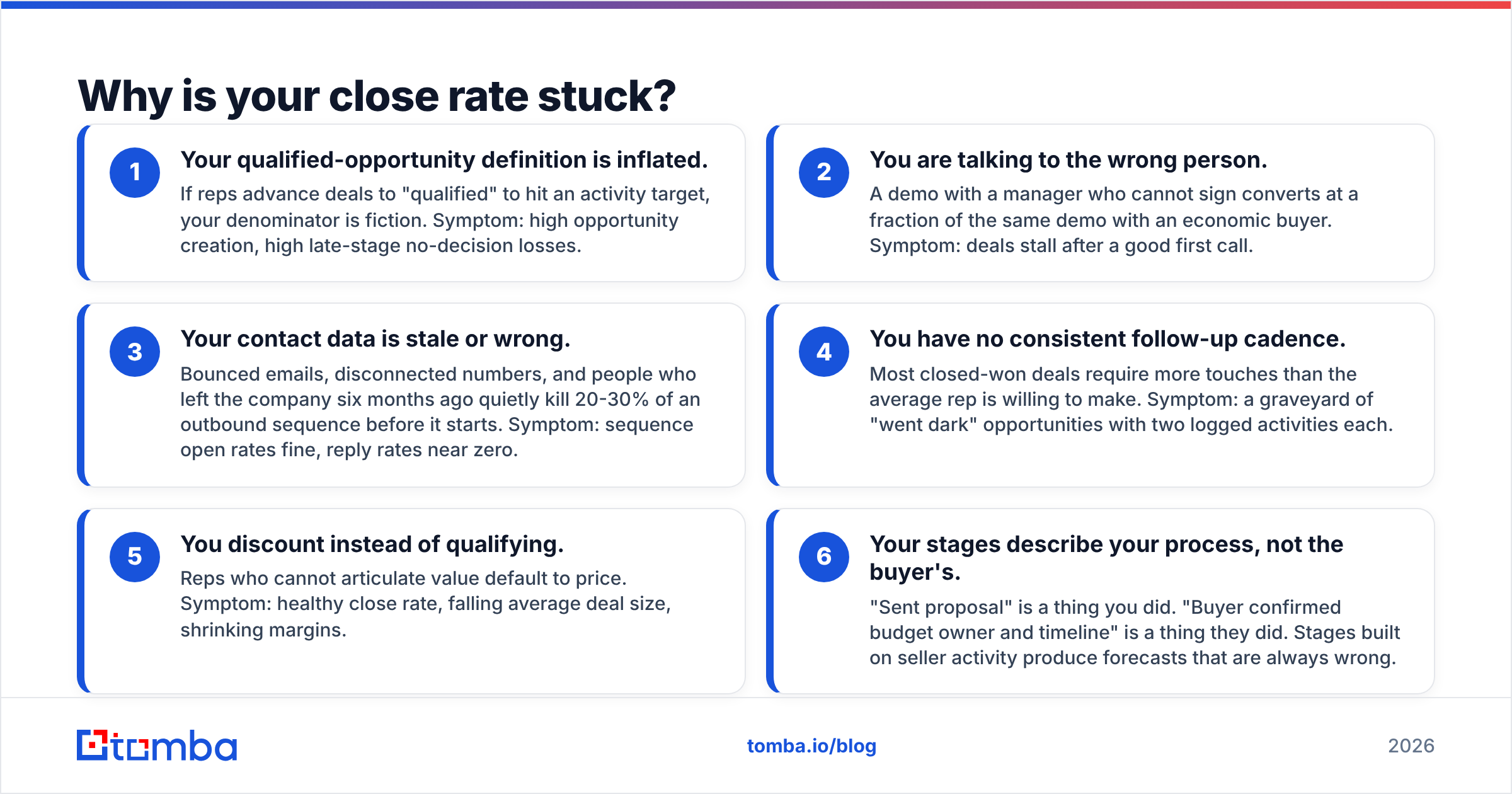
Run this diagnostic in order. Stop at the first one that is clearly broken and fix it before moving on — the later items barely matter if an earlier one is failing.
- Your qualified-opportunity definition is inflated. If reps advance deals to "qualified" to hit an activity target, your denominator is fiction. Symptom: high opportunity creation, high late-stage no-decision losses.
- You are talking to the wrong person. A demo with a manager who cannot sign converts at a fraction of the same demo with an economic buyer. Symptom: deals stall after a good first call.
- Your contact data is stale or wrong. Bounced emails, disconnected numbers, and people who left the company six months ago quietly kill 20-30% of an outbound sequence before it starts. Symptom: sequence open rates fine, reply rates near zero.
- You have no consistent follow-up cadence. Most closed-won deals require more touches than the average rep is willing to make. Symptom: a graveyard of "went dark" opportunities with two logged activities each.
- You discount instead of qualifying. Reps who cannot articulate value default to price. Symptom: healthy close rate, falling average deal size, shrinking margins.
- Your stages describe your process, not the buyer's. "Sent proposal" is a thing you did. "Buyer confirmed budget owner and timeline" is a thing they did. Stages built on seller activity produce forecasts that are always wrong.
Most teams jump straight to number five or six because those feel like real sales problems. In practice, items two and three account for the majority of stuck close rates in outbound-heavy orgs, and they are the cheapest to fix.
Does better contact data really improve sales close rate?#
Yes, and the mechanism is worth understanding because it is not the obvious one.
Bad data hurts close rate twice. The first hit is direct: emails that bounce never generate a conversation. The second hit is statistical and sneakier. When a rep works a list of 500 contacts where 150 are invalid, they burn the same hours for 70% of the coverage. To hit their opportunity quota, they lower their bar on the accounts they can reach. Weak opportunities enter the pipeline, and your close rate drops — even though the root cause was a data problem three steps earlier.
The fix is boring and mechanical:
- Verify every address before it enters a sequence. A dedicated email verifier removes hard bounces and catch-all ambiguity before your sender reputation absorbs the damage.
- Enrich contacts with title, seniority, and department so your targeting filters mean something. Contact enrichment is what turns "a name at the account" into "the person who owns this budget."
- Add a second channel. Deals that get a live conversation close materially better than email-only deals, so pairing verified email with a phone finder gives reps a fallback when inboxes go quiet.
- Re-verify quarterly. B2B contact data decays somewhere around 2-3% per month through job changes alone. A list you built in January is meaningfully wrong by June.
How do qualification frameworks compare?#
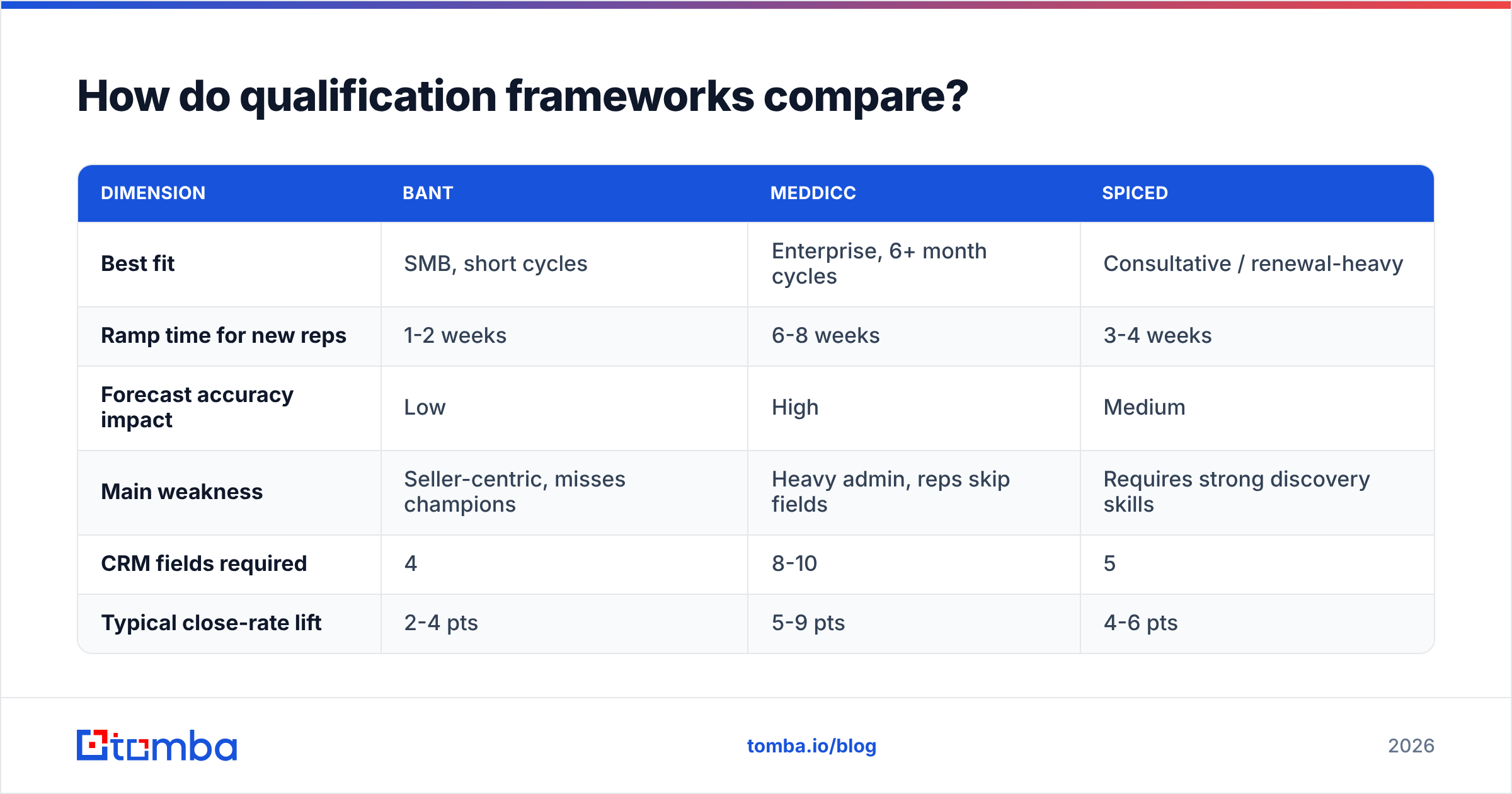
Qualification discipline is the single biggest in-call lever on close rate. The framework matters less than picking one and actually enforcing it in your CRM fields. Here is an honest comparison of the three most common.
| Dimension | BANT | MEDDICC | SPICED |
|---|---|---|---|
| Best fit | SMB, short cycles | Enterprise, 6+ month cycles | Consultative / renewal-heavy |
| Ramp time for new reps | 1-2 weeks | 6-8 weeks | 3-4 weeks |
| Forecast accuracy impact | Low | High | Medium |
| Main weakness | Seller-centric, misses champions | Heavy admin, reps skip fields | Requires strong discovery skills |
| CRM fields required | 4 | 8-10 | 5 |
| Typical close-rate lift | 2-4 pts | 5-9 pts | 4-6 pts |
The lift figures are directional, drawn from what teams report after a full quarter of enforcement — not a guarantee. The pattern holds regardless: heavier frameworks pay off in complex deals and actively slow down transactional ones. If your average cycle is three weeks, MEDDICC will cost you more in admin time than it returns.
Whichever you pick, make two fields mandatory before a deal can advance past discovery: who signs and what happens if they do nothing. Those two answers predict close outcomes better than any other pair of fields in a CRM. Vendors like HubSpot and Salesforce both let you gate stage progression on required fields — use it, because voluntary compliance is a myth.
How do you fix follow-up without becoming annoying?#
Persistence is the cheapest close-rate lever available and the one most reps abandon first.
The structural fix is to make follow-up a system rather than a decision. Reps who decide each morning whether a prospect is "still worth chasing" will systematically under-follow-up, because every individual follow-up feels low-value and the aggregate is what pays.
A workable default cadence after a first meeting:
- Day 0: Recap email with the specific business problem in the buyer's own words, plus one agreed next step and a calendar hold.
- Day 3: Value-add touch — a customer example from the same industry, not a check-in.
- Day 7: Multithread. Reach a second stakeholder directly rather than asking your contact to forward things.
- Day 14: Direct question about status, offering an explicit out. "Should I close this out?" gets replies that "just circling back" never will.
- Day 30+: Move to a monthly nurture. Do not mark it closed-lost with no follow-up path; roughly a fifth of revived deals come from this bucket.
The multithread step on day seven is where most of the gain lives. A single-threaded deal dies when one person changes jobs, gets reorganized, or simply loses interest. Reaching a second and third stakeholder requires knowing their addresses, which is exactly where a domain-level lookup earns its keep.
What should you change about pricing and negotiation?#
Three changes, ranked by impact.
Stop discounting to close, start discounting to accelerate. A discount given in exchange for nothing teaches the buyer your price was never real. A discount given in exchange for a shorter cycle, an annual prepay, a case study, or a multi-year term is a trade. Same number, entirely different message.
Present price earlier, not later. Teams that surface pricing ranges in the first or second call close better than teams that hide it until the proposal, because price shock at proposal stage is a leading cause of late-stage no-decision losses. You want budget mismatches to surface in week one when they cost you an hour, not in week eight when they cost you a quarter.
Name the no-decision competitor. In most B2B deals your real competitor is the status quo, not another vendor. Review sites like G2 will tell you what buyers say about alternatives, but they will not tell you why buyers do nothing at all. That answer comes from your own closed-lost interviews, and it is the highest-return research a sales leader can run.
How do you measure the change without fooling yourself?#
Cohort your deals. Take every opportunity created in a given month and track that cohort's outcome to completion. Monthly close rate as usually reported mixes deals from many different creation months and moves for reasons that have nothing to do with what you changed.
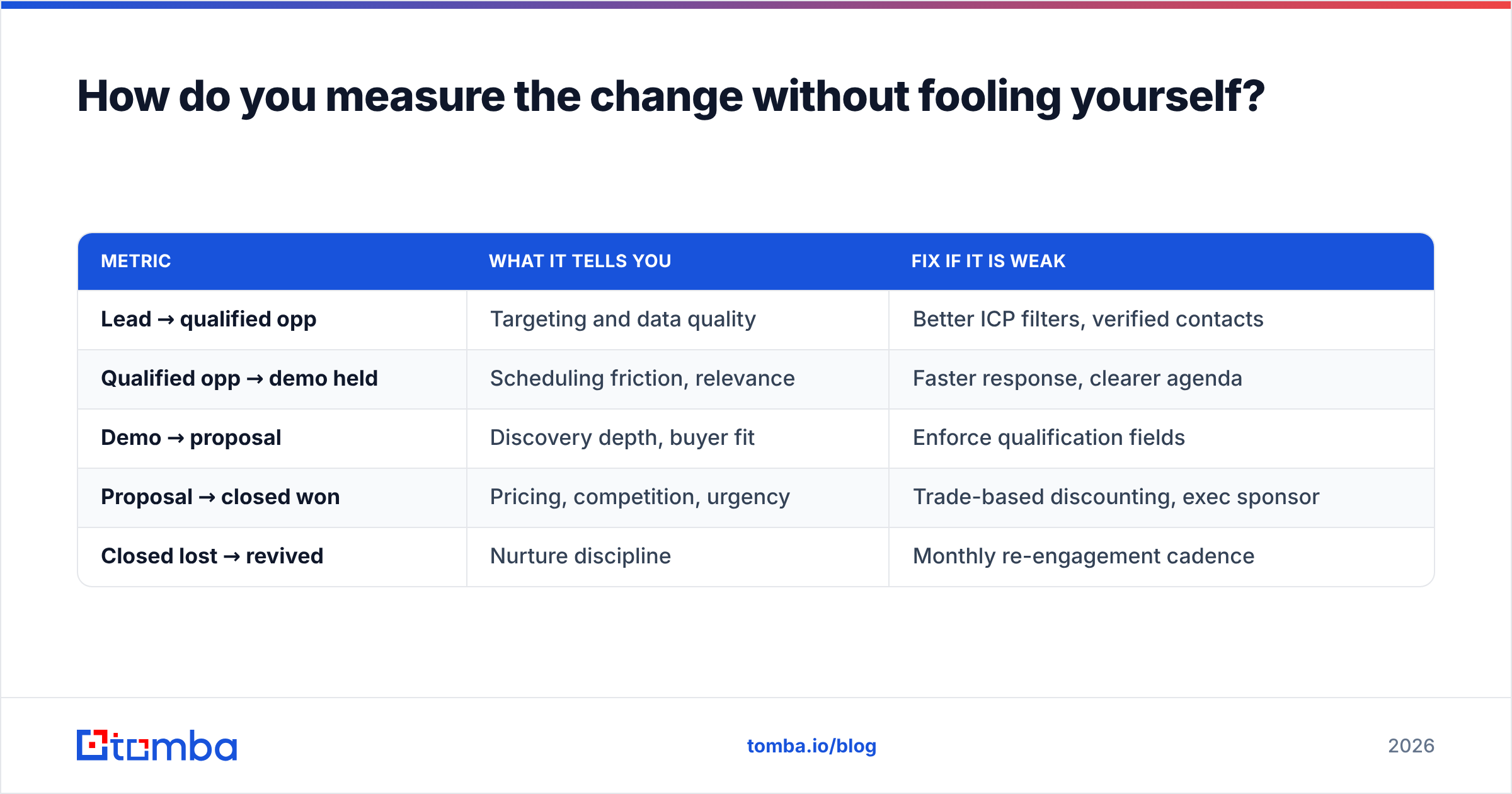
Then instrument stage-to-stage conversion, not just the endpoint:
| Metric | What it tells you | Fix if it is weak |
|---|---|---|
| Lead → qualified opp | Targeting and data quality | Better ICP filters, verified contacts |
| Qualified opp → demo held | Scheduling friction, relevance | Faster response, clearer agenda |
| Demo → proposal | Discovery depth, buyer fit | Enforce qualification fields |
| Proposal → closed won | Pricing, competition, urgency | Trade-based discounting, exec sponsor |
| Closed lost → revived | Nurture discipline | Monthly re-engagement cadence |
A close rate that moves from 14% to 18% could come from any of those five transitions. Without stage data you will credit the wrong change and scale the wrong behavior.
Give any change a full sales cycle plus 30 days before judging it. If your cycle is 60 days, that is a 90-day read. Anything faster is noise.
What does a realistic 90-day plan look like?#
Days 1-30 — Fix the denominator and the data. Rewrite your qualified-opportunity definition, gate CRM stage progression on it, and re-verify your entire active contact list. Expect your reported close rate to improve immediately for a boring reason: you removed junk from the denominator. Note the baseline honestly.
Days 31-60 — Fix qualification and multithreading. Pick one framework, make two fields mandatory, and set a per-deal minimum of three contacts at every account above your mid-market threshold. Review deals weekly against those two criteria only. Resist adding more.
Days 61-90 — Fix follow-up and pricing. Install the cadence, run five closed-lost interviews, and switch to trade-based discounting with a documented approval floor. Now read the day-1 cohort's outcomes and see what actually moved.
Teams that run this sequence typically find that the first 30 days produce the largest measurable jump — not because data hygiene is magic, but because everything downstream of a clean list gets easier at once.
Where should you start today?#
Start with the list your reps are working right now, because it is the only input you can fix this week without changing anyone's behavior.
Pull the accounts in your ICP, find the people who actually own the budget, verify their addresses before a single sequence goes out, and give reps a second channel when email goes quiet. The Tomba Email Finder does the first two in one pass — search by domain or by name, get verified professional addresses with a confidence score and the sources behind them, then push straight into your CRM or sequencer. The free tier covers 25 searches a month if you want to test accuracy on accounts you already know, and paid plans start at $49/mo on Starter; full Tomba pricing is public, with no per-seat minimums to negotiate around.
Clean the input. The close rate follows.
Related guides#
// get started
Find, verify and enrich your first contacts today
Start on the free plan with 25 searches a month, then scale when your team is ready.
Free plan · No credit card required · GDPR & CCPA
// about the author