How to Improve Sales Operations in 2026: A Practical Guide
Most sales ops fixes fail because teams buy tooling before they fix data. Here's the order that actually works: clean records first, then routing, then forecasting, then automation.
TL;DR
- To improve sales operations, fix things in order: data quality, then routing, then process, then forecasting, then automation. Skip a step and the next one inherits the mess.
- The highest-ROI fix in most teams is contact data hygiene. Bad emails and stale records quietly drain pipeline, rep time, and forecast trust.
- Another platform rarely fixes a broken process. A $99/mo enrichment layer with tight field rules usually beats a $40k/yr suite bolted onto dirty records.
- Judge sales ops by leading signals: data decay, lead response time, stage conversion, forecast variance. Closed-won revenue tells you too late.
- Budget 90 days: 30 to audit and clean, 30 to redesign process, 30 to automate and report.
Sales operations is the least glamorous job on the revenue team. It is also the one with the most leverage. Teams that improve sales operations get two things back: reps who spend the day selling, and leaders who trust the number. When it fails, everyone spends Monday arguing about whose report is right.
This guide shows how to improve sales operations: what to fix, in what order, and how to know it worked.
What is sales operations, and what does it actually own?#
Sales operations is the function that makes selling repeatable. It owns the systems, data, process, and analytics that sit under the sales team. It is the plumbing, not the pitch.
In practice that means five domains:
- Data and systems — CRM architecture, field governance, integrations, contact and account records, deduplication, enrichment.
- Process and territory design — territory carving, quota setting, lead routing rules, stage definitions, exit criteria, approval workflows.
- Analytics and forecasting — pipeline inspection, conversion analysis, forecast rollups, win/loss reporting, capacity models.
- Enablement infrastructure — sequence templates, playbooks, call libraries, onboarding ramp tracking.
- Compensation and planning — comp plan mechanics, commission accuracy, headcount modeling.
For the textbook framing, Wikipedia's sales operations entry is a fair neutral summary. The split that matters more in 2026 is between sales ops and revenue operations. Sales ops runs execution inside the sales org. RevOps aligns marketing, sales, and customer success. Small companies run one team. Past roughly 50 reps, most split them.
The failure mode is the same at every size. Sales ops gets pulled into ticket work — "fix this dashboard," "reassign this account." The structural problems that create those tickets never get touched.
Why do most projects to improve sales operations stall?#
Because they start at the wrong layer. The usual sequence goes like this. Leadership sees a bad forecast, so they buy a forecasting tool. The tool reads from the CRM. In that CRM, 30% of contact emails bounce, half the deals have no next step, and three reps have logged the same account under different names. The tool now ships a confident, well-designed, wrong forecast.
Data quality is not a subtask of a sales ops project. It is the floor the rest of the work stands on. B2B contact data decays fast. People change jobs, domains migrate, companies restructure. A real share of any contact database goes stale every year. If you never re-verify, it rots whether or not anyone notices.
The second cause is field sprawl. Every quarter someone adds a custom field. Nobody removes one. After three years the opportunity object has 140 fields. Ninety of them are filled in less than 10% of the time, and reps have learned to ignore the form. Reports built on those fields are fiction.
The third is vague stage exit criteria. If "Discovery" means whatever the rep thinks it means, stage conversion measures vocabulary, not progress.
Which metrics tell you sales operations is broken?#
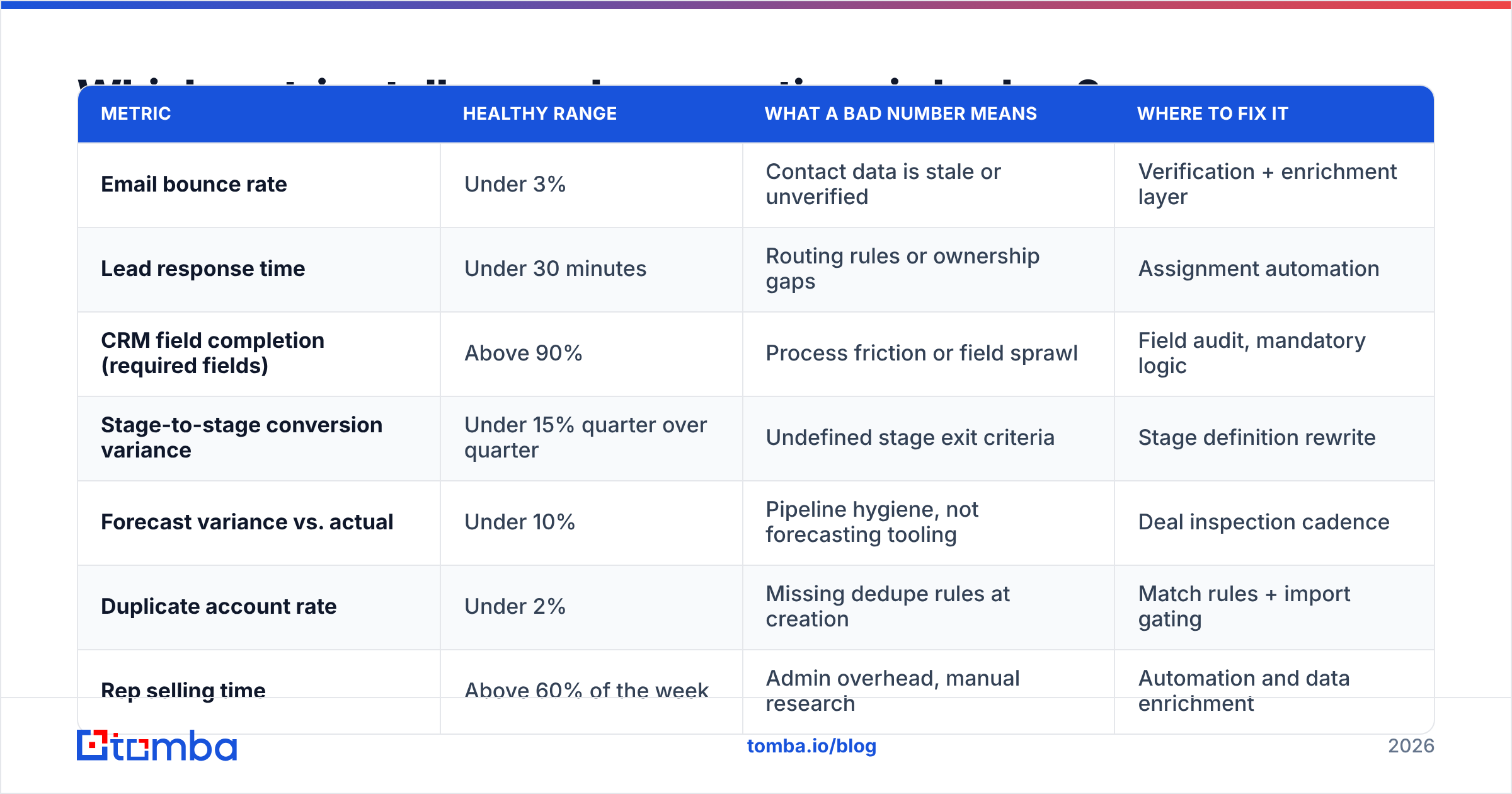
Revenue is a lagging number. It hides trouble for a full quarter. The signals below surface it in days.
| Metric | Healthy range | What a bad number means | Where to fix it |
|---|---|---|---|
| Email bounce rate | Under 3% | Contact data is stale or unverified | Verification + enrichment layer |
| Lead response time | Under 30 minutes | Routing rules or ownership gaps | Assignment automation |
| CRM field completion (required fields) | Above 90% | Process friction or field sprawl | Field audit, mandatory logic |
| Stage-to-stage conversion variance | Under 15% quarter over quarter | Undefined stage exit criteria | Stage definition rewrite |
| Forecast variance vs. actual | Under 10% | Pipeline hygiene, not forecasting tooling | Deal inspection cadence |
| Duplicate account rate | Under 2% | Missing dedupe rules at creation | Match rules + import gating |
| Rep selling time | Above 60% of the week | Admin overhead, manual research | Automation and data enrichment |
Track these weekly, not quarterly. An operational metric earns its keep by moving before revenue does.
One caveat on bounce rate. It is not just a deliverability stat. A 12% bounce rate means one in eight prospecting attempts hits nothing. That shows up as weak activity-to-meeting conversion, and it gets blamed on the reps. Fix the input before you coach the output. If your bounce rate is climbing, run a sample through an email verifier before you rebuild your sequences.
How do you fix the data layer first?#
Start with an audit you can finish in a week, not a quarter.
Step 1 — Sample, don't boil the ocean. Pull 1,000 random contacts created in the last 24 months. Run them through verification. That pass rate tells you the health of the whole database. No six-week project needed.
Step 2 — Segment the damage. Sort failures into three buckets: hard invalid (the mailbox does not exist), catch-all or unknown (the server accepts everything, so the check is inconclusive), and role-based (info@, sales@). Each needs a different response. Catch-all domains are where most simple tools give up. A dedicated catch-all verifier saves records that a plain valid/invalid check would throw away.
Step 3 — Re-source instead of deleting. A bounced contact is not a worthless row. The company is still a target. The person may still work there under a new address. Run the name and domain back through an email finder to recover the current address.
Step 4 — Enrich what survives. Fill the firmographic and contact gaps so routing and scoring have something to work with. Contact enrichment at the record level costs a fraction of manual research at the rep level.
Step 5 — Gate the front door. Cleanup is wasted if intake stays open. Add verification to form submissions, list imports, and any API that creates contacts. Most teams do the cleanup, skip the gate, then repeat the cleanup a year later.
Step 6 — Schedule re-verification. Quarterly for active pipeline. Twice a year for the long-tail database. Put it on a calendar and give it a named owner.
The cost math surprises people. Verification and enrichment for a mid-size database run in the low hundreds of dollars a month. One rep spending 40% of the week on manual contact research costs many times that.
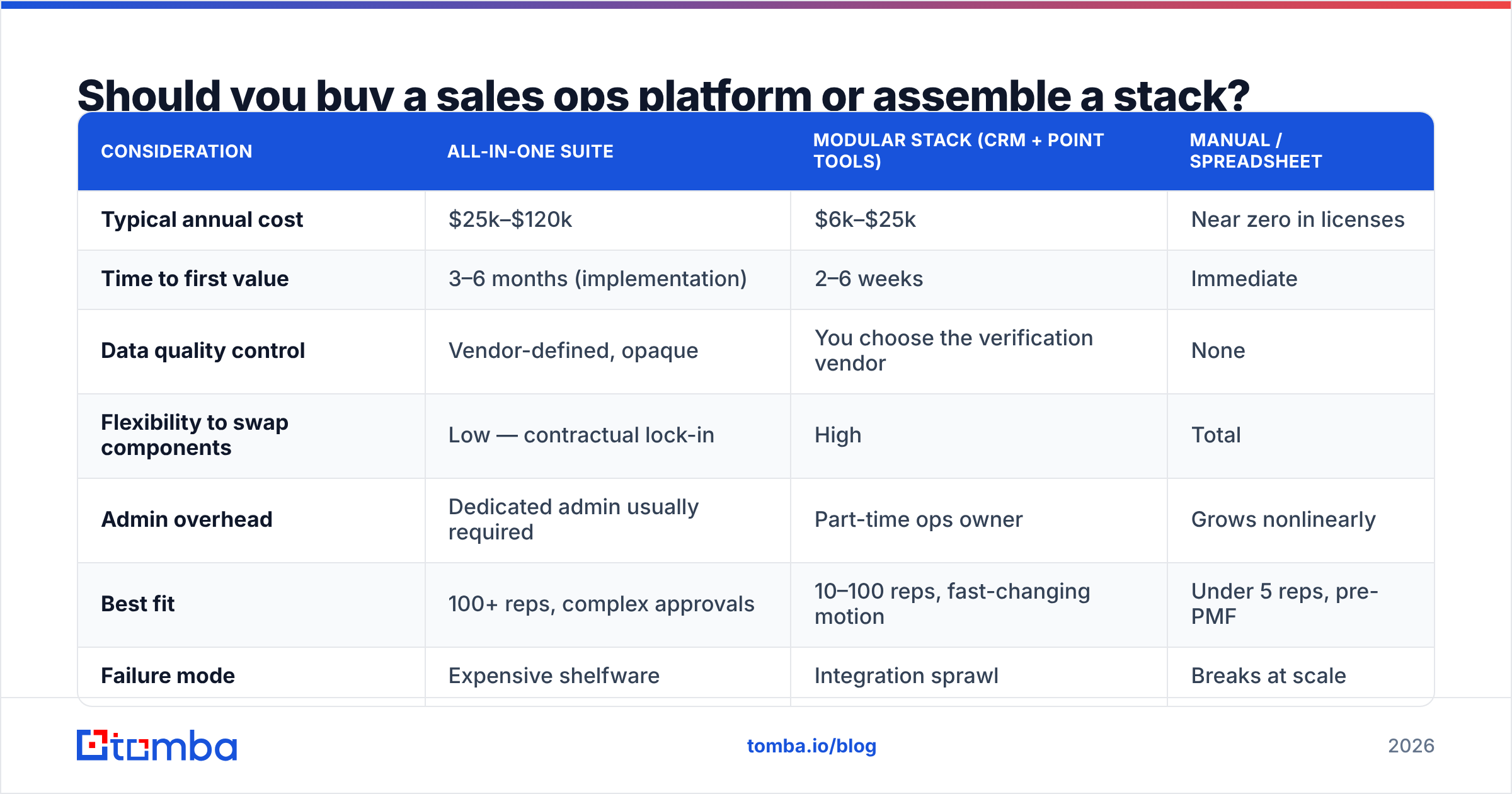
Should you buy a sales ops platform or assemble a stack?#
Most teams hit this fork around 15-30 reps. Here is the honest trade-off.
| Consideration | All-in-one suite | Modular stack (CRM + point tools) | Manual / spreadsheet |
|---|---|---|---|
| Typical annual cost | $25k–$120k | $6k–$25k | Near zero in licenses |
| Time to first value | 3–6 months (implementation) | 2–6 weeks | Immediate |
| Data quality control | Vendor-defined, opaque | You choose the verification vendor | None |
| Flexibility to swap components | Low — contractual lock-in | High | Total |
| Admin overhead | Dedicated admin usually required | Part-time ops owner | Grows nonlinearly |
| Best fit | 100+ reps, complex approvals | 10–100 reps, fast-changing motion | Under 5 reps, pre-PMF |
| Failure mode | Expensive shelfware | Integration sprawl | Breaks at scale |
There is no universally right answer. There is a common mistake: buying the suite to solve a discipline problem. If your team does not log next steps today, a platform with a next-step field will not change that. Process discipline is a management problem with a tooling assist, not the reverse.
If you are shortlisting vendors, G2's sales analytics category beats vendor sites for filtering by company size. HubSpot and Salesforce both publish detailed feature matrices you can hold side by side.
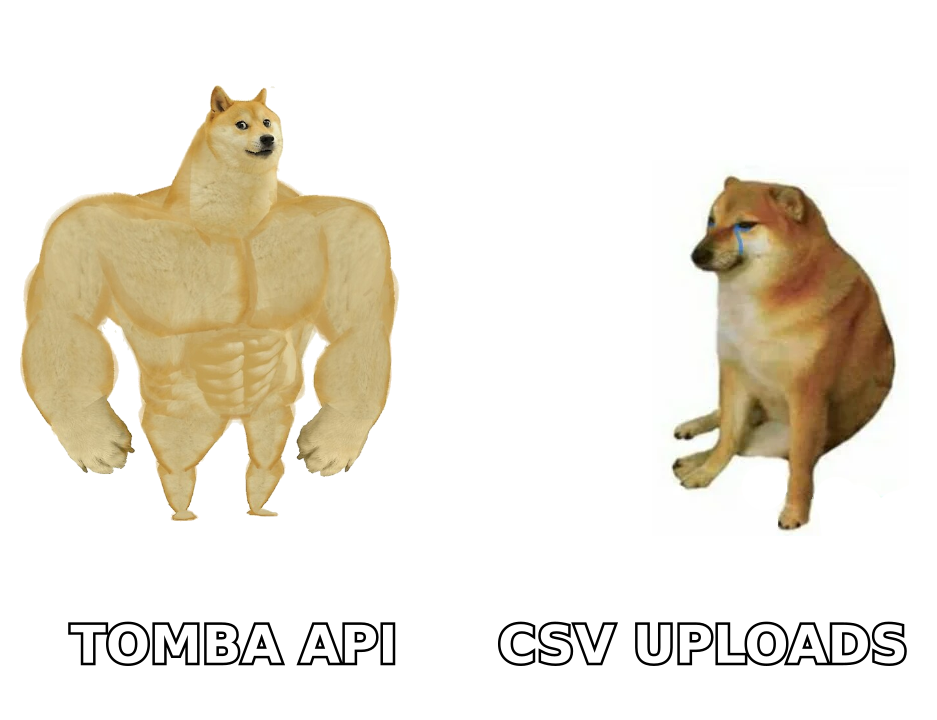
The modular path has one requirement people underestimate. Someone must own the integration surface. If your enrichment tool, your CRM, and your sequencer each define "account" differently, you have three databases, not one. Pick a system of record. Define the join key — usually the company domain — and enforce it. A Tomba API call at record creation writes straight into the CRM. That is a cleaner pattern than a weekly CSV round-trip nobody remembers to run.
How do you improve forecast accuracy without buying a forecasting tool?#
Forecast accuracy comes mostly from pipeline hygiene and inspection cadence. Tools help at the margin. These mechanics move variance:
- Write stage exit criteria as events, not feelings. "Champion identified" is a feeling. "The economic buyer joined a call and we share a mutual action plan" is an event. Every stage needs at least one criterion an outsider could confirm.
- Require a next step with a date. Any deal without a future-dated next step is out of the forecast. This one rule clears most of the zombie pipeline that inflates coverage ratios.
- Track age-in-stage, not just total age. A deal parked in Negotiation for 60 days is a different problem from one that is 60 days old and still moving.
- Inspect deals on a fixed cadence with a fixed script. Same questions, every week. A loose inspection produces a loose forecast.
- Compare commit vs. actual by rep, not just in total. Aggregate variance nets out. One rep sandbagging cancels another rep's happy ears, and both problems hide.
Salesforce's State of Sales research is a fair outside benchmark if you want to sanity-check your own numbers. Treat any vendor-published statistic as directional, not precise.
How should sales ops handle prospecting data at scale?#
The prospecting layer is where sales ops most directly affects rep output. Three patterns work well.
Pattern one — enrich at the account level, not the contact level. Rather than chase single contacts, run domain search across target accounts to map the full contact surface. Then let routing and scoring pick who to work. That beats reps hunting names one at a time.
Pattern two — batch overnight, verify at send. Run bulk email finder jobs on the account list off-hours. Re-verify each address right before a sequence starts. Data that was right three weeks ago may be wrong today.
Pattern three — put the tools where the reps already are. A browser extension or a Sheets add-on gets used far more than a separate web app reps have to remember to open. Adoption beats capability in ops tooling.
When you compare data vendors, look at coverage in your own ICP geography and industry. Headline database size means little. A 700-million-record database that is thin in mid-market European manufacturing is worse for you than a smaller one with depth there. Vendors like BookYourData verify at purchase, which suits list-buying motions. API-first providers suit continuous enrichment inside a workflow. Both are legitimate. Pick the one that matches your motion.
What does a 90-day plan to improve sales operations look like?#
Days 1–30: audit and stabilize. Run the data sample. Inventory CRM fields and kill anything under 10% populated. Write down how stages are actually used today, not what the playbook claims. Baseline the seven metrics in the table above. Change nothing yet. You need the before picture.
Days 31–60: redesign the process. Rewrite stage exit criteria. Rebuild routing rules with explicit SLA timers. Tie field requirements to stage progression. Clean and re-source the contact database. Get written sign-off from sales leadership on the new definitions. Unratified process changes get ignored.
Days 61–90: automate and instrument. Wire enrichment into record creation. Build the weekly operating dashboard. Automate the inspection prep so managers arrive at pipeline reviews with the analysis already done. Re-measure the baseline metrics and publish the delta.
Two rules for the whole 90 days. First, change one variable at a time. If you rewrite stages and swap tools in the same week, you will never know which one helped. Second, ship something visible in the first two weeks. Ops programs die from looking slow more often than from bad design.
How do you prove sales operations ROI?#
Tie every change to a metric you baselined in week one. Then say the causal chain out loud.
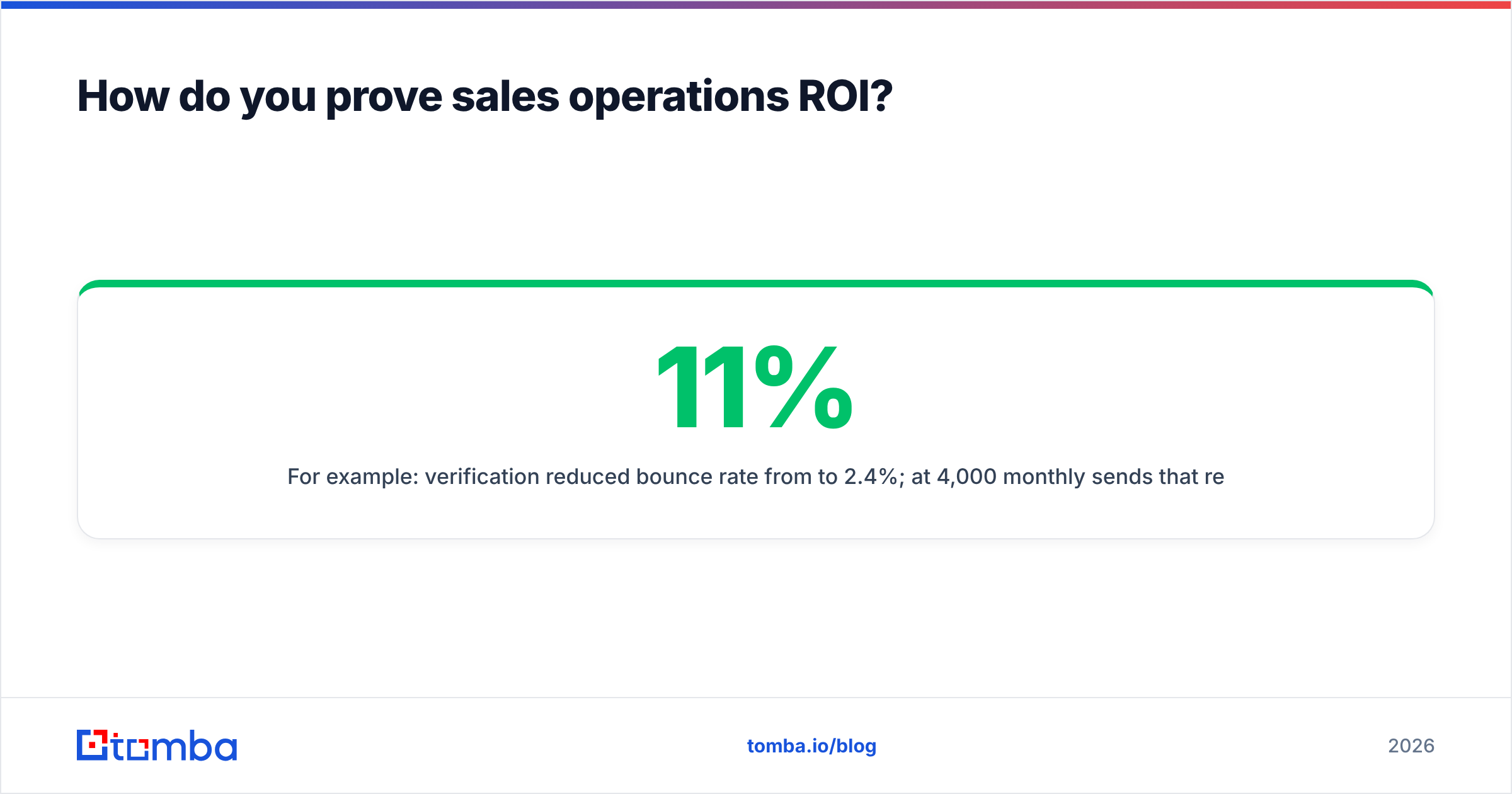
Here is an example. Verification cut bounce rate from 11% to 2.4%. At 4,000 monthly sends, that recovers about 344 delivered emails a month. At a 4% reply rate and a 22% reply-to-meeting rate, that is roughly three extra meetings a month. Apply your win rate and ACV, and you have a number for the slide.
The chain is an estimate, not a measurement. Say so, and people will trust it more, not less. Do the same for lead response time, admin hours saved, and forecast variance. Sales ops loses budget fights when it reports activity ("we cleaned 40,000 records") instead of outcomes ("we recovered three meetings a month and cut rep research time by four hours a week").
Also track the negative space. What did you stop doing? Retired reports, deleted fields, and cancelled tools are real wins. An ops team that only adds surface area collapses under its own maintenance load.
Where should you start this week?#
Start with the data sample. It is cheap, it is fast, and it tells you whether every other project you have planned is built on sand.
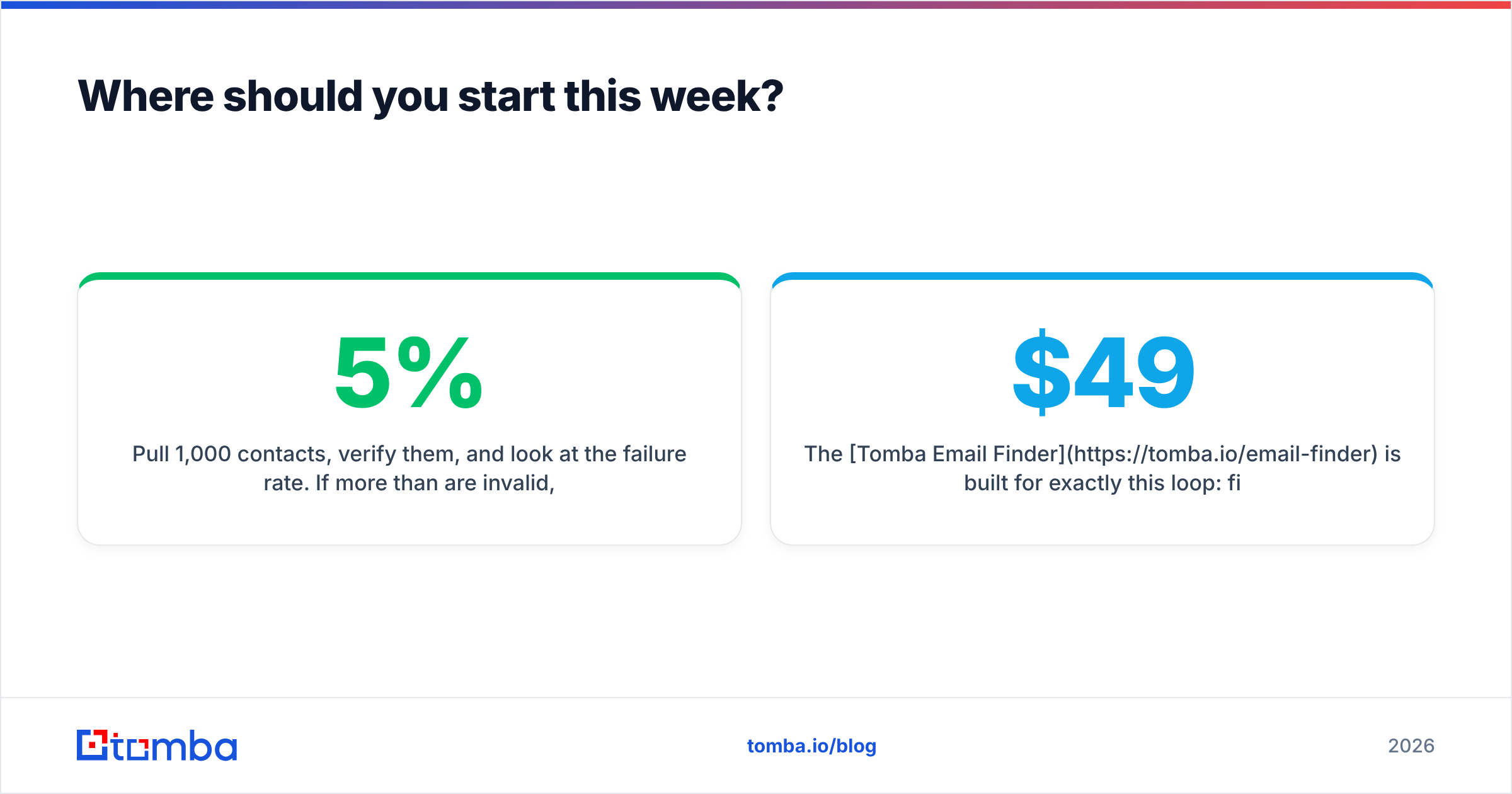
Pull 1,000 contacts and verify them. Look at the failure rate. If more than 5% are invalid, your prospecting numbers, your routing, and your forecast all report on a database that partly does not exist. No process redesign outruns that.
The Tomba Email Finder is built for this loop. Find current addresses by domain, name, or company. Verify them before they enter the CRM. Re-source contacts whose old addresses have died. The free tier gives you 25 searches a month, enough to run a sample. Paid plans start at $49/mo, and Growth is $99/mo for teams running continuous enrichment — see full Tomba pricing. Run the audit first, then decide what to buy. In that order, efforts to improve sales operations tend to stick.
Related guides#
// get started
Find, verify and enrich your first contacts today
Start on the free plan with 25 searches a month, then scale when your team is ready.
Free plan · No credit card required · GDPR & CCPA
// about the author