How to Improve Sales Team Performance: A 2026 Playbook
Most sales teams underperform for boring, fixable reasons: bad data, unclear stage definitions, and coaching that never happens. Here is the diagnostic order that actually moves quota attainment.
TL;DR
- Most "performance problems" are not motivation problems. They are data, process, and coaching problems that show up as low activity and blame the rep.
- Diagnose in this order: data quality → ICP fit → stage definitions → coaching cadence → comp. Fixing comp first is the most expensive mistake in sales management.
- One weak rep is a coaching issue. Three weak reps in the same segment is a system issue. Count before you conclude.
- Measure leading indicators (conversations per week, stage-2 conversion, cycle time by segment), not just closed-won. Lagging metrics tell you what already failed.
- Reps waste 20-40% of prospecting time on bad contact data. Cleaning your list is the cheapest performance lever you have and the one nobody puts on the board.
Why do most attempts to improve sales team performance fail?#
Because they start at the wrong end of the funnel.
The standard playbook when a quarter goes sideways looks like this: raise activity targets, add a SPIF, run a two-day training offsite, and if that fails, backfill the bottom two reps. That sequence treats effort as the constraint. It almost never is.
Think of a sales team like a restaurant kitchen. When tickets back up, the instinct is to yell at the line cooks. But if the walk-in is stocked with wilted produce and the ticket printer is jammed, faster cooks make worse food. You fix the inputs and the flow before you fix the people.
In sales, the wilted produce is your contact data and your ICP definition. The jammed printer is your CRM stage logic. The line cooks are usually fine.
Research from Gartner has consistently found that sellers spend a minority of their working hours actually selling — the rest goes to admin, research, and internal coordination. That is the number to attack. Not the number of dials.
What should you diagnose first — and in what order?#
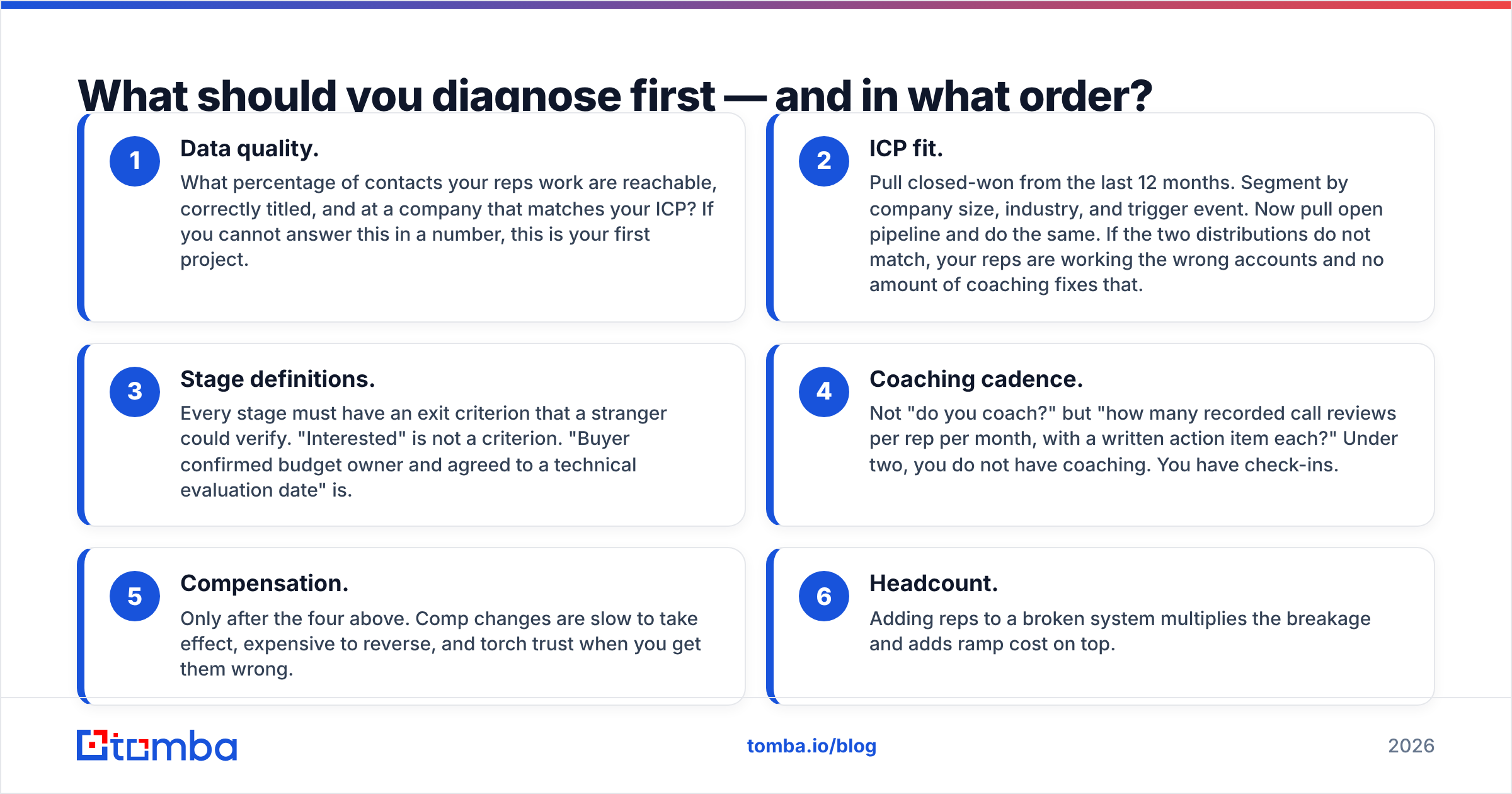
Run the diagnosis in a fixed order, because each layer poisons the one below it. If your data is bad, your conversion rates are meaningless, which means your coaching is aimed at noise.
- Data quality. What percentage of contacts your reps work are reachable, correctly titled, and at a company that matches your ICP? If you cannot answer this in a number, this is your first project.
- ICP fit. Pull closed-won from the last 12 months. Segment by company size, industry, and trigger event. Now pull open pipeline and do the same. If the two distributions do not match, your reps are working the wrong accounts and no amount of coaching fixes that.
- Stage definitions. Every stage must have an exit criterion that a stranger could verify. "Interested" is not a criterion. "Buyer confirmed budget owner and agreed to a technical evaluation date" is.
- Coaching cadence. Not "do you coach?" but "how many recorded call reviews per rep per month, with a written action item each?" Under two, you do not have coaching. You have check-ins.
- Compensation. Only after the four above. Comp changes are slow to take effect, expensive to reverse, and torch trust when you get them wrong.
- Headcount. Adding reps to a broken system multiplies the breakage and adds ramp cost on top.
Sorry — the correct embed is below.
How do you tell a rep problem from a system problem?#
Count. That is the entire method.
Take your metric — say, meetings booked per 100 contacts touched. Plot every rep. If one rep sits two standard deviations below the pack and the rest cluster tightly, you have a rep problem, and it is a coaching or fit conversation. If the whole team clusters low, or if the low performers all share a territory, segment, or lead source, you have a system problem.
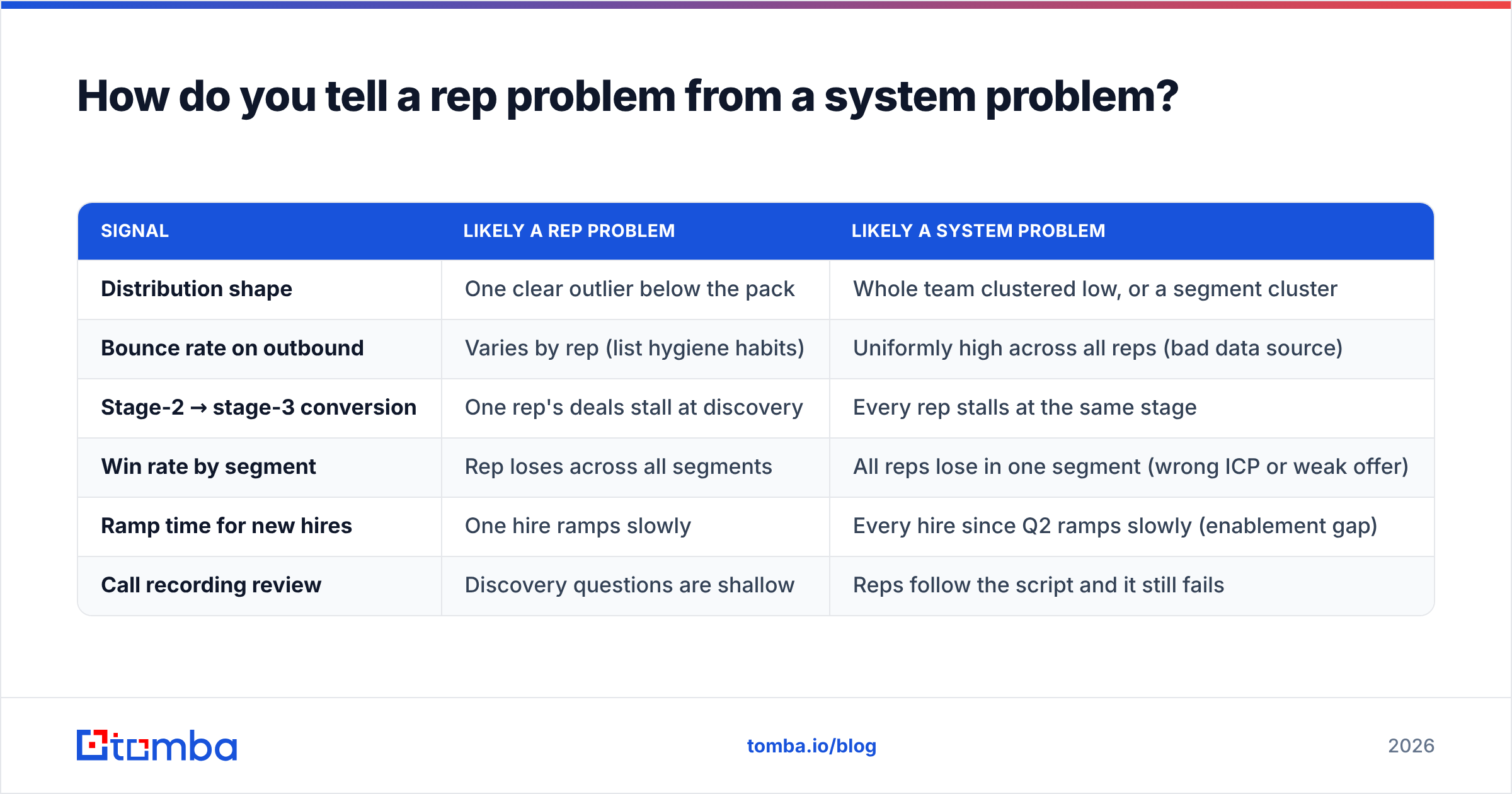
| Signal | Likely a rep problem | Likely a system problem |
|---|---|---|
| Distribution shape | One clear outlier below the pack | Whole team clustered low, or a segment cluster |
| Bounce rate on outbound | Varies by rep (list hygiene habits) | Uniformly high across all reps (bad data source) |
| Stage-2 → stage-3 conversion | One rep's deals stall at discovery | Every rep stalls at the same stage |
| Win rate by segment | Rep loses across all segments | All reps lose in one segment (wrong ICP or weak offer) |
| Ramp time for new hires | One hire ramps slowly | Every hire since Q2 ramps slowly (enablement gap) |
| Call recording review | Discovery questions are shallow | Reps follow the script and it still fails |
The uncomfortable version of this table: if you have replaced three reps in a row on the same territory and the territory still misses, the territory is the problem.
Which metrics actually predict quota attainment?#
Split your dashboard into leading and lagging. Lagging metrics — revenue, quota attainment, win rate — tell you what already happened. You cannot coach a closed-lost deal back to life.
Leading indicators are the ones that move within a week of an intervention:
- Qualified conversations per rep per week. Not dials, not emails sent. Two-way conversations with someone who matches ICP. This is the single highest-correlation input to pipeline in most B2B motions.
- Contact reachability rate. Of the contacts a rep works, what share produce a delivered email or a connected call? Below 70% and your rep is doing data entry, not selling.
- Stage-2 conversion (discovery → validated opportunity). This is where coaching pays fastest. It is almost entirely a questioning-skill metric.
- Average days in current stage. Deals rot at a predictable rate. Anything past 1.5x the median for its stage should trigger a manager review, not a forecast comment.
- Multi-threading depth. Number of distinct contacts engaged per open opportunity. Single-threaded deals lose to no-decision far more often than they lose to competitors.
- Response rate by sequence and segment. Track email response rate at the segment level, not the team level — an average hides which motion is dead.
The rule: if a metric cannot change in the next 14 days as a result of something a rep does differently, it is not a coaching metric. Report it monthly and move on.
How much does bad contact data cost your team?#
More than any other single fixable input.
Work the math on a five-rep team. Say each rep builds 40 new contacts a week. If 30% of those contacts are stale — wrong company, wrong title, dead mailbox — that is 12 wasted contacts per rep per week. At roughly four minutes of research and outreach per contact, you have lost about 48 minutes per rep per week to nothing. Across five reps and 48 working weeks, that is roughly 190 hours of selling time incinerated annually. Nobody puts that on a QBR slide.
The second-order damage is worse. High bounce rates degrade your sender reputation, which means the emails to your good contacts start landing in spam. Now your best-fit accounts get silence, and your CRM records it as "no interest." Your win-rate analysis is now built on a lie.
Two operational fixes, in order:
Verify before you send, not after you bounce. Running lists through an email verifier before a campaign takes minutes and prevents the reputation damage entirely. Bounce data collected after the fact is a post-mortem, not a control.
Standardize how contacts get sourced. When every rep has their own scraping habit, quality varies by rep and you cannot tell coaching problems from sourcing problems. Give the team one sourcing path — a shared email finder plus a defined domain search workflow for account mapping — and rep-to-rep variance suddenly becomes signal instead of noise.
What does a coaching cadence that works look like?#
Structured, recurring, and written down. Everything else is a hallway conversation with a calendar invite.
The version that survives a busy quarter:
- Weekly 1:1, 30 minutes, fixed agenda. Ten minutes on pipeline hygiene, fifteen on one specific skill, five on blockers. Do not let this become a forecast call — forecast belongs in a separate meeting or it eats coaching every single time.
- Two recorded call reviews per rep per month. The rep picks one, you pick one. The rep-picked call surfaces what they think is hard; the manager-picked call surfaces what they cannot see.
- One written action item per session, reviewed at the top of the next session. Unreviewed action items train reps that coaching is theater.
- Quarterly skill map. Rate each rep on four to six named competencies (discovery, multi-threading, pricing conversations, technical qualification). Track movement, not absolute scores.
- Peer review every two weeks. Two reps swap a call recording and give each other one thing to keep and one to change. Costs a manager nothing and builds the vocabulary faster than top-down coaching.
The failure mode to watch for: managers who coach the deal instead of the rep. Reviewing a specific opportunity and telling the rep what to say next is deal-desk work. It closes that deal and teaches nothing. Coaching means naming the repeatable behavior — "you accepted the first answer on budget three times in this call" — and running it back next week.
How should you structure the sales org itself?#
Specialization beats generalization above a certain volume, and hurts below it.
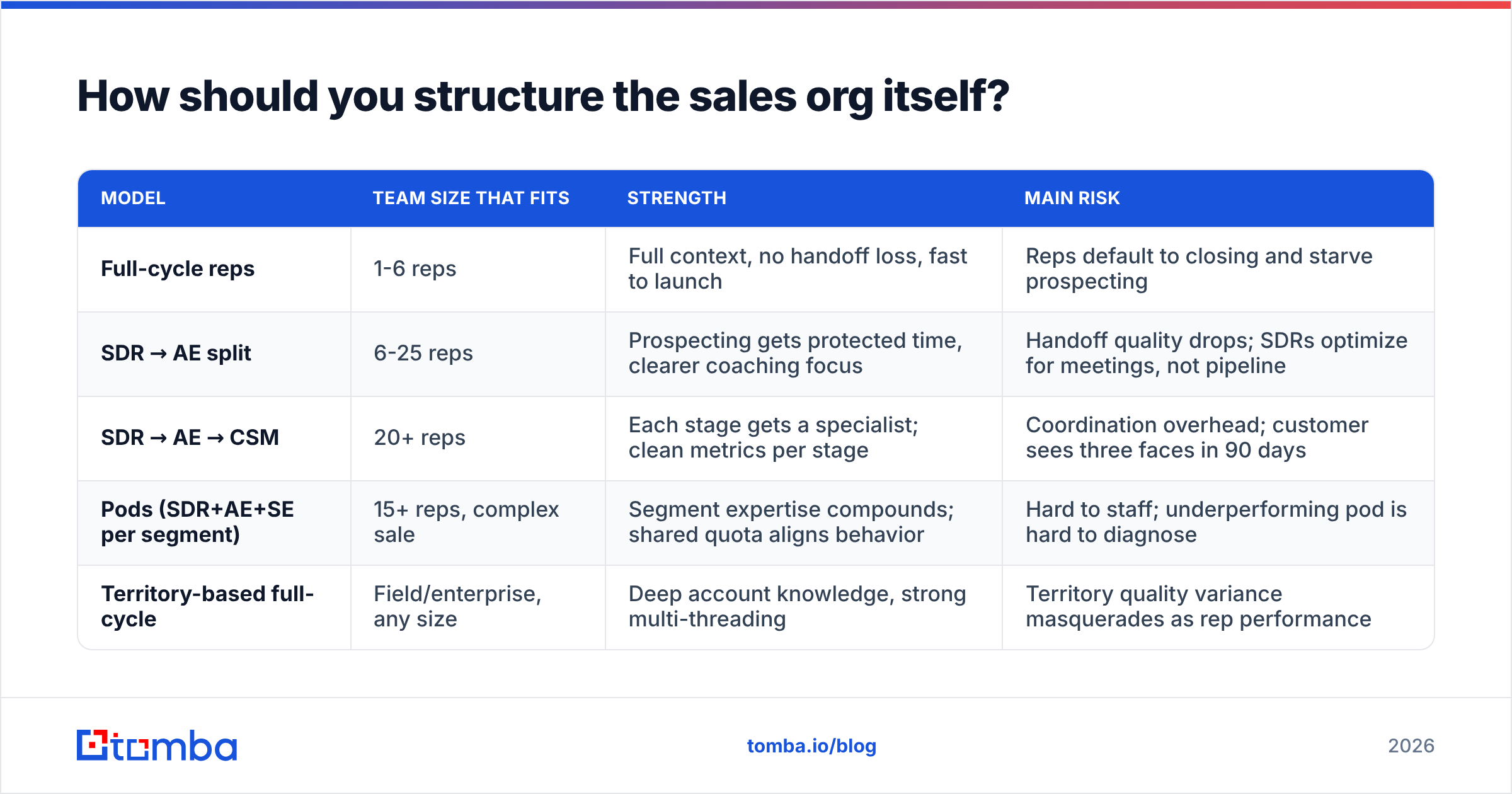
| Model | Team size that fits | Strength | Main risk |
|---|---|---|---|
| Full-cycle reps | 1-6 reps | Full context, no handoff loss, fast to launch | Reps default to closing and starve prospecting |
| SDR → AE split | 6-25 reps | Prospecting gets protected time, clearer coaching focus | Handoff quality drops; SDRs optimize for meetings, not pipeline |
| SDR → AE → CSM | 20+ reps | Each stage gets a specialist; clean metrics per stage | Coordination overhead; customer sees three faces in 90 days |
| Pods (SDR+AE+SE per segment) | 15+ reps, complex sale | Segment expertise compounds; shared quota aligns behavior | Hard to staff; underperforming pod is hard to diagnose |
| Territory-based full-cycle | Field/enterprise, any size | Deep account knowledge, strong multi-threading | Territory quality variance masquerades as rep performance |
Two rules that hold across models. First, whoever prospects must be measured on qualified pipeline created, never on meetings booked — meetings-booked targets reliably produce meetings that should not exist. Second, when you split roles, write the handoff criteria down with the same rigor as your stage exit criteria. Most "SDR quality problems" are undocumented handoff standards.
For teams running account-based motions, HubSpot's sales research has decent public benchmarks on ramp time and quota attainment by model — worth checking your numbers against before you restructure.
What tooling actually moves the needle?#
Buy in this order, and only buy the next one when the previous is fully adopted.
- CRM with enforced stage criteria. Not a fancier CRM — the one you have, configured so a rep cannot advance a deal without the exit criterion filled. Configuration beats migration.
- Call recording with searchable transcripts. This is the single highest-ROI purchase for a manager who wants to coach. You cannot coach calls you did not hear.
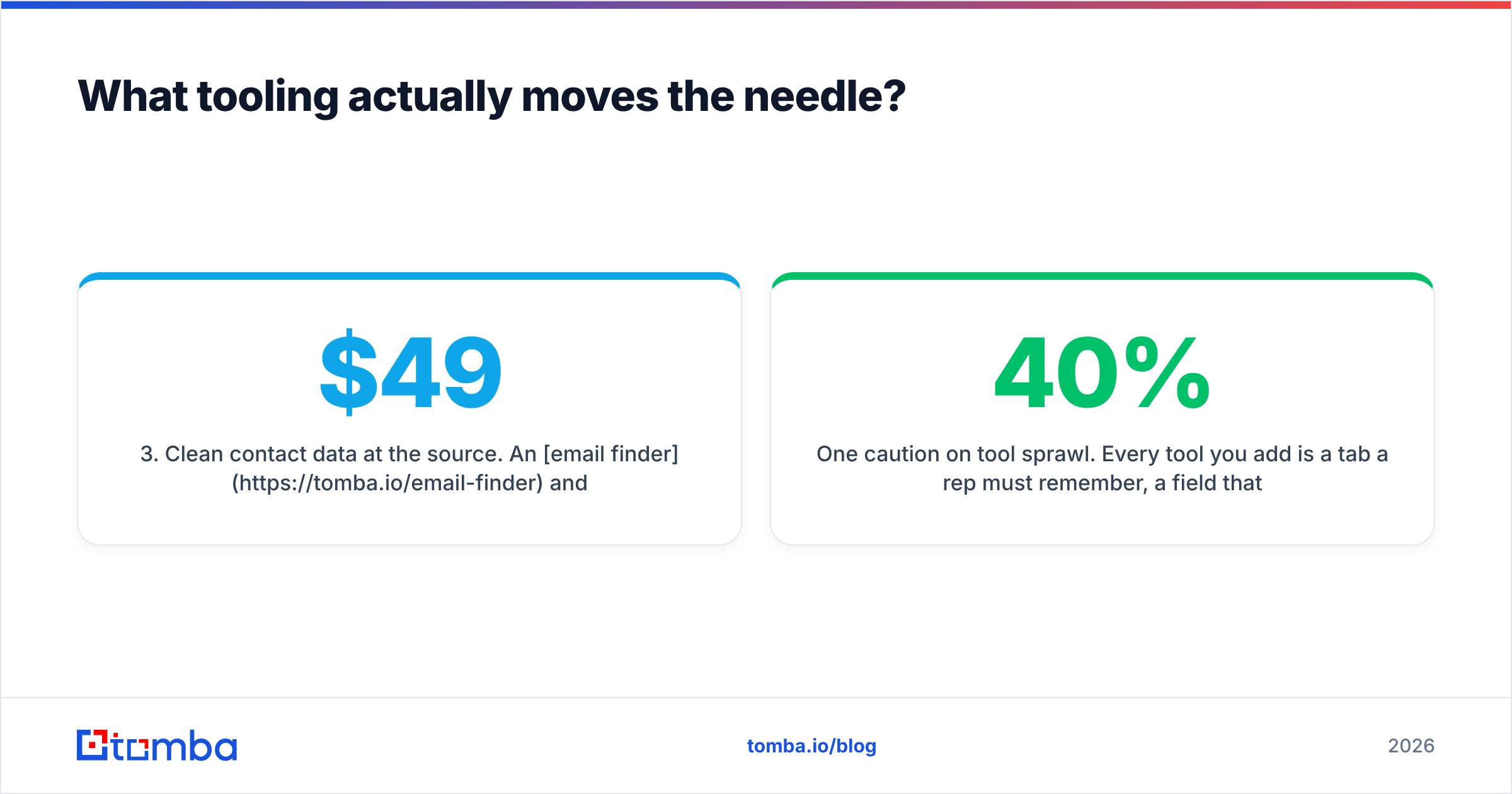
- Clean contact data at the source. An email finder and verification step wired into the prospecting workflow, so quality is a system property rather than a rep habit. Tomba's free tier gives 25 searches/mo to test the workflow; paid plans start at $49/mo (Starter), $99/mo (Growth), and $249/mo (Pro) — see Tomba pricing for the full breakdown.
- Sequencing/engagement tool. Only after 1-3. Sequencing bad data at scale just damages your domain faster.
- Forecasting/conversation intelligence. Real value, but it needs 12+ months of clean stage data to say anything useful. Buying it early gives you confident predictions from garbage inputs.
For teams that pull contacts from LinkedIn-heavy prospecting, a LinkedIn finder closes the gap between "I found the person" and "I can actually reach them," which is where most LinkedIn-sourced lists die. And if you run large batches, doing it through a bulk email finder keeps sourcing consistent across the team instead of rep-by-rep.
One caution on tool sprawl. Every tool you add is a tab a rep must remember, a field that goes stale, and a data source that disagrees with the others. Vendor review sites like G2 are useful for shortlisting, but adoption rate matters far more than feature count. A tool at 40% adoption is worse than no tool, because now half your reporting is wrong in a way nobody has noticed.
What is a realistic 90-day plan?#
Days 1-30 — Measure. Pull baseline numbers for the six leading indicators above. Audit 200 random CRM contacts for reachability and ICP fit. Sit in on ten calls without commenting. Do not change anything yet; you will not be able to attribute the result.
Days 31-60 — Fix inputs. Rewrite stage exit criteria with the team in the room, not for them. Standardize the sourcing workflow and run every active list through verification. Start the weekly 1:1 cadence with the fixed agenda. Expect a temporary drop in reported pipeline as fake deals get purged — say this out loud to leadership in advance or it will look like a collapse.
Days 61-90 — Coach the delta. Now the metrics mean something. Pick one skill per rep based on where their conversion breaks, run two call reviews each, and track movement on that one skill only. Resist adding a second focus area; teams that coach four things at once move none of them.
Only after day 90 should you touch comp or headcount. By then you will know whether you have a capacity problem or a conversion problem, and those have opposite solutions.
Get the input layer right first#
You cannot coach your way past a contact list that is 30% wrong. Before you rewrite the comp plan or open a req, put every rep on the same sourcing and verification workflow — accurate contacts, verified before send, sourced the same way team-wide — so the numbers on your dashboard describe your reps instead of your data.
Tomba's Email Finder is built for exactly that layer: find verified professional emails by name and domain, map whole companies with domain search, and keep bounce rates low enough that your sender reputation stays intact. Start on the free tier (25 searches/mo) to benchmark your current list quality, then scale the workflow across the team when the numbers prove it out.
Related guides#
// get started
Find, verify and enrich your first contacts today
Start on the free plan with 25 searches a month, then scale when your team is ready.
Free plan · No credit card required · GDPR & CCPA
Get the Tomba newsletter
Product and data updates
// about the author