Inaccurate Forecasting: Why Sales Forecasts Miss and How to Fix It
Most B2B sales forecasts miss by 20% or more, and the cause is rarely the model. Here's what actually breaks forecast accuracy, plus a data-hygiene fix most teams skip.
TL;DR
- Inaccurate forecasting is almost never a math problem. It's a data problem wearing a math costume — bad contact records, stale stages, and rep-reported "commit" numbers that nobody audits.
- The average B2B sales team misses its quarterly forecast by 15-25%. Teams that hit within 5% do one thing differently: they gate the pipeline on verified data, not on rep optimism.
- Six root causes account for most forecast error: stage inflation, dead contacts, single-threaded deals, missing close-date discipline, unweighted category math, and no historical baseline.
- Fixing forecasting starts upstream. If 30% of your CRM contacts bounce or have left the company, no forecasting model — AI or otherwise — can save the number.
- Practical fix: run a quarterly contact-integrity audit, adopt a three-category forecast (commit / best case / pipeline), and calibrate stage probabilities against your own closed-won history, not vendor defaults.
What is inaccurate forecasting, and why does it keep happening?#
Inaccurate forecasting is the gap between what your sales team says it will close and what it actually closes. In practice, it shows up as a number handed to the CFO in week one of the quarter that bears little resemblance to the number reported in week thirteen.
Think of it like a weather forecast built from broken sensors. The meteorologist's model might be excellent, but if half the thermometers are reading a room that no longer exists, the forecast is fiction. That's most CRM pipelines: the model is fine, the sensors are broken.
The persistence is what's interesting. Forecasting tools have gotten dramatically better since 2020 — Gartner research consistently flags revenue forecasting as a top-three CRO priority, and every major CRM now ships with AI-driven predictive scoring. Yet accuracy hasn't moved much. The reason is that better prediction on top of worse inputs produces confident wrongness rather than correct answers.
Three structural forces keep the gap open:
- Reps are graded on the forecast, so they manage the forecast. A deal marked "commit" at 90% is a social claim, not a probability. Nobody wants to downgrade their own number in week ten.
- CRM data decays faster than teams refresh it. B2B contact data goes stale at roughly 2-3% per month through job changes, restructures, and departures. Over four quarters that's a quarter of your database.
- Stage definitions drift. "Demo completed" means one thing to a rep hitting quota and another to a rep on a PIP. Without exit criteria, stages become vibes.
What are the real root causes of forecast error?#
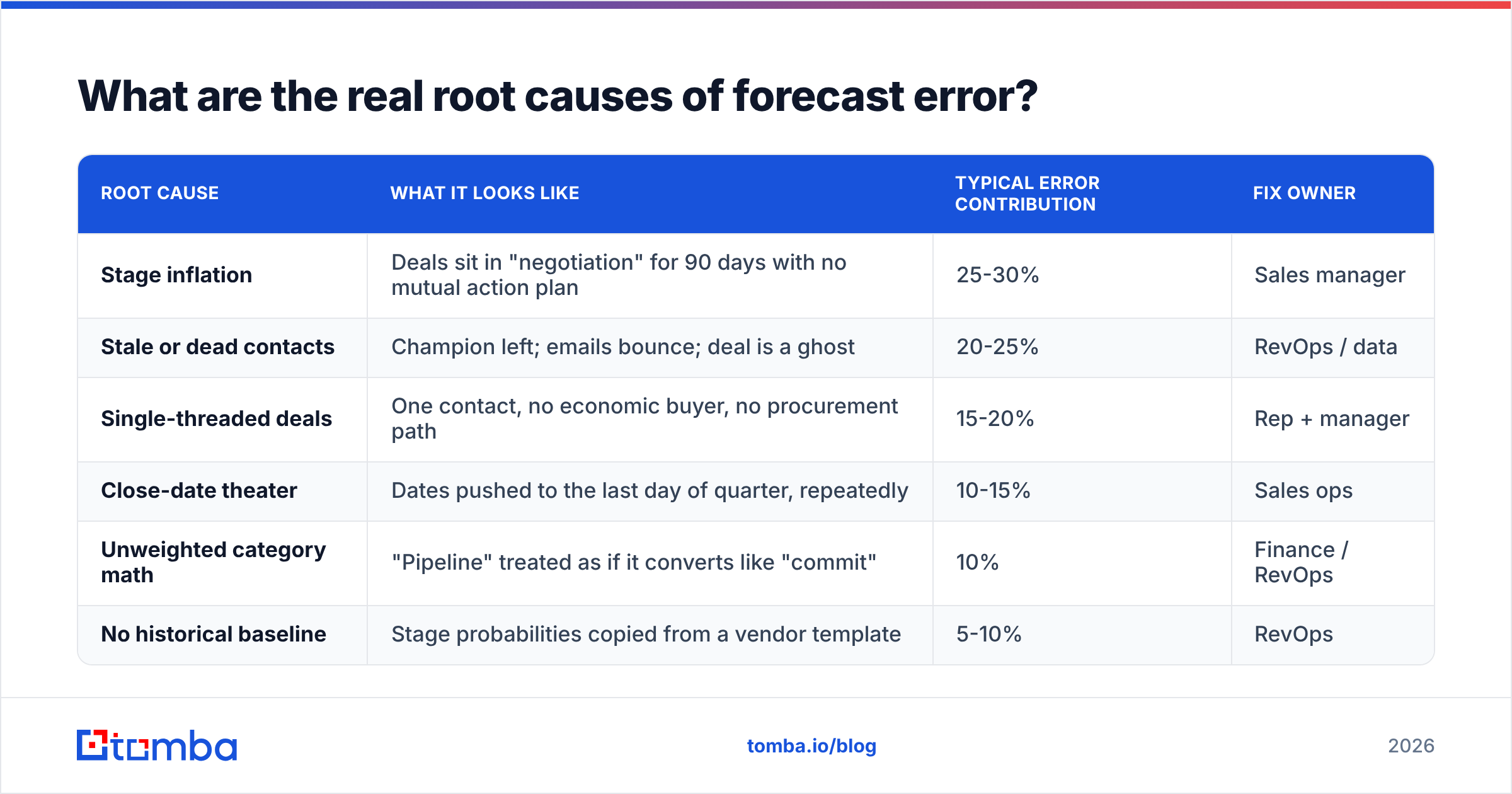
Here's the honest breakdown of where the error comes from. This is the structured version of what most post-mortems conclude after three hours of arguing.
| Root cause | What it looks like | Typical error contribution | Fix owner |
|---|---|---|---|
| Stage inflation | Deals sit in "negotiation" for 90 days with no mutual action plan | 25-30% | Sales manager |
| Stale or dead contacts | Champion left; emails bounce; deal is a ghost | 20-25% | RevOps / data |
| Single-threaded deals | One contact, no economic buyer, no procurement path | 15-20% | Rep + manager |
| Close-date theater | Dates pushed to the last day of quarter, repeatedly | 10-15% | Sales ops |
| Unweighted category math | "Pipeline" treated as if it converts like "commit" | 10% | Finance / RevOps |
| No historical baseline | Stage probabilities copied from a vendor template | 5-10% | RevOps |
The two at the top are worth dwelling on because they compound. A deal that's stage-inflated and has a dead champion looks like your healthiest opportunity — big number, late stage, long history — right up until it evaporates.
Contact decay is the quieter of the two. Your rep isn't lying when they say the deal is live; they genuinely don't know that the VP who sponsored it moved to a competitor six weeks ago. This is where data enrichment and routine email verification stop being a marketing-ops nicety and become forecast infrastructure. If your CRM says a contact is reachable and they aren't, every downstream probability is wrong.
How do you measure forecast accuracy properly?#
Conclusion first: measure at the category level, weekly, against a locked snapshot — not as a single quarter-end number.
The single-number approach ("we forecast $4M, we closed $3.4M, so we were 85% accurate") hides everything useful. It nets out overcalls and undercalls, so a team that missed badly on both sides looks average.
Use these four metrics instead:
- Forecast accuracy by category. Track commit, best case, and pipeline separately. Commit should land within ±5%. Best case within ±15%. Pipeline is directional only.
- Slippage rate. Percentage of deals forecast to close this period that pushed to the next one. Above 25% means your close-date discipline is broken, not your model.
- Stage conversion by cohort. What percentage of deals entering "proposal" in Q1 closed within two quarters? Compare against your vendor-default probabilities — the gap is usually embarrassing.
- Forecast drift curve. Plot the forecast each Monday of the quarter. A healthy curve is flat with a small upward tick. A curve that collapses in week eleven means your reps knew earlier than they told you.
- Data integrity score. Percentage of open-opportunity contacts that pass verification. Below 85% and you're forecasting on fumes.
That last metric is the one nobody tracks and the one that moves fastest. It's also the cheapest to fix.
Is AI forecasting better than manual forecasting?#
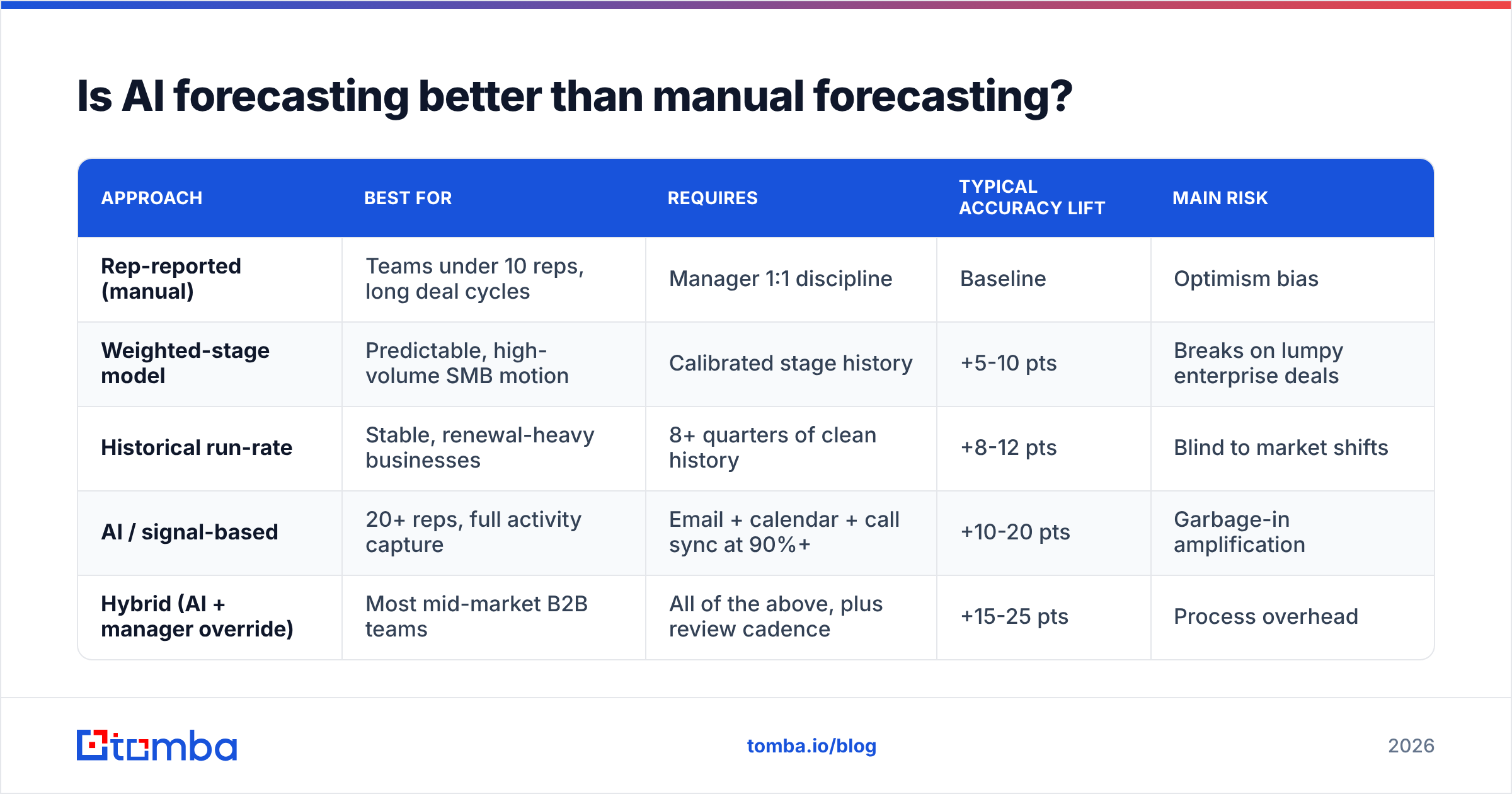
Sometimes — but the comparison is more nuanced than vendor decks suggest.
AI forecasting reads signals humans skip: email response latency, meeting cadence, number of stakeholders on threads, sentiment in call transcripts. Tools in this category (Clari, Gong, BoostUp, the native predictive layers in Salesforce and HubSpot) genuinely reduce error when the underlying activity data is complete.
The failure mode is specific: AI forecasting degrades badly when activity capture is partial. If reps work deals over WhatsApp, in-person, or from a personal inbox that isn't synced, the model sees silence and marks a healthy deal as at-risk. You get precise nonsense.
| Approach | Best for | Requires | Typical accuracy lift | Main risk |
|---|---|---|---|---|
| Rep-reported (manual) | Teams under 10 reps, long deal cycles | Manager 1:1 discipline | Baseline | Optimism bias |
| Weighted-stage model | Predictable, high-volume SMB motion | Calibrated stage history | +5-10 pts | Breaks on lumpy enterprise deals |
| Historical run-rate | Stable, renewal-heavy businesses | 8+ quarters of clean history | +8-12 pts | Blind to market shifts |
| AI / signal-based | 20+ reps, full activity capture | Email + calendar + call sync at 90%+ | +10-20 pts | Garbage-in amplification |
| Hybrid (AI + manager override) | Most mid-market B2B teams | All of the above, plus review cadence | +15-25 pts | Process overhead |
The hybrid row is where most teams should land. Let the model produce the baseline, let managers override with documented reasons, and then — this is the part teams skip — score the overrides. After two quarters you'll know whether your managers add signal or noise. Usually it's both, unevenly distributed.
How does bad contact data cause inaccurate forecasting?#
Directly and expensively. Here's the chain of causation, which is shorter than people expect.
A deal's probability is really a bet on a set of humans doing a set of things. When one of those humans is unreachable, the bet is void — but the CRM doesn't know that. The record still shows a name, a title, and an email address. The stage still says "proposal sent." The forecast still counts the number.
Concretely, this is what dead contact data does to a pipeline:
- Inflates late-stage volume. Deals that should be disqualified stay in "negotiation" because nobody can confirm they're dead. Silence reads as "still thinking."
- Corrupts stage conversion rates. Your historical proposal-to-close rate is computed over a denominator that includes zombie deals. Every future forecast inherits the distortion.
- Hides single-threading. When a champion leaves and isn't replaced in the CRM, the deal looks multi-threaded on paper while being effectively unstaffed.
- Wastes the follow-up that would have surfaced truth. Sequences bounce, email deliverability suffers, and the rep's remaining outreach lands in spam — so even the live contacts stop responding.
- Delays the bad news. The single most valuable thing forecasting does is give finance time to react. Dead data eats that time.
The fix is unglamorous: verify contacts on every open opportunity at the start of each forecast cycle. A bulk verify pass across open-pipeline contacts takes minutes and typically flags 10-20% of records on a database that hasn't been cleaned in a year. When a champion's address fails, that's not a data chore — that's a forecast correction you would otherwise have discovered in week twelve.
Re-sourcing matters as much as flagging. When verification kills a contact, you need the replacement fast — the new VP of Ops, the person who inherited the evaluation. That's a job for domain search against the account, filtered by department, rather than a rep guessing at LinkedIn for twenty minutes.
What does a forecast-accuracy fix actually look like?#
Four moves, in order. Do them sequentially; doing them at once produces a change-management mess and no clean read on what worked.
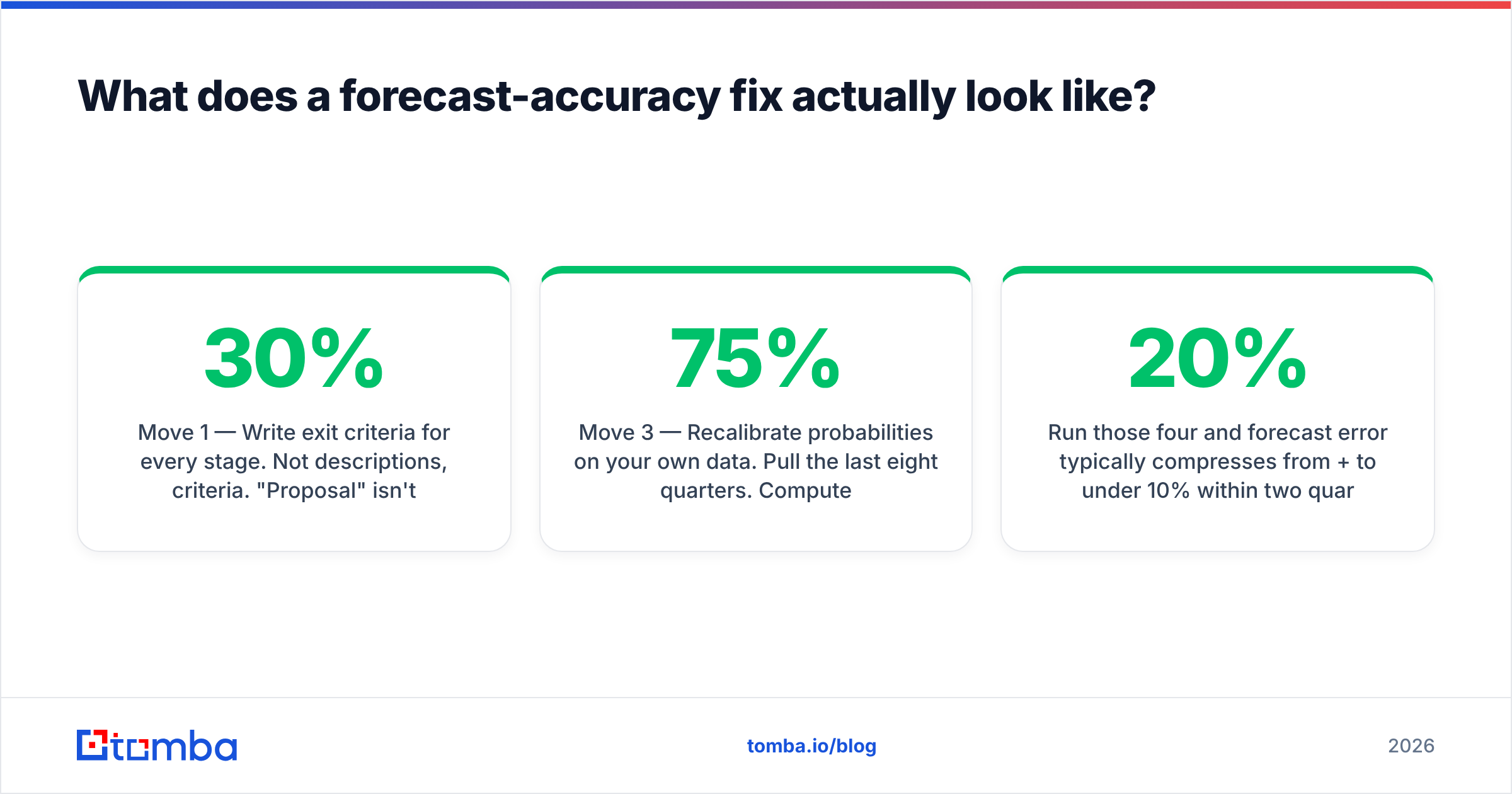
Move 1 — Write exit criteria for every stage. Not descriptions, criteria. "Proposal" isn't a feeling; it's pricing delivered in writing to a named economic buyer with a mutual close plan attached. If the criteria aren't met, the deal moves back. Expect one painful quarter where the pipeline appears to shrink 30%. It didn't shrink; it got honest.
Move 2 — Institute a contact-integrity gate. Before the forecast call, every commit-category deal must have at least two verified, currently-employed contacts. No exceptions, no "I'll check after." This single rule removes most zombie deals from the commit line.
Move 3 — Recalibrate probabilities on your own data. Pull the last eight quarters. Compute actual close rate by entering stage. Replace the vendor defaults. Most teams discover their "75% negotiation" stage converts at 41%, which explains roughly all of their overcalling.
Move 4 — Score the overrides. Every manager adjustment gets a one-line reason and a retrospective grade. Managers who consistently improve accuracy get more override authority. Managers who don't get less. This is uncomfortable and it works.
Run those four and forecast error typically compresses from 20%+ to under 10% within two quarters. It won't get to zero — enterprise deals are lumpy and buyers are irrational — but sub-10% is enough for finance to plan hiring against.
What tools help, and where do they fit?#
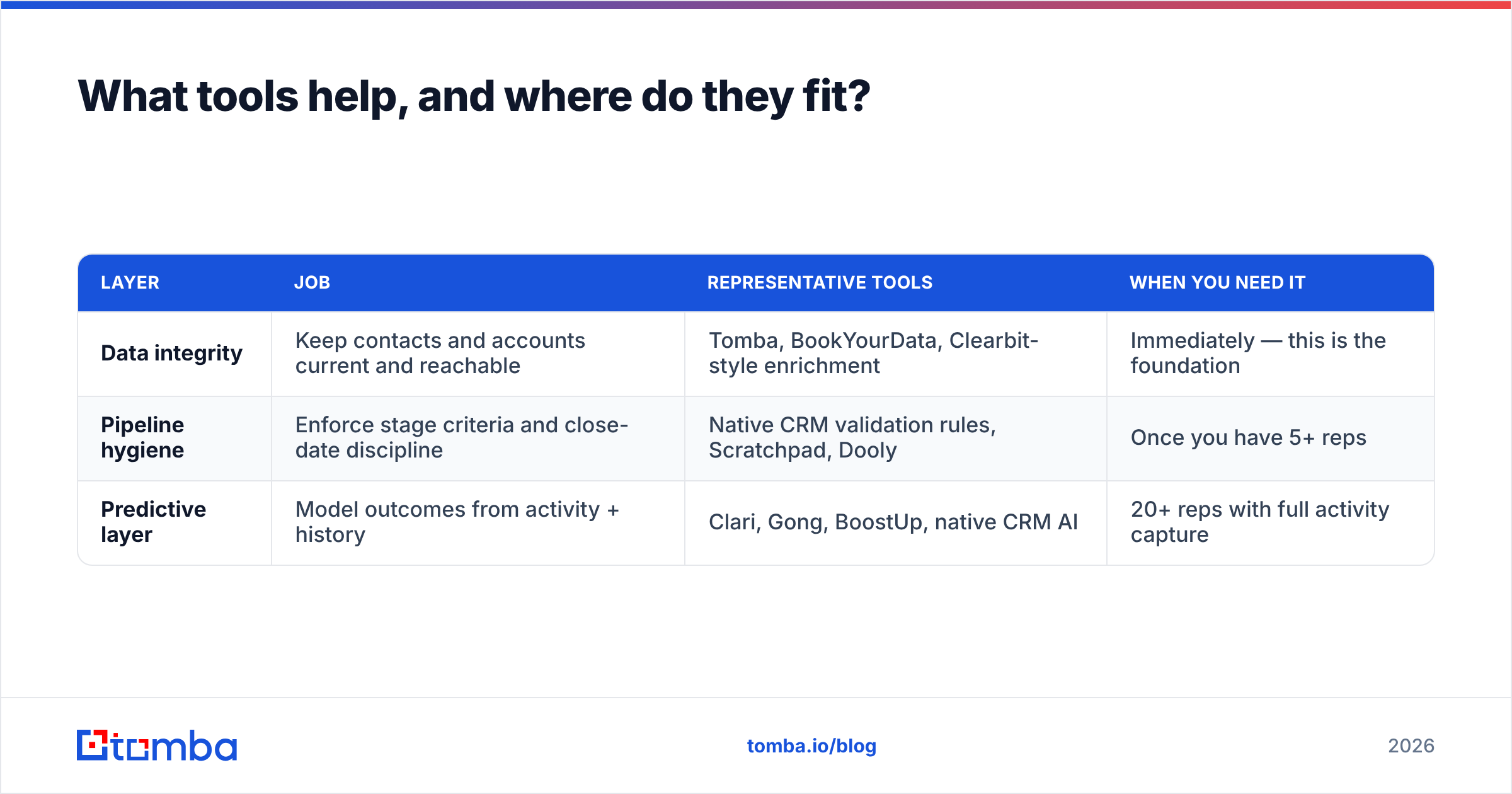
Forecasting isn't a single-tool category. It's three layers, and buying the wrong layer first is the most common mistake.
| Layer | Job | Representative tools | When you need it |
|---|---|---|---|
| Data integrity | Keep contacts and accounts current and reachable | Tomba, BookYourData, Clearbit-style enrichment | Immediately — this is the foundation |
| Pipeline hygiene | Enforce stage criteria and close-date discipline | Native CRM validation rules, Scratchpad, Dooly | Once you have 5+ reps |
| Predictive layer | Model outcomes from activity + history | Clari, Gong, BoostUp, native CRM AI | 20+ reps with full activity capture |
Teams routinely buy layer three first because it demos well, then discover it amplifies layer-one problems. A predictive model trained on a pipeline where a fifth of the contacts are unreachable will confidently forecast revenue from deals that cannot close.
On the data-integrity layer, the practical evaluation criteria are coverage in your target geographies, verification depth (does it catch catch-all domains, or just syntax?), and cost per verified record at your volume. Tomba pricing starts free at 25 searches/month, with Starter at $49/mo and Growth at $99/mo — which puts a quarterly pipeline audit well inside most RevOps discretionary budgets. BookYourData is a solid option when you want pre-built, pay-as-you-go list purchasing rather than a search-and-verify workflow; the two solve adjacent problems and plenty of teams run both.
Whatever you pick, the test is the same: after a cleanup pass, does your week-two forecast look more like your week-twelve forecast than it did last quarter? That's the only benchmark that matters.
What should you do in the next 30 days?#
Start narrow. Pick one segment — one team, one region, one product line — and run the full protocol there rather than boiling the ocean.
Week one: export every open opportunity and its associated contacts. Verify the lot. Count the failures. That number is your credibility argument for everything that follows.
Week two: rewrite stage exit criteria with your two best managers. Not with a committee. Publish them.
Week three: recalibrate stage probabilities against eight quarters of history. Present the delta to leadership before anyone can accuse you of moving goalposts mid-quarter.
Week four: run the first forecast call under the new rules. Expect the number to drop. Expect someone to be upset. Hold the line — a lower honest number is worth vastly more to the business than a higher fictional one, and by quarter's end the accuracy data will make the argument for you.
If you want a starting point that costs nothing, pull the contacts on your ten largest open deals and run them through the Tomba Email Finder to confirm every champion and economic buyer is still where your CRM says they are. Ten minutes of work. In our experience, one or two of those ten come back wrong — and finding that out in week two instead of week twelve is exactly what accurate forecasting is made of.
Related guides#
// get started
Find, verify and enrich your first contacts today
Start on the free plan with 25 searches a month, then scale when your team is ready.
Free plan · No credit card required · GDPR & CCPA
// about the author