Inbound and Outbound Sales in 2026: How to Blend Both Motions
Inbound compounds slowly. Outbound turns on this week. Here is how the two motions actually differ on cost, speed, and control, and how to run both without burning your domain or your budget.
TL;DR
- Inbound and outbound sales are not rivals. They are two different ways to buy attention: inbound rents it from search and content over months, outbound buys it with contact data and sequences this week.
- Outbound gives you speed and account control. Inbound gives you lower cost per opportunity once it compounds, and better win rates because the buyer started the conversation.
- Most teams under $5M ARR should run outbound as the primary motion and treat inbound as a compounding asset, not a pipeline plan for this quarter.
- The shared dependency nobody budgets for is contact data. Both motions die on bad email addresses, one through bounces, the other through lead forms that fill up with junk.
- A blended motion works when both sides share one account list, one enrichment layer, and one pipeline number. Separate targets create separate wars.
What Are Inbound and Outbound Sales, Exactly?#
Inbound sales is the motion where the buyer moves first. They search a problem, land on your content, download something, book a demo, or reply to a nurture email. Your job starts at the point of hand-raise: qualify, route, and close.
Outbound sales is the motion where you move first. You define an account list, find the right people, reach them by email, phone, or LinkedIn, and create demand that was not going to surface on its own this quarter.
The useful analogy: inbound is a shop on a busy street, outbound is a knock on the door. The shop takes years to end up on a busy street, and once it is there, foot traffic costs you almost nothing per visitor. The door knock works tonight, but you pay for every single door.
That difference in timing is the whole strategic argument. Everything else, the debates about which is "modern" or which is "spammy," is noise. A team with 90 days of runway and no organic traffic does not have an inbound option. A team with 400,000 monthly organic sessions and a 30-person SDR org has a different problem entirely.
Three things blur the line in 2026, and you should know them before you draw a hard boundary:
- Intent data turns inbound signals into outbound triggers. Someone reads three pricing pages, never fills a form, and a rep reaches out. Is that inbound or outbound? Operationally it is outbound with an inbound signal, and it converts better than either alone.
- Content is now an outbound asset. The best cold emails cite a specific piece of research the sender published. The content did not generate the lead, it earned the reply.
- Self-serve trials collapse the middle. Product-led motions produce hand-raises that look inbound but need outbound-style follow-up within minutes, or they go cold.
How Do Inbound and Outbound Sales Compare Head to Head?#
Here is the honest comparison, using ranges that hold across most B2B SaaS and services teams. Your numbers will differ, but the shape rarely does.
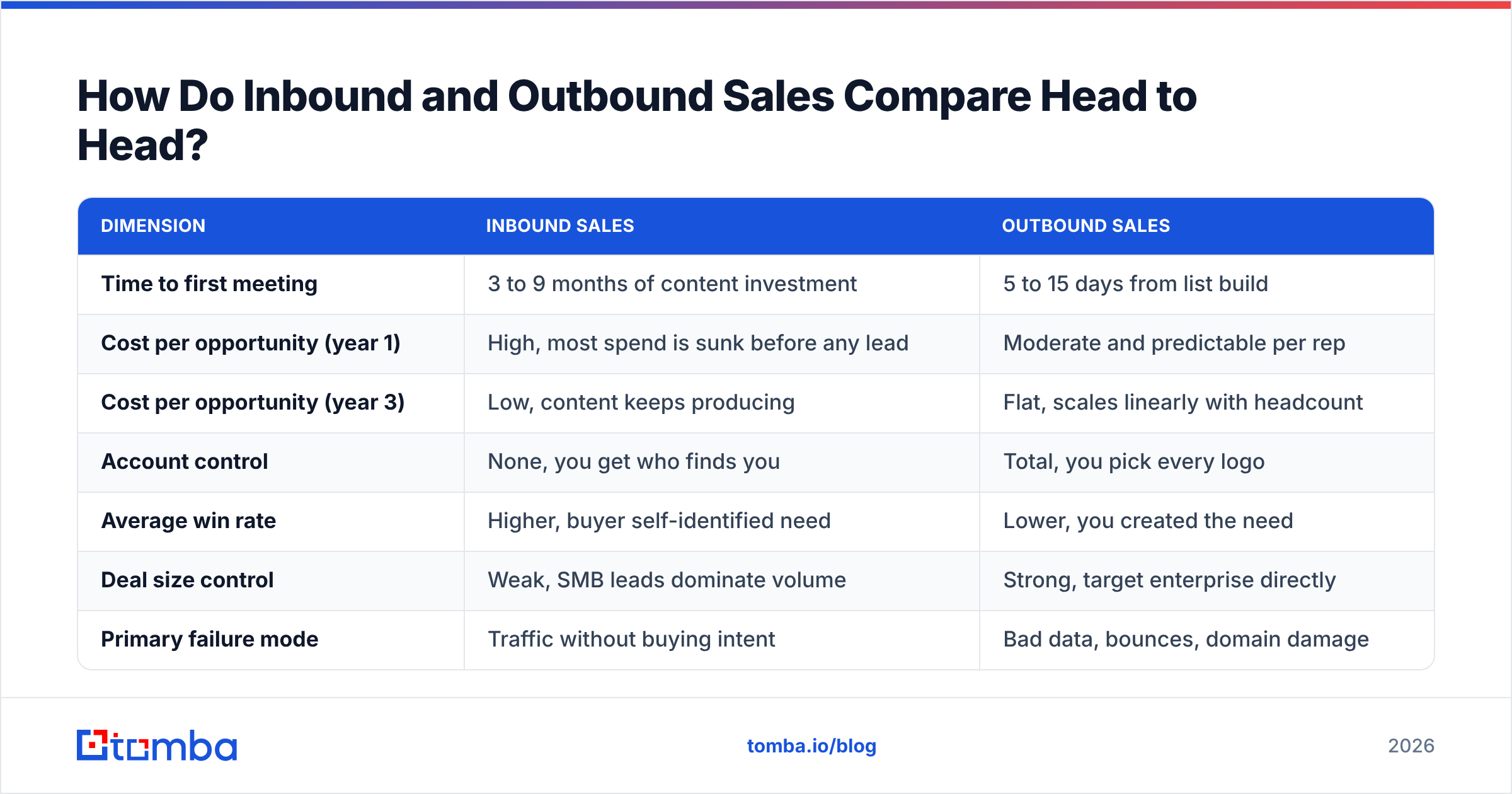
| Dimension | Inbound sales | Outbound sales |
|---|---|---|
| Time to first meeting | 3 to 9 months of content investment | 5 to 15 days from list build |
| Cost per opportunity (year 1) | High, most spend is sunk before any lead | Moderate and predictable per rep |
| Cost per opportunity (year 3) | Low, content keeps producing | Flat, scales linearly with headcount |
| Account control | None, you get who finds you | Total, you pick every logo |
| Average win rate | Higher, buyer self-identified need | Lower, you created the need |
| Deal size control | Weak, SMB leads dominate volume | Strong, target enterprise directly |
| Primary failure mode | Traffic without buying intent | Bad data, bounces, domain damage |
| Team profile | Content, SEO, demand gen, AE | SDR, RevOps, data ops, AE |
| Predictability month to month | Low early, high once compounding | High from week one |
| Main input cost | Writers, designers, ad spend | Contact data, tooling, SDR salaries |
The row that decides most strategies is "time to first meeting." If your board wants pipeline in Q1 and you started building content in January, inbound is not on the menu. Outbound is the only motion that turns on inside a two-week window.
The row that decides most long-term strategies is "cost per opportunity (year 3)." Outbound never gets cheaper on its own. You add a rep, you add pipeline, you add cost. Inbound has a genuinely different curve: an article that ranks keeps producing leads at close to zero marginal cost. That is why mature companies fund content even when outbound is working.

Which Motion Actually Costs More Per Meeting?#
Outbound costs more per meeting in year one and less per meeting than most people assume in year two. Run the math instead of trusting the vibe.
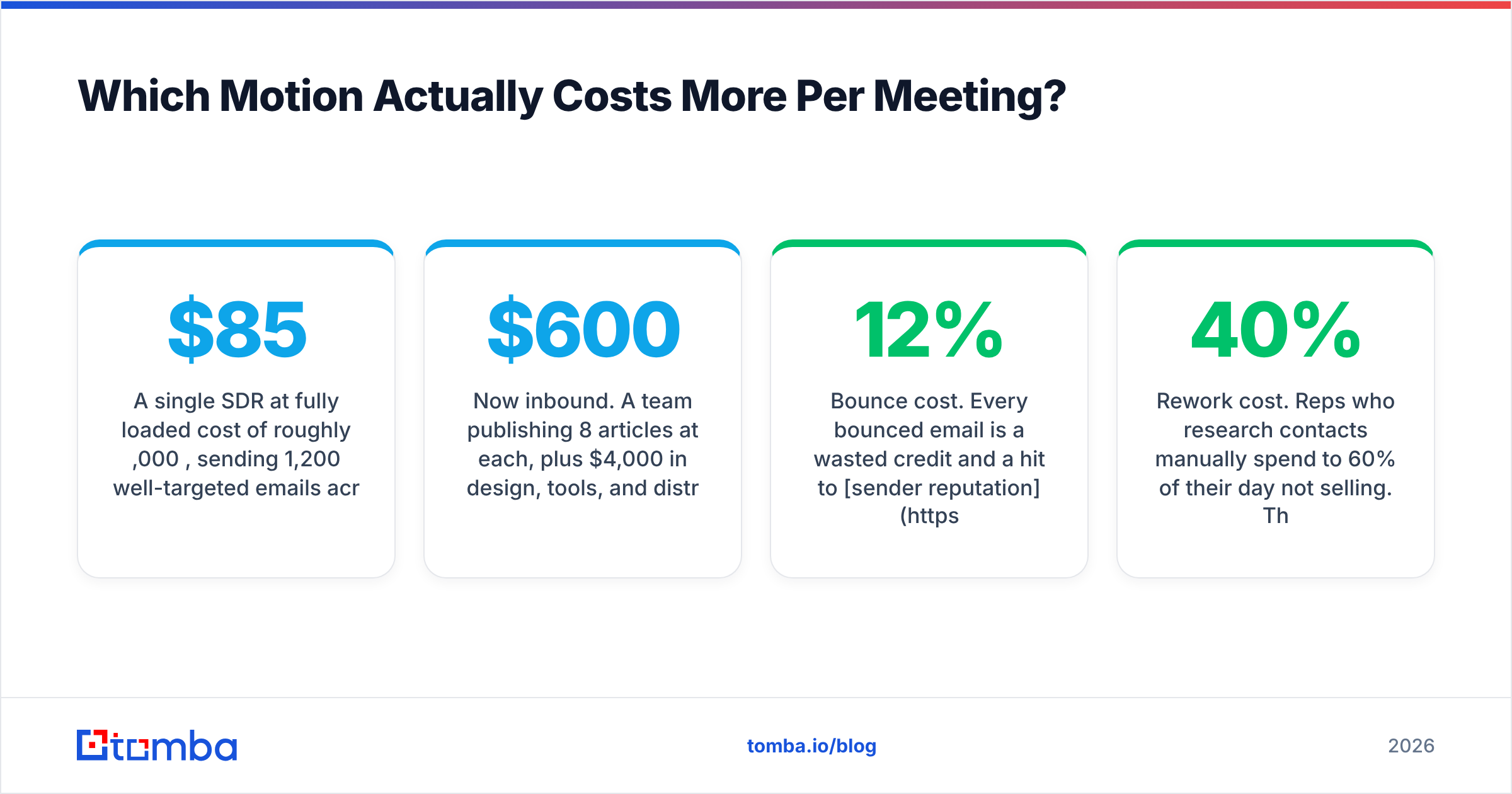
A single SDR at fully loaded cost of roughly $85,000 per year, sending 1,200 well-targeted emails per month across three mailboxes, at a 4% positive reply rate and a 55% reply-to-meeting conversion, produces about 26 meetings per month. That is roughly $270 per meeting before tooling. Add data and sequencing tools at $500 to $900 per rep per month and you land near $300 to $310 per meeting.
Now inbound. A team publishing 8 articles per month at $600 each, plus $4,000 in design, tools, and distribution, spends about $8,800 monthly. In month three that program might produce 5 qualified meetings, which is $1,760 per meeting and looks terrible. In month eighteen the same program produces 60 meetings a month with the same spend, which is $146 per meeting and looks like magic.
The mistake is comparing the two at the same point in time. Compare them across a 24-month window and the picture is clear: outbound is a flat line, inbound is a hockey stick that starts underwater.
Two hidden costs distort this math, and both live on the outbound side:
- Bounce cost. Every bounced email is a wasted credit and a hit to sender reputation. At a 12% bounce rate, mailbox providers start throttling you, and your reply rate on valid addresses falls too. The damage is not linear.
- Rework cost. Reps who research contacts manually spend 40% to 60% of their day not selling. That is the single largest line item in outbound and it never shows up in a tooling budget.

When Should You Lead With Inbound?#
Lead with inbound when three conditions hold together.
You have a category people already search for. If buyers type "invoice reconciliation software" into Google 12,000 times a month, inbound is a demand-capture play and it works. If you invented the category last year, nobody is searching, and content becomes an education project with a two-year payback.
Your ACV supports a self-serve or low-touch close. Inbound leads at $8,000 ACV can close with one demo and a proposal. Inbound leads at $250,000 ACV still need six months of outbound-style multithreading, so inbound only supplies the first contact.
You can survive the ramp. Inbound is a balance-sheet decision. If you cannot fund 9 to 12 months of content with no attributable pipeline, do not start it as your primary motion. Start it as a 15% side investment and let outbound pay the bills.
One more signal: check whether your existing customers found you or you found them. If more than 40% of closed-won deals last year started with an inbound touch, you already have a working demand engine and you should feed it.
When Should You Lead With Outbound?#
Lead with outbound when you need control, and control comes in three forms.
Control over which accounts you sell to. A 200-account target list is a strategy. Waiting to see who fills out a form is not. If your ideal customer profile is narrow, for example Series B fintechs in the EU with 50 to 300 employees, outbound is the only motion that touches exactly those companies.
Control over timing. Outbound is the only pipeline source you can turn up in a week. New quarter, new territory, new product launch, competitor just got acquired — all of these are outbound triggers, and none of them wait for content to rank.
Control over deal size. Inbound skews small because small companies search more and buy faster. If your growth plan needs six-figure deals, someone has to go get them.
Outbound also has a prerequisite that inbound does not: contact data you can trust. You cannot send to accounts you cannot reach. That means a working process for turning a company name into a verified decision-maker email, which is where a domain search or a dedicated email finder does the heavy lifting that reps otherwise do by hand.
What Does a Blended Motion Actually Look Like?#
The blend is not "do 50% of each." It is a sequence of dependencies where each motion feeds the other. Here is the structure that works, in the order you should build it.
- One account list, owned by RevOps. Marketing and sales target the same named accounts. Inbound content is written for those accounts' problems, outbound sequences go to those accounts' buyers. Two lists means two companies.
- One enrichment layer under both. Whether a contact arrives via form fill or list build, it passes through the same data enrichment and verification step. Inbound forms are full of
test@gmail.comand typo'd work emails; they need cleaning just as badly as cold lists do. - Outbound triggered by inbound signals. Pricing page visits, repeat content reads, competitor comparison views. These become SDR tasks within 24 hours, not a monthly report nobody reads.
- Inbound content written from outbound objections. Your SDRs hear the same five objections every week. Those are your five highest-converting articles. Most content teams never ask, which is why so much B2B content answers questions nobody has.
- One pipeline number, one forecast. Split targets create attribution wars. Give both sides a shared sourced-pipeline goal and let them argue about tactics, not credit.
- Shared feedback loop on ICP. Outbound learns which segments reply. Inbound learns which segments convert. Merge those two datasets quarterly and your ICP definition gets sharper than either motion could make it alone.
Research from Gartner's sales practice has consistently shown B2B buyers spend only a small fraction of their journey with any vendor's sales team, which is the strongest argument for running both: you need to be findable when they research alone and reachable when they are ready to talk.
How Do You Build the Data Layer Both Motions Need?#
Both motions consume the same raw material: accurate contact records. The difference is where the record enters your system.
Outbound needs the full path: company to buying committee to verified email to phone. Inbound needs the reverse: a form submission with a partial record that must be enriched into something a rep can act on before the lead goes cold.
A practical setup looks like this:
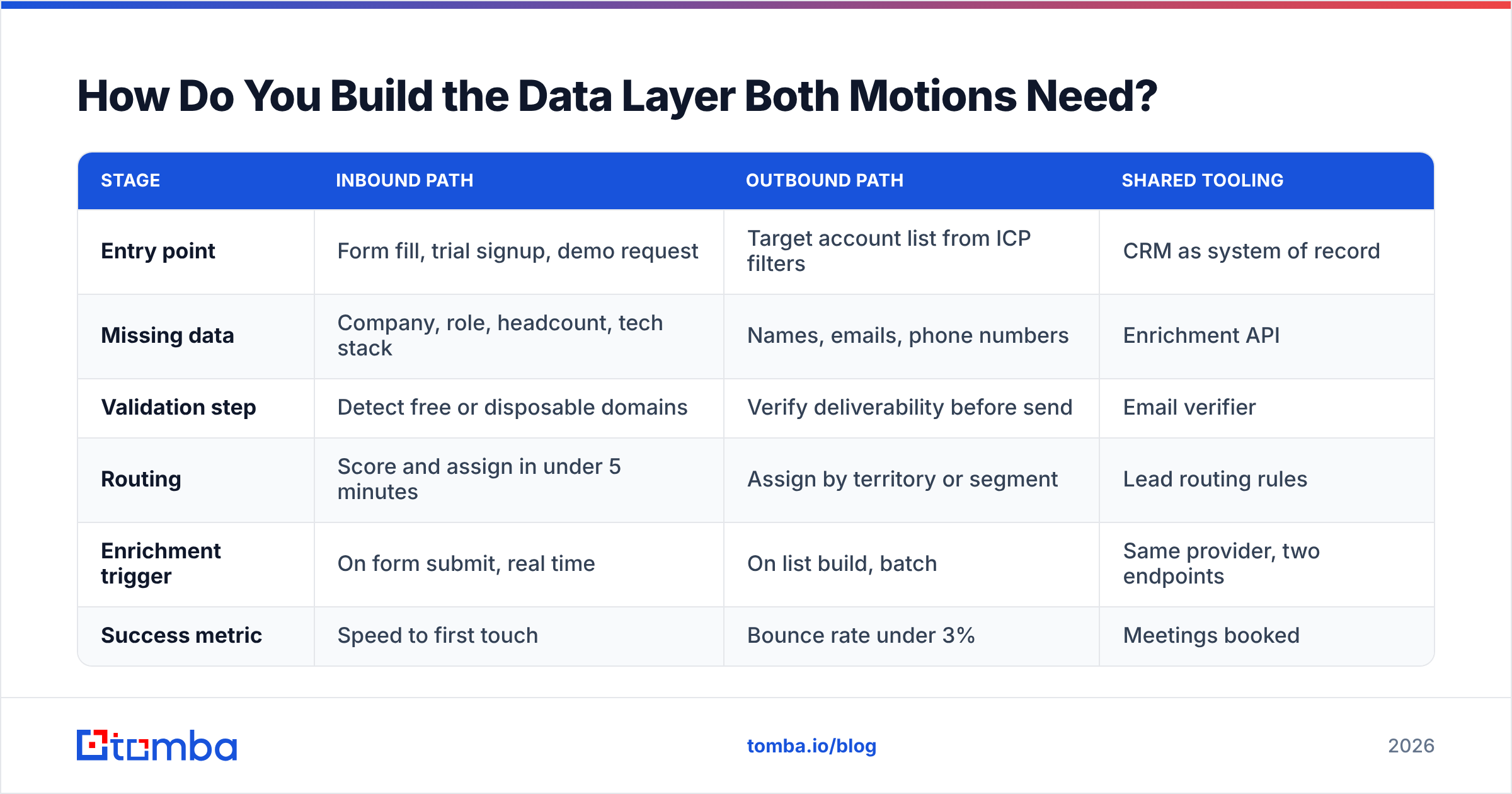
| Stage | Inbound path | Outbound path | Shared tooling |
|---|---|---|---|
| Entry point | Form fill, trial signup, demo request | Target account list from ICP filters | CRM as system of record |
| Missing data | Company, role, headcount, tech stack | Names, emails, phone numbers | Enrichment API |
| Validation step | Detect free or disposable domains | Verify deliverability before send | Email verifier |
| Routing | Score and assign in under 5 minutes | Assign by territory or segment | Lead routing rules |
| Enrichment trigger | On form submit, real time | On list build, batch | Same provider, two endpoints |
| Success metric | Speed to first touch | Bounce rate under 3% | Meetings booked |
Two rules make this hold up in practice. First, verify before every send, not once per quarter — B2B contact data decays at roughly 2% to 2.5% per month as people change jobs. Second, treat catch-all domains as their own category rather than lumping them with valid or invalid, since a large share of enterprise domains accept everything at the gateway and tell you nothing about the individual mailbox.
If you want a comparison of how different providers handle this validation step, G2's category listings are a reasonable starting point for unfiltered practitioner reviews, and vendor documentation like HubSpot's sales resources covers the CRM-side routing patterns in depth.
What Metrics Should You Track for Each Motion?#
Do not use one dashboard for both. The leading indicators are genuinely different.
For outbound, track bounce rate, positive reply rate, meetings booked per 1,000 contacts, and show rate. If bounce rate creeps above 3%, stop sending and fix the data. If positive reply rate is under 2%, the problem is targeting or offer, not volume, and sending more will only accelerate the damage.
For inbound, track organic sessions on commercial-intent pages, form conversion rate, MQL-to-SQL rate, and speed to first touch. If MQL-to-SQL is under 20%, your form is capturing the wrong people. If speed to first touch is over an hour, you are losing deals you already paid to generate.
For both, track one shared number: sourced pipeline against target. That is the only figure the board cares about, and it is the only one that stops the internal argument about which motion "really" produced the deal.
What Mistakes Kill Blended Motions?#
Running outbound on unverified data. This is the most expensive mistake in the entire category, because the cost is delayed. You do not pay on the day you send to 5,000 bad addresses. You pay three weeks later when your domain reputation drops and even your good emails land in spam.
Expecting inbound to produce pipeline in 90 days. It will not. Fund it as an asset, measure it at 12 months, and do not let a quarterly review kill it at month four.
Letting marketing and sales define ICP separately. You end up with content targeting VPs of Engineering and sequences targeting Heads of Procurement at the same accounts, and neither converts.
Treating inbound leads with outbound cadence rules. Someone who requested a demo does not need a seven-touch nurture sequence. They need a call in five minutes. Speed to lead beats every other variable for inbound conversion.
Scaling volume before fixing conversion. Doubling outbound send volume on a 1% reply rate gets you the same bad outcome twice as fast, plus deliverability damage. Fix the message and the list first, then scale.
Where Should You Start This Quarter?#
If you have no pipeline and no traffic, start outbound. Build a 300-account target list, find the two or three real decision-makers at each, verify every address, and send a tight sequence tied to a specific trigger. You will know within 30 days whether the message works.
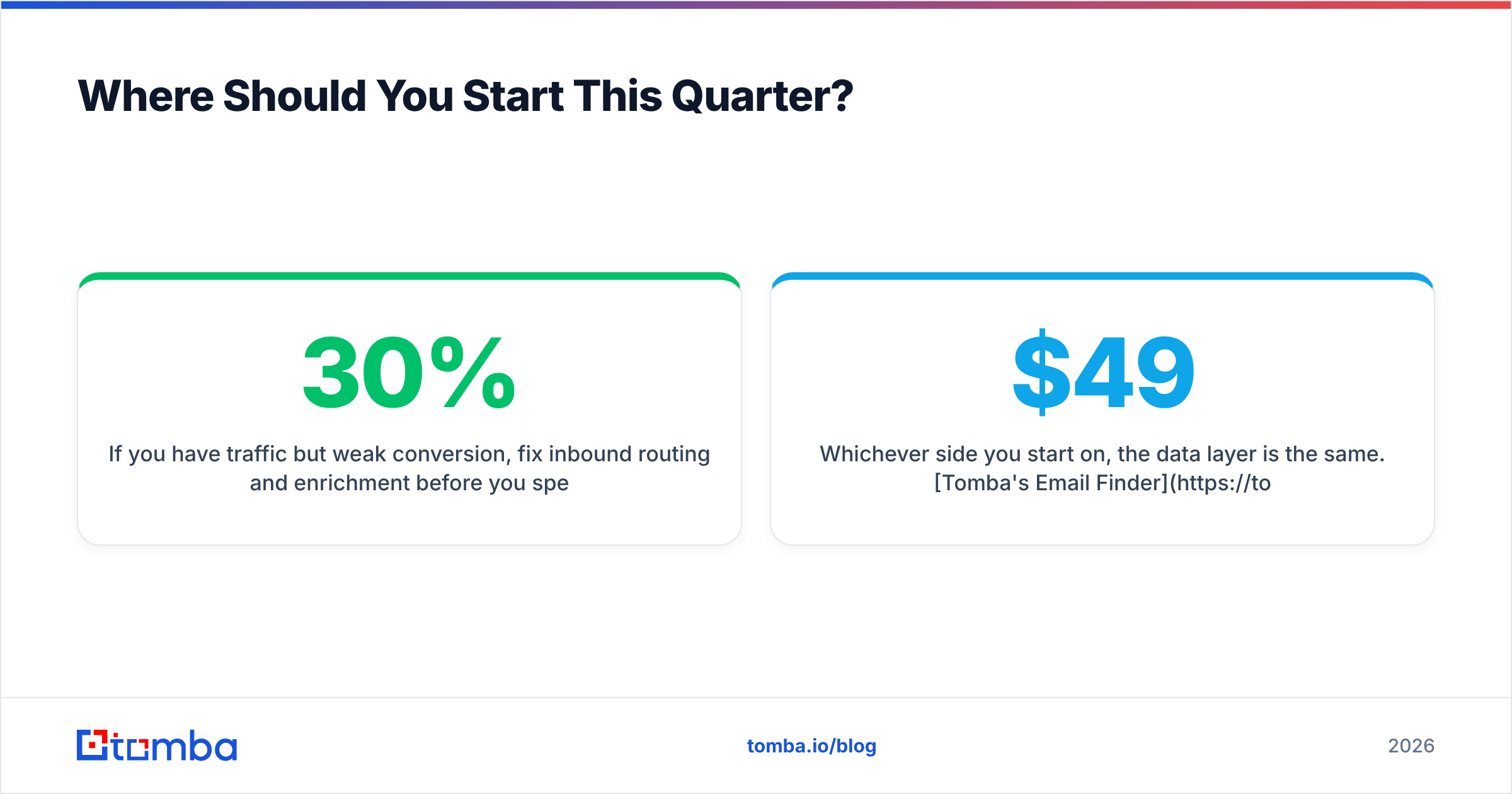
If you have traffic but weak conversion, fix inbound routing and enrichment before you spend another dollar on content. Most teams are already leaking 30% of their inbound leads to bad routing and slow follow-up.
If you have both and they are fighting, the fix is structural, not motivational: one account list, one enrichment layer, one pipeline number.
Whichever side you start on, the data layer is the same. Tomba's Email Finder turns a company domain and a name into a verified work email, with a free tier of 25 searches a month to test the accuracy on your own target accounts before committing. Paid plans start at $49/mo for Starter, $99/mo for Growth, and $249/mo for Pro, and you can see full Tomba pricing alongside the bulk and API options if you need to run enrichment across an entire list rather than one contact at a time. Build the list, verify it, then pick your motion.
Related guides#
// get started
Find, verify and enrich your first contacts today
Start on the free plan with 25 searches a month, then scale when your team is ready.
Free plan · No credit card required · GDPR & CCPA
Get the Tomba newsletter
Product and data updates
// about the author