Inbound Lead Definition: How to Qualify, Score, and Route
Most teams call every form fill an inbound lead, then wonder why the pipeline forecast misses. Here is a working inbound lead definition, the qualification tiers behind it, and the routing rules that turn raw submissions into revenue.
TL;DR
- An inbound lead is a person who initiated contact with your company and left enough identity behind for you to follow up. Initiation plus identifiability. Everything else is a detail.
- A form fill is not automatically an inbound lead. Job seekers, students, competitors, and bots all submit forms. Treat submissions as raw input, not as pipeline.
- Split inbound into intent tiers (demo request, pricing view, gated content, newsletter). Each tier deserves a different response, a different owner, and a different SLA.
- Enrich and verify before routing. A lead with a validated work email, a company size, and a job title routes itself. One with
j***@gmail.comand nothing else burns an SDR hour. - Write the definition down, get sales and marketing to sign it, and re-audit it every quarter. An unwritten inbound lead definition drifts into "whatever marketing counted last month."
What is an inbound lead?#
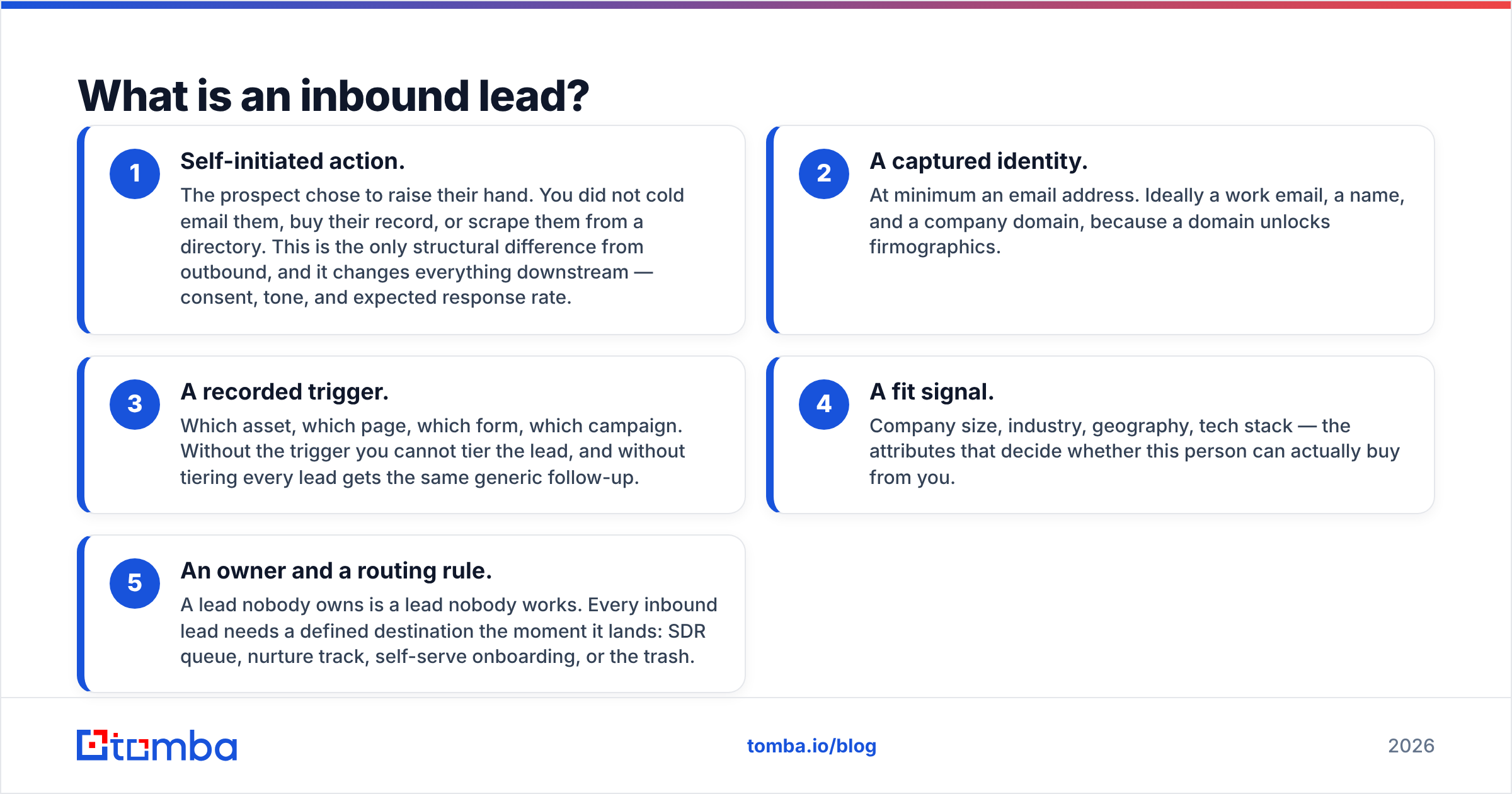
An inbound lead is a prospect who initiated contact with your company and gave you enough information to contact them back.
Two conditions have to hold. The prospect moved first — they filled a form, started a chat, requested a demo, replied to a newsletter, or called your sales line. And they became identifiable — you have a name, an email, a company, or a phone number attached to that action. Miss either condition and you do not have a lead. Anonymous traffic that reads three pricing pages is intent, not a lead. A conference badge scan you initiated is outbound, not inbound.
The pieces that make an inbound lead usable:
- Self-initiated action. The prospect chose to raise their hand. You did not cold email them, buy their record, or scrape them from a directory. This is the only structural difference from outbound, and it changes everything downstream — consent, tone, and expected response rate.
- A captured identity. At minimum an email address. Ideally a work email, a name, and a company domain, because a domain unlocks firmographics.
- A recorded trigger. Which asset, which page, which form, which campaign. Without the trigger you cannot tier the lead, and without tiering every lead gets the same generic follow-up.
- A fit signal. Company size, industry, geography, tech stack — the attributes that decide whether this person can actually buy from you.
- An owner and a routing rule. A lead nobody owns is a lead nobody works. Every inbound lead needs a defined destination the moment it lands: SDR queue, nurture track, self-serve onboarding, or the trash.
If your CRM records a submission without three of those five, you do not have an inbound lead definition problem — you have a data capture problem.
Inbound vs outbound lead: what is the actual difference?#
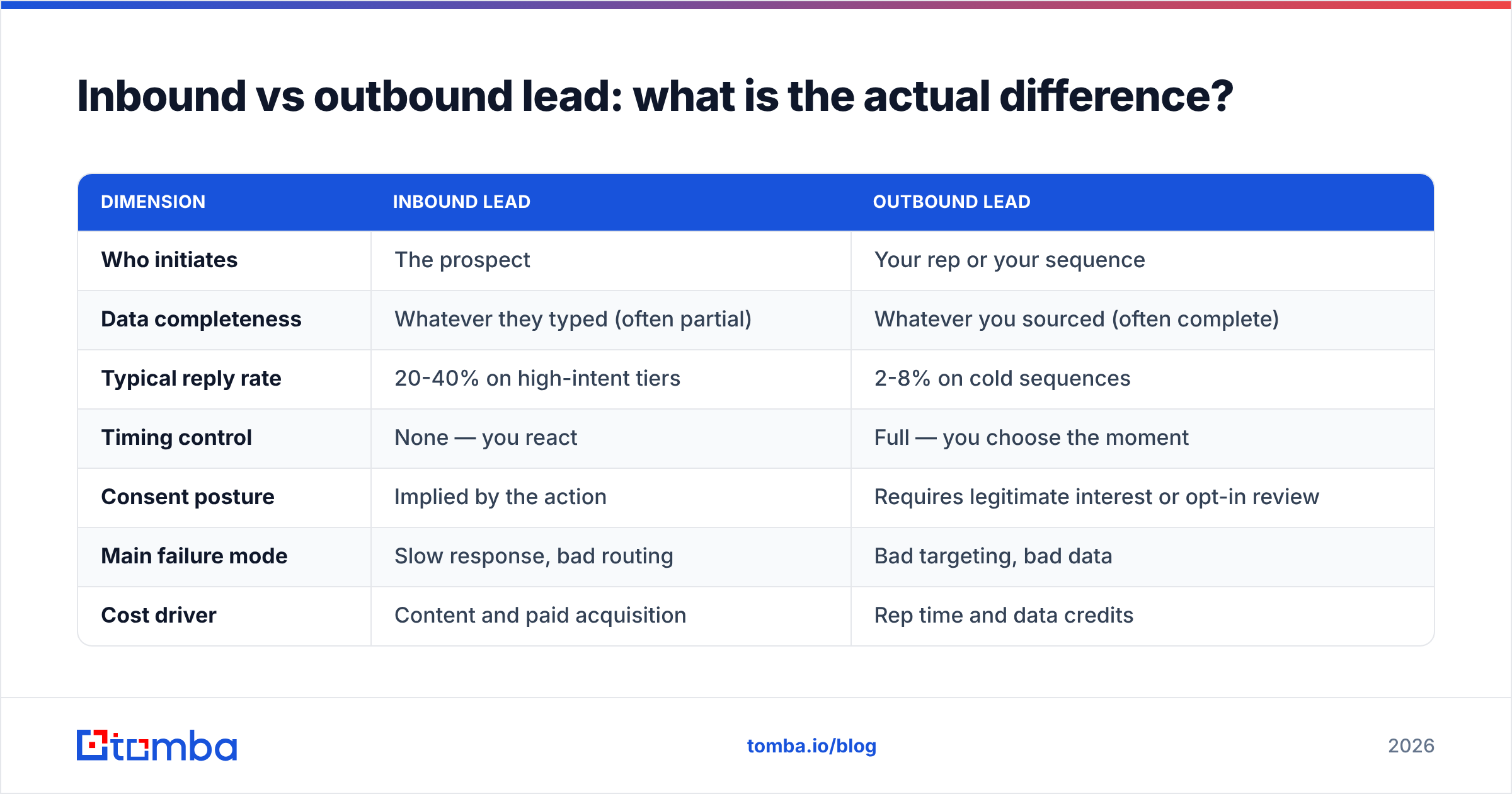
The distinction is about who started the conversation, and that single fact cascades into completely different economics.
| Dimension | Inbound lead | Outbound lead |
|---|---|---|
| Who initiates | The prospect | Your rep or your sequence |
| Data completeness | Whatever they typed (often partial) | Whatever you sourced (often complete) |
| Typical reply rate | 20-40% on high-intent tiers | 2-8% on cold sequences |
| Timing control | None — you react | Full — you choose the moment |
| Consent posture | Implied by the action | Requires legitimate interest or opt-in review |
| Main failure mode | Slow response, bad routing | Bad targeting, bad data |
| Cost driver | Content and paid acquisition | Rep time and data credits |
| Volume ceiling | Capped by traffic | Capped by list size and sending capacity |
Notice the asymmetry in data completeness. Outbound leads arrive with clean firmographics because you built the list deliberately. Inbound leads arrive with whatever the prospect could be bothered to type into a three-field form, which is usually a first name and a personal email. That gap is the single biggest reason inbound conversion looks worse than it should on paper.
HubSpot's inbound framework popularized the attract-engage-delight model that most modern definitions inherit, and the general lead generation entry on Wikipedia is a decent neutral baseline if you need to align a mixed marketing and sales audience on vocabulary before arguing about thresholds.
What are the types of inbound leads?#
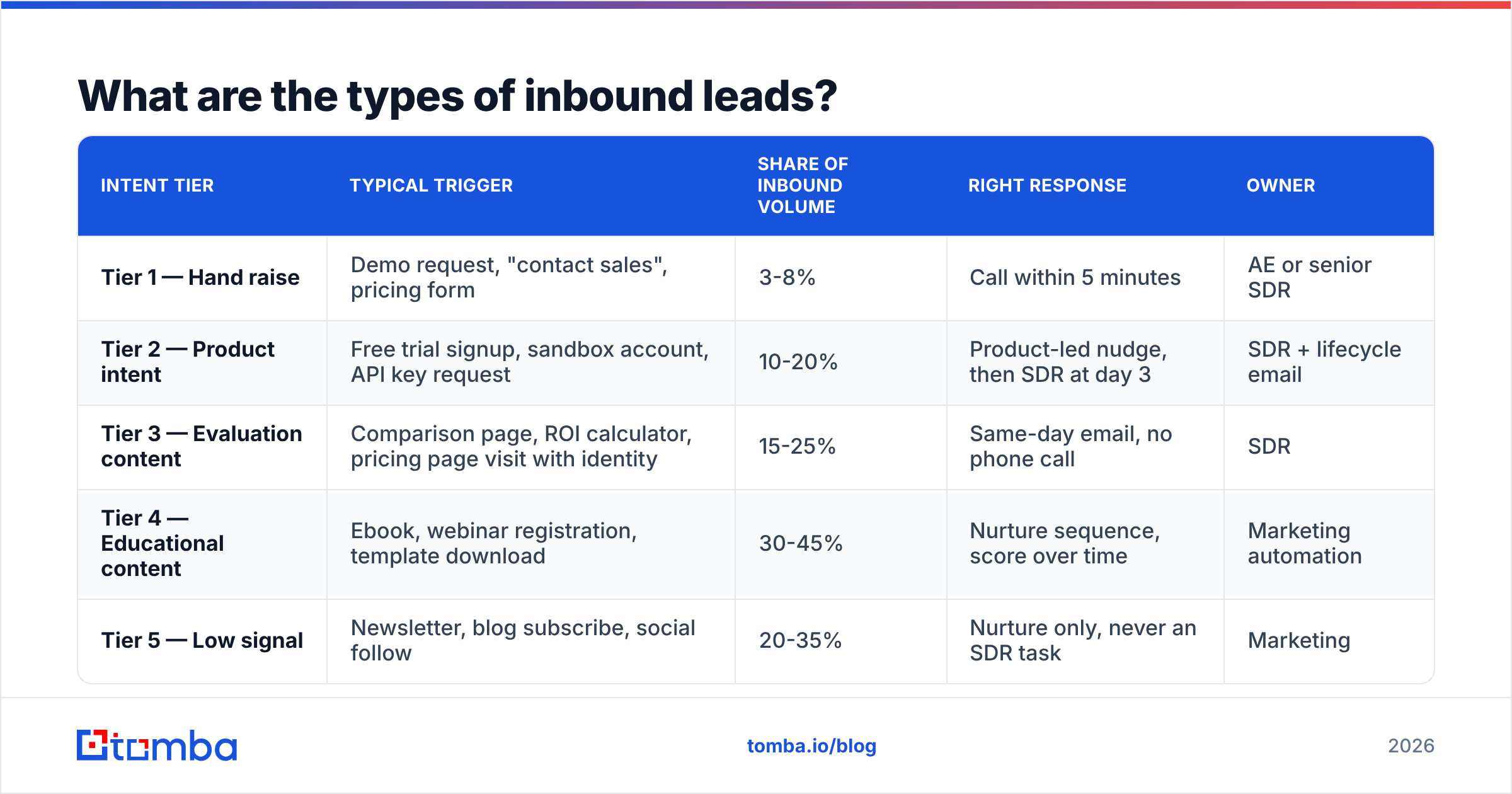
Not all raised hands mean the same thing. A demo request and a newsletter signup are both inbound, and treating them identically is how teams end up with a 4% MQL-to-opportunity rate and a sales team that ignores marketing.
| Intent tier | Typical trigger | Share of inbound volume | Right response | Owner |
|---|---|---|---|---|
| Tier 1 — Hand raise | Demo request, "contact sales", pricing form | 3-8% | Call within 5 minutes | AE or senior SDR |
| Tier 2 — Product intent | Free trial signup, sandbox account, API key request | 10-20% | Product-led nudge, then SDR at day 3 | SDR + lifecycle email |
| Tier 3 — Evaluation content | Comparison page, ROI calculator, pricing page visit with identity | 15-25% | Same-day email, no phone call | SDR |
| Tier 4 — Educational content | Ebook, webinar registration, template download | 30-45% | Nurture sequence, score over time | Marketing automation |
| Tier 5 — Low signal | Newsletter, blog subscribe, social follow | 20-35% | Nurture only, never an SDR task | Marketing |
Run this table against your own last 90 days before you accept the percentages. The point is not the exact split — it is that Tier 1 and Tier 5 should never sit in the same queue with the same SLA. Most "inbound isn't working" complaints resolve into "we routed Tier 4 volume to a Tier 1 process."
Is every form fill an inbound lead?#
No, and this is where most definitions quietly break.
A form submission is raw input. It becomes an inbound lead only after it survives a disqualification pass. The categories you need to filter:
- Job seekers. They fill "contact us" because it is the only form on the site. High volume at companies that are visibly hiring.
- Students and researchers. Common on ebook and report downloads. Almost always
.eduor free-mail domains with no company field. - Competitors. They download your comparison pages and pricing sheets. Domain-level blocklists handle this in seconds.
- Existing customers. Routing a customer to an SDR as a "new lead" is an embarrassing, fixable mistake. Deduplicate against your CRM before routing.
- Bad or fake addresses. Typos, throwaway addresses, and bot submissions. A form that does not run email verification at submit time will hand your SDRs bounces to chase.
- Out-of-territory or out-of-ICP. A genuine buyer you cannot serve is not a lead, it is a referral.
A reasonable rule: submissions minus disqualified equals inbound leads. If you report the top number to the board and the bottom number to sales, the two teams will never agree on whether inbound works.
How do you qualify an inbound lead?#
Score fit and intent separately, then let the combination decide the route. Collapsing both into one number is how a newsletter signup from a Fortune 500 outranks a demo request from a perfect-fit mid-market company.
Fit is who they are: employee count, revenue band, industry, geography, tech stack, seniority. It does not change week to week. Enrichment supplies almost all of it.
Intent is what they did: which pages, which assets, how recently, how often. It decays fast. A pricing page visit is worth a lot on day zero and almost nothing on day thirty.
The four quadrants and what to do with each:
- High fit, high intent. Call now. This is the only quadrant that justifies interrupting an AE.
- High fit, low intent. Assign to an SDR for a low-pressure, research-backed touch. Treat it like a warm outbound play, not a demo push.
- Low fit, high intent. Route to self-serve or a lower-touch plan. Do not spend a rep hour. Revisit if they grow.
- Low fit, low intent. Nurture or suppress. No human touch.
Once you have that grid, your marketing qualified lead threshold becomes a line drawn on it rather than an arbitrary score of 50 that someone picked in 2021 and nobody has revisited since.
What does the inbound lead lifecycle look like?#
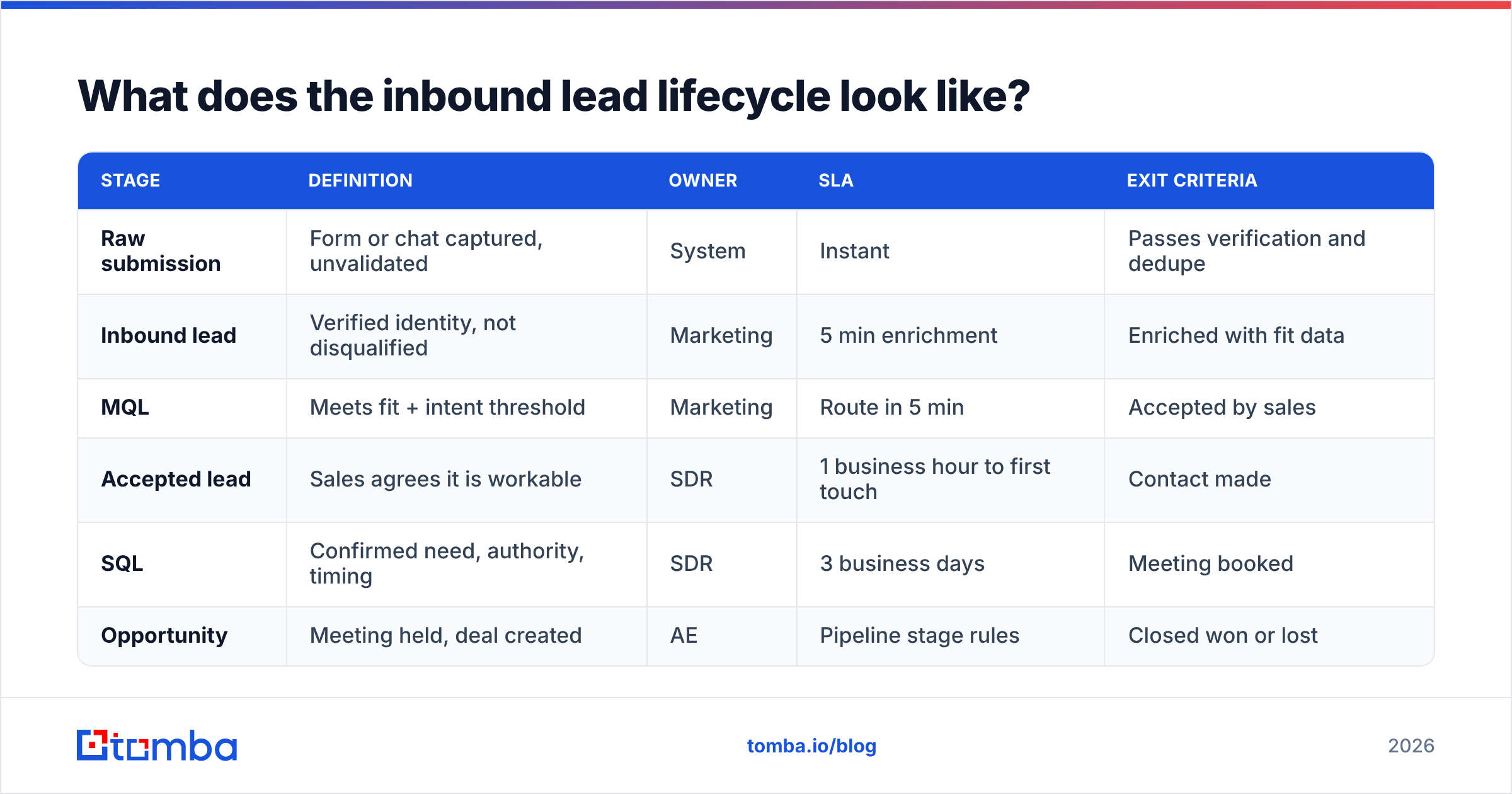
Write the stage definitions down with an owner and an SLA attached to each. Vague stages are where inbound leads go to die.
| Stage | Definition | Owner | SLA | Exit criteria |
|---|---|---|---|---|
| Raw submission | Form or chat captured, unvalidated | System | Instant | Passes verification and dedupe |
| Inbound lead | Verified identity, not disqualified | Marketing | 5 min enrichment | Enriched with fit data |
| MQL | Meets fit + intent threshold | Marketing | Route in 5 min | Accepted by sales |
| Accepted lead | Sales agrees it is workable | SDR | 1 business hour to first touch | Contact made |
| SQL | Confirmed need, authority, timing | SDR | 3 business days | Meeting booked |
| Opportunity | Meeting held, deal created | AE | Pipeline stage rules | Closed won or lost |
Two numbers to watch in that table. Lead acceptance rate — the percentage of MQLs sales accepts — tells you whether your definition matches reality; below 70% and your threshold is too loose. Time from raw submission to first touch tells you whether your operations can keep up with your definition.
How fast should you respond to an inbound lead?#
Faster than you currently do. The classic finding from lead response research is that qualification odds drop by roughly an order of magnitude between a five-minute response and a thirty-minute one, and the effect has been replicated enough times across Gartner's sales research and vendor studies that the direction is not seriously disputed even if exact multipliers vary by market.
Practical targets by tier:
- Tier 1 hand raises: five minutes, by phone, during business hours. Instant automated confirmation outside them.
- Tier 2 product intent: same day, in-product first, email second.
- Tier 3 evaluation: same business day by email.
- Tier 4 and 5: automated nurture only. No SLA needed, because no human is involved.
The bottleneck is almost never rep willingness. It is the enrichment and routing step sitting between the form and the queue. If that step takes six hours because it runs on a nightly batch job, your five-minute SLA is fiction.

How do you enrich an inbound lead before routing it?#
Assume the prospect typed the minimum. Your job is to fill the rest in before the record hits a rep's queue, in seconds not hours.
The sequence that works:
- Validate the address. Run the submitted email through verification at submit time. Catch typos while the prospect is still on the page and offer a correction. This alone recovers a meaningful slice of every form's volume.
- Resolve the person. If all you have is an email, reverse email lookup turns it into a name, a role, and a company. That is the difference between "someone at a company" and "the VP of Ops at a 400-person logistics firm."
- Enrich the company. From the domain, pull headcount, industry, location, and tech stack. This is what your fit score consumes. A data enrichment step here is what makes automated routing possible at all.
- Handle free-mail submissions. A
gmail.comaddress is not automatically junk — founders and consultants use them constantly. Try to resolve the person to a company, and if you can, run a domain search to find the work address and the rest of the buying committee at the same account. - Deduplicate and merge. Check against existing contacts, open opportunities, and current customers before creating anything new.
- Route. Only now does the record get an owner, a tier, and an SLA clock.
Steps one through five should complete in under a minute through an API call, not a weekly CSV export. If your stack cannot do that, your inbound lead definition is aspirational rather than operational.
What should a written inbound lead definition include?#
Six components, one page, signed by both the marketing and sales leader:
- The qualifying action list. Exactly which triggers create an inbound lead. Enumerate them; do not say "engagement."
- The disqualification list. Domains, titles, geographies, and address types that never become leads.
- The fit criteria and their source. Which fields, which enrichment provider, what to do when enrichment returns nothing.
- The intent scoring model. Point values, decay rate, and the MQL threshold.
- The routing matrix. Tier to owner to SLA, including the after-hours and weekend rules.
- The review cadence. Quarterly, with lead acceptance rate and tier-level conversion as the inputs. Definitions rot; schedule the maintenance.
Keep it in a shared doc, version it, and put the last-reviewed date at the top. If nobody can name the date, the definition is not being enforced.
What are the most common inbound lead definition mistakes?#
- Counting submissions as leads in board reporting. It inflates the top of funnel and destroys trust when conversion rates look absurd.
- One SLA for all inbound. Guarantees you will miss the hand raises while chasing ebook downloads.
- Scoring intent without fit. Produces enthusiastic prospects who cannot buy.
- No decay on intent scores. A lead who read your pricing page in March should not still be flagged hot in September.
- Skipping verification. Bounces damage sender reputation and waste rep time on addresses that never existed.
- Treating anonymous high-intent traffic as inbound leads. It is a genuine signal and worth acting on, but it belongs in a separate motion with its own metrics.
- Never auditing acceptance rate. If sales quietly ignores 60% of MQLs, your definition has already been rejected — nobody just told you.
Where should you start?#
Pull last quarter's inbound submissions, tier them with the table above, and calculate acceptance rate per tier. You will usually find that one or two tiers produce nearly all the pipeline and the rest are consuming most of the SDR hours. Fix the routing first, tighten the threshold second, and only then argue about scoring models.
Then fix the data. A definition is only as good as the fields it evaluates, and inbound forms will never give you enough of them. Feed every submission through the Tomba Email Finder and its enrichment endpoints to turn a bare email address into a verified work contact with company firmographics before it ever reaches a rep. The free tier covers 25 searches a month if you want to test it against a sample of last quarter's forms, and paid plans start at $49/mo — full Tomba pricing is public if you need to build the business case. Enrich first, route second, and your inbound lead definition stops being a document and starts being a system.
Related guides#
// get started
Find, verify and enrich your first contacts today
Start on the free plan with 25 searches a month, then scale when your team is ready.
Free plan · No credit card required · GDPR & CCPA
Get the Tomba newsletter
Product and data updates
// about the author