Inbound Lead Generation in 2026: A Complete Playbook
Inbound lead generation didn't die — it got harder. Here's how the channels, scoring models, and enrichment stack actually perform in 2026, plus the numbers to benchmark against.
TL;DR
- Inbound lead generation is the practice of earning contact from buyers who found you first — search, content, community, product-led signups, referrals — instead of interrupting them.
- The channel mix matters more than the volume. Organic search and product-led signups still produce the cheapest qualified pipeline; gated ebooks produce the most junk.
- Most inbound programs fail at the handoff, not the top of funnel. A form fill with a personal Gmail address and no company data is not a lead — it's a row.
- Enrichment and verification turn raw form submissions into routable, scoreable records. That step is where inbound conversion rates double or collapse.
- Budget 3–6 months before organic inbound compounds. Anyone promising qualified pipeline in week two is selling you outbound with a rebrand.
What is inbound lead generation?#
Inbound lead generation is the process of attracting prospects who initiate contact with you — through search, content, referrals, communities, reviews, or a free product tier — and converting that attention into an identified, contactable, qualified record in your CRM.
The everyday analogy: outbound is knocking on doors down the street; inbound is putting a bakery on a busy corner and letting the smell do the work. Both sell bread. One scales linearly with headcount, the other scales with the asset you built.
Technically, inbound has three distinct stages that teams routinely blur together:
- Attraction — a stranger finds your content, tool, listing, or community answer. No identity yet, just traffic.
- Conversion — that stranger gives you something identifying: a form fill, a signup, a demo request, a webinar registration, a review-site click.
- Qualification — you enrich, verify, score, and route the record so a human knows whether to touch it today, nurture it, or ignore it.
Stage 1 gets 90% of the marketing budget. Stage 3 gets almost none, which is why so many inbound programs look great in a traffic dashboard and terrible in a pipeline report. Wikipedia's entry on inbound marketing traces the term back to 2005 — the mechanics have changed completely since, but the definition holds.
How is inbound lead generation different from outbound?#
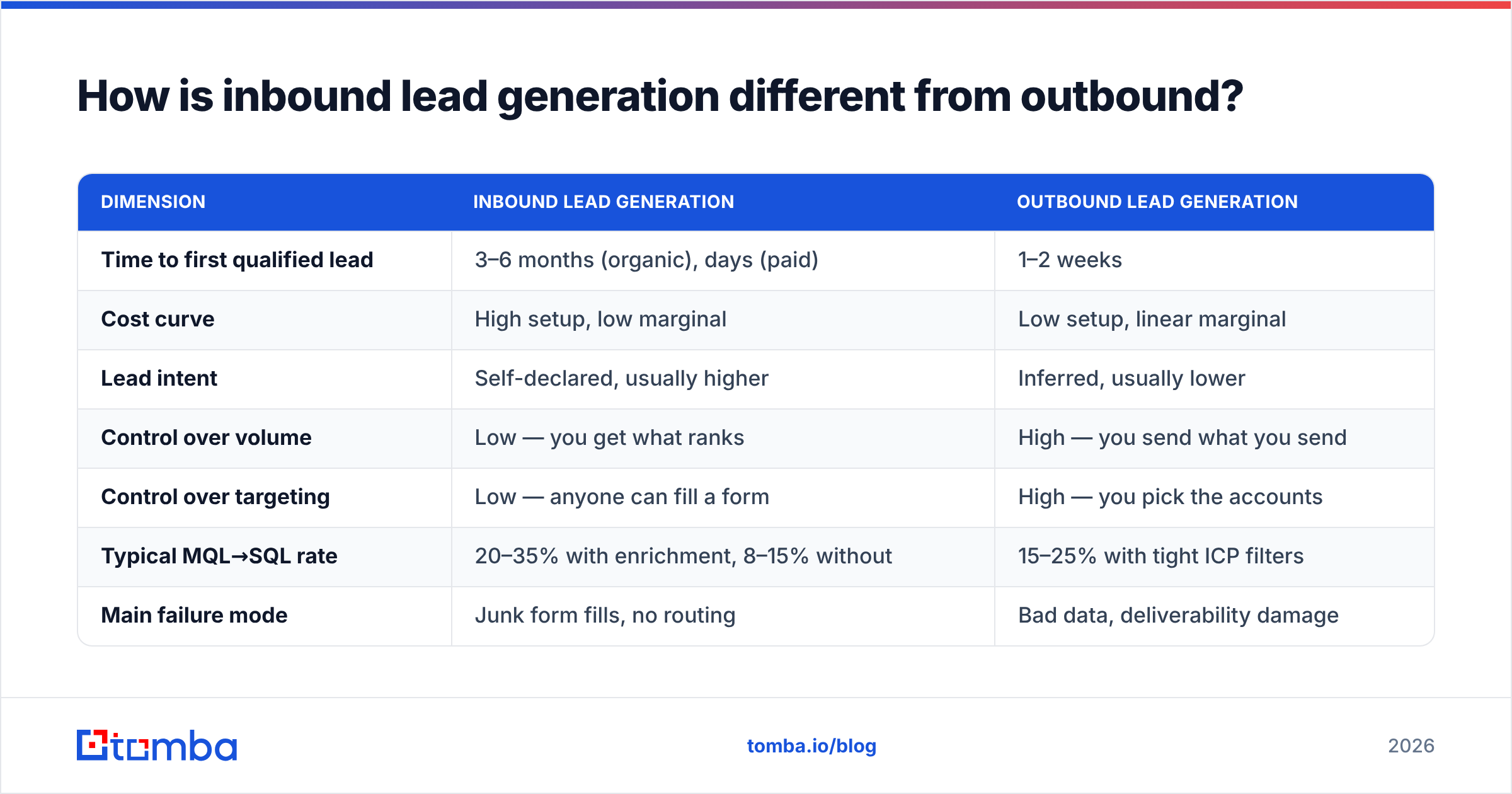
The honest answer: they're different cost curves, not different moral positions. Inbound has high upfront cost and near-zero marginal cost. Outbound has low upfront cost and linear marginal cost. Serious go-to-market teams run both and route them differently.
| Dimension | Inbound lead generation | Outbound lead generation |
|---|---|---|
| Time to first qualified lead | 3–6 months (organic), days (paid) | 1–2 weeks |
| Cost curve | High setup, low marginal | Low setup, linear marginal |
| Lead intent | Self-declared, usually higher | Inferred, usually lower |
| Control over volume | Low — you get what ranks | High — you send what you send |
| Control over targeting | Low — anyone can fill a form | High — you pick the accounts |
| Typical MQL→SQL rate | 20–35% with enrichment, 8–15% without | 15–25% with tight ICP filters |
| Main failure mode | Junk form fills, no routing | Bad data, deliverability damage |
| Compounding? | Yes — content keeps ranking | No — stops when you stop |
Notice the row that decides everything: control over targeting. Inbound cannot filter who fills your form. A student, a competitor, and your ideal $50k-ACV buyer all use the same field. Outbound picks the account list before the first email goes out. That single asymmetry is why inbound needs a qualification layer that outbound doesn't.

Which inbound channels actually produce pipeline in 2026?#
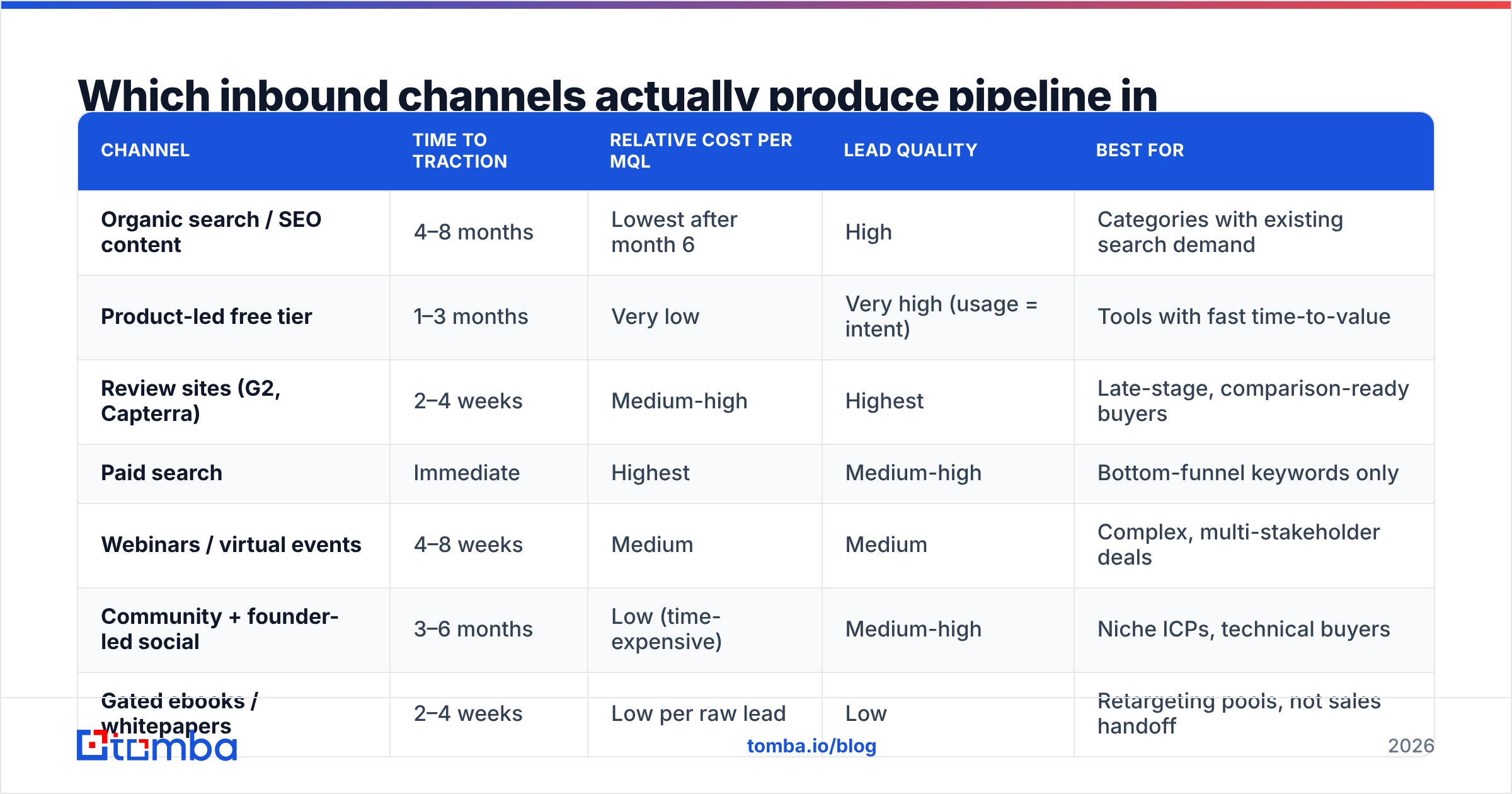
Below is how the main inbound channels compare on the three things a CFO asks about: how long until it works, what it costs per qualified lead, and how well it holds up.
| Channel | Time to traction | Relative cost per MQL | Lead quality | Best for |
|---|---|---|---|---|
| Organic search / SEO content | 4–8 months | Lowest after month 6 | High | Categories with existing search demand |
| Product-led free tier | 1–3 months | Very low | Very high (usage = intent) | Tools with fast time-to-value |
| Review sites (G2, Capterra) | 2–4 weeks | Medium-high | Highest | Late-stage, comparison-ready buyers |
| Paid search | Immediate | Highest | Medium-high | Bottom-funnel keywords only |
| Webinars / virtual events | 4–8 weeks | Medium | Medium | Complex, multi-stakeholder deals |
| Community + founder-led social | 3–6 months | Low (time-expensive) | Medium-high | Niche ICPs, technical buyers |
| Gated ebooks / whitepapers | 2–4 weeks | Low per raw lead | Low | Retargeting pools, not sales handoff |
Two channels deserve specific comment.
Review sites are the most underrated inbound channel in B2B. A buyer browsing a software category on G2 is comparison-shopping with budget in hand. The click costs more than an organic visit and converts several times better. If you have real customers and no review presence, that's the fastest fix on this list.
Gated ebooks are the most overrated. They generate volume, which generates a good-looking MQL chart, which generates a sales team that stops trusting marketing. If you gate content, treat those contacts as a nurture and retargeting pool — not as something you page a rep about.
What does a working inbound funnel actually look like?#
Six stages. If you're missing one, you already know which of your numbers is bad.
- Demand capture — content, listings, and pages that intercept buyers already searching. Bottom-funnel first ("X vs Y", "X pricing", "best X for Y"), top-funnel later.
- Identity capture — the moment traffic becomes a record. Keep forms to 3–4 fields; every extra field costs conversions and the data you're asking for can be enriched anyway.
- Enrichment — append company, size, industry, role, and location from the email domain. This is where a two-field form becomes a fully qualified record.
- Verification — confirm the address is deliverable before it hits your nurture sequence. Fake and typo'd form emails are the top cause of quiet sender-reputation decay.
- Scoring and routing — combine fit (does this match ICP?) with behavior (what did they do?) and send hot records to a human within minutes, not days.
- Feedback loop — push closed-won and closed-lost data back into scoring monthly. A scoring model nobody retrains is a superstition.
Step 3 is the one most teams skip, and it's the cheapest lever in the whole funnel. If a visitor gives you sarah@acmerobotics.com, data enrichment can tell you Acme Robotics has 240 employees, sits in industrial automation, and Sarah runs demand gen — without asking her a single extra question. Shorter form, better data, higher conversion. That's rare in marketing.
Why do most inbound leads never convert?#
Because the record is incomplete, unverified, or stale by the time a human sees it. In practice, the leaks are predictable:
- Personal-domain signups. A
@gmail.comform fill can't be enriched by domain and can't be matched to an account. It isn't worthless, but it needs a different path — social lookup, reverse email lookup, or a nurture track rather than a sales task. - Undeliverable addresses. Typos, throwaways, and role accounts. Running submissions through an email verifier at capture time keeps bounce rates low and protects the domain you also send outbound from.
- Slow response. The research on speed-to-lead has been consistent for over a decade: contact attempts within five minutes convert dramatically better than attempts within an hour. Most inbound routing is measured in days.
- No account context. A rep who opens a lead record showing only a name and email will deprioritize it. A record showing company, headcount, funding, and tech stack gets worked.
- Treating every conversion the same. A pricing-page demo request and a newsletter signup are not the same event. If both create an MQL, your MQL number means nothing.

How do you score and qualify inbound leads?#
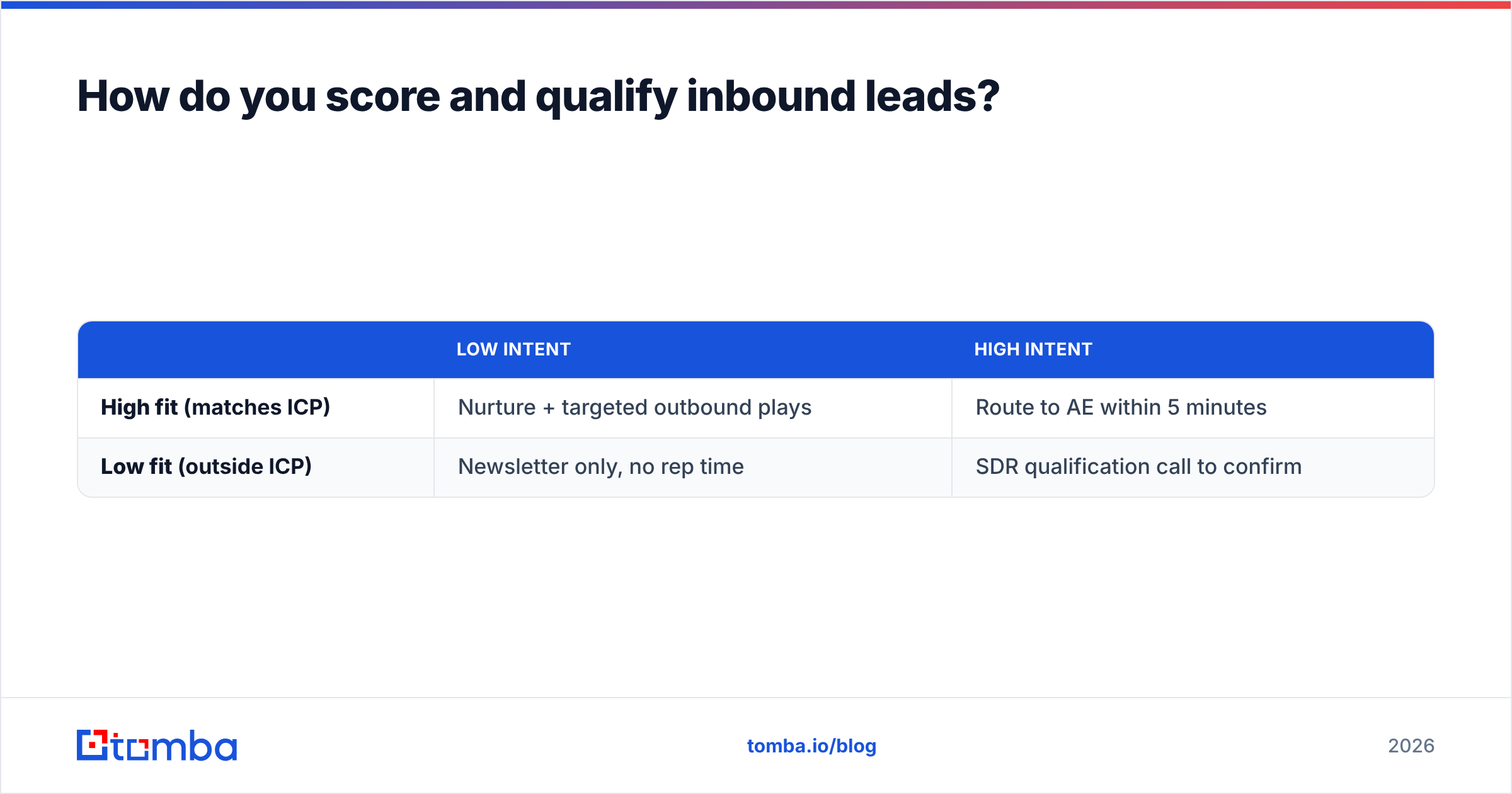
Use a two-axis model. Fit on one axis, intent on the other. Four quadrants, four different actions.
| Low intent | High intent | |
|---|---|---|
| High fit (matches ICP) | Nurture + targeted outbound plays | Route to AE within 5 minutes |
| Low fit (outside ICP) | Newsletter only, no rep time | SDR qualification call to confirm |
Fit comes from enrichment: employee count, industry, revenue band, geography, tech stack. Intent comes from behavior: pages viewed, pricing visits, docs read, trial actions, repeat sessions.
The mistake to avoid is scoring on behavior alone. A student reading your entire blog scores high on intent and will never buy. A VP at a perfect-fit account who visited pricing once scores low on volume and is your best lead of the week. Fit has to gate intent, not the other way around. Gartner's B2B sales research has documented for years that buyers spend the majority of their journey outside of vendor contact — which means the few signals you do capture have to be interpreted carefully rather than summed.
How do you convert anonymous traffic that never fills a form?#
Most of your inbound traffic leaves without converting — that's normal, and the ratio rarely improves past a few percent no matter how good the CTA is. Two plays recover part of that:
Visitor identification. Resolve company-level identity from traffic, so you at least know that three people from a target account read your comparison page this week. That's an outbound trigger, not an inbound lead — but it's the highest-quality trigger you'll get. Tomba's website visitor reveal handles the account-level resolution; you then find the right human at that company rather than guessing.
Content-triggered prospecting. When a target account shows up in analytics or in a community thread, find the specific decision-maker and reach out with context. This is where inbound and outbound stop being separate programs. A domain search returns the contactable people at that account in seconds, with verified addresses and role labels, so the follow-up references what they actually read.
Both plays convert inbound interest into outbound action. That hybrid motion — sometimes called "allbound" — consistently outperforms either channel run in isolation, because you're prospecting into accounts that already raised their hand at the company level.
What should you measure?#
Cut the vanity metrics. Six numbers tell you whether inbound lead generation is working:
- Qualified pipeline sourced, in currency, by channel. Not MQLs. Pipeline.
- MQL→SQL conversion rate by channel and by source page. Below 15% means your definition is too loose.
- Speed to first touch, measured in minutes, tracked at the 90th percentile — the average hides the disasters.
- Cost per qualified opportunity, fully loaded (content, tools, headcount), not cost per lead.
- Email deliverability on nurture sends — bounce rate under 2%, spam complaints under 0.1%. Anything worse means your capture layer is letting junk through.
- Content decay — which ranking pages lost traffic quarter over quarter. Refreshing a decaying page beats writing a new one nearly every time.
HubSpot's inbound marketing resources remain a reasonable public benchmark set if you need external numbers to argue with, though treat any single-vendor benchmark as directional rather than gospel.
What does the tooling stack cost?#
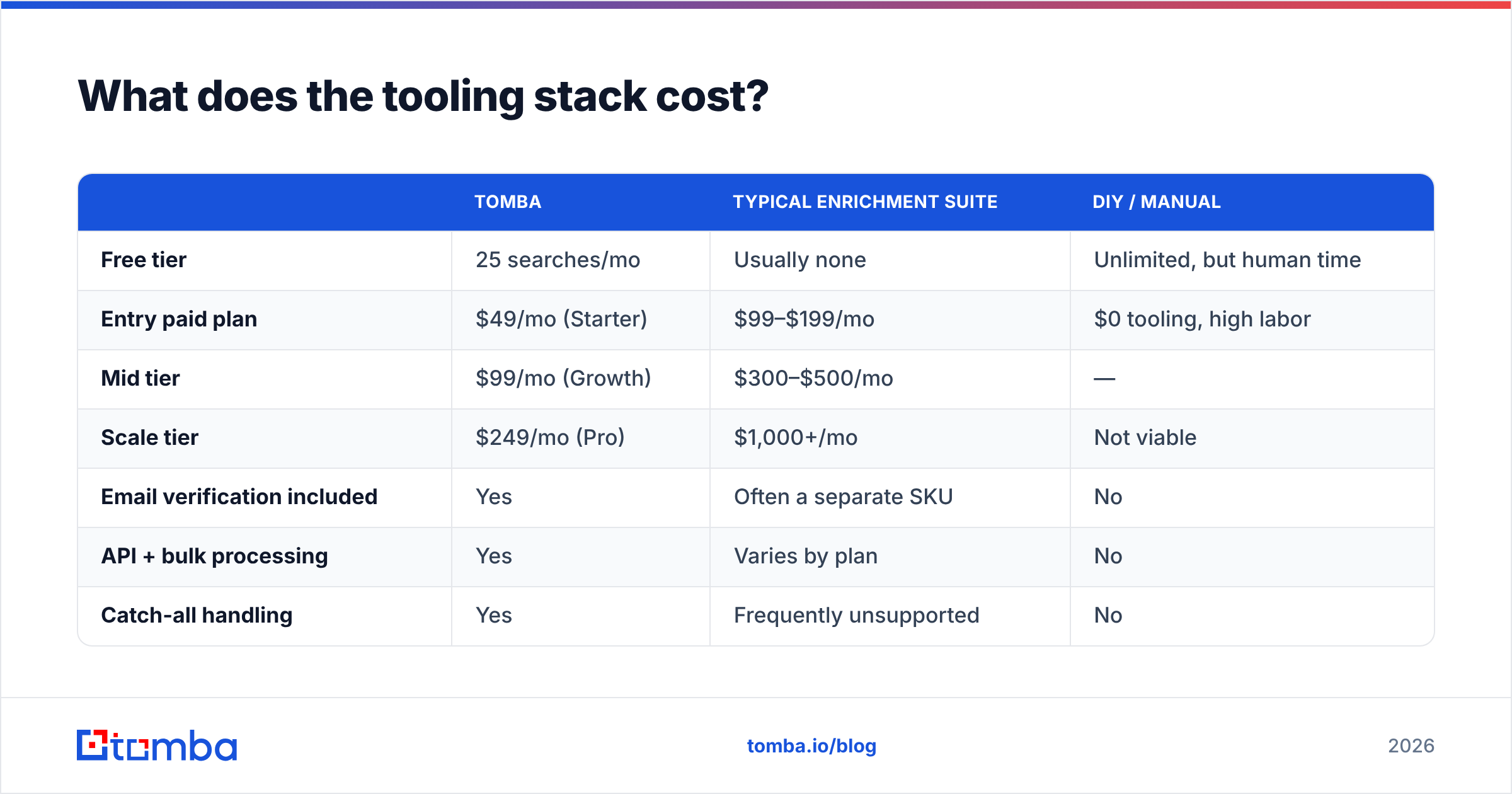
You need four capabilities: attract, capture, enrich/verify, and route. Here's how the enrichment and verification layer prices out, since that's the piece teams most often underbuy.
| Tomba | Typical enrichment suite | DIY / manual | |
|---|---|---|---|
| Free tier | 25 searches/mo | Usually none | Unlimited, but human time |
| Entry paid plan | $49/mo (Starter) | $99–$199/mo | $0 tooling, high labor |
| Mid tier | $99/mo (Growth) | $300–$500/mo | — |
| Scale tier | $249/mo (Pro) | $1,000+/mo | Not viable |
| Email verification included | Yes | Often a separate SKU | No |
| API + bulk processing | Yes | Varies by plan | No |
| Catch-all handling | Yes | Frequently unsupported | No |
Full Tomba pricing is public if you want the per-credit breakdown. The point isn't that cheaper is better — it's that enrichment and verification should cost a small fraction of your content budget. If the tool that qualifies your leads costs more than the content that generates them, the ratio is backwards.
Where should you start if you're building inbound from zero?#
In this order, and don't skip ahead:
- Publish 10 bottom-funnel pages targeting comparison, pricing, and alternative queries. These rank faster and convert better than thought leadership.
- Claim and populate your review-site profiles, then run a structured review-request campaign against happy customers.
- Cut your forms to three fields — work email, name, company — and enrich the rest server-side.
- Verify every submission at capture, before it enters any sequence.
- Build the two-axis scoring model and wire routing so high-fit/high-intent records page a human immediately.
- Only then invest in top-funnel content, webinars, and brand.
Most teams do this list backwards, starting with a podcast and ending, eighteen months later, with a form that still asks for a fax number.
Ready to make your inbound leads actually routable?#
Inbound lead generation lives or dies on what happens in the ninety seconds after someone converts. If a form fill lands in your CRM as a bare name and an unverified address, you've paid content prices for outbound-quality data. Tomba's Email Finder closes that gap — verify the address, resolve the company, find the other decision-makers at the account, and hand your reps a record worth working. Start on the free tier with 25 searches a month, or move to Starter at $49/mo when inbound volume justifies it.
Related guides#
// get started
Find, verify and enrich your first contacts today
Start on the free plan with 25 searches a month, then scale when your team is ready.
Free plan · No credit card required · GDPR & CCPA
// about the author