Inbound Lead Management: The Complete 2026 Playbook
Most inbound leads don't die from bad marketing. They die in the 40 hours between form fill and first reply. Here's the routing, scoring, and enrichment system that fixes it.
TL;DR
- Inbound lead management is the operational chain between "someone raised their hand" and "a rep is in a live conversation." Most teams optimize the marketing that fills the top and ignore the 40 hours of dead air after the form fill.
- Speed-to-lead is the single highest-leverage variable. Responding inside five minutes beats responding in an hour by a margin no amount of copy testing will recover.
- Scoring only works when the record is complete. A form with an email and a company name is not enough to route on — enrichment has to happen before scoring, not after.
- Routing rules fail silently. Build a fallback owner, an SLA timer, and a weekly leak report or your "working" system will quietly drop 15-30% of demo requests.
- Track five numbers: median first-touch time, SLA compliance rate, MQL-to-meeting rate, lead-to-opportunity conversion by source, and the percentage of inbound records that route to a human within one business hour.
What is inbound lead management?#
Inbound lead management is the process of capturing, enriching, scoring, routing, and following up on people who contacted you first — demo requests, content downloads, pricing page visits, chat conversations, free-trial signups, and webinar registrations.
Think of it like an emergency room. Patients arrive on their own; nobody went out and recruited them. The hospital's job is triage: figure out who's bleeding out, who needs a specialist, who can wait, and who's in the wrong building entirely. A hospital that treats every arrival in order of arrival kills people. A sales team that treats every inbound lead the same way loses the ones worth the most.
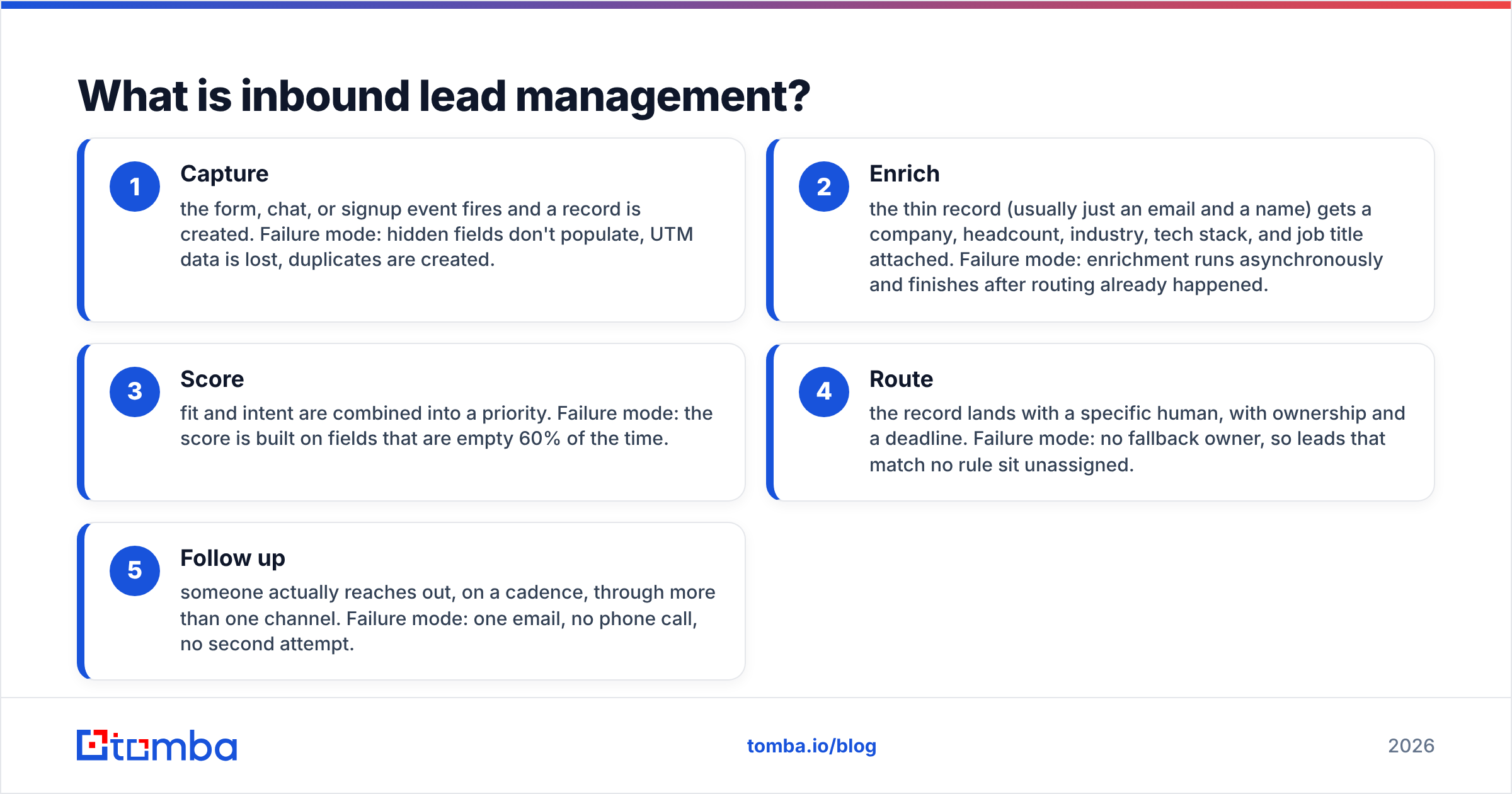
The chain has five links, and each one has its own failure mode:
- Capture — the form, chat, or signup event fires and a record is created. Failure mode: hidden fields don't populate, UTM data is lost, duplicates are created.
- Enrich — the thin record (usually just an email and a name) gets a company, headcount, industry, tech stack, and job title attached. Failure mode: enrichment runs asynchronously and finishes after routing already happened.
- Score — fit and intent are combined into a priority. Failure mode: the score is built on fields that are empty 60% of the time.
- Route — the record lands with a specific human, with ownership and a deadline. Failure mode: no fallback owner, so leads that match no rule sit unassigned.
- Follow up — someone actually reaches out, on a cadence, through more than one channel. Failure mode: one email, no phone call, no second attempt.
Break any single link and the rest of the chain stops mattering. Most teams have four of the five working, which produces exactly the same outcome as having zero.
Why do most inbound leads leak before anyone calls them?#
Because the handoff is invisible. Marketing measures leads generated. Sales measures pipeline created. Nobody owns the gap in between, so the gap is where the losses accumulate.
Three specific leaks account for most of it.
The enrichment race condition. A demo request comes in at 4:47 p.m. with sarah@nuvancehealth.org and nothing else. Your routing rules key off company headcount. The enrichment job is queued and finishes at 4:53. By then the routing rule already evaluated the record with a null headcount, dropped it into the "unqualified" bucket, and nobody will look at it again. This is not hypothetical — it is the most common inbound bug in B2B, and it is nearly always silent.
The personal-email dead end. Roughly one in five B2B form fills uses a Gmail or Outlook address. Your firmographic enrichment has nothing to match on, so the record scores zero and routes to nurture. Meanwhile the person is a VP at a 4,000-person company who was signed into a personal browser profile. Resolving that identity requires a reverse email lookup or a domain match against the company they typed into the free-text field, not a firmographic lookup on gmail.com.
The unassigned bucket. Every routing system has leads that match no rule. Territories change, a rep leaves, a picklist value gets renamed, an integration silently fails. Without a named fallback owner and a daily report of unassigned records, that bucket becomes a landfill. Audit it once and you will find demo requests from three quarters ago.

How fast do you actually need to respond?#
Fast enough that the prospect is still in the tab they filled the form from.
The research on this has been consistent for over a decade and has not softened. HubSpot's own sales data and every major lead-response study since 2011 land in the same place: contact attempts made within five minutes of a form fill convert at multiples of attempts made within an hour, and the curve is brutally steep in the first 30 minutes. After 24 hours, you are effectively cold-calling someone who happens to recognize your name.
What that means operationally:
- Under 5 minutes for high-fit demo and pricing requests. This requires automation — a real-time alert to a Slack channel or a mobile push, not an email digest.
- Under 1 business hour for mid-fit inbound with clear buying intent (trial signups, ROI calculator completions).
- Under 1 business day for content downloads and webinar registrations, where the intent signal is weak and an aggressive call feels invasive.
- Never, automatically for students, job seekers, competitors, and support requests that ended up in the wrong form. Filter these out at the routing layer or your reps will stop trusting the queue.
The thing most teams get wrong: they optimize the median and ignore the tail. A median first-touch time of 22 minutes looks great until you notice that 18% of leads take more than four hours because they arrive outside business hours and no one has a coverage plan. The tail is where the enterprise deals hide.
Which lead scoring model should you use?#
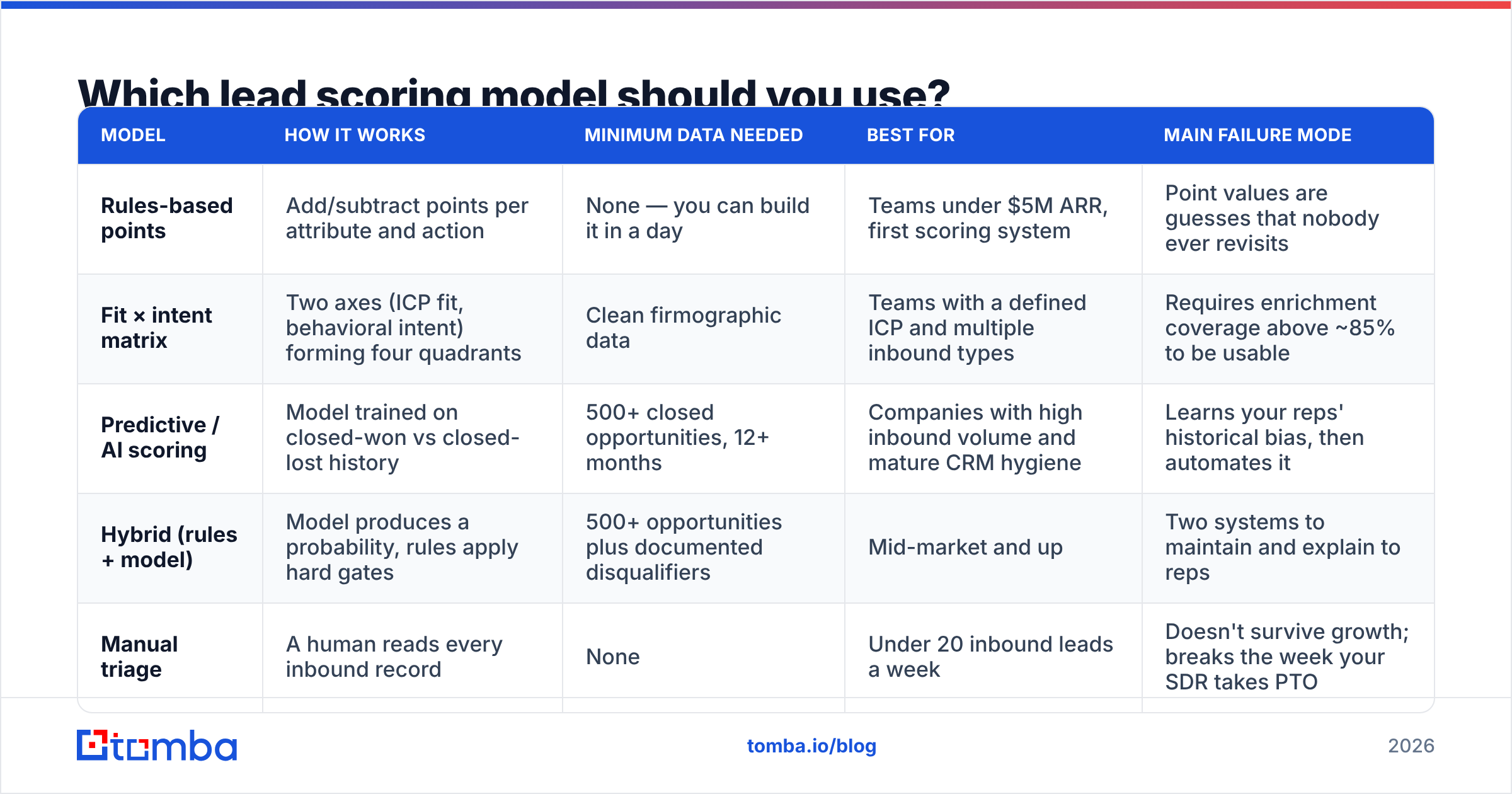
Pick based on data volume, not on what sounds sophisticated. Predictive scoring on 300 historical opportunities is astrology with a confidence interval.
| Model | How it works | Minimum data needed | Best for | Main failure mode |
|---|---|---|---|---|
| Rules-based points | Add/subtract points per attribute and action | None — you can build it in a day | Teams under $5M ARR, first scoring system | Point values are guesses that nobody ever revisits |
| Fit × intent matrix | Two axes (ICP fit, behavioral intent) forming four quadrants | Clean firmographic data | Teams with a defined ICP and multiple inbound types | Requires enrichment coverage above ~85% to be usable |
| Predictive / AI scoring | Model trained on closed-won vs closed-lost history | 500+ closed opportunities, 12+ months | Companies with high inbound volume and mature CRM hygiene | Learns your reps' historical bias, then automates it |
| Hybrid (rules + model) | Model produces a probability, rules apply hard gates | 500+ opportunities plus documented disqualifiers | Mid-market and up | Two systems to maintain and explain to reps |
| Manual triage | A human reads every inbound record | None | Under 20 inbound leads a week | Doesn't survive growth; breaks the week your SDR takes PTO |
The fit × intent matrix is the right default for most B2B teams in 2026. It's explainable to a skeptical AE, it doesn't need a data scientist, and it forces you to separate "should we want them" from "are they ready" — two questions that a single blended score collapses into mush. If you're still defining the thresholds, the distinction between a marketing qualified lead and a sales-accepted one is worth writing down explicitly before you touch the point values.
Why does enrichment decide whether routing works?#
Because routing rules are functions of fields, and empty fields evaluate to false.
Every routing decision you want to make — territory, segment, vertical, rep specialty, account ownership — depends on data the prospect did not give you. Nobody types their company's employee count into a demo form. If you ask for it, your conversion rate drops. So you ask for three fields and derive the rest.
That derivation is where inbound lead management is won or lost. Concretely, you need:
- Domain resolution — turn a work email into a company domain, and a company name into a domain when the email is personal.
- Firmographics — headcount, revenue band, industry, HQ country. These drive territory and segment routing.
- Contact-level data — job title, seniority, department. These drive whether the lead goes to an SDR or straight to an AE.
- Deliverability status — a real-time email verifier check so your first automated reply doesn't bounce and your sender reputation doesn't absorb the damage from typo'd form fills.
- Direct dial or mobile — for the sub-5-minute tier, where calling beats emailing by a wide margin.
Run all of this synchronously, before the routing rule evaluates. If your enrichment provider can't return in under two seconds via API, enrich on form submit and delay the routing trigger by a fixed interval rather than letting the two race. A data enrichment call that adds 800 milliseconds to your form handler is cheap; a routing decision made on a null field costs you the deal.

What does the inbound tool stack actually look like?#
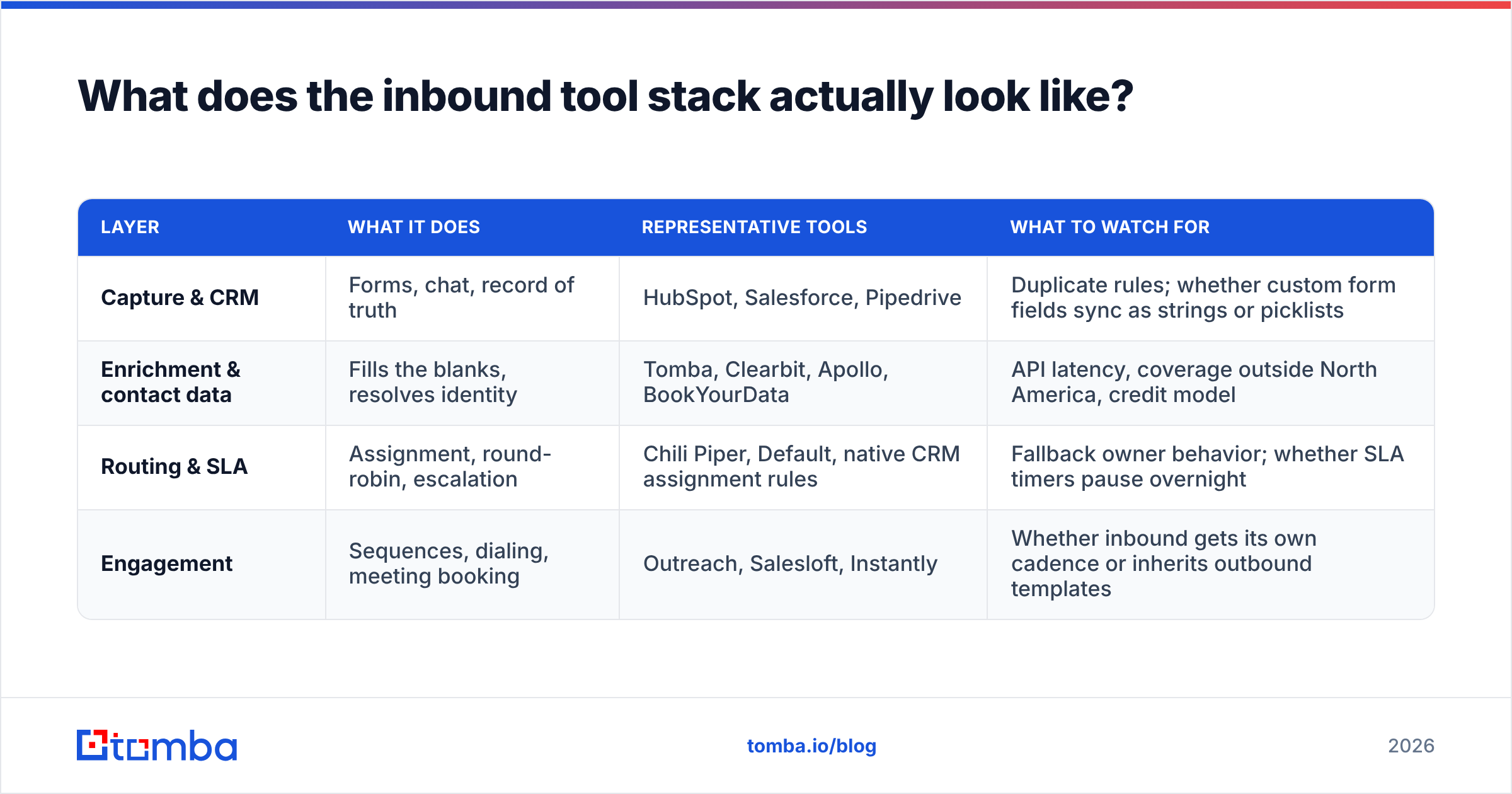
There are four layers, and no single vendor is genuinely best at all of them. Here's how the common options map:
| Layer | What it does | Representative tools | What to watch for |
|---|---|---|---|
| Capture & CRM | Forms, chat, record of truth | HubSpot, Salesforce, Pipedrive | Duplicate rules; whether custom form fields sync as strings or picklists |
| Enrichment & contact data | Fills the blanks, resolves identity | Tomba, Clearbit, Apollo, BookYourData | API latency, coverage outside North America, credit model |
| Routing & SLA | Assignment, round-robin, escalation | Chili Piper, Default, native CRM assignment rules | Fallback owner behavior; whether SLA timers pause overnight |
| Engagement | Sequences, dialing, meeting booking | Outreach, Salesloft, Instantly | Whether inbound gets its own cadence or inherits outbound templates |
A few honest notes on the enrichment layer, since that's where the decisions are least obvious:
- Tomba is API-first and priced for volume: a free tier at 25 searches/month, Starter at $49/mo, Growth at $99/mo, and Pro at $249/mo, with per-call email finder and verification endpoints you can drop directly into a form handler. Full Tomba pricing is public, which matters when you're modeling cost per enriched lead.
- BookYourData takes a different approach — pay-as-you-go, verified B2B contact lists with a strong accuracy guarantee. If your inbound motion is paired with list-based ABM outreach, it's a solid complement rather than a competitor to a real-time API.
- Apollo and Clearbit bundle enrichment with broader platforms. That's convenient if you're already committed, and expensive if enrichment is all you need. Check current user reviews on G2 before assuming feature parity from a pricing page.
The correct question isn't "which vendor wins" — it's "which layer is currently broken." Most teams shopping for a new engagement platform actually have an enrichment gap, and buying more sequencing software makes the underlying problem harder to see.
What metrics should you actually track?#
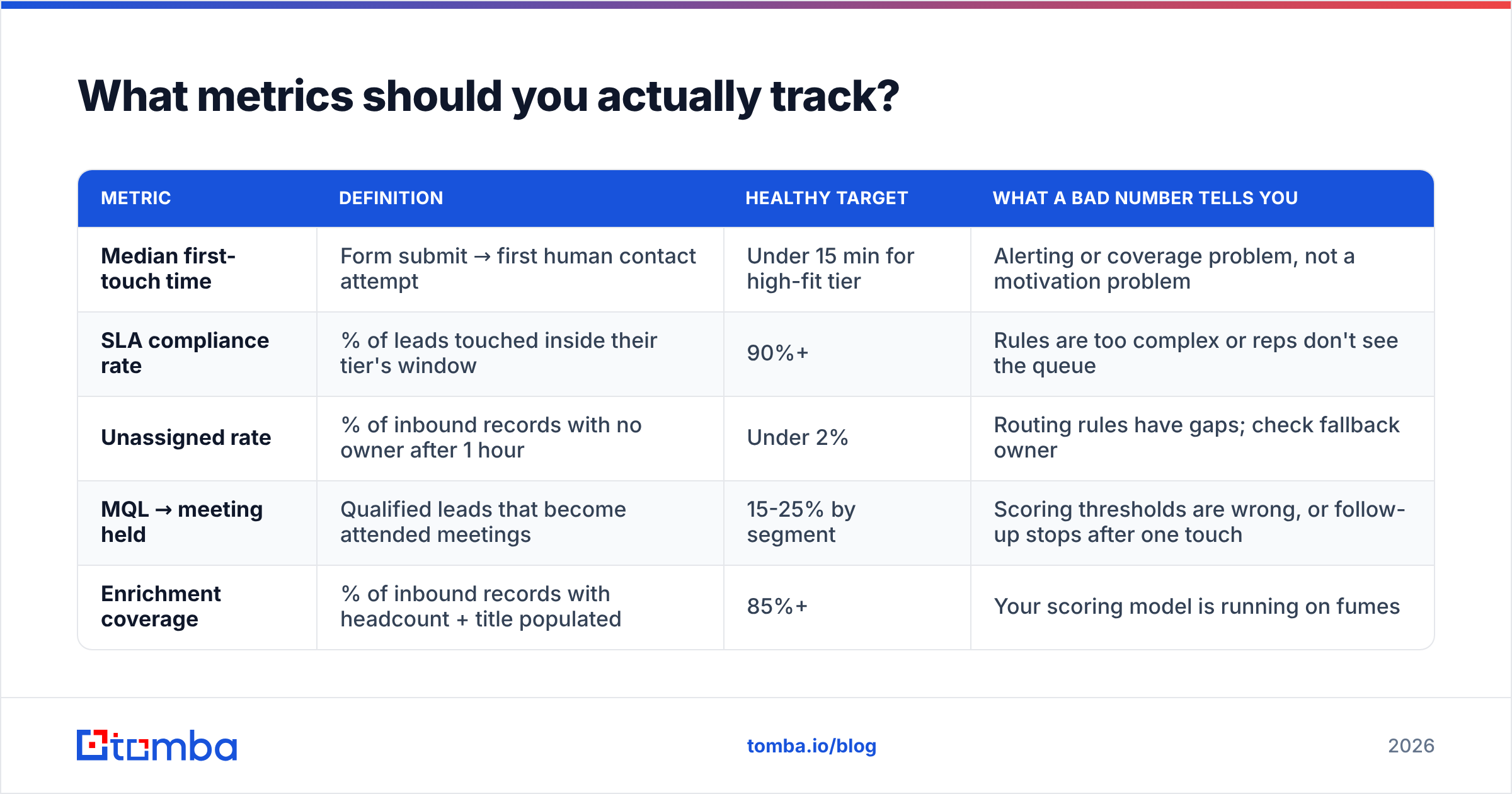
Five, reported weekly, visible to both marketing and sales. Anything more becomes a dashboard nobody opens.
| Metric | Definition | Healthy target | What a bad number tells you |
|---|---|---|---|
| Median first-touch time | Form submit → first human contact attempt | Under 15 min for high-fit tier | Alerting or coverage problem, not a motivation problem |
| SLA compliance rate | % of leads touched inside their tier's window | 90%+ | Rules are too complex or reps don't see the queue |
| Unassigned rate | % of inbound records with no owner after 1 hour | Under 2% | Routing rules have gaps; check fallback owner |
| MQL → meeting held | Qualified leads that become attended meetings | 15-25% by segment | Scoring thresholds are wrong, or follow-up stops after one touch |
| Enrichment coverage | % of inbound records with headcount + title populated | 85%+ | Your scoring model is running on fumes |
Enrichment coverage is the one people skip, and it's the leading indicator for the other four. When coverage drops — a provider changes their data mix, a form field stops mapping — scoring degrades first, then routing, then response time. Watch it as a canary.
How do you handle inbound leads that aren't ready to buy?#
Route them somewhere other than the trash.
A content download from a 12-person company is not a bad lead; it's an early one. The mistake is binary thinking: leads either get a rep or get nothing. Build a third path.
- Recycle with a trigger. Set a re-scoring date. If the same person returns to your pricing page in six weeks, they jump the queue.
- Watch the account, not the person. If three people from the same domain download three different assets, that's an account-level signal even though no individual crossed the threshold. This is where website visitor reveal earns its keep — the anonymous sessions around a form fill often say more than the form.
- Keep the data warm. Verify email addresses on a quarterly cycle. B2B contact data decays at roughly 25-30% per year through job changes alone; a nurture list you haven't cleaned in 18 months is mostly bouncing.
- Don't sequence them like outbound. They know who you are. A cold-outbound template sent to someone who downloaded your guide reads as incompetence.
Where should you start if your system is broken today?#
Audit before you buy. Pull every inbound record from the last 90 days and answer three questions: how many were never assigned to a human, what the actual distribution of first-touch times looks like (not the median — the histogram), and what percentage have a populated headcount and title.
Whichever of those three is worst is your project. It is almost never the one you assumed.
If the answer is enrichment coverage — and for most teams it is — start there, because scoring and routing are both downstream of it. Tomba's Email Finder resolves work emails and company domains from names, domains, or partial records via a single API call, so your form handler can complete the record before the routing rule ever fires. Free tier is 25 searches a month if you want to test the latency against your own inbound before committing; Starter runs $49/mo when you're ready to put it in the critical path. Fix the data first, and the rest of the chain starts behaving.
Related guides#
// get started
Find, verify and enrich your first contacts today
Start on the free plan with 25 searches a month, then scale when your team is ready.
Free plan · No credit card required · GDPR & CCPA
// about the author