Inbound Lead Nurturing in 2026: The Complete Playbook
Most inbound leads never get a real second touch. Here is the timing, scoring, data hygiene, and 30-day sequence structure that turns form fills into booked meetings instead of dead rows in a CRM.
TL;DR
- Inbound lead nurturing is the structured follow-up you run after someone raises their hand — not a drip campaign you set once and forget.
- Speed beats cleverness. A same-hour reply to a demo request outperforms a beautifully written email sent on day three, every single time.
- Most nurture programs fail on data, not copy: a form gives you one email and a company name, and nobody enriches the rest.
- Score on behaviour plus fit, route on score, and cap your nurture track at 30 days before you either book, recycle, or archive.
- Measure meetings booked per 100 inbound leads. Open rates tell you nothing about pipeline.
What is inbound lead nurturing?#
Inbound lead nurturing is the process of moving someone who already contacted you — a form fill, a pricing-page visit, a webinar signup, a free-trial start — toward a sales conversation, using timed, relevant follow-up across email, phone, and social.
Think of it like a restaurant host. Someone walks in the door on their own; nobody had to drag them off the street. The host's job is not to convince them to eat — it's to seat them fast, read what they want, and not leave them standing at the podium for eleven minutes. Most B2B teams leave inbound leads standing at the podium.
Technically, nurturing sits between capture and qualification. The lead has expressed intent but hasn't been scored, enriched, routed, or contacted by a human. That gap is where the majority of inbound pipeline evaporates.
The distinction that matters: outbound starts with your list and manufactures interest. Inbound starts with interest and has to avoid destroying it. Those require completely different sequences, and running outbound copy on inbound leads is one of the most common and expensive mistakes in B2B.
Why do most inbound leads go cold?#
Four reasons, in rough order of damage:
- Response lag. The widely cited Lead Response Management research found that odds of qualifying a lead drop dramatically once follow-up passes the five-minute mark, and fall off a cliff after an hour. Most teams reply in a day or more because the lead sits in a queue waiting for a rep to open a tab.
- Incomplete records. A typical form captures a work email, a first name, and maybe a company. No title, no headcount, no tech stack, no phone. So the rep either sends a generic email or spends ten minutes researching before touching the lead — and ten minutes times fifty leads a week is a full workday lost.
- One touch and done. A single unanswered email gets filed as "no interest." In reality, the buyer was in a meeting, and the message sank under sixty others.
- No exit rule. Leads that will never buy stay in the nurture track for nine months, poisoning your engagement metrics and your sender reputation.
Notice that three of the four failures are operational, not creative. You cannot write your way out of a routing problem.
What does a modern inbound nurture stack look like?#
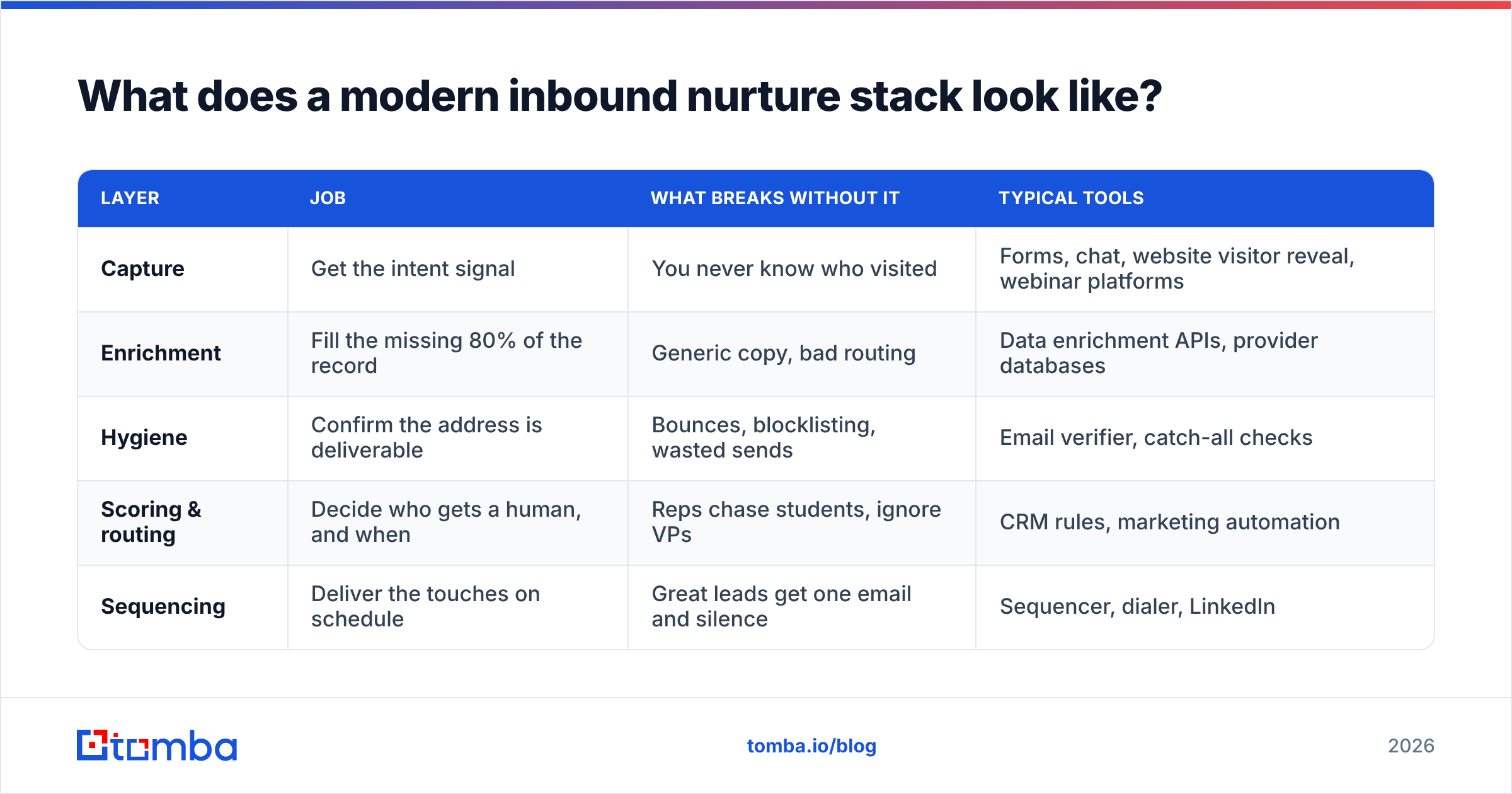
You need five layers. Each one has a specific job, and skipping any of them creates a leak the next layer cannot patch.
| Layer | Job | What breaks without it | Typical tools |
|---|---|---|---|
| Capture | Get the intent signal | You never know who visited | Forms, chat, website visitor reveal, webinar platforms |
| Enrichment | Fill the missing 80% of the record | Generic copy, bad routing | Data enrichment APIs, provider databases |
| Hygiene | Confirm the address is deliverable | Bounces, blocklisting, wasted sends | Email verifier, catch-all checks |
| Scoring & routing | Decide who gets a human, and when | Reps chase students, ignore VPs | CRM rules, marketing automation |
| Sequencing | Deliver the touches on schedule | Great leads get one email and silence | Sequencer, dialer, LinkedIn |
The layer teams skip most often is enrichment, and it is the one that determines whether everything downstream works. You cannot score fit without firmographics. You cannot personalise without a title. You cannot route to the enterprise rep without headcount. Enrichment is not a nice-to-have on top of nurturing — it is the input to it.
A practical rule: if your enrichment step doesn't run within 60 seconds of form submission, your nurture program is running on guesses. Most enrichment APIs, including Tomba's, return in under a second, so the bottleneck is almost always that nobody wired it into the form handler.
How should you score inbound leads?#
Score on two axes and multiply. Fit answers "should we want them," behaviour answers "do they want us." A high-fit, low-behaviour lead needs education. A low-fit, high-behaviour lead needs a self-serve link. Only high-high gets a rep's calendar.
Here's a workable starting model — tune the weights against your closed-won data after one quarter, not before:
- Fit — company size. Inside your ICP headcount band: +20. One band off: +5. Way off: −15.
- Fit — title seniority. Director and above in a relevant function: +25. Individual contributor in that function: +10. Unrelated function: 0.
- Fit — email type. Verified corporate domain: +10. Free provider (gmail, outlook): −10. Undeliverable: disqualify immediately.
- Behaviour — page intent. Pricing page visit: +25. Comparison or alternatives page: +20. Blog post: +3.
- Behaviour — form type. Demo request: +40. Trial start: +30. Ebook download: +5.
- Behaviour — recency decay. Subtract 10 points per week of inactivity so old scores don't masquerade as hot leads.
A demo request from a VP at a 400-person company scores around 95 and should be called within the hour. A gated-ebook download from an unlisted title at a 6-person shop scores about 15 and belongs in an automated newsletter track, not a rep's queue. If you're formalising these definitions across marketing and sales, agree on what counts as a marketing qualified lead in writing before you build the rules — undocumented scoring is where the two teams start arguing.
How fast do you actually need to respond?#
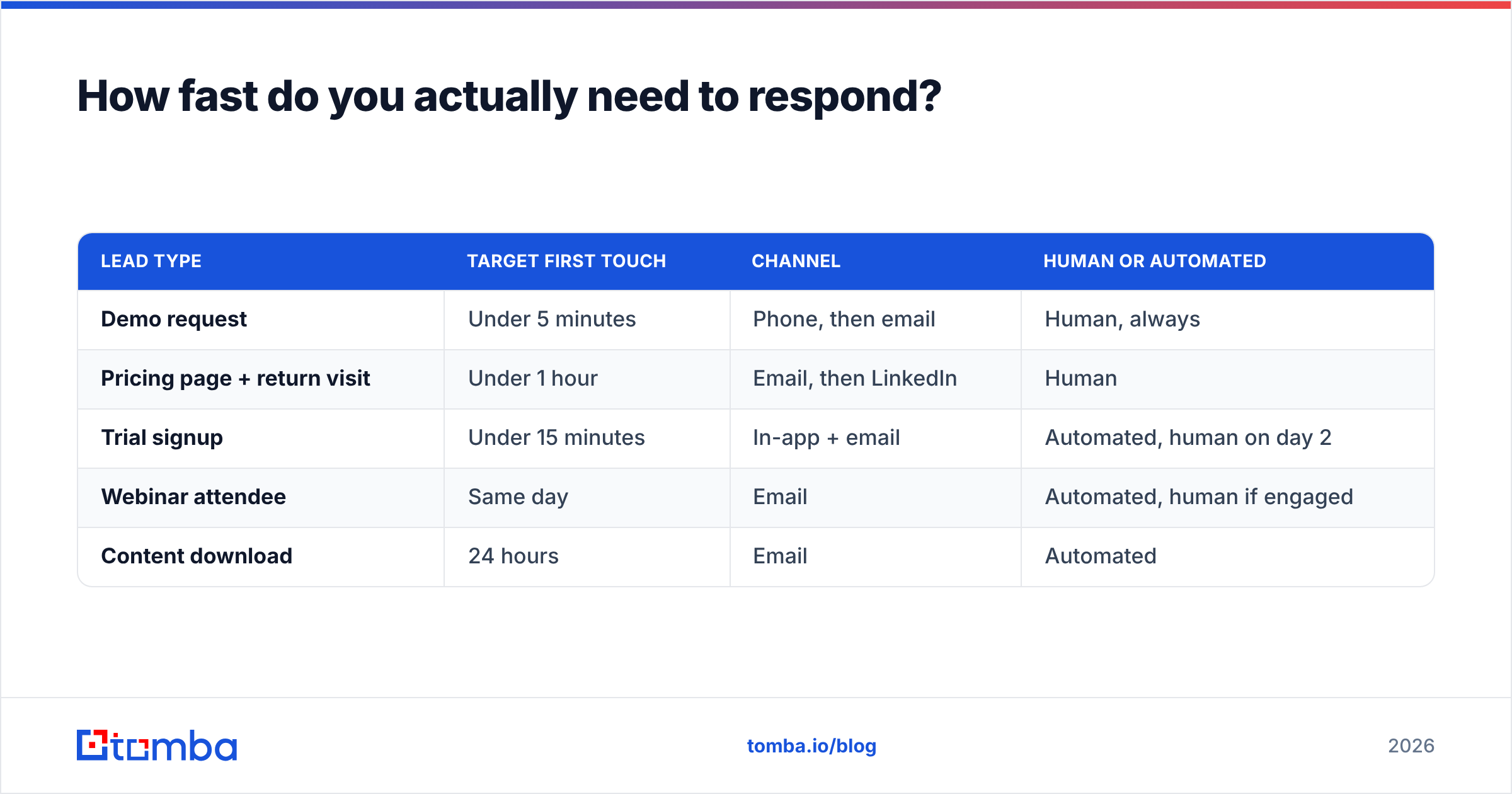
Faster than feels comfortable, and the tiering below is what most well-run teams converge on. Gartner's sales research consistently finds that B2B buyers spend only a small fraction of their total buying journey with any one vendor's sellers — so the window you're competing for is narrow and shared. If you show up on day four, someone else already had the conversation.
| Lead type | Target first touch | Channel | Human or automated |
|---|---|---|---|
| Demo request | Under 5 minutes | Phone, then email | Human, always |
| Pricing page + return visit | Under 1 hour | Email, then LinkedIn | Human |
| Trial signup | Under 15 minutes | In-app + email | Automated, human on day 2 |
| Webinar attendee | Same day | Automated, human if engaged | |
| Content download | 24 hours | Automated |
The "human, always" column is the one people negotiate away. Don't. An automated confirmation email after a demo request is table stakes, not a response — the buyer typed their number in because they wanted a conversation.
What does a 30-day inbound nurture sequence look like?#
Cap it at 30 days. Longer sequences don't convert better, they just look busier in the dashboard. This structure assumes a mid-score inbound lead — someone who downloaded a comparison guide but hasn't requested a demo.
- Day 0 — Instant value email. Deliver what they asked for plus one specific, useful extra. No pitch. One link.
- Day 1 — The relevance email. Reference the exact resource they took, tie it to a problem their company size typically has. This is where enrichment pays for itself: "most 200-person RevOps teams hit this at the CRM migration stage" only works if you know they're a 200-person company.
- Day 3 — Phone attempt. Two rings of effort. Leave a voicemail that names the resource they downloaded and gives a reason to call back.
- Day 5 — Social touch. Connect on LinkedIn with no pitch in the request. Comment on something they've posted if it exists.
- Day 8 — Proof email. One customer story from their industry and segment. Short. The story does the arguing.
- Day 14 — Different angle. Change the problem you lead with. If email one was about accuracy, email four is about time saved. People ignore messages because the topic missed, not because the writing was bad.
- Day 21 — The soft close. Direct ask for 15 minutes, with two concrete time options.
- Day 30 — Breakup and route. Tell them you're closing the loop, offer the self-serve path, and move them to a quarterly newsletter. Then stop.
Two disciplines make or break this. First, every send goes through verification — a list that sat for three weeks decays, and inbound lists decay faster than you'd think because people change jobs. Second, the sequence pauses the instant a human replies. Nothing kills trust like an automated day-14 email arriving after a rep already booked the call. Syncing sequence state back to the CRM through your HubSpot integration or equivalent isn't optional plumbing; it's the difference between looking organised and looking like a robot.

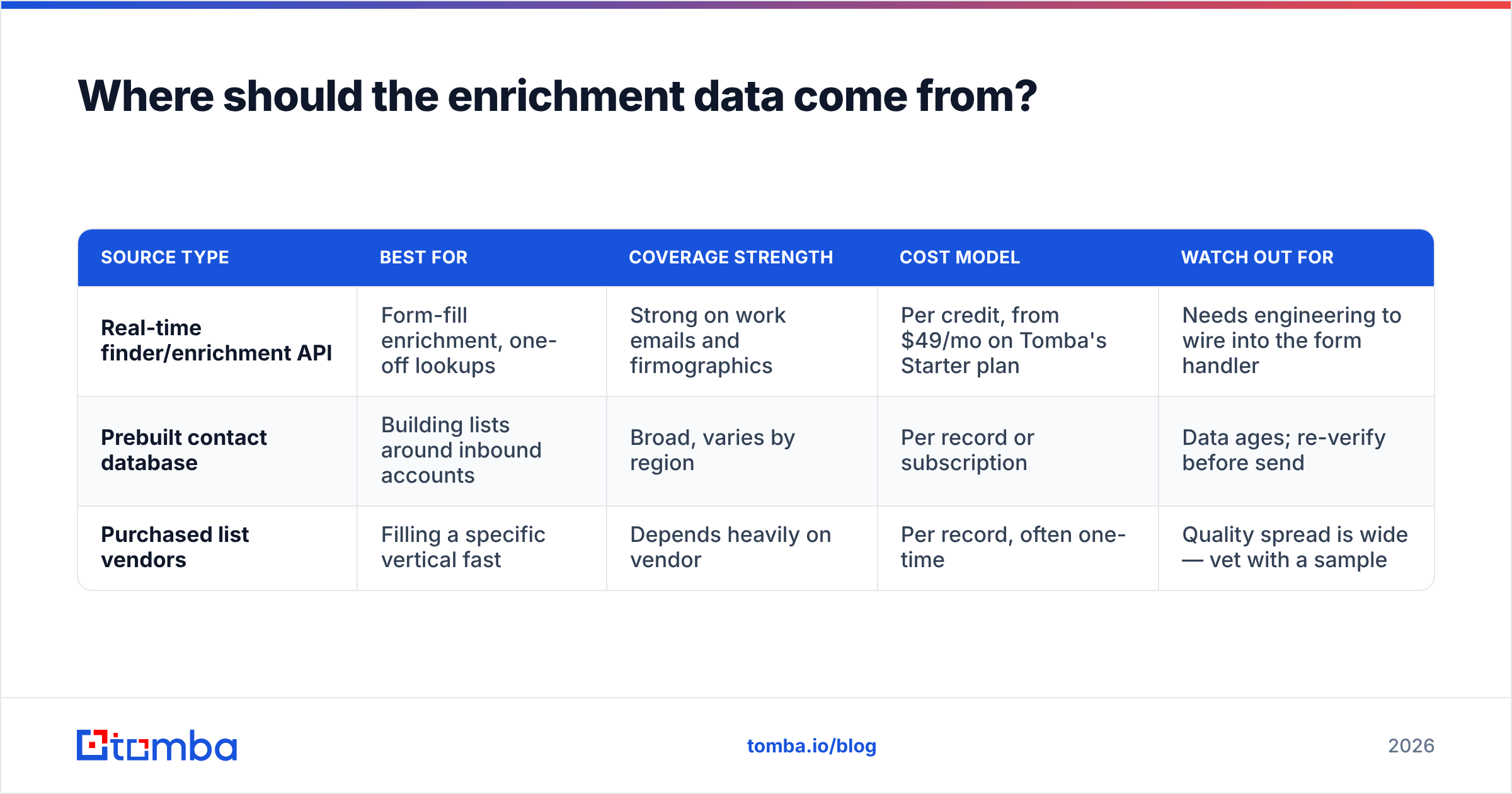
Where should the enrichment data come from?#
You have three broad options, and most mature teams use two of them together.
| Source type | Best for | Coverage strength | Cost model | Watch out for |
|---|---|---|---|---|
| Real-time finder/enrichment API | Form-fill enrichment, one-off lookups | Strong on work emails and firmographics | Per credit, from $49/mo on Tomba's Starter plan | Needs engineering to wire into the form handler |
| Prebuilt contact database | Building lists around inbound accounts | Broad, varies by region | Per record or subscription | Data ages; re-verify before send |
| Purchased list vendors | Filling a specific vertical fast | Depends heavily on vendor | Per record, often one-time | Quality spread is wide — vet with a sample |
For the database route, established providers like BookYourData and Tomba's own B2B database both work well when you need account-level coverage around an inbound signal — someone from a target company filled a form, and you want the other four stakeholders on that buying committee. For the real-time route, the requirement is simply latency: the API has to return before the lead leaves your thank-you page.
Whichever you choose, run everything through verification before it enters a sequence. Bounce rates above 3% start affecting deliverability, and inbound leads are the last list you want to burn your domain reputation on. If you want independent signal on vendors before committing, G2's marketing automation category has enough recent reviews to be useful, and HubSpot's marketing research is a reasonable baseline for benchmark numbers.
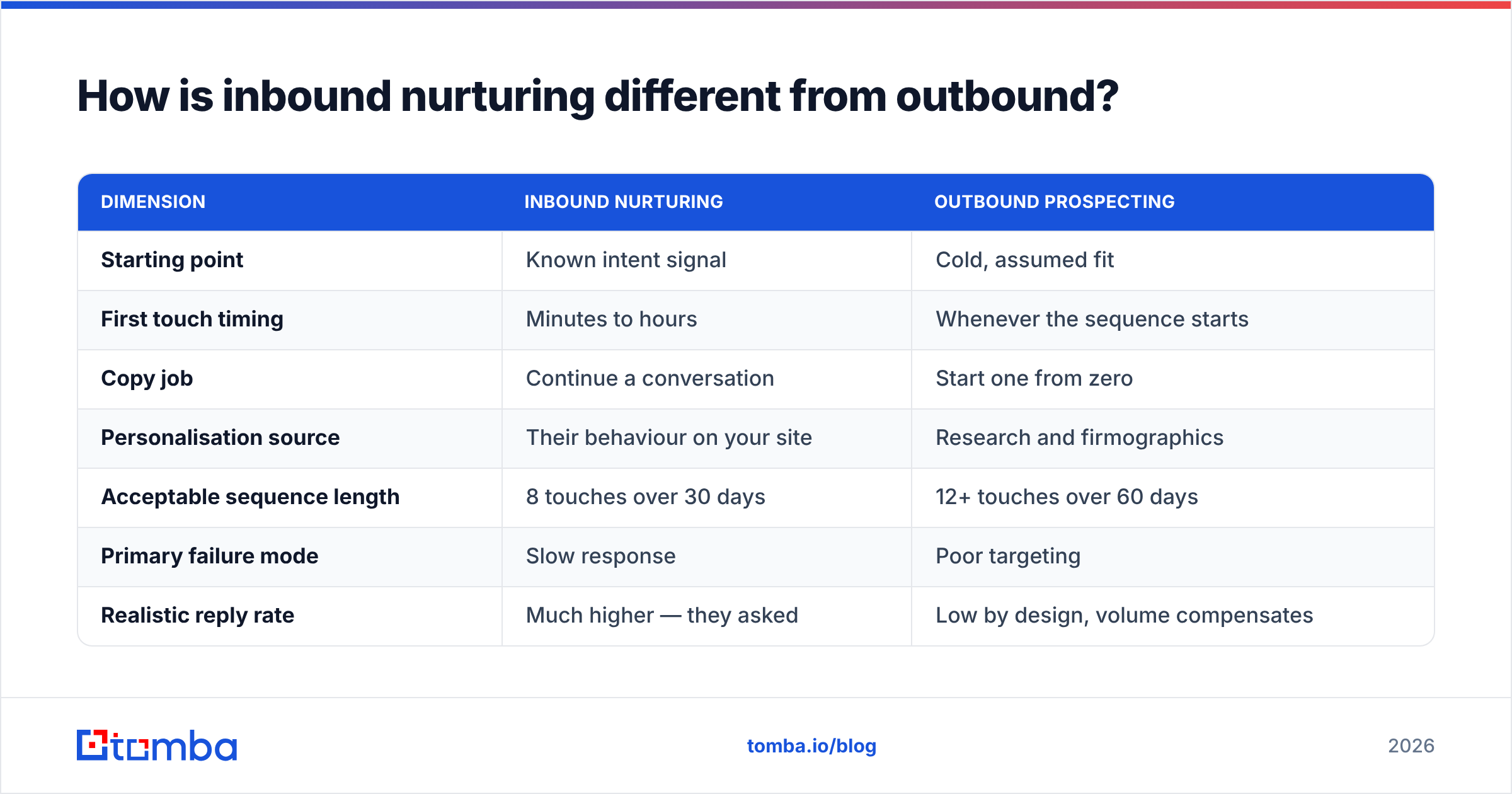
How is inbound nurturing different from outbound?#
Treating them the same is why so many inbound programs underperform. The buyer's state of mind is completely different, and the copy has to reflect that.
| Dimension | Inbound nurturing | Outbound prospecting |
|---|---|---|
| Starting point | Known intent signal | Cold, assumed fit |
| First touch timing | Minutes to hours | Whenever the sequence starts |
| Copy job | Continue a conversation | Start one from zero |
| Personalisation source | Their behaviour on your site | Research and firmographics |
| Acceptable sequence length | 8 touches over 30 days | 12+ touches over 60 days |
| Primary failure mode | Slow response | Poor targeting |
| Realistic reply rate | Much higher — they asked | Low by design, volume compensates |
The practical takeaway: inbound copy should reference what they did. "You looked at our pricing page twice this week" is not creepy if you say it plainly and it's true. It's the whole reason the email is relevant.
What metrics actually prove it's working?#
Kill open rate as a primary metric — Apple Mail Privacy Protection has made it unreliable since 2021, and it never correlated with revenue anyway. Track these instead:
- Meetings booked per 100 inbound leads. The number that matters. Everything else is a diagnostic for this one.
- Median time to first human touch. Measure the median, not the average — one 4-day outlier ruins an average and hides a systemic queue problem.
- Enrichment fill rate. What percentage of inbound records have title, headcount, and a verified email within five minutes of submission? Under 70% means your personalisation is fiction.
- Reply rate by score band. If your high-score band doesn't reply meaningfully more than your low band, your scoring model is decorative.
- Sequence exit reason distribution. Booked, replied-no, breakup, disqualified. If "breakup" dominates, your ICP targeting upstream is off, not your emails.
Review these monthly with both marketing and sales in the room. Scoring models drift as your product and market move, and a model nobody has retuned in a year is usually worse than no model at all.
What are the most common inbound nurturing mistakes?#
- Sending the same sequence to a CFO and an intern. Segment by score band at minimum.
- Never verifying. Inbound emails contain typos, role addresses, and abandoned accounts. Verify at capture and again before any send that's more than a week old.
- Nurturing forever. Thirty days, then recycle. Perpetual nurture tracks are where pipeline goes to look alive.
- No phone attempt. Inbound leads gave you a number for a reason. Calling a demo request is not aggressive; ignoring it is negligent.
- Marketing owning the whole thing. Scoring thresholds and routing rules need sales input or reps will ignore the leads they're handed.
Where should you start?#
Fix the fastest leak first: response time. Instrument your median time-to-first-touch this week — if it's over an hour for demo requests, nothing else on this page will matter until that's solved. Then wire enrichment into your form handler so reps stop researching and start calling. Scoring and sequence copy come third, because they only compound gains that already exist.
If enrichment is your gap, start with the Tomba Email Finder. It resolves work emails and firmographics from a name and domain in under a second, which is fast enough to run inline on form submission, and the free tier gives you 25 searches a month to test the flow before committing to a plan. Wire it into your thank-you page handler, push the enriched record into your CRM, and let your reps spend their day talking to buyers instead of hunting for the buyer's job title.
Related guides#
// get started
Find, verify and enrich your first contacts today
Start on the free plan with 25 searches a month, then scale when your team is ready.
Free plan · No credit card required · GDPR & CCPA
// about the author