Inbound Leads vs Outbound Leads: Which Drives More Revenue?
Inbound leads close faster but arrive on their own schedule. Outbound leads are predictable but expensive. Here is the honest cost-per-meeting math, the conversion gaps, and how to decide which one gets your next dollar.
TL;DR
- Inbound leads convert better per lead; outbound leads convert better per dollar of control. Inbound wins on close rate and sales cycle. Outbound wins on predictability and account targeting.
- The real inbound cost is time, not spend. Content and SEO take 6-12 months to compound, and the payback shows up as lower CAC later, not this quarter.
- The real outbound cost is data quality. A 20% bounce rate does not just waste sends — it damages sender reputation and drags every future campaign down with it.
- Most teams that "pick one" pick wrong. If your ACV is under $5K, inbound-led usually wins. Above $25K with a defined account list, outbound-led usually wins.
- The blend beats either alone. Warm outbound — outbound sequences aimed at accounts already showing inbound signals — consistently outperforms both pure motions.
What are inbound leads and outbound leads?#
The difference in inbound leads vs outbound leads comes down to one question: who started the conversation?
An inbound lead raises their hand first. They found your blog post through a search, downloaded a comparison guide, watched a demo video, or clicked a retargeting ad and filled in a form. By the time they hit your CRM, they have already spent time in your world. They have context, and often a rough sense of budget.
An outbound lead never asked. You identified them — by industry, headcount, tech stack, funding stage, or job title — found their contact details, and sent the first message. Cold email, cold calls, LinkedIn messages, and paid direct mail all live here. The prospect's awareness starts at zero, and every bit of it after that is something you built.
The practical consequence: inbound is a demand capture motion, outbound is a demand creation motion. Inbound harvests intent that already exists. Outbound manufactures it. That single distinction explains almost every downstream difference in cost, conversion, and forecast accuracy.
One nuance most comparison posts skip: the labels describe the first touch, not the account. The same company can be an inbound lead this month and an outbound target next quarter after the champion leaves. Treat inbound and outbound as motions you apply to accounts, not permanent categories you file accounts under.
How do inbound and outbound leads actually compare?#
Here is the honest side-by-side. Numbers below are typical B2B SaaS ranges rather than universal truths — your ACV, category maturity, and sales cycle will shift every row.
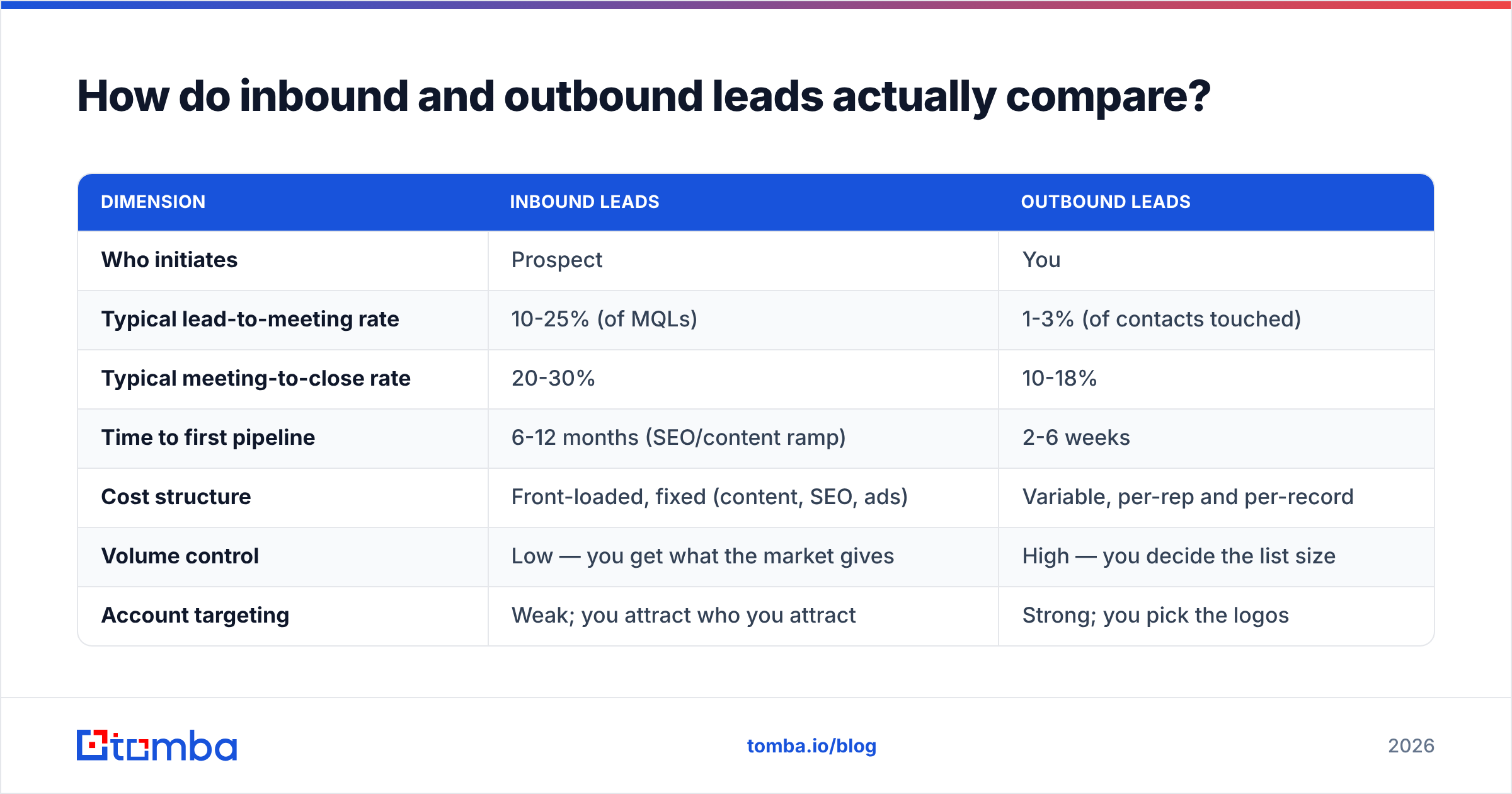
| Dimension | Inbound leads | Outbound leads |
|---|---|---|
| Who initiates | Prospect | You |
| Typical lead-to-meeting rate | 10-25% (of MQLs) | 1-3% (of contacts touched) |
| Typical meeting-to-close rate | 20-30% | 10-18% |
| Time to first pipeline | 6-12 months (SEO/content ramp) | 2-6 weeks |
| Cost structure | Front-loaded, fixed (content, SEO, ads) | Variable, per-rep and per-record |
| Volume control | Low — you get what the market gives | High — you decide the list size |
| Account targeting | Weak; you attract who you attract | Strong; you pick the logos |
| Scales by | Compounding content and brand | Headcount, data, and sending capacity |
| Sales cycle | Shorter (prospect is pre-educated) | Longer (education happens in-cycle) |
| Main failure mode | Traffic that never converts | Bad data and burned domains |
| Best fit | Self-serve, PLG, ACV under $15K | Enterprise, ABM, defined TAM |
Two rows deserve extra attention.
Volume control is the single most underrated advantage of outbound. If your board asks for 40 more opportunities next quarter, an outbound team can answer that question with arithmetic: contacts × reply rate × meeting rate. Inbound cannot. You can spend more on ads, but you cannot make more people search for a category that nobody is searching for yet.
Account targeting is the second. Inbound will happily deliver you 300 leads from companies with 4 employees while the 12 accounts on your dream list never visit your site. If your revenue depends on specific logos, inbound alone will not get you there.

What does each channel really cost per meeting?#
Cost per lead is a vanity metric. Cost per qualified meeting is the one that survives a CFO conversation.
Work it out honestly for inbound:
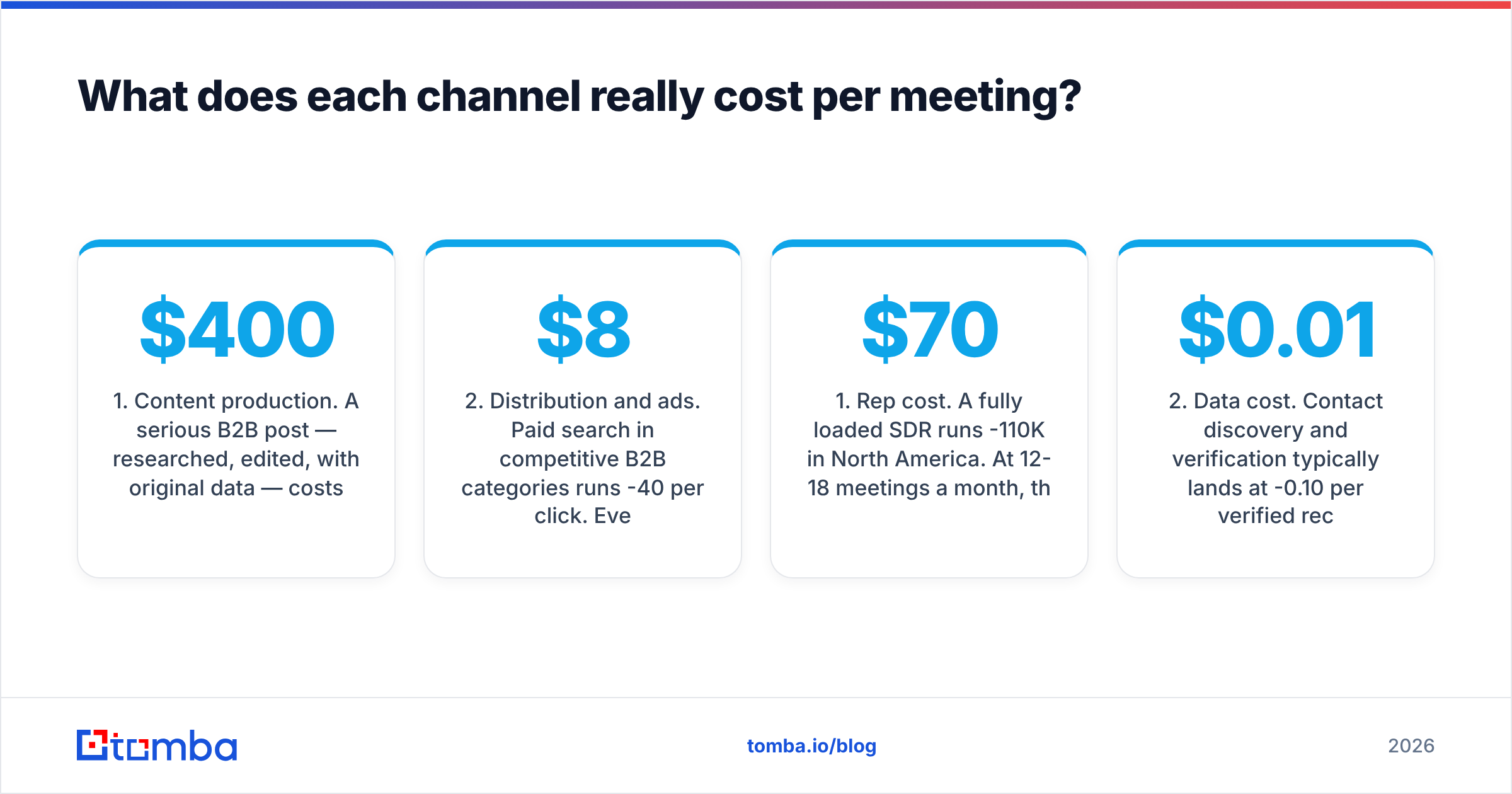
- Content production. A serious B2B post — researched, edited, with original data — costs $400-1,200 to produce, whether you pay a freelancer or amortize a salary.
- Distribution and ads. Paid search in competitive B2B categories runs $8-40 per click. Even a 3% form conversion rate puts a raw form-fill at $260-1,300.
- Time-to-payback. Organic content typically takes 6-12 months to rank and another quarter to compound. That capital is locked up.
- Qualification loss. Roughly half of form fills in most B2B funnels are students, competitors, or people at companies you cannot sell to.
And for outbound:
- Rep cost. A fully loaded SDR runs $70-110K in North America. At 12-18 meetings a month, that alone is $400-750 per meeting before tooling.
- Data cost. Contact discovery and verification typically lands at $0.01-0.10 per verified record depending on volume and provider.
- Sending infrastructure. Domains, mailboxes, warmup, and a sequencer add $200-800/month for a small team.
- Waste from bad data. This is the line item nobody budgets. If 20% of your list bounces, you did not just lose 20% of your sends — you lost deliverability on the remaining 80% too.
For most mid-market B2B teams, blended cost per qualified meeting lands somewhere between $300 and $900 in both channels. The difference is shape. Inbound cost is fixed and falls over time as content compounds. Outbound cost is variable and stays roughly flat per meeting no matter how long you run it.
That shape difference is the real decision. Inbound is a capital investment with a delayed, compounding return. Outbound is an operating expense with an immediate, linear return. Which one you need depends on whether your runway measures in quarters or years.
Which channel converts better?#
Inbound, on a per-lead basis, and it is not close.
A prospect who searched "best CRM for construction companies," read your comparison, and requested a demo has already done the top-of-funnel work for you. They know the category, they know roughly what things cost, and they have an internal reason for looking. HubSpot's marketing research has documented this pattern for over a decade, and analyst coverage from Gartner's sales practice points the same way: buyers now complete most of their evaluation before contacting a vendor.
But per-lead conversion is a trap if you read it alone. Consider two teams:
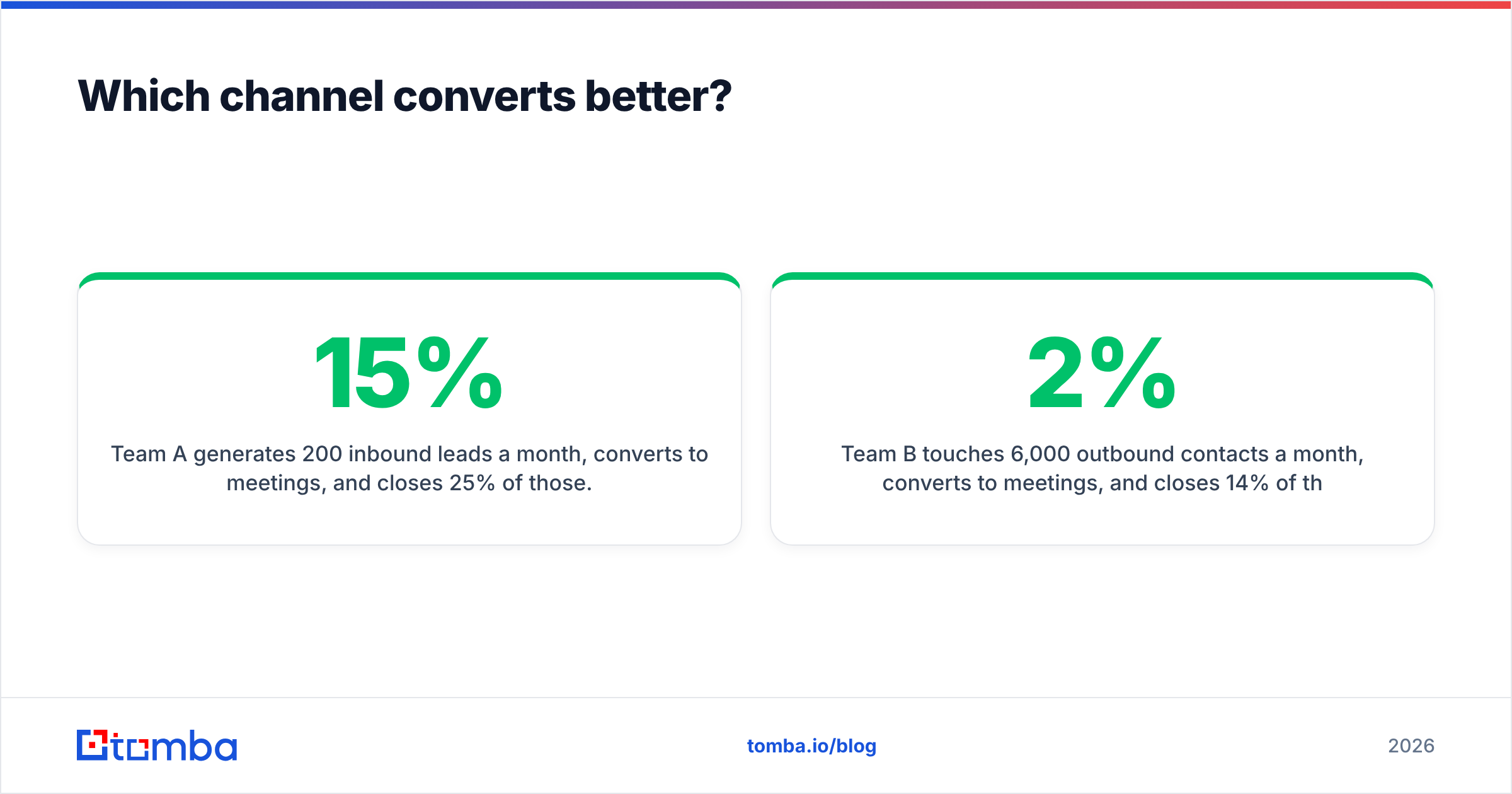
- Team A generates 200 inbound leads a month, converts 15% to meetings, and closes 25% of those. That is 7.5 new customers.
- Team B touches 6,000 outbound contacts a month, converts 2% to meetings, and closes 14% of those. That is 16.8 new customers.
Team B has a conversion rate seven times worse and produces more than twice the customers. Volume control is a real lever, and outbound owns it.
The honest framing: inbound converts better, outbound scales more predictably. A team that optimizes only for conversion rate will underinvest in outbound and cap its own growth. A team that optimizes only for volume will burn domains and reputation chasing meetings it could have earned cheaply.
There is also a compounding effect people miss. Strong inbound raises outbound reply rates, because prospects who half-recognize your brand from a search result or a LinkedIn post reply more often. Measured in isolation, that lift gets attributed to outbound copy. It is actually brand equity built by inbound.
When should you lead with inbound?#
Lead with inbound when these conditions hold:
- Your category already has search demand. If people are typing your problem into Google, capture is cheaper than creation. Check volume before committing a content budget.
- Your ACV is under roughly $15K. Low ACV cannot support an SDR team's cost per meeting. The math only closes with self-serve or low-touch motions.
- Your TAM is large and diffuse. If you sell to 400,000 small businesses, you cannot list-build your way there. Let search do the sorting.
- You have 12+ months of runway. Inbound needs time to compound. Starting it with two quarters of cash left is a gamble, not a strategy.
- Your product is easy to explain. Content sells products people can understand from a page. Genuinely novel categories need a human on the phone.
The trap: inbound teams often mistake traffic for pipeline. Ten thousand monthly readers who will never buy is a media business, not a growth engine. Track your marketing qualified lead definition ruthlessly and prune the content that attracts the wrong audience.
When should you lead with outbound?#
Lead with outbound when these conditions hold:
- Your buyers are not searching. New categories have no search volume by definition. If nobody knows the problem has a name, outbound is the only way in.
- Your ACV is above roughly $25K. High contract values justify per-meeting costs that would destroy a low-ACV model.
- Your TAM is small and nameable. If 900 companies in the world can buy your product, you can write that list down. Inbound is wasteful precision-wise; outbound is exactly right.
- You need pipeline this quarter. Outbound produces meetings in weeks. Nothing else does.
- You have a wedge insight. Outbound only works when your first line proves you know something specific about the account — a hiring pattern, a tech-stack change, a funding round.
The trap: outbound teams routinely blame copy for a data problem. Before rewriting a sequence for the fourth time, check the bounce rate. If it is above 3%, your copy was never the issue. Run the list through an email verifier and re-test with the same copy — the lift usually settles the argument.

How do you blend inbound and outbound into one motion?#
The highest-performing teams stopped treating these as separate departments. The blend has a name — warm outbound — and it works because it uses inbound signal to aim outbound effort.
The pattern:
- Capture intent signals from inbound. Anonymous website visits, content downloads, pricing-page views, repeat sessions, webinar registrations.
- Resolve the signal to an account and a person. A visit from an IP block or a form fill from a personal Gmail is not actionable until you know which company it maps to and who the decision maker is.
- Enrich the account. Headcount, funding, tech stack, and hiring signals turn a name into a reason to reach out.
- Sequence with the signal in the first line. "Saw your team is hiring three RevOps analysts" outperforms "I wanted to reach out about" by an order of magnitude.
- Route based on fit, not source. A high-fit inbound lead and a high-fit outbound lead should both go to your best AE. Source-based routing is an org-chart artifact, not a revenue decision.
- Measure the account, not the touch. Attribution wars between inbound and outbound teams are almost always a measurement design failure.
This is where the two motions stop competing. Inbound tells you who is warm. Outbound tells you what to do about it. Neither half is useful alone at the moment a buyer is actually in-market.
What data do both motions actually need?#
Both funnels fail at the same place: contact data.
Inbound fails when a form fill gives you "john@gmail.com, Acme" and nothing else. You cannot route it, score it, or personalize follow-up without knowing whether Acme is 12 people or 12,000. That gap is a data enrichment problem, and it silently costs inbound teams a meaningful share of their pipeline.
Outbound fails when the list is stale. B2B contact data decays at roughly 25-30% per year through job changes alone, according to widely cited industry benchmarks you can sanity-check against vendor reviews on G2. A list built 18 months ago is close to half wrong today.
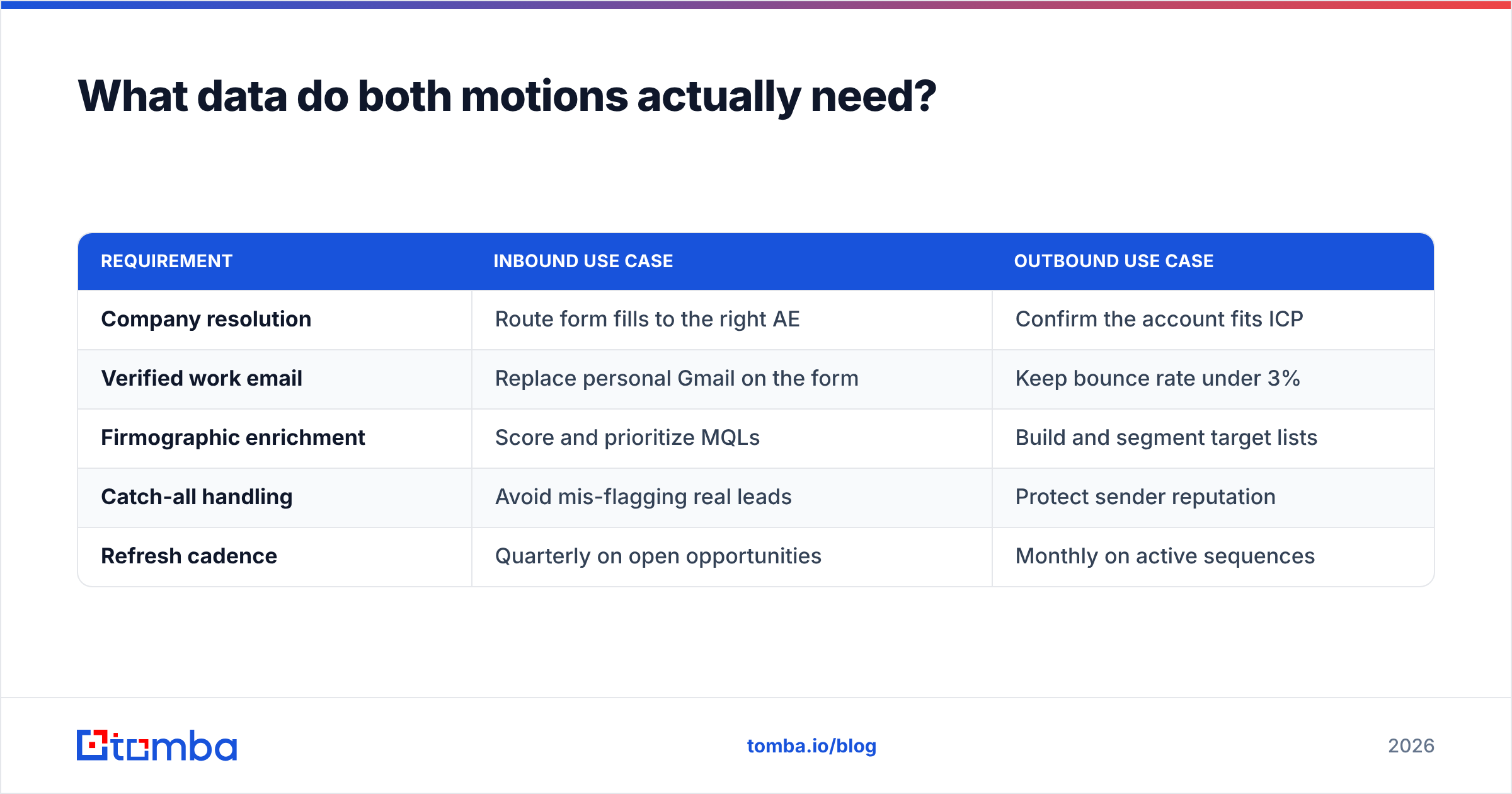
What good data hygiene looks like in practice, regardless of motion:
| Requirement | Inbound use case | Outbound use case |
|---|---|---|
| Company resolution | Route form fills to the right AE | Confirm the account fits ICP |
| Verified work email | Replace personal Gmail on the form | Keep bounce rate under 3% |
| Firmographic enrichment | Score and prioritize MQLs | Build and segment target lists |
| Catch-all handling | Avoid mis-flagging real leads | Protect sender reputation |
| Refresh cadence | Quarterly on open opportunities | Monthly on active sequences |
The tooling question is smaller than it looks. You need a reliable way to turn a domain plus a name into a verified work email, and a way to keep that email fresh. Tomba covers this at $49/mo on the Starter plan with a free tier of 25 searches for testing; you can compare limits on Tomba pricing. Peers like BookYourData take a database-first approach that suits teams buying pre-built lists rather than resolving contacts on demand — both models are legitimate, and the right one depends on whether your list is known in advance or discovered as you go.
For a plain-language primer on how the broader discipline fits together, Wikipedia's lead generation entry is a reasonable neutral starting point.
So which one should you fund next?#
Answer three questions and the decision usually makes itself.
One: can you name your buyers? If you can write down the 500 companies that should buy from you, fund outbound. Targeting precision is worth paying for.
Two: how much runway do you have? Under nine months, fund outbound. It produces pipeline inside the window you can actually survive. Over eighteen months, start inbound now so it compounds before you need it.
Three: what is your ACV? Under $15K, inbound-led. Over $25K, outbound-led. In between, run both at half intensity and let the cost-per-meeting data decide within two quarters.
The teams that get this wrong are usually the ones that treated the choice as ideological. Inbound is not "more sophisticated" and outbound is not "more aggressive." They are two different instruments for two different problems, and the debate about inbound leads vs outbound leads is really a debate about whether your constraint is time or targeting.
Whichever motion you fund, it runs on contact data that is actually correct. Start with the Tomba Email Finder — feed it a domain and a name, get back a verified work email with a confidence score and the sources behind it. The free tier gives you 25 searches to test against a list you already know the answers to, which is the only benchmark that matters. Fix the data layer first, then argue about channels.
Related guides#
// get started
Find, verify and enrich your first contacts today
Start on the free plan with 25 searches a month, then scale when your team is ready.
Free plan · No credit card required · GDPR & CCPA
// about the author