Inbound or Outbound in 2026: Which Engine Wins?
Inbound compounds but takes 9-18 months. Outbound is fast but expensive per meeting. Here is the honest math, a side-by-side comparison, and how to pick based on your ACV and market size.
TL;DR
- Inbound and outbound are not philosophies. They are two different ways to buy attention: inbound pays up front in content and waits, outbound pays per contact and gets an answer this week.
- Outbound wins when your total addressable market is small and named, your ACV is above roughly $8K-$10K, and you need pipeline inside 90 days.
- Inbound wins when your ACV is low, your buyers search for the problem by name, and you can survive 9-18 months before the curve bends.
- Most teams above $1M ARR run both, but sequenced — one motion feeds the other's targeting data instead of competing for the same headcount.
- The expensive mistake is not picking wrong. It is running both at 40% effort and concluding neither works.
What does "inbound or outbound" actually mean in 2026?#
Start with the only distinction that matters: who initiates the conversation.
Inbound means the buyer moves first. They search, read, click an ad, download a comparison guide, or ask an AI assistant for options, and they land in your funnel already carrying intent. Outbound means you move first. You build a list of accounts that look like your best customers, find the right person, and interrupt them with a reason to care.
Think of it like fishing versus farming. Outbound is fishing — you go where the fish are, you cast, and you find out today whether the bait works. Inbound is farming — you prepare soil, plant, and wait a season, but the field keeps producing after you stop working it. Neither is morally superior. They have different cash-flow shapes.
That distinction has gotten blurrier since AI answer engines started intercepting the top of the funnel. A buyer who would have read three blog posts in 2022 now reads one AI summary and skips the vendor sites entirely. That does not kill inbound; it changes what inbound content has to do. It has to be the source the model cites, not the page the human browses. Meanwhile, outbound has gotten harder in a different way: inbox providers tightened authentication and volume rules, so the spray-and-pray version of outbound is functionally dead while the precise version got more valuable.
Here is the practical framing to carry through the rest of this post:
- Outbound is a targeting problem. Your ceiling is set by how accurately you can identify and reach the right 500 people. Message quality matters second.
- Inbound is a demand-capture problem. Your ceiling is set by how many people already search for what you solve. If nobody searches, no amount of content creates the query.
- Both are constrained by data quality. A bad inbound form fill and a bad outbound email address fail the same way — a rep wastes a slot on someone who cannot buy.
- Neither is free. Inbound costs salary and time before revenue. Outbound costs tooling and rejection at the same time as revenue.
- The winner is decided by unit economics, not preference. Run the numbers below before you argue about it in a strategy meeting.

Is outbound better than inbound for early-stage teams?#
Usually yes — for one specific reason. Outbound gives you a feedback loop measured in days.
When you have no brand and no traffic, inbound has nothing to capture. You can publish twenty excellent articles and get 300 visitors, because organic authority is a function of time and links, and you have neither yet. Outbound does not care about your authority. If you can name 400 companies that have the problem you solve, you can be in 400 inboxes on Thursday and know by the following Tuesday whether your positioning lands.
That speed is not just about pipeline. It is about learning. The objections you collect in your first 500 cold emails are the raw material for the inbound content that actually ranks later. Teams that do outbound first write better inbound content, because they know the exact words buyers use.
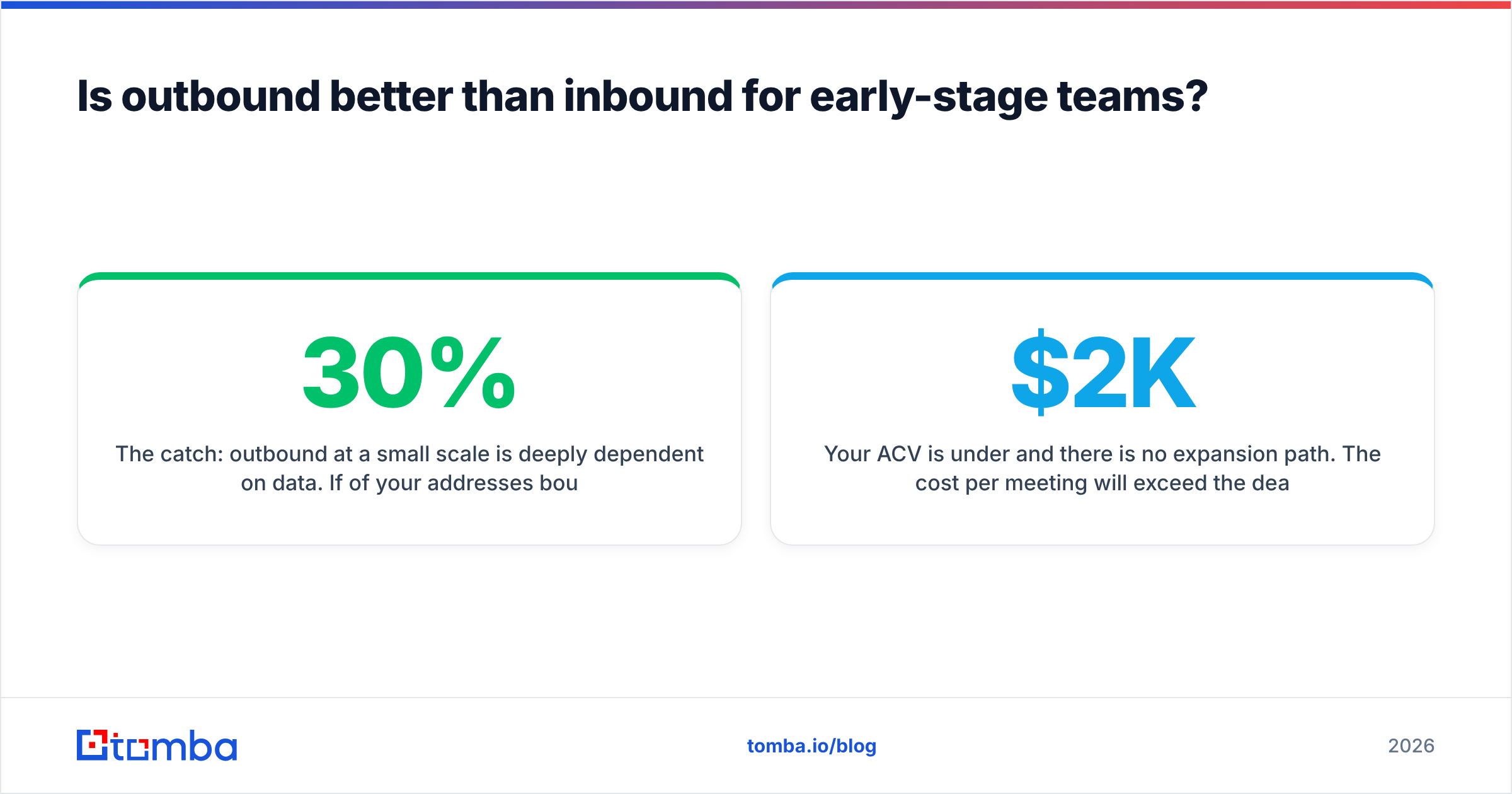
The catch: outbound at a small scale is deeply dependent on data. If 30% of your addresses bounce, you are not testing your message — you are testing your list. That is why the first infrastructure investment for an outbound-first team is not a sequencer, it is a way to find email addresses and verify emails before send. Bounce rate above 3% starts damaging your domain, and once your sender reputation is dented, every future send — inbound nurture included — performs worse.
When outbound is the wrong first move:
- Your ACV is under $2K and there is no expansion path. The cost per meeting will exceed the deal value.
- Your buyer is a consumer or prosumer. Cold B2B email to individuals is both less effective and legally riskier.
- Your TAM is enormous and undifferentiated. If 400,000 companies could buy, list-building has no leverage — you cannot out-target a market that big, and search demand is probably already there to capture.
How do inbound and outbound compare head to head?#
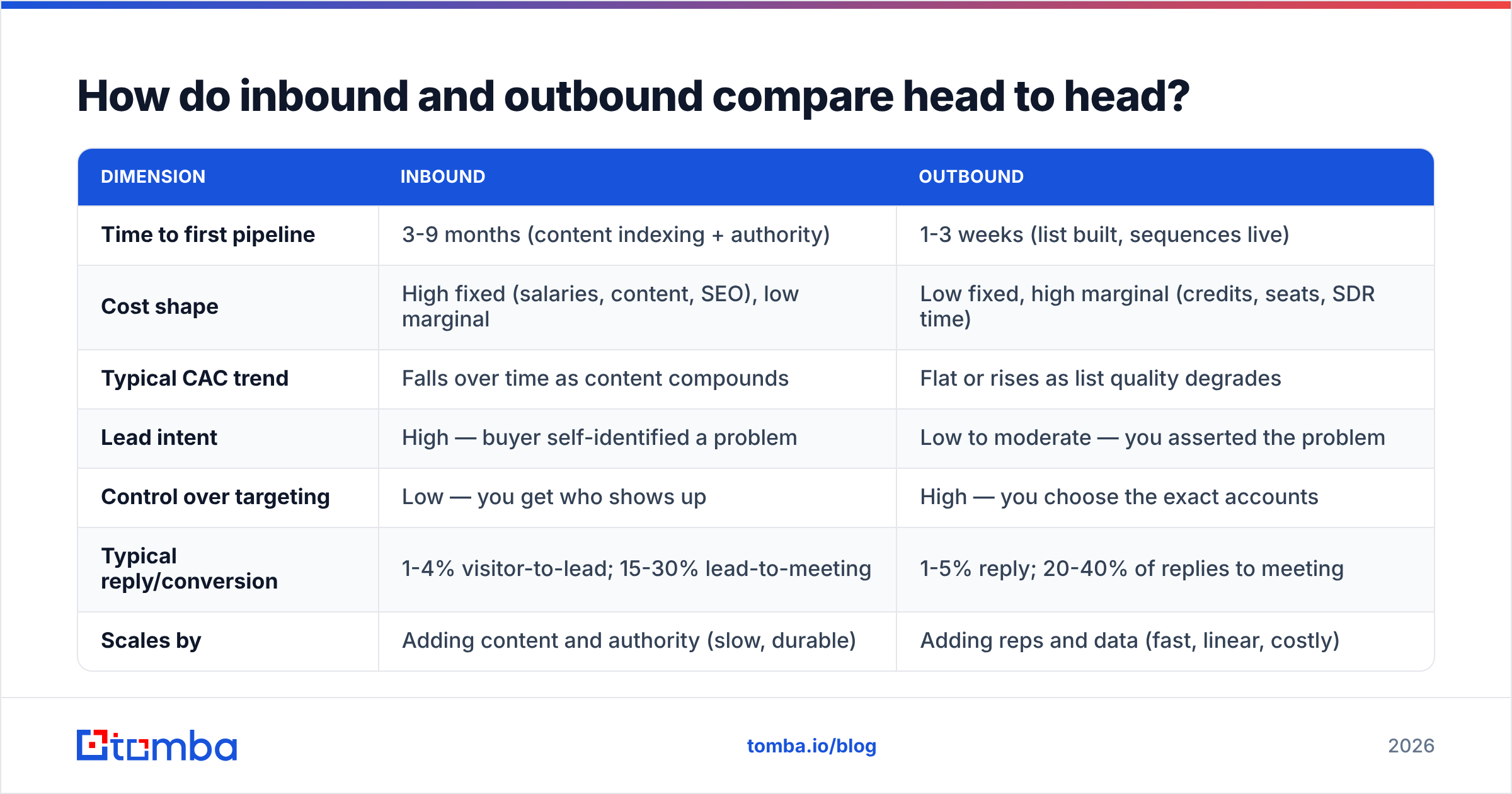
The honest answer is that they differ on almost every operational axis, which is why comparing them as "which is better" is the wrong question. Compare them on the axes that map to your constraints.
| Dimension | Inbound | Outbound |
|---|---|---|
| Time to first pipeline | 3-9 months (content indexing + authority) | 1-3 weeks (list built, sequences live) |
| Cost shape | High fixed (salaries, content, SEO), low marginal | Low fixed, high marginal (credits, seats, SDR time) |
| Typical CAC trend | Falls over time as content compounds | Flat or rises as list quality degrades |
| Lead intent | High — buyer self-identified a problem | Low to moderate — you asserted the problem |
| Control over targeting | Low — you get who shows up | High — you choose the exact accounts |
| Typical reply/conversion | 1-4% visitor-to-lead; 15-30% lead-to-meeting | 1-5% reply; 20-40% of replies to meeting |
| Scales by | Adding content and authority (slow, durable) | Adding reps and data (fast, linear, costly) |
| Fails when | Nobody searches for the problem | Data is stale or targeting is broad |
| Best ACV range | Under $15K, high volume | $8K and up, named accounts |
| Durability if you stop | Keeps producing 6-18 months | Stops within 2 weeks |
Read the last two rows together and you get the real strategic tension. Outbound is a faucet — instant on, instant off, and you pay for every liter. Inbound is a reservoir — slow to fill, but it holds water when you stop pumping. A company that only ever runs outbound has bought pipeline; a company that has built inbound owns an asset.
The G2 and Capterra category pages for your software category are a useful reality check on which motion your market rewards. If G2 shows your category with dozens of vendors and heavy review volume, buyers are actively searching and comparing — inbound demand exists and you should capture it. If your category barely exists as a category, nobody is searching for it, and outbound is your only near-term option.
What does each motion actually cost per meeting?#
Here is where most inbound-versus-outbound debates die, because the two motions get measured with incompatible math. Force them onto the same denominator: fully loaded cost per booked meeting.
Outbound, one SDR, one month (illustrative):
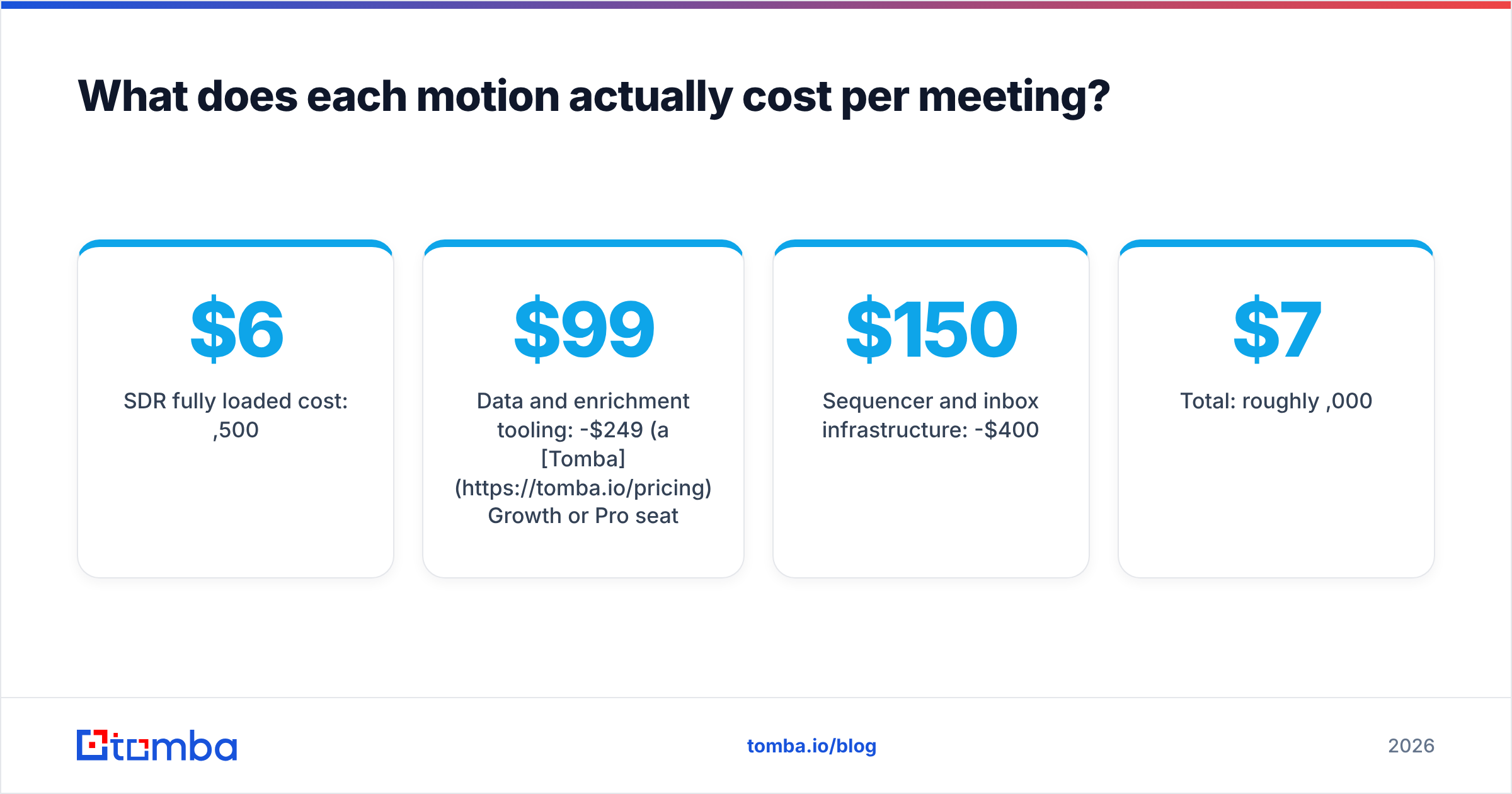
- SDR fully loaded cost: $6,500
- Data and enrichment tooling: $99-$249 (a Tomba Growth or Pro seat covers a serious monthly volume)
- Sequencer and inbox infrastructure: $150-$400
- Total: roughly $7,000
- Output at reasonable performance: 1,200 verified contacts, 3% reply rate, 35% reply-to-meeting → about 12-13 meetings
- Cost per meeting: $540-$580
Inbound, one content marketer plus freelance budget, month 10:
- Marketer fully loaded: $8,000
- Freelance writing and design: $2,500
- SEO tooling: $300
- Total: roughly $10,800
- Output at month 10: 9,000 organic visits, 2.5% visitor-to-lead → 225 leads, 12% lead-to-meeting → 27 meetings
- Cost per meeting: $400
Inbound looks better — at month 10. Run the same calculation at month 3 and inbound produced 800 visits and 4 meetings, for a cost per meeting of $2,700. That crossover point is the entire decision. If your runway or your board's patience ends before the crossover, the theoretically cheaper motion is the one that kills you.
Two adjustments to make these numbers yours. First, your reply rate is mostly a function of data quality and list precision, not copy cleverness — a targeted 400-contact list beats a sloppy 4,000-contact list on absolute meetings booked, and costs less. Second, inbound's lead-to-meeting rate collapses if you accept junk form fills, which is why contact enrichment on inbound leads is not a luxury; it is what keeps your inbound cost-per-meeting honest by routing real buyers to reps immediately.

When should you run both — and in what order?#
Run both once you have proof that one works. Not before.
The sequencing rule that holds up across most B2B companies: outbound proves the message, inbound scales it. Your cold outreach tells you which pain point gets replies, which industry converts, and which objection kills deals. Those are exactly the inputs a content strategist needs. Writing inbound content before you have that data means guessing at keywords and angles, then discovering nine months later that you ranked for a query your buyers do not use.
A workable phased plan:
- Months 0-4 — outbound only. Build tight lists of 300-500 accounts per segment. Test three value propositions. Instrument everything. Target: repeatable meetings and a documented list of the five objections you hear most.
- Months 3-9 — outbound continues, inbound foundation starts. Turn objections into content. Build the pages that answer the questions your prospects ask on calls. Do not expect traffic yet.
- Months 9-15 — inbound starts contributing, outbound gets sharper. Use inbound signals to prioritize outbound. Someone who read your pricing page twice is not a cold prospect anymore.
- Months 15+ — the two motions merge into one targeting system. Anonymous website traffic gets identified and routed into outbound sequences. Outbound reply data feeds the content calendar.
Step 4 is where the compounding really shows up, and it is the step most teams skip. If someone from a target account visits three pages and leaves without filling a form, that is the highest-intent signal you will ever get — and it is invisible unless you reveal anonymous traffic and connect it to a contact record. That is not inbound or outbound. It is inbound intent executed with outbound mechanics, and it typically converts several times better than either motion alone.
HubSpot's own research on the topic has been arguing this blended position for years, and Gartner's buyer-journey work points the same direction: buyers spend the majority of their evaluation independent of vendors, then want a specific, informed conversation when they do engage. Content earns you the right to be in the consideration set. Outbound gets you the conversation at the moment they are considering.
How do you tell which motion your business should lead with?#
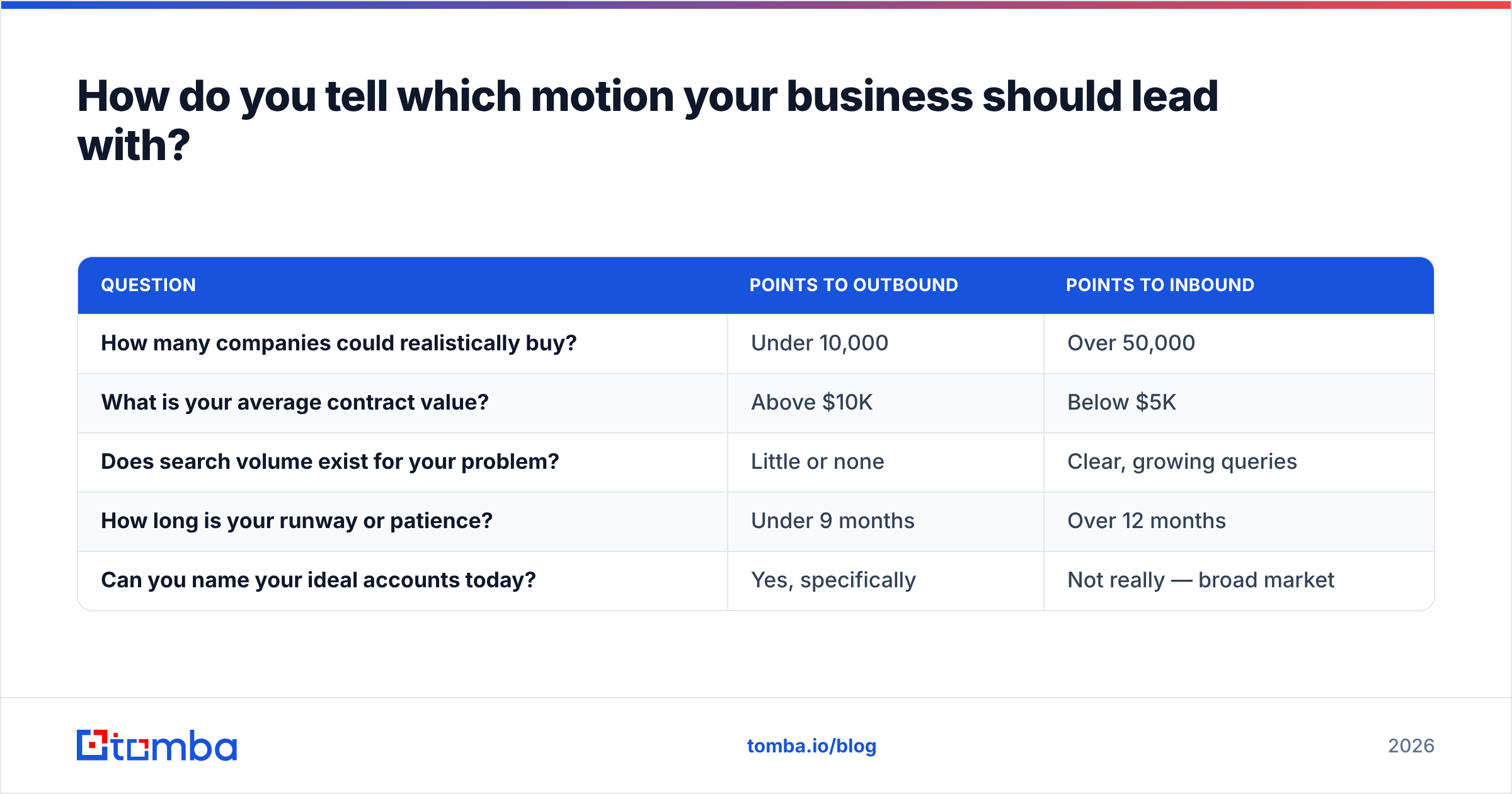
Answer five questions honestly. Count your answers.
| Question | Points to outbound | Points to inbound |
|---|---|---|
| How many companies could realistically buy? | Under 10,000 | Over 50,000 |
| What is your average contract value? | Above $10K | Below $5K |
| Does search volume exist for your problem? | Little or none | Clear, growing queries |
| How long is your runway or patience? | Under 9 months | Over 12 months |
| Can you name your ideal accounts today? | Yes, specifically | Not really — broad market |
Three or more answers in the outbound column and you should lead with outbound, no debate. Three or more in the inbound column and outbound will feel expensive and unfocused, because you will be spending targeting effort on a market too large to target.
Two edge cases worth naming. Product-led companies with a free tier are effectively running inbound with an outbound layer on top — the free signups are the list, and outbound targets the accounts with multiple active users. Category creators have no choice: nobody searches for a thing that does not have a name yet, so outbound funds the company while inbound content slowly creates the category vocabulary.
One more practical constraint that decides more strategies than anyone admits: whether you can actually reach the person. If your buyer is a hospital procurement director whose email is not published anywhere, your outbound viability depends entirely on your data provider's coverage of that segment. Test coverage before you commit headcount. Run 100 known-good target names through a domain search and see what percentage returns a verified, deliverable address. Below 60% coverage in your specific niche, outbound math gets ugly fast regardless of how good your reps are. Providers like BookYourData and Tomba each publish their coverage approach, and it is worth checking both against your exact ICP rather than trusting a generic accuracy claim.
What are the most common ways teams get this wrong?#
- Running both at half strength. Two motions at 50% effort produce roughly 25% of the results of one at 100%, because both need a critical mass of volume before signal separates from noise.
- Judging inbound on a quarterly cycle. Content published in Q1 often peaks in Q4. Quarterly evaluation kills programs one quarter before they work.
- Judging outbound on volume instead of accuracy. Sending 10,000 emails to a 60%-accurate list burns your domain and teaches you nothing. Sending 1,000 to a 95%-accurate list teaches you everything.
- Treating inbound leads as warmer than they are. A whitepaper download is not buying intent. Score it properly or you will conclude inbound "does not convert" when what you had was a content-consumption signal.
- Letting the CRM rot. Both motions degrade at roughly 25-30% per year as people change jobs. Whichever motion you pick, budget for periodic re-verification of your database, or your cost per meeting climbs silently.
The through-line: neither motion fails because of strategy. They fail because of execution details that look boring on a slide — bounce rates, coverage gaps, attribution windows, and evaluation timelines.
Where should you start this quarter?#
Pick the motion your unit economics point to, commit to it fully for two quarters, and instrument it well enough to know whether it worked. Then add the second motion on top of proven ground, not alongside an unproven one.
If that means outbound — and for most teams under $3M ARR with a nameable market, it does — your first bottleneck will be contact data, not copy. Start with the Tomba Email Finder to build and verify target lists from company domains and names. The free tier gives you 25 searches a month to sanity-check coverage in your niche before spending anything, and Starter at $49/mo covers a realistic first outbound test. If it turns out your niche has thin coverage, you have learned that for free, which is a far cheaper way to find out than three months into an SDR hire.
Related guides#
// get started
Find, verify and enrich your first contacts today
Start on the free plan with 25 searches a month, then scale when your team is ready.
Free plan · No credit card required · GDPR & CCPA
// about the author