Inbound Sales in 2026: The Complete Process, Metrics & Playbook
Inbound sales looks easy until the leads arrive. Here is the 2026 process that actually converts demand into pipeline: routing rules, response SLAs, qualification without 12-field forms, and the metrics that expose a broken funnel.
TL;DR
- Inbound sales is the process of converting self-declared buyer interest (demo requests, trials, content downloads, pricing-page visits) into revenue. The demand already exists; your job is speed, context, and qualification.
- The single biggest lever is response time. Widely cited research on lead response shows the vast majority of deals go to whoever replies first, and qualification odds collapse after the first hour.
- Inbound is not cheaper than outbound. It front-loads cost into marketing and back-loads it into rep time wasted on unqualified traffic.
- Modern inbound teams qualify with enrichment, not with 12-field forms. Ask for a work email, then fill in company size, industry, and tech stack automatically.
- The metrics that matter: speed-to-lead, lead-to-meeting rate, meeting-to-opportunity rate, and inbound source ROI. Everything else is vanity.
What is inbound sales?#
Inbound sales is a sales motion where the buyer initiates contact. Someone reads a comparison post, watches a webinar, starts a free trial, or fills out a "talk to sales" form, and a rep picks up the thread from there.
Think of it like a restaurant with a line out the door versus a food truck that drives to find customers. The restaurant did not stop selling; it moved the selling upstream into location, menu, and reputation. Inbound sales works the same way: content, product-led signals, and brand do the top-of-funnel work, and the rep's job shifts from "create interest" to "qualify, diagnose, and close."
Technically, inbound sales sits downstream of inbound marketing and is usually formalized as a stage-gated process: lead captured → routed → contacted → qualified → meeting held → opportunity created. HubSpot popularized the modern framing in its inbound sales methodology, which splits the rep's work into Identify, Connect, Explore, and Advise.
The critical distinction: an inbound lead is not a warm lead. It is an interested lead. Interest without fit is a time tax. A student writing a thesis and a VP of Sales at a 400-person company can fill out the identical form.
How is inbound sales different from outbound sales?#
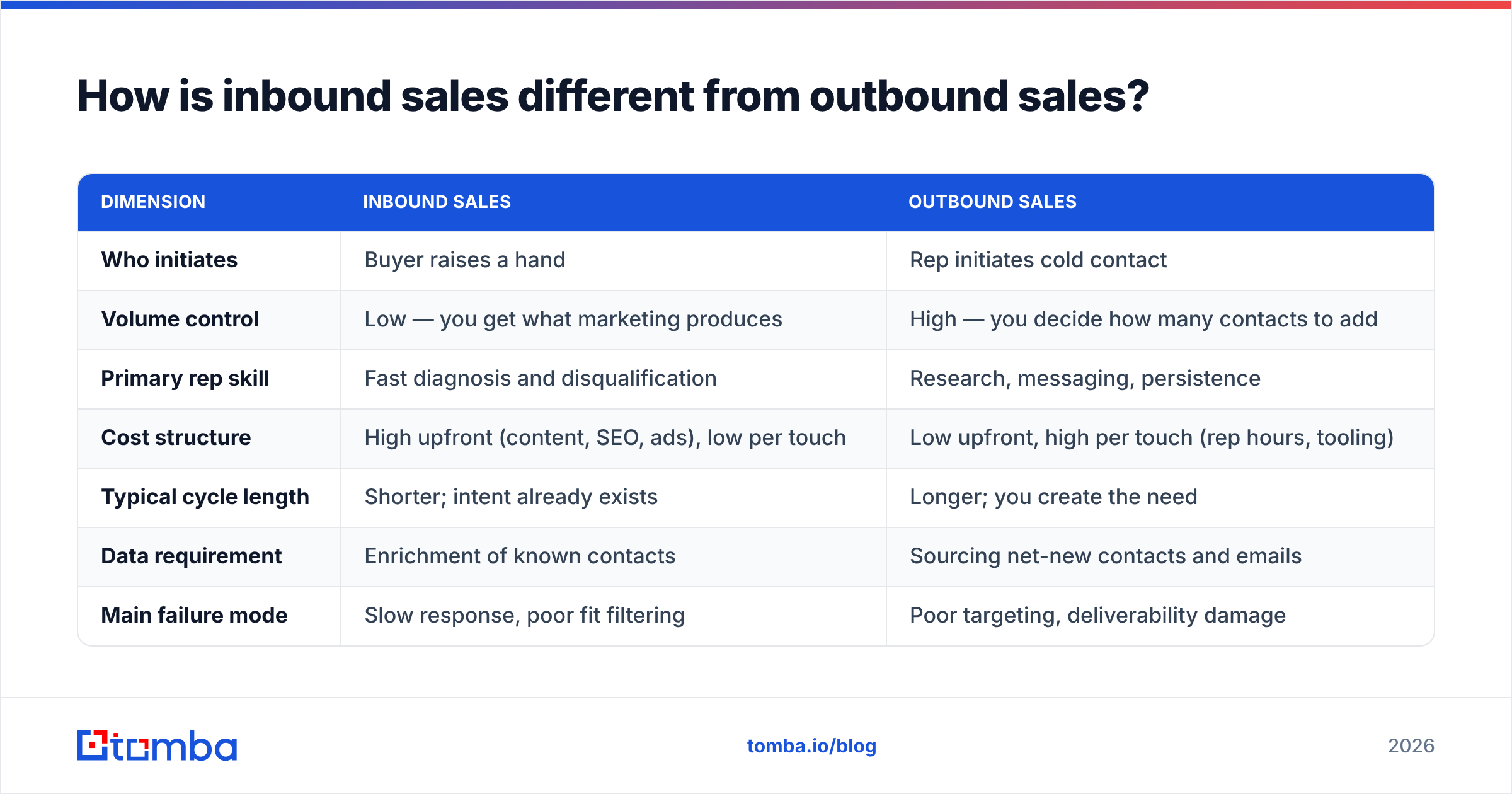
The two motions share a CRM and almost nothing else. They demand different rep profiles, different data, different comp plans, and different failure modes.
| Dimension | Inbound sales | Outbound sales |
|---|---|---|
| Who initiates | Buyer raises a hand | Rep initiates cold contact |
| Volume control | Low — you get what marketing produces | High — you decide how many contacts to add |
| Primary rep skill | Fast diagnosis and disqualification | Research, messaging, persistence |
| Cost structure | High upfront (content, SEO, ads), low per touch | Low upfront, high per touch (rep hours, tooling) |
| Typical cycle length | Shorter; intent already exists | Longer; you create the need |
| Data requirement | Enrichment of known contacts | Sourcing net-new contacts and emails |
| Main failure mode | Slow response, poor fit filtering | Poor targeting, deliverability damage |
| Ramp time for a new rep | 3–6 weeks | 8–12 weeks |
Neither motion wins on principle. Inbound scales beautifully in categories with high search volume and a self-serve entry point. Outbound is the only option when your buyer does not know the category exists, or when you sell to 800 named accounts and 40 of them will ever search for you.
Most teams that hit a plateau are running one motion and calling it a strategy. The healthiest 2026 GTM orgs run both and route by signal strength, which is what Gartner's sales research keeps pointing at: buyers move between self-serve and rep-led channels inside a single deal, and the vendor that handles the handoff without friction wins.
What does the inbound sales process look like in 2026?#
Six steps. Skip any one of them and the funnel leaks in a predictable place.
- Capture with the shortest possible form. Work email plus one qualifying question. Every extra field costs conversion. You will recover the missing data in step two.
- Enrich before the lead hits a rep. Company size, industry, funding stage, tech stack, and headcount should be appended automatically within seconds. A rep opening a record that says only "jane@acme.com" is a rep about to waste 15 minutes on research. Automated contact enrichment removes that step entirely.
- Score and route. Combine fit (firmographics) with intent (pages visited, product actions taken). High fit plus high intent goes to an AE immediately. Low fit goes to self-serve or nurture. A marketing qualified lead that no one defined precisely is just a spreadsheet row.
- Respond inside five minutes during business hours. This is the whole ballgame. More on it below.
- Qualify on the first call, ruthlessly. Use a lightweight framework (budget authority is often irrelevant in PLG; problem severity and timeline are not). Disqualify out loud. A fast "no" is worth more than a slow "maybe."
- Hand off with context, then measure. Log the source, the trigger page, and the qualifying answers on the opportunity. Without source attribution you cannot tell which content produces revenue and which produces traffic.
Notice what is missing: a discovery call scheduled 11 days out, a 45-minute generic demo, and a "let me send you some materials" email. Inbound buyers arrive mid-journey. Treating them like cold prospects insults their research.
Why do most inbound leads go cold?#
Because someone waited. The classic Harvard Business Review analysis of online lead response found that companies contacting a lead within an hour were dramatically more likely to qualify it than those waiting even 60 minutes longer, and the drop-off past 24 hours is brutal. The commonly repeated shorthand in sales ops circles is that the first vendor to respond wins the large majority of deals.
Here is why the delay happens in practice, and none of the reasons are laziness:
- Routing rules break silently. A round-robin that assigns to a rep on PTO. A territory rule with no fallback owner. Nobody notices for a week.
- The form data is useless, so the rep researches first. Twenty minutes of LinkedIn scrolling before the first touch. Enrichment eliminates it.
- No phone number on file. Email-only follow-up on a hot demo request cuts your connect rate roughly in half. If your CRM has a work email but no direct dial, a phone finder closes that gap before the rep dials.
- The email bounces. A typo'd or role-based address from a form fill means the reply never lands, and the rep assumes the lead ghosted. Running submissions through an email verifier at capture time catches this in under a second.
- Nobody owns off-hours. A Friday 6pm demo request answered Monday at 10am is a 64-hour SLA breach that no dashboard flags.
Fix the mechanics before you fix the messaging. A brilliant follow-up email sent 26 hours late underperforms a mediocre one sent in four minutes.
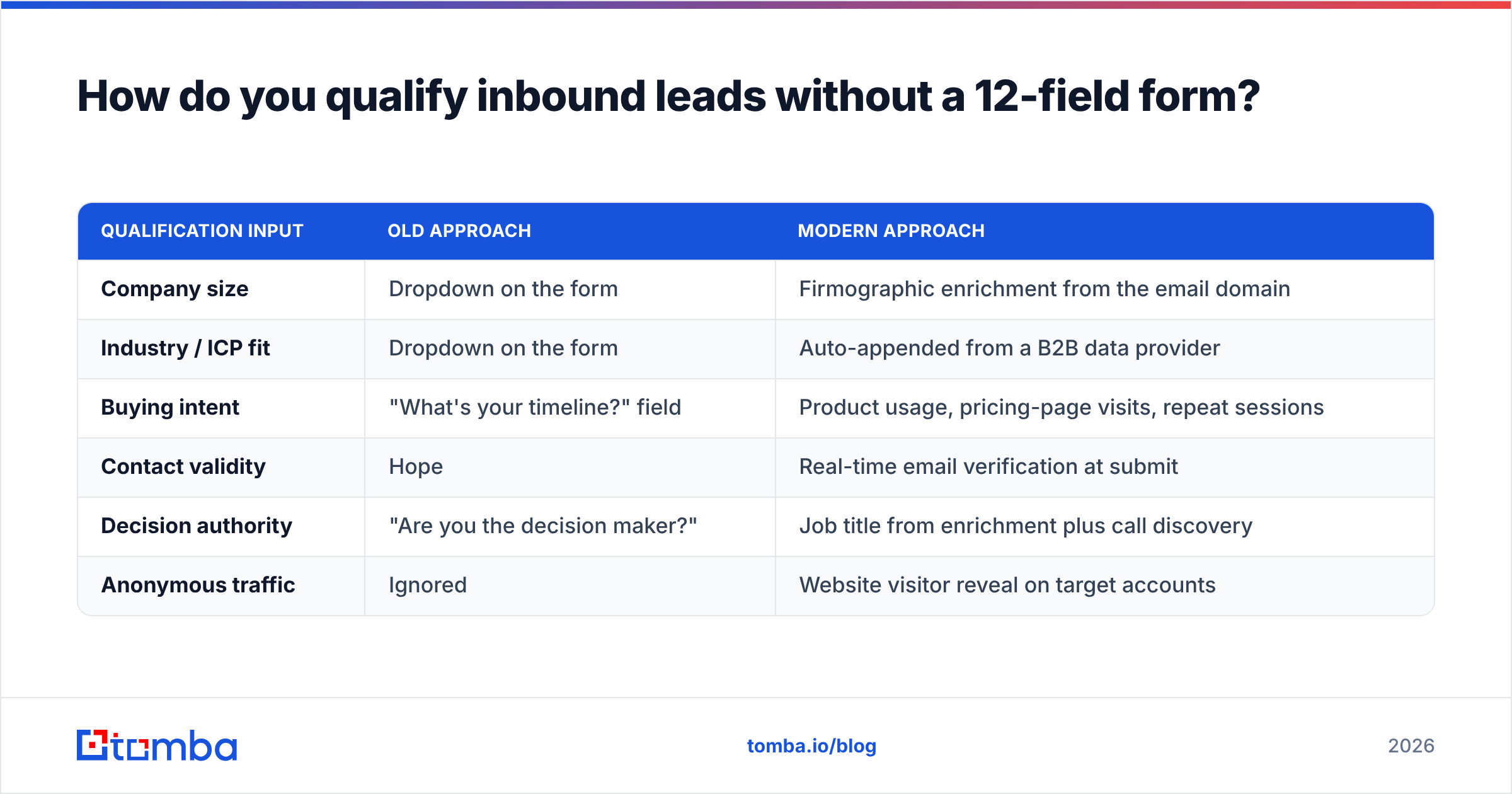
How do you qualify inbound leads without a 12-field form?#
You move the qualification burden off the buyer and onto your data stack.
The old model asked the prospect to self-report company size, role, budget, and timeline in a form. Conversion rates on those forms are grim, and the answers are frequently wrong (people pick "1000+" to get the good demo, or "just researching" to avoid a call).
The 2026 model looks like this:
| Qualification input | Old approach | Modern approach |
|---|---|---|
| Company size | Dropdown on the form | Firmographic enrichment from the email domain |
| Industry / ICP fit | Dropdown on the form | Auto-appended from a B2B data provider |
| Buying intent | "What's your timeline?" field | Product usage, pricing-page visits, repeat sessions |
| Contact validity | Hope | Real-time email verification at submit |
| Decision authority | "Are you the decision maker?" | Job title from enrichment plus call discovery |
| Anonymous traffic | Ignored | Website visitor reveal on target accounts |
That last row is the one most teams underuse. The overwhelming majority of qualified buyers never fill out anything. They read three pages, check pricing, and leave. Identifying the company behind that session turns a silent visit into a routable signal, which is functionally inbound intent without the form.
One caution: do not let enrichment become an excuse for a longer sales process. The point of automating qualification is to shorten the time to first human contact, not to add a scoring committee.
What metrics actually matter in inbound sales?#
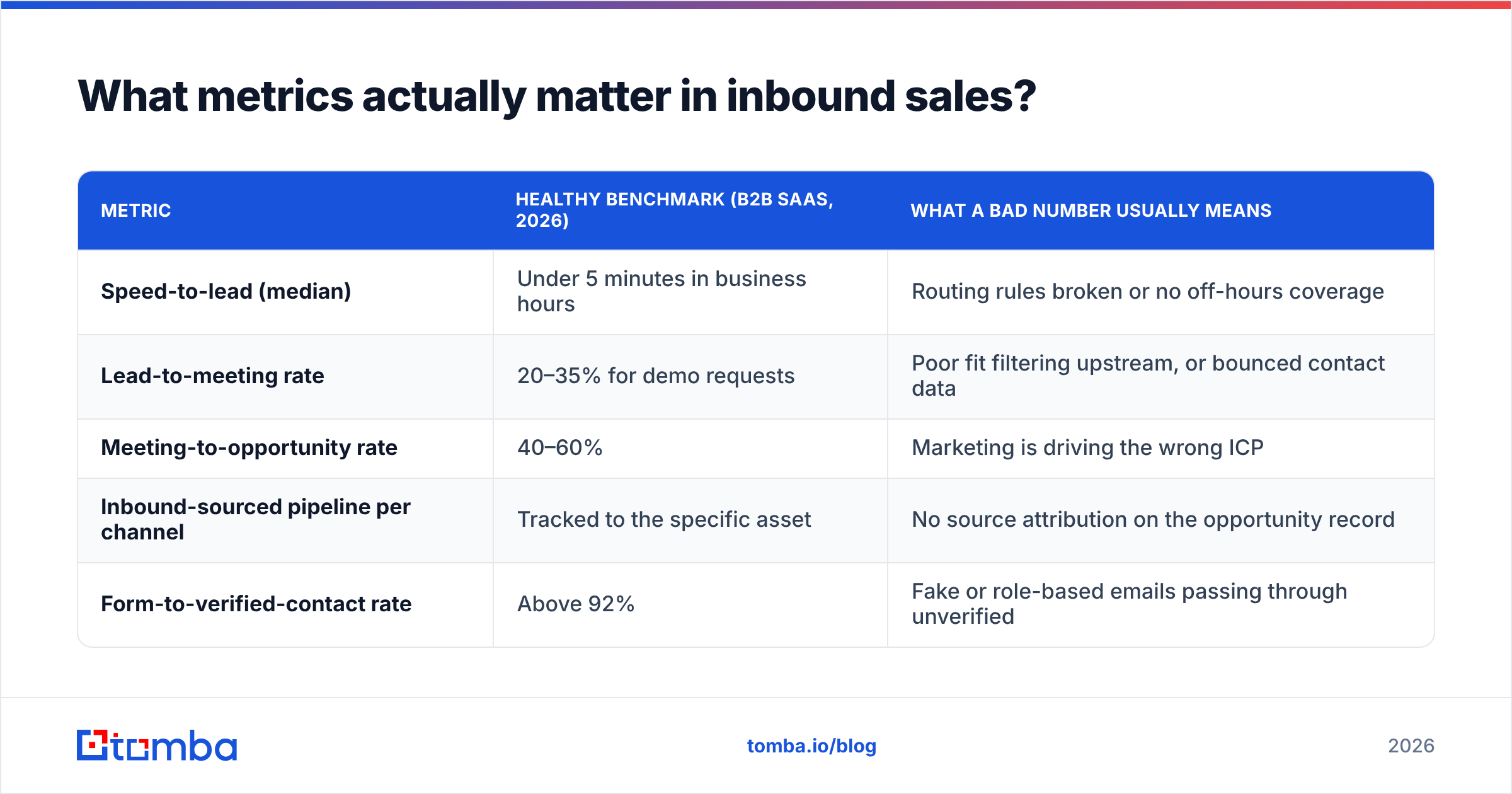
Four numbers tell you whether the motion is healthy. Everything else is decoration for a QBR slide.
| Metric | Healthy benchmark (B2B SaaS, 2026) | What a bad number usually means |
|---|---|---|
| Speed-to-lead (median) | Under 5 minutes in business hours | Routing rules broken or no off-hours coverage |
| Lead-to-meeting rate | 20–35% for demo requests | Poor fit filtering upstream, or bounced contact data |
| Meeting-to-opportunity rate | 40–60% | Marketing is driving the wrong ICP |
| Inbound-sourced pipeline per channel | Tracked to the specific asset | No source attribution on the opportunity record |
| Form-to-verified-contact rate | Above 92% | Fake or role-based emails passing through unverified |
Two traps. First, MQL volume is not a metric; it is a budget justification. Tie every count to downstream conversion or delete it from the dashboard. Second, a rising response rate with a flat meeting rate means you got better at emailing people who were never going to buy.
If you want an external sanity check on tooling before you blame the process, category reviews on G2 are a reasonable read on where the friction actually sits for teams your size.
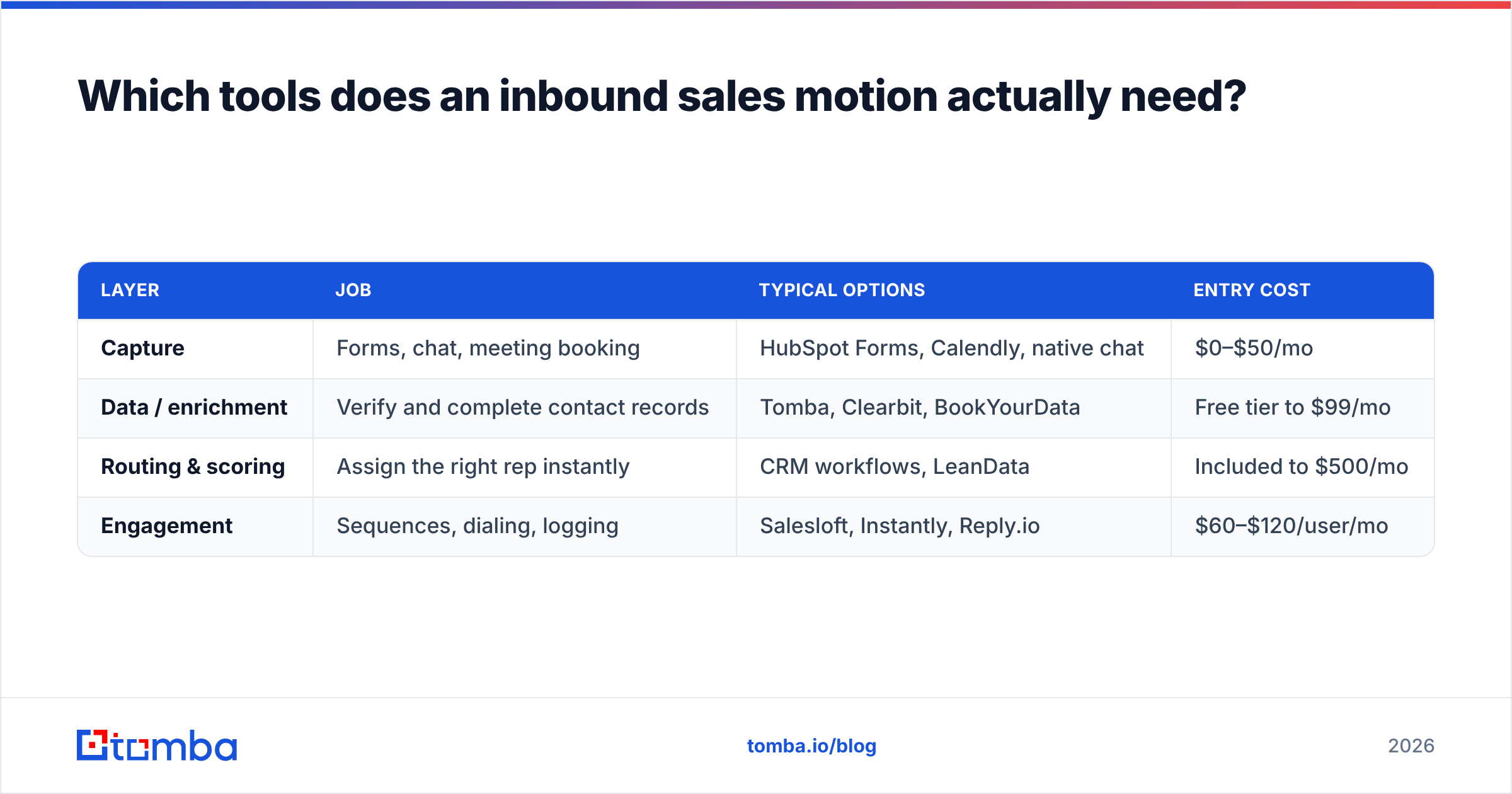
Which tools does an inbound sales motion actually need?#
Fewer than vendors would like you to believe. Four layers, and you can start each one cheap.
| Layer | Job | Typical options | Entry cost |
|---|---|---|---|
| Capture | Forms, chat, meeting booking | HubSpot Forms, Calendly, native chat | $0–$50/mo |
| Data / enrichment | Verify and complete contact records | Tomba, Clearbit, BookYourData | Free tier to $99/mo |
| Routing & scoring | Assign the right rep instantly | CRM workflows, LeanData | Included to $500/mo |
| Engagement | Sequences, dialing, logging | Salesloft, Instantly, Reply.io | $60–$120/user/mo |
On the data layer specifically: Tomba pricing starts with a free tier at 25 searches per month, with Starter at $49/mo, Growth at $99/mo, and Pro at $249/mo, which covers verification and enrichment for most teams processing a few thousand inbound records monthly. BookYourData is a solid option when you need pre-built, purchased contact lists rather than on-demand lookups, and plenty of teams run both: purchased data for account planning, on-demand lookup for inbound records that arrive incomplete.
Resist the temptation to buy the engagement layer first. A sequencing tool applied to unverified inbound leads produces bounces, and bounces damage the sending domain you also use for legitimate replies.
Is inbound sales better than outbound sales?#
No, and the question is usually a proxy for a budget argument.
Inbound wins on cost per meeting once the content engine matures, typically 9–18 months in. It loses on predictability: you cannot decide on Monday to generate 200 extra inbound demos this quarter. Outbound wins on control and on named-account coverage. It loses on efficiency and on rep morale.
The practical answer for 2026:
- Under $2M ARR: run outbound as the primary motion, publish content continuously, and treat inbound as a bonus you handle within five minutes.
- $2M–$20M ARR: inbound should be 30–50% of pipeline. Split the team so nobody is expected to do both well in the same day.
- Above $20M ARR: inbound and product-led signals dominate volume, outbound narrows to strategic accounts and expansion.
The teams that struggle are the ones that fire their SDRs the quarter inbound looks strong, then discover 90 days later that content compounds slowly and does not respond to panic.
Where does inbound sales break most often?#
Three places, in order of frequency.
Bad contact data at the entry point. A form fill with a typo, a personal Gmail on an enterprise deal, or a role address like info@ that routes to nobody. Verify at submit and the problem disappears. For records that arrive with a name and company but no usable address, a domain-level lookup fills the gap.
Undefined ownership between marketing and sales. Marketing counts the lead, sales says it was junk, and no one adjusts the definition. Write the MQL definition down, review it monthly against meeting-to-opportunity rate, and let sales reject leads with a required reason code.
Treating every inbound the same. A trial signup from a two-person agency and a demo request from a 3,000-person enterprise deserve different treatment. Route the first to self-serve onboarding; route the second to a human within minutes, with the account's headcount, funding, and tech stack already on the record.
Get the data layer right first#
Inbound sales fails on plumbing far more often than on strategy. Before you rewrite your qualification framework or rebuild the website, make sure every inbound record arrives complete and reachable: a verified work email, a direct phone line where possible, and firmographics attached automatically.
That is exactly what the Tomba Email Finder handles. Verify form submissions in real time, recover the correct work address when a lead types the wrong one, and enrich incomplete records before they reach a rep's queue. Start on the free tier at 25 searches a month, then move to Starter at $49/mo when the inbound volume justifies it. Your reps get five minutes back on every lead, and five minutes is the entire difference between winning the deal and reading about it in a competitor's case study.
Related guides#
// get started
Find, verify and enrich your first contacts today
Start on the free plan with 25 searches a month, then scale when your team is ready.
Free plan · No credit card required · GDPR & CCPA
// about the author