Inbound Sales Call Script: A 2026 Framework That Converts
Inbound leads convert far better than cold ones — until a rep improvises. Here is a minute-by-minute inbound sales call script, the qualification questions that work, objection lines, and the metrics that prove it converts.
TL;DR
- An inbound sales call script is not a cold call script with the objection handling removed. The buyer already raised a hand, so your job is diagnosis and routing, not persuasion.
- The highest-leverage variable is not wording — it is speed. Call back inside five minutes or the script barely matters.
- A working structure is roughly: 30 seconds of context, 2 minutes of confirmed intent, 5 minutes of diagnosis, 3 minutes of tailored proof, 2 minutes of next step.
- Qualify with three questions the buyer wants to answer, not eleven your CRM wants filled.
- Measure connect rate, qualified rate, and next-step rate separately. A script that books meetings but not qualified ones is a leak, not a win.
What is an inbound sales call script?#
An inbound sales call script is a repeatable conversation structure for prospects who contacted you first — a demo request, a pricing page form, a trial signup, a chat handoff, or a callback request.
Think of it like a hospital triage desk versus a door-to-door salesperson. The door-to-door rep has to earn the right to speak. The triage nurse already has a patient who walked in voluntarily and is in some amount of pain; the entire job is asking the right questions fast enough to route them correctly. Inbound calls are triage. Most reps run them like door-to-door.
That mismatch is why so many inbound calls feel awkward. The rep opens with a pitch the buyer has already read on the website, then spends nine minutes re-establishing interest that was never in doubt. Meanwhile the buyer, who has three tabs open with your competitors, is waiting for someone to tell them whether this thing solves their specific problem.
A good script fixes the order of operations. It assumes intent, confirms the trigger, diagnoses the situation, and converts that diagnosis into a next step — in that sequence, every time, regardless of which rep picks up.
Why do inbound calls convert better — and why do reps still lose them?#
Inbound leads convert at multiples of outbound because the buyer has self-selected. They have budget curiosity at minimum, and often an active project. What kills the advantage is latency and improvisation.
The classic lead-response research from Harvard Business Review found that companies contacting a lead within an hour were dramatically more likely to have a meaningful conversation than those who waited even two hours — and the median firm took far longer than that. Nothing about that dynamic has softened in 2026. If anything, buyers now expect an answer at chat speed, and every hour you wait, your prospect is having your discovery call with someone else.
The second killer is the improvised open. Two reps handling identical inbound forms will run wildly different calls if nobody wrote the structure down. One asks about company size first, one pitches integrations first, and the manager reviewing the recordings cannot tell whether the loss was the lead or the handling.
A script solves the attribution problem before it solves the conversion problem. When everyone runs the same skeleton, the variance you see is signal.
What does the inbound call flow actually look like, minute by minute?#
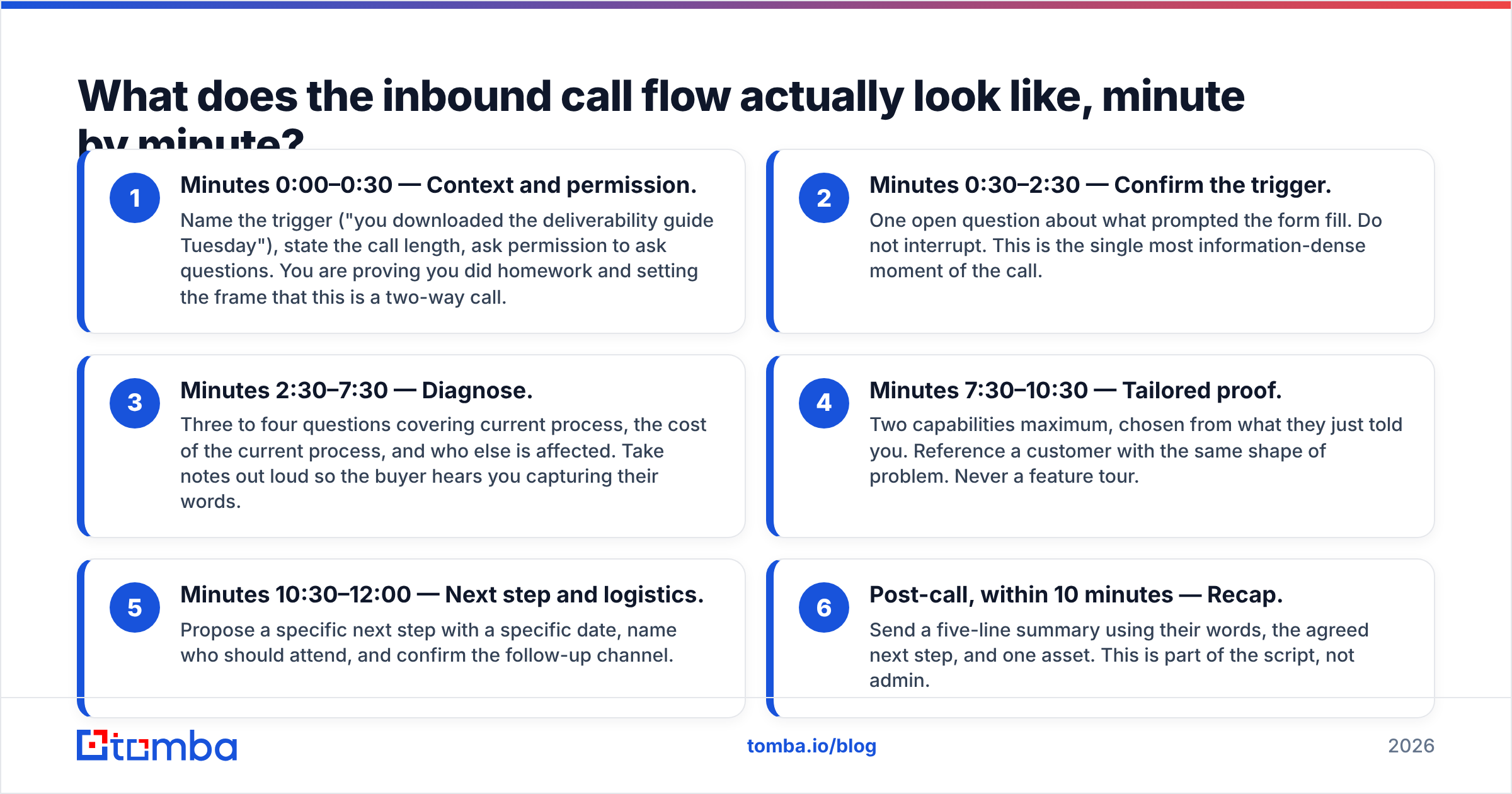
Here is the skeleton. Twelve minutes is the target for a first inbound call — long enough to diagnose, short enough that nobody reschedules.
- Minutes 0:00–0:30 — Context and permission. Name the trigger ("you downloaded the deliverability guide Tuesday"), state the call length, ask permission to ask questions. You are proving you did homework and setting the frame that this is a two-way call.
- Minutes 0:30–2:30 — Confirm the trigger. One open question about what prompted the form fill. Do not interrupt. This is the single most information-dense moment of the call.
- Minutes 2:30–7:30 — Diagnose. Three to four questions covering current process, the cost of the current process, and who else is affected. Take notes out loud so the buyer hears you capturing their words.
- Minutes 7:30–10:30 — Tailored proof. Two capabilities maximum, chosen from what they just told you. Reference a customer with the same shape of problem. Never a feature tour.
- Minutes 10:30–12:00 — Next step and logistics. Propose a specific next step with a specific date, name who should attend, and confirm the follow-up channel.
- Post-call, within 10 minutes — Recap. Send a five-line summary using their words, the agreed next step, and one asset. This is part of the script, not admin.
The structure holds whether the deal is $500 a month or $500,000 a year. What changes is how many people join step 5.
How should an inbound script differ from an outbound one?#
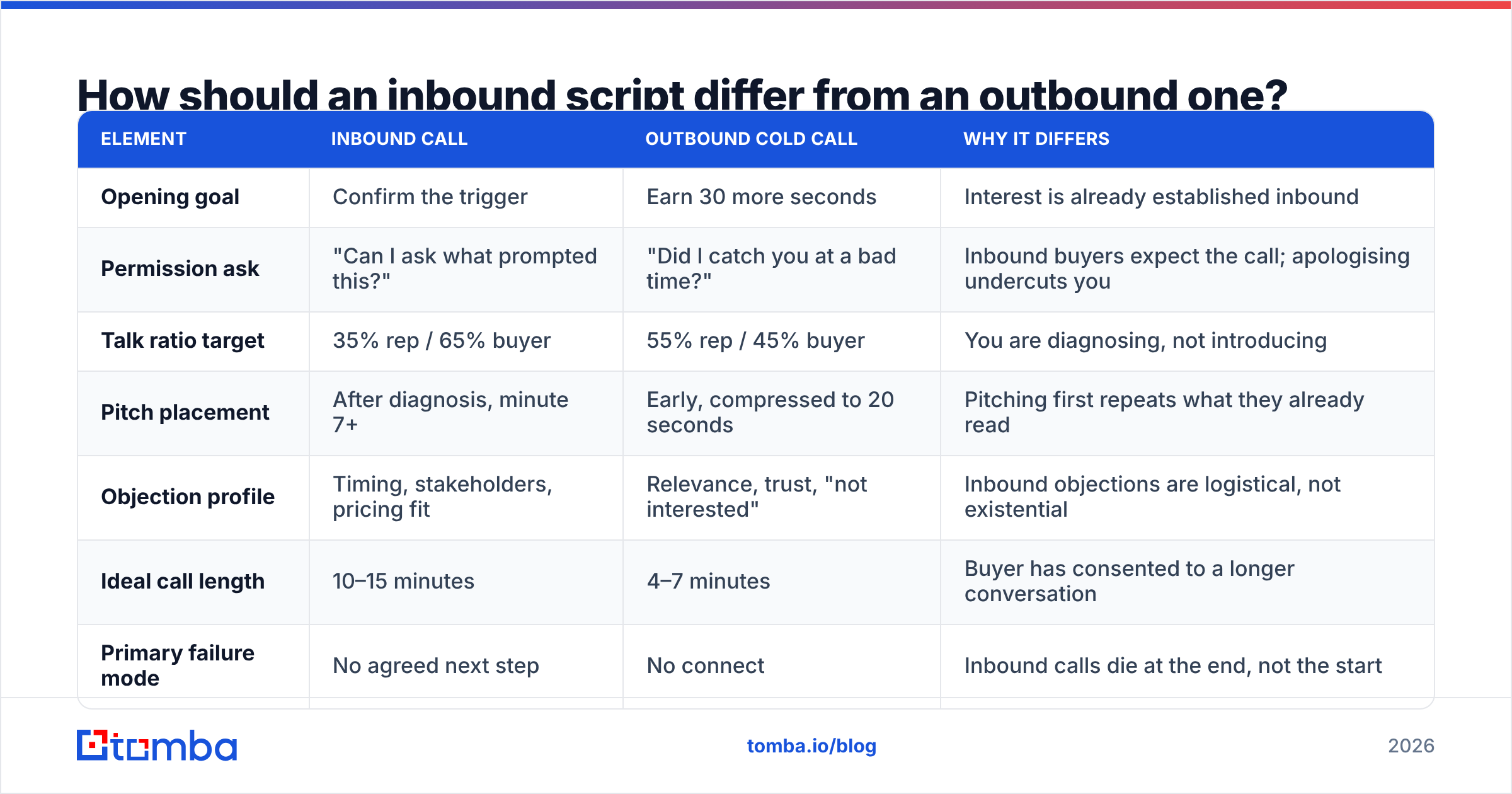
Reps who came up through cold calling tend to import habits that actively hurt inbound conversations. The differences are concrete.
| Element | Inbound call | Outbound cold call | Why it differs |
|---|---|---|---|
| Opening goal | Confirm the trigger | Earn 30 more seconds | Interest is already established inbound |
| Permission ask | "Can I ask what prompted this?" | "Did I catch you at a bad time?" | Inbound buyers expect the call; apologising undercuts you |
| Talk ratio target | 35% rep / 65% buyer | 55% rep / 45% buyer | You are diagnosing, not introducing |
| Pitch placement | After diagnosis, minute 7+ | Early, compressed to 20 seconds | Pitching first repeats what they already read |
| Objection profile | Timing, stakeholders, pricing fit | Relevance, trust, "not interested" | Inbound objections are logistical, not existential |
| Ideal call length | 10–15 minutes | 4–7 minutes | Buyer has consented to a longer conversation |
| Primary failure mode | No agreed next step | No connect | Inbound calls die at the end, not the start |
The last row is the one worth pinning above your desk. Cold calls fail at the top of the funnel; inbound calls fail at the close of the call, when a friendly conversation ends with "send me some info" and nothing on the calendar.
What should you say in the first 30 seconds?#
Use a four-beat open. Name, trigger, agenda, permission.
"Hi Dana, it's Sam from Northwind. You requested pricing on the multi-domain plan about ten minutes ago — thanks for that. I've got you for twelve minutes; I'd like to ask three or four questions about what you're running today so I don't waste your time on the wrong half of the product. Fair?"
Four things happened there. You referenced the exact trigger, so the buyer knows this is not a random dial. You bounded the time, which lowers resistance. You explained why you are asking questions instead of pitching. And you asked for a yes that costs nothing.
Avoid these openers, which quietly cost you the frame:
- "Is now a good time?" — On an inbound callback, this invites a reschedule you did not need to offer.
- "So, tell me about your company." — They filled in the form; you should already know. This signals you did no prep.
- "Let me tell you a bit about us." — They read the website. That is why they called.
- "I just wanted to follow up on..." — "Just" and "wanted" both shrink you. Say what the call is for.
How do you qualify without interrogating?#
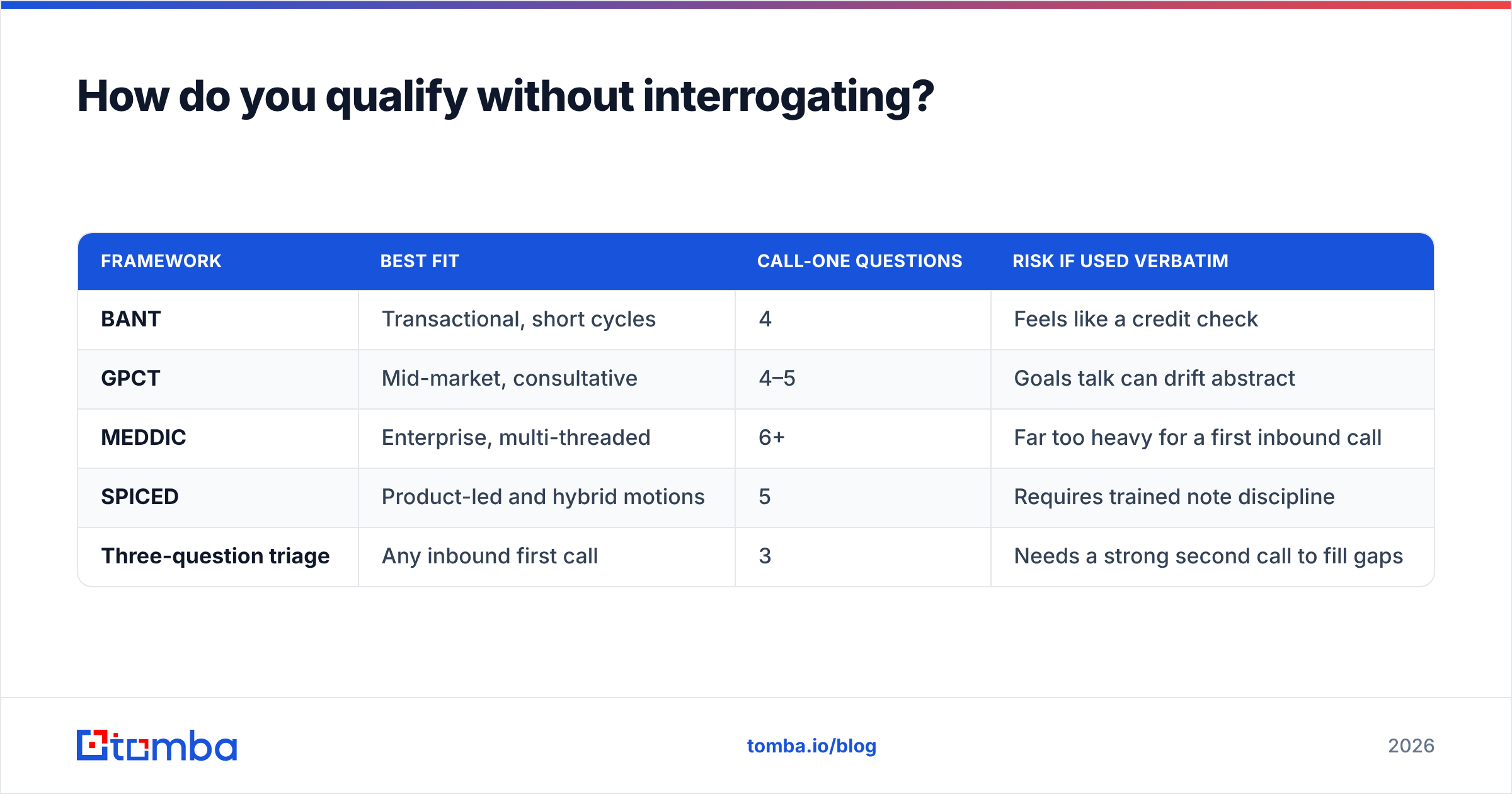
Pick a framework, then cut it in half for call one. The most common frameworks all try to capture the same four dimensions; they differ in emphasis and in how much of it you can realistically get in twelve minutes.
| Framework | Best fit | Call-one questions | Risk if used verbatim |
|---|---|---|---|
| BANT | Transactional, short cycles | 4 | Feels like a credit check |
| GPCT | Mid-market, consultative | 4–5 | Goals talk can drift abstract |
| MEDDIC | Enterprise, multi-threaded | 6+ | Far too heavy for a first inbound call |
| SPICED | Product-led and hybrid motions | 5 | Requires trained note discipline |
| Three-question triage | Any inbound first call | 3 | Needs a strong second call to fill gaps |
For a first inbound call, three questions carry most of the weight:
- "What changed recently that made this a priority?" — Surfaces the compelling event. No event, no urgency, no forecast.
- "How are you handling it today, and what does that cost you?" — Establishes the baseline and quantifies the gap in the buyer's own numbers.
- "Besides you, who else feels this problem?" — Multi-threads early without asking the insulting version, "are you the decision maker?"
Everything else — contract dates, procurement steps, security review — belongs on call two. HubSpot's inbound sales methodology makes the same argument from a different angle: connect and explore before you advise, because advice given before diagnosis is just noise with confidence.
How do you handle the four objections inbound calls actually produce?#
Inbound objections are logistical, not hostile. Treat them as scheduling problems and they mostly resolve.
- "I'm just researching for now." — "Totally fine, most people on this call are. What would you need to see today for this to be worth a second look in Q1?" You are converting a soft no into criteria.
- "Can you just send pricing?" — "I can send it in the next five minutes. Two quick questions so I send the right tier instead of the whole rate card — how many domains and how many seats?" Never refuse; make the send more accurate.
- "We already use [competitor]." — "Good, then you know the category. What made you fill in the form anyway?" The form fill is the objection's own counterargument.
- "I need to loop in my manager." — "Makes sense. Rather than you recapping this secondhand, can we get 20 minutes with them Thursday? I'll send an agenda you can forward." Never let the buyer become your unpaid internal seller.
Notice that none of these end with the rep talking. Each ends with a question or a specific proposal that moves the calendar.
What data should you already have before you dial?#
The credibility of your first 30 seconds depends entirely on prep, and prep on an inbound call takes about 90 seconds if your stack is set up correctly.
Before dialing, you want the person's role and tenure, the company's size and tech stack, the exact page or asset that triggered the form, and a verified phone number and email. Form fills are notoriously incomplete — buyers type "n/a" into the company field and use personal Gmail addresses — so contact enrichment on inbound records is the difference between a triage call and a guessing game.
Three practical moves:
- Enrich on form submit, not on assignment. By the time a rep opens the record, role, company, and seniority should already be populated.
- Identify the anonymous traffic behind the visit. Website visitor reveal tells you when three people from the same domain read the pricing page before one of them filled in a form — that is a buying committee, and it changes your step-5 ask.
- Verify the phone number before the first attempt. Nothing torches speed-to-lead like burning your five-minute window on a dead line. A quick pass through a phone validator or B2B phone numbers lookup keeps the dial productive.
How do you close the call with a next step?#
The close of an inbound call is a scheduling transaction, not a persuasion event. Say the recommendation out loud, propose two concrete times, and name who should attend.
"Based on what you described — two domains, deliverability dropping since the January inbox changes, and Ops owning the sending infrastructure — the useful next step is a 30-minute working session with you and whoever owns Ops. I have Thursday at 10 or Friday at 2. Which is easier?"
Three components matter: a one-line recap in their words, a specific format and duration, and an alternative-choice ask. Drop any one and you get "send me something and I'll get back to you," which converts at approximately the rate of a coin flip that lands on its edge.
If the buyer genuinely cannot commit, downgrade the ask instead of abandoning it: "Can I put a 15-minute hold on Thursday you can decline if it doesn't work?" A holdable slot beats an open loop.
What does the full inbound sales call script look like?#
Copy this, then replace the bracketed parts with your product's language.
Open (0:00–0:30) "Hi [name], [rep] from [company]. You [trigger] about [time] ago. I've got twelve minutes — I'd like to ask three or four questions so I don't waste your time on the wrong part of the product. Fair?"
Trigger (0:30–2:30) "What changed recently that made this a priority?" (Silence. Let them finish. Then: "What else?")
Diagnose (2:30–7:30) "How are you handling [problem] today?" "What does that cost you — hours, dollars, or missed pipeline?" "Besides you, who else feels this?" "If this were solved by [realistic date], what would that unlock?"
Prove (7:30–10:30) "Two things stood out. On [their words], we [specific capability]. On [their second point], [customer of similar shape] went from [before] to [after] in [timeframe]. Does that match what you're picturing?"
Close (10:30–12:00) "Recapping: [three points in their words]. The next step I'd recommend is [format, duration] with you and [role]. Thursday 10 or Friday 2?"
Recap email (within 10 minutes) Five lines: what they said, what you recommended, the booked time, one relevant asset, one open question for them to answer before the call.
How do you know the script is working?#
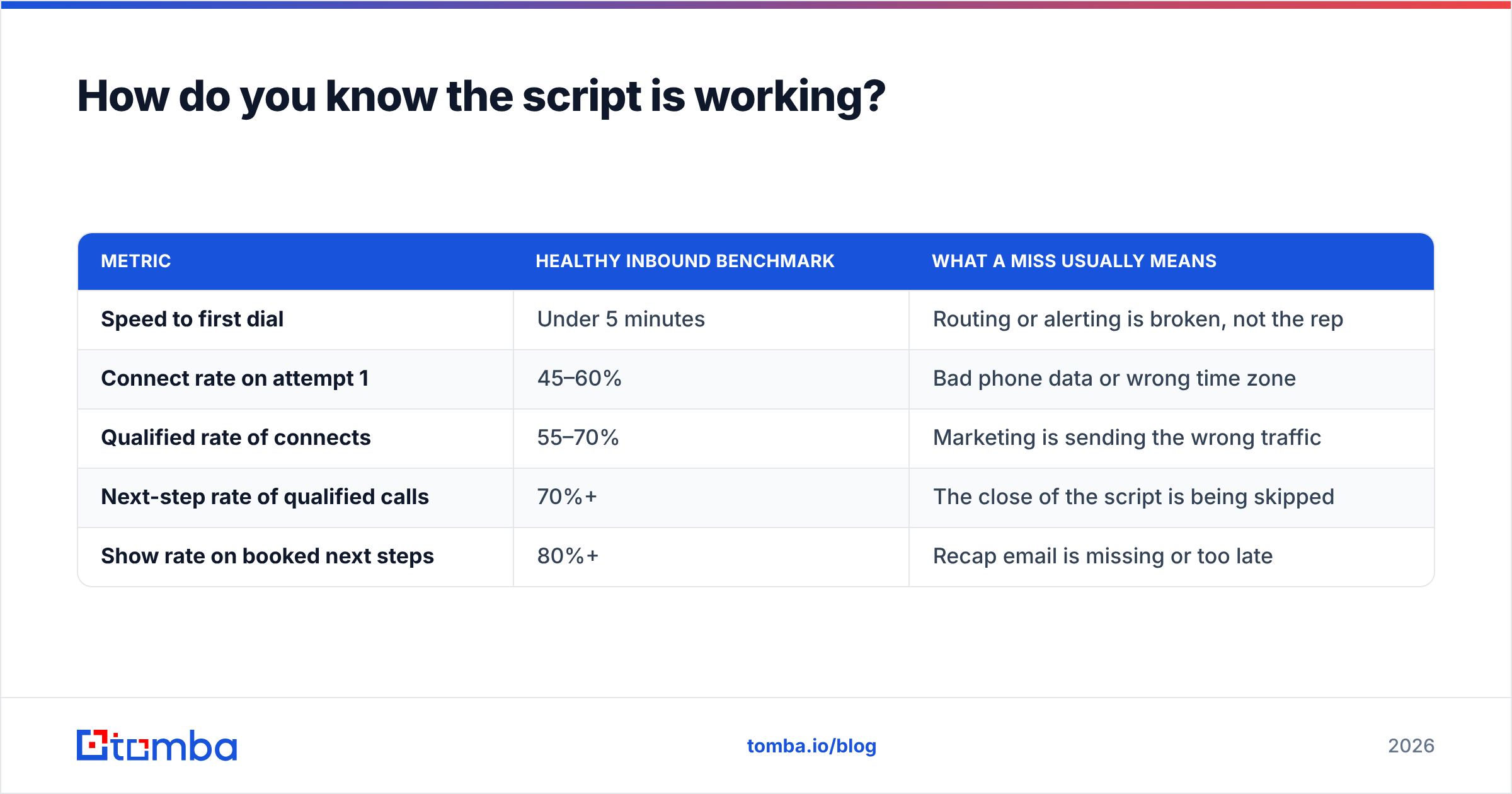
Track four metrics separately. Blending them hides the actual leak.
| Metric | Healthy inbound benchmark | What a miss usually means |
|---|---|---|
| Speed to first dial | Under 5 minutes | Routing or alerting is broken, not the rep |
| Connect rate on attempt 1 | 45–60% | Bad phone data or wrong time zone |
| Qualified rate of connects | 55–70% | Marketing is sending the wrong traffic |
| Next-step rate of qualified calls | 70%+ | The close of the script is being skipped |
| Show rate on booked next steps | 80%+ | Recap email is missing or too late |
Review recordings against the skeleton, not against a vibe. Score each call for whether the five blocks happened in order. Reps improve fastest when feedback is structural — "you pitched at minute two" — rather than motivational. Salesforce's sales-call guidance makes the same point about consistency: the value of a script is that it makes coaching specific.
One more habit worth building: check that the contact record you created is actually reachable. Inbound forms produce a meaningful share of typos and role addresses, and a booked meeting that bounces on the calendar invite is a loss you never see in the CRM. A quick pass with an email verifier before you send the recap closes that gap. If you want the broader context on how response speed compounds, the response rate entry in the glossary is a useful primer.
Where should you start this week?#
Pick one thing: write the twelve-minute skeleton on a single page, have every rep run it for two weeks, and score the recordings against the five blocks. That alone usually moves next-step rate more than any wording change.
Then fix the data underneath it. A script only sounds prepared if the rep actually is prepared, and that depends on enriched, verified contact records arriving at the same moment the form does. Tomba Email Finder fills in the missing work email behind an incomplete form fill, and pairs with enrichment and verification so your rep opens the record already knowing the role, the company, and how to reach the person. There is a free tier with 25 searches a month to test it against your own inbound queue, and paid plans start at $49/month — see Tomba pricing for the full breakdown before you roll it out to the team.
Related guides#
// get started
Find, verify and enrich your first contacts today
Start on the free plan with 25 searches a month, then scale when your team is ready.
Free plan · No credit card required · GDPR & CCPA
// about the author