The Inbound Sales Framework: A Practical 2026 Playbook
Most inbound leads die in the gap between a form fill and a first call. Here is the four-stage inbound sales framework that closes that gap, with qualification rules, metrics, and the tooling that actually earns its seat.
TL;DR
- An inbound sales framework is a repeatable sequence for handling buyers who came to you: identify, connect, explore, advise. It replaces "whoever grabs the lead first improvises."
- The single biggest lever is speed-to-lead. Qualification odds fall off a cliff after the first hour, and most teams still measure response time in days.
- Inbound does not mean passive. You still need enrichment, verified contact data, and a research step before the first call, otherwise you are cold calling a warm lead.
- Qualification frameworks are not interchangeable. GPCTBA/C&I fits inbound better than BANT because inbound buyers arrive mid-research, not mid-budget-cycle.
- Track speed-to-lead, MQL-to-SQL conversion, and inbound win rate by source. If you only track lead volume, marketing and sales will argue forever.
What is an inbound sales framework?#
An inbound sales framework is the documented process your reps follow when a buyer initiates contact — a demo request, a pricing page visit, a content download, a chat message, a reply to a newsletter. It defines who touches the lead, how fast, what research happens first, what questions get asked, and what has to be true before the deal advances.
The concept was formalized by HubSpot's sales team as the sales-side counterpart to inbound marketing. The core insight: a buyer who found you has already done 40-70% of their research. If your rep opens with a discovery script written for cold prospects, the buyer feels demoted, not helped.
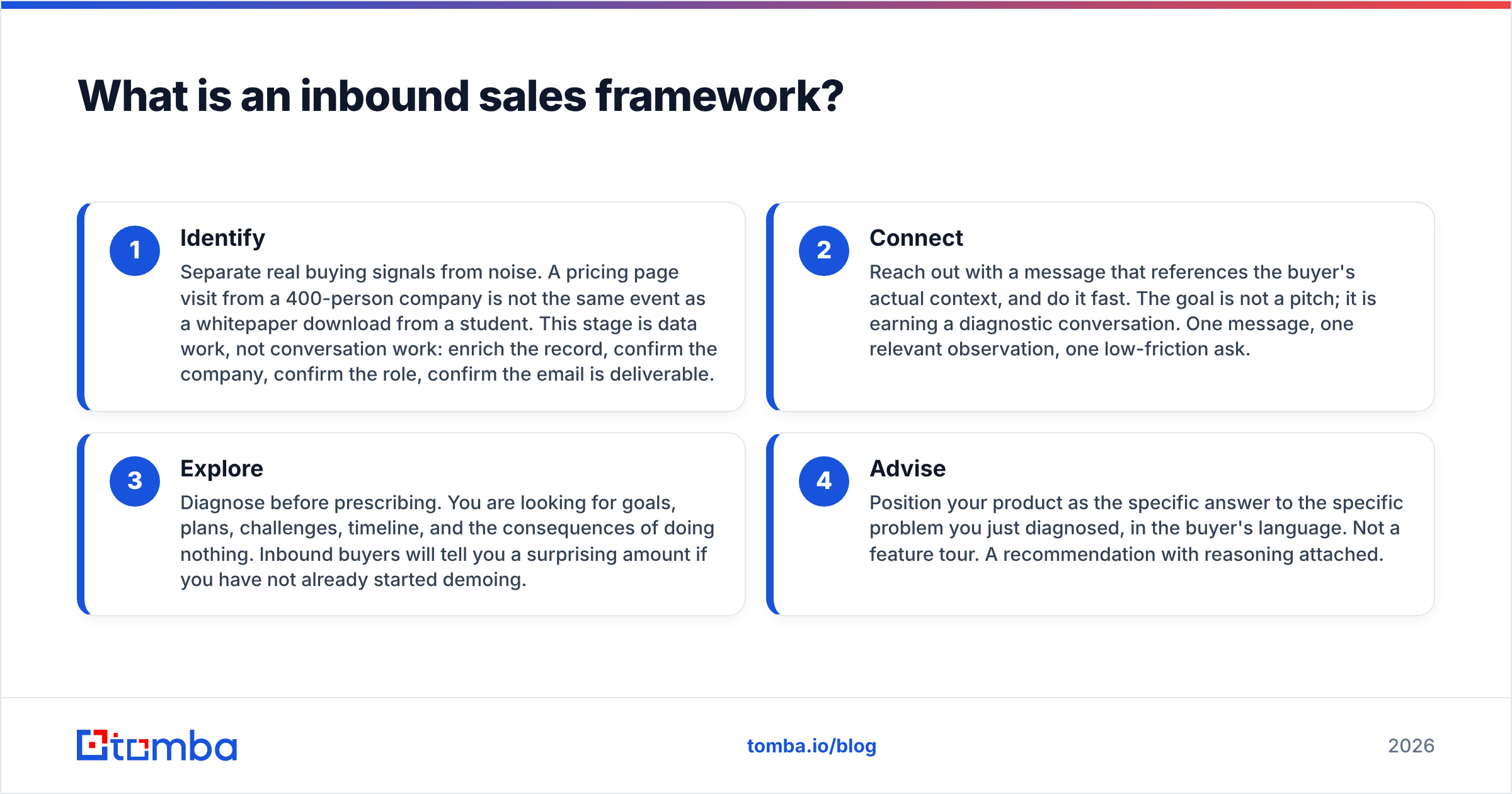
The framework has four stages, and each one has a job:
- Identify — Separate real buying signals from noise. A pricing page visit from a 400-person company is not the same event as a whitepaper download from a student. This stage is data work, not conversation work: enrich the record, confirm the company, confirm the role, confirm the email is deliverable.
- Connect — Reach out with a message that references the buyer's actual context, and do it fast. The goal is not a pitch; it is earning a diagnostic conversation. One message, one relevant observation, one low-friction ask.
- Explore — Diagnose before prescribing. You are looking for goals, plans, challenges, timeline, and the consequences of doing nothing. Inbound buyers will tell you a surprising amount if you have not already started demoing.
- Advise — Position your product as the specific answer to the specific problem you just diagnosed, in the buyer's language. Not a feature tour. A recommendation with reasoning attached.
Each stage has an exit criterion. If a lead cannot pass the exit criterion, it goes back to nurture instead of clogging the pipeline. That single rule is what separates a framework from a vibe.
Why do inbound leads still go cold?#
Because the handoff is broken, not because the leads are bad.
Three failure patterns show up in almost every audit:
Response lag. Research on lead response has been consistent for over a decade: contact a web lead within five minutes and your odds of qualifying it are dramatically higher than at 30 minutes, and the curve keeps falling from there. Most B2B teams respond in hours or days. The lead has already booked a call with two competitors.
No routing logic. A marketing qualified lead lands in a shared inbox or a round-robin queue with no owner, no SLA, and no context. Nobody is accountable, so nobody moves.
Missing contact data. The form captured a work email and a first name. Nothing else. The rep has no company size, no role, no phone number, no LinkedIn, so the first touch is generic — and generic outreach to a warm lead converts about as well as cold outreach.
That third one is fixable in minutes with contact enrichment on form submit. Push the submitted email into an enrichment call, get back company, headcount, title, and social profiles, and route based on the enriched record instead of the raw form.

There is a fourth, quieter failure: treating anonymous traffic as unreachable. A large share of high-intent visits never convert on a form. Website visitor reveal turns some of that anonymous pricing-page traffic into named accounts you can work like inbound rather than outbound — which is the difference between a relevant first line and a guess.
Is inbound better than outbound in 2026?#
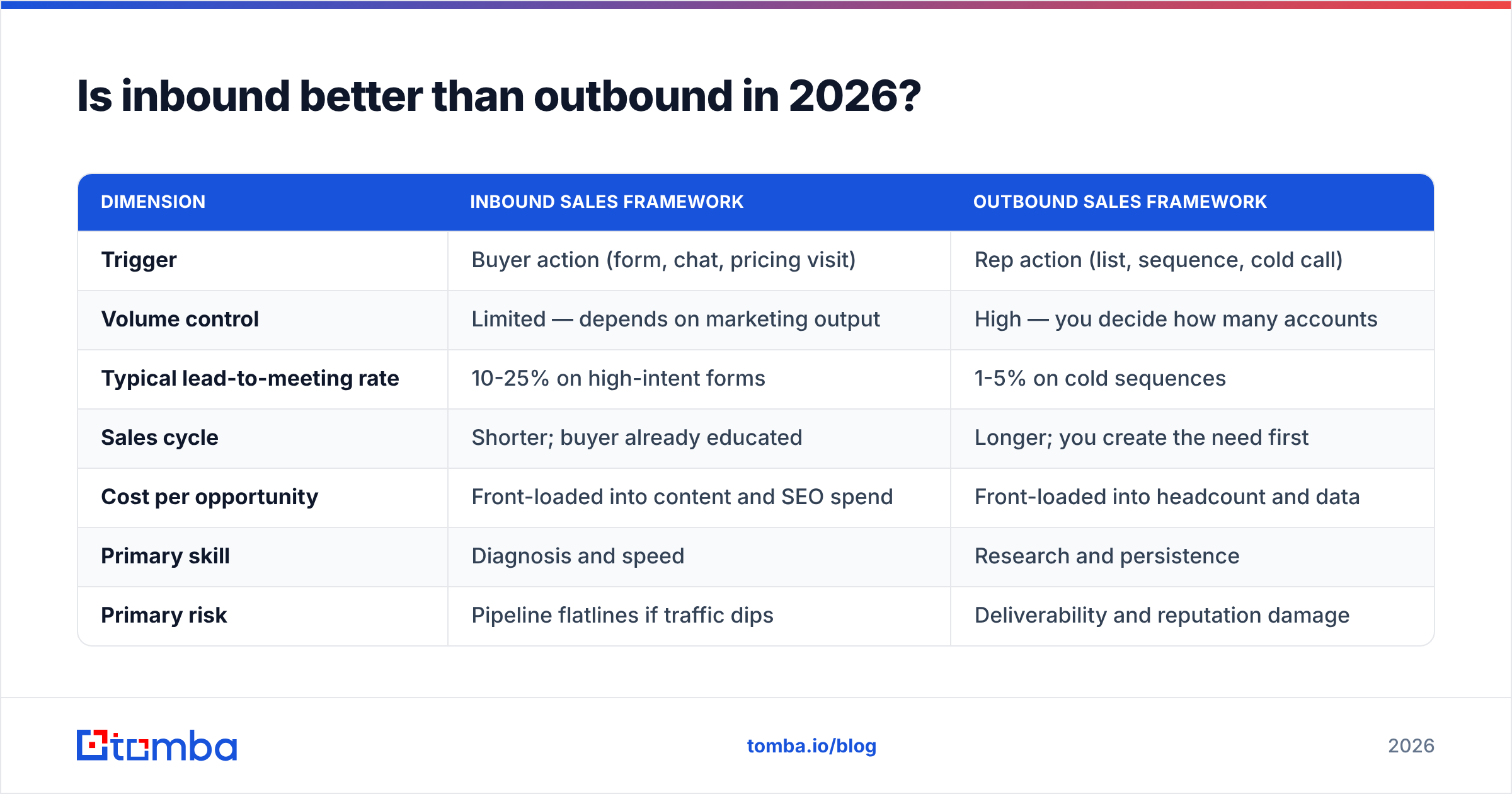
Neither wins outright. They fail differently, and mature teams run both with different playbooks and different metrics.
| Dimension | Inbound sales framework | Outbound sales framework |
|---|---|---|
| Trigger | Buyer action (form, chat, pricing visit) | Rep action (list, sequence, cold call) |
| Volume control | Limited — depends on marketing output | High — you decide how many accounts |
| Typical lead-to-meeting rate | 10-25% on high-intent forms | 1-5% on cold sequences |
| Sales cycle | Shorter; buyer already educated | Longer; you create the need first |
| Cost per opportunity | Front-loaded into content and SEO spend | Front-loaded into headcount and data |
| Primary skill | Diagnosis and speed | Research and persistence |
| Primary risk | Pipeline flatlines if traffic dips | Deliverability and reputation damage |
| Best-fit ICP | Self-serve-aware buyers, PLG motions | Enterprise, low-search-volume categories |
The practical read: inbound gives you better conversion rates on less predictable volume, outbound gives you predictable volume at worse conversion rates. If you need a specific number of opportunities next quarter, you need both. What you should not do is run your inbound leads through your outbound sequence. It is the most common and most expensive mistake in this whole discipline.
What does each stage look like in practice?#
How do you run the Identify stage?#
Identify is where most of the leverage sits, and it should be almost entirely automated.
On form submit, do four things before a human sees the record:
- Verify the email. A typo'd or disposable address wastes an SLA slot and dents your sender reputation. Run every inbound address through an email verifier before it enters a sequence.
- Enrich the company. Headcount, industry, tech stack, region. This drives routing and tier.
- Enrich the person. Title, seniority, department, LinkedIn. This drives which questions the rep opens with.
- Score and route. Tier 1 gets a call within five minutes. Tier 2 gets an email within an hour. Tier 3 goes to nurture. Write the thresholds down.
If the form only collected a personal Gmail address, you are not stuck — a reverse email lookup can often resolve the person and their employer, which is enough to tier the lead.
How do you run the Connect stage?#
The Connect message has one job: earn a conversation. Three rules.
Reference the actual trigger. "You looked at the API docs for the bulk endpoint" beats "I saw you downloaded our ebook." Specificity signals that a human read the record.
Lead with a hypothesis, not a question dump. "Teams that land on that page are usually trying to enrich a CRM backlog without paying per-seat pricing — is that roughly it?" gives the buyer something to correct, which is easier than answering "what are your goals?"
Use the channel the buyer implied. Chat leads want chat. Demo-request leads want a calendar link. Content downloads want email. Phone works when you have a verified number and a genuine reason — for high-tier inbound, a B2B phone number plus a five-minute callback still outperforms almost everything else.
How do you run Explore and Advise?#
Explore is a diagnostic conversation with a structure, not a script. You are trying to leave with five things written down: the buyer's goal in their words, their current plan, what is blocking the plan, the timeline pressure, and what happens if they do nothing.
Advise is where you connect those five things to two or three specific capabilities — no more. A 40-slide feature tour to a buyer who told you they have one problem is a signal that you were not listening. End with a written recommendation and a mutual next step that has a date on it.
Which qualification framework fits inbound leads?#
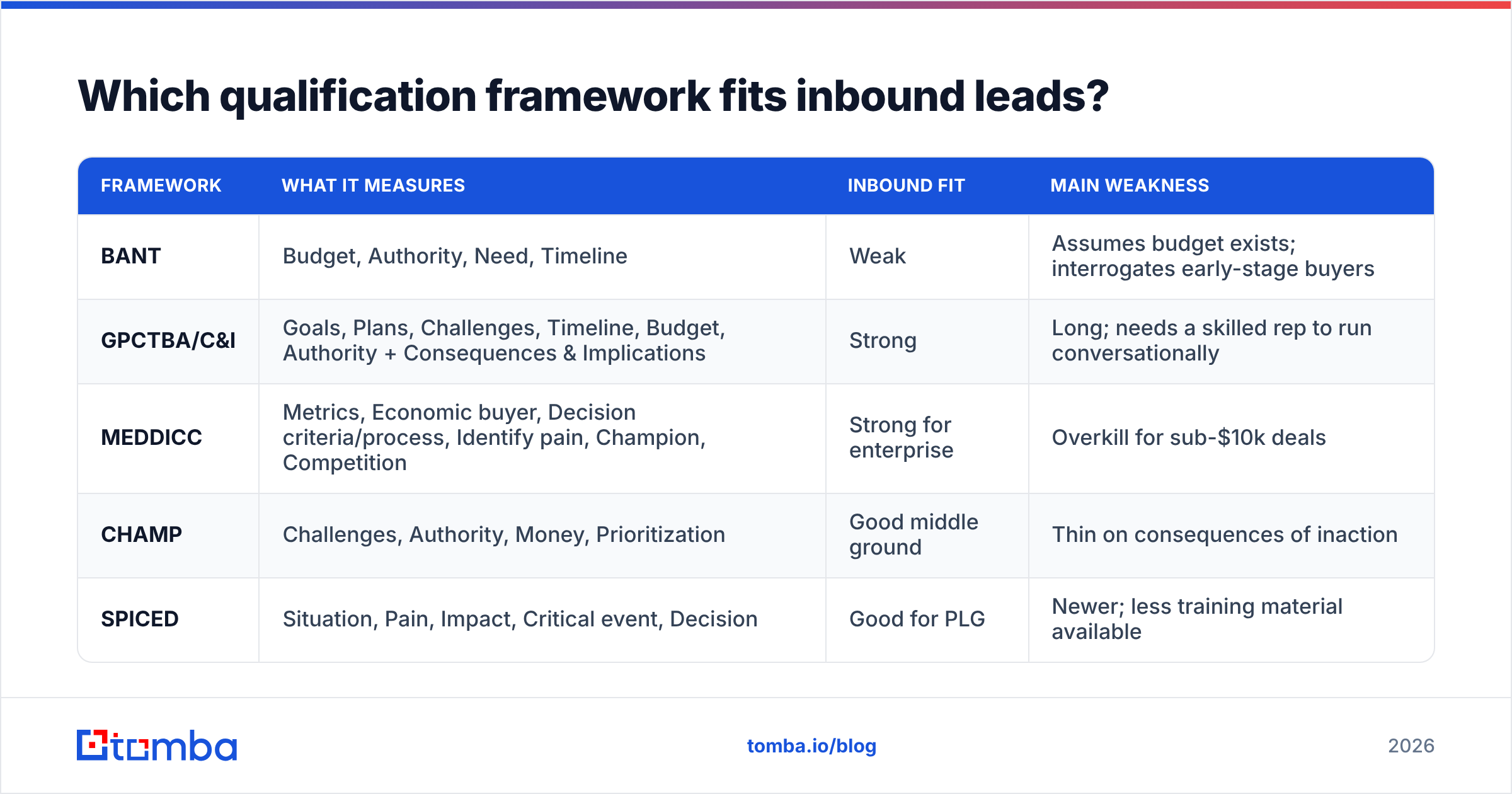
Inbound buyers arrive mid-research, which breaks the assumptions inside older qualification models. Here is how the common options behave on inbound traffic.
| Framework | What it measures | Inbound fit | Main weakness |
|---|---|---|---|
| BANT | Budget, Authority, Need, Timeline | Weak | Assumes budget exists; interrogates early-stage buyers |
| GPCTBA/C&I | Goals, Plans, Challenges, Timeline, Budget, Authority + Consequences & Implications | Strong | Long; needs a skilled rep to run conversationally |
| MEDDICC | Metrics, Economic buyer, Decision criteria/process, Identify pain, Champion, Competition | Strong for enterprise | Overkill for sub-$10k deals |
| CHAMP | Challenges, Authority, Money, Prioritization | Good middle ground | Thin on consequences of inaction |
| SPICED | Situation, Pain, Impact, Critical event, Decision | Good for PLG | Newer; less training material available |
For most mid-market inbound motions, GPCTBA/C&I is the right default because it starts with goals rather than money, which is what an inbound buyer is actually thinking about. Layer MEDDICC on top only once a deal crosses into a multi-stakeholder committee.
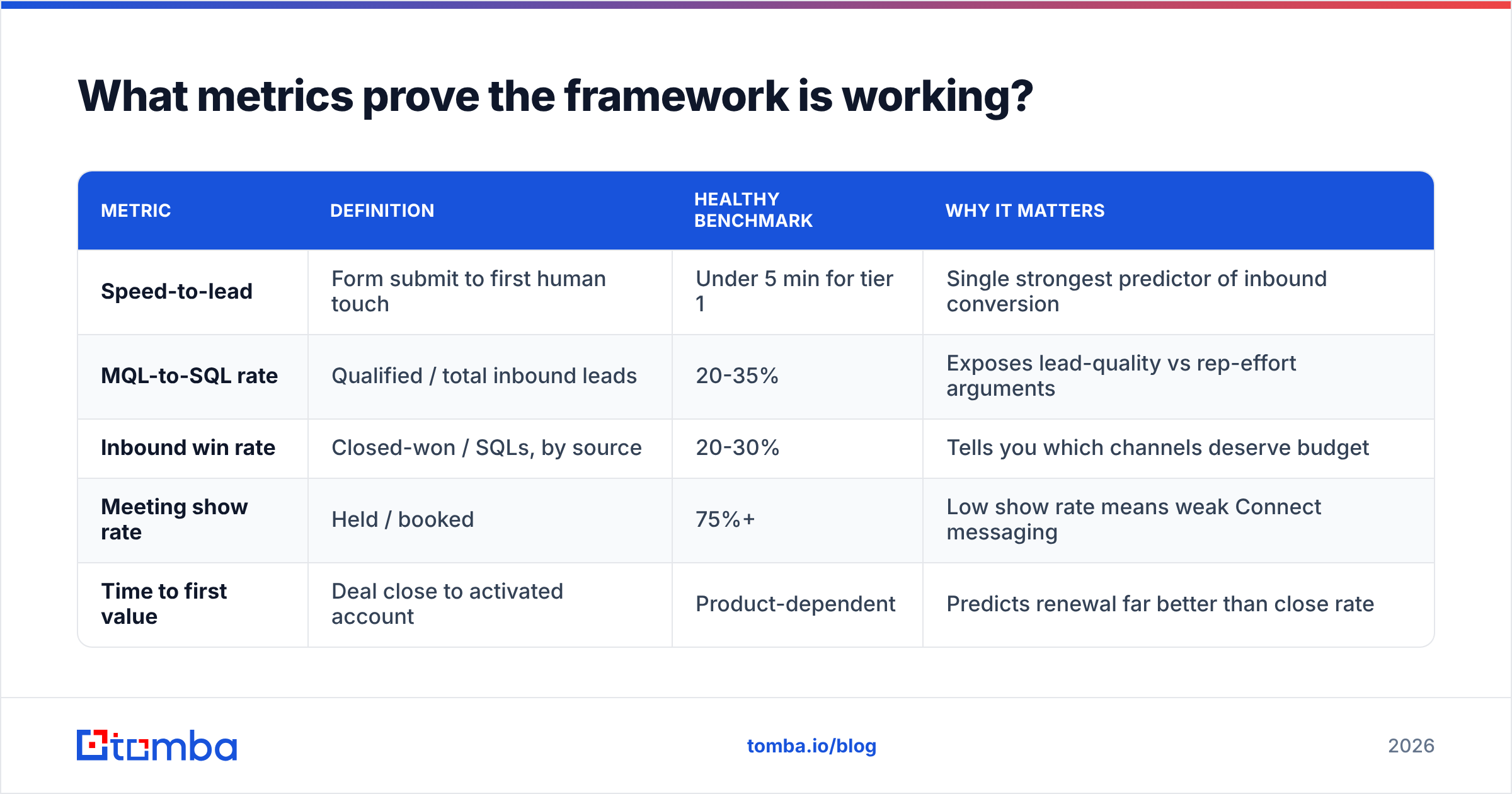
What metrics prove the framework is working?#
Pick five and review them weekly. More than that and nobody looks.
| Metric | Definition | Healthy benchmark | Why it matters |
|---|---|---|---|
| Speed-to-lead | Form submit to first human touch | Under 5 min for tier 1 | Single strongest predictor of inbound conversion |
| MQL-to-SQL rate | Qualified / total inbound leads | 20-35% | Exposes lead-quality vs rep-effort arguments |
| Inbound win rate | Closed-won / SQLs, by source | 20-30% | Tells you which channels deserve budget |
| Meeting show rate | Held / booked | 75%+ | Low show rate means weak Connect messaging |
| Time to first value | Deal close to activated account | Product-dependent | Predicts renewal far better than close rate |
Segment every one of these by source. Aggregate inbound numbers hide the truth: paid search leads and organic comparison-page leads behave nothing alike, and averaging them produces decisions that hurt both.
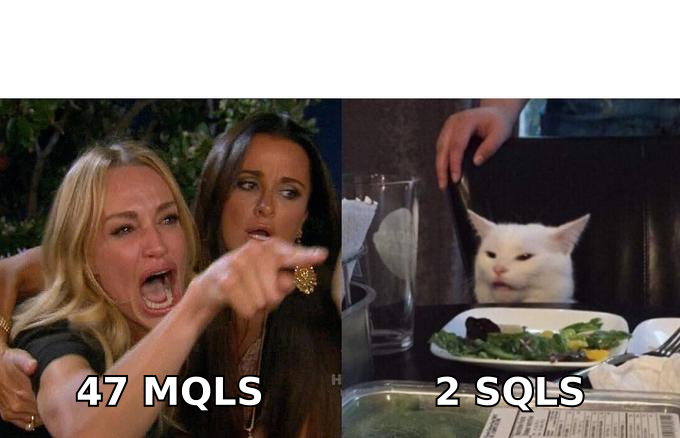
The MQL-to-SQL argument is where most GTM meetings go sideways. The fix is not a better argument, it is a shared, written definition of "qualified" — with enrichment data attached, so the debate is about criteria rather than about whose spreadsheet is right.
What are the most common implementation mistakes?#
- No SLA with teeth. An SLA nobody reports on is a suggestion. Publish speed-to-lead by rep weekly.
- Treating inbound like outbound. Nine-step automated sequences aimed at someone who already asked for a demo read as spam and burn goodwill.
- Over-gating content. Every extra required form field cuts conversion. Collect the work email and enrich the rest — you will get better data than the buyer would have typed.
- Skipping data hygiene. Unverified addresses in your sequences damage email deliverability, which eventually degrades your outbound too.
- Buying volume instead of fixing conversion. Purchased lists from reputable providers like BookYourData have a legitimate role in outbound coverage, but they cannot repair a broken inbound handoff. Fix the process first, then add volume.
- No disqualification path. If nothing ever leaves the pipeline, forecast accuracy collapses. Write down what "not now" means and where those records go.
How long does it take to stand this up?#
Realistically, two to four weeks for a small team.
Week one: write the tier definitions and SLAs, and pick your qualification framework. Week two: wire enrichment and verification onto form submit, and set up routing. Week three: rewrite Connect templates around triggers rather than personas, and train reps on the Explore structure. Week four: instrument the five metrics and hold the first review.
The infrastructure piece is smaller than people expect. Enrichment and verification are API calls; tools like Tomba's API or a Zapier integration handle it without engineering time. Vendor comparisons on G2 are useful for shortlisting, and analyst coverage from firms like Gartner is worth reading for category context, but do not let tool selection stall the process work. The process is what produces the lift.
Ready to fix the Identify stage first?#
Start where the returns are largest and the effort is smallest: the data underneath your inbound leads. Enrich every form submit, verify every address before it touches a sequence, and fill the gaps where a buyer gave you a partial record.
Tomba's Email Finder covers exactly that layer — find and confirm the right professional address by domain, name, or company, then hand a complete record to the rep who has five minutes to respond. The free tier includes 25 searches per month to test it against your own leads, Starter runs $49/mo, and Growth is $99/mo; full Tomba pricing is public. Wire it into your form handler this week, measure speed-to-lead next week, and let the numbers decide whether the rest of the framework is worth the rollout.
Related guides#
// get started
Find, verify and enrich your first contacts today
Start on the free plan with 25 searches a month, then scale when your team is ready.
Free plan · No credit card required · GDPR & CCPA
Get the Tomba newsletter
Product and data updates
// about the author