Inbound Sales Funnel: Stages, Metrics, and Fixes for 2026
Most inbound funnels leak in the same three places. Here is the stage-by-stage breakdown, the benchmarks that matter, and what to fix first when demo requests stall.
TL;DR
- An inbound sales funnel is the path a self-identified prospect takes from first content touch to closed deal — the buyer starts the conversation, not you.
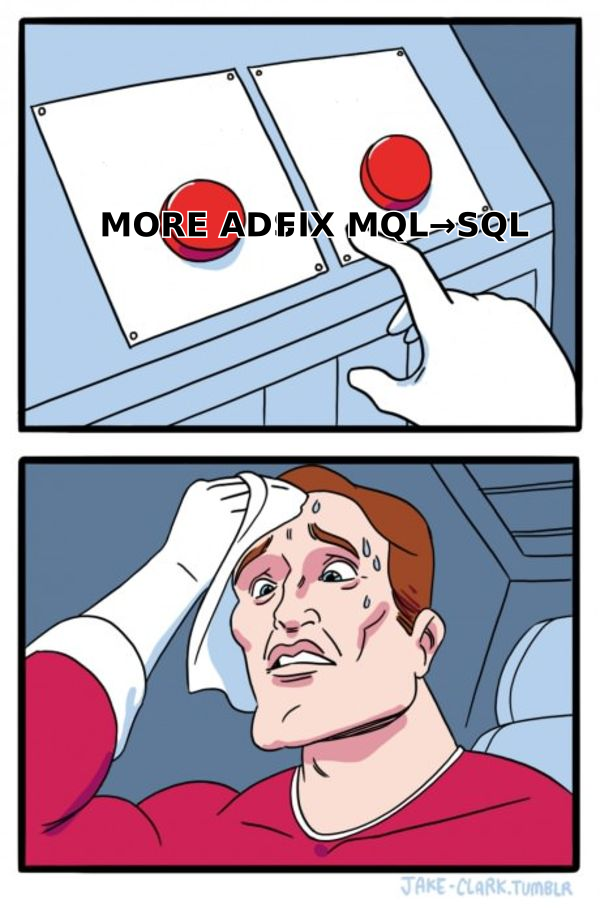
- Most funnels do not have a traffic problem. They have a handoff problem: MQL-to-SQL conversion sits around 13% for most B2B teams, and that is where revenue evaporates.
- The four stages that actually matter operationally are Attract, Capture, Qualify, and Convert. Everything else is reporting decoration.
- Inbound and outbound are not rivals in 2026. The highest-performing teams run "allbound" — inbound intent signals feed outbound sequences to the 90%+ of interested accounts that never fill in a form.
- Fix your data layer before your content layer. A form fill with a personal Gmail address and no company context is a lead you cannot route, score, or enrich.
What Is an Inbound Sales Funnel?#
An inbound sales funnel is the sequence of stages a buyer moves through after they discover you on their own terms — a search result, a podcast, a peer recommendation, a G2 category page — and eventually becomes a customer.
Think of it like a restaurant with a great sign on a busy street. Outbound is standing outside handing out flyers. Inbound is the sign, the smell, and the reviews doing the work; your job starts when someone walks in the door. And the thing most restaurants get wrong is not the sign — it is what happens in the first ninety seconds after someone sits down.
The mechanical difference from outbound: in an inbound funnel, the prospect self-selects. That changes everything downstream. Intent is higher, but qualification is weaker, volume is less predictable, and the window to respond is brutally short. HubSpot's inbound methodology popularized the model, but the version most teams run in 2026 looks different from the 2014 original — mainly because organic discovery now happens across AI answers, communities, and review sites, not just blog posts.
What Are the Stages of an Inbound Sales Funnel?#
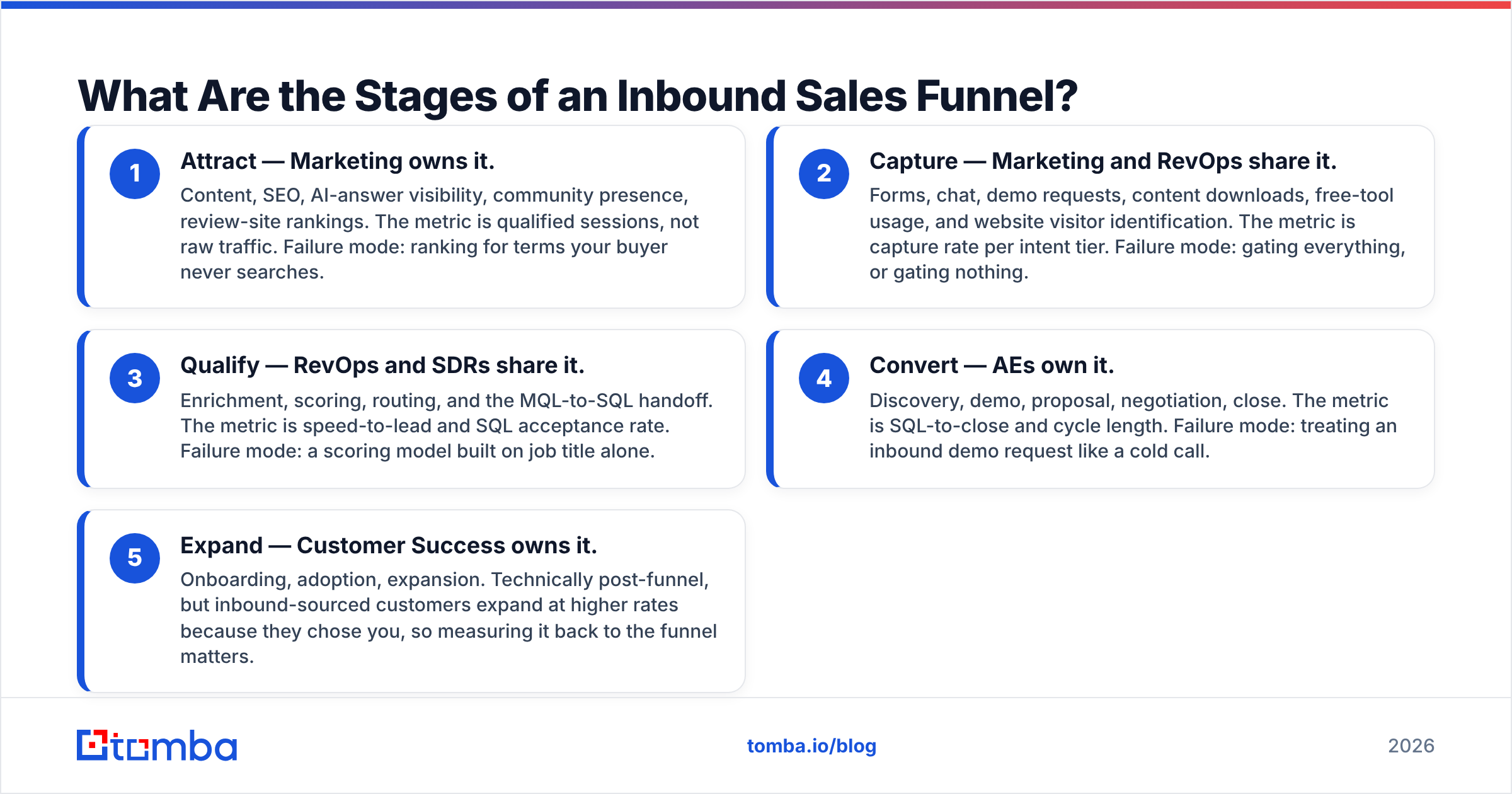
Strip out the vanity stages and you are left with four operational ones. Each has a distinct owner, a distinct failure mode, and a distinct metric.
- Attract — Marketing owns it. Content, SEO, AI-answer visibility, community presence, review-site rankings. The metric is qualified sessions, not raw traffic. Failure mode: ranking for terms your buyer never searches.
- Capture — Marketing and RevOps share it. Forms, chat, demo requests, content downloads, free-tool usage, and website visitor identification. The metric is capture rate per intent tier. Failure mode: gating everything, or gating nothing.
- Qualify — RevOps and SDRs share it. Enrichment, scoring, routing, and the MQL-to-SQL handoff. The metric is speed-to-lead and SQL acceptance rate. Failure mode: a scoring model built on job title alone.
- Convert — AEs own it. Discovery, demo, proposal, negotiation, close. The metric is SQL-to-close and cycle length. Failure mode: treating an inbound demo request like a cold call.
- Expand — Customer Success owns it. Onboarding, adoption, expansion. Technically post-funnel, but inbound-sourced customers expand at higher rates because they chose you, so measuring it back to the funnel matters.
The reason to draw the funnel this way is accountability. When conversion drops, "our funnel is broken" is useless. "Capture-to-qualify fell from 41% to 26% after we added the two extra form fields" is a Monday-morning fix.
What Do Good Inbound Funnel Benchmarks Look Like?#
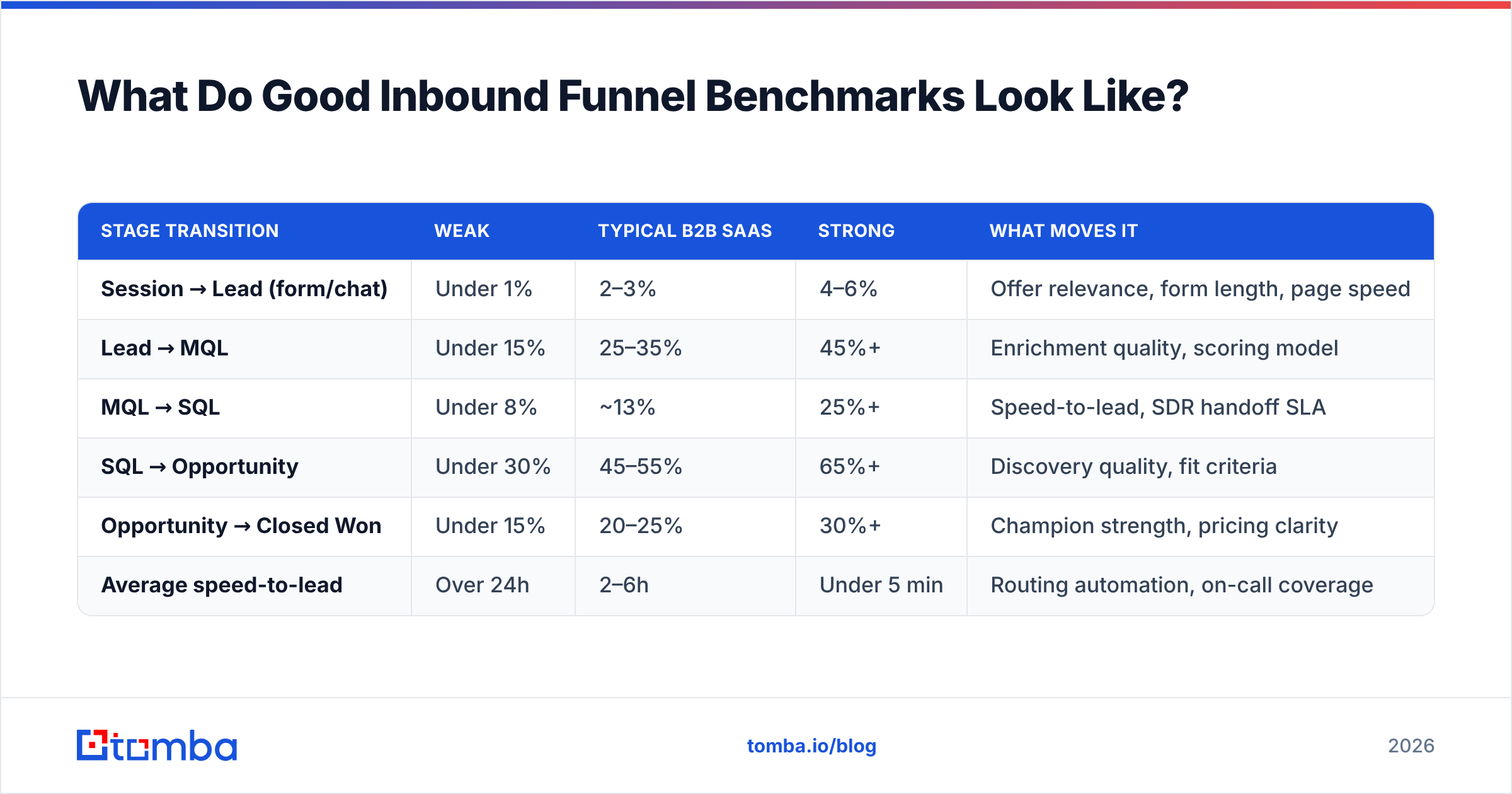
Benchmarks vary wildly by ACV, category, and motion, so treat these as orientation rather than targets. The useful move is comparing your own stage-over-stage rates month to month.
| Stage transition | Weak | Typical B2B SaaS | Strong | What moves it |
|---|---|---|---|---|
| Session → Lead (form/chat) | Under 1% | 2–3% | 4–6% | Offer relevance, form length, page speed |
| Lead → MQL | Under 15% | 25–35% | 45%+ | Enrichment quality, scoring model |
| MQL → SQL | Under 8% | ~13% | 25%+ | Speed-to-lead, SDR handoff SLA |
| SQL → Opportunity | Under 30% | 45–55% | 65%+ | Discovery quality, fit criteria |
| Opportunity → Closed Won | Under 15% | 20–25% | 30%+ | Champion strength, pricing clarity |
| Average speed-to-lead | Over 24h | 2–6h | Under 5 min | Routing automation, on-call coverage |
Two numbers deserve special attention.
MQL-to-SQL at ~13% is the single most quoted figure in B2B funnel reporting, and it is quoted because it is awful. Eighty-seven percent of the leads marketing celebrates get rejected by sales. Sometimes that is a marketing quality problem. Often it is a definitions problem — nobody wrote down what a marketing qualified lead actually means for your business, so each team applies its own.
Speed-to-lead under five minutes is not a nice-to-have. The classic Lead Response Management study found contact rates drop off a cliff after the first five minutes, and every replication since has confirmed the shape of the curve. If your inbound demo requests sit in a queue overnight, you are paying full price for traffic and capturing a fraction of its value.
Why Do Most Inbound Funnels Leak at the Capture Stage?#
Because the form is a tax, and you are charging too much of it.
Every field you add reduces submissions. But every field you remove reduces the data your routing and scoring depend on. Teams resolve this tension badly in one of two directions: they demand twelve fields and get forty leads a month, or they ask for an email only and get four hundred leads they cannot qualify.
The resolution is enrichment. Ask for the minimum — work email, maybe company — and derive the rest programmatically. From a business email domain you can resolve company name, size, industry, tech stack, and location before the lead ever hits a rep's queue. A data enrichment layer running at form-submit time turns a two-field form into a fifteen-field record.
Three capture-stage leaks worth auditing this week:
- Personal-domain submissions. A gmail.com address on a demo form is either a consumer, a consultant, or someone hiding. Do not reject them outright — run a reverse email lookup to resolve the person and their actual employer before routing.
- Typo'd and disposable emails. Roughly 2–5% of form submissions contain a malformed or throwaway address. Real-time email verification at submit time catches these before they pollute your CRM and your sender reputation.
- Anonymous high-intent traffic. The majority of buying-committee research never converts on a form at all. Website visitor reveal turns anonymous pricing-page sessions into named accounts you can route to outbound.
That third point is where inbound funnels have changed most since 2020. The buying committee for a mid-market B2B purchase now involves six to ten people, and typically one of them fills in a form. Treating that one form fill as "the lead" while ignoring the other nine researchers is how you lose deals you were already winning.
How Should Inbound and Outbound Work Together?#
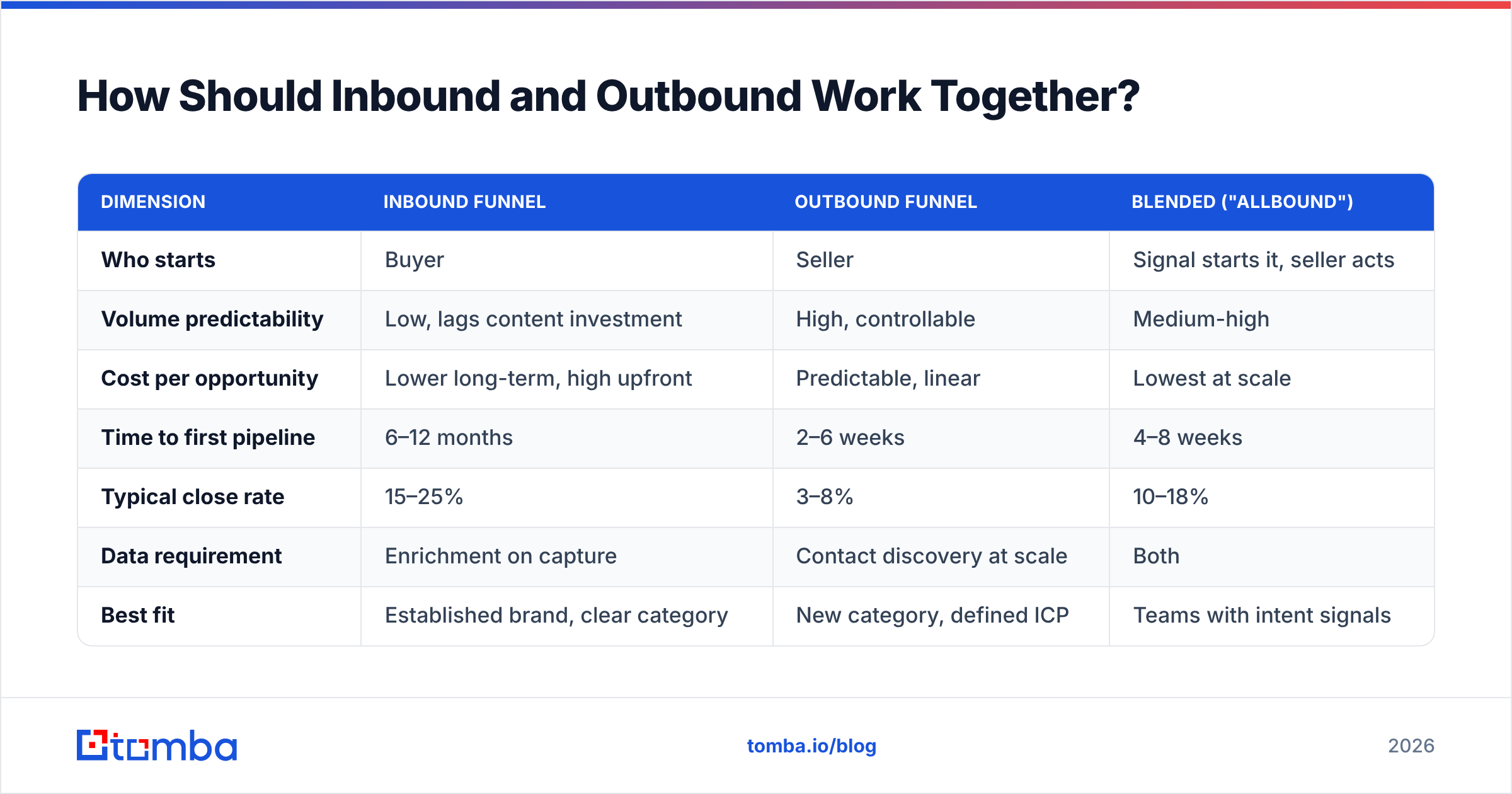
They should share a data layer and a definition of a good account. Beyond that, the split is about who initiates.
| Dimension | Inbound funnel | Outbound funnel | Blended ("allbound") |
|---|---|---|---|
| Who starts | Buyer | Seller | Signal starts it, seller acts |
| Volume predictability | Low, lags content investment | High, controllable | Medium-high |
| Cost per opportunity | Lower long-term, high upfront | Predictable, linear | Lowest at scale |
| Time to first pipeline | 6–12 months | 2–6 weeks | 4–8 weeks |
| Typical close rate | 15–25% | 3–8% | 10–18% |
| Data requirement | Enrichment on capture | Contact discovery at scale | Both |
| Best fit | Established brand, clear category | New category, defined ICP | Teams with intent signals |
The practical blend looks like this. Your content and SEO generate intent signals — someone reads three comparison posts, someone visits pricing twice, someone's company shows up repeatedly in visitor reveal. Only a fraction of those people will ever complete a form. For the rest, you resolve the account, find the right contacts on the buying committee, and reach out with context you actually earned.
That last step needs contact data. If a target account visited your pricing page four times, you need the VP of Engineering's address, not the generic info@ inbox. A domain search returns the verified addresses and email pattern for a company in one call, which is what makes the inbound-to-outbound handoff practical rather than aspirational.
What Metrics Should You Actually Track?#
Fewer than you currently do. Pick one metric per stage and one health metric for the whole funnel.
- Attract: qualified sessions. Sessions from companies matching your ICP, not total sessions. Traffic that will never buy is a cost, not an asset.
- Capture: capture rate by intent tier. Pricing-page visitors and comparison-page readers should convert at multiples of blog readers. If they do not, your high-intent pages have a conversion problem, not a traffic problem.
- Qualify: speed-to-lead, measured in minutes. Median, not average — one weekend outlier will hide a systemic delay.
- Convert: SQL-to-close and cycle length together. Either one alone is gameable. A rep can lift close rate by cherry-picking, or shorten cycles by discounting.
- Health: inbound-sourced pipeline coverage. Pipeline created from inbound divided by the inbound quota. Below 3x, you are relying on unusual close rates to hit the number.
Two anti-metrics to stop reporting: total MQLs (rewards volume over fit) and content-piece-level attribution (rewards last-touch gaming in a multi-touch reality). Forrester's research on buyer engagement has been consistent for years that single-touch attribution misrepresents how B2B purchases actually happen.
How Do You Fix a Leaking Inbound Funnel?#
Work backward from the money. Fixing the top of a funnel that leaks at the bottom just increases the volume of waste.
Week 1 — Instrument the handoff. Log a timestamp at form submit, at CRM creation, at first rep touch, and at qualification decision. Most teams discover their "instant" routing has a 40-minute enrichment job sitting in the middle of it.
Week 2 — Rewrite MQL and SQL definitions with sales in the room. Not a document marketing writes and sales receives. A shared definition with explicit disqualifiers: company size floor, geography, blocked industries, existing customer check.
Week 3 — Add enrichment and verification at capture. Two-field form, everything else derived. Verify the address before it enters the CRM. This alone typically moves lead-to-MQL by ten points or more, because scoring finally has inputs.
Week 4 — Route by fit, not by round-robin. Enterprise-shaped accounts to AEs directly. Mid-market to SDRs. Sub-threshold to nurture. Round-robin distributes fairly and converts poorly.
Ongoing — Feed unconverted intent to outbound. Accounts that showed high intent but never converted are your best outbound list. They are pre-qualified by behavior. Use bulk lead generation to resolve contacts across those accounts in one pass rather than one-off lookups.
What Tools Does an Inbound Funnel Actually Need?#
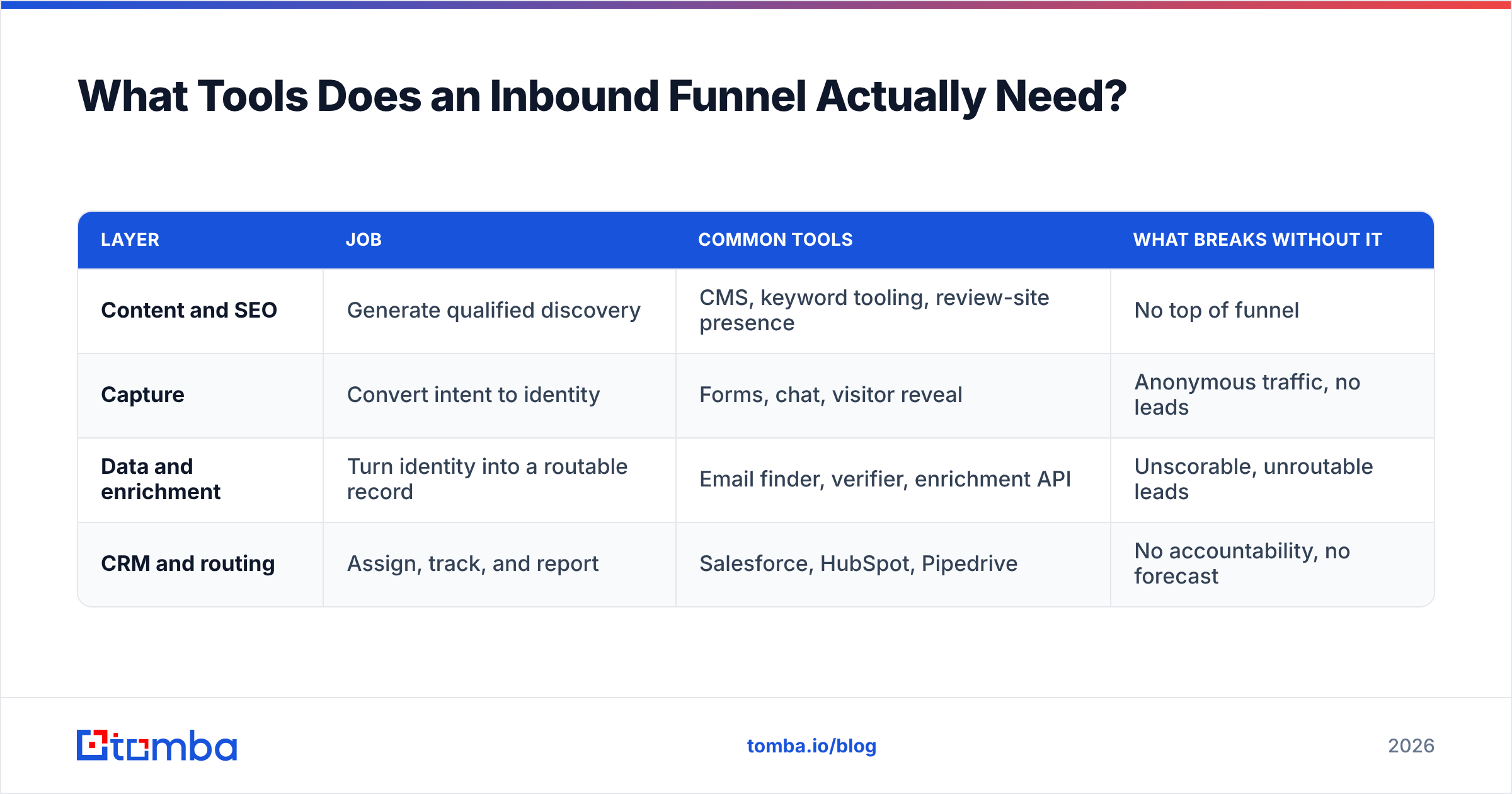
Less than the average stack diagram suggests. You need four layers, and most teams over-buy on the first and under-buy on the third.
| Layer | Job | Common tools | What breaks without it |
|---|---|---|---|
| Content and SEO | Generate qualified discovery | CMS, keyword tooling, review-site presence | No top of funnel |
| Capture | Convert intent to identity | Forms, chat, visitor reveal | Anonymous traffic, no leads |
| Data and enrichment | Turn identity into a routable record | Email finder, verifier, enrichment API | Unscorable, unroutable leads |
| CRM and routing | Assign, track, and report | Salesforce, HubSpot, Pipedrive | No accountability, no forecast |
The data layer is where inbound funnels quietly fail. Everything downstream — scoring, routing, personalization, forecasting — depends on knowing who submitted the form and what company they belong to. If that record is incomplete, your CRM becomes an expensive list of first names.
Pricing for that layer is more reasonable than most teams assume. Tomba runs a free tier at 25 searches per month for testing the workflow, then Starter at $49/mo, Growth at $99/mo, and Pro at $249/mo, with Enterprise on custom terms — the full Tomba pricing breakdown shows credit allocations per tier. For teams that would rather buy static lists than run lookups, BookYourData is a solid pay-as-you-go option with strong coverage; the tradeoff is list freshness versus on-demand resolution, and plenty of teams run both. Compare vendor claims on G2's lead intelligence category before committing to an annual contract.
Is the Inbound Sales Funnel Still Worth Building in 2026?#
Yes, but the payback period is longer and the mechanics have shifted.
What changed: AI-generated answers now intercept a meaningful share of informational queries, so ranking for "what is X" converts less than it did in 2021. What did not change: buyers still research independently, still shortlist before they talk to sales, and still trust peer signals over vendor claims. The funnel did not die — its top just moved into surfaces you do not fully control.
The strategic response is to build inbound around decision-stage content rather than awareness content. Comparison pages, pricing transparency, integration documentation, and honest alternative roundups still pull qualified traffic because they answer questions that AI summaries handle poorly and that buyers refuse to decide without. Those pages convert at three to five times blog-post rates in most B2B accounts we have seen benchmarked.
And pair it with a real outbound motion. An inbound-only 2026 go-to-market is a bet that your category has enough search volume and that you will win it. For most companies, that bet has gotten worse, not better.
Where Should You Start?#
Start with the handoff, because it is the cheapest fix with the largest effect. Time-stamp your funnel, rewrite your MQL definition with sales present, and enrich every capture at submit time.
The enrichment step is the one most teams skip and most regret skipping. When a two-field form becomes a complete company record — verified address, firmographics, buying-committee contacts — every downstream system suddenly works the way the vendor demo promised.
The Tomba Email Finder is built for exactly that step: resolve verified business emails from a name and domain, enrich inbound submissions in real time via the API, and pull the rest of the buying committee for the accounts that showed intent but never filled anything in. Start on the free tier, run it against last month's inbound leads, and see how many of them your CRM was quietly mis-scoring.
Related guides#
// get started
Find, verify and enrich your first contacts today
Start on the free plan with 25 searches a month, then scale when your team is ready.
Free plan · No credit card required · GDPR & CCPA
// about the author