The Inbound Sales Process: A 7-Stage Framework for 2026
Most inbound sales advice stops at "be helpful." This guide breaks the inbound sales process into seven stages with owners, exit criteria, speed-to-lead benchmarks, and the data work that makes routing actually function.
TL;DR
- The inbound sales process is a defined sequence for handling buyers who raised their hand first — it fails when teams treat "they came to us" as a substitute for qualification and speed.
- Seven stages, each with an owner and an exit criterion: capture, enrich, score, route, respond, qualify, close. Skipping enrichment is the single most common cause of bad routing.
- Speed-to-lead beats almost every other lever. Responding inside five minutes is a different business than responding the next morning.
- Inbound and outbound are not opposites. The highest-performing teams run the same discovery motion on both, with different entry points and different levels of context.
- Form fills give you a name and a personal Gmail more often than you'd like. Enrichment turns that into a work email, a company, a headcount, and a routing decision.
What is an inbound sales process?#
An inbound sales process is the repeatable sequence your team runs when a prospect initiates contact — a demo request, a pricing page form, a chatbot conversation, a free-trial signup, a content download, or a reply to a newsletter.
Think of it like a restaurant that takes reservations versus one that does street promotion. Outbound is standing outside handing out flyers. Inbound is the phone ringing. But a ringing phone doesn't seat anyone. You still need a host, a table map, a wait-time policy, and a way to tell the party of two from the party of twenty before they walk in. Most inbound teams have the ringing phone and none of the rest.
The technical version: inbound sales is a stage-gated pipeline where the trigger event is buyer-initiated, and where the primary competitive advantage is context — you know what page they read, what they downloaded, what they typed into a form — combined with speed. Lose either and inbound collapses into ordinary lead handling.
HubSpot's inbound sales framework popularized the identify → connect → explore → advise sequence, and it's still a reasonable mental model. In practice, modern B2B teams need more granularity, because the failure points sit in the gaps between those four words.
What are the 7 stages of the inbound sales process?#
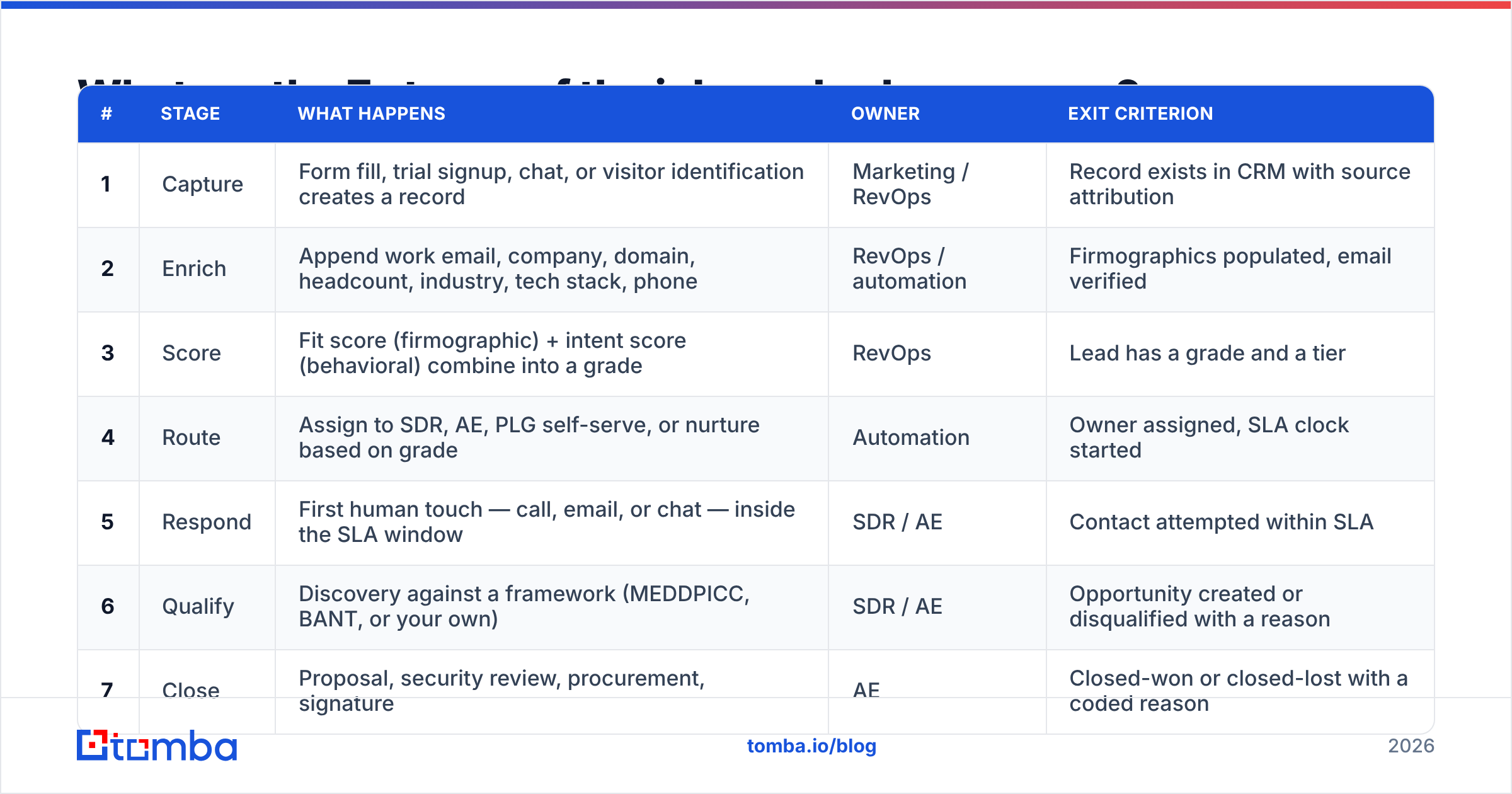
Here's the version that survives contact with a real pipeline. Each stage has one owner and one exit criterion. If you can't state the exit criterion, the stage isn't real.
| # | Stage | What happens | Owner | Exit criterion |
|---|---|---|---|---|
| 1 | Capture | Form fill, trial signup, chat, or visitor identification creates a record | Marketing / RevOps | Record exists in CRM with source attribution |
| 2 | Enrich | Append work email, company, domain, headcount, industry, tech stack, phone | RevOps / automation | Firmographics populated, email verified |
| 3 | Score | Fit score (firmographic) + intent score (behavioral) combine into a grade | RevOps | Lead has a grade and a tier |
| 4 | Route | Assign to SDR, AE, PLG self-serve, or nurture based on grade | Automation | Owner assigned, SLA clock started |
| 5 | Respond | First human touch — call, email, or chat — inside the SLA window | SDR / AE | Contact attempted within SLA |
| 6 | Qualify | Discovery against a framework (MEDDPICC, BANT, or your own) | SDR / AE | Opportunity created or disqualified with a reason |
| 7 | Close | Proposal, security review, procurement, signature | AE | Closed-won or closed-lost with a coded reason |
Two things to notice. First, stages 2 through 4 are almost entirely automated — no human should be manually deciding whether a lead with 5,000 employees goes to enterprise. Second, the only stages where reps add judgment are 5 through 7. If your reps are spending their morning cleaning up form data, you have a stage-2 problem masquerading as a productivity problem.
Which stage leaks the most pipeline?#
In most audits, the leak is at stage 2 and shows up as a symptom at stage 4.
- Bad routing looks like a rules problem. It usually isn't. The rules are fine; the data they read is empty.
- Personal email addresses break firmographic lookup. Someone submits a Gmail address, the enrichment provider can't resolve a domain, and the lead falls into the "unknown company" bucket that nobody checks.
- Free-text company fields are noise. "Acme", "acme inc", "ACME Corporation Ltd." are three companies to your CRM and one company to your CFO.
- Missing headcount kills tiering. Without employee count, your enterprise rules never fire and every lead lands in the same SMB queue.
- Unverified emails poison the follow-up. Your SDR sends a sequence, it bounces, sender reputation drops, and the next legitimate inbound reply lands in spam.
Why does speed-to-lead matter more than anything else?#
Because attention decays faster than intent does.
A buyer who filled out your pricing form at 10:14 a.m. is, at 10:19 a.m., still in the tab. At 10:14 the next morning, they've evaluated two competitors and forgotten which form they filled. The research on this is old and consistent — response inside five minutes produces dramatically higher connect and qualification rates than response inside an hour, and the curve is steep, not linear. Gartner's sales research has documented the same directional effect across B2B buying journeys: buyers spend a minority of their time with any single vendor, so the window where you're the vendor they're thinking about is narrow.
Practical SLA structure that works:
- Tier A (high fit + high intent, e.g. demo request from a 500+ employee ICP account): 5-minute SLA, phone first, email second, calendar link in both.
- Tier B (good fit, mid intent — pricing page, comparison content): 30-minute SLA, email first with a specific reference to what they viewed.
- Tier C (fit unclear, low intent — ebook download): 24-hour SLA, automated sequence, human touch only on engagement.
- Tier D (out of ICP): No rep time. Self-serve nurture or a polite redirect to documentation.
The mistake is applying a 5-minute SLA to everything. That's how reps burn out on ebook downloads and miss the demo request. Tiering is what makes speed affordable.
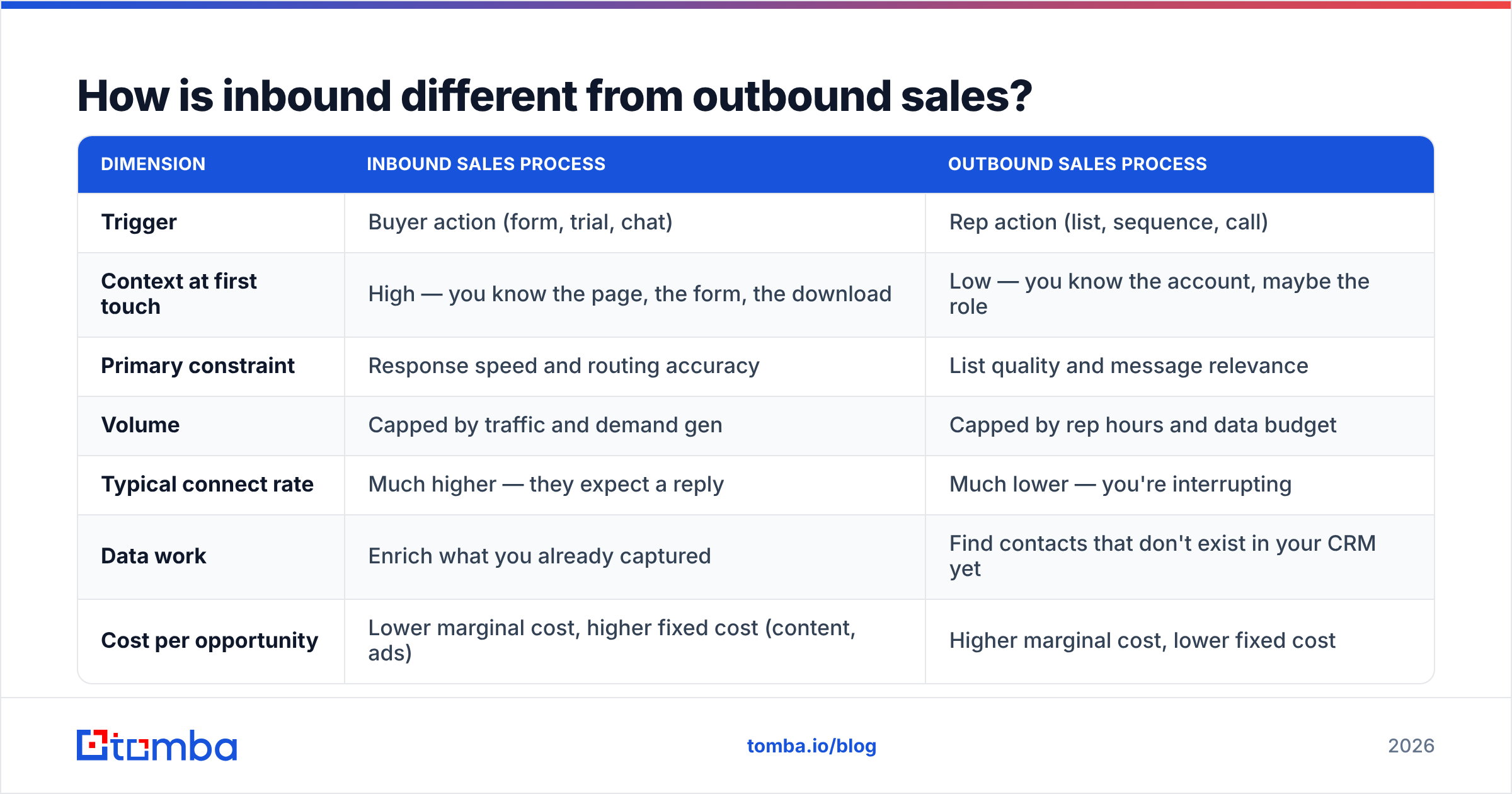
How is inbound different from outbound sales?#
They converge after the first conversation. Before it, they're genuinely different jobs.
| Dimension | Inbound sales process | Outbound sales process |
|---|---|---|
| Trigger | Buyer action (form, trial, chat) | Rep action (list, sequence, call) |
| Context at first touch | High — you know the page, the form, the download | Low — you know the account, maybe the role |
| Primary constraint | Response speed and routing accuracy | List quality and message relevance |
| Volume | Capped by traffic and demand gen | Capped by rep hours and data budget |
| Typical connect rate | Much higher — they expect a reply | Much lower — you're interrupting |
| Data work | Enrich what you already captured | Find contacts that don't exist in your CRM yet |
| Cost per opportunity | Lower marginal cost, higher fixed cost (content, ads) | Higher marginal cost, lower fixed cost |
| Failure mode | Slow response, bad routing, dead form data | Poor targeting, bounced emails, generic copy |
The strategic point: inbound is a fixed-cost, high-conversion channel and outbound is a variable-cost, high-control channel. Teams that treat them as competing budgets miss that the same data layer serves both. The data enrichment that turns an inbound Gmail address into a routable account is the same enrichment that qualifies an outbound list.
There's also a blended motion worth naming: inbound-triggered outbound. Someone from a target account visits your pricing page three times but never fills a form. Website visitor reveal surfaces the account, you find the right buyer inside it, and you reach out with context you earned rather than guessed. That's neither pure inbound nor pure outbound, and it's often the highest-converting pipeline a team has.
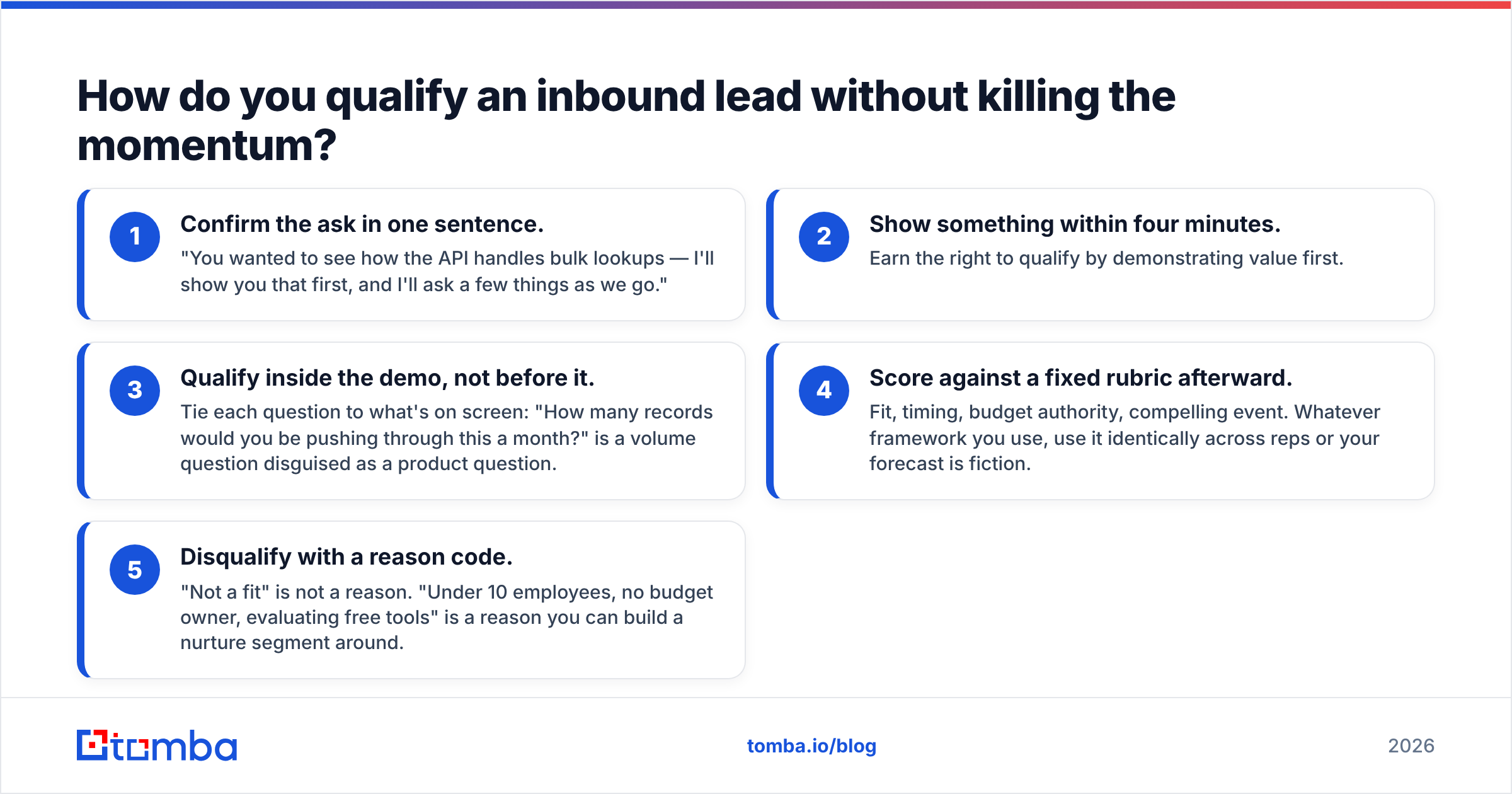
How do you qualify an inbound lead without killing the momentum?#
Qualification on inbound is a different exercise than qualification on outbound, and copying your outbound discovery script is the classic error.
An outbound prospect owes you nothing — you interrupted them, so you earn the right to ask questions gradually. An inbound prospect asked for something specific. Leading with "So tell me about your current process" when they clicked "Book a demo" reads as a stall. They want to see the thing.
A better inbound sequence:
- Confirm the ask in one sentence. "You wanted to see how the API handles bulk lookups — I'll show you that first, and I'll ask a few things as we go."
- Show something within four minutes. Earn the right to qualify by demonstrating value first.
- Qualify inside the demo, not before it. Tie each question to what's on screen: "How many records would you be pushing through this a month?" is a volume question disguised as a product question.
- Score against a fixed rubric afterward. Fit, timing, budget authority, compelling event. Whatever framework you use, use it identically across reps or your forecast is fiction.
- Disqualify with a reason code. "Not a fit" is not a reason. "Under 10 employees, no budget owner, evaluating free tools" is a reason you can build a nurture segment around.
Note the difference between a marketing qualified lead and a sales-accepted one. An MQL is a marketing prediction. Sales acceptance is an actual judgment. Tracking the gap between them — MQL-to-SAL conversion by source — tells you more about your demand gen quality than any traffic dashboard.
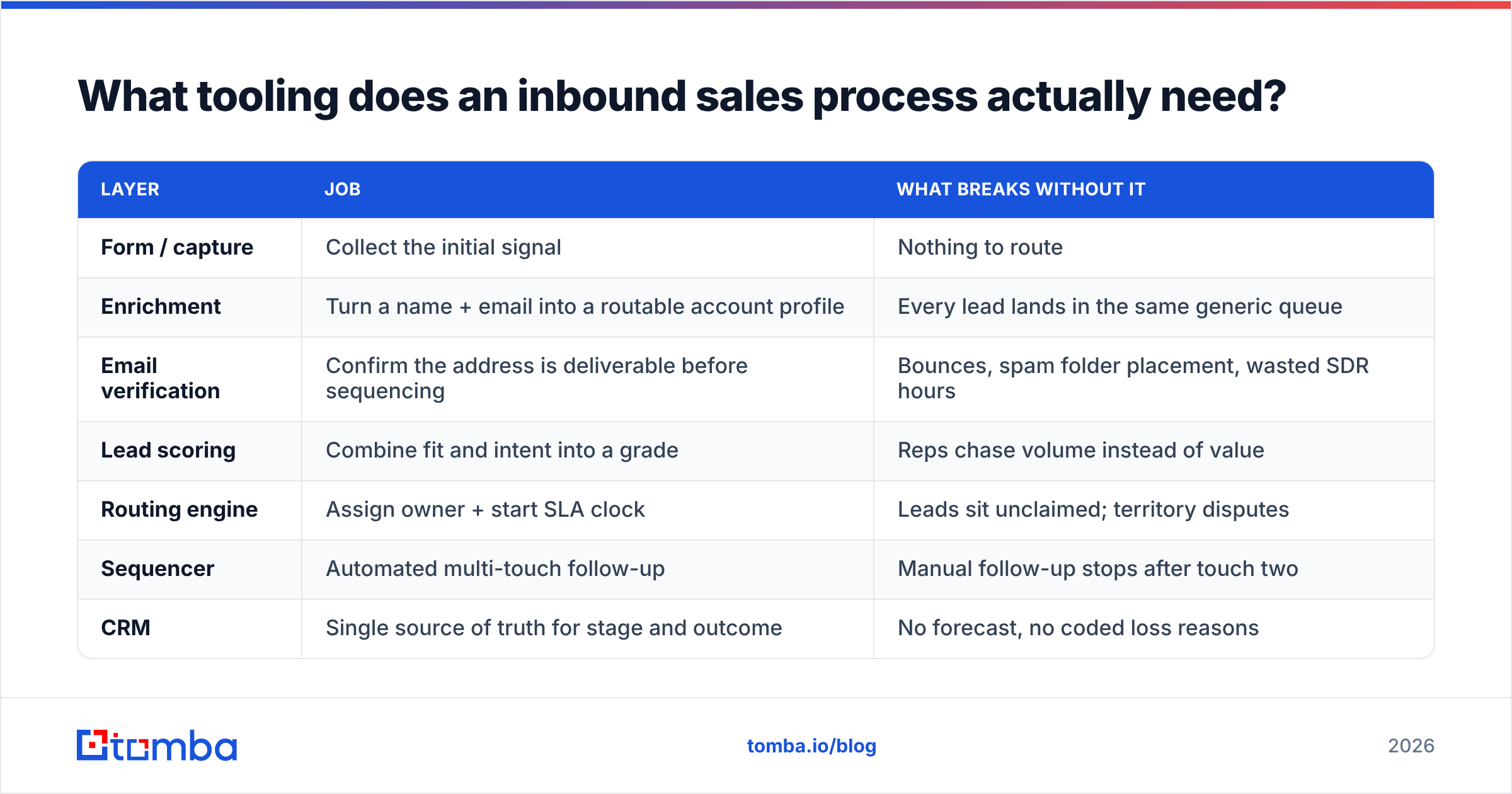
What tooling does an inbound sales process actually need?#
Less than vendors suggest, but the pieces you do need have to be reliable.
| Layer | Job | What breaks without it |
|---|---|---|
| Form / capture | Collect the initial signal | Nothing to route |
| Enrichment | Turn a name + email into a routable account profile | Every lead lands in the same generic queue |
| Email verification | Confirm the address is deliverable before sequencing | Bounces, spam folder placement, wasted SDR hours |
| Lead scoring | Combine fit and intent into a grade | Reps chase volume instead of value |
| Routing engine | Assign owner + start SLA clock | Leads sit unclaimed; territory disputes |
| Sequencer | Automated multi-touch follow-up | Manual follow-up stops after touch two |
| CRM | Single source of truth for stage and outcome | No forecast, no coded loss reasons |
The unglamorous middle of that table is where inbound teams underinvest. Enrichment and verification are treated as nice-to-haves, then the routing engine gets blamed for decisions it made with missing inputs. Run an email verifier pass on inbound submissions before they enter a sequence — a typo'd address at capture becomes a bounce three days later, and bounces compound into deliverability problems that affect every send after them.
For scoring, keep the model simple enough that a rep can explain it out loud. Lead scoring models fail when they become black boxes nobody trusts; reps then route around them, and you're back to first-come-first-served.
What metrics should you track on an inbound sales process?#
Six numbers, reviewed weekly:
- Speed-to-first-touch (median, by tier). Medians, not averages — one 3-day outlier hides a good week, and one fast response hides a bad one.
- MQL-to-SAL rate by source. Which channels produce leads sales actually accepts. Paid social and organic search rarely score the same.
- Enrichment coverage. Percentage of inbound records with a verified work email, domain, and headcount. Under 80% and your routing is guessing.
- SAL-to-opportunity rate. Whether your reps can convert an accepted lead into a real deal. Low here means a discovery problem, not a lead problem.
- Inbound win rate vs. outbound win rate. Inbound should be meaningfully higher. If it isn't, you're either under-qualifying inbound or your reps are treating it as an order-taking exercise.
- Time in stage. Where deals stall. A pile-up between stage 6 and 7 is usually a security-review or procurement gap, not a selling gap.
Resist the urge to add a seventh. Dashboards with 30 metrics get checked zero times a week.
What are the most common inbound sales mistakes?#
Treating inbound as easy. Inbound leads convert better, which tempts teams to assign junior reps and thin process. The result is a channel with the best raw material and the worst execution.
Round-robin routing with no fit logic. Every rep gets an equal share of everything, including leads they can't serve. Enterprise-shaped deals land with reps who've never run a security review.
No follow-up beyond touch two. A demo no-show is not a dead lead. Most inbound teams stop after one reschedule attempt; a five-touch, two-week sequence recovers a meaningful share of them.
Manual data cleanup as a rep task. If an SDR spends 40 minutes a day fixing company names and hunting down work emails, that's roughly 3 hours a week — per rep — spent on something automation does in seconds.
Ignoring the anonymous majority. Under 3% of site visitors fill anything out. The other 97% are not all tire-kickers; some are your best-fit accounts doing quiet research. Visitor identification plus targeted contact discovery converts that silence into pipeline.
No disqualification discipline. Reps who never disqualify have inflated pipelines and unreliable forecasts. Coded loss reasons are how you find out that half your "lost to competitor" deals were actually "no budget cycle until Q3."
Where should you start if your inbound process is a mess?#
Fix the data layer first, because every other fix depends on it. Concretely: audit last quarter's inbound records, count how many have a verified work email and a resolved company domain, and you'll usually find the number is worse than anyone assumed. Then set tiered SLAs, then rebuild routing rules on top of clean fields, then tune scoring.
Doing it in the other order — scoring first, data last — is how teams end up with an elegant model that grades empty records.
If the gap in your inbound process is contact data — form fills with personal addresses, anonymous accounts you can't reach, or a CRM full of records missing the one field routing depends on — start with the Tomba Email Finder. It resolves work emails from a name and domain, verifies deliverability before your sequence sends, and plugs into the enrichment step where most inbound processes quietly break. The free tier covers 25 searches a month if you want to test it against your own dead records first; paid plans start at $49/mo, with full Tomba pricing laid out if you need bulk or API volume.
Related guides#
// get started
Find, verify and enrich your first contacts today
Start on the free plan with 25 searches a month, then scale when your team is ready.
Free plan · No credit card required · GDPR & CCPA
// about the author