Inbound Sales Strategy: How to Build One That Converts in 2026
Most inbound sales strategies leak revenue between the form fill and the first call. Here is the 2026 playbook: routing rules, response-time SLAs, qualification tiers, enrichment, and the metrics that actually predict pipeline.
TL;DR
- An inbound sales strategy is the system that turns self-initiated interest — demo requests, trial signups, content downloads, pricing-page visits — into booked revenue. The strategy is not the content. It is what happens in the 30 minutes after someone raises a hand.
- Response speed beats almost every other variable. Teams that reply within five minutes qualify dramatically more leads than teams that reply in an hour, and the curve falls off a cliff after the first 60 minutes.
- Enrichment is the difference between a lead and a lead you can sell to. A form that captures a work email plus a company domain can be expanded into title, headcount, tech stack, and direct phone before the rep picks up the phone.
- Tier your inbound, do not score it into a single number. Three buckets (rep-owned, nurture, self-serve) route faster and argue less than a 0–100 model nobody trusts.
- Measure speed-to-first-touch, contact rate, and inbound-to-opportunity rate. MQL volume is a vanity number that hides the leak.
What is an inbound sales strategy?#
An inbound sales strategy is a documented set of rules for how your revenue team captures, qualifies, routes, and works demand that comes to you rather than demand you go find. It covers five things: what counts as a signal, how fast you respond, who owns the lead, what data you attach to it before first contact, and what the rep says.
The confusion in most companies is that "inbound" is treated as a marketing deliverable. Marketing publishes, ranks, runs paid, fills the funnel, and hands over a list. Sales then treats that list the way it treats a cold list — batch it, sequence it, work it on Tuesday. That is the single most expensive mistake in the whole motion, because an inbound lead has a half-life measured in minutes, not days.
HubSpot's inbound sales framework frames it as identify → connect → explore → advise. That is a useful mental model, but it is a conversation model, not an operations model. The operations layer — routing, SLAs, enrichment, dedup against existing accounts — is where the revenue actually leaks, and it is what this guide focuses on.
Think of inbound like a restaurant where the door is already open and people are walking in. Your marketing is the sign on the street. Your inbound sales strategy is whether anyone greets them in the first 30 seconds, whether the host knows they booked a table for eight, and whether the kitchen already knows the party has a nut allergy. Great signage with no host is just a busy doorway.
How is inbound sales different from outbound?#
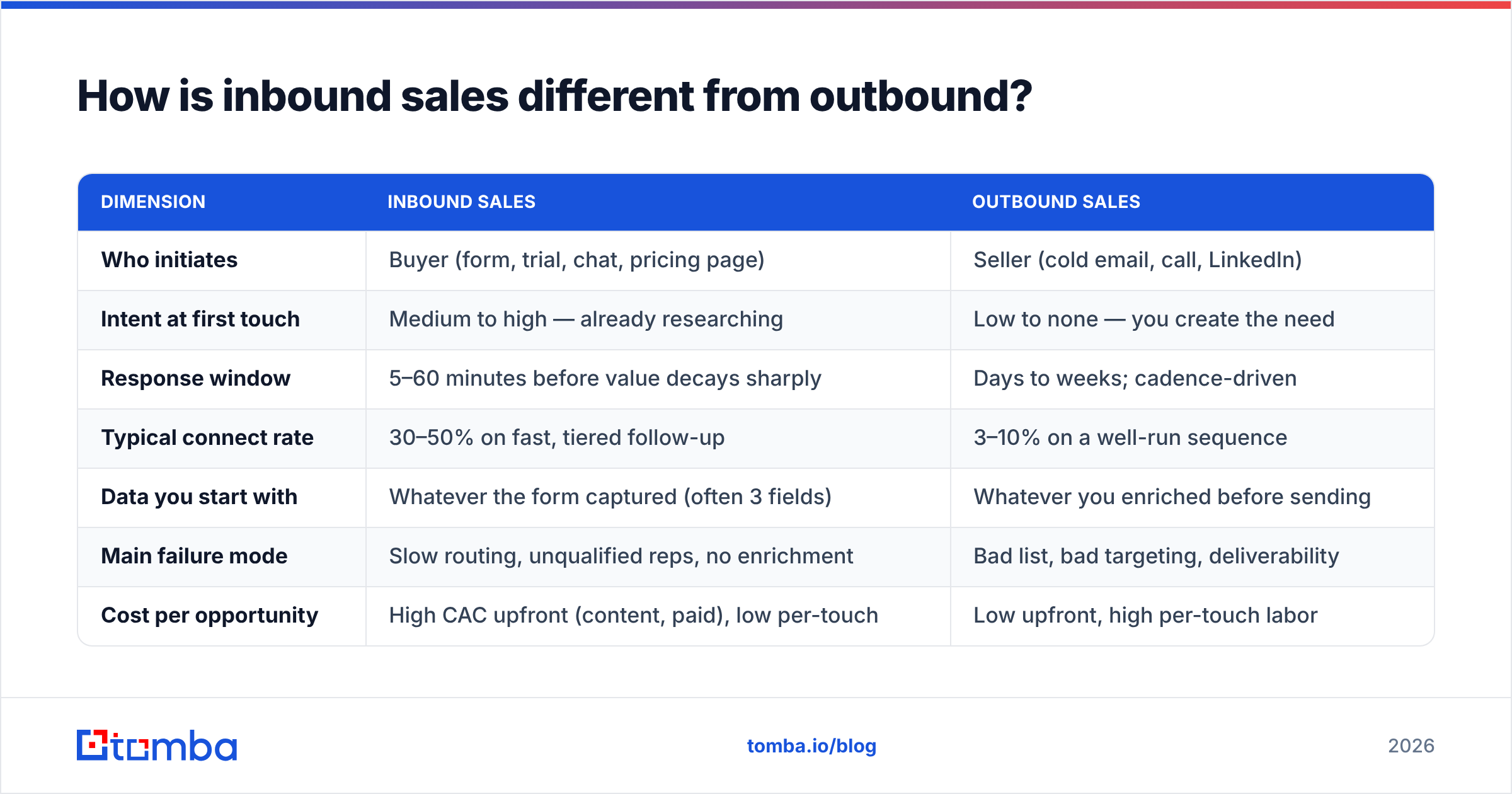
They share tooling and often share reps, but the economics, the timing pressure, and the opening line are all different.
| Dimension | Inbound sales | Outbound sales |
|---|---|---|
| Who initiates | Buyer (form, trial, chat, pricing page) | Seller (cold email, call, LinkedIn) |
| Intent at first touch | Medium to high — already researching | Low to none — you create the need |
| Response window | 5–60 minutes before value decays sharply | Days to weeks; cadence-driven |
| Typical connect rate | 30–50% on fast, tiered follow-up | 3–10% on a well-run sequence |
| Data you start with | Whatever the form captured (often 3 fields) | Whatever you enriched before sending |
| Main failure mode | Slow routing, unqualified reps, no enrichment | Bad list, bad targeting, deliverability |
| Cost per opportunity | High CAC upfront (content, paid), low per-touch | Low upfront, high per-touch labor |
| Best-fit deal size | Mid-market and self-serve expansion | Enterprise, named-account, new category |
The practical takeaway: an inbound lead deserves a different first 24 hours than an outbound prospect. Same rep, different playbook. If your team runs one shared sequence for both, you are underworking your best leads and overworking your worst ones.

Why do most inbound sales strategies leak revenue?#
Five leaks account for most of it, and they are all operational rather than strategic.
- The handoff delay. The lead sits in a marketing automation queue, waits for a nightly sync, lands in the CRM the next morning, and gets assigned by round-robin at 9am. You just burned 14 hours of the highest-intent window your business will ever get with that person.
- The thin record. The form asked for name, email, and company. The rep opens the record and knows nothing — no headcount, no title, no funding stage, no current stack — so the first call is spent asking questions the buyer expects you to already know.
- The single-score fallacy. A lead scoring model spits out "72." Nobody on the sales floor knows whether 72 is good. Reps cherry-pick by company logo instead, and the model quietly becomes decoration.
- The dedup miss. The inbound "new lead" is actually the fourth person from an account an AE is already working. Two reps now contact the same company in the same week with different messages.
- The one-and-done follow-up. One email, one call, no answer, mark it closed-lost. Inbound leads frequently need five to eight touches across two channels — the difference is that they usually answer, whereas cold prospects usually do not.
Each of these is fixable with rules, not with more content. That is the good news: an inbound sales strategy is largely a plumbing problem, and plumbing is cheap compared to demand generation.
What are the stages of an inbound sales process?#
Here is the operational sequence, from signal to closed-won. Every stage should have an owner and a time budget.
- Capture. Keep forms to three or four fields — work email, name, company. Every additional field costs conversion. You will backfill the rest with data, not with questions.
- Enrich. Within seconds of submission, expand the record: job title, seniority, department, company headcount, industry, domain, tech stack, and a direct phone where available. This is where a data enrichment API earns its keep, because it turns three fields into twenty before a human ever looks at the row.
- Validate. Confirm the email is deliverable and is not a role account, a disposable domain, or a typo. A quick email verifier pass here protects your sender reputation and stops reps from wasting a follow-up cycle on
inf@company.com. - Dedup and match. Check the domain against open opportunities and existing accounts. If it matches, route to the owning rep as a buying-committee signal, not as a new lead.
- Tier and route. Assign to one of three lanes (see the next section) and push to the right owner instantly — not on a batch schedule.
- First touch. Call first, email second, within the SLA. The call is the differentiator; almost nobody calls anymore, and inbound leads answer far more often than cold ones.
- Qualify and advise. Run discovery against the enriched context. You already know headcount and stack, so spend the call on the problem, not on data collection.
That seven-step chain is the whole strategy. Everything else — playbooks, battlecards, nurture tracks — hangs off it.
How fast do you need to respond to an inbound lead?#
Faster than you currently do. The classic Harvard Business Review study on online lead response found that firms responding within an hour were roughly seven times more likely to have a meaningful conversation with a decision-maker than those responding in the second hour — and around 60 times more likely than those waiting 24 hours or more. Fifteen years later, buyer patience has not improved.
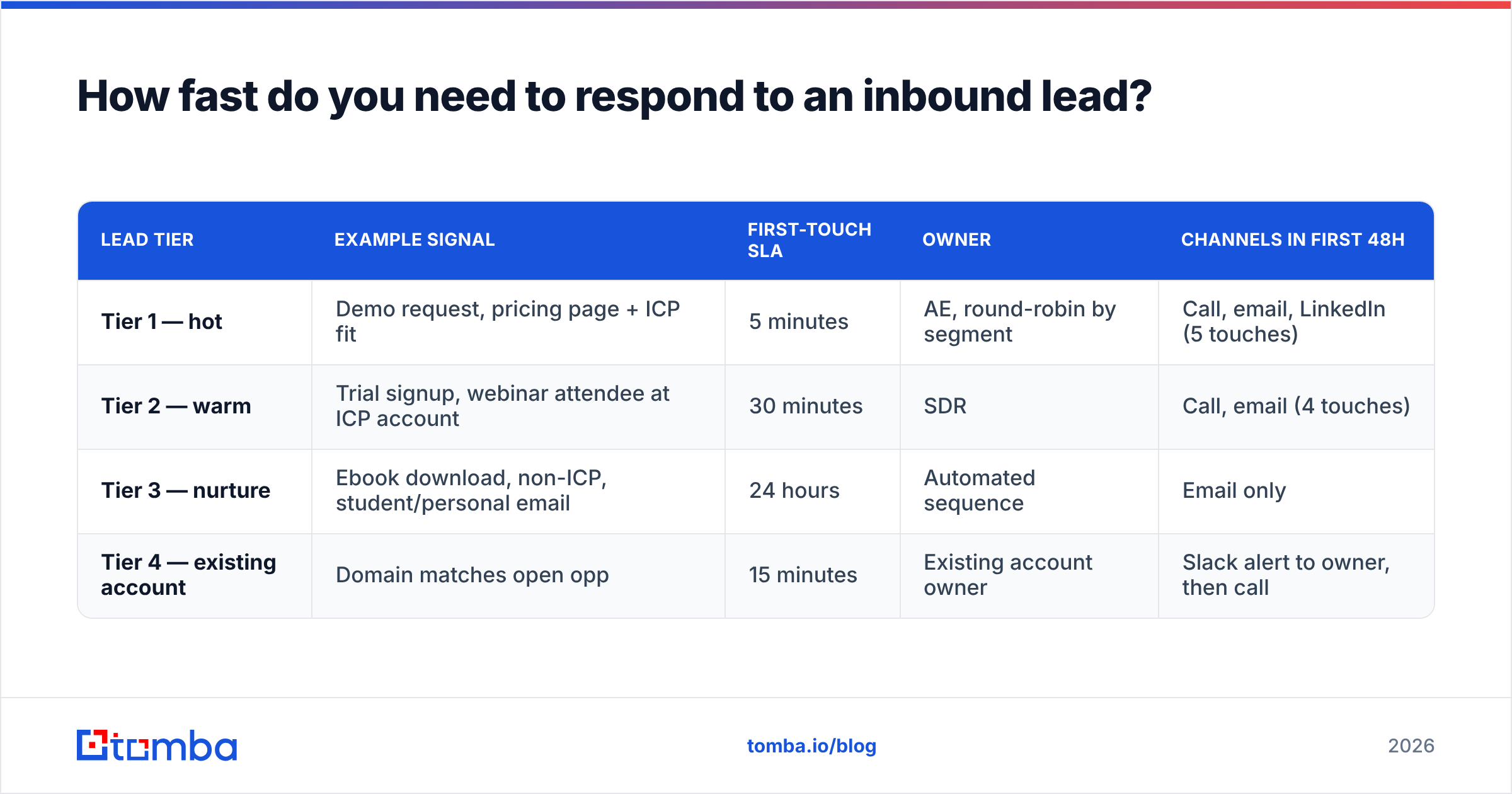
Set the SLA by tier and publish it on a dashboard the whole team can see:
| Lead tier | Example signal | First-touch SLA | Owner | Channels in first 48h |
|---|---|---|---|---|
| Tier 1 — hot | Demo request, pricing page + ICP fit | 5 minutes | AE, round-robin by segment | Call, email, LinkedIn (5 touches) |
| Tier 2 — warm | Trial signup, webinar attendee at ICP account | 30 minutes | SDR | Call, email (4 touches) |
| Tier 3 — nurture | Ebook download, non-ICP, student/personal email | 24 hours | Automated sequence | Email only |
| Tier 4 — existing account | Domain matches open opp | 15 minutes | Existing account owner | Slack alert to owner, then call |
Three tiers plus an account-match lane beat a 100-point score because a rep can hold all four rules in their head. If you already run a scoring model, keep it — but collapse the output into these buckets before it reaches the floor.
How should you qualify inbound leads without killing conversion?#
Qualify with data first and questions second. The order matters.
Before the call, you should already know: company size, industry, funding or revenue band, the person's title and seniority, whether the domain matches an existing customer or competitor, and whether other people from that domain have visited in the past 30 days. A website visitor reveal layer adds the accounts that never filled anything in, which is usually the larger half of your traffic.
On the call, you are then testing three things only:
- Problem fit — is the pain they described one you actually solve, or an adjacent one?
- Timing — is there a trigger (funding, new hire, tool churn, compliance deadline) or is this research?
- Access — can this person convene the two or three others who will sign off?
Notice what is missing: budget interrogation on call one. Asking about budget before you have established problem fit is the fastest way to turn a warm inbound into a ghost. Gartner's sales research has been consistent for years that B2B buyers complete most of their evaluation before they talk to a vendor — which means your first call is a validation checkpoint, not a discovery blank slate. Treat it accordingly.
One more distinction worth getting right internally: a marketing qualified lead is a marketing commitment, not a sales promise. If marketing and sales have not agreed in writing on what an MQL is and what happens to it within 30 minutes, the term is generating meetings about meetings instead of meetings with buyers.
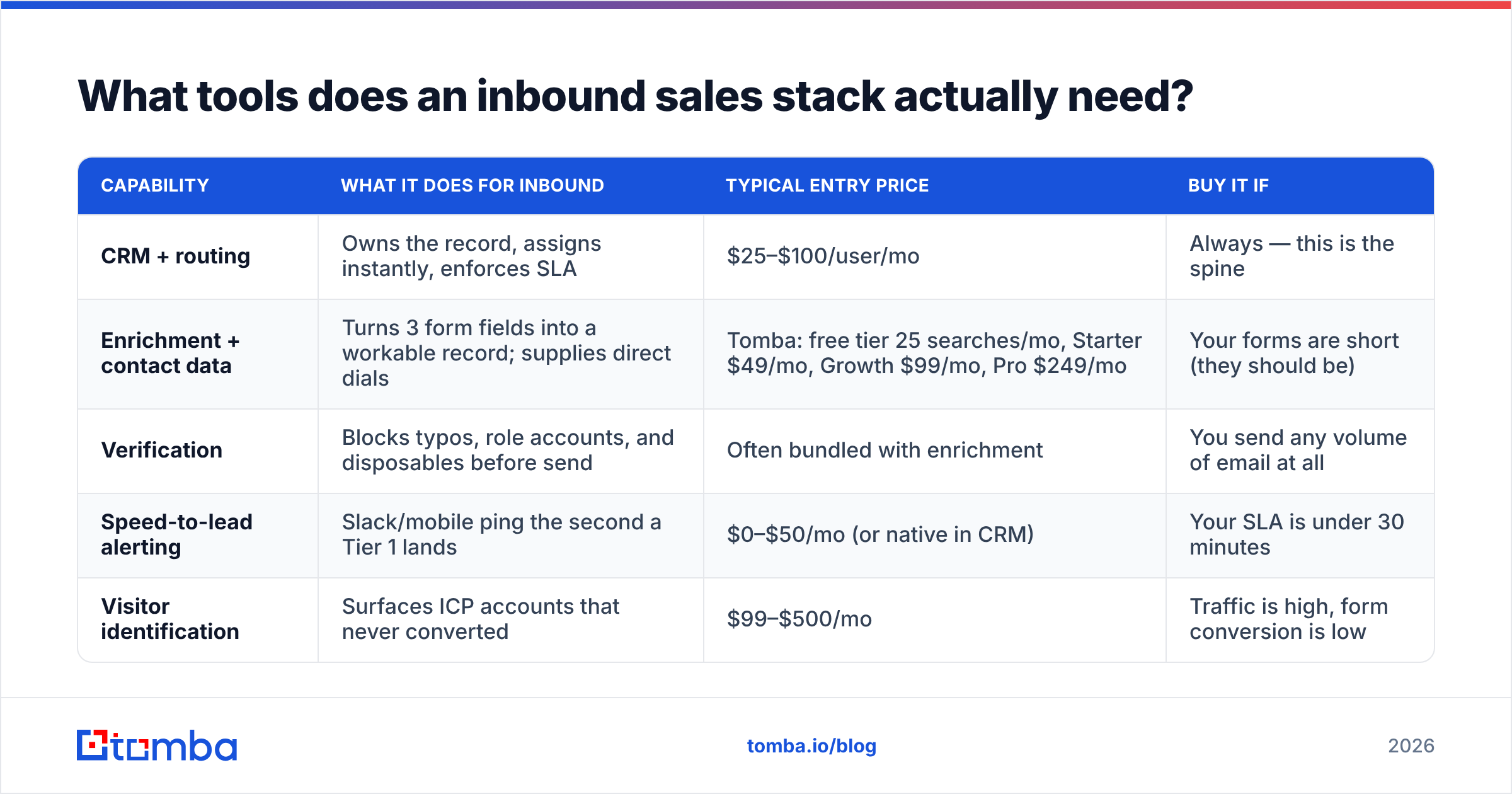
What tools does an inbound sales stack actually need?#
You need four capabilities, and most teams overbuy on two of them while ignoring the other two.
| Capability | What it does for inbound | Typical entry price | Buy it if |
|---|---|---|---|
| CRM + routing | Owns the record, assigns instantly, enforces SLA | $25–$100/user/mo | Always — this is the spine |
| Enrichment + contact data | Turns 3 form fields into a workable record; supplies direct dials | Tomba: free tier 25 searches/mo, Starter $49/mo, Growth $99/mo, Pro $249/mo | Your forms are short (they should be) |
| Verification | Blocks typos, role accounts, and disposables before send | Often bundled with enrichment | You send any volume of email at all |
| Speed-to-lead alerting | Slack/mobile ping the second a Tier 1 lands | $0–$50/mo (or native in CRM) | Your SLA is under 30 minutes |
| Visitor identification | Surfaces ICP accounts that never converted | $99–$500/mo | Traffic is high, form conversion is low |
Two notes on spend. First, enrichment is the highest-leverage line item on that list relative to cost — full Tomba pricing starts free and the $49/mo Starter plan covers most seed-to-Series-A inbound volume. Second, do not buy visitor identification until your speed-to-lead SLA is actually being hit. Adding more top-of-funnel to a process that leaks at the handoff just increases the volume of leakage.
If you are comparing vendors in the contact-data category, cross-check claims on a review site like G2 rather than taking any single provider's accuracy chart at face value — including ours. Coverage varies enormously by geography and by company size, and the honest answer is that you should test two providers against 200 rows of your own ICP before signing anything annual. Peers such as BookYourData take a database-first approach that suits teams buying static lists, while API-first providers suit teams enriching in real time at the moment of form submission. Both are legitimate; they solve different shapes of the same problem.
How do you measure an inbound sales strategy?#
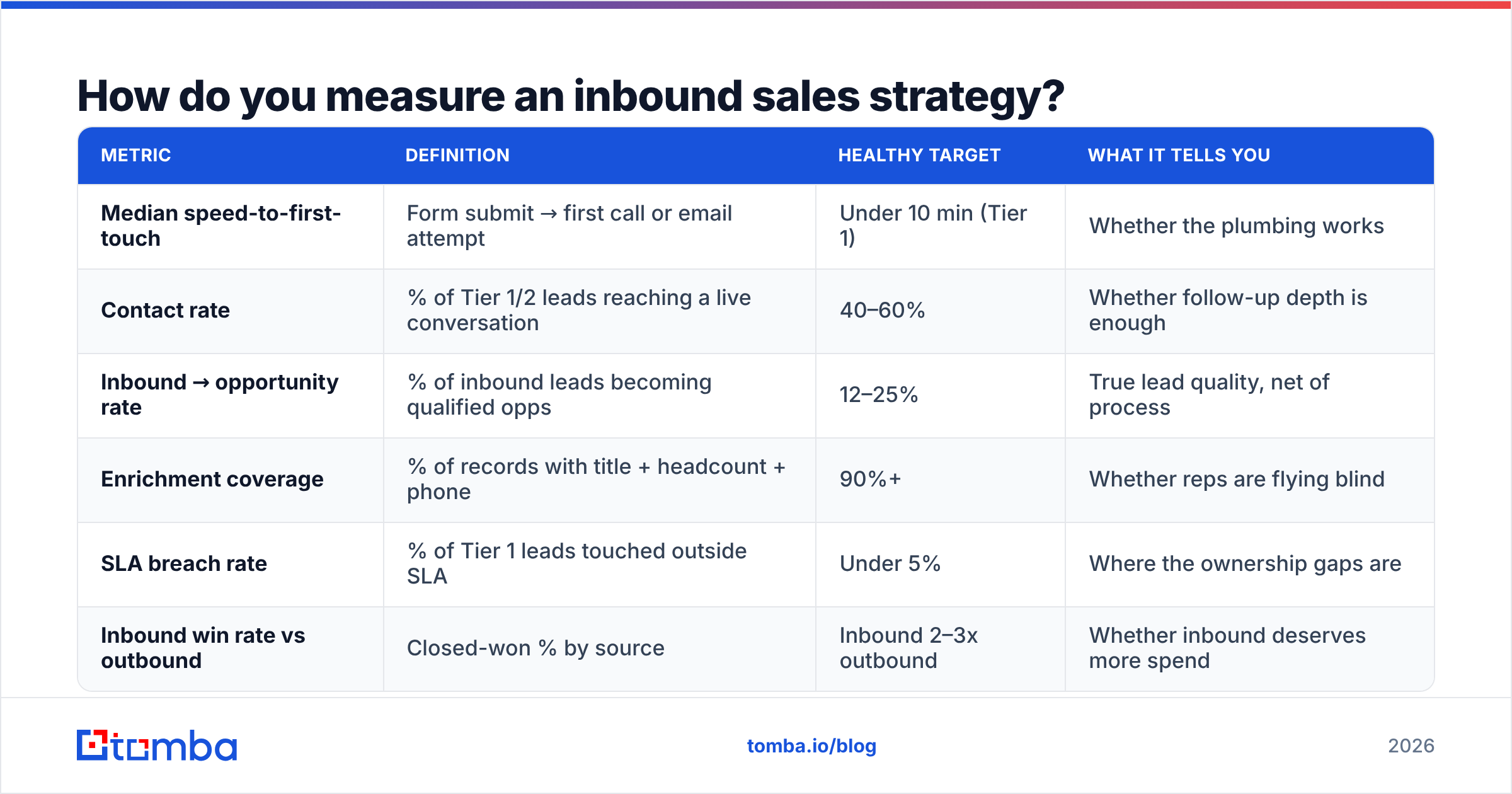
Drop MQL volume from the exec dashboard. It rewards the wrong behavior — marketing optimizes for form fills, sales complains about quality, and nobody sees the handoff gap. Track these instead:
| Metric | Definition | Healthy target | What it tells you |
|---|---|---|---|
| Median speed-to-first-touch | Form submit → first call or email attempt | Under 10 min (Tier 1) | Whether the plumbing works |
| Contact rate | % of Tier 1/2 leads reaching a live conversation | 40–60% | Whether follow-up depth is enough |
| Inbound → opportunity rate | % of inbound leads becoming qualified opps | 12–25% | True lead quality, net of process |
| Enrichment coverage | % of records with title + headcount + phone | 90%+ | Whether reps are flying blind |
| SLA breach rate | % of Tier 1 leads touched outside SLA | Under 5% | Where the ownership gaps are |
| Inbound win rate vs outbound | Closed-won % by source | Inbound 2–3x outbound | Whether inbound deserves more spend |
Review these weekly, by rep and by tier. The first time you chart median speed-to-first-touch by hour of day, you will find a gap — usually a lunch hour, a timezone, or a Friday afternoon — and closing that one gap is often worth more than a quarter of extra content production.
What are the most common inbound sales mistakes?#
- Long forms defended as "qualification." A ten-field form does not qualify anyone; it filters for patience. Enrich instead.
- Round-robin without segment logic. Assigning a 5,000-employee enterprise inbound to whoever is next in the rotation wastes the best lead of the month.
- Treating trial signups as leads. Product usage is a stronger signal than a form. Route on activation events, not on the signup itself.
- No call attempt. Email-only inbound follow-up cuts your contact rate roughly in half. The phone is uncrowded now.
- Killing the record after two touches. Five to eight touches over 14 days, then move to nurture — do not delete.
- Never closing the loop with marketing. Reps should tag disqualification reasons. Without that feedback, marketing has no way to fix the source.
Where should you start if your inbound process is a mess?#
Do this in order, over about three weeks. Week one: instrument speed-to-first-touch and publish the number, even if it is embarrassing. Week two: add enrichment and verification at the point of form submission, and collapse your scoring into three tiers with named owners. Week three: rewrite the first-touch playbook so the opening line references something the enrichment surfaced — their stack, their headcount, their recent hire — rather than "I saw you downloaded our ebook."
That sequence works because each step makes the next one cheaper. You cannot write a good first-touch script without enriched data, and enriched data is wasted if the record sits in a queue for 14 hours.
The one dependency underneath all of it is contact data quality. If your inbound record has an unverified email and no direct phone, every downstream rule — routing, SLA, playbook — is executing against a lead the rep cannot actually reach. Start there.
Ready to fix the thin-record problem? The Tomba Email Finder attaches verified work emails and company context to every inbound record at the moment of submission, via API, extension, or spreadsheet. Start on the free tier with 25 searches a month, and move to Starter at $49/mo when your inbound volume justifies it — no annual contract required to find out whether it moves your contact rate.
Related guides#
// get started
Find, verify and enrich your first contacts today
Start on the free plan with 25 searches a month, then scale when your team is ready.
Free plan · No credit card required · GDPR & CCPA
// about the author