Inbound Selling in 2026: The Process, Playbook, and Metrics
Inbound selling is not "wait for the form fill." It is a defined process with speed-to-lead targets, enrichment rules, and a handoff contract. Here is how the good teams actually run it in 2026.
TL;DR
- Inbound selling is a sales process triggered by buyer intent, not by your call list. The rep's job shifts from convincing to diagnosing and sequencing.
- The single biggest failure point is not messaging — it is the handoff. Most inbound leads die between the form fill and the first human touch.
- Speed-to-lead under 5 minutes, enrichment before the first touch, and a written MQL-to-SQL contract matter more than any script.
- Inbound and outbound are not rivals. In 2026 the winning pattern is inbound-led, outbound-assisted: an inbound signal triggers a multi-threaded outbound motion into the same account.
- You still need contact data. A form gives you one email on a three-field form; you need the other four people on the buying committee.
What is inbound selling, exactly?#
Inbound selling is a sales process where the conversation starts with a buyer-initiated signal — a demo request, a pricing page visit, a content download, a free-trial signup, a community question — and the rep's job is to diagnose the buyer's context and help them reach a decision, rather than to manufacture interest from cold.
The term was popularized by HubSpot's inbound sales framework, and the core idea has held up: when the buyer has already done 60–70% of their research, a pitch-first rep is an obstacle. A rep who knows what the buyer read, which pages they visited, and which competitor they just trialed is an accelerant.
What people get wrong is treating inbound selling as a passive motion. It is not "wait for the form." It is an operational system with four moving parts:
- Signal capture — every intent event (form, trial, pricing view, repeat visit, review-site click) lands in one place with a timestamp and a source. If the signal lives only in your marketing automation tool, sales cannot act on it.
- Enrichment and routing — before a rep sees the lead, it gets company size, industry, tech stack, job title seniority, and ideally the other relevant contacts at that account. Routing rules then send it to the right owner, not to a shared queue nobody owns.
- Speed-to-lead execution — a defined first-touch SLA with a channel order (call, then email, then LinkedIn) and a cadence that does not stop at two attempts.
- Diagnostic qualification — a discovery structure built around the buyer's current state and the cost of inaction, not around your feature list. Scoring happens after the call, not instead of it.
- Multi-threading — the person who filled the form is rarely the person who signs. Inbound selling in 2026 means using one inbound contact as the doorway into three or four more.
Skip any one of those and inbound "doesn't work" — which is the conclusion most teams reach right before they rebuild the funnel instead of fixing the process.
Is inbound selling better than outbound?#
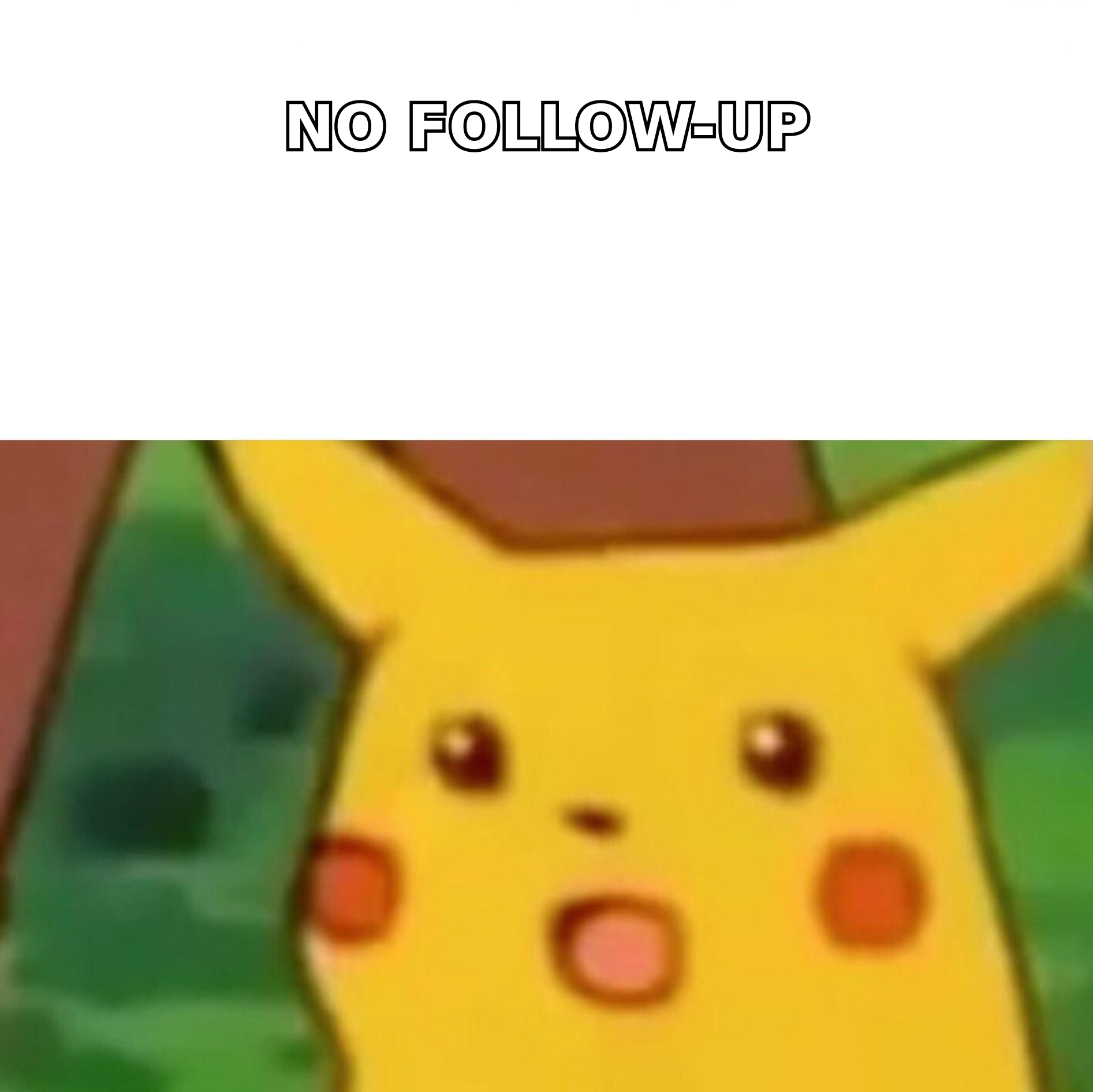
Neither is better. They have different cost curves, different failure modes, and different ceilings. Here is the honest comparison.
| Dimension | Inbound selling | Outbound selling |
|---|---|---|
| Trigger | Buyer-initiated intent signal | Rep-initiated list targeting |
| Typical reply/connect rate | 25–60% of qualified inbound responds | 2–8% reply on cold sequences |
| Time to first meeting | Hours to days | Weeks to months |
| Cost structure | High fixed cost (content, SEO, product-led motion), low marginal cost per lead | Low fixed cost, high marginal cost per meeting (rep hours, data, tooling) |
| Control over volume | Low — you cannot dial demand up next Tuesday | High — you can add accounts tomorrow |
| Control over ICP fit | Low — anyone can fill a form | High — you choose every account |
| Main failure mode | Slow or sloppy follow-up; unqualified volume | Wrong list, bad data, poor relevance |
| Ramp time for a new rep | 2–6 weeks | 8–16 weeks |
| Works for new categories? | Poorly — nobody searches for a problem they cannot name | Yes — you create the awareness |
Read that table as a portfolio decision, not a contest. Inbound gives you efficiency and a shorter cycle; outbound gives you predictability and ICP control. Industry analysts at Gartner have been making the same point for years: buyers move across self-serve and rep-led channels inside a single purchase, so a channel-exclusive go-to-market leaves revenue on the table.
The practical answer for most B2B teams between $1M and $50M ARR: inbound-led, outbound-assisted. Let inbound set the account priority, then run outbound plays into those accounts.
What does the inbound selling process look like stage by stage?#
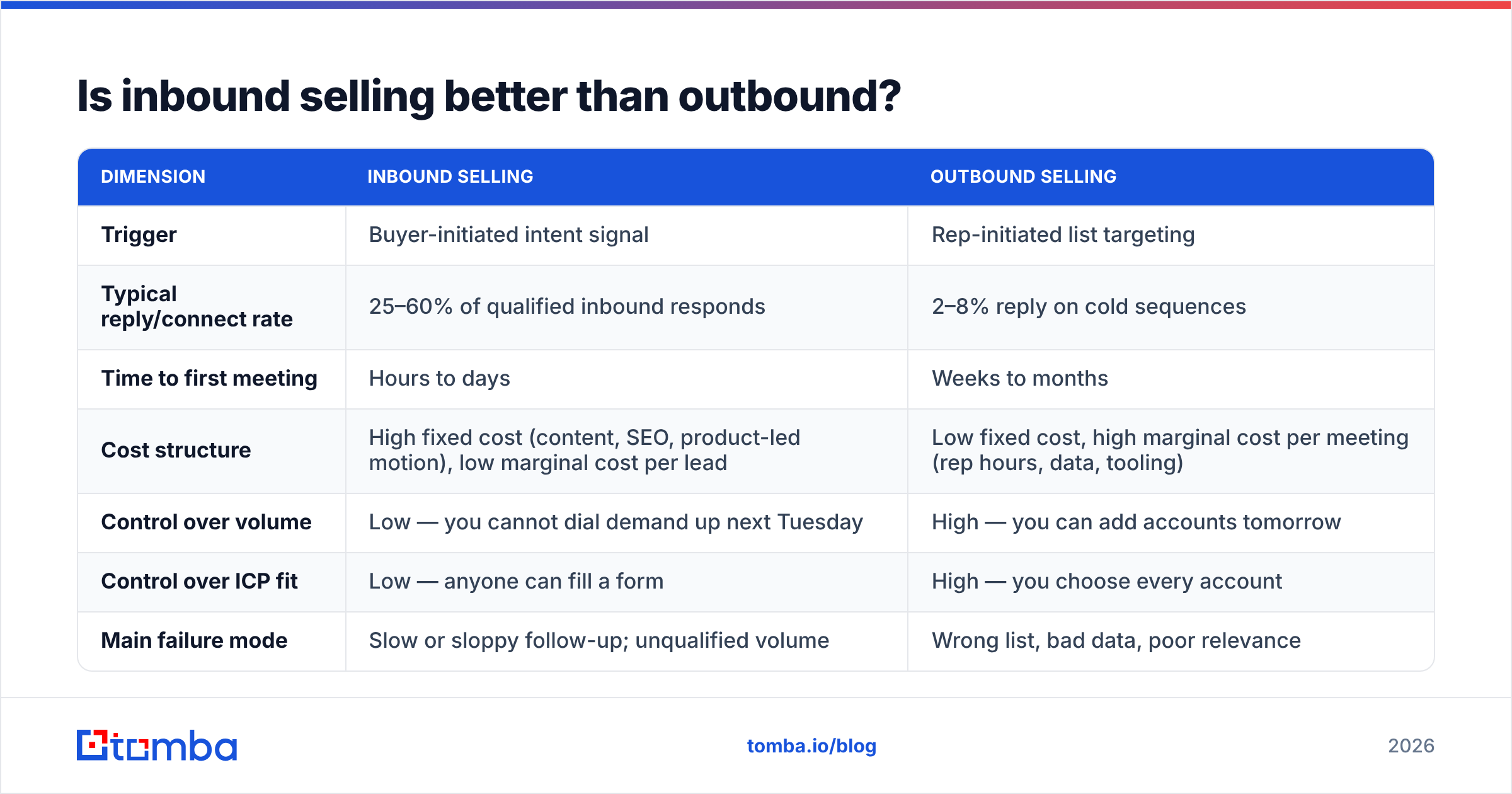
| Stage | Buyer is doing | Rep's job | Exit criteria | Owner |
|---|---|---|---|---|
| Identify | Researching the problem; browsing, downloading, comparing | Watch intent signals, enrich the account, decide if it's ICP | Account tagged ICP / not-ICP with evidence | RevOps + rep |
| Connect | Wants to know if you're relevant in 30 seconds | Open with their context, not your pitch; earn the next 20 minutes | Discovery call booked with a named stakeholder | Rep |
| Explore | Testing whether the problem is worth solving now | Diagnose current state, quantify cost of inaction, map the committee | 2+ stakeholders engaged, pain quantified | Rep + SE |
| Advise | Comparing 2–3 vendors and the do-nothing option | Tailor the recommendation, write the business case with them | Mutual action plan agreed | Rep |
| Decide | Getting internal approval (finance, security, legal) | Arm the champion; remove procurement friction | Signed, onboarded, first value milestone hit | Rep + CS |
Two notes on this table. First, "Identify" happens before any human conversation — that is the stage most teams have no process for, and it is where enrichment lives. Second, the exit criteria are binary and observable. "Prospect seems interested" is not an exit criterion. "Two stakeholders on the last call and a written pain number" is.
Why do inbound leads go cold even when demand is strong?#
Because the clock is the product. Inbound intent decays fast, and nearly every inbound post-mortem lands on one of five causes:
- Speed-to-lead is measured in hours, not minutes. A demo request answered in 4 hours competes with three vendors who answered in 10 minutes. If your SLA is "same business day," you have already lost the accounts that matter.
- One contact, one thread. The form gave you
jordan@company.com, a marketing manager. You never found the VP of Revenue Ops who actually owns the budget, so the deal dies when Jordan gets reassigned. - Attempts stop too early. Teams average two to three touches on inbound before marking it dead. Someone who requested a demo deserves a six-to-eight touch cadence across email, phone, and LinkedIn — they asked you to contact them.
- No enrichment before the first touch. The rep opens with "what do you guys do?" on a call with a buyer who already read your comparison page. That question costs you the credibility you needed to run a diagnostic conversation.
- Routing by round-robin instead of fit. An enterprise inbound lead lands with an SMB rep who cannot navigate a security review, and the account quietly churns out of pipeline.
Fixing the first and the fourth items usually doubles inbound conversion before you touch messaging. That is not a growth hack, it is plumbing — and plumbing is where inbound selling is won.
How do you qualify inbound leads without killing good ones?#
Use a two-gate system: a data gate and a conversation gate.
The data gate runs automatically on every inbound lead and answers one question — is this account plausibly ICP? Company size, industry, region, tech stack, and role seniority are enough. A free Gmail address from a 4-person agency and a VP at a 900-person manufacturer should not enter the same queue. This gate is pure data quality work, which is why data enrichment belongs in the inbound pipeline, not just the outbound one.
The conversation gate is the rep's diagnostic, and it should be a structure, not a scorecard read aloud. Four questions do most of the work:
- What changed recently that made you look? Surfaces the trigger event and whether this is a real project or idle research.
- What are you doing about it today, and what does that cost you? Gets you a number you can put in a business case.
- Who else feels this problem? Opens multi-threading naturally, without asking "who's the decision maker?"
- What happens if you do nothing for two quarters? Separates urgent from interesting, which is the real qualification question.
Avoid disqualifying on budget in the first call for inbound. Budget for an unplanned purchase is usually created after the pain is quantified, not before. Disqualify on pain and priority instead.
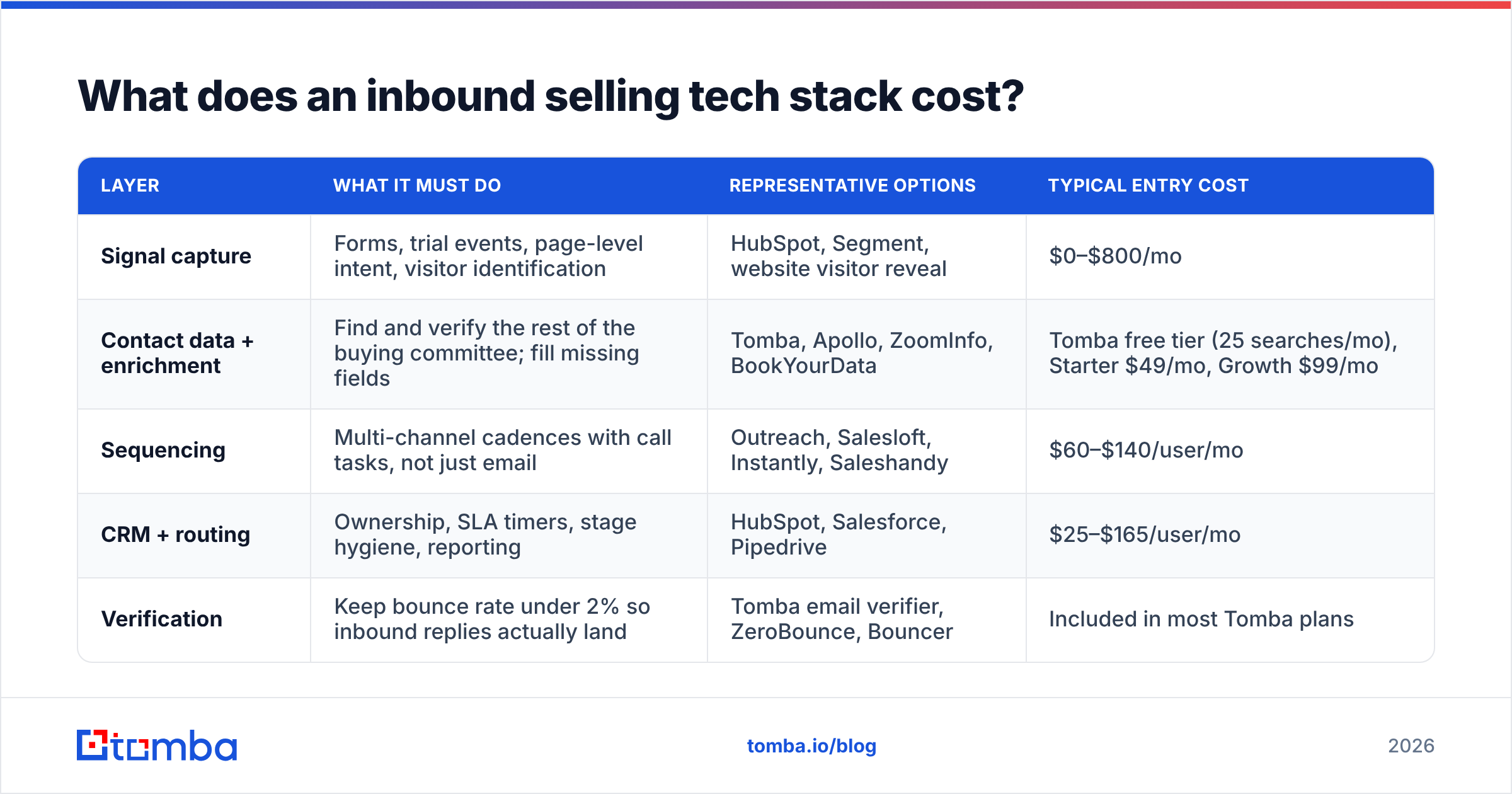
What does an inbound selling tech stack cost?#
You need four capabilities: signal capture, enrichment, sequencing, and CRM hygiene. Here is how typical options compare for a 5–10 rep team.
| Layer | What it must do | Representative options | Typical entry cost |
|---|---|---|---|
| Signal capture | Forms, trial events, page-level intent, visitor identification | HubSpot, Segment, website visitor reveal | $0–$800/mo |
| Contact data + enrichment | Find and verify the rest of the buying committee; fill missing fields | Tomba, Apollo, ZoomInfo, BookYourData | Tomba free tier (25 searches/mo), Starter $49/mo, Growth $99/mo |
| Sequencing | Multi-channel cadences with call tasks, not just email | Outreach, Salesloft, Instantly, Saleshandy | $60–$140/user/mo |
| CRM + routing | Ownership, SLA timers, stage hygiene, reporting | HubSpot, Salesforce, Pipedrive | $25–$165/user/mo |
| Verification | Keep bounce rate under 2% so inbound replies actually land | Tomba email verifier, ZeroBounce, Bouncer | Included in most Tomba plans |
Two cost traps worth naming. First, seat-based sequencing tools get expensive fast when you add SDRs, so check whether you need a seat for every rep or just for the ones running cadences. Second, bundled all-in-one platforms look cheaper on paper but often charge credit overages on the data layer — read the overage clause before you sign, and cross-check reviews on G2 for how the vendor handles credit rollover.
If your inbound volume is modest and your real problem is "I have one contact and need four," a focused data tool plus your existing CRM beats a platform migration. Full Tomba pricing sits in the mid-range of that table, and the free tier is enough to test whether enrichment actually moves your inbound conversion before you commit budget.

Which metrics actually tell you if inbound selling is working?#
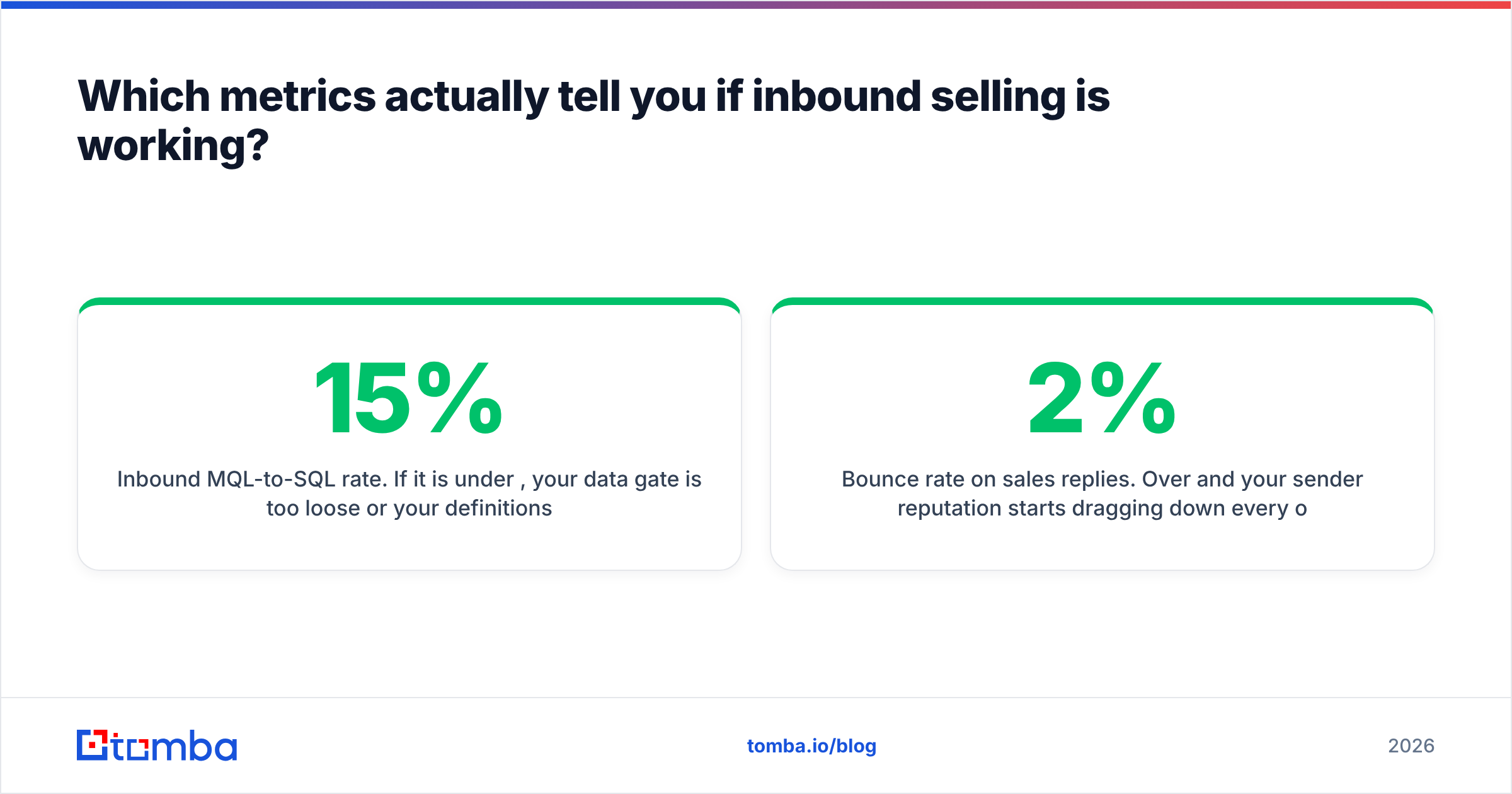
Track six. Ignore the rest until these are healthy.
- Speed-to-lead (median, not average). Target under 5 minutes for demo requests, under 1 hour for content leads. Averages hide the 9-hour outliers that kill deals.
- Inbound MQL-to-SQL rate. If it is under 15%, your data gate is too loose or your definitions disagree. Healthy B2B SaaS sits around 20–35% for high-intent inbound.
- Touches before first contact. Count them. If your dead-lead pile averages 2.4 touches, you do not have an inbound problem, you have a persistence problem.
- Stakeholders per opportunity. Single-threaded inbound deals lose to do-nothing far more often than multi-threaded ones. Three or more engaged contacts is the benchmark to push toward.
- Bounce rate on sales replies. Over 2% and your sender reputation starts dragging down every outbound assist you run off inbound signals. Run contacts through an email verifier before they hit a sequence.
- Inbound-sourced win rate vs. outbound-sourced. If inbound's win rate is not meaningfully higher, you are treating high-intent leads like cold ones.
Report these weekly in one view. The fastest inbound improvement most teams find is not a new channel — it is a dashboard that makes slow follow-up visible to the person responsible for it.
How do you layer outbound onto an inbound signal?#
This is the highest-leverage play in the whole post. When a qualified inbound signal arrives, do not just reply to the one contact. Run a 48-hour account play:
- Hour 0–1: Reply to the inbound contact by their preferred channel. Reference the specific thing they did, not "your recent interest."
- Hour 1–4: Enrich the account. Find the two or three adjacent roles who own the budget and the pain — typically a director or VP one or two levels above the form filler.
- Hour 4–24: Soft outbound to those roles: a short, specific note mentioning that their colleague is evaluating solutions to a named problem. No pitch deck, no pricing.
- Hour 24–48: LinkedIn touch and a single call attempt to the senior stakeholder. Then fold everyone into a shared account cadence.
The whole play depends on finding accurate contacts for people who never filled out your form. That is a data problem with a clean solution: run the company domain, get the verified contacts for the roles you need, and go. A domain search turns one inbound form fill into a mapped buying committee in about the time it takes to read the lead record.
Where should you start if your inbound motion is broken?#
Pick the cheapest fix first, in this order:
- Instrument speed-to-lead and publish the median weekly. Costs nothing, changes behavior immediately.
- Extend your inbound cadence from 3 touches to 7 across three channels.
- Add enrichment before routing so reps open calls with context.
- Write the MQL-to-SQL definition down and have both leaders sign it.
- Only then rebuild content, forms, or scoring models.
Inbound selling rewards operational discipline far more than creativity. The teams that win are rarely the ones with the cleverest nurture sequence — they are the ones who answer in four minutes with the right person's name already on the screen.
Turn one inbound form fill into a full buying committee. The Tomba Email Finder gives you verified professional emails by name, company, or domain, so your reps can multi-thread an inbound account before the intent decays. Start on the free tier with 25 searches per month, or move to Starter at $49/mo when inbound volume justifies it — no platform migration required.
Related guides#
// get started
Find, verify and enrich your first contacts today
Start on the free plan with 25 searches a month, then scale when your team is ready.
Free plan · No credit card required · GDPR & CCPA
// about the author